Author: swatibalani@gmail.com

  • From Reporting to Predicting: How Technology Is Redesigning Sustainability for the Next Decade

    From Reporting to Predicting: How Technology Is Redesigning Sustainability for the Next Decade

    Table of Contents

    For years, sustainability lived in spreadsheets, annual reports, and compliance checklists. Companies collected lagging indicators—last quarter’s emissions, last year’s audit scores, historical waste data—and tried to piece together what went wrong and why.

    But lagging indicators can only do one thing: tell you how much damage has already been done.

    Today, however, something extraordinary is happening. Technologies that once powered finance, logistics, and consumer analytics are now redefining sustainability itself. Businesses are moving from passive reporting to active anticipation, from identifying risks too late to preventing them entirely.

    We are entering the era of predictive sustainability—a world where companies don’t just track ESG performance; they forecast environmental, social, and supply chain impacts before they occur.

    And it’s reshaping competitive advantage, regulatory trust, and brand value across industries.


    The Shift: From Yesterday’s Data to Tomorrow’s Insight

    Traditional sustainability reporting works like looking into a rear-view mirror:

    • “What were last year’s emissions?”
    • “How many water violations occurred?”
    • “How did suppliers perform in the last audit?”

    But the world is no longer forgiving of delays. Climate risk accelerates. Supply chains stretch across continents. Regulations change monthly. Consumers respond instantly.

    Reactive reporting is too slow, too shallow, and too static.

    Technology changes that.
    It turns sustainability into a live system, not a yearly compliance exercise. Data becomes dynamic. Insights become immediate. And companies can detect weak signals before they erupt into scandals, shutdowns, or regulatory fines.

    The model has shifted from:
    “Report what happened.”
    to
    “Predict what will happen—and act now.”


    Technologies Powering Predictive Sustainability

    For decades, sustainability operated like a rear-view mirror—measuring what happened after factories polluted rivers, forests were cleared, or workers were exploited.
    But a new era is emerging. One where businesses not only track ESG performance—they predict risks before the world notices them.

    This transformation is powered by a suite of breakthrough technologies: AI, digital twins, blockchain, IoT sensors, satellite intelligence, and advanced analytics systems.

    The companies that embrace these tools are shifting from reactive to predictive sustainability—catching violations early, preventing crises, and building trust through transparency.

    This blog dives into the core technologies powering this revolution—with real-world examples that show how leading companies are already using predictive systems to future-proof their supply chains, operations, and ESG performance.


    1. Artificial Intelligence: The Brain of Predictive Sustainability

    AI and machine learning are the engines behind the shift toward proactive risk management.
    Unlike traditional ESG reporting, which compiles historical data, AI analyzes massive datasets in real time to spot ESG risks before they cause damage.

    Predictive Sustainability - AI

    How AI Enables Predictive Sustainability

    • Detects patterns that humans overlook
    • Flags ESG anomalies in supplier data
    • Predicts equipment failures that cause emissions spikes
    • Monitors worker welfare using digital behaviour signals
    • Forecasts climate-related risks like droughts & floods

    Real-World Example: Microsoft + AI for Carbon Forecasting

    Microsoft uses AI-driven carbon models to predict emissions from its cloud data centers weeks in advance.
    By forecasting high-emission periods, Microsoft diverts workloads to cleaner regions—reducing total carbon output without sacrificing performance.

    Real-World Example: Unilever’s AI Palm Oil Model

    Unilever uses AI to detect deforestation risks among its palm oil suppliers by analyzing satellite imagery, rainfall, land-use change, and transport patterns.
    The system predicts which plantations may engage in illegal deforestation before trees are cut—allowing Unilever to intervene early.


    2. Blockchain: Transparent, Tamper-Proof Supply Chains

    Blockchain is transforming supply chain integrity.
    Why? Because sustainability fails most often in places where companies have the least visibility—tier 2, 3, and 4 suppliers.

    Blockchain creates immutable, traceable records of every step in the supply chain, reducing fraud and enabling real-time oversight.

    Predictive Sustainability - Blockchain technology

    How Blockchain Enables Predictive Sustainability

    • Ensures full traceability of raw materials
    • Quickly identifies supply chain gaps and suspicious patterns
    • Makes audits faster and verifiable
    • Reduces risk of corruption or falsified documents

    ⭐ Real-World Example: IBM & Ford — Predicting Cobalt Risks Before They Become Scandals

    This is one of the strongest examples of blockchain preventing ESG disasters.

    Ford and IBM built a blockchain-powered cobalt traceability system to track cobalt used in EV batteries from mine → trader → exporter → smelter → battery plant.

    Here’s how it predicts risk:

    1. Every batch of cobalt gets a digital identity
      Origin, miner ID, timestamp, and GPS data are recorded on the blockchain—tamper-proof.
    2. Each movement creates a new block
      Chain-of-custody records show exactly who handled the material.
    3. AI scans the blockchain for missing records
      Missing links = high risk of mining from areas with child labor.
    4. Ford receives a pre-emptive alert
      The system flagged a shipment with missing custody data.
      The shipment was blocked before entering the production cycle.

    What would earlier have led to an exposé and global outrage was stopped before it happened.

    This is predictive sustainability in action.


    3. Digital Twins: Simulating Risks Before They Happen

    A digital twin is a virtual replica of a physical system—factory, power plant, warehouse, or even an entire supply chain.

    Digital twins allow companies to simulate future ESG risks, test scenarios, and see “what could go wrong” without waiting for real damage.

    Predictive Sustainability - Digital Twin

    How Digital Twins Drive Predictive Sustainability

    • Predict emissions spikes during peak production
    • Identify energy or water waste hotspots
    • Test sustainability outcomes of design changes
    • Model climate impacts on operations (heatwaves, floods, storms)

    Real-World Example: Siemens Digital Twin for Factories

    Siemens uses digital twins to simulate:

    • Energy consumption
    • Emissions intensity
    • Machine failure probability
    • Chemical leakage potential

    The model helps factories predict environmental risks and schedule preventive maintenance before environmental incidents occur.

    Real-World Example: Unilever’s Digital Twin for Water Risk

    Unilever uses digital twins to model water availability for its factories.
    If local water stress is predicted to rise above sustainable thresholds, Unilever shifts production, upgrades water recycling, or invests in local water conservation.


    4. IoT Sensors: Real-Time Environmental Monitoring

    IoT sensors turn factories, warehouses, farms, and vehicles into live data ecosystems.

    The result? Companies see ESG risks as they emerge, enabling immediate mitigation.

    IOT

    What IoT Enables

    • Continuous emissions monitoring (CEMS)
    • Worker safety tracking
    • Water and waste discharge alerts
    • Noise and vibration monitoring
    • Predictive maintenance to prevent leaks/spills

    Real-World Example: Shell Using IoT to Prevent Methane Leaks

    Methane is 28x more harmful than CO₂.

    Shell uses IoT methane sensors on wells and pipelines.
    The sensors detect leaks the moment they occur, triggering auto-shutdown protocols.

    Result:
    Methane leakage dropped significantly, avoiding environmental fines and reputational damage.


    Real-World Example: Danone Using IoT to Predict Water Use Surges

    Danone installed IoT flow meters in its dairy plants and farms.
    The system identifies sudden spikes in water use—often early signs of pipeline leaks or over-extraction.

    This predictive capability saves millions of liters annually.


    5. Satellite Monitoring & Remote Sensing: Watching What the Eyes Can’t See

    Satellites now play a major role in ESG oversight, especially for risks in remote regions.

    Combined with AI, satellites detect:

    • Deforestation
    • Illegal mining
    • Forced labor camps
    • Water contamination
    • Night-time light anomalies (proxy for illegal activity)

    Real-World Example: Nestlé & Ferrero — Predicting Deforestation Risks in Cocoa Supply Chains

    Using satellite imagery and heat-mapping:

    • Forest loss is detected in real time
    • High-risk cocoa farms are flagged
    • Procurement is paused before shipments are made

    This system prevents deforestation-linked cocoa from entering the supply chain.


    Real-World Example: BP Using Satellites to Predict Oil Spill Risks

    BP uses satellite ocean data + AI to detect:

    • Early leakage
    • Abnormal vessel patterns
    • Chemical signatures on water surfaces

    This helps prevent small leaks from becoming catastrophic spills.


    6. ESG Analytics Platforms & Predictive Dashboards

    Modern ESG platforms like SAP Sustainability Control Tower (SCT), Microsoft Cloud for Sustainability, and Watershed are shifting sustainability from reporting to prediction.

    What Predictive Platforms Offer

    • Automated Scope 1–3 forecasting
    • Supplier ESG risk heatmaps
    • Alerts when a supplier’s ESG rating drops
    • Carbon pricing simulations
    • Climate scenario planning (e.g., TCFD)
    • Predictive compliance tracking

    Real-World Example: SAP SCT for Scope 3 Risk Prediction

    Companies using SCT can:

    • Predict Scope 3 emission hotspots for upcoming quarters
    • Simulate impact of supplier changes
    • Identify high-risk shipments
    • Calculate future regulatory exposure
    • Test carbon reduction strategies

    This is no longer about reporting emissions—it’s about making operational decisions guided by sustainability intelligence.


    7. Worker Voice Tech & Digital Labor Compliance

    Worker welfare violations are usually discovered too late—after scandals break.
    Technology now enables direct, anonymous worker communication.

    Platforms like Ulula, OnSight, and LaborVoices allow workers to report:

    • Unsafe conditions
    • Forced overtime
    • Wage theft
    • Harassment
    • Child labor risks

    These systems create predictive, bottom-up visibility into labor conditions.


    Real-World Example: Nestlé Using Worker Voice to Predict Labor Abuse

    Nestlé uses mobile worker surveys across farms and factories.
    Patterns of complaints help them identify factories at risk before abuse escalates or becomes public.

    This technology is transforming labor monitoring from annual audits to continuous feedback.


    8. Predictive Climate Models: Preparing for Extreme Weather Before It Hits

    Climate is now a business risk.

    Predictive climate models combine:

    • historical weather data
    • climate science projections
    • local geospatial data
    • machine learning

    They reveal how climate change will affect:

    • supply chain flows
    • factory productivity
    • asset life
    • water risk
    • operational downtime

    Real-World Example: Coca-Cola Using Predictive Climate Models for Water Security

    Coca-Cola uses climate models to:

    • forecast water scarcity near bottling plants
    • predict drought cycles
    • plan investments in watershed restoration

    This prevents shutdowns and ensures operational resilience.


    9. Integrated ESG Command Centers: The Future of Predictive Sustainability

    Leading organizations now deploy ESG Control Rooms—centralized digital dashboards that integrate:

    • AI
    • IoT
    • satellite data
    • blockchain
    • worker voice
    • supply chain mapping

    These command centers make sustainability:

    • Real-time
    • Predictive
    • Integrated into business strategy

    Conclusion: From Reactive to Predictive — The Next Decade Belongs to Data-Driven Sustainability

    We are entering a future where…

    Companies won’t wait for environmental fines—
    AI will warn them days before emissions spike.

    Brands won’t wait for exposés on child labor—
    Blockchain will block the shipment automatically.

    Businesses won’t wait for factories to shut down due to climate stress—
    Digital twins will predict future water shortages.

    Sustainability is no longer about reporting what happened.
    It’s about forecasting what could happen, and acting early enough to change the outcome.

    The companies that win the next decade will be those that integrate predictive technologies at the heart of their ESG strategy.


    🌍 Call to Action: The Future Will Reward Those Who Predict — Not Those Who React

    We are entering a decade where sustainability is no longer about reporting what happened — it’s about knowing what will happen next.
    The companies that thrive will be those that treat ESG not as compliance, but as intelligence, foresight, and competitive advantage.

    The question is no longer:
    “Are we measuring our impact?”
    It is:
    “Are we predicting our risks before they become headlines, lawsuits, or supply-chain failures?”

    The tools exist — digital twins, blockchain, satellites, AI, IoT.
    The leaders who succeed will be the ones who act now, not the ones who wait for a crisis to show them what they should have seen coming.

    🚀 Your next move defines your next decade.
    Build the systems.
    Map the risks.
    Invest in predictive intelligence.

    Because the future will belong to companies that see around corners.

    👉 Are you ready to redesign your sustainability strategy for a predictive world?

    Read more blogs on sustainability here.

    Here’s a highly credible reference link for technology in predictive sustainability:

    IBM – Blockchain and Sustainability Through Responsible Sourcing:
    It explains how IBM’s blockchain platform is used to trace minerals like cobalt responsibly across the supply chain, ensuring transparency and ESG integrity. ibm.com
  • From Reporting to Predicting: How Technology Is Redesigning Sustainability for the Next Decade

    From Reporting to Predicting: How Technology Is Redesigning Sustainability for the Next Decade

    Table of Contents

    For years, sustainability lived in spreadsheets, annual reports, and compliance checklists. Companies collected lagging indicators—last quarter’s emissions, last year’s audit scores, historical waste data—and tried to piece together what went wrong and why.

    But lagging indicators can only do one thing: tell you how much damage has already been done.

    Today, however, something extraordinary is happening. Technologies that once powered finance, logistics, and consumer analytics are now redefining sustainability itself. Businesses are moving from passive reporting to active anticipation, from identifying risks too late to preventing them entirely.

    We are entering the era of predictive sustainability—a world where companies don’t just track ESG performance; they forecast environmental, social, and supply chain impacts before they occur.

    And it’s reshaping competitive advantage, regulatory trust, and brand value across industries.


    The Shift: From Yesterday’s Data to Tomorrow’s Insight

    Traditional sustainability reporting works like looking into a rear-view mirror:

    • “What were last year’s emissions?”
    • “How many water violations occurred?”
    • “How did suppliers perform in the last audit?”

    But the world is no longer forgiving of delays. Climate risk accelerates. Supply chains stretch across continents. Regulations change monthly. Consumers respond instantly.

    Reactive reporting is too slow, too shallow, and too static.

    Technology changes that.
    It turns sustainability into a live system, not a yearly compliance exercise. Data becomes dynamic. Insights become immediate. And companies can detect weak signals before they erupt into scandals, shutdowns, or regulatory fines.

    The model has shifted from:
    “Report what happened.”
    to
    “Predict what will happen—and act now.”


    Technologies Powering Predictive Sustainability

    For decades, sustainability operated like a rear-view mirror—measuring what happened after factories polluted rivers, forests were cleared, or workers were exploited.
    But a new era is emerging. One where businesses not only track ESG performance—they predict risks before the world notices them.

    This transformation is powered by a suite of breakthrough technologies: AI, digital twins, blockchain, IoT sensors, satellite intelligence, and advanced analytics systems.

    The companies that embrace these tools are shifting from reactive to predictive sustainability—catching violations early, preventing crises, and building trust through transparency.

    This blog dives into the core technologies powering this revolution—with real-world examples that show how leading companies are already using predictive systems to future-proof their supply chains, operations, and ESG performance.


    1. Artificial Intelligence: The Brain of Predictive Sustainability

    AI and machine learning are the engines behind the shift toward proactive risk management.
    Unlike traditional ESG reporting, which compiles historical data, AI analyzes massive datasets in real time to spot ESG risks before they cause damage.

    Predictive Sustainability - AI

    How AI Enables Predictive Sustainability

    • Detects patterns that humans overlook
    • Flags ESG anomalies in supplier data
    • Predicts equipment failures that cause emissions spikes
    • Monitors worker welfare using digital behaviour signals
    • Forecasts climate-related risks like droughts & floods

    Real-World Example: Microsoft + AI for Carbon Forecasting

    Microsoft uses AI-driven carbon models to predict emissions from its cloud data centers weeks in advance.
    By forecasting high-emission periods, Microsoft diverts workloads to cleaner regions—reducing total carbon output without sacrificing performance.

    Real-World Example: Unilever’s AI Palm Oil Model

    Unilever uses AI to detect deforestation risks among its palm oil suppliers by analyzing satellite imagery, rainfall, land-use change, and transport patterns.
    The system predicts which plantations may engage in illegal deforestation before trees are cut—allowing Unilever to intervene early.


    2. Blockchain: Transparent, Tamper-Proof Supply Chains

    Blockchain is transforming supply chain integrity.
    Why? Because sustainability fails most often in places where companies have the least visibility—tier 2, 3, and 4 suppliers.

    Blockchain creates immutable, traceable records of every step in the supply chain, reducing fraud and enabling real-time oversight.

    Predictive Sustainability - Blockchain technology

    How Blockchain Enables Predictive Sustainability

    • Ensures full traceability of raw materials
    • Quickly identifies supply chain gaps and suspicious patterns
    • Makes audits faster and verifiable
    • Reduces risk of corruption or falsified documents

    ⭐ Real-World Example: IBM & Ford — Predicting Cobalt Risks Before They Become Scandals

    This is one of the strongest examples of blockchain preventing ESG disasters.

    Ford and IBM built a blockchain-powered cobalt traceability system to track cobalt used in EV batteries from mine → trader → exporter → smelter → battery plant.

    Here’s how it predicts risk:

    1. Every batch of cobalt gets a digital identity
      Origin, miner ID, timestamp, and GPS data are recorded on the blockchain—tamper-proof.
    2. Each movement creates a new block
      Chain-of-custody records show exactly who handled the material.
    3. AI scans the blockchain for missing records
      Missing links = high risk of mining from areas with child labor.
    4. Ford receives a pre-emptive alert
      The system flagged a shipment with missing custody data.
      The shipment was blocked before entering the production cycle.

    What would earlier have led to an exposé and global outrage was stopped before it happened.

    This is predictive sustainability in action.


    3. Digital Twins: Simulating Risks Before They Happen

    A digital twin is a virtual replica of a physical system—factory, power plant, warehouse, or even an entire supply chain.

    Digital twins allow companies to simulate future ESG risks, test scenarios, and see “what could go wrong” without waiting for real damage.

    Predictive Sustainability - Digital Twin

    How Digital Twins Drive Predictive Sustainability

    • Predict emissions spikes during peak production
    • Identify energy or water waste hotspots
    • Test sustainability outcomes of design changes
    • Model climate impacts on operations (heatwaves, floods, storms)

    Real-World Example: Siemens Digital Twin for Factories

    Siemens uses digital twins to simulate:

    • Energy consumption
    • Emissions intensity
    • Machine failure probability
    • Chemical leakage potential

    The model helps factories predict environmental risks and schedule preventive maintenance before environmental incidents occur.

    Real-World Example: Unilever’s Digital Twin for Water Risk

    Unilever uses digital twins to model water availability for its factories.
    If local water stress is predicted to rise above sustainable thresholds, Unilever shifts production, upgrades water recycling, or invests in local water conservation.


    4. IoT Sensors: Real-Time Environmental Monitoring

    IoT sensors turn factories, warehouses, farms, and vehicles into live data ecosystems.

    The result? Companies see ESG risks as they emerge, enabling immediate mitigation.

    IOT

    What IoT Enables

    • Continuous emissions monitoring (CEMS)
    • Worker safety tracking
    • Water and waste discharge alerts
    • Noise and vibration monitoring
    • Predictive maintenance to prevent leaks/spills

    Real-World Example: Shell Using IoT to Prevent Methane Leaks

    Methane is 28x more harmful than CO₂.

    Shell uses IoT methane sensors on wells and pipelines.
    The sensors detect leaks the moment they occur, triggering auto-shutdown protocols.

    Result:
    Methane leakage dropped significantly, avoiding environmental fines and reputational damage.


    Real-World Example: Danone Using IoT to Predict Water Use Surges

    Danone installed IoT flow meters in its dairy plants and farms.
    The system identifies sudden spikes in water use—often early signs of pipeline leaks or over-extraction.

    This predictive capability saves millions of liters annually.


    5. Satellite Monitoring & Remote Sensing: Watching What the Eyes Can’t See

    Satellites now play a major role in ESG oversight, especially for risks in remote regions.

    Combined with AI, satellites detect:

    • Deforestation
    • Illegal mining
    • Forced labor camps
    • Water contamination
    • Night-time light anomalies (proxy for illegal activity)

    Real-World Example: Nestlé & Ferrero — Predicting Deforestation Risks in Cocoa Supply Chains

    Using satellite imagery and heat-mapping:

    • Forest loss is detected in real time
    • High-risk cocoa farms are flagged
    • Procurement is paused before shipments are made

    This system prevents deforestation-linked cocoa from entering the supply chain.


    Real-World Example: BP Using Satellites to Predict Oil Spill Risks

    BP uses satellite ocean data + AI to detect:

    • Early leakage
    • Abnormal vessel patterns
    • Chemical signatures on water surfaces

    This helps prevent small leaks from becoming catastrophic spills.


    6. ESG Analytics Platforms & Predictive Dashboards

    Modern ESG platforms like SAP Sustainability Control Tower (SCT), Microsoft Cloud for Sustainability, and Watershed are shifting sustainability from reporting to prediction.

    What Predictive Platforms Offer

    • Automated Scope 1–3 forecasting
    • Supplier ESG risk heatmaps
    • Alerts when a supplier’s ESG rating drops
    • Carbon pricing simulations
    • Climate scenario planning (e.g., TCFD)
    • Predictive compliance tracking

    Real-World Example: SAP SCT for Scope 3 Risk Prediction

    Companies using SCT can:

    • Predict Scope 3 emission hotspots for upcoming quarters
    • Simulate impact of supplier changes
    • Identify high-risk shipments
    • Calculate future regulatory exposure
    • Test carbon reduction strategies

    This is no longer about reporting emissions—it’s about making operational decisions guided by sustainability intelligence.


    7. Worker Voice Tech & Digital Labor Compliance

    Worker welfare violations are usually discovered too late—after scandals break.
    Technology now enables direct, anonymous worker communication.

    Platforms like Ulula, OnSight, and LaborVoices allow workers to report:

    • Unsafe conditions
    • Forced overtime
    • Wage theft
    • Harassment
    • Child labor risks

    These systems create predictive, bottom-up visibility into labor conditions.


    Real-World Example: Nestlé Using Worker Voice to Predict Labor Abuse

    Nestlé uses mobile worker surveys across farms and factories.
    Patterns of complaints help them identify factories at risk before abuse escalates or becomes public.

    This technology is transforming labor monitoring from annual audits to continuous feedback.


    8. Predictive Climate Models: Preparing for Extreme Weather Before It Hits

    Climate is now a business risk.

    Predictive climate models combine:

    • historical weather data
    • climate science projections
    • local geospatial data
    • machine learning

    They reveal how climate change will affect:

    • supply chain flows
    • factory productivity
    • asset life
    • water risk
    • operational downtime

    Real-World Example: Coca-Cola Using Predictive Climate Models for Water Security

    Coca-Cola uses climate models to:

    • forecast water scarcity near bottling plants
    • predict drought cycles
    • plan investments in watershed restoration

    This prevents shutdowns and ensures operational resilience.


    9. Integrated ESG Command Centers: The Future of Predictive Sustainability

    Leading organizations now deploy ESG Control Rooms—centralized digital dashboards that integrate:

    • AI
    • IoT
    • satellite data
    • blockchain
    • worker voice
    • supply chain mapping

    These command centers make sustainability:

    • Real-time
    • Predictive
    • Integrated into business strategy

    Conclusion: From Reactive to Predictive — The Next Decade Belongs to Data-Driven Sustainability

    We are entering a future where…

    Companies won’t wait for environmental fines—
    AI will warn them days before emissions spike.

    Brands won’t wait for exposés on child labor—
    Blockchain will block the shipment automatically.

    Businesses won’t wait for factories to shut down due to climate stress—
    Digital twins will predict future water shortages.

    Sustainability is no longer about reporting what happened.
    It’s about forecasting what could happen, and acting early enough to change the outcome.

    The companies that win the next decade will be those that integrate predictive technologies at the heart of their ESG strategy.


    🌍 Call to Action: The Future Will Reward Those Who Predict — Not Those Who React

    We are entering a decade where sustainability is no longer about reporting what happened — it’s about knowing what will happen next.
    The companies that thrive will be those that treat ESG not as compliance, but as intelligence, foresight, and competitive advantage.

    The question is no longer:
    “Are we measuring our impact?”
    It is:
    “Are we predicting our risks before they become headlines, lawsuits, or supply-chain failures?”

    The tools exist — digital twins, blockchain, satellites, AI, IoT.
    The leaders who succeed will be the ones who act now, not the ones who wait for a crisis to show them what they should have seen coming.

    🚀 Your next move defines your next decade.
    Build the systems.
    Map the risks.
    Invest in predictive intelligence.

    Because the future will belong to companies that see around corners.

    👉 Are you ready to redesign your sustainability strategy for a predictive world?

    Read more blogs on sustainability here.

    Here’s a highly credible reference link for technology in predictive sustainability:

    IBM – Blockchain and Sustainability Through Responsible Sourcing:
    It explains how IBM’s blockchain platform is used to trace minerals like cobalt responsibly across the supply chain, ensuring transparency and ESG integrity. ibm.com

  • From Reporting to Predicting: How Technology Is Redesigning Sustainability for the Next Decade

    From Reporting to Predicting: How Technology Is Redesigning Sustainability for the Next Decade

    Table of Contents

    For years, sustainability lived in spreadsheets, annual reports, and compliance checklists. Companies collected lagging indicators—last quarter’s emissions, last year’s audit scores, historical waste data—and tried to piece together what went wrong and why.

    But lagging indicators can only do one thing: tell you how much damage has already been done.

    Today, however, something extraordinary is happening. Technologies that once powered finance, logistics, and consumer analytics are now redefining sustainability itself. Businesses are moving from passive reporting to active anticipation, from identifying risks too late to preventing them entirely.

    We are entering the era of predictive sustainability—a world where companies don’t just track ESG performance; they forecast environmental, social, and supply chain impacts before they occur.

    And it’s reshaping competitive advantage, regulatory trust, and brand value across industries.


    The Shift: From Yesterday’s Data to Tomorrow’s Insight

    Traditional sustainability reporting works like looking into a rear-view mirror:

    • “What were last year’s emissions?”
    • “How many water violations occurred?”
    • “How did suppliers perform in the last audit?”

    But the world is no longer forgiving of delays. Climate risk accelerates. Supply chains stretch across continents. Regulations change monthly. Consumers respond instantly.

    Reactive reporting is too slow, too shallow, and too static.

    Technology changes that.
    It turns sustainability into a live system, not a yearly compliance exercise. Data becomes dynamic. Insights become immediate. And companies can detect weak signals before they erupt into scandals, shutdowns, or regulatory fines.

    The model has shifted from:
    “Report what happened.”
    to
    “Predict what will happen—and act now.”


    Technologies Powering Predictive Sustainability

    For decades, sustainability operated like a rear-view mirror—measuring what happened after factories polluted rivers, forests were cleared, or workers were exploited.
    But a new era is emerging. One where businesses not only track ESG performance—they predict risks before the world notices them.

    This transformation is powered by a suite of breakthrough technologies: AI, digital twins, blockchain, IoT sensors, satellite intelligence, and advanced analytics systems.

    The companies that embrace these tools are shifting from reactive to predictive sustainability—catching violations early, preventing crises, and building trust through transparency.

    This blog dives into the core technologies powering this revolution—with real-world examples that show how leading companies are already using predictive systems to future-proof their supply chains, operations, and ESG performance.


    1. Artificial Intelligence: The Brain of Predictive Sustainability

    AI and machine learning are the engines behind the shift toward proactive risk management.
    Unlike traditional ESG reporting, which compiles historical data, AI analyzes massive datasets in real time to spot ESG risks before they cause damage.

    Predictive Sustainability - AI

    How AI Enables Predictive Sustainability

    • Detects patterns that humans overlook
    • Flags ESG anomalies in supplier data
    • Predicts equipment failures that cause emissions spikes
    • Monitors worker welfare using digital behaviour signals
    • Forecasts climate-related risks like droughts & floods

    Real-World Example: Microsoft + AI for Carbon Forecasting

    Microsoft uses AI-driven carbon models to predict emissions from its cloud data centers weeks in advance.
    By forecasting high-emission periods, Microsoft diverts workloads to cleaner regions—reducing total carbon output without sacrificing performance.

    Real-World Example: Unilever’s AI Palm Oil Model

    Unilever uses AI to detect deforestation risks among its palm oil suppliers by analyzing satellite imagery, rainfall, land-use change, and transport patterns.
    The system predicts which plantations may engage in illegal deforestation before trees are cut—allowing Unilever to intervene early.


    2. Blockchain: Transparent, Tamper-Proof Supply Chains

    Blockchain is transforming supply chain integrity.
    Why? Because sustainability fails most often in places where companies have the least visibility—tier 2, 3, and 4 suppliers.

    Blockchain creates immutable, traceable records of every step in the supply chain, reducing fraud and enabling real-time oversight.

    Predictive Sustainability - Blockchain technology

    How Blockchain Enables Predictive Sustainability

    • Ensures full traceability of raw materials
    • Quickly identifies supply chain gaps and suspicious patterns
    • Makes audits faster and verifiable
    • Reduces risk of corruption or falsified documents

    ⭐ Real-World Example: IBM & Ford — Predicting Cobalt Risks Before They Become Scandals

    This is one of the strongest examples of blockchain preventing ESG disasters.

    Ford and IBM built a blockchain-powered cobalt traceability system to track cobalt used in EV batteries from mine → trader → exporter → smelter → battery plant.

    Here’s how it predicts risk:

    1. Every batch of cobalt gets a digital identity
      Origin, miner ID, timestamp, and GPS data are recorded on the blockchain—tamper-proof.
    2. Each movement creates a new block
      Chain-of-custody records show exactly who handled the material.
    3. AI scans the blockchain for missing records
      Missing links = high risk of mining from areas with child labor.
    4. Ford receives a pre-emptive alert
      The system flagged a shipment with missing custody data.
      The shipment was blocked before entering the production cycle.

    What would earlier have led to an exposé and global outrage was stopped before it happened.

    This is predictive sustainability in action.


    3. Digital Twins: Simulating Risks Before They Happen

    A digital twin is a virtual replica of a physical system—factory, power plant, warehouse, or even an entire supply chain.

    Digital twins allow companies to simulate future ESG risks, test scenarios, and see “what could go wrong” without waiting for real damage.

    Predictive Sustainability - Digital Twin

    How Digital Twins Drive Predictive Sustainability

    • Predict emissions spikes during peak production
    • Identify energy or water waste hotspots
    • Test sustainability outcomes of design changes
    • Model climate impacts on operations (heatwaves, floods, storms)

    Real-World Example: Siemens Digital Twin for Factories

    Siemens uses digital twins to simulate:

    • Energy consumption
    • Emissions intensity
    • Machine failure probability
    • Chemical leakage potential

    The model helps factories predict environmental risks and schedule preventive maintenance before environmental incidents occur.

    Real-World Example: Unilever’s Digital Twin for Water Risk

    Unilever uses digital twins to model water availability for its factories.
    If local water stress is predicted to rise above sustainable thresholds, Unilever shifts production, upgrades water recycling, or invests in local water conservation.


    4. IoT Sensors: Real-Time Environmental Monitoring

    IoT sensors turn factories, warehouses, farms, and vehicles into live data ecosystems.

    The result? Companies see ESG risks as they emerge, enabling immediate mitigation.

    IOT

    What IoT Enables

    • Continuous emissions monitoring (CEMS)
    • Worker safety tracking
    • Water and waste discharge alerts
    • Noise and vibration monitoring
    • Predictive maintenance to prevent leaks/spills

    Real-World Example: Shell Using IoT to Prevent Methane Leaks

    Methane is 28x more harmful than CO₂.

    Shell uses IoT methane sensors on wells and pipelines.
    The sensors detect leaks the moment they occur, triggering auto-shutdown protocols.

    Result:
    Methane leakage dropped significantly, avoiding environmental fines and reputational damage.


    Real-World Example: Danone Using IoT to Predict Water Use Surges

    Danone installed IoT flow meters in its dairy plants and farms.
    The system identifies sudden spikes in water use—often early signs of pipeline leaks or over-extraction.

    This predictive capability saves millions of liters annually.


    5. Satellite Monitoring & Remote Sensing: Watching What the Eyes Can’t See

    Satellites now play a major role in ESG oversight, especially for risks in remote regions.

    Combined with AI, satellites detect:

    • Deforestation
    • Illegal mining
    • Forced labor camps
    • Water contamination
    • Night-time light anomalies (proxy for illegal activity)

    Real-World Example: Nestlé & Ferrero — Predicting Deforestation Risks in Cocoa Supply Chains

    Using satellite imagery and heat-mapping:

    • Forest loss is detected in real time
    • High-risk cocoa farms are flagged
    • Procurement is paused before shipments are made

    This system prevents deforestation-linked cocoa from entering the supply chain.


    Real-World Example: BP Using Satellites to Predict Oil Spill Risks

    BP uses satellite ocean data + AI to detect:

    • Early leakage
    • Abnormal vessel patterns
    • Chemical signatures on water surfaces

    This helps prevent small leaks from becoming catastrophic spills.


    6. ESG Analytics Platforms & Predictive Dashboards

    Modern ESG platforms like SAP Sustainability Control Tower (SCT), Microsoft Cloud for Sustainability, and Watershed are shifting sustainability from reporting to prediction.

    What Predictive Platforms Offer

    • Automated Scope 1–3 forecasting
    • Supplier ESG risk heatmaps
    • Alerts when a supplier’s ESG rating drops
    • Carbon pricing simulations
    • Climate scenario planning (e.g., TCFD)
    • Predictive compliance tracking

    Real-World Example: SAP SCT for Scope 3 Risk Prediction

    Companies using SCT can:

    • Predict Scope 3 emission hotspots for upcoming quarters
    • Simulate impact of supplier changes
    • Identify high-risk shipments
    • Calculate future regulatory exposure
    • Test carbon reduction strategies

    This is no longer about reporting emissions—it’s about making operational decisions guided by sustainability intelligence.


    7. Worker Voice Tech & Digital Labor Compliance

    Worker welfare violations are usually discovered too late—after scandals break.
    Technology now enables direct, anonymous worker communication.

    Platforms like Ulula, OnSight, and LaborVoices allow workers to report:

    • Unsafe conditions
    • Forced overtime
    • Wage theft
    • Harassment
    • Child labor risks

    These systems create predictive, bottom-up visibility into labor conditions.


    Real-World Example: Nestlé Using Worker Voice to Predict Labor Abuse

    Nestlé uses mobile worker surveys across farms and factories.
    Patterns of complaints help them identify factories at risk before abuse escalates or becomes public.

    This technology is transforming labor monitoring from annual audits to continuous feedback.


    8. Predictive Climate Models: Preparing for Extreme Weather Before It Hits

    Climate is now a business risk.

    Predictive climate models combine:

    • historical weather data
    • climate science projections
    • local geospatial data
    • machine learning

    They reveal how climate change will affect:

    • supply chain flows
    • factory productivity
    • asset life
    • water risk
    • operational downtime

    Real-World Example: Coca-Cola Using Predictive Climate Models for Water Security

    Coca-Cola uses climate models to:

    • forecast water scarcity near bottling plants
    • predict drought cycles
    • plan investments in watershed restoration

    This prevents shutdowns and ensures operational resilience.


    9. Integrated ESG Command Centers: The Future of Predictive Sustainability

    Leading organizations now deploy ESG Control Rooms—centralized digital dashboards that integrate:

    • AI
    • IoT
    • satellite data
    • blockchain
    • worker voice
    • supply chain mapping

    These command centers make sustainability:

    • Real-time
    • Predictive
    • Integrated into business strategy

    Conclusion: From Reactive to Predictive — The Next Decade Belongs to Data-Driven Sustainability

    We are entering a future where…

    Companies won’t wait for environmental fines—
    AI will warn them days before emissions spike.

    Brands won’t wait for exposés on child labor—
    Blockchain will block the shipment automatically.

    Businesses won’t wait for factories to shut down due to climate stress—
    Digital twins will predict future water shortages.

    Sustainability is no longer about reporting what happened.
    It’s about forecasting what could happen, and acting early enough to change the outcome.

    The companies that win the next decade will be those that integrate predictive technologies at the heart of their ESG strategy.


    🌍 Call to Action: The Future Will Reward Those Who Predict — Not Those Who React

    We are entering a decade where sustainability is no longer about reporting what happened — it’s about knowing what will happen next.
    The companies that thrive will be those that treat ESG not as compliance, but as intelligence, foresight, and competitive advantage.

    The question is no longer:
    “Are we measuring our impact?”
    It is:
    “Are we predicting our risks before they become headlines, lawsuits, or supply-chain failures?”

    The tools exist — digital twins, blockchain, satellites, AI, IoT.
    The leaders who succeed will be the ones who act now, not the ones who wait for a crisis to show them what they should have seen coming.

    🚀 Your next move defines your next decade.
    Build the systems.
    Map the risks.
    Invest in predictive intelligence.

    Because the future will belong to companies that see around corners.

    👉 Are you ready to redesign your sustainability strategy for a predictive world?

    Read more blogs on sustainability here.

    Here’s a highly credible reference link for technology in predictive sustainability:

    IBM – Blockchain and Sustainability Through Responsible Sourcing:
    It explains how IBM’s blockchain platform is used to trace minerals like cobalt responsibly across the supply chain, ensuring transparency and ESG integrity. ibm.com

  • Internal Conflicts – Do You Feel Safe to Disagree?

    Internal Conflicts – Do You Feel Safe to Disagree?


    Fear of Internal Conflict

    The Question No One Asks Out Loud

    Do you feel safe to disagree at your workplace?

    It’s a simple question.
    But its implications run deep.

    Disagreement is natural.
    Disagreement is healthy.
    Disagreement is the birthplace of innovation, creativity, and strong decisions.

    Yet in countless organizations — from startups to multinationals — employees hesitate to voice even the smallest concern. Fear becomes stronger than truth. Silence becomes safer than honesty.

    This blog is about that silence.
    About the toxic cultures that punish honesty.
    About the leaders who fear feedback.
    And about one woman — Sushma — whose story reflects thousands of real people who silently walk away because their workplace does not allow them to disagree.


    The Hidden Fear: Why People Don’t Speak Up

    Before we meet Sushma, let’s understand a harsh truth:

    Most people don’t feel safe to disagree at work.

    Not because they lack courage.
    Not because they don’t care.
    But because:

    • They fear retaliation
    • They fear being labeled “negative”
    • They fear being excluded
    • They fear that truth will cost them promotion
    • They fear political games, not professional discussions

    Organizations keep telling employees:
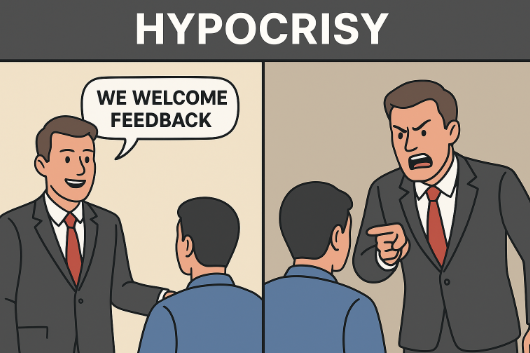
    “We welcome your feedback.”

    But employees know the reality:
    Some truths are punishable.

    And some managers want only positive feedback disguised as “team spirit.”


    Meet Sushma: The Quiet Perfectionist Who Truly Cared

    Sushma was the kind of employee managers should dream of.

    A high-performing individual.
    A perfectionist in the best sense.
    A believer in continuous improvement — in herself, her work, her team, and her company.
    She wasn’t political.
    She was straightforward.
    She was simply committed.

    She loved improving things.
    She believed in processes.
    She believed that feedback is a gift.
    She believed that honesty and improvement must go hand-in-hand.

    Every retrospective, every process review, every meeting — she showed up thoughtfully.
    She wrote down suggestions based on experience, root-cause analysis, and genuine care for customers.

    She thought she was doing the right thing.

    But the right thing is not always the safe thing.


    The Manager Who Said “Give Feedback” — But Didn’t Mean It

    Her manager, a mid-level leader, often preached about “openness,” “teamwork,” and “improvement culture.”

    “We are a transparent team,” he repeated.
    “We grow through feedback,” he insisted.
    “Everyone should share honestly,” he emphasized.

    He encouraged people to put ideas on whiteboards, vote on improvements, challenge existing processes.

    Sushma took these words seriously.

    And that was her mistake.

    Because the manager didn’t want feedback.
    He wanted praise.
    He wanted validation.
    He wanted loyalty disguised as professionalism.

    The moment he read her improvement suggestions, the atmosphere shifted.


    The Turning Point: When Honesty Became Threatening

    Internal Conflicts-Disagree - Resignation - Office Culture -

    At first, he simply ignored her feedback.

    Then he started avoiding eye contact.
    Then he began interrupting her in meetings.
    Then he rolled his eyes when she spoke.
    Next came the sarcasm:
    “Oh, another improvement idea from you?”
    “Maybe you should focus on your tasks instead of pointing out issues.”
    “You always think negatively.”

    Sushma was confused.

    She had only written observations like:

    • Customer pain points
    • Communication delays affecting customers
    • Inefficient internal handovers
    • Repetitive errors caused by unclear processes
    • Missing quality checkpoints
    • Better ways to collaborate within teams

    Nothing personal.
    Nothing exaggerated.
    Nothing emotional.
    Just facts.

    But facts were his enemy.

    Because feedback without flattery felt like an attack to him.


    The Hypocrisy Becomes Visible

    Slowly, the mask fell off.

    This manager praised the culture of “openness” yet punished openness.
    He invited suggestions yet resented them.
    He encouraged discussion yet demanded obedience.
    He asked for honesty yet rewarded flattery.

    In meetings, he smiled.
    In one-on-ones, he showed his real face.

    “Sushma, your feedback is too negative.”
    “You come across as aggressive.”
    “Leaders don’t like people who complain.”
    “You should learn how to talk to managers.”

    Sushma felt suffocated.
    Her integrity was being attacked.
    Her intent was being twisted.
    Her improvements were being labelled as rebellion.

    But that was only the beginning.


    The Politics: The Silent Revenge for Speaking Up

    It started subtly.

    Her workload increased without explanation.
    She was excluded from informal conversations, ignored.
    Her achievements went unrecognized.
    Her name was dropped from important emails, events.
    Her responsibilities were reduced.
    Her growth opportunities vanished.

    Her promotion denied.

    Soon, colleagues were told quietly:

    “She has an attitude.”
    “She is too aggressive.”
    “She criticizes the team.”
    “She is not aligned with the manager.”

    People began distancing themselves from her, afraid of being on the “wrong side.”

    The manager had created a trap — rewarding those who praised him and isolating those who dared to disagree.

    It was a culture where flattery led to promotion and honesty led to punishment.


    The Breaking Point: When Speaking Up Becomes a Liability

    One afternoon, in a one-on-one, the manager said something that broke Sushma’s heart:

    “You should stop giving improvement suggestions.
    Just highlight positives.
    Focus on praising what works.
    That’s what makes your manager happy.”

    Her mind went blank.

    She wasn’t being asked to improve her communication.
    She wasn’t being asked to be constructive.
    She was being asked to stop thinking.

    To stop caring.
    To stop being herself.
    To stop being honest.

    In that moment, she realized the truth:

    This wasn’t a place for improvement.
    This wasn’t a place for honesty.
    This wasn’t a place that valued customers.
    This wasn’t a place that valued integrity.

    This was a place where truth was treated as aggression, and silence was rewarded as maturity.

    She silently left the room with tears she didn’t want to show.

    Not tears of weakness — but tears of clarity.


    Her Decision: Leaving Was Not Running Away — It Was Standing Up

    Internal Conflict - Resignation - Respect at Work

    After 4 years of emotional erosion, isolation, and political punishment, Sushma resigned.

    She didn’t fight.
    She didn’t argue.
    She didn’t justify.
    She didn’t explain.

    She simply walked away.

    The manager kept smiling looking at her feeling happy about his victory.

    Victory of seeing only yes man in the team after Sushma’s exit.

    Victory of seeing all praise the manager so he gets promotions.

    Some colleagues whispered,
    “She was too sincere for this place.”

    But deep down, everyone knew the truth:

    The company had lost a rare gem.
    The team had lost its conscience.
    The manager had lost the one person who genuinely tried to make things better.

    Sushma didn’t just leave a job.
    She left a culture that feared truth.
    She left a system that punished improvement.
    She left leaders who could not handle honesty.

    Most importantly, she left for her own mental peace, self-respect, and future growth.


    The Bigger Question: Why Does This Keep Happening?

    Sushma is not alone.
    This story repeats every day in thousands of workplaces.

    The problem is not disagreement.
    The problem is how disagreement is punished.

    Many companies say:

    “We support open culture.”
    But they silence dissent.

    “We welcome feedback.”
    But only if it praises leadership.

    “We encourage improvement.”
    But only if it doesn’t question existing systems.

    The result?

    • Innovation dies
    • Good employees quit
    • Toxic managers rise
    • Groupthink becomes culture
    • Customers suffer
    • The company stagnates

    Disagreement is the lifeblood of a healthy organization.
    But only if people feel safe to express it.


    What Psychological Safety Truly Means

    Psychological safety is not about being “nice.”

    It is about:

    • Allowing people to disagree without fear
    • Encouraging debate and diversity of thought
    • Rewarding truth over flattery
    • Accepting uncomfortable ideas
    • Respecting questions, not punishing them
    • Removing politics from feedback
    • Building trust, not hierarchy-based fear

    Google’s Project Aristotle proved one thing:

    Teams with high psychological safety outperform every other type of team.

    Not because they agree all the time.
    But because they disagree — openly and safely.


    How Leaders Can Should Treat Disagreements

    Here are behaviors that build trust instead of fear:

    1. Respond, don’t retaliate

    Thank people for honesty, even when it’s uncomfortable.

    2. Reward improvement-oriented feedback

    Promote those who think critically, not those who flatter.

    3. Normalize disagreement

    Say things like:
    “Who has a different perspective?”
    “What can we improve next time?”

    4. Remove ego from leadership

    Leadership is not about being right — it’s about enabling what’s right.

    5. Stop labeling people as “negative”

    Challenge the problem, not the person.

    6. Build inclusive discussions

    Give everyone equal opportunity to speak.

    7. Make feedback a two-way process

    Leaders should also receive feedback, not only give it.

    When leaders create safety, people don’t fear honesty — they embrace it.


    What Employees Like Sushma Teach Us

    Employees like Sushma are priceless.

    They:

    • Think deeply
    • Care genuinely
    • Improve consistently
    • Speak responsibly
    • Challenge the status quo
    • Push for quality
    • Stand up for customers

    If organizations cannot retain such people, the problem is not the employees.

    The problem is leadership.

    When honest people leave, companies lose:

    • Integrity
    • Innovation
    • Intelligence
    • Courage
    • Insight
    • Growth potential

    No business strategy can compensate for the loss of good people forced out by bad managers.


    Conclusion: The Real Question Organizations Must Ask

    So, let’s return to the question:

    Do you feel safe to disagree at your workplace?

    Your answer reveals more than your comfort level —
    It reveals your workplace culture.

    If the answer is no, then your organization is not growing — it is surviving on silence.

    If the answer is yes, then your organization is on a path of genuine innovation and trust.

    Sushma’s story is not just a story.
    It is a mirror.
    A wake-up call.
    A warning.
    And a reminder:

    People don’t leave companies.
    They leave managers who punish truth.

    The world needs more leaders who welcome disagreement — because disagreement is not a threat.
    It is a gift.
    It is courage.
    It is commitment.
    It is the foundation of progress.

    And if you are a leader reading this:
    Ask yourself — Do your people feel safe to disagree with you?

    Their silence is telling you more than their words.

    Read more blogs on sustainability here.

    References:

    🔗 Harvard Business Review – “What Psychological Safety Looks Like in a Hybrid Workplace”
    https://hbr.org/2021/02/what-psychological-safety-looks-like-in-a-hybrid-workplace

    Deloitte – “Barriers to Breakthrough: Why Psychological Safety May Not Be Enough” (Deloitte article) Deloitte

    McKinsey & Company – “What is Psychological Safety?” McKinsey & Company

    McKinsey – “Psychological Safety and the Critical Role of Leadership Development” McKinsey & Company

  • Internal Conflicts – Do You Feel Safe to Disagree?

    Internal Conflicts – Do You Feel Safe to Disagree?


    Fear of Internal Conflict

    The Question No One Asks Out Loud

    Do you feel safe to disagree at your workplace?

    It’s a simple question.
    But its implications run deep.

    Disagreement is natural.
    Disagreement is healthy.
    Disagreement is the birthplace of innovation, creativity, and strong decisions.

    Yet in countless organizations — from startups to multinationals — employees hesitate to voice even the smallest concern. Fear becomes stronger than truth. Silence becomes safer than honesty.

    This blog is about that silence.
    About the toxic cultures that punish honesty.
    About the leaders who fear feedback.
    And about one woman — Sushma — whose story reflects thousands of real people who silently walk away because their workplace does not allow them to disagree.


    The Hidden Fear: Why People Don’t Speak Up

    Before we meet Sushma, let’s understand a harsh truth:

    Most people don’t feel safe to disagree at work.

    Not because they lack courage.
    Not because they don’t care.
    But because:

    • They fear retaliation
    • They fear being labeled “negative”
    • They fear being excluded
    • They fear that truth will cost them promotion
    • They fear political games, not professional discussions

    Organizations keep telling employees:
    “We welcome your feedback.”

    But employees know the reality:
    Some truths are punishable.

    And some managers want only positive feedback disguised as “team spirit.”


    Meet Sushma: The Quiet Perfectionist Who Truly Cared

    Sushma was the kind of employee managers should dream of.

    A high-performing individual.
    A perfectionist in the best sense.
    A believer in continuous improvement — in herself, her work, her team, and her company.
    She wasn’t political.
    She was straightforward.
    She was simply committed.

    She loved improving things.
    She believed in processes.
    She believed that feedback is a gift.
    She believed that honesty and improvement must go hand-in-hand.

    Every retrospective, every process review, every meeting — she showed up thoughtfully.
    She wrote down suggestions based on experience, root-cause analysis, and genuine care for customers.

    She thought she was doing the right thing.

    But the right thing is not always the safe thing.


    The Manager Who Said “Give Feedback” — But Didn’t Mean It

    Her manager, a mid-level leader, often preached about “openness,” “teamwork,” and “improvement culture.”

    “We are a transparent team,” he repeated.
    “We grow through feedback,” he insisted.
    “Everyone should share honestly,” he emphasized.

    He encouraged people to put ideas on whiteboards, vote on improvements, challenge existing processes.

    Sushma took these words seriously.

    And that was her mistake.

    Because the manager didn’t want feedback.
    He wanted praise.
    He wanted validation.
    He wanted loyalty disguised as professionalism.

    The moment he read her improvement suggestions, the atmosphere shifted.


    The Turning Point: When Honesty Became Threatening

    Internal Conflicts-Disagree - Resignation - Office Culture -

    At first, he simply ignored her feedback.

    Then he started avoiding eye contact.
    Then he began interrupting her in meetings.
    Then he rolled his eyes when she spoke.
    Next came the sarcasm:
    “Oh, another improvement idea from you?”
    “Maybe you should focus on your tasks instead of pointing out issues.”
    “You always think negatively.”

    Sushma was confused.

    She had only written observations like:

    • Customer pain points
    • Communication delays affecting customers
    • Inefficient internal handovers
    • Repetitive errors caused by unclear processes
    • Missing quality checkpoints
    • Better ways to collaborate within teams

    Nothing personal.
    Nothing exaggerated.
    Nothing emotional.
    Just facts.

    But facts were his enemy.

    Because feedback without flattery felt like an attack to him.


    The Hypocrisy Becomes Visible

    Slowly, the mask fell off.

    This manager praised the culture of “openness” yet punished openness.
    He invited suggestions yet resented them.
    He encouraged discussion yet demanded obedience.
    He asked for honesty yet rewarded flattery.

    In meetings, he smiled.
    In one-on-ones, he showed his real face.

    “Sushma, your feedback is too negative.”
    “You come across as aggressive.”
    “Leaders don’t like people who complain.”
    “You should learn how to talk to managers.”

    Sushma felt suffocated.
    Her integrity was being attacked.
    Her intent was being twisted.
    Her improvements were being labelled as rebellion.

    But that was only the beginning.


    The Politics: The Silent Revenge for Speaking Up

    It started subtly.

    Her workload increased without explanation.
    She was excluded from informal conversations, ignored.
    Her achievements went unrecognized.
    Her name was dropped from important emails, events.
    Her responsibilities were reduced.
    Her growth opportunities vanished.

    Her promotion denied.

    Soon, colleagues were told quietly:

    “She has an attitude.”
    “She is too aggressive.”
    “She criticizes the team.”
    “She is not aligned with the manager.”

    People began distancing themselves from her, afraid of being on the “wrong side.”

    The manager had created a trap — rewarding those who praised him and isolating those who dared to disagree.

    It was a culture where flattery led to promotion and honesty led to punishment.


    The Breaking Point: When Speaking Up Becomes a Liability

    One afternoon, in a one-on-one, the manager said something that broke Sushma’s heart:

    “You should stop giving improvement suggestions.
    Just highlight positives.
    Focus on praising what works.
    That’s what makes your manager happy.”

    Her mind went blank.

    She wasn’t being asked to improve her communication.
    She wasn’t being asked to be constructive.
    She was being asked to stop thinking.

    To stop caring.
    To stop being herself.
    To stop being honest.

    In that moment, she realized the truth:

    This wasn’t a place for improvement.
    This wasn’t a place for honesty.
    This wasn’t a place that valued customers.
    This wasn’t a place that valued integrity.

    This was a place where truth was treated as aggression, and silence was rewarded as maturity.

    She silently left the room with tears she didn’t want to show.

    Not tears of weakness — but tears of clarity.


    Her Decision: Leaving Was Not Running Away — It Was Standing Up

    Internal Conflict - Resignation - Respect at Work

    After 4 years of emotional erosion, isolation, and political punishment, Sushma resigned.

    She didn’t fight.
    She didn’t argue.
    She didn’t justify.
    She didn’t explain.

    She simply walked away.

    The manager kept smiling looking at her feeling happy about his victory.

    Victory of seeing only yes man in the team after Sushma’s exit.

    Victory of seeing all praise the manager so he gets promotions.

    Some colleagues whispered,
    “She was too sincere for this place.”

    But deep down, everyone knew the truth:

    The company had lost a rare gem.
    The team had lost its conscience.
    The manager had lost the one person who genuinely tried to make things better.

    Sushma didn’t just leave a job.
    She left a culture that feared truth.
    She left a system that punished improvement.
    She left leaders who could not handle honesty.

    Most importantly, she left for her own mental peace, self-respect, and future growth.


    The Bigger Question: Why Does This Keep Happening?

    Sushma is not alone.
    This story repeats every day in thousands of workplaces.

    The problem is not disagreement.
    The problem is how disagreement is punished.

    Many companies say:

    “We support open culture.”
    But they silence dissent.

    “We welcome feedback.”
    But only if it praises leadership.

    “We encourage improvement.”
    But only if it doesn’t question existing systems.

    The result?

    • Innovation dies
    • Good employees quit
    • Toxic managers rise
    • Groupthink becomes culture
    • Customers suffer
    • The company stagnates

    Disagreement is the lifeblood of a healthy organization.
    But only if people feel safe to express it.


    What Psychological Safety Truly Means

    Psychological safety is not about being “nice.”

    It is about:

    • Allowing people to disagree without fear
    • Encouraging debate and diversity of thought
    • Rewarding truth over flattery
    • Accepting uncomfortable ideas
    • Respecting questions, not punishing them
    • Removing politics from feedback
    • Building trust, not hierarchy-based fear

    Google’s Project Aristotle proved one thing:

    Teams with high psychological safety outperform every other type of team.

    Not because they agree all the time.
    But because they disagree — openly and safely.


    How Leaders Can Should Treat Disagreements

    Here are behaviors that build trust instead of fear:

    1. Respond, don’t retaliate

    Thank people for honesty, even when it’s uncomfortable.

    2. Reward improvement-oriented feedback

    Promote those who think critically, not those who flatter.

    3. Normalize disagreement

    Say things like:
    “Who has a different perspective?”
    “What can we improve next time?”

    4. Remove ego from leadership

    Leadership is not about being right — it’s about enabling what’s right.

    5. Stop labeling people as “negative”

    Challenge the problem, not the person.

    6. Build inclusive discussions

    Give everyone equal opportunity to speak.

    7. Make feedback a two-way process

    Leaders should also receive feedback, not only give it.

    When leaders create safety, people don’t fear honesty — they embrace it.


    What Employees Like Sushma Teach Us

    Employees like Sushma are priceless.

    They:

    • Think deeply
    • Care genuinely
    • Improve consistently
    • Speak responsibly
    • Challenge the status quo
    • Push for quality
    • Stand up for customers

    If organizations cannot retain such people, the problem is not the employees.

    The problem is leadership.

    When honest people leave, companies lose:

    • Integrity
    • Innovation
    • Intelligence
    • Courage
    • Insight
    • Growth potential

    No business strategy can compensate for the loss of good people forced out by bad managers.


    Conclusion: The Real Question Organizations Must Ask

    So, let’s return to the question:

    Do you feel safe to disagree at your workplace?

    Your answer reveals more than your comfort level —
    It reveals your workplace culture.

    If the answer is no, then your organization is not growing — it is surviving on silence.

    If the answer is yes, then your organization is on a path of genuine innovation and trust.

    Sushma’s story is not just a story.
    It is a mirror.
    A wake-up call.
    A warning.
    And a reminder:

    People don’t leave companies.
    They leave managers who punish truth.

    The world needs more leaders who welcome disagreement — because disagreement is not a threat.
    It is a gift.
    It is courage.
    It is commitment.
    It is the foundation of progress.

    And if you are a leader reading this:
    Ask yourself — Do your people feel safe to disagree with you?

    Their silence is telling you more than their words.

    Read more blogs on sustainability here.

    References:

    🔗 Harvard Business Review – “What Psychological Safety Looks Like in a Hybrid Workplace”
    https://hbr.org/2021/02/what-psychological-safety-looks-like-in-a-hybrid-workplace

    Deloitte – “Barriers to Breakthrough: Why Psychological Safety May Not Be Enough” (Deloitte article) Deloitte

    McKinsey & Company – “What is Psychological Safety?” McKinsey & Company

    McKinsey – “Psychological Safety and the Critical Role of Leadership Development” McKinsey & Company

  • Internal Conflicts – Do You Feel Safe to Disagree?

    Internal Conflicts – Do You Feel Safe to Disagree?


    Fear of Internal Conflict

    The Question No One Asks Out Loud

    Do you feel safe to disagree at your workplace?

    It’s a simple question.
    But its implications run deep.

    Disagreement is natural.
    Disagreement is healthy.
    Disagreement is the birthplace of innovation, creativity, and strong decisions.

    Yet in countless organizations — from startups to multinationals — employees hesitate to voice even the smallest concern. Fear becomes stronger than truth. Silence becomes safer than honesty.

    This blog is about that silence.
    About the toxic cultures that punish honesty.
    About the leaders who fear feedback.
    And about one woman — Sushma — whose story reflects thousands of real people who silently walk away because their workplace does not allow them to disagree.


    The Hidden Fear: Why People Don’t Speak Up

    Before we meet Sushma, let’s understand a harsh truth:

    Most people don’t feel safe to disagree at work.

    Not because they lack courage.
    Not because they don’t care.
    But because:

    • They fear retaliation
    • They fear being labeled “negative”
    • They fear being excluded
    • They fear that truth will cost them promotion
    • They fear political games, not professional discussions

    Organizations keep telling employees:
    “We welcome your feedback.”

    But employees know the reality:
    Some truths are punishable.

    And some managers want only positive feedback disguised as “team spirit.”


    Meet Sushma: The Quiet Perfectionist Who Truly Cared

    Sushma was the kind of employee managers should dream of.

    A high-performing individual.
    A perfectionist in the best sense.
    A believer in continuous improvement — in herself, her work, her team, and her company.
    She wasn’t political.
    She was straightforward.
    She was simply committed.

    She loved improving things.
    She believed in processes.
    She believed that feedback is a gift.
    She believed that honesty and improvement must go hand-in-hand.

    Every retrospective, every process review, every meeting — she showed up thoughtfully.
    She wrote down suggestions based on experience, root-cause analysis, and genuine care for customers.

    She thought she was doing the right thing.

    But the right thing is not always the safe thing.


    The Manager Who Said “Give Feedback” — But Didn’t Mean It

    Her manager, a mid-level leader, often preached about “openness,” “teamwork,” and “improvement culture.”

    “We are a transparent team,” he repeated.
    “We grow through feedback,” he insisted.
    “Everyone should share honestly,” he emphasized.

    He encouraged people to put ideas on whiteboards, vote on improvements, challenge existing processes.

    Sushma took these words seriously.

    And that was her mistake.

    Because the manager didn’t want feedback.
    He wanted praise.
    He wanted validation.
    He wanted loyalty disguised as professionalism.

    The moment he read her improvement suggestions, the atmosphere shifted.


    The Turning Point: When Honesty Became Threatening

    Internal Conflicts-Disagree - Resignation - Office Culture -

    At first, he simply ignored her feedback.

    Then he started avoiding eye contact.
    Then he began interrupting her in meetings.
    Then he rolled his eyes when she spoke.
    Next came the sarcasm:
    “Oh, another improvement idea from you?”
    “Maybe you should focus on your tasks instead of pointing out issues.”
    “You always think negatively.”

    Sushma was confused.

    She had only written observations like:

    • Customer pain points
    • Communication delays affecting customers
    • Inefficient internal handovers
    • Repetitive errors caused by unclear processes
    • Missing quality checkpoints
    • Better ways to collaborate within teams

    Nothing personal.
    Nothing exaggerated.
    Nothing emotional.
    Just facts.

    But facts were his enemy.

    Because feedback without flattery felt like an attack to him.


    The Hypocrisy Becomes Visible

    Slowly, the mask fell off.

    This manager praised the culture of “openness” yet punished openness.
    He invited suggestions yet resented them.
    He encouraged discussion yet demanded obedience.
    He asked for honesty yet rewarded flattery.

    In meetings, he smiled.
    In one-on-ones, he showed his real face.

    “Sushma, your feedback is too negative.”
    “You come across as aggressive.”
    “Leaders don’t like people who complain.”
    “You should learn how to talk to managers.”

    Sushma felt suffocated.
    Her integrity was being attacked.
    Her intent was being twisted.
    Her improvements were being labelled as rebellion.

    But that was only the beginning.


    The Politics: The Silent Revenge for Speaking Up

    It started subtly.

    Her workload increased without explanation.
    She was excluded from informal conversations, ignored.
    Her achievements went unrecognized.
    Her name was dropped from important emails, events.
    Her responsibilities were reduced.
    Her growth opportunities vanished.

    Her promotion denied.

    Soon, colleagues were told quietly:

    “She has an attitude.”
    “She is too aggressive.”
    “She criticizes the team.”
    “She is not aligned with the manager.”

    People began distancing themselves from her, afraid of being on the “wrong side.”

    The manager had created a trap — rewarding those who praised him and isolating those who dared to disagree.

    It was a culture where flattery led to promotion and honesty led to punishment.


    The Breaking Point: When Speaking Up Becomes a Liability

    One afternoon, in a one-on-one, the manager said something that broke Sushma’s heart:

    “You should stop giving improvement suggestions.
    Just highlight positives.
    Focus on praising what works.
    That’s what makes your manager happy.”

    Her mind went blank.

    She wasn’t being asked to improve her communication.
    She wasn’t being asked to be constructive.
    She was being asked to stop thinking.

    To stop caring.
    To stop being herself.
    To stop being honest.

    In that moment, she realized the truth:

    This wasn’t a place for improvement.
    This wasn’t a place for honesty.
    This wasn’t a place that valued customers.
    This wasn’t a place that valued integrity.

    This was a place where truth was treated as aggression, and silence was rewarded as maturity.

    She silently left the room with tears she didn’t want to show.

    Not tears of weakness — but tears of clarity.


    Her Decision: Leaving Was Not Running Away — It Was Standing Up

    Internal Conflict - Resignation - Respect at Work

    After 4 years of emotional erosion, isolation, and political punishment, Sushma resigned.

    She didn’t fight.
    She didn’t argue.
    She didn’t justify.
    She didn’t explain.

    She simply walked away.

    The manager kept smiling looking at her feeling happy about his victory.

    Victory of seeing only yes man in the team after Sushma’s exit.

    Victory of seeing all praise the manager so he gets promotions.

    Some colleagues whispered,
    “She was too sincere for this place.”

    But deep down, everyone knew the truth:

    The company had lost a rare gem.
    The team had lost its conscience.
    The manager had lost the one person who genuinely tried to make things better.

    Sushma didn’t just leave a job.
    She left a culture that feared truth.
    She left a system that punished improvement.
    She left leaders who could not handle honesty.

    Most importantly, she left for her own mental peace, self-respect, and future growth.


    The Bigger Question: Why Does This Keep Happening?

    Sushma is not alone.
    This story repeats every day in thousands of workplaces.

    The problem is not disagreement.
    The problem is how disagreement is punished.

    Many companies say:

    “We support open culture.”
    But they silence dissent.

    “We welcome feedback.”
    But only if it praises leadership.

    “We encourage improvement.”
    But only if it doesn’t question existing systems.

    The result?

    • Innovation dies
    • Good employees quit
    • Toxic managers rise
    • Groupthink becomes culture
    • Customers suffer
    • The company stagnates

    Disagreement is the lifeblood of a healthy organization.
    But only if people feel safe to express it.


    What Psychological Safety Truly Means

    Psychological safety is not about being “nice.”

    It is about:

    • Allowing people to disagree without fear
    • Encouraging debate and diversity of thought
    • Rewarding truth over flattery
    • Accepting uncomfortable ideas
    • Respecting questions, not punishing them
    • Removing politics from feedback
    • Building trust, not hierarchy-based fear

    Google’s Project Aristotle proved one thing:

    Teams with high psychological safety outperform every other type of team.

    Not because they agree all the time.
    But because they disagree — openly and safely.


    How Leaders Can Should Treat Disagreements

    Here are behaviors that build trust instead of fear:

    1. Respond, don’t retaliate

    Thank people for honesty, even when it’s uncomfortable.

    2. Reward improvement-oriented feedback

    Promote those who think critically, not those who flatter.

    3. Normalize disagreement

    Say things like:
    “Who has a different perspective?”
    “What can we improve next time?”

    4. Remove ego from leadership

    Leadership is not about being right — it’s about enabling what’s right.

    5. Stop labeling people as “negative”

    Challenge the problem, not the person.

    6. Build inclusive discussions

    Give everyone equal opportunity to speak.

    7. Make feedback a two-way process

    Leaders should also receive feedback, not only give it.

    When leaders create safety, people don’t fear honesty — they embrace it.


    What Employees Like Sushma Teach Us

    Employees like Sushma are priceless.

    They:

    • Think deeply
    • Care genuinely
    • Improve consistently
    • Speak responsibly
    • Challenge the status quo
    • Push for quality
    • Stand up for customers

    If organizations cannot retain such people, the problem is not the employees.

    The problem is leadership.

    When honest people leave, companies lose:

    • Integrity
    • Innovation
    • Intelligence
    • Courage
    • Insight
    • Growth potential

    No business strategy can compensate for the loss of good people forced out by bad managers.


    Conclusion: The Real Question Organizations Must Ask

    So, let’s return to the question:

    Do you feel safe to disagree at your workplace?

    Your answer reveals more than your comfort level —
    It reveals your workplace culture.

    If the answer is no, then your organization is not growing — it is surviving on silence.

    If the answer is yes, then your organization is on a path of genuine innovation and trust.

    Sushma’s story is not just a story.
    It is a mirror.
    A wake-up call.
    A warning.
    And a reminder:

    People don’t leave companies.
    They leave managers who punish truth.

    The world needs more leaders who welcome disagreement — because disagreement is not a threat.
    It is a gift.
    It is courage.
    It is commitment.
    It is the foundation of progress.

    And if you are a leader reading this:
    Ask yourself — Do your people feel safe to disagree with you?

    Their silence is telling you more than their words.

    Read more blogs on sustainability here.

    References:

    🔗 Harvard Business Review – “What Psychological Safety Looks Like in a Hybrid Workplace”
    https://hbr.org/2021/02/what-psychological-safety-looks-like-in-a-hybrid-workplace

    Deloitte – “Barriers to Breakthrough: Why Psychological Safety May Not Be Enough” (Deloitte article) Deloitte

    McKinsey & Company – “What is Psychological Safety?” McKinsey & Company

    McKinsey – “Psychological Safety and the Critical Role of Leadership Development” McKinsey & Company

  • Internal Conflicts – Do You Feel Safe to Disagree?

    Internal Conflicts – Do You Feel Safe to Disagree?


    Fear of Internal Conflict

    The Question No One Asks Out Loud

    Do you feel safe to disagree at your workplace?

    It’s a simple question.
    But its implications run deep.

    Disagreement is natural.
    Disagreement is healthy.
    Disagreement is the birthplace of innovation, creativity, and strong decisions.

    Yet in countless organizations — from startups to multinationals — employees hesitate to voice even the smallest concern. Fear becomes stronger than truth. Silence becomes safer than honesty.

    This blog is about that silence.
    About the toxic cultures that punish honesty.
    About the leaders who fear feedback.
    And about one woman — Sushma — whose story reflects thousands of real people who silently walk away because their workplace does not allow them to disagree.


    The Hidden Fear: Why People Don’t Speak Up

    Before we meet Sushma, let’s understand a harsh truth:

    Most people don’t feel safe to disagree at work.

    Not because they lack courage.
    Not because they don’t care.
    But because:

    • They fear retaliation
    • They fear being labeled “negative”
    • They fear being excluded
    • They fear that truth will cost them promotion
    • They fear political games, not professional discussions

    Organizations keep telling employees:
    “We welcome your feedback.”

    But employees know the reality:
    Some truths are punishable.

    And some managers want only positive feedback disguised as “team spirit.”


    Meet Sushma: The Quiet Perfectionist Who Truly Cared

    Sushma was the kind of employee managers should dream of.

    A high-performing individual.
    A perfectionist in the best sense.
    A believer in continuous improvement — in herself, her work, her team, and her company.
    She wasn’t political.
    She was straightforward.
    She was simply committed.

    She loved improving things.
    She believed in processes.
    She believed that feedback is a gift.
    She believed that honesty and improvement must go hand-in-hand.

    Every retrospective, every process review, every meeting — she showed up thoughtfully.
    She wrote down suggestions based on experience, root-cause analysis, and genuine care for customers.

    She thought she was doing the right thing.

    But the right thing is not always the safe thing.


    The Manager Who Said “Give Feedback” — But Didn’t Mean It

    Her manager, a mid-level leader, often preached about “openness,” “teamwork,” and “improvement culture.”

    “We are a transparent team,” he repeated.
    “We grow through feedback,” he insisted.
    “Everyone should share honestly,” he emphasized.

    He encouraged people to put ideas on whiteboards, vote on improvements, challenge existing processes.

    Sushma took these words seriously.

    And that was her mistake.

    Because the manager didn’t want feedback.
    He wanted praise.
    He wanted validation.
    He wanted loyalty disguised as professionalism.

    The moment he read her improvement suggestions, the atmosphere shifted.


    The Turning Point: When Honesty Became Threatening

    Internal Conflicts-Disagree - Resignation - Office Culture -

    At first, he simply ignored her feedback.

    Then he started avoiding eye contact.
    Then he began interrupting her in meetings.
    Then he rolled his eyes when she spoke.
    Next came the sarcasm:
    “Oh, another improvement idea from you?”
    “Maybe you should focus on your tasks instead of pointing out issues.”
    “You always think negatively.”

    Sushma was confused.

    She had only written observations like:

    • Customer pain points
    • Communication delays affecting customers
    • Inefficient internal handovers
    • Repetitive errors caused by unclear processes
    • Missing quality checkpoints
    • Better ways to collaborate within teams

    Nothing personal.
    Nothing exaggerated.
    Nothing emotional.
    Just facts.

    But facts were his enemy.

    Because feedback without flattery felt like an attack to him.


    The Hypocrisy Becomes Visible

    Slowly, the mask fell off.

    This manager praised the culture of “openness” yet punished openness.
    He invited suggestions yet resented them.
    He encouraged discussion yet demanded obedience.
    He asked for honesty yet rewarded flattery.

    In meetings, he smiled.
    In one-on-ones, he showed his real face.

    “Sushma, your feedback is too negative.”
    “You come across as aggressive.”
    “Leaders don’t like people who complain.”
    “You should learn how to talk to managers.”

    Sushma felt suffocated.
    Her integrity was being attacked.
    Her intent was being twisted.
    Her improvements were being labelled as rebellion.

    But that was only the beginning.


    The Politics: The Silent Revenge for Speaking Up

    It started subtly.

    Her workload increased without explanation.
    She was excluded from informal conversations, ignored.
    Her achievements went unrecognized.
    Her name was dropped from important emails, events.
    Her responsibilities were reduced.
    Her growth opportunities vanished.

    Her promotion denied.

    Soon, colleagues were told quietly:

    “She has an attitude.”
    “She is too aggressive.”
    “She criticizes the team.”
    “She is not aligned with the manager.”

    People began distancing themselves from her, afraid of being on the “wrong side.”

    The manager had created a trap — rewarding those who praised him and isolating those who dared to disagree.

    It was a culture where flattery led to promotion and honesty led to punishment.


    The Breaking Point: When Speaking Up Becomes a Liability

    One afternoon, in a one-on-one, the manager said something that broke Sushma’s heart:

    “You should stop giving improvement suggestions.
    Just highlight positives.
    Focus on praising what works.
    That’s what makes your manager happy.”

    Her mind went blank.

    She wasn’t being asked to improve her communication.
    She wasn’t being asked to be constructive.
    She was being asked to stop thinking.

    To stop caring.
    To stop being herself.
    To stop being honest.

    In that moment, she realized the truth:

    This wasn’t a place for improvement.
    This wasn’t a place for honesty.
    This wasn’t a place that valued customers.
    This wasn’t a place that valued integrity.

    This was a place where truth was treated as aggression, and silence was rewarded as maturity.

    She silently left the room with tears she didn’t want to show.

    Not tears of weakness — but tears of clarity.


    Her Decision: Leaving Was Not Running Away — It Was Standing Up

    Internal Conflict - Resignation - Respect at Work

    After 4 years of emotional erosion, isolation, and political punishment, Sushma resigned.

    She didn’t fight.
    She didn’t argue.
    She didn’t justify.
    She didn’t explain.

    She simply walked away.

    The manager kept smiling looking at her feeling happy about his victory.

    Victory of seeing only yes man in the team after Sushma’s exit.

    Victory of seeing all praise the manager so he gets promotions.

    Some colleagues whispered,
    “She was too sincere for this place.”

    But deep down, everyone knew the truth:

    The company had lost a rare gem.
    The team had lost its conscience.
    The manager had lost the one person who genuinely tried to make things better.

    Sushma didn’t just leave a job.
    She left a culture that feared truth.
    She left a system that punished improvement.
    She left leaders who could not handle honesty.

    Most importantly, she left for her own mental peace, self-respect, and future growth.


    The Bigger Question: Why Does This Keep Happening?

    Sushma is not alone.
    This story repeats every day in thousands of workplaces.

    The problem is not disagreement.
    The problem is how disagreement is punished.

    Many companies say:

    “We support open culture.”
    But they silence dissent.

    “We welcome feedback.”
    But only if it praises leadership.

    “We encourage improvement.”
    But only if it doesn’t question existing systems.

    The result?

    • Innovation dies
    • Good employees quit
    • Toxic managers rise
    • Groupthink becomes culture
    • Customers suffer
    • The company stagnates

    Disagreement is the lifeblood of a healthy organization.
    But only if people feel safe to express it.


    What Psychological Safety Truly Means

    Psychological safety is not about being “nice.”

    It is about:

    • Allowing people to disagree without fear
    • Encouraging debate and diversity of thought
    • Rewarding truth over flattery
    • Accepting uncomfortable ideas
    • Respecting questions, not punishing them
    • Removing politics from feedback
    • Building trust, not hierarchy-based fear

    Google’s Project Aristotle proved one thing:

    Teams with high psychological safety outperform every other type of team.

    Not because they agree all the time.
    But because they disagree — openly and safely.


    How Leaders Can Should Treat Disagreements

    Here are behaviors that build trust instead of fear:

    1. Respond, don’t retaliate

    Thank people for honesty, even when it’s uncomfortable.

    2. Reward improvement-oriented feedback

    Promote those who think critically, not those who flatter.

    3. Normalize disagreement

    Say things like:
    “Who has a different perspective?”
    “What can we improve next time?”

    4. Remove ego from leadership

    Leadership is not about being right — it’s about enabling what’s right.

    5. Stop labeling people as “negative”

    Challenge the problem, not the person.

    6. Build inclusive discussions

    Give everyone equal opportunity to speak.

    7. Make feedback a two-way process

    Leaders should also receive feedback, not only give it.

    When leaders create safety, people don’t fear honesty — they embrace it.


    What Employees Like Sushma Teach Us

    Employees like Sushma are priceless.

    They:

    • Think deeply
    • Care genuinely
    • Improve consistently
    • Speak responsibly
    • Challenge the status quo
    • Push for quality
    • Stand up for customers

    If organizations cannot retain such people, the problem is not the employees.

    The problem is leadership.

    When honest people leave, companies lose:

    • Integrity
    • Innovation
    • Intelligence
    • Courage
    • Insight
    • Growth potential

    No business strategy can compensate for the loss of good people forced out by bad managers.


    Conclusion: The Real Question Organizations Must Ask

    So, let’s return to the question:

    Do you feel safe to disagree at your workplace?

    Your answer reveals more than your comfort level —
    It reveals your workplace culture.

    If the answer is no, then your organization is not growing — it is surviving on silence.

    If the answer is yes, then your organization is on a path of genuine innovation and trust.

    Sushma’s story is not just a story.
    It is a mirror.
    A wake-up call.
    A warning.
    And a reminder:

    People don’t leave companies.
    They leave managers who punish truth.

    The world needs more leaders who welcome disagreement — because disagreement is not a threat.
    It is a gift.
    It is courage.
    It is commitment.
    It is the foundation of progress.

    And if you are a leader reading this:
    Ask yourself — Do your people feel safe to disagree with you?

    Their silence is telling you more than their words.

    Read more blogs on sustainability here.

    References:

    🔗 Harvard Business Review – “What Psychological Safety Looks Like in a Hybrid Workplace”
    https://hbr.org/2021/02/what-psychological-safety-looks-like-in-a-hybrid-workplace

    Deloitte – “Barriers to Breakthrough: Why Psychological Safety May Not Be Enough” (Deloitte article) Deloitte

    McKinsey & Company – “What is Psychological Safety?” McKinsey & Company

    McKinsey – “Psychological Safety and the Critical Role of Leadership Development” McKinsey & Company

  • Why DEI? The Real Cost of Ignoring Diversity, Equity & Inclusion

    Why DEI? The Real Cost of Ignoring Diversity, Equity & Inclusion

    Ruchika was the only woman in a twelve-member project team — bright, precise, and brimming with ideas.
    She spoke softly but with insight. Yet in every meeting, her words seemed to vanish mid-air.
    A louder male colleague would echo her point moments later — and be applauded.
    Soon, she stopped trying.

    Weeks turned into months. The project began missing deadlines, creativity dipped, and collaboration turned mechanical.
    The team leader wondered why productivity was falling, but the answer was sitting right there — unheard.

    When voices like Ruchika’s are ignored, it’s not just a person who suffers. The business does too.


    🚨 The Hidden Cost of Silence

    Ruchika’s story isn’t rare.
    Across industries, women — especially in male-dominated teams — often find themselves present but powerless.
    They’re in the room, but not in the conversation.
    They contribute, but are overlooked.
    And the consequence? Burnout, disengagement, and eventually — departure.

    McKinsey’s research shows that companies with gender-diverse leadership are 39% more likely to financially outperform peers.
    Yet most organizations still lose talented women mid-career because their culture wasn’t designed to let them lead.

    Alarmingly, 63% of Indian companies reportedly have zero women in key managerial positions (“KMPs”). India Today


    🧩 Team 2: When Inclusion Is Cosmetic

    In another division, a few women were hired “for balance.” They handled operations, reports, admin — but not decisions.
    Every strategic choice was made by male leads.
    The women were present, but their roles were ornamental.

    When they raised valid concerns about process inefficiencies, their ideas were politely “noted” — and quietly dismissed.

    That team’s performance stagnated. Morale dropped. Innovation froze.
    Because diversity without equity and inclusion isn’t progress — it’s performance theatre.


    💬 Team 3: When Inclusion Dies in Silence

    DEI - Inclusion

    Then there was Priya — a senior analyst in Team 3.
    She wasn’t afraid to voice different opinions. She believed that a team grows when ideas clash and evolve.
    But her manager didn’t see it that way.

    He liked “yes-men.”
    Every time Priya offered a new angle or asked tough questions, she was called for a “feedback chat.”
    He told her she was being “too aggressive”, “too emotional”, “not a team player.”
    The message was clear: conform, or be crushed quietly.

    Weeks of subtle criticism turned into months of tension.
    Priya’s confidence faded. She began doubting her own instincts — the very instincts that had made her a top performer.
    Eventually, she resigned.

    After she left, the team’s creativity and energy dropped.
    The remaining members stopped challenging ideas, stopped experimenting, stopped speaking up.
    Within a quarter, the project underperformed and client feedback turned negative.

    That’s what happens when Inclusion dies — innovation dies with it.


    🌍 What DEI Really Means

    • Diversity brings different voices into the room.
    • Equity ensures those voices have equal weight and fair opportunity.
    • Inclusion makes sure everyone feels safe, valued, and empowered to speak up.

    DEI isn’t charity. It’s not HR lip service.
    It’s a business strategy rooted in empathy and evidence.

    McKinsey’s landmark “Diversity Wins” report revealed that inclusive teams are:

    • 2x more likely to meet financial targets,
    • 3x more likely to be high-performing, and
    • 8x more likely to achieve better overall business outcomes.

    Those numbers aren’t about optics — they’re about results.


    ⚖️ The Real Need: Keeping Women in Leadership

    When women rise, organizations don’t just look better — they think better.
    Female leaders bring collaboration, empathy, and balanced risk-taking — qualities that drive long-term success.

    Yet many leave just when they’re most valuable, citing “culture” as the reason.
    Not pay. Not workload.
    Culture.

    Because being constantly ignored is more exhausting than being overworked.


    💡 The Turning Point

    When Ruchika finally left, her exit interview was short:

    “I didn’t leave for another job,” she said. “I left because no one listened.”

    Her departure became a wake-up call.
    The company launched mentorship programs for women, trained male managers in inclusive leadership, and started tracking who spoke — and who got interrupted — in meetings.

    Six months later, engagement rose, innovation returned, and productivity recovered.
    The data proved what McKinsey had long said — DEI isn’t a social goal; it’s a strategic lever.


    🌈 Beyond Gender: The True Spectrum of Diversity

    Diversity isn’t only about men and women.
    It’s about different thinking, different abilities, different experiences.

    It includes people who are differently abled, neurodiverse, from varied ethnicities, economic backgrounds, and belief systems — all bringing unique perspectives that strengthen the organization’s collective intelligence.

    True diversity means valuing the whole human experience, not fitting everyone into a single mold.

    Because innovation doesn’t happen when everyone agrees — it happens when everyone belongs.


    🔔 Call to Action: Build Cultures That Listen

    If you’re a leader, ask yourself — who’s not speaking in your meetings, and why?
    If you’re in HR, track not just who you hire, but who stays — and who feels safe to disagree.
    If you’re part of a team, be the voice that amplifies another’s.

    Change begins when we stop treating DEI as a checkbox — and start living it as a core value.

    Because in the end, diversity counts heads,
    but inclusion makes those heads count.

    Read more blogs on sustainability here.

    🔗 Reference Link:
    McKinsey & Company – Diversity Wins: How Inclusion Matters (2020)

  • Your Supply Chain: The Hidden ESG Time Bomb💣

    Your Supply Chain: The Hidden ESG Time Bomb💣


    The Story Beneath the Surface

    It was supposed to be just another day in the Gulf of Mexico.
    On April 20, 2010, BP’s Deepwater Horizon rig exploded — a single failure in a vast chain of contractors, subcontractors, and safety systems.
    What followed was one of the worst environmental disasters in history: 11 lives lost, 4.9 million barrels of oil spilled, and $65 billion in cleanup and penalties.

    The cause wasn’t only a technical malfunction — it was a supply chain governance failure.
    Multiple suppliers had cut corners on testing, oversight was fragmented, and sustainability risks were treated as peripheral.
    In the aftermath, BP’s reputation sank, its stock price plummeted by 55%, and its name became synonymous with environmental negligence.

    Halfway across the world, in 2013, another tragedy unfolded in Bangladesh.
    The Rana Plaza garment factory collapsed, killing over 1,100 workers, many of whom made clothes for some of the world’s biggest brands — companies that had never set foot in that building, but had outsourced manufacturing to suppliers who did.
    Those brands — from Primark to H&M — faced global outrage, consumer boycotts, and urgent pressure to prove they cared about the people behind their products.

    Fast-forward to Germany, 2015.
    Volkswagen’s Dieselgate scandal erupted when it was discovered that emissions testing software had been manipulated — not only internally, but with the knowledge of component suppliers.
    The fallout? Over $30 billion in fines and recalls, and a massive trust deficit that still shadows the brand today.

    Each of these events began far from corporate headquarters — in oil rigs, garment workshops, and automotive testing labs — but their impacts were seismic.

    They reshaped balance sheets, destroyed brand equity, and forced a global reckoning on what it really means to be responsible.

    Because in today’s interconnected world, what happens in the farthest corner of your supply chain can rewrite the story of your brand, your balance sheet, and your legacy.


    Sustainable & Ethical Sourcing: From Cost to Conscience

    Once upon a time, sourcing was all about the lowest cost per unit. Today, it’s about the highest integrity per decision.
    Sustainable and ethical sourcing means looking beyond price tags to ask deeper questions — Who made this? Under what conditions? At what environmental cost?

    True leadership in sourcing now lies in aligning procurement strategy with planetary and social responsibility. This means:

    • Choosing suppliers who uphold fair wages, safe working conditions, and respect for human rights.
    • Preferring materials that minimize environmental impact — recycled, renewable, or responsibly certified.
    • Encouraging local sourcing to cut emissions and strengthen community economies.

    Companies like Unilever, Patagonia, and Tata Steel have shown that ethical sourcing is not a trade-off — it’s a competitive advantage. By embedding sustainability into supplier selection, they’ve built resilience against regulatory shocks, enhanced brand trust, and attracted purpose-driven investors and customers.

    In an era when transparency defines reputation, every purchase order is a moral statement — about what your brand stands for and the future it’s helping build.


    The Invisible Giant in Your Supply Chain

    Enter Scope 3 emissions — the silent majority of corporate carbon footprints.
    For most industries, these indirect emissions account for up to 90% of total environmental impact, stemming from suppliers, logistics, product use, and end-of-life disposal.

    Yet, they remain the least visible and hardest to control.
    Companies may manage their own factories and fleets efficiently, but if their suppliers burn coal, waste water, or exploit labor, those risks — environmental and ethical — still belong to the brand.

    Scope 3 is not just an emissions category.
    It’s the mirror that reflects the true reach of your business responsibility.


    ♻️ Supply Chain ESG Is Now Strategic

    The global conversation has shifted.
    Supply chains are no longer cost centers — they are strategic assets defining brand credibility, investor confidence, and access to global markets.

    • Regulations like the EU’s CSDDD and India’s BRSR Core are forcing companies to disclose ESG risks in their supply chains.
    • Investors now price sustainability into valuation and risk premiums.
    • Consumers are voting with their wallets, demanding ethical and traceable sourcing.

    ESG isn’t about compliance anymore — it’s about competitive advantage and resilience.


    🧭 The Board’s Dilemma: Visibility vs. Control

    For most boards, the challenge isn’t awareness — it’s accountability without control.
    Companies are expected to manage ESG risks that often lie several tiers deep in supplier networks they don’t own, don’t audit regularly, and sometimes don’t even know exist.

    This is the modern boardroom paradox:
    You’re held responsible for what happens across your value chain — but your visibility ends long before your accountability does.

    🔍 The Visibility Gap

    Even large enterprises often lack real-time insight into the ESG performance of Tier 2, 3, and 4 suppliers. These distant nodes — small subcontractors, raw material extractors, or local logistics providers — are where violations and disruptions most often originate.
    Yet, they remain the hardest to monitor due to fragmented reporting, data silos, and opaque intermediaries.

    As a result, boards face blind spots that can become reputational or financial landmines.
    When a crisis surfaces — child labor in a Tier 3 supplier, a pollution leak in an offshore vendor’s facility — the public doesn’t differentiate between “our supplier” and “our responsibility.”

    ⚙️ The Control Challenge

    Traditional governance frameworks were never designed for today’s hyper-connected supply chains. Boards must now think beyond financial oversight and integrate sustainability risk governance into strategic decision-making:

    • ESG-linked KPIs embedded into procurement and vendor performance reviews
    • Technology-backed monitoring systems that provide dynamic, verifiable supply chain data
    • Cross-functional ESG committees that bridge sustainability, finance, and risk management

    The goal isn’t total control — it’s credible oversight built on transparency, data, and accountability.

    🧩 The Path Forward

    Progressive boards are redefining governance by demanding visibility as a strategic asset. They invest in supply chain traceability tools, mandate supplier ESG training, and link executive pay to sustainability metrics.

    The future board will not just ask, “Are our numbers right?”
    It will ask, “Are our values visible — all the way down the supply chain?”


    ESG-Compliant Sourcing Process: Building Integrity Into Every Purchase

    Embedding ESG principles into sourcing isn’t a one-time compliance task — it’s an ongoing process of alignment, assessment, and accountability. A structured ESG-compliant sourcing process helps companies turn ethical intentions into measurable actions.

    ESG Compliant Sourcing Process

    1. Identify ESG Focus Areas

    Start by defining what ESG means for your business. For a mining company, it may mean carbon emissions and worker safety; for a consumer brand, fair labor and sustainable packaging. Align ESG priorities with both your industry context and your company’s core values.

    2. Pre-Screen Suppliers

    Before onboarding, request transparency. Ask suppliers to disclose ESG data — such as environmental policies, energy and water usage, diversity practices, and third-party certifications. This step sets expectations from day one and builds a culture of openness.

    3. Use Third-Party Ratings

    To ensure credibility, validate supplier claims using trusted data platforms like EcoVadis, MSCI, or Sedex. These rating systems provide independent verification and help benchmark performance across industries and regions.

    4. Score & Compare

    Integrate ESG performance into your supplier evaluation model — alongside traditional parameters like cost, quality, and delivery. This ensures procurement decisions balance value creation with values alignment. A supplier with a lower carbon footprint or better governance should score higher, even if slightly costlier.

    5. Provide Feedback & Support

    ESG sourcing is about partnership, not punishment. Offer clear, time-bound feedback and improvement plans for suppliers who fall short. Encourage knowledge sharing and capacity building — because when your suppliers improve, your entire value chain becomes more resilient and responsible.

    The best supply chains aren’t just efficient — they’re ethical, transparent, and built on shared purpose.


    🚩 Sourcing Red Flags To Watch For

    Red FlagWhat It SignalsWhy It Matters
    Prices significantly below marketPossible exploitation or cost-cutting cornersIndicates unethical or unsustainable practices that may trigger reputational and compliance risks
    Reluctance to allow facility visitsSupplier may be hiding poor labor or environmental conditionsBlocks transparency and prevents proper due diligence
    High supplier turnoverTransactional or unstable relationshipsLimits long-term collaboration and continuous improvement
    Single-country sourcing for critical materialsOverdependence on one region or political systemCreates vulnerability to geopolitical, climate, or supply disruptions
    No visibility into Tier 2/Tier 3 suppliersLack of transparency beyond direct vendorsAllows hidden ESG violations (e.g., forced labor, unsafe sourcing) to persist undetected

    🌍 ESG Risks in Global Supply Chains: Hidden Vulnerabilities

    No matter how polished a company’s sustainability report looks, the true ESG risk often hides deep within its supply chain — in places where oversight is weakest and stakes are highest. Every industry has its ESG hotspots — regions, materials, and processes where violations are most likely to occur. The smartest boards don’t spread resources thin; they focus risk management where it matters most.

    IndustryKey RisksExamples / HotspotsStrategic Focus Areas
    Apparel & TextilesChild labor, unsafe conditions, water pollutionBangladesh, China, VietnamFactory safety programs, fair wages, wastewater management
    Electronics & TechnologyConflict minerals, forced labor, toxic e-wasteDRC (cobalt), Xinjiang (labor), MalaysiaEthical mineral sourcing, supplier audits, circular design
    Food & AgricultureDeforestation, pesticide overuse, unfair laborBrazil, Indonesia, IndiaSustainable land use, regenerative farming, farmer livelihood programs
    AutomotiveMineral extraction risks, high carbon footprint in manufacturingChile (lithium), China (battery metals)Battery supply chain traceability, energy efficiency, recycling & reuse

    Why It Matters

    Global supply chains are complex ecosystems — and one weak link can undermine an entire ESG strategy.
    A factory fire in Bangladesh can expose a fashion giant. A forced labor scandal in Xinjiang can stall electronics shipments worldwide. A deforestation-linked supplier can cost a food brand its ESG credibility overnight.

    Understanding where vulnerabilities lie — and acting before regulators or activists do — is now a hallmark of resilient, responsible enterprises.

    In the age of transparency, your ESG risk map is your business map.


    🧾 Supplier Due Diligence & ESG Audits: What Boards Must Know

    Traditional supplier due diligence once meant ticking boxes — reviewing financials, technical capability, and compliance certificates once a year. That model no longer works. In today’s environment, ESG due diligence is as critical as financial due diligence — and far more complex. The old approach relied on static questionnaires and annual audits that detected problems only after damage was done. The new model is dynamic, data-driven, and partnership-oriented. Boards are now expected to ensure risk-based assessments tailored to supplier geography, material sensitivity, and social context — supported by real-time monitoring technologies and continuous engagement.

    Instead of punishing suppliers post-violation, leading companies collaborate to build capacity and improve standards. In essence, ESG due diligence has evolved from a compliance checkbox into a strategic governance tool — one that defines not just how responsibly a company buys, but how sustainably it grows.


    🧩 Multi-Layered ESG Assessment Framework

    Effective ESG assurance needs more than a one-time audit — it demands a multi-layered approach. It starts with a Desktop Review of financials, certifications, and public ESG data to flag risks. On-Site Audits then verify realities on the ground through inspections and worker interviews. Third-Party Verification adds credibility via independent assessors, NGO inputs, and satellite data. Finally, Continuous Monitoring ensures real-time visibility through AI alerts and environmental sensors. Together, these layers create a dynamic, always-on ESG due diligence system that keeps risks visible and integrity intact.


    🌐 ESG and Global Trade: Regulatory Pressures and Market Access

    Global trade is entering an era where ESG compliance defines market access. Regulations across major economies are rewriting the rules of cross-border business, making sustainability not just an ethical choice — but a trade requirement. The EU Deforestation Regulation (effective December 2024) bans the sale of products linked to deforestation after 2020, mandating GPS-based traceability. The US Uyghur Forced Labor Prevention Act presumes all goods from Xinjiang involve forced labor unless proven otherwise, demanding robust supplier mapping and third-party audits. And starting 2026, the EU Carbon Border Adjustment Mechanism (CBAM) will impose carbon costs on imports like steel, cement, and fertilizers. For global companies, this means ESG is now a passport — without transparency and traceability, market access itself is at risk.


    Transparency Is the Foundation

    You can’t fix what you can’t see.

    That’s why leading enterprises are investing in supply chain mapping, real-time monitoring, and digital visibility platforms.
    Technologies like SAP Sustainability Control Tower (SCT), blockchain traceability, and AI-driven supplier analytics are helping companies identify hidden ESG risks before they become public crises.

    Transparency turns supply chains from liabilities into levers of trust.


    Tech Enablers of Responsible Supply Chains

    The future of ESG-driven supply chains is digital, data-led, and decision-ready.
    Technology is transforming what used to be blind spots into actionable insights.
    Here’s how leading companies are using next-gen tools to make their supply chains more transparent, accountable, and resilient:

    TechnologyWhat It DoesBusiness Value / Real-World Example
    🗺️ Supply Chain MappingDigitally visualizes every tier of the supply chain, from raw materials to finished goods.Nike maps over 700 factories across 40 countries, identifying high-risk regions for labor and environmental impact before issues arise.
    📡 Real-Time MonitoringUses IoT sensors, satellite data, and live dashboards to track emissions, waste, and compliance in real time.Unilever employs satellite monitoring to detect deforestation linked to its palm oil suppliers, enabling immediate corrective action.
    🧠 SAP Sustainability Control Tower (SCT)Integrates ESG metrics directly into enterprise systems like procurement, logistics, and finance.Larsen & Toubro (L&T) uses digital ESG dashboards to assess supplier carbon footprints and safety compliance before awarding contracts.
    🔗 Blockchain TraceabilityCreates tamper-proof transaction records, ensuring ethical sourcing and full material traceability.IBM & Ford use blockchain to verify that cobalt used in EV batteries is sourced responsibly, eliminating links to child labor.
    🤖 AI-Driven Supplier AnalyticsPredicts ESG risks by analyzing supplier history, local conditions, and global trends.Walmart uses AI tools to flag suppliers with high carbon intensity or poor human rights track records, prioritizing engagement and remediation.
    🌍 Digital Product Passport (DPP) (emerging trend)Provides full transparency on a product’s lifecycle — from origin to end-of-life recycling.The EU’s upcoming DPP framework will make product traceability mandatory in sectors like textiles, electronics, and batteries.

    Why It Matters

    These tools are turning sustainability into a data discipline.
    Companies can now:

    • Detect ESG risks before they become public crises.
    • Prove compliance to investors and regulators with credible, auditable data.
    • Build resilience against geopolitical, environmental, and reputational shocks.

    In short, technology is helping businesses move from reactive reporting to predictive sustainability — from finding problems to foreseeing them.


    Supply Chain Mapping: Your First Line of Defense

    You can’t manage risks you can’t see.

    Most companies have solid visibility into their Tier 1 suppliers — the direct partners they contract with. But beyond that first layer lies a complex web of subcontractors, raw material providers, and logistics intermediaries that often operate in the shadows.
    And that’s where most ESG risks hide — in the deeper tiers where oversight is weakest, yet reputational and operational impact can be greatest.

    Think of supply chain mapping as building an X-ray of your value chain — exposing every connection, dependency, and hidden hotspot that could threaten sustainability performance.


    Why Supply Chain Mapping Matters

    When companies fail to see beyond Tier 1, they risk being blindsided by issues like:

    • Illegal sourcing of raw materials (e.g., conflict minerals, deforestation)
    • Human rights violations at subcontracted sites
    • Environmental hazards from unregulated waste or emissions
    • Overdependence on a single supplier or country

    A clear map helps companies shift from reactive to preventive ESG management — identifying where to focus audits, resources, and partnerships before a crisis erupts.


    Essential Mapping Elements

    ElementWhat It MeansWhy It Matters
    🌍 Geographic ConcentrationUnderstand where your suppliers and their facilities are located.Overreliance on one region (like Southeast Asia for textiles or China for electronics) creates climate, political, and trade disruption risks. Example: COVID-19 exposed global vulnerability to single-country dependencies.
    🔄 Material FlowTrack how raw materials move through your value chain — from source to finished product.Certain materials carry high ESG risk — such as cobalt (human rights), palm oil (deforestation), or cotton (forced labor). Mapping material flow highlights risk hotspots.
    💰 Value ConcentrationIdentify which suppliers represent the largest portions of your procurement spend.High-spend suppliers have the biggest leverage and risk exposure. Focusing ESG engagement here maximizes impact and efficiency.
    ⚠️ Risk ConcentrationPinpoint where high-value and high-risk suppliers overlap.This intersection is your ESG red zone — where disruptions, reputational crises, or compliance failures can cause the greatest damage. Prioritize monitoring and mitigation here first.


    From Blind Spots to Business Intelligence

    Modern supply chain mapping uses data analytics, AI, and visualization platforms to turn millions of supplier data points into actionable intelligence.
    By layering geographic, financial, and ESG data, companies can predict disruptions before they occur and allocate sustainability resources strategically.

    Supply chain mapping isn’t just a compliance tool — it’s your first line of defense against financial, environmental, and ethical risk.


    Real-World Example

    Apple has over 200 suppliers across 43 countries. Through comprehensive supply chain mapping, it identified regions with high energy intensity and labor risk, enabling targeted renewable energy programs and supplier training.
    This proactive approach not only cut carbon intensity but also reduced long-term supply volatility — turning transparency into a strategic advantage.


    Integration Drives Success

    The next evolution of supply chains will make ESG a decision filter — not an afterthought.

    • Procurement teams now assess carbon intensity and labor ethics alongside price.
    • Operations optimize logistics for lower emissions and circularity.
    • Finance ties credit terms and investments to supplier sustainability performance.

    This integration transforms ESG from a report to a business capability.


    The Path Forward: Building Tomorrow’s Responsible Supply Chains

    1. Measure What Matters: Map and quantify Scope 3 emissions.
    2. Engage, Don’t Exclude: Help suppliers meet ESG expectations through collaboration.
    3. Digitize for Visibility: Use technology to track, predict, and mitigate risks.
    4. Align with Global Standards: Follow GRI, ISSB, and BRSR Core frameworks for comparability.
    5. Continuously Improve: Treat ESG as a living system that evolves with innovation.

    Final Thought

    “The companies that understand supply chains are about moving the world toward a more sustainable, equitable, and resilient future will thrive. Those that don’t will find themselves increasingly isolated.”

    The message is clear:
    Lead on Scope 3 and supply chain ESG — or be left behind.

    Is your supply chain ready for the ESG future?

    Read more blogs on sustainability here.

    Reference “Supply chain visibility in the digital age” — KPMG report. assets.kpmg.com

  • Your Supply Chain: The Hidden ESG Time Bomb💣

    Your Supply Chain: The Hidden ESG Time Bomb💣


    The Story Beneath the Surface

    It was supposed to be just another day in the Gulf of Mexico.
    On April 20, 2010, BP’s Deepwater Horizon rig exploded — a single failure in a vast chain of contractors, subcontractors, and safety systems.
    What followed was one of the worst environmental disasters in history: 11 lives lost, 4.9 million barrels of oil spilled, and $65 billion in cleanup and penalties.

    The cause wasn’t only a technical malfunction — it was a supply chain governance failure.
    Multiple suppliers had cut corners on testing, oversight was fragmented, and sustainability risks were treated as peripheral.
    In the aftermath, BP’s reputation sank, its stock price plummeted by 55%, and its name became synonymous with environmental negligence.

    Halfway across the world, in 2013, another tragedy unfolded in Bangladesh.
    The Rana Plaza garment factory collapsed, killing over 1,100 workers, many of whom made clothes for some of the world’s biggest brands — companies that had never set foot in that building, but had outsourced manufacturing to suppliers who did.
    Those brands — from Primark to H&M — faced global outrage, consumer boycotts, and urgent pressure to prove they cared about the people behind their products.

    Fast-forward to Germany, 2015.
    Volkswagen’s Dieselgate scandal erupted when it was discovered that emissions testing software had been manipulated — not only internally, but with the knowledge of component suppliers.
    The fallout? Over $30 billion in fines and recalls, and a massive trust deficit that still shadows the brand today.

    Each of these events began far from corporate headquarters — in oil rigs, garment workshops, and automotive testing labs — but their impacts were seismic.

    They reshaped balance sheets, destroyed brand equity, and forced a global reckoning on what it really means to be responsible.

    Because in today’s interconnected world, what happens in the farthest corner of your supply chain can rewrite the story of your brand, your balance sheet, and your legacy.


    Sustainable & Ethical Sourcing: From Cost to Conscience

    Once upon a time, sourcing was all about the lowest cost per unit. Today, it’s about the highest integrity per decision.
    Sustainable and ethical sourcing means looking beyond price tags to ask deeper questions — Who made this? Under what conditions? At what environmental cost?

    True leadership in sourcing now lies in aligning procurement strategy with planetary and social responsibility. This means:

    • Choosing suppliers who uphold fair wages, safe working conditions, and respect for human rights.
    • Preferring materials that minimize environmental impact — recycled, renewable, or responsibly certified.
    • Encouraging local sourcing to cut emissions and strengthen community economies.

    Companies like Unilever, Patagonia, and Tata Steel have shown that ethical sourcing is not a trade-off — it’s a competitive advantage. By embedding sustainability into supplier selection, they’ve built resilience against regulatory shocks, enhanced brand trust, and attracted purpose-driven investors and customers.

    In an era when transparency defines reputation, every purchase order is a moral statement — about what your brand stands for and the future it’s helping build.


    The Invisible Giant in Your Supply Chain

    Enter Scope 3 emissions — the silent majority of corporate carbon footprints.
    For most industries, these indirect emissions account for up to 90% of total environmental impact, stemming from suppliers, logistics, product use, and end-of-life disposal.

    Yet, they remain the least visible and hardest to control.
    Companies may manage their own factories and fleets efficiently, but if their suppliers burn coal, waste water, or exploit labor, those risks — environmental and ethical — still belong to the brand.

    Scope 3 is not just an emissions category.
    It’s the mirror that reflects the true reach of your business responsibility.


    ♻️ Supply Chain ESG Is Now Strategic

    The global conversation has shifted.
    Supply chains are no longer cost centers — they are strategic assets defining brand credibility, investor confidence, and access to global markets.

    • Regulations like the EU’s CSDDD and India’s BRSR Core are forcing companies to disclose ESG risks in their supply chains.
    • Investors now price sustainability into valuation and risk premiums.
    • Consumers are voting with their wallets, demanding ethical and traceable sourcing.

    ESG isn’t about compliance anymore — it’s about competitive advantage and resilience.


    🧭 The Board’s Dilemma: Visibility vs. Control

    For most boards, the challenge isn’t awareness — it’s accountability without control.
    Companies are expected to manage ESG risks that often lie several tiers deep in supplier networks they don’t own, don’t audit regularly, and sometimes don’t even know exist.

    This is the modern boardroom paradox:
    You’re held responsible for what happens across your value chain — but your visibility ends long before your accountability does.

    🔍 The Visibility Gap

    Even large enterprises often lack real-time insight into the ESG performance of Tier 2, 3, and 4 suppliers. These distant nodes — small subcontractors, raw material extractors, or local logistics providers — are where violations and disruptions most often originate.
    Yet, they remain the hardest to monitor due to fragmented reporting, data silos, and opaque intermediaries.

    As a result, boards face blind spots that can become reputational or financial landmines.
    When a crisis surfaces — child labor in a Tier 3 supplier, a pollution leak in an offshore vendor’s facility — the public doesn’t differentiate between “our supplier” and “our responsibility.”

    ⚙️ The Control Challenge

    Traditional governance frameworks were never designed for today’s hyper-connected supply chains. Boards must now think beyond financial oversight and integrate sustainability risk governance into strategic decision-making:

    • ESG-linked KPIs embedded into procurement and vendor performance reviews
    • Technology-backed monitoring systems that provide dynamic, verifiable supply chain data
    • Cross-functional ESG committees that bridge sustainability, finance, and risk management

    The goal isn’t total control — it’s credible oversight built on transparency, data, and accountability.

    🧩 The Path Forward

    Progressive boards are redefining governance by demanding visibility as a strategic asset. They invest in supply chain traceability tools, mandate supplier ESG training, and link executive pay to sustainability metrics.

    The future board will not just ask, “Are our numbers right?”
    It will ask, “Are our values visible — all the way down the supply chain?”


    ESG-Compliant Sourcing Process: Building Integrity Into Every Purchase

    Embedding ESG principles into sourcing isn’t a one-time compliance task — it’s an ongoing process of alignment, assessment, and accountability. A structured ESG-compliant sourcing process helps companies turn ethical intentions into measurable actions.

    ESG Compliant Sourcing Process

    1. Identify ESG Focus Areas

    Start by defining what ESG means for your business. For a mining company, it may mean carbon emissions and worker safety; for a consumer brand, fair labor and sustainable packaging. Align ESG priorities with both your industry context and your company’s core values.

    2. Pre-Screen Suppliers

    Before onboarding, request transparency. Ask suppliers to disclose ESG data — such as environmental policies, energy and water usage, diversity practices, and third-party certifications. This step sets expectations from day one and builds a culture of openness.

    3. Use Third-Party Ratings

    To ensure credibility, validate supplier claims using trusted data platforms like EcoVadis, MSCI, or Sedex. These rating systems provide independent verification and help benchmark performance across industries and regions.

    4. Score & Compare

    Integrate ESG performance into your supplier evaluation model — alongside traditional parameters like cost, quality, and delivery. This ensures procurement decisions balance value creation with values alignment. A supplier with a lower carbon footprint or better governance should score higher, even if slightly costlier.

    5. Provide Feedback & Support

    ESG sourcing is about partnership, not punishment. Offer clear, time-bound feedback and improvement plans for suppliers who fall short. Encourage knowledge sharing and capacity building — because when your suppliers improve, your entire value chain becomes more resilient and responsible.

    The best supply chains aren’t just efficient — they’re ethical, transparent, and built on shared purpose.


    🚩 Sourcing Red Flags To Watch For

    Red FlagWhat It SignalsWhy It Matters
    Prices significantly below marketPossible exploitation or cost-cutting cornersIndicates unethical or unsustainable practices that may trigger reputational and compliance risks
    Reluctance to allow facility visitsSupplier may be hiding poor labor or environmental conditionsBlocks transparency and prevents proper due diligence
    High supplier turnoverTransactional or unstable relationshipsLimits long-term collaboration and continuous improvement
    Single-country sourcing for critical materialsOverdependence on one region or political systemCreates vulnerability to geopolitical, climate, or supply disruptions
    No visibility into Tier 2/Tier 3 suppliersLack of transparency beyond direct vendorsAllows hidden ESG violations (e.g., forced labor, unsafe sourcing) to persist undetected

    🌍 ESG Risks in Global Supply Chains: Hidden Vulnerabilities

    No matter how polished a company’s sustainability report looks, the true ESG risk often hides deep within its supply chain — in places where oversight is weakest and stakes are highest. Every industry has its ESG hotspots — regions, materials, and processes where violations are most likely to occur. The smartest boards don’t spread resources thin; they focus risk management where it matters most.

    IndustryKey RisksExamples / HotspotsStrategic Focus Areas
    Apparel & TextilesChild labor, unsafe conditions, water pollutionBangladesh, China, VietnamFactory safety programs, fair wages, wastewater management
    Electronics & TechnologyConflict minerals, forced labor, toxic e-wasteDRC (cobalt), Xinjiang (labor), MalaysiaEthical mineral sourcing, supplier audits, circular design
    Food & AgricultureDeforestation, pesticide overuse, unfair laborBrazil, Indonesia, IndiaSustainable land use, regenerative farming, farmer livelihood programs
    AutomotiveMineral extraction risks, high carbon footprint in manufacturingChile (lithium), China (battery metals)Battery supply chain traceability, energy efficiency, recycling & reuse

    Why It Matters

    Global supply chains are complex ecosystems — and one weak link can undermine an entire ESG strategy.
    A factory fire in Bangladesh can expose a fashion giant. A forced labor scandal in Xinjiang can stall electronics shipments worldwide. A deforestation-linked supplier can cost a food brand its ESG credibility overnight.

    Understanding where vulnerabilities lie — and acting before regulators or activists do — is now a hallmark of resilient, responsible enterprises.

    In the age of transparency, your ESG risk map is your business map.


    🧾 Supplier Due Diligence & ESG Audits: What Boards Must Know

    Traditional supplier due diligence once meant ticking boxes — reviewing financials, technical capability, and compliance certificates once a year. That model no longer works. In today’s environment, ESG due diligence is as critical as financial due diligence — and far more complex. The old approach relied on static questionnaires and annual audits that detected problems only after damage was done. The new model is dynamic, data-driven, and partnership-oriented. Boards are now expected to ensure risk-based assessments tailored to supplier geography, material sensitivity, and social context — supported by real-time monitoring technologies and continuous engagement.

    Instead of punishing suppliers post-violation, leading companies collaborate to build capacity and improve standards. In essence, ESG due diligence has evolved from a compliance checkbox into a strategic governance tool — one that defines not just how responsibly a company buys, but how sustainably it grows.


    🧩 Multi-Layered ESG Assessment Framework

    Effective ESG assurance needs more than a one-time audit — it demands a multi-layered approach. It starts with a Desktop Review of financials, certifications, and public ESG data to flag risks. On-Site Audits then verify realities on the ground through inspections and worker interviews. Third-Party Verification adds credibility via independent assessors, NGO inputs, and satellite data. Finally, Continuous Monitoring ensures real-time visibility through AI alerts and environmental sensors. Together, these layers create a dynamic, always-on ESG due diligence system that keeps risks visible and integrity intact.


    🌐 ESG and Global Trade: Regulatory Pressures and Market Access

    Global trade is entering an era where ESG compliance defines market access. Regulations across major economies are rewriting the rules of cross-border business, making sustainability not just an ethical choice — but a trade requirement. The EU Deforestation Regulation (effective December 2024) bans the sale of products linked to deforestation after 2020, mandating GPS-based traceability. The US Uyghur Forced Labor Prevention Act presumes all goods from Xinjiang involve forced labor unless proven otherwise, demanding robust supplier mapping and third-party audits. And starting 2026, the EU Carbon Border Adjustment Mechanism (CBAM) will impose carbon costs on imports like steel, cement, and fertilizers. For global companies, this means ESG is now a passport — without transparency and traceability, market access itself is at risk.


    Transparency Is the Foundation

    You can’t fix what you can’t see.

    That’s why leading enterprises are investing in supply chain mapping, real-time monitoring, and digital visibility platforms.
    Technologies like SAP Sustainability Control Tower (SCT), blockchain traceability, and AI-driven supplier analytics are helping companies identify hidden ESG risks before they become public crises.

    Transparency turns supply chains from liabilities into levers of trust.


    Tech Enablers of Responsible Supply Chains

    The future of ESG-driven supply chains is digital, data-led, and decision-ready.
    Technology is transforming what used to be blind spots into actionable insights.
    Here’s how leading companies are using next-gen tools to make their supply chains more transparent, accountable, and resilient:

    TechnologyWhat It DoesBusiness Value / Real-World Example
    🗺️ Supply Chain MappingDigitally visualizes every tier of the supply chain, from raw materials to finished goods.Nike maps over 700 factories across 40 countries, identifying high-risk regions for labor and environmental impact before issues arise.
    📡 Real-Time MonitoringUses IoT sensors, satellite data, and live dashboards to track emissions, waste, and compliance in real time.Unilever employs satellite monitoring to detect deforestation linked to its palm oil suppliers, enabling immediate corrective action.
    🧠 SAP Sustainability Control Tower (SCT)Integrates ESG metrics directly into enterprise systems like procurement, logistics, and finance.Larsen & Toubro (L&T) uses digital ESG dashboards to assess supplier carbon footprints and safety compliance before awarding contracts.
    🔗 Blockchain TraceabilityCreates tamper-proof transaction records, ensuring ethical sourcing and full material traceability.IBM & Ford use blockchain to verify that cobalt used in EV batteries is sourced responsibly, eliminating links to child labor.
    🤖 AI-Driven Supplier AnalyticsPredicts ESG risks by analyzing supplier history, local conditions, and global trends.Walmart uses AI tools to flag suppliers with high carbon intensity or poor human rights track records, prioritizing engagement and remediation.
    🌍 Digital Product Passport (DPP) (emerging trend)Provides full transparency on a product’s lifecycle — from origin to end-of-life recycling.The EU’s upcoming DPP framework will make product traceability mandatory in sectors like textiles, electronics, and batteries.

    Why It Matters

    These tools are turning sustainability into a data discipline.
    Companies can now:

    • Detect ESG risks before they become public crises.
    • Prove compliance to investors and regulators with credible, auditable data.
    • Build resilience against geopolitical, environmental, and reputational shocks.

    In short, technology is helping businesses move from reactive reporting to predictive sustainability — from finding problems to foreseeing them.


    Supply Chain Mapping: Your First Line of Defense

    You can’t manage risks you can’t see.

    Most companies have solid visibility into their Tier 1 suppliers — the direct partners they contract with. But beyond that first layer lies a complex web of subcontractors, raw material providers, and logistics intermediaries that often operate in the shadows.
    And that’s where most ESG risks hide — in the deeper tiers where oversight is weakest, yet reputational and operational impact can be greatest.

    Think of supply chain mapping as building an X-ray of your value chain — exposing every connection, dependency, and hidden hotspot that could threaten sustainability performance.


    Why Supply Chain Mapping Matters

    When companies fail to see beyond Tier 1, they risk being blindsided by issues like:

    • Illegal sourcing of raw materials (e.g., conflict minerals, deforestation)
    • Human rights violations at subcontracted sites
    • Environmental hazards from unregulated waste or emissions
    • Overdependence on a single supplier or country

    A clear map helps companies shift from reactive to preventive ESG management — identifying where to focus audits, resources, and partnerships before a crisis erupts.


    Essential Mapping Elements

    ElementWhat It MeansWhy It Matters
    🌍 Geographic ConcentrationUnderstand where your suppliers and their facilities are located.Overreliance on one region (like Southeast Asia for textiles or China for electronics) creates climate, political, and trade disruption risks. Example: COVID-19 exposed global vulnerability to single-country dependencies.
    🔄 Material FlowTrack how raw materials move through your value chain — from source to finished product.Certain materials carry high ESG risk — such as cobalt (human rights), palm oil (deforestation), or cotton (forced labor). Mapping material flow highlights risk hotspots.
    💰 Value ConcentrationIdentify which suppliers represent the largest portions of your procurement spend.High-spend suppliers have the biggest leverage and risk exposure. Focusing ESG engagement here maximizes impact and efficiency.
    ⚠️ Risk ConcentrationPinpoint where high-value and high-risk suppliers overlap.This intersection is your ESG red zone — where disruptions, reputational crises, or compliance failures can cause the greatest damage. Prioritize monitoring and mitigation here first.


    From Blind Spots to Business Intelligence

    Modern supply chain mapping uses data analytics, AI, and visualization platforms to turn millions of supplier data points into actionable intelligence.
    By layering geographic, financial, and ESG data, companies can predict disruptions before they occur and allocate sustainability resources strategically.

    Supply chain mapping isn’t just a compliance tool — it’s your first line of defense against financial, environmental, and ethical risk.


    Real-World Example

    Apple has over 200 suppliers across 43 countries. Through comprehensive supply chain mapping, it identified regions with high energy intensity and labor risk, enabling targeted renewable energy programs and supplier training.
    This proactive approach not only cut carbon intensity but also reduced long-term supply volatility — turning transparency into a strategic advantage.


    Integration Drives Success

    The next evolution of supply chains will make ESG a decision filter — not an afterthought.

    • Procurement teams now assess carbon intensity and labor ethics alongside price.
    • Operations optimize logistics for lower emissions and circularity.
    • Finance ties credit terms and investments to supplier sustainability performance.

    This integration transforms ESG from a report to a business capability.


    The Path Forward: Building Tomorrow’s Responsible Supply Chains

    1. Measure What Matters: Map and quantify Scope 3 emissions.
    2. Engage, Don’t Exclude: Help suppliers meet ESG expectations through collaboration.
    3. Digitize for Visibility: Use technology to track, predict, and mitigate risks.
    4. Align with Global Standards: Follow GRI, ISSB, and BRSR Core frameworks for comparability.
    5. Continuously Improve: Treat ESG as a living system that evolves with innovation.

    Final Thought

    “The companies that understand supply chains are about moving the world toward a more sustainable, equitable, and resilient future will thrive. Those that don’t will find themselves increasingly isolated.”

    The message is clear:
    Lead on Scope 3 and supply chain ESG — or be left behind.

    Is your supply chain ready for the ESG future?

    Read more blogs on sustainability here.

    Reference “Supply chain visibility in the digital age” — KPMG report. assets.kpmg.com