Author: swatibalani@gmail.com

  • Red Flags in Forensic Accounting – And 15 Powerful Tools to Catch Them

    Red Flags in Forensic Accounting – And 15 Powerful Tools to Catch Them


    Story of Shruthi – How a Forensic Team Gets Deployed

    In most companies, forensic accounting teams are not part of daily operations—they are specialists called in when something feels “off.” The trigger could be an anonymous whistleblower complaint, unexplained financial discrepancies, or regulatory pressure after an audit.

    For Shruthi, the trigger came on a Monday morning. The board had received a short, anonymous email:

    “Check the vendor payments—numbers don’t match deliveries.”

    This was enough to set the wheels in motion. The CEO called the company’s external forensic accounting firm. Within 48 hours, Shruthi and her team were inside the premises, laptops open, data access granted, and a clear mandate:
    “Find out if there’s fraud—and how deep it goes. Uncover the truth – fast”.

    Forensic accountants aren’t there to speculate—they investigate with precision.


    Red Flags in Forensic Accounting

    Forensic accounting team investigation showed many red flags, indicating possible fraud or financial manipulation:

    1. Unusual or Unexplained Transactions

    • Large round-figure payments
    • Multiple payments just below approval thresholds
      Example: Vendor invoices consistently at ₹4,99,000 when manager approval was required at ₹5,00,000.

    While scanning vendor payments, Shruthi saw multiple invoices at ₹4,99,000 — suspiciously just below the ₹5,00,000 limit requiring CFO approval. This pattern repeated across 4 months.

    2. Sudden Spikes or Drops in Expenses/Revenue

    • Seasonal patterns disrupted without clear business reason.

    In April, the company’s travel expenses tripled despite no major client events or new projects. A deep dive revealed fake travel bills routed through a friendly agency.

    3. Suspicious Vendor or Customer Activity

    • Same address for multiple vendors
    • Vendors with no online presence
    • Newly created vendors getting large contracts

    Shruthi found three “different” vendors all registered at the same small residential flat. None had a website. All received large maintenance contracts.

    4. Frequent Journal Entry Adjustments

    • Backdated entries
    • Adjustments near quarter/year-end
    • Entries made by unauthorized personnel

    End-of-quarter entries were being backdated by a junior accountant—approved remotely by a manager on leave. Many adjustments lacked supporting documentation.

    5. Employee Lifestyle Mismatches

    • Sudden luxury purchases not in line with salary

    A mid-level procurement officer arrived to work in a new imported SUV, posted luxury holiday pictures abroad, and was spotted wearing a ₹6 lakh watch—on a ₹14 lakh annual salary.

    6. Poor Documentation

    • Missing invoices
    • Altered purchase orders
    • Signatures that don’t match authorized signatories

    Several high-value purchase orders had scanned signatures that forensic handwriting comparison proved did not match the actual approving manager’s handwriting

    7. Overly Complex Transactions

    • Layered payments through multiple accounts
    • Offshore shell entities

    Example: A single payment for equipment was routed through four intermediary companies, adding layers of “service fees” that inflated costs by 30%.

    8. Reconciliation Gaps

    • Bank statements not matching general ledger
    • Long-pending reconciling items

    Example: Bank reconciliation showed ₹18 lakh in unaccounted credits sitting unreconciled for over 60 days—money traced back to overpayment to a vendor, which was never refunded.


    How Shruthi Used Tools to Catch Each Red Flag

    Red FlagTool UsedFinding
    Unusual TransactionsPayment threshold analysisMultiple invoices at ₹4,99,000
    Expense SpikesTrend analysisTravel expense tripled in April
    Suspicious VendorsVendor database searchSame address for three vendors
    Journal AdjustmentsJournal entry testingBackdated entries without proof
    Lifestyle MismatchLifestyle auditSUV, foreign trip, luxury watch
    Poor DocumentationDocument verification toolsForged scanned signatures
    Complex TransactionsTransaction mapping software4 intermediary companies
    Reconciliation GapsBank statement vs. GL check₹18 lakh overpayment unreconciled

    Red Flags in Forensic Accounting by Category

    Here’s a comprehensive list of red flags in forensic accounting, grouped by category so it’s easy to scan and use in investigations, reports, or training material.

    1. Financial Statement Red Flags

    These show up in reported results, ratios, and trends.

    • Unusual revenue growth without matching increase in cash flows.
    • Sudden spikes/drops in revenue or expenses at quarter/year-end.
    • Negative cash flows despite positive reported profits.
    • Large, unexplained adjustments to prior periods.
    • Inconsistent trends between related accounts (e.g., sales up but receivables down).
    • Significant related-party transactions without clear business purpose.
    • Frequent restatements of financial results.
    • Gross margin fluctuations not explained by business changes.

    Example (Shruthi): Shruthi notices a 35% jump in revenue in the last quarter of the year, but cash receipts remained flat — triggering her deeper look.


    2. Transaction-Level Red Flags

    Suspicious entries or payment activity.

    • Round-dollar amounts in large payments.
    • Multiple payments to same vendor on the same day with similar amounts.
    • Payments just below approval thresholds to avoid review.
    • Backdated journal entries.
    • Manual journal entries posted outside normal accounting cycles.
    • Split transactions to bypass limits.
    • Frequent write-offs or credit memos for specific customers.
    • Unusual vendor invoice numbering or format inconsistencies.

    Example (Shruthi): She finds multiple ₹9,95,000 vendor payments (limit ₹10,00,000 for approval) — suggesting someone was avoiding higher-level sign-off.


    3. Vendor & Customer Red Flags

    Indications of fictitious, related-party, or shell entities.

    • Vendors/customers with incomplete or false addresses.
    • PO box or residential addresses instead of commercial ones.
    • Same contact number or email for multiple vendors.
    • Recently created vendors with high transaction volumes.
    • Vendors without tax registrations or licenses.
    • Multiple vendors with similar names.
    • Payments to vendors in unrelated geographies to business operations.

    Example (Shruthi): She discovers that three “different” suppliers share the same GST number — classic sign of a shell network.


    4. Payroll & HR Red Flags

    Fake employees, inflated pay, or ghost workers.

    • Employees with no physical presence but receiving salaries.
    • Multiple bank accounts for salary credit for the same person.
    • Unusually high overtime for select employees.
    • Salaries above market rate without clear justification.
    • Frequent manual changes to payroll master data.

    Example (Shruthi): She spots payroll for an employee ID that was terminated six months earlier — the salary still being credited to the same bank account.


    5. Expense & Asset Red Flags

    Misappropriation or overstatement of assets.

    • High travel/entertainment expenses without receipts.
    • Capital assets purchased but never received/used.
    • Frequent repairs on new assets.
    • Unexplained scrap/disposals of assets.
    • Inventory shrinkage without proper investigation.

    Example (Shruthi): She sees repeated repair invoices for a machine supposedly brand new — turns out the machine never existed.


    6. Banking & Fund Flow Red Flags

    Indicating possible diversion of funds.

    • Transfers to personal accounts from company funds.
    • Use of multiple intermediary bank accounts before final beneficiary.
    • Frequent cash withdrawals by the same person.
    • Payments to offshore accounts without business rationale.
    • Unusual SWIFT/wire transfers near reporting dates.

    Example (Shruthi): She tracks a ₹50 lakh vendor payment that ends up in the personal account of a procurement manager’s relative.


    7. Behavioral Red Flags

    Signs from people rather than data.

    • Employees living well beyond their means.
    • Reluctance to share information or bypassing standard processes.
    • Aggressive resistance to audits or questioning.
    • Frequent override of controls by senior management.
    • Unusual secrecy around certain transactions or projects.

    Example (Shruthi): The purchase manager refuses to share supplier contracts, claiming “confidentiality,” which pushes her to dig deeper.


    Risk of regulatory breaches.

    • Non-compliance with KYC/AML requirements for vendors/customers.
    • Missing statutory filings or inconsistent reporting to regulators.
    • Transactions with sanctioned countries/entities.
    • Unexplained legal settlements or penalties.

    Example (Shruthi): She finds payments to an overseas entity later revealed to be on an international sanctions list.


    9. IT & Systems Red Flags

    Tampering or exploitation of ERP systems.

    • Unauthorized access to financial systems.
    • Changes to master data without logs.
    • User accounts active after employee termination.
    • Deletion of audit logs or missing transaction history.

    Example (Shruthi): An ex-employee’s login was used to make entries a month after leaving — indicating compromised credentials.


    Tools and Techniques to Catch Red Flags in Forensic Accounting

    Forensic accountants use a range of techniques:

    • Ratio Analysis (e.g., debt-to-equity, quick ratio)
    • Trend Analysis
    • Benford’s Law (to spot anomalies in numerical data)
    • Cash Flow Testing
    • Related Party Transaction Review
    • Shell Company Detection
    • KYC & UBO Mapping
    • Email and Digital Forensics

    These tools help spot discrepancies between reported data and actual performance or behavior.

    Forensic accounting isn’t just about looking at numbers—it’s about investigating the story behind the numbers. Professionals in this field rely on a mix of analytical tools, digital technologies, and investigative techniques to uncover fraud or misconduct early.

    🔍 A. Analytical & Financial Techniques

    1. Ratio Analysis
      • Compare ratios like debt-to-equity, quick ratio, inventory turnover, and return on equity over time or against industry benchmarks.
      • Sudden or unexplained changes often signal misreporting or manipulation.
    2. Trend Analysis
      • Observing patterns in revenue, expenses, profit margins, or loan performance.
      • Flat or falling cash flow while profits surge can be a red flag.
    3. Benford’s Law
      • This statistical principle helps detect fraud in large datasets.
      • Abnormal distributions of digits (e.g., too many numbers starting with 9) may suggest data manipulation.
    4. Cash Flow Testing
      • True health lies in cash from operations, not profits on paper.
      • Discrepancies between cash flow and net income raise suspicions.
    5. Journal Entry Testing
      • Random or manual entries made late in the period or without documentation are reviewed.
      • This is where most “adjustments” happen to meet earnings targets.

    🔗 B. Investigative Techniques

    1. Related Party Transaction Review
      • Forensic teams scrutinize deals involving promoters, family-owned vendors, or “friendly” companies.
      • These often mask diversion of funds, overstated revenue, or kickbacks.
    2. Shell Company Detection
      • Identifying fake or inactive companies created to route money.
      • They may exist only on paper with common addresses or directors.
    3. KYC & Ultimate Beneficial Ownership (UBO) Mapping
      • Tracing hidden ownerships through corporate layering.
      • Helps discover undisclosed control, especially in money laundering or fake loan cases.

    💻 C. Digital Forensics & Technology Aids

    1. Email & Communication Forensics
      • Analyzing metadata and content in emails, chats, and internal communication.
      • Useful in tracing intent or collusion between employees or executives.
    2. Data Mining & Visualization
    • Use of tools like Tableau, Power BI, or ACL Analytics to extract patterns from financial data.
    • Helps in visual spotting of trends, anomalies, and concentrations.
    1. Artificial Intelligence & Machine Learning
    • Advanced forensic setups use AI to learn patterns of legitimate vs. fraudulent behavior.
    • Can flag suspicious transactions in real time.
    1. ERP and Transaction Log Review
    • Forensic accountants dive into enterprise systems (SAP, Oracle, Tally) to audit digital trails.
    • They examine audit logs, time stamps, and deleted entries.

    1. Contract Review
    • Examining terms in loan agreements, vendor contracts, and MoUs for unusual clauses.
    • For instance, backdated agreements or missing payment terms.
    1. Board Minutes and Resolutions Audit
    • Cross-checking what was officially approved vs. what was executed.
    • Red flags include missing minutes, vague resolutions, or frequent director absences.
    1. Audit Trail Verification
    • Following the full trail of financial entries, approvals, and documentation.
    • A broken or missing trail usually indicates fabrication or concealment.

    📚 Tools Commonly Used

    CategoryTools
    Data AnalysisExcel, ACL, IDEA, Tableau
    Accounting SystemsSAP, Oracle, Tally
    Document ReviewAdobe Acrobat Pro, Concord
    Email AnalysisEnCase, FTK, X1 Social Discovery
    Digital ForensicsAutopsy, Sleuth Kit, Cellebrite
    VisualizationPower BI, Visallo, i2 Analyst’s Notebook

    Red Flags & Tools Mapping — Shruthi’s Investigation

    Red FlagTool / Technique UsedShruthi’s Story
    Unusual revenue growth with flat cash flowsFinancial Ratio Analysis in Excel/Power BI + Cash Flow MatchingShruthi plotted monthly revenue vs. cash receipts and saw the spike with no matching inflow — triggering deeper contract reviews.
    Negative cash flows despite profitTrend & Variance Analysis in IDEAIDEA’s automated variance report showed operating cash flow plunging while net income rose — a mismatch worth probing.
    Round-dollar paymentsSQL Query to filter transactions ending in “000”Her SQL extract showed multiple ₹5,00,000 payments to the same vendor — a perfect laundering sign.
    Multiple payments just below approval thresholdACL / IDEA filters by “amount < limit”She caught 18 payments of ₹9,95,000 split over 3 days — exactly ₹5k below approval level.
    Backdated entriesERP Audit Log ReviewThe ERP’s metadata showed journal entries “posted” in January but actually created in March — indicating concealment.
    Vendors with same GST or addressMaster Data Match in Excel/Power BI + Fuzzy MatchingShruthi’s fuzzy match report found 3 vendors with slightly different names but the same GST — a shell vendor ring.
    New vendor with huge transactionsVendor Aging Analysis in IDEAShe flagged a vendor created just 2 weeks earlier but already billing ₹2 crores — no legitimate onboarding trail.
    Ghost employeesPayroll-to-HR Cross-Match in SQLBy matching HR active list vs payroll bank credits, she found an ex-employee still “getting paid” six months after leaving.
    High repair costs for new assetAsset Register Audit + Physical VerificationThe machine supposedly “repaired” didn’t exist in the plant — invoices were entirely fabricated.
    Fund diversion to personal accountBank Statement Scrutiny + Beneficial Ownership LookupA vendor payment was traced to the personal account of a procurement manager’s cousin.
    Frequent offshore transfersSWIFT/MT103 Transaction Review + AML SoftwareSWIFT records revealed layered transfers via two offshore banks — classic layering stage of laundering.
    Lavish lifestyle beyond meansLifestyle Audit + Open-Source Intelligence (OSINT)Shruthi matched Instagram posts of exotic trips with bank withdrawals — lifestyle not matching salary.
    Aggressive resistance to auditsControl Environment AssessmentWhen a manager stalled audit requests, Shruthi pushed for surprise checks — uncovering forged vendor files.
    Payments to sanctioned countriesOFAC/UN Sanctions List Screening ToolA small ₹15 lakh “consulting” payment matched a sanctioned entity — creating legal exposure.
    Unauthorized ERP accessUser Access Review & Segregation of Duties (SoD) AnalysisShe found an ex-employee’s login used to post entries — access hadn’t been revoked after resignation.
    Deletion of audit logsSystem Backup ReviewArchived backups revealed the original logs, proving intentional deletion.

    Real World Example – Satyam Computer Services

    One strong real-world example is Satyam Computer Services (India, 2009) — often called “India’s Enron.”

    Red Flag Detected:
    Unusually high cash balances reported in financial statements, inconsistent with interest income actually earned.

    Tool Used:

    • Bank Confirmation & Cash Flow Testing – Forensic accountants cross-verified bank statements directly with banks (instead of relying on documents provided by management).
    • Ratio Analysis – They compared reported cash balances with returns from interest income and saw the mismatch.

    Outcome:
    The forensic investigation revealed that ₹7,136 crore in cash was fictitious. Because the fraud was caught before Satyam’s stock fully collapsed, the government was able to intervene, replace the board, and arrange a takeover by Tech Mahindra — saving thousands of jobs and protecting a portion of investor wealth.


    5 Real World Forensic Accounting Cases

    Here’s a table of 5 real-world forensic accounting cases showing the red flag, tool used, and outcome:

    Company & YearRed Flag DetectedForensic Tool UsedOutcome
    Satyam Computer Services (India, 2009)Reported huge cash balances inconsistent with interest income.Bank Confirmation & Cash Flow Testing; Ratio Analysis.₹7,136 crore fictitious cash uncovered; board replaced; Tech Mahindra takeover saved jobs and limited investor loss.
    Wirecard (Germany, 2020)Claimed €1.9 billion in escrow accounts that didn’t exist.Third-Party Bank Verification; Audit Trail Analysis.Fraud exposed; CEO arrested; company filed insolvency, saving further investor loss by halting new inflows.
    DHFL (India, 2019)Large unexplained related-party transactions; high NPAs hidden.Transaction Mapping; Journal Entry Testing.₹31,000 crore loan fraud detected; assets frozen; prevented further lending and bigger loss to banks.
    Enron (USA, 2001)Complex off-balance-sheet entities hiding debt.Special Purpose Entity (SPE) Analysis; Cash Flow Testing.Bankruptcy declared; triggered major corporate governance reforms (SOX Act).
    Yes Bank (India, 2020)Sudden spike in advances to risky borrowers; interest income mismatch.Trend Analysis; Related Party Transaction Review.RBI intervention; takeover by SBI-led consortium avoided total collapse.

    🔍 Call to Action — Don’t Wait for a Scandal to Strike


    Fraud doesn’t happen overnight — it brews in silence, hidden behind numbers, fake invoices, and forged approvals. By the time it comes to light, the damage is often irreversible — money lost, reputation shattered, trust destroyed.

    If you’re an employee, speak up — whistleblowing is the first defense.
    If you’re a leader or investor, act now — build or engage a strong, independent forensic accounting team that can see what others miss. Equip them with the right tools, authority, and freedom to investigate without fear or favor.

    In today’s corporate world, fraud is inevitable — but being blindsided is not. The question is: Will you discover it in time, or read about it in the headlines?

    Read more blogs on Corporate Governance here.

    Here’s a high-quality Indian reference link that offers valuable insights on forensic accounting tools and fraud detection from a recognized authority:

    Institute of Chartered Accountants of India (ICAI) — Certificate Course in Forensic Accounting and Fraud Detection, covering tools such as CAATs, data mining, investigative auditing skills, and more ICAI.

    This resource outlines practical methods and tools used in forensic investigations, making it a great reference for your readers.


  • 🚩Long Tenured Complacent Employees & Bleeding Customers: 2 Case Studies

    🚩Long Tenured Complacent Employees & Bleeding Customers: 2 Case Studies


    🚩Priya’s Story

    Priya - Lateral Hire

    It started on Priya’s first day.
    Priya already had a decade of diverse experience across industries, worked with different companies, full of data-backed ideas for customer engagement, she was upskilled with all the latest certifications & was thrilled to join one of the city’s most respected companies.

    What she never imagined was stepping into a culture that felt less like a workplace and more like a guarded fortress of sameness. To her shock, long-tenured colleagues were elevated a full band above her — even without crucial certifications or real customer-facing experience — simply because they had “been around.”


    The Closed Club: Long Tenure Over Merit

    The company’s proudest claim?

    “Majority of our workforce are long tenure employees. Most joined us as their first job after their college and never left

    The work anniversary culture — emails and company-wide shoutouts for every milestone — while intended to be positive, became a subtle tool of hierarchy.

    • Those with 1- or 2-year tenures inside the company barely got noticed.
    • For few lateral hires although they did bring decades of experience from outside,they were ignored, treated like outsiders in someone else’s house.
    • Those with 15- or 20-year anniversaries were celebrated like royalty. Given lot of respect.

    Company’s another proud claim –

    “We promote 95% from within. We’re a family.”

    But in practice, this “family” was a gated community.

    Majority had been there for over a decade. They knew each other’s families, routines, and inside jokes — and their biases ran deep. Respect was given based on tenure, because the company culture itself equated years served with worth. Old-timers were automatically valued and supported, while new joiners were subtly dismissed, ignored, or treated as outsiders — a hierarchy built not on merit, but on how long you’d been in the building.

    The Inner Circle of Tenure
    In every meeting, the long-tenured employees formed an unspoken circle of power. Colleagues lingered around them, offering flattery and agreement, knowing that siding with the veterans meant safety and influence. For new lateral hires bringing fresh ideas, there was no such support. Their suggestions were met with silence, eye-rolls, or quick dismissals — no one dared stand beside them. Over time, this loyalty-to-tenure culture crushed innovation and left talented newcomers isolated.


    HR’s Tenure-First Policy

    The company’s HR policies were designed to keep long-serving employees a full band above any external hires, no matter the skills or experience the new joiners brought. Lateral hires were denied authority to lead teams or take key decisions — all power remained in the hands of long-tenured staff. This was an intentional retention strategy, aimed at motivating employees to stay for decades and avoid replacement costs. But over time, it handed disproportionate influence to complacent veterans while silencing fresh, diverse perspectives. Customers’ needs were ignored, innovation stalled, and the business paid the price for protecting tenure over performance.


    Manager’s Role: Protecting Comfort Over Progress

    The real problem wasn’t just the employees — it was leadership’s bias.
    Long-tenured staff were considered “safe bets” for promotions, their opinions weighed more heavily than fresh perspectives. Any idea that broke tradition was “too risky” or “not our culture.”

    The result? An echo chamber where decisions were recycled, innovation stalled, and the market moved on without them.


    When Managers Put Themselves Before the Company

    The Dark Side of Pulse Surveys
    Priya’s company ran pulse surveys twice a year to gauge employee sentiment and gather feedback on managers. While these surveys promised anonymity, some managers treated them like a personal threat. Instead of addressing the concerns raised, they tried to guess who had given critical feedback — not to improve, but to retaliate. Outwardly, they encouraged open feedback to appear compliant with company policy. Behind the scenes, they watched employee behavior closely, identifying potential critics and subtly pushing them out through constant harsh treatment and isolation.

    Priya’s manager was one of them — quick to see her honesty and courage as a threat. Her habit of speaking her mind without fear wasn’t valued; it was seen as a danger to his personal survey ratings.


    When Customer’s Voice Was Ignored

    During a client workshop, a major customer highlighted a critical pain point that, if fixed, could significantly improve their experience. Priya took the request seriously — it was exactly the kind of market feedback she believed the company needed to act on.

    But when she brought it to the project team, the old-tenure employees shrugged it off.

    “We’ve heard that before. It’s not a priority,” one said, without even reviewing the details.

    Priya escalated it to the team lead and manager, expecting them to back the customer’s needs. Instead, they sided with the old-timers. Their loyalty wasn’t to the customer or the company’s long-term success — it was to the comfort of their long-serving colleagues.

    For weeks, Priya kept urging them to initiate work on the issue. Each time, her request was either postponed or ignored entirely. The result? The customer’s concern went unaddressed, and the company sent a quiet but dangerous message: internal harmony mattered more than market responsiveness.

    In a company where pulse surveys asked teams to rate their managers — and most team members were complacent old-timers — the manager’s priority was keeping them happy for good feedback, choosing personal ratings over the customer’s needs and the company’s future.

    Hiring - Priya's Story

    Priya soon found herself isolated. The manager turned against her, labelling her “stubborn” and “not a team player” simply because she wouldn’t blindly follow the long-tenured clique. In one-on-ones, his relentless criticism chipped away at her confidence, leaving her anxious, sleepless, and physically drained. Every morning became a battle just to face the workday. In the end, Priya chose to walk away — not because she lacked commitment, but because the toxic culture was destroying her mental and physical health.

    The manager’s treatment of Priya was neither just nor fair — it crossed into emotional and psychological abuse.
    When a leader uses their authority to isolate, label, and repeatedly criticize an employee for holding a different view, it becomes toxic.
    Abusive managers erode trust, harm mental and physical health, and push talented employees out — all while protecting their own image.


    The Illusion of Success

    Months after Priya left, the company was still posting glossy photos of promotional events — award nights, product launches, and work anniversary celebrations. The leadership beamed on stage, confident the business was thriving. What they didn’t see was the quiet erosion beneath the surface: loyal customers becoming unhappy, sincere, customer-focused employees like Priya walking out the door, disheartened by the bias and mistreatment from their managers.

    The top leadership, far removed from day-to-day realities, never grasped that their trusted managers were shielding complacent old-timers, punishing dissent, and sidelining fresh thinking. The events looked good on social media, but behind the curtain, the company was losing the very talent that could have carried it into the future.


    Governance Watch Alert: Internal Hiring Complacency

    Red Flag: Over 80% hiring from within for years + long tenure dominance → Groupthink, resistance to change, loss of market agility.

    Red Flag: Managers prioritizing personal image in employee surveys by siding with complacent old-timers, even at the cost of customer satisfaction and company growth.

    Priya’s experience was more than just a workplace clash — it was a live demonstration of every warning sign in the Governance Watch Alert. A manager protecting complacent old-timers for personal survey scores, leadership ignoring customer needs, and a culture rewarding internal tenure over performance — all of it converged to push away a talented, customer-focused employee. In the end, the company didn’t just lose Priya; it lost trust, market responsiveness, and a piece of its future. That’s the true cost when governance fails.

    Best Practice Ratios:

    • Internal to External Hiring (senior roles): 60:40 for balanced continuity and fresh thinking.
    • Diversity Representation in Workforce: At least 40% across gender, ethnicity, age, and educational background.
    • Board Diversity: Minimum one-third independent directors with varied professional and cultural backgrounds.

    Warning Signs to Watch:

    • New hires Exit.
    • Meetings dominated by long-timers.
    • Decisions dominated by long-timers.
    • Same decision-makers for 5+ years with no external rotation.
    • Social recognition skewed toward tenure instead of innovation or results.
    • Managers safeguarding old complacent employees to secure positive survey feedback, ignoring market needs.

    🚩Why This is a Corporate Governance Red Flag

    This isn’t just a culture issue — it’s a boardroom-level governance concern.

    • Lack of independent thought – Like a board packed with loyalists, a workforce of long-timers can’t challenge flawed assumptions.
    • Groupthink risk – Without outside viewpoints, blind spots grow until they become costly mistakes.
    • Inertia in decision-making – Slow adaptation to market changes erodes competitive advantage.
    • Hostile climate for diversity – New hires leave, taking innovation with them.

    The Business Cost of This Blind Spot

    • Innovation dies: Competitors outpace you in product, tech, and customer experience.
    • Talent drain: High performers from diverse backgrounds leave for places where they can thrive.
    • Brand erosion: Employer reputation suffers, making it harder to attract top talent.
    • Market irrelevance: You’re the last to notice when customers’ needs change.

    🚩Case Study 1: Nokia – A Lesson in Market Adaptation

    Nokia, once the world’s leading mobile phone manufacturer, is now frequently cited in business schools as an example of how market leaders can lose ground.
    According to multiple analyses, including reports in Harvard Business Review and The Guardian, Nokia’s leadership team was predominantly composed of long-serving executives who had grown within the company. While this brought stability, it also created a culture that favored established ways of working.

    Industry analysts note that when smartphones with touch interfaces gained popularity in the late 2000s, internal decision-making processes were slow to adapt. New ideas and external insights reportedly struggled to gain traction in the company’s strategy discussions.
    By the time Nokia shifted focus, Apple’s iPhone and Android competitors had captured significant market share. This case is often used as an illustration of how insularity and slow responsiveness can hinder even the most successful organizations.

    Sources:

    • Harvard Business Review, “The Real Reason Nokia Lost Its Way” (2016)
    • The Guardian, “Nokia: Rise and Fall of a Mobile Phone Giant” (2013)

    🚩Case Study 2: Air India – Cultural Transformation After Ownership Change

    Prior to its acquisition by the Tata Group in January 2022, Air India faced challenges related to service standards, operational efficiency, and financial performance.
    As reported by Economic Times and Business Standard, the airline had a workforce with a high proportion of long-serving employees. While this provided operational familiarity, experts and analysts observed that it also led to a deeply entrenched internal hierarchy.

    Some industry commentators suggested that new hires and lateral entrants from outside the airline sometimes found it challenging to integrate and influence established processes. Customer satisfaction surveys during this period reflected ongoing concerns about delays and service quality.
    Since the Tata Group takeover, Air India has embarked on a restructuring program aimed at modernizing operations, improving service quality, and introducing new leadership practices to refresh its culture.

    Sources:

    • Economic Times, “Air India Set for Makeover Under Tata Group” (2022)
    • Business Standard, “Air India: From Maharaja to Turnaround Story” (2022)

    🗣 Call to Action: Break the Echo Chamber

    If you’re on a board, in senior management, or an HR decision-maker, treat cultural insularity as seriously as financial misreporting.

    1. Audit hiring patterns annually for internal vs. external ratios, ensuring a healthy balance.
    2. Tie leadership KPIs to diversity, inclusion, and innovation goals — not just tenure or internal harmony.
    3. Reform pulse surveys so they don’t become popularity contests; weight results with objective performance metrics and customer impact.
    4. Train managers to handle diverse opinions respectfully, rewarding those who prioritize customers and company goals over personal ratings.
    5. Assess and develop leaders for emotional and spiritual health, ensuring they don’t retaliate against dissent but instead keep company welfare and customer needs at the top of their ethical priority list.
    6. Create structured onboarding with internal advocates to support new hires.
    7. Reward openness — make the adoption of new ideas part of performance reviews.
    8. Rotate roles and responsibilities to prevent entrenched comfort zones.

    Final Word:
    Loyalty is an asset — but blind loyalty is a liability. When everyone thinks alike, it’s not teamwork — it’s groupthink. The best-run companies know that stability and fresh thinking are not enemies. They’re the twin engines of sustainable growth.

    Companies must implement zero-tolerance policies for retaliation, train leaders in emotional intelligence, and create truly anonymous reporting channels so employees can speak up without fear of being targeted.

    When managers shield complacent old-timers for personal gain and leadership rewards tenure over results, it’s not just a culture issue — it’s a corporate governance failure that drives away talent, customers, and the company’s future.

    Read our blogs on Corporate Governance here.

    Reference: Harvard Business Review – Why Diverse Teams Are Smarter link

  • 5 Powerful Ways Forensic Accounting Catches Silent Theft

    5 Powerful Ways Forensic Accounting Catches Silent Theft

    How forensic accounting uncover frauds hidden in plain sight


    Forensic Accounting: The Financial Detective Work That Saves Billions

    When most people think of detectives, they imagine trench coats, magnifying glasses, and crime scenes. But in the corporate world, there’s another kind of detective — one who hunts for hidden numbers, suspicious transactions, and financial cover-ups. These specialists are forensic accountants — and they might just be the unsung heroes preventing billion-dollar disasters.


    What is Forensic Accounting?

    Forensic accounting is the use of accounting, auditing, and investigative skills to examine financial records for fraud, mismanagement, or legal disputes. Unlike regular accounting, which focuses on recording transactions, forensic accounting aims to uncover the truth — often before it’s too late.

    It’s used in:

    • Corporate fraud investigations
    • Litigation support
    • Insurance claims verification
    • Divorce settlements involving large assets
    • Bankruptcy and insolvency cases

    Think of it as financial CSI — but instead of fingerprints and DNA, the clues are hidden in spreadsheets, ledgers, and emails.


    Why It Matters

    Corporate fraud isn’t just a big company problem — it’s an everyone problem. When fraud happens, investors lose money, employees lose jobs, and public trust takes a hit.

    Early detection can save:

    • Shareholder wealth (Wirecard collapse wiped out €24 billion)
    • Jobs (Enron’s downfall left 20,000 unemployed)
    • Taxpayer money (public sector scams)

    Forensic accountants are trained to spot red flags long before they turn into headlines.


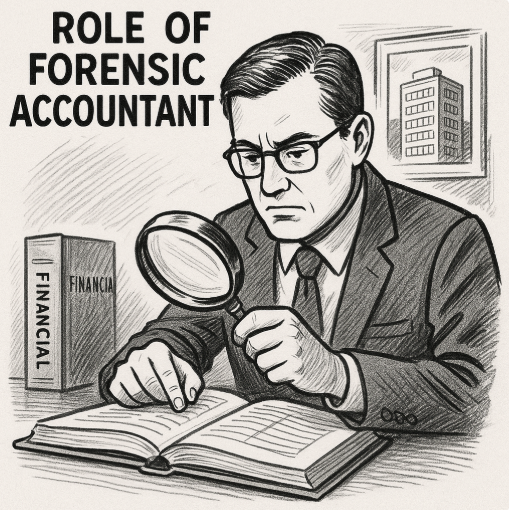
    Role of a Forensic Accountant

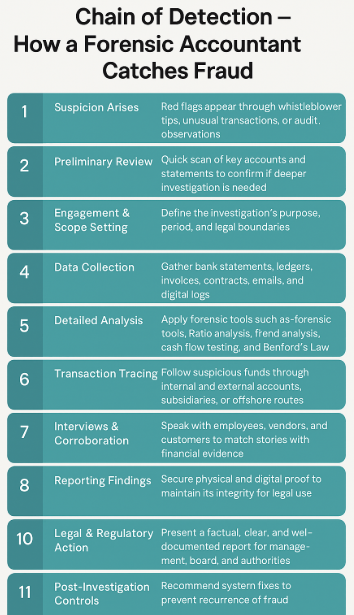
    Fraud Detection – Identifies suspicious transactions, inconsistencies, and patterns in financial data.

    Evidence Gathering – Collects and secures financial records that can stand in a court of law.

    Data Analysis – Uses tools like ratio analysis, trend analysis, and Benford’s Law to spot anomalies.

    Transaction Tracing – Follows the money trail across accounts, subsidiaries, and offshore entities.

    Interview & Inquiry – Works with employees, management, and stakeholders to gather facts.

    Reporting – Prepares detailed investigation reports for boards, regulators, and legal authorities.

    Litigation Support – Assists in legal proceedings by presenting financial evidence and expert testimony.

    Prevention & Controls – Recommends improvements in internal controls to avoid future fraud.

    Forensic Accounting

    Story of SilverShine CapitalA Shine That Hid the Shadows

    SilverSpark Capital Building

    The tall glass building of SilverShine Capital sparkled in the morning sun. From the outside, it looked like a place where dreams came true — a symbol of wealth, power, and success. Inside, the air buzzed with energy. Phones rang, deals were signed, and big screens flashed numbers that made investors feel safe.

    But hidden in those numbers… was a secret no one wanted to see.


    The First Whisper of Trouble

    It started with something small. A payment to a supplier was delayed — nothing unusual in business. A small mismatch in the accounts — easy to overlook.

    But Sakshi, a young accounts assistant, didn’t overlook it. She had a love for details that others found obsessive. While preparing a routine report, she noticed something strange — the company’s debt had shot up by 40% in just three months, even though profits were supposedly rising.

    Her colleague brushed it off.

    “That’s just creative accounting,” he said with a smile.

    But Sakshi’s gut told her otherwise.


    When the Numbers Don’t Match

    Sakshi compared the profit and loss statement with the cash flow statement.

    • The profit report showed booming sales.
    • The cash flow report showed… no matching cash coming in.

    She visited the warehouse to confirm. The shelves were full — the stock hadn’t moved much. This meant the company was reporting sales without actually selling products — a classic red flag.


    The Midnight Entry

    Sakshi found Red Flags - Forensic Accounting

    Then came the turning point. Sakshi noticed a huge journal entry posted at midnight, credited to a user ID she didn’t recognize. The entry shifted millions between accounts in a way that made the balance sheet look healthier than it actually was.

    Sakshi used the company’s Whistleblower Portal, sending an anonymous tip to the Audit Committee — an arm of the board that included Independent Directors

    The Independent Directors didn’t ignore the tip. They brought in an external forensic accounting firm within 48 hours.
    The team worked like detectives — not in trench coats, but in Excel sheets and data analytics tools:


    Summary of Initial Steps Taken

    Here is step by step approach:

    1. Initial Suspicion
      • Sakshi, while working in the finance department, noticed numbers that didn’t make sense (e.g., revenue growing but no matching cash inflow).
    2. Internal Safeguard Step
      • She first approached the internal audit head (or compliance officer) — as per whistleblower policy — rather than directly confronting management.
    3. Escalation to 3rd Party
      • The internal audit head realized the anomalies were serious and potentially fraudulent.
      • Following company policy, they hired an independent forensic accounting firm under strict confidentiality.
    4. Why Not Go Public Immediately?
      • Jumping directly to regulators without evidence could have exposed Sakshi to retaliation and the company to lawsuits.
      • The forensic team’s findings gave the board proof, not just suspicion.

    Forensic Accounting Team Enters – The Investigation Begins

    Forensic Accounting Team

    Forensic accountants are detectives of numbers. They use laptops, special software, and an unshakable instinct for patterns. They detects fraud by digging deep into a company’s financial records to uncover hidden patterns, unusual transactions, and inconsistencies.

    Forensic accounting detects fraud by combining ratio analysis, trend analysis, Benford’s Law, cash flow testing, journal entry reviews, data mining, and digital forensics. These techniques uncover hidden patterns, irregular transactions, and mismatched records—revealing when numbers don’t add up and exposing the truth behind financial deception.


    1. Ratio Analysis – The Financial Health Check

    They compared key financial ratios:

    • Debt-to-Equity had spiked unusually fast.
    • Inventory Turnover was too low despite high reported sales.
    • Operating Cash Flow to Net Income was negative — meaning profits were “on paper,” not in reality.

    Why it mattered: Healthy companies don’t show such mismatched trends without a reason.


    2. Trend Analysis – Spotting Sudden Shifts

    They plotted revenues, expenses, and debt over 12 months. Everything looked steady until the last quarter, when profits magically jumped while expenses stayed flat — another red flag.

    Why it mattered: Fraud often shows up as sudden, unrealistic improvements.


    3. Benford’s Law – Numbers Have a Natural Pattern

    Using Benford’s Law, they checked the frequency of first digits in transaction amounts. In real life, numbers follow a predictable pattern (more 1’s than 9’s). The company’s books had unnatural spikes in certain digits, suggesting manipulation.

    Why it mattered: Fake numbers often break natural statistical patterns.


    4. Cash Flow Testing – Following the Money

    The team traced actual bank deposits against reported sales. Many “sales” had no cash inflow at all — meaning they were fake entries just to inflate revenue.


    5. Journal Entry Testing – Midnight Magic

    They pulled all manual journal entries made outside working hours. Almost all suspicious entries were posted late at night, moving amounts between unrelated accounts to hide losses.


    The Boardroom Showdown

    The forensic findings were presented in a closed-door board meeting. The Independent Directors took the floor:

    “We have a duty to our shareholders”

    Management tried to brush it off — “a clerical error” — but the IDs demanded immediate action.


    The Chain of Escalation

    1. Audit Committee → Board of Directors
      • The board was informed in a closed-door meeting.
      • The CFO, who had signed off the manipulated reports, was immediately suspended pending investigation.
    2. Board → External Auditors
      • The external auditors were called in to review the last three years of financial statements.
      • Several prior year profits were restated, bringing them closer to reality.
    3. Board → Regulators & Banks
      • Since the fraud involved loans and investor funds, the matter was escalated to the Securities Regulator and bank lenders.
      • This preemptive disclosure prevented legal penalties for delayed reporting.

    How the Big Fall Was Averted

    At the time the fraud was uncovered, the company was negotiating a large public bond issue.
    If the fake profits had gone unchallenged:

    • Investors would have poured money into a hollow business.
    • When reality hit, the share price would have crashed overnight.

    Because Sakshi and the forensic team acted fast:

    • The bond issue was paused before launch.
    • The company quietly restructured its debt and sold non-core assets to stabilize finances.
    • The share price still dipped, but a controlled correction avoided a full-blown collapse.

    A Fall That Never Happened

    The ₹300 crore was stopped in time. Had it gone through, the company’s quarterly results would have shown inflated expenses, triggering a stock crash and shaking investor trust.

    Instead, when the news broke, it was framed as a victory for corporate governance — “Fraud Averted by Early Action of Independent Directors.”
    Investors responded with relief, not panic. The share price dipped briefly but recovered quickly.


    Sakshi’s Quiet Triumph

    Sakshi was quietly transferred to a secure role, her identity still protected. The lead Independent Director sent her a short note:

    “Your courage saved thousands of investors. You may never get public credit, but you have our gratitude.”


    The Lesson

    Sakshi’s courage to act when she noticed irregularities proved that one alert person can save thousands from loss.
    Her decision to quietly document evidence, write whistle blower complain,resulted in a chain of investigations & actions from audit committee to the forensic accounting team, to the Board, the external audit committee to regulators, banks & thus prevented a multi-crore fraud from wiping out employee livelihoods, investor wealth, and the company’s reputation.

    Why the Forensic Accounting Team Was Crucial:

    • They had the specialized skills to dig beyond surface numbers and uncover hidden manipulations.
    • They connected financial clues like a puzzle, proving the fraud with evidence that could stand in court.
    • They worked independently and fearlessly, ensuring no internal pressure could bury the truth.
    • Their findings gave independent directors the confidence to act quickly before the fraud grew bigger

    Key Takeaways:

    • Early detection saves lives and livelihoods — delays can make recovery impossible.
    • Documentation is power — facts and evidence speak louder than suspicion.
    • Forensic accountants are allies — they turn whispers of doubt into proof of wrongdoing.
    • Independent directors matter — they can push for transparency and protect whistleblowers.
    • Silence protects fraud, not jobs — raising red flags is a responsibility, not a risk.

    Sakshi’s story is proof: when numbers tell lies, speaking up tells the truth.


    Final Thoughts

    Forensic accounting isn’t just about catching fraudsters — it’s about preventing the damage before it happens.
    Whether you’re an investor, a board member, or a regulator, adopting a forensic mindset can protect wealth, jobs, and trust.

    Forensic accounting isn’t just about numbers — it’s about saving trust before it’s too late.

    Fraud doesn’t arrive with warning bells. It slips in quietly, hiding behind clever entries and polished reports. And when it’s finally exposed, it’s not just money that’s gone — it’s jobs, dreams, and people’s life savings.

    A strong forensic team is the alarm that can stop a collapse before it begins. They don’t just catch the guilty; they protect the innocent.

    Because when numbers lie… they’re the ones who make them tell the truth.


    Call to Action

    ⚠️ When Fraud Strikes, Everyone Bleeds.
    Fraud is not just a corporate scandal—it’s a human disaster.

    • Investors lose their lifetime savings.
    • Employees lose jobs and future security.
    • Suppliers & partners are left unpaid.
    • Customers lose trust in the brand.
    • Communities suffer from economic ripple effects.

    If you see red flags — don’t stay silent. Speak up through whistleblower channels.
    If you’re an investor — ask the hard questions, demand transparency, and insist on a strong forensic accounting team.
    If you’re in leadership — build or engage with expert forensic accountants to detect trouble before it becomes a disaster.

    Fraud thrives in silence. Truth wins when we act — with the right team on our side.

    One ignored red flag can destroy decades of work.
    Speak up. Raise the alarm. Do not let fear of retaliation silence you.
    Your courage today can save thousands from loss tomorrow.

    Read our blogs on Corporate Governance here.

    The Council of the Institute of Chartered Accountants of India, recognizing the need for Forensic Accounting and Fraud Detection, has decided to launch this Certificate Course on Forensic Accounting and Fraud Detection.Check details here.

  • 5 Powerful Ways Forensic Accounting Catches Silent Theft

    5 Powerful Ways Forensic Accounting Catches Silent Theft

    How forensic accounting uncover frauds hidden in plain sight


    Forensic Accounting: The Financial Detective Work That Saves Billions

    When most people think of detectives, they imagine trench coats, magnifying glasses, and crime scenes. But in the corporate world, there’s another kind of detective — one who hunts for hidden numbers, suspicious transactions, and financial cover-ups. These specialists are forensic accountants — and they might just be the unsung heroes preventing billion-dollar disasters.


    What is Forensic Accounting?

    Forensic accounting is the use of accounting, auditing, and investigative skills to examine financial records for fraud, mismanagement, or legal disputes. Unlike regular accounting, which focuses on recording transactions, forensic accounting aims to uncover the truth — often before it’s too late.

    It’s used in:

    • Corporate fraud investigations
    • Litigation support
    • Insurance claims verification
    • Divorce settlements involving large assets
    • Bankruptcy and insolvency cases

    Think of it as financial CSI — but instead of fingerprints and DNA, the clues are hidden in spreadsheets, ledgers, and emails.


    Why It Matters

    Corporate fraud isn’t just a big company problem — it’s an everyone problem. When fraud happens, investors lose money, employees lose jobs, and public trust takes a hit.

    Early detection can save:

    • Shareholder wealth (Wirecard collapse wiped out €24 billion)
    • Jobs (Enron’s downfall left 20,000 unemployed)
    • Taxpayer money (public sector scams)

    Forensic accountants are trained to spot red flags long before they turn into headlines.


    Role of a Forensic Accountant

    Fraud Detection – Identifies suspicious transactions, inconsistencies, and patterns in financial data.

    Evidence Gathering – Collects and secures financial records that can stand in a court of law.

    Data Analysis – Uses tools like ratio analysis, trend analysis, and Benford’s Law to spot anomalies.

    Transaction Tracing – Follows the money trail across accounts, subsidiaries, and offshore entities.

    Interview & Inquiry – Works with employees, management, and stakeholders to gather facts.

    Reporting – Prepares detailed investigation reports for boards, regulators, and legal authorities.

    Litigation Support – Assists in legal proceedings by presenting financial evidence and expert testimony.

    Prevention & Controls – Recommends improvements in internal controls to avoid future fraud.

    Forensic Accounting

    Story of SilverShine CapitalA Shine That Hid the Shadows

    SilverSpark Capital Building

    The tall glass building of SilverShine Capital sparkled in the morning sun. From the outside, it looked like a place where dreams came true — a symbol of wealth, power, and success. Inside, the air buzzed with energy. Phones rang, deals were signed, and big screens flashed numbers that made investors feel safe.

    But hidden in those numbers… was a secret no one wanted to see.


    The First Whisper of Trouble

    It started with something small. A payment to a supplier was delayed — nothing unusual in business. A small mismatch in the accounts — easy to overlook.

    But Sakshi, a young accounts assistant, didn’t overlook it. She had a love for details that others found obsessive. While preparing a routine report, she noticed something strange — the company’s debt had shot up by 40% in just three months, even though profits were supposedly rising.

    Her colleague brushed it off.

    “That’s just creative accounting,” he said with a smile.

    But Sakshi’s gut told her otherwise.


    When the Numbers Don’t Match

    Sakshi compared the profit and loss statement with the cash flow statement.

    • The profit report showed booming sales.
    • The cash flow report showed… no matching cash coming in.

    She visited the warehouse to confirm. The shelves were full — the stock hadn’t moved much. This meant the company was reporting sales without actually selling products — a classic red flag.


    The Midnight Entry

    Sakshi found Red Flags - Forensic Accounting

    Then came the turning point. Sakshi noticed a huge journal entry posted at midnight, credited to a user ID she didn’t recognize. The entry shifted millions between accounts in a way that made the balance sheet look healthier than it actually was.

    Sakshi used the company’s Whistleblower Portal, sending an anonymous tip to the Audit Committee — an arm of the board that included Independent Directors

    The Independent Directors didn’t ignore the tip. They brought in an external forensic accounting firm within 48 hours.
    The team worked like detectives — not in trench coats, but in Excel sheets and data analytics tools:


    Summary of Initial Steps Taken

    Here is step by step approach:

    1. Initial Suspicion
      • Sakshi, while working in the finance department, noticed numbers that didn’t make sense (e.g., revenue growing but no matching cash inflow).
    2. Internal Safeguard Step
      • She first approached the internal audit head (or compliance officer) — as per whistleblower policy — rather than directly confronting management.
    3. Escalation to 3rd Party
      • The internal audit head realized the anomalies were serious and potentially fraudulent.
      • Following company policy, they hired an independent forensic accounting firm under strict confidentiality.
    4. Why Not Go Public Immediately?
      • Jumping directly to regulators without evidence could have exposed Sakshi to retaliation and the company to lawsuits.
      • The forensic team’s findings gave the board proof, not just suspicion.

    Forensic Accounting Team Enters – The Investigation Begins

    Forensic Accounting Team

    Forensic accountants are detectives of numbers. They use laptops, special software, and an unshakable instinct for patterns. They detects fraud by digging deep into a company’s financial records to uncover hidden patterns, unusual transactions, and inconsistencies.

    Forensic accounting detects fraud by combining ratio analysis, trend analysis, Benford’s Law, cash flow testing, journal entry reviews, data mining, and digital forensics. These techniques uncover hidden patterns, irregular transactions, and mismatched records—revealing when numbers don’t add up and exposing the truth behind financial deception.


    1. Ratio Analysis – The Financial Health Check

    They compared key financial ratios:

    • Debt-to-Equity had spiked unusually fast.
    • Inventory Turnover was too low despite high reported sales.
    • Operating Cash Flow to Net Income was negative — meaning profits were “on paper,” not in reality.

    Why it mattered: Healthy companies don’t show such mismatched trends without a reason.


    2. Trend Analysis – Spotting Sudden Shifts

    They plotted revenues, expenses, and debt over 12 months. Everything looked steady until the last quarter, when profits magically jumped while expenses stayed flat — another red flag.

    Why it mattered: Fraud often shows up as sudden, unrealistic improvements.


    3. Benford’s Law – Numbers Have a Natural Pattern

    Using Benford’s Law, they checked the frequency of first digits in transaction amounts. In real life, numbers follow a predictable pattern (more 1’s than 9’s). The company’s books had unnatural spikes in certain digits, suggesting manipulation.

    Why it mattered: Fake numbers often break natural statistical patterns.


    4. Cash Flow Testing – Following the Money

    The team traced actual bank deposits against reported sales. Many “sales” had no cash inflow at all — meaning they were fake entries just to inflate revenue.


    5. Journal Entry Testing – Midnight Magic

    They pulled all manual journal entries made outside working hours. Almost all suspicious entries were posted late at night, moving amounts between unrelated accounts to hide losses.


    The Boardroom Showdown

    The forensic findings were presented in a closed-door board meeting. The Independent Directors took the floor:

    “We have a duty to our shareholders”

    Management tried to brush it off — “a clerical error” — but the IDs demanded immediate action.


    The Chain of Escalation

    1. Audit Committee → Board of Directors
      • The board was informed in a closed-door meeting.
      • The CFO, who had signed off the manipulated reports, was immediately suspended pending investigation.
    2. Board → External Auditors
      • The external auditors were called in to review the last three years of financial statements.
      • Several prior year profits were restated, bringing them closer to reality.
    3. Board → Regulators & Banks
      • Since the fraud involved loans and investor funds, the matter was escalated to the Securities Regulator and bank lenders.
      • This preemptive disclosure prevented legal penalties for delayed reporting.

    How the Big Fall Was Averted

    At the time the fraud was uncovered, the company was negotiating a large public bond issue.
    If the fake profits had gone unchallenged:

    • Investors would have poured money into a hollow business.
    • When reality hit, the share price would have crashed overnight.

    Because Sakshi and the forensic team acted fast:

    • The bond issue was paused before launch.
    • The company quietly restructured its debt and sold non-core assets to stabilize finances.
    • The share price still dipped, but a controlled correction avoided a full-blown collapse.

    A Fall That Never Happened

    The ₹300 crore was stopped in time. Had it gone through, the company’s quarterly results would have shown inflated expenses, triggering a stock crash and shaking investor trust.

    Instead, when the news broke, it was framed as a victory for corporate governance — “Fraud Averted by Early Action of Independent Directors.”
    Investors responded with relief, not panic. The share price dipped briefly but recovered quickly.


    Sakshi’s Quiet Triumph

    Sakshi was quietly transferred to a secure role, her identity still protected. The lead Independent Director sent her a short note:

    “Your courage saved thousands of investors. You may never get public credit, but you have our gratitude.”


    The Lesson

    Sakshi’s courage to act when she noticed irregularities proved that one alert person can save thousands from loss.
    Her decision to quietly document evidence, write whistle blower complain,resulted in a chain of investigations & actions from audit committee to the forensic accounting team, to the Board, the external audit committee to regulators, banks & thus prevented a multi-crore fraud from wiping out employee livelihoods, investor wealth, and the company’s reputation.

    Why the Forensic Accounting Team Was Crucial:

    • They had the specialized skills to dig beyond surface numbers and uncover hidden manipulations.
    • They connected financial clues like a puzzle, proving the fraud with evidence that could stand in court.
    • They worked independently and fearlessly, ensuring no internal pressure could bury the truth.
    • Their findings gave independent directors the confidence to act quickly before the fraud grew bigger

    Key Takeaways:

    • Early detection saves lives and livelihoods — delays can make recovery impossible.
    • Documentation is power — facts and evidence speak louder than suspicion.
    • Forensic accountants are allies — they turn whispers of doubt into proof of wrongdoing.
    • Independent directors matter — they can push for transparency and protect whistleblowers.
    • Silence protects fraud, not jobs — raising red flags is a responsibility, not a risk.

    Sakshi’s story is proof: when numbers tell lies, speaking up tells the truth.


    Final Thoughts

    Forensic accounting isn’t just about catching fraudsters — it’s about preventing the damage before it happens.
    Whether you’re an investor, a board member, or a regulator, adopting a forensic mindset can protect wealth, jobs, and trust.

    Forensic accounting isn’t just about numbers — it’s about saving trust before it’s too late.

    Fraud doesn’t arrive with warning bells. It slips in quietly, hiding behind clever entries and polished reports. And when it’s finally exposed, it’s not just money that’s gone — it’s jobs, dreams, and people’s life savings.

    A strong forensic team is the alarm that can stop a collapse before it begins. They don’t just catch the guilty; they protect the innocent.

    Because when numbers lie… they’re the ones who make them tell the truth.


    Call to Action

    ⚠️ When Fraud Strikes, Everyone Bleeds.
    Fraud is not just a corporate scandal—it’s a human disaster.

    • Investors lose their lifetime savings.
    • Employees lose jobs and future security.
    • Suppliers & partners are left unpaid.
    • Customers lose trust in the brand.
    • Communities suffer from economic ripple effects.

    If you see red flags — don’t stay silent. Speak up through whistleblower channels.
    If you’re an investor — ask the hard questions, demand transparency, and insist on a strong forensic accounting team.
    If you’re in leadership — build or engage with expert forensic accountants to detect trouble before it becomes a disaster.

    Fraud thrives in silence. Truth wins when we act — with the right team on our side.

    One ignored red flag can destroy decades of work.
    Speak up. Raise the alarm. Do not let fear of retaliation silence you.
    Your courage today can save thousands from loss tomorrow.

    Read our blogs on Corporate Governance here.

    The Council of the Institute of Chartered Accountants of India, recognizing the need for Forensic Accounting and Fraud Detection, has decided to launch this Certificate Course on Forensic Accounting and Fraud Detection.Check details here.

  • 5 Powerful Ways Forensic Accounting Catches Silent Theft

    5 Powerful Ways Forensic Accounting Catches Silent Theft

    How forensic accounting uncover frauds hidden in plain sight


    Forensic Accounting: The Financial Detective Work That Saves Billions

    When most people think of detectives, they imagine trench coats, magnifying glasses, and crime scenes. But in the corporate world, there’s another kind of detective — one who hunts for hidden numbers, suspicious transactions, and financial cover-ups. These specialists are forensic accountants — and they might just be the unsung heroes preventing billion-dollar disasters.


    What is Forensic Accounting?

    Forensic accounting is the use of accounting, auditing, and investigative skills to examine financial records for fraud, mismanagement, or legal disputes. Unlike regular accounting, which focuses on recording transactions, forensic accounting aims to uncover the truth — often before it’s too late.

    It’s used in:

    • Corporate fraud investigations
    • Litigation support
    • Insurance claims verification
    • Divorce settlements involving large assets
    • Bankruptcy and insolvency cases

    Think of it as financial CSI — but instead of fingerprints and DNA, the clues are hidden in spreadsheets, ledgers, and emails.


    Why It Matters

    Corporate fraud isn’t just a big company problem — it’s an everyone problem. When fraud happens, investors lose money, employees lose jobs, and public trust takes a hit.

    Early detection can save:

    • Shareholder wealth (Wirecard collapse wiped out €24 billion)
    • Jobs (Enron’s downfall left 20,000 unemployed)
    • Taxpayer money (public sector scams)

    Forensic accountants are trained to spot red flags long before they turn into headlines.


    Role of a Forensic Accountant

    Fraud Detection – Identifies suspicious transactions, inconsistencies, and patterns in financial data.

    Evidence Gathering – Collects and secures financial records that can stand in a court of law.

    Data Analysis – Uses tools like ratio analysis, trend analysis, and Benford’s Law to spot anomalies.

    Transaction Tracing – Follows the money trail across accounts, subsidiaries, and offshore entities.

    Interview & Inquiry – Works with employees, management, and stakeholders to gather facts.

    Reporting – Prepares detailed investigation reports for boards, regulators, and legal authorities.

    Litigation Support – Assists in legal proceedings by presenting financial evidence and expert testimony.

    Prevention & Controls – Recommends improvements in internal controls to avoid future fraud.

    Forensic Accounting

    Story of SilverShine CapitalA Shine That Hid the Shadows

    SilverSpark Capital Building

    The tall glass building of SilverShine Capital sparkled in the morning sun. From the outside, it looked like a place where dreams came true — a symbol of wealth, power, and success. Inside, the air buzzed with energy. Phones rang, deals were signed, and big screens flashed numbers that made investors feel safe.

    But hidden in those numbers… was a secret no one wanted to see.


    The First Whisper of Trouble

    It started with something small. A payment to a supplier was delayed — nothing unusual in business. A small mismatch in the accounts — easy to overlook.

    But Sakshi, a young accounts assistant, didn’t overlook it. She had a love for details that others found obsessive. While preparing a routine report, she noticed something strange — the company’s debt had shot up by 40% in just three months, even though profits were supposedly rising.

    Her colleague brushed it off.

    “That’s just creative accounting,” he said with a smile.

    But Sakshi’s gut told her otherwise.


    When the Numbers Don’t Match

    Sakshi compared the profit and loss statement with the cash flow statement.

    • The profit report showed booming sales.
    • The cash flow report showed… no matching cash coming in.

    She visited the warehouse to confirm. The shelves were full — the stock hadn’t moved much. This meant the company was reporting sales without actually selling products — a classic red flag.


    The Midnight Entry

    Sakshi found Red Flags - Forensic Accounting

    Then came the turning point. Sakshi noticed a huge journal entry posted at midnight, credited to a user ID she didn’t recognize. The entry shifted millions between accounts in a way that made the balance sheet look healthier than it actually was.

    Sakshi used the company’s Whistleblower Portal, sending an anonymous tip to the Audit Committee — an arm of the board that included Independent Directors

    The Independent Directors didn’t ignore the tip. They brought in an external forensic accounting firm within 48 hours.
    The team worked like detectives — not in trench coats, but in Excel sheets and data analytics tools:


    Summary of Initial Steps Taken

    Here is step by step approach:

    1. Initial Suspicion
      • Sakshi, while working in the finance department, noticed numbers that didn’t make sense (e.g., revenue growing but no matching cash inflow).
    2. Internal Safeguard Step
      • She first approached the internal audit head (or compliance officer) — as per whistleblower policy — rather than directly confronting management.
    3. Escalation to 3rd Party
      • The internal audit head realized the anomalies were serious and potentially fraudulent.
      • Following company policy, they hired an independent forensic accounting firm under strict confidentiality.
    4. Why Not Go Public Immediately?
      • Jumping directly to regulators without evidence could have exposed Sakshi to retaliation and the company to lawsuits.
      • The forensic team’s findings gave the board proof, not just suspicion.

    Forensic Accounting Team Enters – The Investigation Begins

    Forensic Accounting Team

    Forensic accountants are detectives of numbers. They use laptops, special software, and an unshakable instinct for patterns. They detects fraud by digging deep into a company’s financial records to uncover hidden patterns, unusual transactions, and inconsistencies.

    Forensic accounting detects fraud by combining ratio analysis, trend analysis, Benford’s Law, cash flow testing, journal entry reviews, data mining, and digital forensics. These techniques uncover hidden patterns, irregular transactions, and mismatched records—revealing when numbers don’t add up and exposing the truth behind financial deception.


    1. Ratio Analysis – The Financial Health Check

    They compared key financial ratios:

    • Debt-to-Equity had spiked unusually fast.
    • Inventory Turnover was too low despite high reported sales.
    • Operating Cash Flow to Net Income was negative — meaning profits were “on paper,” not in reality.

    Why it mattered: Healthy companies don’t show such mismatched trends without a reason.


    2. Trend Analysis – Spotting Sudden Shifts

    They plotted revenues, expenses, and debt over 12 months. Everything looked steady until the last quarter, when profits magically jumped while expenses stayed flat — another red flag.

    Why it mattered: Fraud often shows up as sudden, unrealistic improvements.


    3. Benford’s Law – Numbers Have a Natural Pattern

    Using Benford’s Law, they checked the frequency of first digits in transaction amounts. In real life, numbers follow a predictable pattern (more 1’s than 9’s). The company’s books had unnatural spikes in certain digits, suggesting manipulation.

    Why it mattered: Fake numbers often break natural statistical patterns.


    4. Cash Flow Testing – Following the Money

    The team traced actual bank deposits against reported sales. Many “sales” had no cash inflow at all — meaning they were fake entries just to inflate revenue.


    5. Journal Entry Testing – Midnight Magic

    They pulled all manual journal entries made outside working hours. Almost all suspicious entries were posted late at night, moving amounts between unrelated accounts to hide losses.


    The Boardroom Showdown

    The forensic findings were presented in a closed-door board meeting. The Independent Directors took the floor:

    “We have a duty to our shareholders”

    Management tried to brush it off — “a clerical error” — but the IDs demanded immediate action.


    The Chain of Escalation

    1. Audit Committee → Board of Directors
      • The board was informed in a closed-door meeting.
      • The CFO, who had signed off the manipulated reports, was immediately suspended pending investigation.
    2. Board → External Auditors
      • The external auditors were called in to review the last three years of financial statements.
      • Several prior year profits were restated, bringing them closer to reality.
    3. Board → Regulators & Banks
      • Since the fraud involved loans and investor funds, the matter was escalated to the Securities Regulator and bank lenders.
      • This preemptive disclosure prevented legal penalties for delayed reporting.

    How the Big Fall Was Averted

    At the time the fraud was uncovered, the company was negotiating a large public bond issue.
    If the fake profits had gone unchallenged:

    • Investors would have poured money into a hollow business.
    • When reality hit, the share price would have crashed overnight.

    Because Sakshi and the forensic team acted fast:

    • The bond issue was paused before launch.
    • The company quietly restructured its debt and sold non-core assets to stabilize finances.
    • The share price still dipped, but a controlled correction avoided a full-blown collapse.

    A Fall That Never Happened

    The ₹300 crore was stopped in time. Had it gone through, the company’s quarterly results would have shown inflated expenses, triggering a stock crash and shaking investor trust.

    Instead, when the news broke, it was framed as a victory for corporate governance — “Fraud Averted by Early Action of Independent Directors.”
    Investors responded with relief, not panic. The share price dipped briefly but recovered quickly.


    Sakshi’s Quiet Triumph

    Sakshi was quietly transferred to a secure role, her identity still protected. The lead Independent Director sent her a short note:

    “Your courage saved thousands of investors. You may never get public credit, but you have our gratitude.”


    The Lesson

    Sakshi’s courage to act when she noticed irregularities proved that one alert person can save thousands from loss.
    Her decision to quietly document evidence, write whistle blower complain,resulted in a chain of investigations & actions from audit committee to the forensic accounting team, to the Board, the external audit committee to regulators, banks & thus prevented a multi-crore fraud from wiping out employee livelihoods, investor wealth, and the company’s reputation.

    Why the Forensic Accounting Team Was Crucial:

    • They had the specialized skills to dig beyond surface numbers and uncover hidden manipulations.
    • They connected financial clues like a puzzle, proving the fraud with evidence that could stand in court.
    • They worked independently and fearlessly, ensuring no internal pressure could bury the truth.
    • Their findings gave independent directors the confidence to act quickly before the fraud grew bigger

    Key Takeaways:

    • Early detection saves lives and livelihoods — delays can make recovery impossible.
    • Documentation is power — facts and evidence speak louder than suspicion.
    • Forensic accountants are allies — they turn whispers of doubt into proof of wrongdoing.
    • Independent directors matter — they can push for transparency and protect whistleblowers.
    • Silence protects fraud, not jobs — raising red flags is a responsibility, not a risk.

    Sakshi’s story is proof: when numbers tell lies, speaking up tells the truth.


    Final Thoughts

    Forensic accounting isn’t just about catching fraudsters — it’s about preventing the damage before it happens.
    Whether you’re an investor, a board member, or a regulator, adopting a forensic mindset can protect wealth, jobs, and trust.

    Forensic accounting isn’t just about numbers — it’s about saving trust before it’s too late.

    Fraud doesn’t arrive with warning bells. It slips in quietly, hiding behind clever entries and polished reports. And when it’s finally exposed, it’s not just money that’s gone — it’s jobs, dreams, and people’s life savings.

    A strong forensic team is the alarm that can stop a collapse before it begins. They don’t just catch the guilty; they protect the innocent.

    Because when numbers lie… they’re the ones who make them tell the truth.


    Call to Action

    ⚠️ When Fraud Strikes, Everyone Bleeds.
    Fraud is not just a corporate scandal—it’s a human disaster.

    • Investors lose their lifetime savings.
    • Employees lose jobs and future security.
    • Suppliers & partners are left unpaid.
    • Customers lose trust in the brand.
    • Communities suffer from economic ripple effects.

    If you see red flags — don’t stay silent. Speak up through whistleblower channels.
    If you’re an investor — ask the hard questions, demand transparency, and insist on a strong forensic accounting team.
    If you’re in leadership — build or engage with expert forensic accountants to detect trouble before it becomes a disaster.

    Fraud thrives in silence. Truth wins when we act — with the right team on our side.

    One ignored red flag can destroy decades of work.
    Speak up. Raise the alarm. Do not let fear of retaliation silence you.
    Your courage today can save thousands from loss tomorrow.

    Read our blogs on Corporate Governance here.

    The Council of the Institute of Chartered Accountants of India, recognizing the need for Forensic Accounting and Fraud Detection, has decided to launch this Certificate Course on Forensic Accounting and Fraud Detection.Check details here.

  • 5 Powerful Ways Forensic Accounting Catches Silent Theft

    5 Powerful Ways Forensic Accounting Catches Silent Theft

    How forensic accounting uncover frauds hidden in plain sight


    Forensic Accounting: The Financial Detective Work That Saves Billions

    When most people think of detectives, they imagine trench coats, magnifying glasses, and crime scenes. But in the corporate world, there’s another kind of detective — one who hunts for hidden numbers, suspicious transactions, and financial cover-ups. These specialists are forensic accountants — and they might just be the unsung heroes preventing billion-dollar disasters.


    What is Forensic Accounting?

    Forensic accounting is the use of accounting, auditing, and investigative skills to examine financial records for fraud, mismanagement, or legal disputes. Unlike regular accounting, which focuses on recording transactions, forensic accounting aims to uncover the truth — often before it’s too late.

    It’s used in:

    • Corporate fraud investigations
    • Litigation support
    • Insurance claims verification
    • Divorce settlements involving large assets
    • Bankruptcy and insolvency cases

    Think of it as financial CSI — but instead of fingerprints and DNA, the clues are hidden in spreadsheets, ledgers, and emails.


    Why It Matters

    Corporate fraud isn’t just a big company problem — it’s an everyone problem. When fraud happens, investors lose money, employees lose jobs, and public trust takes a hit.

    Early detection can save:

    • Shareholder wealth (Wirecard collapse wiped out €24 billion)
    • Jobs (Enron’s downfall left 20,000 unemployed)
    • Taxpayer money (public sector scams)

    Forensic accountants are trained to spot red flags long before they turn into headlines.


    Role of a Forensic Accountant

    Fraud Detection – Identifies suspicious transactions, inconsistencies, and patterns in financial data.

    Evidence Gathering – Collects and secures financial records that can stand in a court of law.

    Data Analysis – Uses tools like ratio analysis, trend analysis, and Benford’s Law to spot anomalies.

    Transaction Tracing – Follows the money trail across accounts, subsidiaries, and offshore entities.

    Interview & Inquiry – Works with employees, management, and stakeholders to gather facts.

    Reporting – Prepares detailed investigation reports for boards, regulators, and legal authorities.

    Litigation Support – Assists in legal proceedings by presenting financial evidence and expert testimony.

    Prevention & Controls – Recommends improvements in internal controls to avoid future fraud.

    Forensic Accounting

    Story of SilverShine CapitalA Shine That Hid the Shadows

    SilverSpark Capital Building

    The tall glass building of SilverShine Capital sparkled in the morning sun. From the outside, it looked like a place where dreams came true — a symbol of wealth, power, and success. Inside, the air buzzed with energy. Phones rang, deals were signed, and big screens flashed numbers that made investors feel safe.

    But hidden in those numbers… was a secret no one wanted to see.


    The First Whisper of Trouble

    It started with something small. A payment to a supplier was delayed — nothing unusual in business. A small mismatch in the accounts — easy to overlook.

    But Sakshi, a young accounts assistant, didn’t overlook it. She had a love for details that others found obsessive. While preparing a routine report, she noticed something strange — the company’s debt had shot up by 40% in just three months, even though profits were supposedly rising.

    Her colleague brushed it off.

    “That’s just creative accounting,” he said with a smile.

    But Sakshi’s gut told her otherwise.


    When the Numbers Don’t Match

    Sakshi compared the profit and loss statement with the cash flow statement.

    • The profit report showed booming sales.
    • The cash flow report showed… no matching cash coming in.

    She visited the warehouse to confirm. The shelves were full — the stock hadn’t moved much. This meant the company was reporting sales without actually selling products — a classic red flag.


    The Midnight Entry

    Sakshi found Red Flags - Forensic Accounting

    Then came the turning point. Sakshi noticed a huge journal entry posted at midnight, credited to a user ID she didn’t recognize. The entry shifted millions between accounts in a way that made the balance sheet look healthier than it actually was.

    Sakshi used the company’s Whistleblower Portal, sending an anonymous tip to the Audit Committee — an arm of the board that included Independent Directors

    The Independent Directors didn’t ignore the tip. They brought in an external forensic accounting firm within 48 hours.
    The team worked like detectives — not in trench coats, but in Excel sheets and data analytics tools:


    Summary of Initial Steps Taken

    Here is step by step approach:

    1. Initial Suspicion
      • Sakshi, while working in the finance department, noticed numbers that didn’t make sense (e.g., revenue growing but no matching cash inflow).
    2. Internal Safeguard Step
      • She first approached the internal audit head (or compliance officer) — as per whistleblower policy — rather than directly confronting management.
    3. Escalation to 3rd Party
      • The internal audit head realized the anomalies were serious and potentially fraudulent.
      • Following company policy, they hired an independent forensic accounting firm under strict confidentiality.
    4. Why Not Go Public Immediately?
      • Jumping directly to regulators without evidence could have exposed Sakshi to retaliation and the company to lawsuits.
      • The forensic team’s findings gave the board proof, not just suspicion.

    Forensic Accounting Team Enters – The Investigation Begins

    Forensic Accounting Team

    Forensic accountants are detectives of numbers. They use laptops, special software, and an unshakable instinct for patterns. They detects fraud by digging deep into a company’s financial records to uncover hidden patterns, unusual transactions, and inconsistencies.

    Forensic accounting detects fraud by combining ratio analysis, trend analysis, Benford’s Law, cash flow testing, journal entry reviews, data mining, and digital forensics. These techniques uncover hidden patterns, irregular transactions, and mismatched records—revealing when numbers don’t add up and exposing the truth behind financial deception.


    1. Ratio Analysis – The Financial Health Check

    They compared key financial ratios:

    • Debt-to-Equity had spiked unusually fast.
    • Inventory Turnover was too low despite high reported sales.
    • Operating Cash Flow to Net Income was negative — meaning profits were “on paper,” not in reality.

    Why it mattered: Healthy companies don’t show such mismatched trends without a reason.


    2. Trend Analysis – Spotting Sudden Shifts

    They plotted revenues, expenses, and debt over 12 months. Everything looked steady until the last quarter, when profits magically jumped while expenses stayed flat — another red flag.

    Why it mattered: Fraud often shows up as sudden, unrealistic improvements.


    3. Benford’s Law – Numbers Have a Natural Pattern

    Using Benford’s Law, they checked the frequency of first digits in transaction amounts. In real life, numbers follow a predictable pattern (more 1’s than 9’s). The company’s books had unnatural spikes in certain digits, suggesting manipulation.

    Why it mattered: Fake numbers often break natural statistical patterns.


    4. Cash Flow Testing – Following the Money

    The team traced actual bank deposits against reported sales. Many “sales” had no cash inflow at all — meaning they were fake entries just to inflate revenue.


    5. Journal Entry Testing – Midnight Magic

    They pulled all manual journal entries made outside working hours. Almost all suspicious entries were posted late at night, moving amounts between unrelated accounts to hide losses.


    The Boardroom Showdown

    The forensic findings were presented in a closed-door board meeting. The Independent Directors took the floor:

    “We have a duty to our shareholders”

    Management tried to brush it off — “a clerical error” — but the IDs demanded immediate action.


    The Chain of Escalation

    1. Audit Committee → Board of Directors
      • The board was informed in a closed-door meeting.
      • The CFO, who had signed off the manipulated reports, was immediately suspended pending investigation.
    2. Board → External Auditors
      • The external auditors were called in to review the last three years of financial statements.
      • Several prior year profits were restated, bringing them closer to reality.
    3. Board → Regulators & Banks
      • Since the fraud involved loans and investor funds, the matter was escalated to the Securities Regulator and bank lenders.
      • This preemptive disclosure prevented legal penalties for delayed reporting.

    How the Big Fall Was Averted

    At the time the fraud was uncovered, the company was negotiating a large public bond issue.
    If the fake profits had gone unchallenged:

    • Investors would have poured money into a hollow business.
    • When reality hit, the share price would have crashed overnight.

    Because Sakshi and the forensic team acted fast:

    • The bond issue was paused before launch.
    • The company quietly restructured its debt and sold non-core assets to stabilize finances.
    • The share price still dipped, but a controlled correction avoided a full-blown collapse.

    A Fall That Never Happened

    The ₹300 crore was stopped in time. Had it gone through, the company’s quarterly results would have shown inflated expenses, triggering a stock crash and shaking investor trust.

    Instead, when the news broke, it was framed as a victory for corporate governance — “Fraud Averted by Early Action of Independent Directors.”
    Investors responded with relief, not panic. The share price dipped briefly but recovered quickly.


    Sakshi’s Quiet Triumph

    Sakshi was quietly transferred to a secure role, her identity still protected. The lead Independent Director sent her a short note:

    “Your courage saved thousands of investors. You may never get public credit, but you have our gratitude.”


    The Lesson

    Sakshi’s courage to act when she noticed irregularities proved that one alert person can save thousands from loss.
    Her decision to quietly document evidence, write whistle blower complain,resulted in a chain of investigations & actions from audit committee to the forensic accounting team, to the Board, the external audit committee to regulators, banks & thus prevented a multi-crore fraud from wiping out employee livelihoods, investor wealth, and the company’s reputation.

    Why the Forensic Accounting Team Was Crucial:

    • They had the specialized skills to dig beyond surface numbers and uncover hidden manipulations.
    • They connected financial clues like a puzzle, proving the fraud with evidence that could stand in court.
    • They worked independently and fearlessly, ensuring no internal pressure could bury the truth.
    • Their findings gave independent directors the confidence to act quickly before the fraud grew bigger

    Key Takeaways:

    • Early detection saves lives and livelihoods — delays can make recovery impossible.
    • Documentation is power — facts and evidence speak louder than suspicion.
    • Forensic accountants are allies — they turn whispers of doubt into proof of wrongdoing.
    • Independent directors matter — they can push for transparency and protect whistleblowers.
    • Silence protects fraud, not jobs — raising red flags is a responsibility, not a risk.

    Sakshi’s story is proof: when numbers tell lies, speaking up tells the truth.


    Final Thoughts

    Forensic accounting isn’t just about catching fraudsters — it’s about preventing the damage before it happens.
    Whether you’re an investor, a board member, or a regulator, adopting a forensic mindset can protect wealth, jobs, and trust.

    Forensic accounting isn’t just about numbers — it’s about saving trust before it’s too late.

    Fraud doesn’t arrive with warning bells. It slips in quietly, hiding behind clever entries and polished reports. And when it’s finally exposed, it’s not just money that’s gone — it’s jobs, dreams, and people’s life savings.

    A strong forensic team is the alarm that can stop a collapse before it begins. They don’t just catch the guilty; they protect the innocent.

    Because when numbers lie… they’re the ones who make them tell the truth.


    Call to Action

    ⚠️ When Fraud Strikes, Everyone Bleeds.
    Fraud is not just a corporate scandal—it’s a human disaster.

    • Investors lose their lifetime savings.
    • Employees lose jobs and future security.
    • Suppliers & partners are left unpaid.
    • Customers lose trust in the brand.
    • Communities suffer from economic ripple effects.

    If you see red flags — don’t stay silent. Speak up through whistleblower channels.
    If you’re an investor — ask the hard questions, demand transparency, and insist on a strong forensic accounting team.
    If you’re in leadership — build or engage with expert forensic accountants to detect trouble before it becomes a disaster.

    Fraud thrives in silence. Truth wins when we act — with the right team on our side.

    One ignored red flag can destroy decades of work.
    Speak up. Raise the alarm. Do not let fear of retaliation silence you.
    Your courage today can save thousands from loss tomorrow.

    Read our blogs on Corporate Governance here.

    The Council of the Institute of Chartered Accountants of India, recognizing the need for Forensic Accounting and Fraud Detection, has decided to launch this Certificate Course on Forensic Accounting and Fraud Detection.Check details here.

  • 5 Powerful Ways Forensic Accounting Catches Silent Theft

    5 Powerful Ways Forensic Accounting Catches Silent Theft

    How forensic accounting uncover frauds hidden in plain sight


    Forensic Accounting: The Financial Detective Work That Saves Billions

    When most people think of detectives, they imagine trench coats, magnifying glasses, and crime scenes. But in the corporate world, there’s another kind of detective — one who hunts for hidden numbers, suspicious transactions, and financial cover-ups. These specialists are forensic accountants — and they might just be the unsung heroes preventing billion-dollar disasters.


    What is Forensic Accounting?

    Forensic accounting is the use of accounting, auditing, and investigative skills to examine financial records for fraud, mismanagement, or legal disputes. Unlike regular accounting, which focuses on recording transactions, forensic accounting aims to uncover the truth — often before it’s too late.

    It’s used in:

    • Corporate fraud investigations
    • Litigation support
    • Insurance claims verification
    • Divorce settlements involving large assets
    • Bankruptcy and insolvency cases

    Think of it as financial CSI — but instead of fingerprints and DNA, the clues are hidden in spreadsheets, ledgers, and emails.


    Why It Matters

    Corporate fraud isn’t just a big company problem — it’s an everyone problem. When fraud happens, investors lose money, employees lose jobs, and public trust takes a hit.

    Early detection can save:

    • Shareholder wealth (Wirecard collapse wiped out €24 billion)
    • Jobs (Enron’s downfall left 20,000 unemployed)
    • Taxpayer money (public sector scams)

    Forensic accountants are trained to spot red flags long before they turn into headlines.


    Role of a Forensic Accountant

    Fraud Detection – Identifies suspicious transactions, inconsistencies, and patterns in financial data.

    Evidence Gathering – Collects and secures financial records that can stand in a court of law.

    Data Analysis – Uses tools like ratio analysis, trend analysis, and Benford’s Law to spot anomalies.

    Transaction Tracing – Follows the money trail across accounts, subsidiaries, and offshore entities.

    Interview & Inquiry – Works with employees, management, and stakeholders to gather facts.

    Reporting – Prepares detailed investigation reports for boards, regulators, and legal authorities.

    Litigation Support – Assists in legal proceedings by presenting financial evidence and expert testimony.

    Prevention & Controls – Recommends improvements in internal controls to avoid future fraud.

    Forensic Accounting

    Story of SilverShine CapitalA Shine That Hid the Shadows

    SilverSpark Capital Building

    The tall glass building of SilverShine Capital sparkled in the morning sun. From the outside, it looked like a place where dreams came true — a symbol of wealth, power, and success. Inside, the air buzzed with energy. Phones rang, deals were signed, and big screens flashed numbers that made investors feel safe.

    But hidden in those numbers… was a secret no one wanted to see.


    The First Whisper of Trouble

    It started with something small. A payment to a supplier was delayed — nothing unusual in business. A small mismatch in the accounts — easy to overlook.

    But Sakshi, a young accounts assistant, didn’t overlook it. She had a love for details that others found obsessive. While preparing a routine report, she noticed something strange — the company’s debt had shot up by 40% in just three months, even though profits were supposedly rising.

    Her colleague brushed it off.

    “That’s just creative accounting,” he said with a smile.

    But Sakshi’s gut told her otherwise.


    When the Numbers Don’t Match

    Sakshi compared the profit and loss statement with the cash flow statement.

    • The profit report showed booming sales.
    • The cash flow report showed… no matching cash coming in.

    She visited the warehouse to confirm. The shelves were full — the stock hadn’t moved much. This meant the company was reporting sales without actually selling products — a classic red flag.


    The Midnight Entry

    Sakshi found Red Flags - Forensic Accounting

    Then came the turning point. Sakshi noticed a huge journal entry posted at midnight, credited to a user ID she didn’t recognize. The entry shifted millions between accounts in a way that made the balance sheet look healthier than it actually was.

    Sakshi used the company’s Whistleblower Portal, sending an anonymous tip to the Audit Committee — an arm of the board that included Independent Directors

    The Independent Directors didn’t ignore the tip. They brought in an external forensic accounting firm within 48 hours.
    The team worked like detectives — not in trench coats, but in Excel sheets and data analytics tools:


    Summary of Initial Steps Taken

    Here is step by step approach:

    1. Initial Suspicion
      • Sakshi, while working in the finance department, noticed numbers that didn’t make sense (e.g., revenue growing but no matching cash inflow).
    2. Internal Safeguard Step
      • She first approached the internal audit head (or compliance officer) — as per whistleblower policy — rather than directly confronting management.
    3. Escalation to 3rd Party
      • The internal audit head realized the anomalies were serious and potentially fraudulent.
      • Following company policy, they hired an independent forensic accounting firm under strict confidentiality.
    4. Why Not Go Public Immediately?
      • Jumping directly to regulators without evidence could have exposed Sakshi to retaliation and the company to lawsuits.
      • The forensic team’s findings gave the board proof, not just suspicion.

    Forensic Accounting Team Enters – The Investigation Begins

    Forensic Accounting Team

    Forensic accountants are detectives of numbers. They use laptops, special software, and an unshakable instinct for patterns. They detects fraud by digging deep into a company’s financial records to uncover hidden patterns, unusual transactions, and inconsistencies.

    Forensic accounting detects fraud by combining ratio analysis, trend analysis, Benford’s Law, cash flow testing, journal entry reviews, data mining, and digital forensics. These techniques uncover hidden patterns, irregular transactions, and mismatched records—revealing when numbers don’t add up and exposing the truth behind financial deception.


    1. Ratio Analysis – The Financial Health Check

    They compared key financial ratios:

    • Debt-to-Equity had spiked unusually fast.
    • Inventory Turnover was too low despite high reported sales.
    • Operating Cash Flow to Net Income was negative — meaning profits were “on paper,” not in reality.

    Why it mattered: Healthy companies don’t show such mismatched trends without a reason.


    2. Trend Analysis – Spotting Sudden Shifts

    They plotted revenues, expenses, and debt over 12 months. Everything looked steady until the last quarter, when profits magically jumped while expenses stayed flat — another red flag.

    Why it mattered: Fraud often shows up as sudden, unrealistic improvements.


    3. Benford’s Law – Numbers Have a Natural Pattern

    Using Benford’s Law, they checked the frequency of first digits in transaction amounts. In real life, numbers follow a predictable pattern (more 1’s than 9’s). The company’s books had unnatural spikes in certain digits, suggesting manipulation.

    Why it mattered: Fake numbers often break natural statistical patterns.


    4. Cash Flow Testing – Following the Money

    The team traced actual bank deposits against reported sales. Many “sales” had no cash inflow at all — meaning they were fake entries just to inflate revenue.


    5. Journal Entry Testing – Midnight Magic

    They pulled all manual journal entries made outside working hours. Almost all suspicious entries were posted late at night, moving amounts between unrelated accounts to hide losses.


    The Boardroom Showdown

    The forensic findings were presented in a closed-door board meeting. The Independent Directors took the floor:

    “We have a duty to our shareholders”

    Management tried to brush it off — “a clerical error” — but the IDs demanded immediate action.


    The Chain of Escalation

    1. Audit Committee → Board of Directors
      • The board was informed in a closed-door meeting.
      • The CFO, who had signed off the manipulated reports, was immediately suspended pending investigation.
    2. Board → External Auditors
      • The external auditors were called in to review the last three years of financial statements.
      • Several prior year profits were restated, bringing them closer to reality.
    3. Board → Regulators & Banks
      • Since the fraud involved loans and investor funds, the matter was escalated to the Securities Regulator and bank lenders.
      • This preemptive disclosure prevented legal penalties for delayed reporting.

    How the Big Fall Was Averted

    At the time the fraud was uncovered, the company was negotiating a large public bond issue.
    If the fake profits had gone unchallenged:

    • Investors would have poured money into a hollow business.
    • When reality hit, the share price would have crashed overnight.

    Because Sakshi and the forensic team acted fast:

    • The bond issue was paused before launch.
    • The company quietly restructured its debt and sold non-core assets to stabilize finances.
    • The share price still dipped, but a controlled correction avoided a full-blown collapse.

    A Fall That Never Happened

    The ₹300 crore was stopped in time. Had it gone through, the company’s quarterly results would have shown inflated expenses, triggering a stock crash and shaking investor trust.

    Instead, when the news broke, it was framed as a victory for corporate governance — “Fraud Averted by Early Action of Independent Directors.”
    Investors responded with relief, not panic. The share price dipped briefly but recovered quickly.


    Sakshi’s Quiet Triumph

    Sakshi was quietly transferred to a secure role, her identity still protected. The lead Independent Director sent her a short note:

    “Your courage saved thousands of investors. You may never get public credit, but you have our gratitude.”


    The Lesson

    Sakshi’s courage to act when she noticed irregularities proved that one alert person can save thousands from loss.
    Her decision to quietly document evidence, write whistle blower complain,resulted in a chain of investigations & actions from audit committee to the forensic accounting team, to the Board, the external audit committee to regulators, banks & thus prevented a multi-crore fraud from wiping out employee livelihoods, investor wealth, and the company’s reputation.

    Why the Forensic Accounting Team Was Crucial:

    • They had the specialized skills to dig beyond surface numbers and uncover hidden manipulations.
    • They connected financial clues like a puzzle, proving the fraud with evidence that could stand in court.
    • They worked independently and fearlessly, ensuring no internal pressure could bury the truth.
    • Their findings gave independent directors the confidence to act quickly before the fraud grew bigger

    Key Takeaways:

    • Early detection saves lives and livelihoods — delays can make recovery impossible.
    • Documentation is power — facts and evidence speak louder than suspicion.
    • Forensic accountants are allies — they turn whispers of doubt into proof of wrongdoing.
    • Independent directors matter — they can push for transparency and protect whistleblowers.
    • Silence protects fraud, not jobs — raising red flags is a responsibility, not a risk.

    Sakshi’s story is proof: when numbers tell lies, speaking up tells the truth.


    Final Thoughts

    Forensic accounting isn’t just about catching fraudsters — it’s about preventing the damage before it happens.
    Whether you’re an investor, a board member, or a regulator, adopting a forensic mindset can protect wealth, jobs, and trust.

    Forensic accounting isn’t just about numbers — it’s about saving trust before it’s too late.

    Fraud doesn’t arrive with warning bells. It slips in quietly, hiding behind clever entries and polished reports. And when it’s finally exposed, it’s not just money that’s gone — it’s jobs, dreams, and people’s life savings.

    A strong forensic team is the alarm that can stop a collapse before it begins. They don’t just catch the guilty; they protect the innocent.

    Because when numbers lie… they’re the ones who make them tell the truth.


    Call to Action

    ⚠️ When Fraud Strikes, Everyone Bleeds.
    Fraud is not just a corporate scandal—it’s a human disaster.

    • Investors lose their lifetime savings.
    • Employees lose jobs and future security.
    • Suppliers & partners are left unpaid.
    • Customers lose trust in the brand.
    • Communities suffer from economic ripple effects.

    If you see red flags — don’t stay silent. Speak up through whistleblower channels.
    If you’re an investor — ask the hard questions, demand transparency, and insist on a strong forensic accounting team.
    If you’re in leadership — build or engage with expert forensic accountants to detect trouble before it becomes a disaster.

    Fraud thrives in silence. Truth wins when we act — with the right team on our side.

    One ignored red flag can destroy decades of work.
    Speak up. Raise the alarm. Do not let fear of retaliation silence you.
    Your courage today can save thousands from loss tomorrow.

    Read our blogs on Corporate Governance here.

    The Council of the Institute of Chartered Accountants of India, recognizing the need for Forensic Accounting and Fraud Detection, has decided to launch this Certificate Course on Forensic Accounting and Fraud Detection.Check details here.

  • Rakhi 2025: A Sister’s Eternal Love, A Mother’s Bold Stand for Daughters Dreams & a Plea for Safer Roads

    Rakhi 2025: A Sister’s Eternal Love, A Mother’s Bold Stand for Daughters Dreams & a Plea for Safer Roads

    One rakhi left untied, a love that still ties us together.


    Rakhi 2025 – A Sister’s Love, A Bond Beyond Time

    Rakhi 2025 is more than just a thread tied around a wrist — it’s a timeless symbol of the unbreakable bond between a brother and sister. This sacred festival celebrates love, protection, and the promise to stand by each other through life’s joys and challenges. Each Rakhi carries emotions woven with memories, making it a tradition that transcends generations.

    For Vimal Meghrajani, also called Vimmy, or Cheeni, Rakhi was always a day of joy and togetherness. Every year, she and her elder sister Radhika lovingly tied rakhis to their brothers, sharing laughter, sweets, and stories of childhood. It was a ritual that not only celebrated sibling love but also strengthened their family bonds — a tradition she cherished deeply, never missing a single Rakhi… until fate intervened just days before Rakhi 2025.


    A Sister Called Cheeni

    Vimal Meghrajani was fondly called Cheeni for her sweet-as-sugar nature — had a smile that could light up a room and a heart that embraced everyone she met. She connected effortlessly with people of all ages — elders found comfort in her presence, children adored her, and friends treasured her as a lifelong companion.

    Cheeni had a magical way of making every guest feel at home — greeting them with a warm embrace, her radiant smile, and plates full of delicious, lovingly prepared food. From fragrant curries to her signature sweets, every dish carried the taste of her affection, leaving hearts as full as the stomachs she fed.There was magic in Cheeni’s hands — every recipe she touched turned into a masterpiece of flavour. Her kitchen was a place where aromas danced, spices sang, and every bite told a story of love, care, and tradition.

    She was the kind of person whose presence felt like a comforting embrace — always ready with emotional support, a listening ear, and words that could soothe even the deepest wounds. Her jovial spirit and ever-present smile lit up every room she entered. She loved to sing, often filling the air with melodies that carried away the heaviness of life. No matter what sorrows she faced, she had an extraordinary gift of moving forward with grace, never letting pain dim her cheerfulness. In her gentle way, she not only healed her own heart but became a source of healing and hope for everyone around her.


    Roots in Vidarbha, Dreams in Nagpur

    Born in the Nagpur city, major commercial and political centre of the Vidarbha region of Maharashtra, Vimal was a gentle, graceful young woman with apple-pink cheeks and a smile so radiant it could light up any room. She got married to a hardworking clothes merchant from the small town of Lakhani, Life in a small town had its charms, but Vimal’s dreams for her children were bigger.

    Her two daughters, Neha and Juhi, were the pride of her life. The small town could not offer them the quality of higher education she envisioned, so with courage and determination, Vimal made a bold move — shifting to Nagpur with her girls while her husband stayed back in Lakhani to continue his business and care for his aging mother.

    Vimal quietly became a pillar of women’s empowerment in her small town of Lakhani. She encouraged families to send their daughters for higher education and become independent, often guiding parents to see the value in a girl’s dreams. Whether it was helping with college admissions, sharing resources, or simply giving words of courage, she lit a path for many young women to study beyond school and stand on their own feet. Her belief was simple yet powerful — “Educate a daughter, and you empower an entire family.” She loved her daughters and fulfilled their dreams same way as she would have done if she had a son.


    A Mother, Masi, Bua — Friend of All

    Cheeni, wasn’t just a mother. She was a masi, a bua, a friend, and a confidante to many. She supported her daughters’ professional education and careers every step of the way. Juhi went on to become an engineer, then earned her MBA from IMT Nagpur, and rose to Deputy General Manager at Airtel. She supported Neha in building her career as interior designer. Neha & Juhi got inspiration from her mother’s strength.

    Cheeni was the emotional anchor for everyone in the family — as a loving bua, a caring masi, a dependable sister, a warm chachi, and a supportive bhabhi & wife. She had a unique way of making each relationship feel special, listening without judgment, offering wise yet gentle advice, and wrapping every heartache in her comforting embrace. For every relative, she was not just family, but a safe haven of love, laughter, and understanding.

    With her infectious smile and lighthearted spirit, Cheeni had a way of dissolving sorrows and turning even the heaviest moments into smiles, bringing warmth and joy into everyone’s life.


    Rakhi 2025 – One Rakhi Untied

    It was Monday, 4th August 2025 — just five days before Raksha Bandhan. Vimal (Cheeni) had already begun preparations, planning to buy sweets, rakhis, coconuts, and an aarti thali, ready to tie the sacred thread of love to her brothers. But fate struck cruelly.

    While returning home on a two-wheeler with her husband, a truck — rashly overtaking another in violation of traffic rules — crashed into the 2 wheeler from the side. The impact caused a fatal brain injury, ending her life in an instant. Her husband lay unconscious, while the driver sped away without even stopping to help.

    This was not just an accident — it was a heinous act of negligence that turned a festive countdown into an unbearable loss on Nagpur’s deadly Ring Road.

    Reference – Times of India, Precautionary: viral-accident video.

    Rakhi 2025 - 1 Rakhi Untied - Ring Road Accident

    Ring Road – A Rising Danger Zone

    Nagpur’s Ring Road, meant to ease traffic, has instead become notorious for fatal accidents — especially near Jeripatka, Kalamna, Mankapur, and Gorewada.
    The facts tell a grim story:

    • Hundreds of crashes every year, many involving heavy trucks.
    • Overspeeding and dangerous overtaking are leading causes.
    • Poor lighting, lack of pedestrian safety measures, and weak enforcement worsen the danger.

    💡 Suggested Improvements

    Here are some practical suggestions to improve safety on Ring Road Nagpur, especially in terms of heavy vehicle vs. smaller vehicle mix:

    1. Dedicated Heavy Vehicle Lanes
      • On stretches of Ring Road with high heavy vehicle traffic, build or mark dedicated lanes for trucks and buses, separated from lighter traffic.
    2. Strengthen Enforcement of Timing Bans
      • Use cameras, checkpoints, and penalties to ensure that heavy vehicles adhere to time restrictions.
      • Increase monitoring, especially during times heavy vehicles are prohibited.
    3. Complete Road Width Consistency
      • Fix bottlenecks like the Mankapur narrowing. Ensure the full stretch maintains uniform lane width and safety dividers.
    4. Pedestrian & Cyclist Infrastructure
      • Build continuous sidewalks/footpaths along Ring Road.
      • Provide safe crossings, pedestrian bridges, or underpasses where needed.
      • Install cycling lanes where cyclists are known to use the road.
    5. Improve Lighting, Signage & Black Spot Treatment
      • Better street lighting especially at night to reduce surprise obstacles.
      • Clear signboards for speed limits, heavy vehicle lanes, and warning markers.
      • Identify black spots (locations with repeated accidents) and rectify them (e.g., rumblers, speed breakers, reflective signage).
    6. Traffic Calming Measures
      • Use speed enforcement, rumble strips, narrow entry zones, etc., especially near residential/urban stretches.
    7. Public Awareness Campaigns
      • Educate drivers (both heavy and small vehicle) about safety, blind spots, correct overtaking, etc.
    8. Better Road Surface Maintenance
      • Fix potholes, broken dividers, bad patches quickly, especially after monsoon. Damaged surfaces are more dangerous when mixed with heavy vehicle traffic.
    9. Emergency Response & Camera Surveillance
      • Deploy quick emergency response teams for accidents.
      • Use CCTV and speed cameras to monitor violations and accidents.
    10. Policy & Planning Transparency
      • Publish up-to-date statistics for Ring Road accidents so citizens can see the scale.
      • Involve community in planning road safety for Ring Road (residents, frequent users).

    Turning Loss into Change

    Vimal’s story should not be another forgotten statistic. Her life and love must inspire safer roads for everyone.

    We call for:

    1. Strict action against such drivers overtaking, rash driving.
    2. Strict speed monitoring with working CCTV and speed cameras.
    3. Driver rest enforcement for heavy vehicles to reduce fatigue-related crashes.
    4. Better road lighting & pedestrian crossings on accident-prone stretches.
    5. Swift prosecution of rash and negligent drivers.
    6. Awareness campaigns to change reckless driving culture.

    Call to Action – Making Roads Safer Before Another Rakhi Turns into Mourning

    Despite the tragedy, the truck driver responsible for the accident is still not arrested. This raises painful questions—Why is there a delay in action? Is a sister’s life so easily forgotten once the headlines fade?

    We call upon the authorities to act swiftly:

    • Arrest the accused driver without delay
    • Ensure transparent investigation and speedy trial
    • Send a strong message that reckless driving will not go unpunished

    Justice delayed is justice denied—and for families like Vimal’s, every day without accountability deepens the wound.

    According to reports from The Times of India, the Ring Road stretch in Nagpur—where Vimal Meghrajani lost her life—has witnessed several fatal accidents in recent years. The loss of a beloved sister just days before Rakhi 2025 is a grim reminder that road safety cannot remain a low priority.

    We urge:

    • Government Authorities – Install better lighting, functional speed cameras, and dedicated pedestrian crossings on accident-prone stretches like Ring Road.
    • Traffic Police – Intensify patrolling, conduct surprise checks for rash driving, and ensure immediate prosecution of offenders.
    • Local Administration – Create public awareness drives in nearby villages and city areas to educate about road discipline.

    🌍 What’s Needed in India

    • Dedicated Freight Corridors: The govt is building some for trains, but not enough for trucks.
    • Strict Lane Enforcement: Cameras + higher penalties for trucks not following rules.
    • Separate Lanes in Cities: Bus-only or truck-only lanes in metros can reduce accidents.
    • Better Driver Training: Many truck drivers are poorly trained, fatigued, and underpaid — increasing risk.

    Every life lost is not just a statistic—it’s a family torn apart. Let Vimal’s story be the turning point that brings quick, decisive action.


    What You Can Do

    • Share Vimal’s story to amplify the call for road safety.
    • Raise the issue in local ward meetings and civic forums.
    • Drive responsibly — someone’s sister, mother, or daughter is waiting for them.
    • Personal Safety Practices: Always wear helmets/seatbelts, avoid night driving on highways, stay alert near heavy vehicles.
    • Family Awareness: Make safety a strict family value — no speeding, no mobile while driving.
    • Advocacy: Join or support local road safety groups that push for better enforcement and infrastructure.

    Until infrastructure improves, defensive driving is our only shield:

    • Always give trucks/buses extra space.
    • Never ride/drive in their blind spots (sides, right in front, or behind).
    • Avoid overtaking from the left.
    • Prefer safer timings (avoid highways at night when trucks dominate).

    In Memory of Cheeni

    The rakhi may have been left untied, but the love it symbolises will never fade. Let Vimal’s courage as a mother and warmth as a sister inspire a movement — for safer roads, stronger communities, and a future where no bond of love is cut short.

    In loving memory of Cheeni, whose gentle heart, radiant smile, and boundless warmth touched every soul she met. Though she is no longer with us, her love, laughter, and the beautiful memories she created will continue to live on in the hearts of all who knew her, forever inspiring kindness and joy❤.

    RIP – Rest in Peace.🙏

    Read more blogs on women empowerment here.

  • Rakhi 2025: A Sister’s Eternal Love, A Mother’s Bold Stand for Daughters Dreams & a Plea for Safer Roads

    Rakhi 2025: A Sister’s Eternal Love, A Mother’s Bold Stand for Daughters Dreams & a Plea for Safer Roads

    One rakhi left untied, a love that still ties us together.


    Rakhi 2025 – A Sister’s Love, A Bond Beyond Time

    Rakhi 2025 is more than just a thread tied around a wrist — it’s a timeless symbol of the unbreakable bond between a brother and sister. This sacred festival celebrates love, protection, and the promise to stand by each other through life’s joys and challenges. Each Rakhi carries emotions woven with memories, making it a tradition that transcends generations.

    For Vimal Meghrajani, also called Vimmy, or Cheeni, Rakhi was always a day of joy and togetherness. Every year, she and her elder sister Radhika lovingly tied rakhis to their brothers, sharing laughter, sweets, and stories of childhood. It was a ritual that not only celebrated sibling love but also strengthened their family bonds — a tradition she cherished deeply, never missing a single Rakhi… until fate intervened just days before Rakhi 2025.


    A Sister Called Cheeni

    Vimal Meghrajani was fondly called Cheeni for her sweet-as-sugar nature — had a smile that could light up a room and a heart that embraced everyone she met. She connected effortlessly with people of all ages — elders found comfort in her presence, children adored her, and friends treasured her as a lifelong companion.

    Cheeni had a magical way of making every guest feel at home — greeting them with a warm embrace, her radiant smile, and plates full of delicious, lovingly prepared food. From fragrant curries to her signature sweets, every dish carried the taste of her affection, leaving hearts as full as the stomachs she fed.There was magic in Cheeni’s hands — every recipe she touched turned into a masterpiece of flavour. Her kitchen was a place where aromas danced, spices sang, and every bite told a story of love, care, and tradition.

    She was the kind of person whose presence felt like a comforting embrace — always ready with emotional support, a listening ear, and words that could soothe even the deepest wounds. Her jovial spirit and ever-present smile lit up every room she entered. She loved to sing, often filling the air with melodies that carried away the heaviness of life. No matter what sorrows she faced, she had an extraordinary gift of moving forward with grace, never letting pain dim her cheerfulness. In her gentle way, she not only healed her own heart but became a source of healing and hope for everyone around her.


    Roots in Vidarbha, Dreams in Nagpur

    Born in the Nagpur city, major commercial and political centre of the Vidarbha region of Maharashtra, Vimal was a gentle, graceful young woman with apple-pink cheeks and a smile so radiant it could light up any room. She got married to a hardworking clothes merchant from the small town of Lakhani, Life in a small town had its charms, but Vimal’s dreams for her children were bigger.

    Her two daughters, Neha and Juhi, were the pride of her life. The small town could not offer them the quality of higher education she envisioned, so with courage and determination, Vimal made a bold move — shifting to Nagpur with her girls while her husband stayed back in Lakhani to continue his business and care for his aging mother.

    Vimal quietly became a pillar of women’s empowerment in her small town of Lakhani. She encouraged families to send their daughters for higher education and become independent, often guiding parents to see the value in a girl’s dreams. Whether it was helping with college admissions, sharing resources, or simply giving words of courage, she lit a path for many young women to study beyond school and stand on their own feet. Her belief was simple yet powerful — “Educate a daughter, and you empower an entire family.” She loved her daughters and fulfilled their dreams same way as she would have done if she had a son.


    A Mother, Masi, Bua — Friend of All

    Cheeni, wasn’t just a mother. She was a masi, a bua, a friend, and a confidante to many. She supported her daughters’ professional education and careers every step of the way. Juhi went on to become an engineer, then earned her MBA from IMT Nagpur, and rose to Deputy General Manager at Airtel. She supported Neha in building her career as interior designer. Neha & Juhi got inspiration from her mother’s strength.

    Cheeni was the emotional anchor for everyone in the family — as a loving bua, a caring masi, a dependable sister, a warm chachi, and a supportive bhabhi & wife. She had a unique way of making each relationship feel special, listening without judgment, offering wise yet gentle advice, and wrapping every heartache in her comforting embrace. For every relative, she was not just family, but a safe haven of love, laughter, and understanding.

    With her infectious smile and lighthearted spirit, Cheeni had a way of dissolving sorrows and turning even the heaviest moments into smiles, bringing warmth and joy into everyone’s life.


    Rakhi 2025 – One Rakhi Untied

    It was Monday, 4th August 2025 — just five days before Raksha Bandhan. Vimal (Cheeni) had already begun preparations, planning to buy sweets, rakhis, coconuts, and an aarti thali, ready to tie the sacred thread of love to her brothers. But fate struck cruelly.

    While returning home on a two-wheeler with her husband, a truck — rashly overtaking another in violation of traffic rules — crashed into the 2 wheeler from the side. The impact caused a fatal brain injury, ending her life in an instant. Her husband lay unconscious, while the driver sped away without even stopping to help.

    This was not just an accident — it was a heinous act of negligence that turned a festive countdown into an unbearable loss on Nagpur’s deadly Ring Road.

    Reference – Times of India, Precautionary: viral-accident video.

    Rakhi 2025 - 1 Rakhi Untied - Ring Road Accident

    Ring Road – A Rising Danger Zone

    Nagpur’s Ring Road, meant to ease traffic, has instead become notorious for fatal accidents — especially near Jeripatka, Kalamna, Mankapur, and Gorewada.
    The facts tell a grim story:

    • Hundreds of crashes every year, many involving heavy trucks.
    • Overspeeding and dangerous overtaking are leading causes.
    • Poor lighting, lack of pedestrian safety measures, and weak enforcement worsen the danger.

    💡 Suggested Improvements

    Here are some practical suggestions to improve safety on Ring Road Nagpur, especially in terms of heavy vehicle vs. smaller vehicle mix:

    1. Dedicated Heavy Vehicle Lanes
      • On stretches of Ring Road with high heavy vehicle traffic, build or mark dedicated lanes for trucks and buses, separated from lighter traffic.
    2. Strengthen Enforcement of Timing Bans
      • Use cameras, checkpoints, and penalties to ensure that heavy vehicles adhere to time restrictions.
      • Increase monitoring, especially during times heavy vehicles are prohibited.
    3. Complete Road Width Consistency
      • Fix bottlenecks like the Mankapur narrowing. Ensure the full stretch maintains uniform lane width and safety dividers.
    4. Pedestrian & Cyclist Infrastructure
      • Build continuous sidewalks/footpaths along Ring Road.
      • Provide safe crossings, pedestrian bridges, or underpasses where needed.
      • Install cycling lanes where cyclists are known to use the road.
    5. Improve Lighting, Signage & Black Spot Treatment
      • Better street lighting especially at night to reduce surprise obstacles.
      • Clear signboards for speed limits, heavy vehicle lanes, and warning markers.
      • Identify black spots (locations with repeated accidents) and rectify them (e.g., rumblers, speed breakers, reflective signage).
    6. Traffic Calming Measures
      • Use speed enforcement, rumble strips, narrow entry zones, etc., especially near residential/urban stretches.
    7. Public Awareness Campaigns
      • Educate drivers (both heavy and small vehicle) about safety, blind spots, correct overtaking, etc.
    8. Better Road Surface Maintenance
      • Fix potholes, broken dividers, bad patches quickly, especially after monsoon. Damaged surfaces are more dangerous when mixed with heavy vehicle traffic.
    9. Emergency Response & Camera Surveillance
      • Deploy quick emergency response teams for accidents.
      • Use CCTV and speed cameras to monitor violations and accidents.
    10. Policy & Planning Transparency
      • Publish up-to-date statistics for Ring Road accidents so citizens can see the scale.
      • Involve community in planning road safety for Ring Road (residents, frequent users).

    Turning Loss into Change

    Vimal’s story should not be another forgotten statistic. Her life and love must inspire safer roads for everyone.

    We call for:

    1. Strict action against such drivers overtaking, rash driving.
    2. Strict speed monitoring with working CCTV and speed cameras.
    3. Driver rest enforcement for heavy vehicles to reduce fatigue-related crashes.
    4. Better road lighting & pedestrian crossings on accident-prone stretches.
    5. Swift prosecution of rash and negligent drivers.
    6. Awareness campaigns to change reckless driving culture.

    Call to Action – Making Roads Safer Before Another Rakhi Turns into Mourning

    Despite the tragedy, the truck driver responsible for the accident is still not arrested. This raises painful questions—Why is there a delay in action? Is a sister’s life so easily forgotten once the headlines fade?

    We call upon the authorities to act swiftly:

    • Arrest the accused driver without delay
    • Ensure transparent investigation and speedy trial
    • Send a strong message that reckless driving will not go unpunished

    Justice delayed is justice denied—and for families like Vimal’s, every day without accountability deepens the wound.

    According to reports from The Times of India, the Ring Road stretch in Nagpur—where Vimal Meghrajani lost her life—has witnessed several fatal accidents in recent years. The loss of a beloved sister just days before Rakhi 2025 is a grim reminder that road safety cannot remain a low priority.

    We urge:

    • Government Authorities – Install better lighting, functional speed cameras, and dedicated pedestrian crossings on accident-prone stretches like Ring Road.
    • Traffic Police – Intensify patrolling, conduct surprise checks for rash driving, and ensure immediate prosecution of offenders.
    • Local Administration – Create public awareness drives in nearby villages and city areas to educate about road discipline.

    🌍 What’s Needed in India

    • Dedicated Freight Corridors: The govt is building some for trains, but not enough for trucks.
    • Strict Lane Enforcement: Cameras + higher penalties for trucks not following rules.
    • Separate Lanes in Cities: Bus-only or truck-only lanes in metros can reduce accidents.
    • Better Driver Training: Many truck drivers are poorly trained, fatigued, and underpaid — increasing risk.

    Every life lost is not just a statistic—it’s a family torn apart. Let Vimal’s story be the turning point that brings quick, decisive action.


    What You Can Do

    • Share Vimal’s story to amplify the call for road safety.
    • Raise the issue in local ward meetings and civic forums.
    • Drive responsibly — someone’s sister, mother, or daughter is waiting for them.
    • Personal Safety Practices: Always wear helmets/seatbelts, avoid night driving on highways, stay alert near heavy vehicles.
    • Family Awareness: Make safety a strict family value — no speeding, no mobile while driving.
    • Advocacy: Join or support local road safety groups that push for better enforcement and infrastructure.

    Until infrastructure improves, defensive driving is our only shield:

    • Always give trucks/buses extra space.
    • Never ride/drive in their blind spots (sides, right in front, or behind).
    • Avoid overtaking from the left.
    • Prefer safer timings (avoid highways at night when trucks dominate).

    In Memory of Cheeni

    The rakhi may have been left untied, but the love it symbolises will never fade. Let Vimal’s courage as a mother and warmth as a sister inspire a movement — for safer roads, stronger communities, and a future where no bond of love is cut short.

    In loving memory of Cheeni, whose gentle heart, radiant smile, and boundless warmth touched every soul she met. Though she is no longer with us, her love, laughter, and the beautiful memories she created will continue to live on in the hearts of all who knew her, forever inspiring kindness and joy❤.

    RIP – Rest in Peace.🙏

    Read more blogs on women empowerment here.

  • Rakhi 2025: A Sister’s Eternal Love, A Mother’s Bold Stand for Daughters Dreams & a Plea for Safer Roads

    Rakhi 2025: A Sister’s Eternal Love, A Mother’s Bold Stand for Daughters Dreams & a Plea for Safer Roads

    One rakhi left untied, a love that still ties us together.


    Rakhi 2025 – A Sister’s Love, A Bond Beyond Time

    Rakhi 2025 is more than just a thread tied around a wrist — it’s a timeless symbol of the unbreakable bond between a brother and sister. This sacred festival celebrates love, protection, and the promise to stand by each other through life’s joys and challenges. Each Rakhi carries emotions woven with memories, making it a tradition that transcends generations.

    For Vimal Meghrajani, also called Vimmy, or Cheeni, Rakhi was always a day of joy and togetherness. Every year, she and her elder sister Radhika lovingly tied rakhis to their brothers, sharing laughter, sweets, and stories of childhood. It was a ritual that not only celebrated sibling love but also strengthened their family bonds — a tradition she cherished deeply, never missing a single Rakhi… until fate intervened just days before Rakhi 2025.


    A Sister Called Cheeni

    Vimal Meghrajani was fondly called Cheeni for her sweet-as-sugar nature — had a smile that could light up a room and a heart that embraced everyone she met. She connected effortlessly with people of all ages — elders found comfort in her presence, children adored her, and friends treasured her as a lifelong companion.

    Cheeni had a magical way of making every guest feel at home — greeting them with a warm embrace, her radiant smile, and plates full of delicious, lovingly prepared food. From fragrant curries to her signature sweets, every dish carried the taste of her affection, leaving hearts as full as the stomachs she fed.There was magic in Cheeni’s hands — every recipe she touched turned into a masterpiece of flavour. Her kitchen was a place where aromas danced, spices sang, and every bite told a story of love, care, and tradition.

    She was the kind of person whose presence felt like a comforting embrace — always ready with emotional support, a listening ear, and words that could soothe even the deepest wounds. Her jovial spirit and ever-present smile lit up every room she entered. She loved to sing, often filling the air with melodies that carried away the heaviness of life. No matter what sorrows she faced, she had an extraordinary gift of moving forward with grace, never letting pain dim her cheerfulness. In her gentle way, she not only healed her own heart but became a source of healing and hope for everyone around her.


    Roots in Vidarbha, Dreams in Nagpur

    Born in the Nagpur city, major commercial and political centre of the Vidarbha region of Maharashtra, Vimal was a gentle, graceful young woman with apple-pink cheeks and a smile so radiant it could light up any room. She got married to a hardworking clothes merchant from the small town of Lakhani, Life in a small town had its charms, but Vimal’s dreams for her children were bigger.

    Her two daughters, Neha and Juhi, were the pride of her life. The small town could not offer them the quality of higher education she envisioned, so with courage and determination, Vimal made a bold move — shifting to Nagpur with her girls while her husband stayed back in Lakhani to continue his business and care for his aging mother.

    Vimal quietly became a pillar of women’s empowerment in her small town of Lakhani. She encouraged families to send their daughters for higher education and become independent, often guiding parents to see the value in a girl’s dreams. Whether it was helping with college admissions, sharing resources, or simply giving words of courage, she lit a path for many young women to study beyond school and stand on their own feet. Her belief was simple yet powerful — “Educate a daughter, and you empower an entire family.” She loved her daughters and fulfilled their dreams same way as she would have done if she had a son.


    A Mother, Masi, Bua — Friend of All

    Cheeni, wasn’t just a mother. She was a masi, a bua, a friend, and a confidante to many. She supported her daughters’ professional education and careers every step of the way. Juhi went on to become an engineer, then earned her MBA from IMT Nagpur, and rose to Deputy General Manager at Airtel. She supported Neha in building her career as interior designer. Neha & Juhi got inspiration from her mother’s strength.

    Cheeni was the emotional anchor for everyone in the family — as a loving bua, a caring masi, a dependable sister, a warm chachi, and a supportive bhabhi & wife. She had a unique way of making each relationship feel special, listening without judgment, offering wise yet gentle advice, and wrapping every heartache in her comforting embrace. For every relative, she was not just family, but a safe haven of love, laughter, and understanding.

    With her infectious smile and lighthearted spirit, Cheeni had a way of dissolving sorrows and turning even the heaviest moments into smiles, bringing warmth and joy into everyone’s life.


    Rakhi 2025 – One Rakhi Untied

    It was Monday, 4th August 2025 — just five days before Raksha Bandhan. Vimal (Cheeni) had already begun preparations, planning to buy sweets, rakhis, coconuts, and an aarti thali, ready to tie the sacred thread of love to her brothers. But fate struck cruelly.

    While returning home on a two-wheeler with her husband, a truck — rashly overtaking another in violation of traffic rules — crashed into the 2 wheeler from the side. The impact caused a fatal brain injury, ending her life in an instant. Her husband lay unconscious, while the driver sped away without even stopping to help.

    This was not just an accident — it was a heinous act of negligence that turned a festive countdown into an unbearable loss on Nagpur’s deadly Ring Road.

    Reference – Times of India, Precautionary: viral-accident video.

    Rakhi 2025 - 1 Rakhi Untied - Ring Road Accident

    Ring Road – A Rising Danger Zone

    Nagpur’s Ring Road, meant to ease traffic, has instead become notorious for fatal accidents — especially near Jeripatka, Kalamna, Mankapur, and Gorewada.
    The facts tell a grim story:

    • Hundreds of crashes every year, many involving heavy trucks.
    • Overspeeding and dangerous overtaking are leading causes.
    • Poor lighting, lack of pedestrian safety measures, and weak enforcement worsen the danger.

    💡 Suggested Improvements

    Here are some practical suggestions to improve safety on Ring Road Nagpur, especially in terms of heavy vehicle vs. smaller vehicle mix:

    1. Dedicated Heavy Vehicle Lanes
      • On stretches of Ring Road with high heavy vehicle traffic, build or mark dedicated lanes for trucks and buses, separated from lighter traffic.
    2. Strengthen Enforcement of Timing Bans
      • Use cameras, checkpoints, and penalties to ensure that heavy vehicles adhere to time restrictions.
      • Increase monitoring, especially during times heavy vehicles are prohibited.
    3. Complete Road Width Consistency
      • Fix bottlenecks like the Mankapur narrowing. Ensure the full stretch maintains uniform lane width and safety dividers.
    4. Pedestrian & Cyclist Infrastructure
      • Build continuous sidewalks/footpaths along Ring Road.
      • Provide safe crossings, pedestrian bridges, or underpasses where needed.
      • Install cycling lanes where cyclists are known to use the road.
    5. Improve Lighting, Signage & Black Spot Treatment
      • Better street lighting especially at night to reduce surprise obstacles.
      • Clear signboards for speed limits, heavy vehicle lanes, and warning markers.
      • Identify black spots (locations with repeated accidents) and rectify them (e.g., rumblers, speed breakers, reflective signage).
    6. Traffic Calming Measures
      • Use speed enforcement, rumble strips, narrow entry zones, etc., especially near residential/urban stretches.
    7. Public Awareness Campaigns
      • Educate drivers (both heavy and small vehicle) about safety, blind spots, correct overtaking, etc.
    8. Better Road Surface Maintenance
      • Fix potholes, broken dividers, bad patches quickly, especially after monsoon. Damaged surfaces are more dangerous when mixed with heavy vehicle traffic.
    9. Emergency Response & Camera Surveillance
      • Deploy quick emergency response teams for accidents.
      • Use CCTV and speed cameras to monitor violations and accidents.
    10. Policy & Planning Transparency
      • Publish up-to-date statistics for Ring Road accidents so citizens can see the scale.
      • Involve community in planning road safety for Ring Road (residents, frequent users).

    Turning Loss into Change

    Vimal’s story should not be another forgotten statistic. Her life and love must inspire safer roads for everyone.

    We call for:

    1. Strict action against such drivers overtaking, rash driving.
    2. Strict speed monitoring with working CCTV and speed cameras.
    3. Driver rest enforcement for heavy vehicles to reduce fatigue-related crashes.
    4. Better road lighting & pedestrian crossings on accident-prone stretches.
    5. Swift prosecution of rash and negligent drivers.
    6. Awareness campaigns to change reckless driving culture.

    Call to Action – Making Roads Safer Before Another Rakhi Turns into Mourning

    Despite the tragedy, the truck driver responsible for the accident is still not arrested. This raises painful questions—Why is there a delay in action? Is a sister’s life so easily forgotten once the headlines fade?

    We call upon the authorities to act swiftly:

    • Arrest the accused driver without delay
    • Ensure transparent investigation and speedy trial
    • Send a strong message that reckless driving will not go unpunished

    Justice delayed is justice denied—and for families like Vimal’s, every day without accountability deepens the wound.

    According to reports from The Times of India, the Ring Road stretch in Nagpur—where Vimal Meghrajani lost her life—has witnessed several fatal accidents in recent years. The loss of a beloved sister just days before Rakhi 2025 is a grim reminder that road safety cannot remain a low priority.

    We urge:

    • Government Authorities – Install better lighting, functional speed cameras, and dedicated pedestrian crossings on accident-prone stretches like Ring Road.
    • Traffic Police – Intensify patrolling, conduct surprise checks for rash driving, and ensure immediate prosecution of offenders.
    • Local Administration – Create public awareness drives in nearby villages and city areas to educate about road discipline.

    🌍 What’s Needed in India

    • Dedicated Freight Corridors: The govt is building some for trains, but not enough for trucks.
    • Strict Lane Enforcement: Cameras + higher penalties for trucks not following rules.
    • Separate Lanes in Cities: Bus-only or truck-only lanes in metros can reduce accidents.
    • Better Driver Training: Many truck drivers are poorly trained, fatigued, and underpaid — increasing risk.

    Every life lost is not just a statistic—it’s a family torn apart. Let Vimal’s story be the turning point that brings quick, decisive action.


    What You Can Do

    • Share Vimal’s story to amplify the call for road safety.
    • Raise the issue in local ward meetings and civic forums.
    • Drive responsibly — someone’s sister, mother, or daughter is waiting for them.
    • Personal Safety Practices: Always wear helmets/seatbelts, avoid night driving on highways, stay alert near heavy vehicles.
    • Family Awareness: Make safety a strict family value — no speeding, no mobile while driving.
    • Advocacy: Join or support local road safety groups that push for better enforcement and infrastructure.

    Until infrastructure improves, defensive driving is our only shield:

    • Always give trucks/buses extra space.
    • Never ride/drive in their blind spots (sides, right in front, or behind).
    • Avoid overtaking from the left.
    • Prefer safer timings (avoid highways at night when trucks dominate).

    In Memory of Cheeni

    The rakhi may have been left untied, but the love it symbolises will never fade. Let Vimal’s courage as a mother and warmth as a sister inspire a movement — for safer roads, stronger communities, and a future where no bond of love is cut short.

    In loving memory of Cheeni, whose gentle heart, radiant smile, and boundless warmth touched every soul she met. Though she is no longer with us, her love, laughter, and the beautiful memories she created will continue to live on in the hearts of all who knew her, forever inspiring kindness and joy❤.

    RIP – Rest in Peace.🙏

    Read more blogs on women empowerment here.