Author: swatibalani@gmail.com

  • 🚩Red Flags in Corporate Governance: How to Detect, Correct, Protect: 2 Case Studies

    🚩Red Flags in Corporate Governance: How to Detect, Correct, Protect: 2 Case Studies

    Silent Stakeholders Create Loud Collapses—Don’t Wait Until Trust, Jobs, and Money Are Gone.


    Table of Contents


    She Watched It All Fall Apart—From the Inside

    Priya had joined the company—young, driven, and full of hope.

    Every morning, she’d walk into the sleek glass building with pride. The brand was respected, the leadership hailed in magazines, and the future looked promising.

    But within months, whispers started.

    Priya working in awe

    As a lead in internal testing, she knew the system better than most. And she also knew something else: it wasn’t ready. Flaws surfaced in every trial run—glitches, data errors, serious risks. She raised it again and again.

    But her emails went unanswered.
    Her reports were buried.
    Her concern was seen as “negativity.”

    Outside, things were different.

    The company was riding a wave of hype. Press coverage called their product “the future.” Stock prices surged. Big names backed the brand. And leadership? They were busy giving interviews, not taking questions.

    Then came the quiet layoffs—those who spoke up were “restructured.” Those who didn’t clap loud enough were made invisible. There was no whistleblower channel. No town halls. Only silence—and rising fear.

    The truth came out too late. The product failed and the layoffs turned into mass firings.


    He Saw the Numbers—But Missed the Signals

    Aryan had invested his life savings in shares of the tech company & when it hit all time high, he was fascinated:
    📈 Explosive revenue growth
    💬 Media buzz
    📊 Analyst upgrades
    💼 Founders with charisma

    Aryan, an Investor

    What he missed then now haunts him:

    • Two independent directors had resigned in the past year—no reasons disclosed.
    • The board was made up entirely of insiders and long-time associates—not a single woman or diverse voice.
    • Poor financial disclosures, inflated numbers.
    • Internal audits were outsourced to a small firm barely known in the industry.
    • Excessive Remuneration to Top Management Without Performance Link
    • And despite product delays and defect rumors, leadership kept pushing a narrative of dominance and disruption.

    He dismissed them all. “It’s just noise,” he told himself. “The market believes in them.”

    Until it crashed. Share prices plunged, his life savings lost.

    Both Priya & Aryan watched it all fall apart realizing only when it was too late—knowing it could have been prevented.


    Introduction: When Governance Fails, Everyone Pays


    What went wrong?
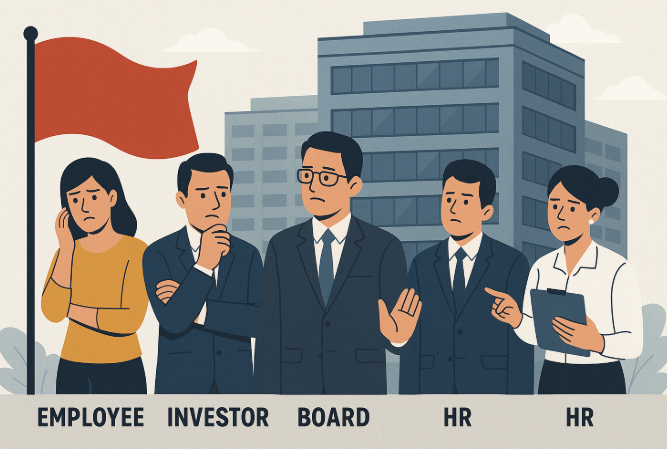
    The answer often lies in poor corporate governance—and the red flags were there all along.


    Why Corporate Governance Matters

    Corporate governance is the system of rules, practices, and processes by which a company is directed and controlled. Good governance ensures transparency, fairness, and accountability to shareholders, employees, and the public.

    But when governance breaks down, the consequences can be massive:
    📉 Shareholder value destruction
    ⚖️ Legal penalties for directors
    📰 Reputation loss
    💼 Mass layoffs


    Top 10 Red Flags in Corporate Governance

    Here are some early warning signs that should not be ignored:

    1. 🚪Frequent Resignation of Independent Directors

    When Independent Directors step down without detailed reasons, it could indicate internal pressure or ethical concerns.

    2. 🧑‍🤝‍🧑 Boardroom Dominated by Promoters or Family Members

    Lack of independence in the board leads to biased decisions and suppression of dissent.

    3. ❌ No Separation of CEO and Chairperson Roles

    This consolidation reduces checks and balances and increases the risk of authoritarian leadership.

    4. 📉 Poor Financial Disclosures or Frequent Restatements

    Opaque accounting or revised earnings often hint at manipulation or cover-ups.

    5. 💼 Lack of Board Diversity

    Diversity in gender, experience, and backgrounds enhances scrutiny and reduces groupthink.

    6. 🤐 No Whistleblower Mechanism or Ignored Complaints

    If employees fear retaliation for raising issues, serious misconduct can go unchecked.

    This can be a pathway for siphoning funds or unethical favoritism.

    Shows weak oversight and prioritizing executives over stakeholders.

    9. 🕳️ Internal Audit Function Missing or Weak

    No independent monitoring increases the risk of fraud going unnoticed.

    10. 📵 Silence During Crises

    If the board doesn’t address crises transparently, it shows disregard for accountability.


    🚩 Additional Red Flags in Corporate Governance (Employee & Cultural Focus)

    • Yes-man culture that suppresses dissent
    • Ignoring employee concerns or feedback
    • No safe, trusted whistleblower mechanism
    • Culture of fear or retaliation for speaking up
    • Unethical behavior tolerated or rewarded
    • Silent or opaque layoffs (especially of dissenters)
    • Exit interviews ignored or never conducted
    • Promotions based on loyalty, not merit
    • Leadership disconnected from ground reality
    • Scripted or forced positivity in internal communication
    • HR used to silence or isolate vocal employees
    • Lack of transparency in performance reviews or exits

    🚩Additional Red Flags in Corporate Governance (Investor Perspective Only)

    • Promoters or insiders selling shares ahead of negative news
    • Frequent changes in auditors or legal counsel
    • Lack of board disclosures or detailed minutes
    • No clear succession planning for top leadership
    • Excessive promoter share pledging
    • Repeated financial restatements without clarity
    • Overly optimistic projections unsupported by fundamentals
    • Undisclosed or quietly settled litigations
    • Lack of clear strategy in major mergers or acquisitions
    • Poor or evasive investor communication
    • Minimal or scripted engagement during AGMs or earnings calls
    • Strategic dependence on one customer, geography, or contract
    • Weak cash flow despite reported profits (earnings quality mismatch)
    • Poor quality or credibility of internal or statutory audit firms
    • Stock price driven by media hype, not business performance
    • No ESG (Environmental, Social, Governance) disclosures despite investor demand

    What Should Stakeholders Do?

    🔍 Monitor corporate announcements regularly
    🧾 Read independent auditor reports
    👥 Check board composition and changes
    📣 Support whistleblowers
    📈 Ask questions during AGMs


    🛠️ How to Act on Red Flags in Corporate Governance

    ✅ A Unified Stakeholder Action Framework


    1. Independent Directors

    • Ask tough questions; ensure discussions are recorded in minutes
    • Escalate unresolved issues to the Audit or Risk Committee
    • Demand third-party investigations when serious allegations arise
    • Refuse to be a rubber stamp—resign if governance is compromised
    • Push for board diversity, fair disclosures, and whistleblower protections

    2. Board of Directors

    • Review board composition for independence and diversity
    • Commission special audits if repeated red flags emerge
    • Oversee whistleblower cases and act without bias
    • Ensure transparency in financial reporting, pay, and related-party transactions
    • Conduct annual board evaluations and act on feedback

    3. Senior Management (CXOs, VPs)

    • Ensure functional independence of HR, Audit, and Risk teams
    • Report major issues or unethical practices to the board
    • Avoid punishing employees who raise concerns
    • Establish a culture of openness—no retaliation or favoritism
    • Address internal product or compliance issues proactively

    4. HR Department

    • Enable safe, anonymous, and well-communicated whistleblower channels
    • Monitor patterns in attrition, layoffs, and performance exits
    • Conduct confidential exit interviews and flag recurring red flags
    • Prevent use of HR for silencing dissent or unethical layoffs
    • Promote ethics training and cultural audits
    • Escalate serious complaints when management ignores them

    5. Employees

    • Document issues with time-stamped evidence
    • Use formal internal channels to raise complaints
    • Speak to HR or Ethics Committees where safe
    • If ignored, escalate through legal/regulatory mechanisms
    • Support whistleblowers; avoid silence out of fear

    6. Investors & Shareholders

    • Read disclosures, auditor reports, and resignation letters critically
    • Attend AGMs/EGMs and ask accountability questions
    • Engage IR to seek clarification on board changes or red flags
    • Vote against resolutions that show governance compromise
    • Divest or reduce exposure if governance lapses remain unaddressed

    7. Regulators & Authorities

    • Investigate whistleblower complaints without bias
    • Monitor resignation patterns, audit failures, and financial restatements
    • Mandate disclosures of internal investigations and resolutions
    • Penalize directors and officers for negligence or misconduct
    • Promote board accountability through listing regulations

    🧩 Summary:

    Red flags aren’t just signals—they are warnings.
    Every stakeholder has a duty to act—not with silence or delay, but with integrity, urgency, and transparency.


    Real-World Cases to Learn From

    • Wirecard: Ignored warnings from auditors; whistleblower was sidelined. Result: $2 billion missing.
    • IL&FS (India): Massive debt mismanagement; weak board oversight; conflict of interest.
    • Theranos: Powerful board, but little technical knowledge—blind trust in founder’s claims.

    Here’s a detailed contrast between two real-world case studies—one where red flags were ignored, resulting in massive failure, and another where red flags were addressed in time, saving the company.


    📉 Case Study 1: Wirecard – Red Flags Ignored, Disaster Unfolded

    🏢 Company: Wirecard AG (Germany)

    💥 Outcome: €1.9 billion missing, insolvency, executives arrested


    🚨 What Were the Red Flags?

    1. Frequent auditor changes and delays in audit reports
    2. Independent journalists (like the Financial Times) and whistleblowers raised concerns as early as 2015
    3. High-margin operations reported from opaque overseas subsidiaries
    4. Aggressive attacks by management against critics rather than engaging in transparent clarification
    5. Resignations from internal staff uncomfortable with financial practices

    😓 What Went Wrong?

    Despite these clear red flags, major stakeholders—regulators, auditors (EY), investors, and board members—chose to look the other way. German regulators even investigated journalists instead of the company.

    The house of cards collapsed in 2020 when auditors revealed that €1.9 billion in cash didn’t exist. CEO Markus Braun was arrested, and the company filed for insolvency.


    🧨 Damage:

    • €20 billion in market value destroyed
    • Complete loss of investor trust
    • Reputation damage to German regulatory systems
    • Thousands of employees jobless
    • Criminal proceedings for top executives

    Case Study 2: Infosys – Red Flags Acknowledged, Crisis Averted

    🏢 Company: Infosys (India)

    💡 Outcome: Restored investor trust, prevented reputational loss


    ⚠️ What Were the Red Flags?

    1. Whistleblower allegations in 2019 against top leadership, accusing them of:
      • Pressuring teams to inflate revenue
      • Bypassing board and audit committee on large deals
    2. Anonymous complaints surfaced about ethical lapses

    🛡️ What Did the Company Do Right?

    • Immediately informed SEBI (the Indian market regulator) about the complaints
    • Set up an independent investigation led by external legal counsel and forensic auditors
    • Gave regular updates to the public and investors on the probe
    • Independent Directors took charge of overseeing the process without CEO interference
    • Eventually, the investigation found no wrongdoing, and the transparency helped restore credibility

    💪 Result:

    • Investor confidence recovered
    • Stock price stabilized
    • Infosys was seen as a governance-positive company
    • A message was sent internally: ethical conduct matters at the highest level

    🧭 Key Lesson:

    • Wirecard shows what happens when red flags are ignored: hype kills logic, and silence costs billions.
    • Infosys proves that timely, transparent governance isn’t just a legal shield—it’s a long-term business asset.

    Final Thoughts: Prevention Is Cheaper Than Cure

    Corporate governance red flags are often visible before the damage is done. Stakeholders—including investors, regulators, and even employees—must stay alert. The cost of ignoring them? Your savings, your job, your reputation.


    💔 Call to Action: Fix the Red Flags—Before Everything Turns to Zero

    A broken governance system doesn’t just damage a company—
    It destroys lives.

    Red flags are not minor glitches.
    They are early screams in a silent boardroom.
    They are ignored warnings before a storm that wipes everything out.

    When no one listens:

    • Investors lose everything—years of savings, wiped clean overnight.
    • Employees are laid off by the hundreds—careers shattered, families pushed into financial ruin.
    • Markets tremble, and entire sectors suffer.
    • Credibility collapses, and trust takes decades to rebuild.
    • Sometimes, it doesn’t recover at all.

    A single fraud can spark a recession.
    A single cover-up can erase billions.
    One more silence can bring everything to zero.

    Don’t wait for the headlines.
    Don’t wait for the collapse.

    You are not too small to matter.
    If you’re on the board, in the office, in the system—
    You are responsible.

    🔊 Speak up. Step in. Call it out. Correct it.
    Before the red flags become regrets.
    Before everything—and everyone—breaks.

    Read blogs on Corporate Governance here.

    🔗 External Resource

    SEBI’s Corporate Governance Guidelines (India)

  • Oppression and Mismanagement in a Company: 2 Case Studies

    Oppression and Mismanagement in a Company: 2 Case Studies

    Table of Contents


    🧠 Understanding Oppression and Mismanagement in a Company:

    A Simple Story

    Imagine a small company called Sunlight Pvt. Ltd.

    It was started by four friends: Ravi, Meena, Arjun, and Pooja. Over time, the business grew, and many others joined as small investors. But Ravi and Meena held most of the shares, so they had more power in decisions.

    Now here’s what happened:

    🧱 Oppression: When Power Is Misused

    Ravi and Meena started holding board meetings without informing Arjun and Pooja.

    They:

    • Passed decisions without any discussion.
    • Removed Arjun from his role without proper reason.
    • Never shared the financial reports.
    • Used company funds to benefit their own private businesses.

    This is oppression.
    They used their majority power to silence and sideline others. Arjun and Pooja had shares, but no voice. Their rights were being crushed.


    🧯 Mismanagement: When the Company Is Handled Irresponsibly

    On top of that, Ravi and Meena:

    • Took huge loans without a clear plan.
    • Didn’t pay taxes on time.
    • Hired unqualified relatives for key positions.
    • Made bad investments using company money.

    Soon, salaries were delayed, the business started losing clients, and the company’s future was in danger.

    This is mismanagement.
    It’s not just about being unfair—it’s about running the company in a careless and harmful way.


    ⚖️ What Can Be Done?

    In real life, people like Arjun and Pooja can file a case under the Companies Act, 2013—especially Sections 241 and 242—to report oppression and mismanagement to a special court called the NCLT (National Company Law Tribunal).

    The tribunal can:

    • Stop the bad behavior,
    • Remove directors,
    • Order the company to pay back losses,
    • Or even restructure the board.

    Why It Matters

    Oppression and mismanagement harm not just individual shareholders but also:

    • Employees, who lose jobs,
    • Customers, who lose trust,
    • And the economy, which suffers from failed businesses.

    That’s why laws exist—to ensure companies are run fairly, transparently, and responsibly.


    Corporate governance is not just about profits and boardrooms—it is about accountability, fairness, and justice. The Companies Act, 2013 introduced several reforms in India’s corporate law regime, aiming to enhance transparency and protect minority shareholders. Among its key provisions are mechanisms to address oppression and mismanagement within companies.

    But while the law provides remedies on paper, the real question is: Does it truly protect the vulnerable, or just offer procedural solace?


    What Is ‘Oppression and Mismanagement’ – Companies Act 2013

    The terms aren’t explicitly defined in the Act, but judicial interpretations have established some clarity.

    • Oppression refers to conduct that is burdensome, harsh, and wrongful, particularly toward minority shareholders. It often involves the abuse of majority power, exclusion from decision-making, or siphoning of funds.
    • Mismanagement covers acts of gross negligence, fraud, or breach of fiduciary duty that threaten the company’s interest or its stakeholders.

    These are addressed under Sections 241 to 246 of the Companies Act, 2013.


    Section 241: Application to Tribunal for Relief

    A member (usually a minority shareholder) can approach the National Company Law Tribunal (NCLT) if:

    • The company’s affairs are being conducted in a manner prejudicial to public interest, the company’s interest, or oppressive to any member.
    • There’s a material change in management or control, not in the shareholders’ or public interest.

    This is a powerful provision in theory. It allows aggrieved parties to seek remedial action before damage becomes irreversible.


    Section 242: Powers of the Tribunal

    If the NCLT is satisfied that oppression or mismanagement has occurred, it can order:

    • Regulation of company affairs.
    • Purchase of shares by other members.
    • Removal of directors.
    • Recovery of undue gains.
    • Winding up, if absolutely necessary (though this is seen as a last resort).

    These powers aim to restore equity and prevent further abuse of corporate machinery.


    📘 Who Can File a Case for Oppression & Mismanagement?

    Under Section 241 of the Companies Act, 2013, only members (shareholders) of a company can approach the National Company Law Tribunal (NCLT) to seek relief for oppression and mismanagement.

    📌 For companies with share capital:

    • At least 100 members, or
    • Members holding at least 10% of the issued share capital, or
    • With NCLT’s permission, even fewer may apply (discretionary waiver under Section 244).

    📌 For companies without share capital:

    • At least 1/5th of total members.

    🧑‍💻 What about the Employees?

    Employees qualify as members if they own shares in the company.

    ⚖️ When Can Employees Be Involved in NCLT Proceedings?

    • If they hold shares (e.g., as part of ESOPs), they may qualify as minority shareholders and can apply.
    • They may also be called as witnesses, or provide evidence in cases initiated by others (e.g., shareholders or regulators).
    • If the MCA itself files a petition under Section 241(2) (for matters prejudicial to public interest), employees may be part of the investigation.

    If they do not own shares in the company, they can act indirectly in the following ways:


    ScenarioLegal Route
    Retaliation for whistleblowing➤ File complaint under Whistleblower Policy (mandatory in listed companies)
    ➤ Raise issue with SEBI (in case of listed companies)
    Harassment or wrongful termination➤ Approach Labour Court or Industrial Tribunal
    Financial fraud witnessed➤ File complaint with SFIO (Serious Fraud Investigation Office) or SEBI
    Misuse of power, ESG, or public interest violation➤ Inform Registrar of Companies (ROC) or Ministry of Corporate Affairs (MCA)
    Criminal acts (bribery, forgery)➤ File complaint with Police or Economic Offences Wing (EOW)

    🔔 Final Thought:

    While NCLT is not the direct route for most employees, their voices and evidence often form the foundation of larger cases on oppression, mismanagement, or fraud. And in some landmark cases (like Sahara or IL&FS), employee whistleblowers played a crucial role in triggering regulatory action.


    Case Study 1: The Sahara Case

    A Landmark in Corporate Mismanagement and Regulatory Evasion

    The Sahara India Real Estate Corporation Ltd. (SIRECL) and Sahara Housing Investment Corporation Ltd. (SHICL) case is one of the biggest corporate mismanagement and regulatory defiance cases in Indian history. It showcases how misuse of corporate structures, lack of transparency, and deliberate evasion of securities laws led to massive regulatory action by SEBI (Securities and Exchange Board of India) and the Supreme Court.


    📌 Background:

    • Between 2008 and 2011, Sahara companies collected around ₹24,000 crore (approx. $3.5 billion) from nearly 30 million investors through an instrument called OFDs (Optionally Fully Convertible Debentures).
    • They claimed these were private placements, and therefore not subject to SEBI’s regulatory oversight.

    However, SEBI challenged this, arguing that:

    “When the number of investors exceeds 50, it constitutes a public issue, and hence it must comply with SEBI regulations.”


    2010 – SEBI Begins Investigation

    • SEBI received complaints and asked Sahara to submit details.
    • Sahara refused, claiming jurisdiction issues.

    2011 – SEBI Orders Refund

    • SEBI ruled that the debenture issues were illegal public offerings.
    • Sahara was ordered to refund the money with 15% interest.

    2012 – Supreme Court Judgment

    • The Supreme Court upheld SEBI’s order, stating: “Sahara had violated regulatory norms and failed to protect investor interests.”
    • Ordered Sahara to deposit the full amount (₹24,000 crore) with SEBI for refunding investors.

    2014 – Arrest of Subrata Roy

    • Sahara’s chief, Subrata Roy, was arrested for non-compliance with court orders.
    • He was held in Tihar Jail for over 2 years, and released on interim bail after partial payment.

    Key Issues of Mismanagement and Oppression:

    ViolationDetails
    Misuse of Private Placement RouteCollected money from millions, bypassing SEBI norms.
    Lack of Transparency & DocumentationCould not furnish authentic records of investors.
    Failure to Refund InvestorsContinued defiance of regulatory and court orders.
    Oppression of Investor RightsInvestors were kept in the dark, no clarity on where funds were deployed.

    📚 Relevance to Companies Act, 2013

    Although most of the Sahara controversy began before the 2013 Act, it influenced the drafting of stricter corporate governance provisions, such as:

    • Section 42: Clear guidelines for private placements and limits on number of subscribers.
    • Section 245: Class action suits – allowing investors to take collective legal action.
    • Stronger SEBI powers: The SEBI Act was amended in parallel to ensure stricter enforcement.

    🔍 What the Sahara Case Teaches Us:

    LessonImplication
    No one is above regulationEven large conglomerates must comply with SEBI and company law.
    Private placements are not a loopholeAny mass fundraising, even via debentures, is subject to public issue norms.
    Accountability is keyCompanies must maintain transparent records and be ready for audits/reviews.
    Courts will act if regulators failThe Supreme Court played a strong role in enforcing justice when SEBI was challenged.

    🧾 Current Status (as of 2024):

    • Sahara has not yet fully refunded the investors.
    • SEBI has managed to refund only a small portion due to lack of claimant verification.
    • Over ₹24,000 crore remains in the SEBI-Sahara refund account, but investor identification is challenging.

    Conclusion:

    The Sahara case stands as a cautionary tale in Indian corporate history. It revealed how corporate mismanagement, when combined with regulatory evasion, can lead to systemic risk and investor loss. The case also reinforced the power of SEBI and the judiciary in upholding the spirit of corporate governance.

    If corporate laws like the Companies Act, 2013 are not enforced with vigilance, and if regulators are not empowered, corporate oppression will always find a way to masquerade as innovation.


    Case Study 2: Tata Sons Ltd. vs. Cyrus Mistry


    Background:

    • Cyrus Mistry, the sixth chairman of Tata Sons, was abruptly removed in October 2016.
    • He alleged that the removal was oppressive and in violation of corporate governance norms.
    • Mistry’s family firm, Cyrus Investments Pvt. Ltd., a minority shareholder, filed a petition under Section 241 and 242 of the Companies Act, 2013.

    Allegations:

    • Oppressive conduct by the majority (Tata Trusts and Ratan Tata).
    • Mismanagement of Tata Group affairs.
    • Breakdown of governance and boardroom ethics.

    • NCLT (2017): Dismissed Mistry’s petition, ruling that the removal was within the board’s powers.
    • NCLAT (2019): Reversed NCLT’s ruling, reinstated Cyrus Mistry as Executive Chairman, and declared his removal illegal.
    • Supreme Court (2021): Overturned the NCLAT verdict, stating: “There was no case of oppression or mismanagement. The Board had every right to remove a director.”

    Key Takeaways:

    • The case clarified that mere removal from office does not automatically amount to oppression.
    • It reinforced the principle that business decisions made by the board (with majority support) are generally not justiciable unless they breach legal or fiduciary duties.

    Minority Protection vs. Procedural Hurdles

    While the Companies Act, 2013 appears protective, there are practical challenges that often dilute its impact:

    1. Threshold Requirements
      Under Section 244, a minority shareholder must hold 10% of shares or 1/10th of total members to file a petition. This can be restrictive in companies where shareholding is fragmented or tightly held by promoters.
    2. Legal and Financial Barriers
      NCLT proceedings involve legal fees, procedural delays, and often require extensive documentation. Small shareholders may find it difficult to sustain a legal battle—especially when facing a well-resourced majority.
    3. Delays and Inefficiencies
      Despite the intent of speedy justice, NCLT is overburdened. Cases involving oppression and mismanagement often drag on, making “timely relief” more theoretical than real.

    A Critical View: Is It Enough?

    The law provides a framework, but the culture of corporate governance often limits its effectiveness.

    • In many companies, board decisions are rubber-stamped by a majority bloc, with no genuine internal checks.
    • Whistleblowers face retaliation, and internal grievance redressal mechanisms are often cosmetic.
    • Shareholder democracy is weak when promoters or institutional investors dominate votes.

    Until there’s a shift in corporate ethics and accountability, legal remedies will remain reactive rather than preventive.


    Conclusion: Reform Is Ongoing, but Responsibility Is Immediate

    The Companies Act, 2013 was a leap forward from the outdated 1956 Act. But the challenges of oppression and mismanagement are as much about power dynamics and corporate culture as they are about law.

    If India’s corporate sector is to build trust and resilience, then:

    • Legal provisions must be made more accessible to minorities.
    • Regulators and tribunals must ensure faster enforcement.
    • Companies themselves must commit to ethical self-regulation, not just legal compliance.

    Laws can punish, but only governance can prevent.


    Call to Action:

    Don’t stay silent if you see signs of corporate misuse.
    Whether you’re an investor, employee, or stakeholder—know your rights under the Companies Act, 2013.

    🛡️ Speak up. Document it. Seek legal remedy.
    ⚖️ Empower yourself with knowledge. Share this article to raise awareness.
    📩 Have a story or concern? Consult a professional or reach out to the NCLT for guidance.

    Because in corporate governance, silence enables abuse—and awareness fuels accountability.

    Check more blogs on Corporate Governance here.

    Here’s one reliable external link to the official bare act text of the relevant provisions under the Companies Act, 2013 (hosted on the Ministry of Corporate Affairs website or trusted legal portal):

    🔗 Section 241 – Application to Tribunal for Relief in Cases of Oppression (See page 118 onward)


    📚 Frequently Asked Questions (FAQ)


    1. What is “oppression and mismanagement” in a company?

    Answer:
    Oppression refers to unfair treatment of shareholders (especially minority ones), such as being excluded from key decisions, manipulated out of control, or denied rightful benefits.
    Mismanagement refers to reckless, dishonest, or grossly negligent behavior by management that harms the company or its stakeholders.


    2. Who can file a case for oppression and mismanagement under the Companies Act, 2013?

    Answer:
    Only members (shareholders) of the company can file a petition under Section 241 of the Companies Act, 2013. The eligibility typically includes:

    • 100 members or more, or
    • Members holding at least 10% of share capital, or
    • With special permission (waiver) from NCLT.

    3. Can an employee file a complaint under oppression and mismanagement?

    Answer:
    Not directly. An employee cannot file under Section 241 unless they own shares in the company (e.g., through ESOPs).
    However, employees can act indirectly:

    • Report wrongdoing via Whistleblower Policy (mandatory in listed firms)
    • Approach Labour Courts, ROC, SEBI, MCA, or EOW for specific legal violations
    • Provide evidence or testimony in cases initiated by shareholders or regulators

    4. What is the role of the National Company Law Tribunal (NCLT)?

    Answer:
    NCLT is a quasi-judicial body that handles corporate disputes, including:

    • Oppression and mismanagement (Sections 241–246)
    • Shareholder rights and removal of directors
    • Mergers, restructuring, insolvency, and more
      It has powers to remove directors, freeze assets, cancel decisions, or even take over management.

    5. Is there any protection for whistleblowers?

    Answer:
    Yes. Under various laws and SEBI regulations:

    • Listed companies must have a whistleblower policy
    • Employees can anonymously report misconduct
    • Protection from retaliation is a legal requirement—but often poorly enforced, so legal counsel is advised

    6. Can the government take action if a company is acting against public interest?

    Answer:
    Yes. Section 241(2) empowers the Central Government to refer a case to NCLT if a company’s affairs are being conducted in a manner prejudicial to public interest.


    7. What real cases show how this law works?

    Answer:

    • Tata vs. Cyrus Mistry: Alleged boardroom oppression after sudden removal of the chairman
    • Sahara Case: Mismanagement and misleading of investors leading to regulatory action by SEBI and court orders
      These cases show how large firms, too, can be held accountable under law.

    8. How can minority shareholders protect their rights?

    Answer:

    • Stay informed through AGMs and company disclosures
    • Form alliances with other shareholders to meet filing thresholds
    • Maintain written records of questionable practices
    • Consult legal experts for NCLT action under Section 241

  • Oppression and Mismanagement in a Company: 2 Case Studies

    Oppression and Mismanagement in a Company: 2 Case Studies

    Table of Contents


    🧠 Understanding Oppression and Mismanagement in a Company:

    A Simple Story

    Imagine a small company called Sunlight Pvt. Ltd.

    It was started by four friends: Ravi, Meena, Arjun, and Pooja. Over time, the business grew, and many others joined as small investors. But Ravi and Meena held most of the shares, so they had more power in decisions.

    Now here’s what happened:

    🧱 Oppression: When Power Is Misused

    Ravi and Meena started holding board meetings without informing Arjun and Pooja.

    They:

    • Passed decisions without any discussion.
    • Removed Arjun from his role without proper reason.
    • Never shared the financial reports.
    • Used company funds to benefit their own private businesses.

    This is oppression.
    They used their majority power to silence and sideline others. Arjun and Pooja had shares, but no voice. Their rights were being crushed.


    🧯 Mismanagement: When the Company Is Handled Irresponsibly

    On top of that, Ravi and Meena:

    • Took huge loans without a clear plan.
    • Didn’t pay taxes on time.
    • Hired unqualified relatives for key positions.
    • Made bad investments using company money.

    Soon, salaries were delayed, the business started losing clients, and the company’s future was in danger.

    This is mismanagement.
    It’s not just about being unfair—it’s about running the company in a careless and harmful way.


    ⚖️ What Can Be Done?

    In real life, people like Arjun and Pooja can file a case under the Companies Act, 2013—especially Sections 241 and 242—to report oppression and mismanagement to a special court called the NCLT (National Company Law Tribunal).

    The tribunal can:

    • Stop the bad behavior,
    • Remove directors,
    • Order the company to pay back losses,
    • Or even restructure the board.

    Why It Matters

    Oppression and mismanagement harm not just individual shareholders but also:

    • Employees, who lose jobs,
    • Customers, who lose trust,
    • And the economy, which suffers from failed businesses.

    That’s why laws exist—to ensure companies are run fairly, transparently, and responsibly.


    Corporate governance is not just about profits and boardrooms—it is about accountability, fairness, and justice. The Companies Act, 2013 introduced several reforms in India’s corporate law regime, aiming to enhance transparency and protect minority shareholders. Among its key provisions are mechanisms to address oppression and mismanagement within companies.

    But while the law provides remedies on paper, the real question is: Does it truly protect the vulnerable, or just offer procedural solace?


    What Is ‘Oppression and Mismanagement’ – Companies Act 2013

    The terms aren’t explicitly defined in the Act, but judicial interpretations have established some clarity.

    • Oppression refers to conduct that is burdensome, harsh, and wrongful, particularly toward minority shareholders. It often involves the abuse of majority power, exclusion from decision-making, or siphoning of funds.
    • Mismanagement covers acts of gross negligence, fraud, or breach of fiduciary duty that threaten the company’s interest or its stakeholders.

    These are addressed under Sections 241 to 246 of the Companies Act, 2013.


    Section 241: Application to Tribunal for Relief

    A member (usually a minority shareholder) can approach the National Company Law Tribunal (NCLT) if:

    • The company’s affairs are being conducted in a manner prejudicial to public interest, the company’s interest, or oppressive to any member.
    • There’s a material change in management or control, not in the shareholders’ or public interest.

    This is a powerful provision in theory. It allows aggrieved parties to seek remedial action before damage becomes irreversible.


    Section 242: Powers of the Tribunal

    If the NCLT is satisfied that oppression or mismanagement has occurred, it can order:

    • Regulation of company affairs.
    • Purchase of shares by other members.
    • Removal of directors.
    • Recovery of undue gains.
    • Winding up, if absolutely necessary (though this is seen as a last resort).

    These powers aim to restore equity and prevent further abuse of corporate machinery.


    📘 Who Can File a Case for Oppression & Mismanagement?

    Under Section 241 of the Companies Act, 2013, only members (shareholders) of a company can approach the National Company Law Tribunal (NCLT) to seek relief for oppression and mismanagement.

    📌 For companies with share capital:

    • At least 100 members, or
    • Members holding at least 10% of the issued share capital, or
    • With NCLT’s permission, even fewer may apply (discretionary waiver under Section 244).

    📌 For companies without share capital:

    • At least 1/5th of total members.

    🧑‍💻 What about the Employees?

    Employees qualify as members if they own shares in the company.

    ⚖️ When Can Employees Be Involved in NCLT Proceedings?

    • If they hold shares (e.g., as part of ESOPs), they may qualify as minority shareholders and can apply.
    • They may also be called as witnesses, or provide evidence in cases initiated by others (e.g., shareholders or regulators).
    • If the MCA itself files a petition under Section 241(2) (for matters prejudicial to public interest), employees may be part of the investigation.

    If they do not own shares in the company, they can act indirectly in the following ways:


    ScenarioLegal Route
    Retaliation for whistleblowing➤ File complaint under Whistleblower Policy (mandatory in listed companies)
    ➤ Raise issue with SEBI (in case of listed companies)
    Harassment or wrongful termination➤ Approach Labour Court or Industrial Tribunal
    Financial fraud witnessed➤ File complaint with SFIO (Serious Fraud Investigation Office) or SEBI
    Misuse of power, ESG, or public interest violation➤ Inform Registrar of Companies (ROC) or Ministry of Corporate Affairs (MCA)
    Criminal acts (bribery, forgery)➤ File complaint with Police or Economic Offences Wing (EOW)

    🔔 Final Thought:

    While NCLT is not the direct route for most employees, their voices and evidence often form the foundation of larger cases on oppression, mismanagement, or fraud. And in some landmark cases (like Sahara or IL&FS), employee whistleblowers played a crucial role in triggering regulatory action.


    Case Study 1: The Sahara Case

    A Landmark in Corporate Mismanagement and Regulatory Evasion

    The Sahara India Real Estate Corporation Ltd. (SIRECL) and Sahara Housing Investment Corporation Ltd. (SHICL) case is one of the biggest corporate mismanagement and regulatory defiance cases in Indian history. It showcases how misuse of corporate structures, lack of transparency, and deliberate evasion of securities laws led to massive regulatory action by SEBI (Securities and Exchange Board of India) and the Supreme Court.


    📌 Background:

    • Between 2008 and 2011, Sahara companies collected around ₹24,000 crore (approx. $3.5 billion) from nearly 30 million investors through an instrument called OFDs (Optionally Fully Convertible Debentures).
    • They claimed these were private placements, and therefore not subject to SEBI’s regulatory oversight.

    However, SEBI challenged this, arguing that:

    “When the number of investors exceeds 50, it constitutes a public issue, and hence it must comply with SEBI regulations.”


    2010 – SEBI Begins Investigation

    • SEBI received complaints and asked Sahara to submit details.
    • Sahara refused, claiming jurisdiction issues.

    2011 – SEBI Orders Refund

    • SEBI ruled that the debenture issues were illegal public offerings.
    • Sahara was ordered to refund the money with 15% interest.

    2012 – Supreme Court Judgment

    • The Supreme Court upheld SEBI’s order, stating: “Sahara had violated regulatory norms and failed to protect investor interests.”
    • Ordered Sahara to deposit the full amount (₹24,000 crore) with SEBI for refunding investors.

    2014 – Arrest of Subrata Roy

    • Sahara’s chief, Subrata Roy, was arrested for non-compliance with court orders.
    • He was held in Tihar Jail for over 2 years, and released on interim bail after partial payment.

    Key Issues of Mismanagement and Oppression:

    ViolationDetails
    Misuse of Private Placement RouteCollected money from millions, bypassing SEBI norms.
    Lack of Transparency & DocumentationCould not furnish authentic records of investors.
    Failure to Refund InvestorsContinued defiance of regulatory and court orders.
    Oppression of Investor RightsInvestors were kept in the dark, no clarity on where funds were deployed.

    📚 Relevance to Companies Act, 2013

    Although most of the Sahara controversy began before the 2013 Act, it influenced the drafting of stricter corporate governance provisions, such as:

    • Section 42: Clear guidelines for private placements and limits on number of subscribers.
    • Section 245: Class action suits – allowing investors to take collective legal action.
    • Stronger SEBI powers: The SEBI Act was amended in parallel to ensure stricter enforcement.

    🔍 What the Sahara Case Teaches Us:

    LessonImplication
    No one is above regulationEven large conglomerates must comply with SEBI and company law.
    Private placements are not a loopholeAny mass fundraising, even via debentures, is subject to public issue norms.
    Accountability is keyCompanies must maintain transparent records and be ready for audits/reviews.
    Courts will act if regulators failThe Supreme Court played a strong role in enforcing justice when SEBI was challenged.

    🧾 Current Status (as of 2024):

    • Sahara has not yet fully refunded the investors.
    • SEBI has managed to refund only a small portion due to lack of claimant verification.
    • Over ₹24,000 crore remains in the SEBI-Sahara refund account, but investor identification is challenging.

    Conclusion:

    The Sahara case stands as a cautionary tale in Indian corporate history. It revealed how corporate mismanagement, when combined with regulatory evasion, can lead to systemic risk and investor loss. The case also reinforced the power of SEBI and the judiciary in upholding the spirit of corporate governance.

    If corporate laws like the Companies Act, 2013 are not enforced with vigilance, and if regulators are not empowered, corporate oppression will always find a way to masquerade as innovation.


    Case Study 2: Tata Sons Ltd. vs. Cyrus Mistry


    Background:

    • Cyrus Mistry, the sixth chairman of Tata Sons, was abruptly removed in October 2016.
    • He alleged that the removal was oppressive and in violation of corporate governance norms.
    • Mistry’s family firm, Cyrus Investments Pvt. Ltd., a minority shareholder, filed a petition under Section 241 and 242 of the Companies Act, 2013.

    Allegations:

    • Oppressive conduct by the majority (Tata Trusts and Ratan Tata).
    • Mismanagement of Tata Group affairs.
    • Breakdown of governance and boardroom ethics.

    • NCLT (2017): Dismissed Mistry’s petition, ruling that the removal was within the board’s powers.
    • NCLAT (2019): Reversed NCLT’s ruling, reinstated Cyrus Mistry as Executive Chairman, and declared his removal illegal.
    • Supreme Court (2021): Overturned the NCLAT verdict, stating: “There was no case of oppression or mismanagement. The Board had every right to remove a director.”

    Key Takeaways:

    • The case clarified that mere removal from office does not automatically amount to oppression.
    • It reinforced the principle that business decisions made by the board (with majority support) are generally not justiciable unless they breach legal or fiduciary duties.

    Minority Protection vs. Procedural Hurdles

    While the Companies Act, 2013 appears protective, there are practical challenges that often dilute its impact:

    1. Threshold Requirements
      Under Section 244, a minority shareholder must hold 10% of shares or 1/10th of total members to file a petition. This can be restrictive in companies where shareholding is fragmented or tightly held by promoters.
    2. Legal and Financial Barriers
      NCLT proceedings involve legal fees, procedural delays, and often require extensive documentation. Small shareholders may find it difficult to sustain a legal battle—especially when facing a well-resourced majority.
    3. Delays and Inefficiencies
      Despite the intent of speedy justice, NCLT is overburdened. Cases involving oppression and mismanagement often drag on, making “timely relief” more theoretical than real.

    A Critical View: Is It Enough?

    The law provides a framework, but the culture of corporate governance often limits its effectiveness.

    • In many companies, board decisions are rubber-stamped by a majority bloc, with no genuine internal checks.
    • Whistleblowers face retaliation, and internal grievance redressal mechanisms are often cosmetic.
    • Shareholder democracy is weak when promoters or institutional investors dominate votes.

    Until there’s a shift in corporate ethics and accountability, legal remedies will remain reactive rather than preventive.


    Conclusion: Reform Is Ongoing, but Responsibility Is Immediate

    The Companies Act, 2013 was a leap forward from the outdated 1956 Act. But the challenges of oppression and mismanagement are as much about power dynamics and corporate culture as they are about law.

    If India’s corporate sector is to build trust and resilience, then:

    • Legal provisions must be made more accessible to minorities.
    • Regulators and tribunals must ensure faster enforcement.
    • Companies themselves must commit to ethical self-regulation, not just legal compliance.

    Laws can punish, but only governance can prevent.


    Call to Action:

    Don’t stay silent if you see signs of corporate misuse.
    Whether you’re an investor, employee, or stakeholder—know your rights under the Companies Act, 2013.

    🛡️ Speak up. Document it. Seek legal remedy.
    ⚖️ Empower yourself with knowledge. Share this article to raise awareness.
    📩 Have a story or concern? Consult a professional or reach out to the NCLT for guidance.

    Because in corporate governance, silence enables abuse—and awareness fuels accountability.

    Check more blogs on Corporate Governance here.

    Here’s one reliable external link to the official bare act text of the relevant provisions under the Companies Act, 2013 (hosted on the Ministry of Corporate Affairs website or trusted legal portal):

    🔗 Section 241 – Application to Tribunal for Relief in Cases of Oppression (See page 118 onward)


    📚 Frequently Asked Questions (FAQ)


    1. What is “oppression and mismanagement” in a company?

    Answer:
    Oppression refers to unfair treatment of shareholders (especially minority ones), such as being excluded from key decisions, manipulated out of control, or denied rightful benefits.
    Mismanagement refers to reckless, dishonest, or grossly negligent behavior by management that harms the company or its stakeholders.


    2. Who can file a case for oppression and mismanagement under the Companies Act, 2013?

    Answer:
    Only members (shareholders) of the company can file a petition under Section 241 of the Companies Act, 2013. The eligibility typically includes:

    • 100 members or more, or
    • Members holding at least 10% of share capital, or
    • With special permission (waiver) from NCLT.

    3. Can an employee file a complaint under oppression and mismanagement?

    Answer:
    Not directly. An employee cannot file under Section 241 unless they own shares in the company (e.g., through ESOPs).
    However, employees can act indirectly:

    • Report wrongdoing via Whistleblower Policy (mandatory in listed firms)
    • Approach Labour Courts, ROC, SEBI, MCA, or EOW for specific legal violations
    • Provide evidence or testimony in cases initiated by shareholders or regulators

    4. What is the role of the National Company Law Tribunal (NCLT)?

    Answer:
    NCLT is a quasi-judicial body that handles corporate disputes, including:

    • Oppression and mismanagement (Sections 241–246)
    • Shareholder rights and removal of directors
    • Mergers, restructuring, insolvency, and more
      It has powers to remove directors, freeze assets, cancel decisions, or even take over management.

    5. Is there any protection for whistleblowers?

    Answer:
    Yes. Under various laws and SEBI regulations:

    • Listed companies must have a whistleblower policy
    • Employees can anonymously report misconduct
    • Protection from retaliation is a legal requirement—but often poorly enforced, so legal counsel is advised

    6. Can the government take action if a company is acting against public interest?

    Answer:
    Yes. Section 241(2) empowers the Central Government to refer a case to NCLT if a company’s affairs are being conducted in a manner prejudicial to public interest.


    7. What real cases show how this law works?

    Answer:

    • Tata vs. Cyrus Mistry: Alleged boardroom oppression after sudden removal of the chairman
    • Sahara Case: Mismanagement and misleading of investors leading to regulatory action by SEBI and court orders
      These cases show how large firms, too, can be held accountable under law.

    8. How can minority shareholders protect their rights?

    Answer:

    • Stay informed through AGMs and company disclosures
    • Form alliances with other shareholders to meet filing thresholds
    • Maintain written records of questionable practices
    • Consult legal experts for NCLT action under Section 241

  • Oppression and Mismanagement in a Company: 2 Case Studies

    Oppression and Mismanagement in a Company: 2 Case Studies

    Table of Contents


    🧠 Understanding Oppression and Mismanagement in a Company:

    A Simple Story

    Imagine a small company called Sunlight Pvt. Ltd.

    It was started by four friends: Ravi, Meena, Arjun, and Pooja. Over time, the business grew, and many others joined as small investors. But Ravi and Meena held most of the shares, so they had more power in decisions.

    Now here’s what happened:

    🧱 Oppression: When Power Is Misused

    Ravi and Meena started holding board meetings without informing Arjun and Pooja.

    They:

    • Passed decisions without any discussion.
    • Removed Arjun from his role without proper reason.
    • Never shared the financial reports.
    • Used company funds to benefit their own private businesses.

    This is oppression.
    They used their majority power to silence and sideline others. Arjun and Pooja had shares, but no voice. Their rights were being crushed.


    🧯 Mismanagement: When the Company Is Handled Irresponsibly

    On top of that, Ravi and Meena:

    • Took huge loans without a clear plan.
    • Didn’t pay taxes on time.
    • Hired unqualified relatives for key positions.
    • Made bad investments using company money.

    Soon, salaries were delayed, the business started losing clients, and the company’s future was in danger.

    This is mismanagement.
    It’s not just about being unfair—it’s about running the company in a careless and harmful way.


    ⚖️ What Can Be Done?

    In real life, people like Arjun and Pooja can file a case under the Companies Act, 2013—especially Sections 241 and 242—to report oppression and mismanagement to a special court called the NCLT (National Company Law Tribunal).

    The tribunal can:

    • Stop the bad behavior,
    • Remove directors,
    • Order the company to pay back losses,
    • Or even restructure the board.

    Why It Matters

    Oppression and mismanagement harm not just individual shareholders but also:

    • Employees, who lose jobs,
    • Customers, who lose trust,
    • And the economy, which suffers from failed businesses.

    That’s why laws exist—to ensure companies are run fairly, transparently, and responsibly.


    Corporate governance is not just about profits and boardrooms—it is about accountability, fairness, and justice. The Companies Act, 2013 introduced several reforms in India’s corporate law regime, aiming to enhance transparency and protect minority shareholders. Among its key provisions are mechanisms to address oppression and mismanagement within companies.

    But while the law provides remedies on paper, the real question is: Does it truly protect the vulnerable, or just offer procedural solace?


    What Is ‘Oppression and Mismanagement’ – Companies Act 2013

    The terms aren’t explicitly defined in the Act, but judicial interpretations have established some clarity.

    • Oppression refers to conduct that is burdensome, harsh, and wrongful, particularly toward minority shareholders. It often involves the abuse of majority power, exclusion from decision-making, or siphoning of funds.
    • Mismanagement covers acts of gross negligence, fraud, or breach of fiduciary duty that threaten the company’s interest or its stakeholders.

    These are addressed under Sections 241 to 246 of the Companies Act, 2013.


    Section 241: Application to Tribunal for Relief

    A member (usually a minority shareholder) can approach the National Company Law Tribunal (NCLT) if:

    • The company’s affairs are being conducted in a manner prejudicial to public interest, the company’s interest, or oppressive to any member.
    • There’s a material change in management or control, not in the shareholders’ or public interest.

    This is a powerful provision in theory. It allows aggrieved parties to seek remedial action before damage becomes irreversible.


    Section 242: Powers of the Tribunal

    If the NCLT is satisfied that oppression or mismanagement has occurred, it can order:

    • Regulation of company affairs.
    • Purchase of shares by other members.
    • Removal of directors.
    • Recovery of undue gains.
    • Winding up, if absolutely necessary (though this is seen as a last resort).

    These powers aim to restore equity and prevent further abuse of corporate machinery.


    📘 Who Can File a Case for Oppression & Mismanagement?

    Under Section 241 of the Companies Act, 2013, only members (shareholders) of a company can approach the National Company Law Tribunal (NCLT) to seek relief for oppression and mismanagement.

    📌 For companies with share capital:

    • At least 100 members, or
    • Members holding at least 10% of the issued share capital, or
    • With NCLT’s permission, even fewer may apply (discretionary waiver under Section 244).

    📌 For companies without share capital:

    • At least 1/5th of total members.

    🧑‍💻 What about the Employees?

    Employees qualify as members if they own shares in the company.

    ⚖️ When Can Employees Be Involved in NCLT Proceedings?

    • If they hold shares (e.g., as part of ESOPs), they may qualify as minority shareholders and can apply.
    • They may also be called as witnesses, or provide evidence in cases initiated by others (e.g., shareholders or regulators).
    • If the MCA itself files a petition under Section 241(2) (for matters prejudicial to public interest), employees may be part of the investigation.

    If they do not own shares in the company, they can act indirectly in the following ways:


    ScenarioLegal Route
    Retaliation for whistleblowing➤ File complaint under Whistleblower Policy (mandatory in listed companies)
    ➤ Raise issue with SEBI (in case of listed companies)
    Harassment or wrongful termination➤ Approach Labour Court or Industrial Tribunal
    Financial fraud witnessed➤ File complaint with SFIO (Serious Fraud Investigation Office) or SEBI
    Misuse of power, ESG, or public interest violation➤ Inform Registrar of Companies (ROC) or Ministry of Corporate Affairs (MCA)
    Criminal acts (bribery, forgery)➤ File complaint with Police or Economic Offences Wing (EOW)

    🔔 Final Thought:

    While NCLT is not the direct route for most employees, their voices and evidence often form the foundation of larger cases on oppression, mismanagement, or fraud. And in some landmark cases (like Sahara or IL&FS), employee whistleblowers played a crucial role in triggering regulatory action.


    Case Study 1: The Sahara Case

    A Landmark in Corporate Mismanagement and Regulatory Evasion

    The Sahara India Real Estate Corporation Ltd. (SIRECL) and Sahara Housing Investment Corporation Ltd. (SHICL) case is one of the biggest corporate mismanagement and regulatory defiance cases in Indian history. It showcases how misuse of corporate structures, lack of transparency, and deliberate evasion of securities laws led to massive regulatory action by SEBI (Securities and Exchange Board of India) and the Supreme Court.


    📌 Background:

    • Between 2008 and 2011, Sahara companies collected around ₹24,000 crore (approx. $3.5 billion) from nearly 30 million investors through an instrument called OFDs (Optionally Fully Convertible Debentures).
    • They claimed these were private placements, and therefore not subject to SEBI’s regulatory oversight.

    However, SEBI challenged this, arguing that:

    “When the number of investors exceeds 50, it constitutes a public issue, and hence it must comply with SEBI regulations.”


    2010 – SEBI Begins Investigation

    • SEBI received complaints and asked Sahara to submit details.
    • Sahara refused, claiming jurisdiction issues.

    2011 – SEBI Orders Refund

    • SEBI ruled that the debenture issues were illegal public offerings.
    • Sahara was ordered to refund the money with 15% interest.

    2012 – Supreme Court Judgment

    • The Supreme Court upheld SEBI’s order, stating: “Sahara had violated regulatory norms and failed to protect investor interests.”
    • Ordered Sahara to deposit the full amount (₹24,000 crore) with SEBI for refunding investors.

    2014 – Arrest of Subrata Roy

    • Sahara’s chief, Subrata Roy, was arrested for non-compliance with court orders.
    • He was held in Tihar Jail for over 2 years, and released on interim bail after partial payment.

    Key Issues of Mismanagement and Oppression:

    ViolationDetails
    Misuse of Private Placement RouteCollected money from millions, bypassing SEBI norms.
    Lack of Transparency & DocumentationCould not furnish authentic records of investors.
    Failure to Refund InvestorsContinued defiance of regulatory and court orders.
    Oppression of Investor RightsInvestors were kept in the dark, no clarity on where funds were deployed.

    📚 Relevance to Companies Act, 2013

    Although most of the Sahara controversy began before the 2013 Act, it influenced the drafting of stricter corporate governance provisions, such as:

    • Section 42: Clear guidelines for private placements and limits on number of subscribers.
    • Section 245: Class action suits – allowing investors to take collective legal action.
    • Stronger SEBI powers: The SEBI Act was amended in parallel to ensure stricter enforcement.

    🔍 What the Sahara Case Teaches Us:

    LessonImplication
    No one is above regulationEven large conglomerates must comply with SEBI and company law.
    Private placements are not a loopholeAny mass fundraising, even via debentures, is subject to public issue norms.
    Accountability is keyCompanies must maintain transparent records and be ready for audits/reviews.
    Courts will act if regulators failThe Supreme Court played a strong role in enforcing justice when SEBI was challenged.

    🧾 Current Status (as of 2024):

    • Sahara has not yet fully refunded the investors.
    • SEBI has managed to refund only a small portion due to lack of claimant verification.
    • Over ₹24,000 crore remains in the SEBI-Sahara refund account, but investor identification is challenging.

    Conclusion:

    The Sahara case stands as a cautionary tale in Indian corporate history. It revealed how corporate mismanagement, when combined with regulatory evasion, can lead to systemic risk and investor loss. The case also reinforced the power of SEBI and the judiciary in upholding the spirit of corporate governance.

    If corporate laws like the Companies Act, 2013 are not enforced with vigilance, and if regulators are not empowered, corporate oppression will always find a way to masquerade as innovation.


    Case Study 2: Tata Sons Ltd. vs. Cyrus Mistry


    Background:

    • Cyrus Mistry, the sixth chairman of Tata Sons, was abruptly removed in October 2016.
    • He alleged that the removal was oppressive and in violation of corporate governance norms.
    • Mistry’s family firm, Cyrus Investments Pvt. Ltd., a minority shareholder, filed a petition under Section 241 and 242 of the Companies Act, 2013.

    Allegations:

    • Oppressive conduct by the majority (Tata Trusts and Ratan Tata).
    • Mismanagement of Tata Group affairs.
    • Breakdown of governance and boardroom ethics.

    • NCLT (2017): Dismissed Mistry’s petition, ruling that the removal was within the board’s powers.
    • NCLAT (2019): Reversed NCLT’s ruling, reinstated Cyrus Mistry as Executive Chairman, and declared his removal illegal.
    • Supreme Court (2021): Overturned the NCLAT verdict, stating: “There was no case of oppression or mismanagement. The Board had every right to remove a director.”

    Key Takeaways:

    • The case clarified that mere removal from office does not automatically amount to oppression.
    • It reinforced the principle that business decisions made by the board (with majority support) are generally not justiciable unless they breach legal or fiduciary duties.

    Minority Protection vs. Procedural Hurdles

    While the Companies Act, 2013 appears protective, there are practical challenges that often dilute its impact:

    1. Threshold Requirements
      Under Section 244, a minority shareholder must hold 10% of shares or 1/10th of total members to file a petition. This can be restrictive in companies where shareholding is fragmented or tightly held by promoters.
    2. Legal and Financial Barriers
      NCLT proceedings involve legal fees, procedural delays, and often require extensive documentation. Small shareholders may find it difficult to sustain a legal battle—especially when facing a well-resourced majority.
    3. Delays and Inefficiencies
      Despite the intent of speedy justice, NCLT is overburdened. Cases involving oppression and mismanagement often drag on, making “timely relief” more theoretical than real.

    A Critical View: Is It Enough?

    The law provides a framework, but the culture of corporate governance often limits its effectiveness.

    • In many companies, board decisions are rubber-stamped by a majority bloc, with no genuine internal checks.
    • Whistleblowers face retaliation, and internal grievance redressal mechanisms are often cosmetic.
    • Shareholder democracy is weak when promoters or institutional investors dominate votes.

    Until there’s a shift in corporate ethics and accountability, legal remedies will remain reactive rather than preventive.


    Conclusion: Reform Is Ongoing, but Responsibility Is Immediate

    The Companies Act, 2013 was a leap forward from the outdated 1956 Act. But the challenges of oppression and mismanagement are as much about power dynamics and corporate culture as they are about law.

    If India’s corporate sector is to build trust and resilience, then:

    • Legal provisions must be made more accessible to minorities.
    • Regulators and tribunals must ensure faster enforcement.
    • Companies themselves must commit to ethical self-regulation, not just legal compliance.

    Laws can punish, but only governance can prevent.


    Call to Action:

    Don’t stay silent if you see signs of corporate misuse.
    Whether you’re an investor, employee, or stakeholder—know your rights under the Companies Act, 2013.

    🛡️ Speak up. Document it. Seek legal remedy.
    ⚖️ Empower yourself with knowledge. Share this article to raise awareness.
    📩 Have a story or concern? Consult a professional or reach out to the NCLT for guidance.

    Because in corporate governance, silence enables abuse—and awareness fuels accountability.

    Check more blogs on Corporate Governance here.

    Here’s one reliable external link to the official bare act text of the relevant provisions under the Companies Act, 2013 (hosted on the Ministry of Corporate Affairs website or trusted legal portal):

    🔗 Section 241 – Application to Tribunal for Relief in Cases of Oppression (See page 118 onward)


    📚 Frequently Asked Questions (FAQ)


    1. What is “oppression and mismanagement” in a company?

    Answer:
    Oppression refers to unfair treatment of shareholders (especially minority ones), such as being excluded from key decisions, manipulated out of control, or denied rightful benefits.
    Mismanagement refers to reckless, dishonest, or grossly negligent behavior by management that harms the company or its stakeholders.


    2. Who can file a case for oppression and mismanagement under the Companies Act, 2013?

    Answer:
    Only members (shareholders) of the company can file a petition under Section 241 of the Companies Act, 2013. The eligibility typically includes:

    • 100 members or more, or
    • Members holding at least 10% of share capital, or
    • With special permission (waiver) from NCLT.

    3. Can an employee file a complaint under oppression and mismanagement?

    Answer:
    Not directly. An employee cannot file under Section 241 unless they own shares in the company (e.g., through ESOPs).
    However, employees can act indirectly:

    • Report wrongdoing via Whistleblower Policy (mandatory in listed firms)
    • Approach Labour Courts, ROC, SEBI, MCA, or EOW for specific legal violations
    • Provide evidence or testimony in cases initiated by shareholders or regulators

    4. What is the role of the National Company Law Tribunal (NCLT)?

    Answer:
    NCLT is a quasi-judicial body that handles corporate disputes, including:

    • Oppression and mismanagement (Sections 241–246)
    • Shareholder rights and removal of directors
    • Mergers, restructuring, insolvency, and more
      It has powers to remove directors, freeze assets, cancel decisions, or even take over management.

    5. Is there any protection for whistleblowers?

    Answer:
    Yes. Under various laws and SEBI regulations:

    • Listed companies must have a whistleblower policy
    • Employees can anonymously report misconduct
    • Protection from retaliation is a legal requirement—but often poorly enforced, so legal counsel is advised

    6. Can the government take action if a company is acting against public interest?

    Answer:
    Yes. Section 241(2) empowers the Central Government to refer a case to NCLT if a company’s affairs are being conducted in a manner prejudicial to public interest.


    7. What real cases show how this law works?

    Answer:

    • Tata vs. Cyrus Mistry: Alleged boardroom oppression after sudden removal of the chairman
    • Sahara Case: Mismanagement and misleading of investors leading to regulatory action by SEBI and court orders
      These cases show how large firms, too, can be held accountable under law.

    8. How can minority shareholders protect their rights?

    Answer:

    • Stay informed through AGMs and company disclosures
    • Form alliances with other shareholders to meet filing thresholds
    • Maintain written records of questionable practices
    • Consult legal experts for NCLT action under Section 241

  • Oppression and Mismanagement in a Company: 2 Case Studies

    Oppression and Mismanagement in a Company: 2 Case Studies

    Table of Contents


    🧠 Understanding Oppression and Mismanagement in a Company:

    A Simple Story

    Imagine a small company called Sunlight Pvt. Ltd.

    It was started by four friends: Ravi, Meena, Arjun, and Pooja. Over time, the business grew, and many others joined as small investors. But Ravi and Meena held most of the shares, so they had more power in decisions.

    Now here’s what happened:

    🧱 Oppression: When Power Is Misused

    Ravi and Meena started holding board meetings without informing Arjun and Pooja.

    They:

    • Passed decisions without any discussion.
    • Removed Arjun from his role without proper reason.
    • Never shared the financial reports.
    • Used company funds to benefit their own private businesses.

    This is oppression.
    They used their majority power to silence and sideline others. Arjun and Pooja had shares, but no voice. Their rights were being crushed.


    🧯 Mismanagement: When the Company Is Handled Irresponsibly

    On top of that, Ravi and Meena:

    • Took huge loans without a clear plan.
    • Didn’t pay taxes on time.
    • Hired unqualified relatives for key positions.
    • Made bad investments using company money.

    Soon, salaries were delayed, the business started losing clients, and the company’s future was in danger.

    This is mismanagement.
    It’s not just about being unfair—it’s about running the company in a careless and harmful way.


    ⚖️ What Can Be Done?

    In real life, people like Arjun and Pooja can file a case under the Companies Act, 2013—especially Sections 241 and 242—to report oppression and mismanagement to a special court called the NCLT (National Company Law Tribunal).

    The tribunal can:

    • Stop the bad behavior,
    • Remove directors,
    • Order the company to pay back losses,
    • Or even restructure the board.

    Why It Matters

    Oppression and mismanagement harm not just individual shareholders but also:

    • Employees, who lose jobs,
    • Customers, who lose trust,
    • And the economy, which suffers from failed businesses.

    That’s why laws exist—to ensure companies are run fairly, transparently, and responsibly.


    Corporate governance is not just about profits and boardrooms—it is about accountability, fairness, and justice. The Companies Act, 2013 introduced several reforms in India’s corporate law regime, aiming to enhance transparency and protect minority shareholders. Among its key provisions are mechanisms to address oppression and mismanagement within companies.

    But while the law provides remedies on paper, the real question is: Does it truly protect the vulnerable, or just offer procedural solace?


    What Is ‘Oppression and Mismanagement’ – Companies Act 2013

    The terms aren’t explicitly defined in the Act, but judicial interpretations have established some clarity.

    • Oppression refers to conduct that is burdensome, harsh, and wrongful, particularly toward minority shareholders. It often involves the abuse of majority power, exclusion from decision-making, or siphoning of funds.
    • Mismanagement covers acts of gross negligence, fraud, or breach of fiduciary duty that threaten the company’s interest or its stakeholders.

    These are addressed under Sections 241 to 246 of the Companies Act, 2013.


    Section 241: Application to Tribunal for Relief

    A member (usually a minority shareholder) can approach the National Company Law Tribunal (NCLT) if:

    • The company’s affairs are being conducted in a manner prejudicial to public interest, the company’s interest, or oppressive to any member.
    • There’s a material change in management or control, not in the shareholders’ or public interest.

    This is a powerful provision in theory. It allows aggrieved parties to seek remedial action before damage becomes irreversible.


    Section 242: Powers of the Tribunal

    If the NCLT is satisfied that oppression or mismanagement has occurred, it can order:

    • Regulation of company affairs.
    • Purchase of shares by other members.
    • Removal of directors.
    • Recovery of undue gains.
    • Winding up, if absolutely necessary (though this is seen as a last resort).

    These powers aim to restore equity and prevent further abuse of corporate machinery.


    📘 Who Can File a Case for Oppression & Mismanagement?

    Under Section 241 of the Companies Act, 2013, only members (shareholders) of a company can approach the National Company Law Tribunal (NCLT) to seek relief for oppression and mismanagement.

    📌 For companies with share capital:

    • At least 100 members, or
    • Members holding at least 10% of the issued share capital, or
    • With NCLT’s permission, even fewer may apply (discretionary waiver under Section 244).

    📌 For companies without share capital:

    • At least 1/5th of total members.

    🧑‍💻 What about the Employees?

    Employees qualify as members if they own shares in the company.

    ⚖️ When Can Employees Be Involved in NCLT Proceedings?

    • If they hold shares (e.g., as part of ESOPs), they may qualify as minority shareholders and can apply.
    • They may also be called as witnesses, or provide evidence in cases initiated by others (e.g., shareholders or regulators).
    • If the MCA itself files a petition under Section 241(2) (for matters prejudicial to public interest), employees may be part of the investigation.

    If they do not own shares in the company, they can act indirectly in the following ways:


    ScenarioLegal Route
    Retaliation for whistleblowing➤ File complaint under Whistleblower Policy (mandatory in listed companies)
    ➤ Raise issue with SEBI (in case of listed companies)
    Harassment or wrongful termination➤ Approach Labour Court or Industrial Tribunal
    Financial fraud witnessed➤ File complaint with SFIO (Serious Fraud Investigation Office) or SEBI
    Misuse of power, ESG, or public interest violation➤ Inform Registrar of Companies (ROC) or Ministry of Corporate Affairs (MCA)
    Criminal acts (bribery, forgery)➤ File complaint with Police or Economic Offences Wing (EOW)

    🔔 Final Thought:

    While NCLT is not the direct route for most employees, their voices and evidence often form the foundation of larger cases on oppression, mismanagement, or fraud. And in some landmark cases (like Sahara or IL&FS), employee whistleblowers played a crucial role in triggering regulatory action.


    Case Study 1: The Sahara Case

    A Landmark in Corporate Mismanagement and Regulatory Evasion

    The Sahara India Real Estate Corporation Ltd. (SIRECL) and Sahara Housing Investment Corporation Ltd. (SHICL) case is one of the biggest corporate mismanagement and regulatory defiance cases in Indian history. It showcases how misuse of corporate structures, lack of transparency, and deliberate evasion of securities laws led to massive regulatory action by SEBI (Securities and Exchange Board of India) and the Supreme Court.


    📌 Background:

    • Between 2008 and 2011, Sahara companies collected around ₹24,000 crore (approx. $3.5 billion) from nearly 30 million investors through an instrument called OFDs (Optionally Fully Convertible Debentures).
    • They claimed these were private placements, and therefore not subject to SEBI’s regulatory oversight.

    However, SEBI challenged this, arguing that:

    “When the number of investors exceeds 50, it constitutes a public issue, and hence it must comply with SEBI regulations.”


    2010 – SEBI Begins Investigation

    • SEBI received complaints and asked Sahara to submit details.
    • Sahara refused, claiming jurisdiction issues.

    2011 – SEBI Orders Refund

    • SEBI ruled that the debenture issues were illegal public offerings.
    • Sahara was ordered to refund the money with 15% interest.

    2012 – Supreme Court Judgment

    • The Supreme Court upheld SEBI’s order, stating: “Sahara had violated regulatory norms and failed to protect investor interests.”
    • Ordered Sahara to deposit the full amount (₹24,000 crore) with SEBI for refunding investors.

    2014 – Arrest of Subrata Roy

    • Sahara’s chief, Subrata Roy, was arrested for non-compliance with court orders.
    • He was held in Tihar Jail for over 2 years, and released on interim bail after partial payment.

    Key Issues of Mismanagement and Oppression:

    ViolationDetails
    Misuse of Private Placement RouteCollected money from millions, bypassing SEBI norms.
    Lack of Transparency & DocumentationCould not furnish authentic records of investors.
    Failure to Refund InvestorsContinued defiance of regulatory and court orders.
    Oppression of Investor RightsInvestors were kept in the dark, no clarity on where funds were deployed.

    📚 Relevance to Companies Act, 2013

    Although most of the Sahara controversy began before the 2013 Act, it influenced the drafting of stricter corporate governance provisions, such as:

    • Section 42: Clear guidelines for private placements and limits on number of subscribers.
    • Section 245: Class action suits – allowing investors to take collective legal action.
    • Stronger SEBI powers: The SEBI Act was amended in parallel to ensure stricter enforcement.

    🔍 What the Sahara Case Teaches Us:

    LessonImplication
    No one is above regulationEven large conglomerates must comply with SEBI and company law.
    Private placements are not a loopholeAny mass fundraising, even via debentures, is subject to public issue norms.
    Accountability is keyCompanies must maintain transparent records and be ready for audits/reviews.
    Courts will act if regulators failThe Supreme Court played a strong role in enforcing justice when SEBI was challenged.

    🧾 Current Status (as of 2024):

    • Sahara has not yet fully refunded the investors.
    • SEBI has managed to refund only a small portion due to lack of claimant verification.
    • Over ₹24,000 crore remains in the SEBI-Sahara refund account, but investor identification is challenging.

    Conclusion:

    The Sahara case stands as a cautionary tale in Indian corporate history. It revealed how corporate mismanagement, when combined with regulatory evasion, can lead to systemic risk and investor loss. The case also reinforced the power of SEBI and the judiciary in upholding the spirit of corporate governance.

    If corporate laws like the Companies Act, 2013 are not enforced with vigilance, and if regulators are not empowered, corporate oppression will always find a way to masquerade as innovation.


    Case Study 2: Tata Sons Ltd. vs. Cyrus Mistry


    Background:

    • Cyrus Mistry, the sixth chairman of Tata Sons, was abruptly removed in October 2016.
    • He alleged that the removal was oppressive and in violation of corporate governance norms.
    • Mistry’s family firm, Cyrus Investments Pvt. Ltd., a minority shareholder, filed a petition under Section 241 and 242 of the Companies Act, 2013.

    Allegations:

    • Oppressive conduct by the majority (Tata Trusts and Ratan Tata).
    • Mismanagement of Tata Group affairs.
    • Breakdown of governance and boardroom ethics.

    • NCLT (2017): Dismissed Mistry’s petition, ruling that the removal was within the board’s powers.
    • NCLAT (2019): Reversed NCLT’s ruling, reinstated Cyrus Mistry as Executive Chairman, and declared his removal illegal.
    • Supreme Court (2021): Overturned the NCLAT verdict, stating: “There was no case of oppression or mismanagement. The Board had every right to remove a director.”

    Key Takeaways:

    • The case clarified that mere removal from office does not automatically amount to oppression.
    • It reinforced the principle that business decisions made by the board (with majority support) are generally not justiciable unless they breach legal or fiduciary duties.

    Minority Protection vs. Procedural Hurdles

    While the Companies Act, 2013 appears protective, there are practical challenges that often dilute its impact:

    1. Threshold Requirements
      Under Section 244, a minority shareholder must hold 10% of shares or 1/10th of total members to file a petition. This can be restrictive in companies where shareholding is fragmented or tightly held by promoters.
    2. Legal and Financial Barriers
      NCLT proceedings involve legal fees, procedural delays, and often require extensive documentation. Small shareholders may find it difficult to sustain a legal battle—especially when facing a well-resourced majority.
    3. Delays and Inefficiencies
      Despite the intent of speedy justice, NCLT is overburdened. Cases involving oppression and mismanagement often drag on, making “timely relief” more theoretical than real.

    A Critical View: Is It Enough?

    The law provides a framework, but the culture of corporate governance often limits its effectiveness.

    • In many companies, board decisions are rubber-stamped by a majority bloc, with no genuine internal checks.
    • Whistleblowers face retaliation, and internal grievance redressal mechanisms are often cosmetic.
    • Shareholder democracy is weak when promoters or institutional investors dominate votes.

    Until there’s a shift in corporate ethics and accountability, legal remedies will remain reactive rather than preventive.


    Conclusion: Reform Is Ongoing, but Responsibility Is Immediate

    The Companies Act, 2013 was a leap forward from the outdated 1956 Act. But the challenges of oppression and mismanagement are as much about power dynamics and corporate culture as they are about law.

    If India’s corporate sector is to build trust and resilience, then:

    • Legal provisions must be made more accessible to minorities.
    • Regulators and tribunals must ensure faster enforcement.
    • Companies themselves must commit to ethical self-regulation, not just legal compliance.

    Laws can punish, but only governance can prevent.


    Call to Action:

    Don’t stay silent if you see signs of corporate misuse.
    Whether you’re an investor, employee, or stakeholder—know your rights under the Companies Act, 2013.

    🛡️ Speak up. Document it. Seek legal remedy.
    ⚖️ Empower yourself with knowledge. Share this article to raise awareness.
    📩 Have a story or concern? Consult a professional or reach out to the NCLT for guidance.

    Because in corporate governance, silence enables abuse—and awareness fuels accountability.

    Check more blogs on Corporate Governance here.

    Here’s one reliable external link to the official bare act text of the relevant provisions under the Companies Act, 2013 (hosted on the Ministry of Corporate Affairs website or trusted legal portal):

    🔗 Section 241 – Application to Tribunal for Relief in Cases of Oppression (See page 118 onward)


    📚 Frequently Asked Questions (FAQ)


    1. What is “oppression and mismanagement” in a company?

    Answer:
    Oppression refers to unfair treatment of shareholders (especially minority ones), such as being excluded from key decisions, manipulated out of control, or denied rightful benefits.
    Mismanagement refers to reckless, dishonest, or grossly negligent behavior by management that harms the company or its stakeholders.


    2. Who can file a case for oppression and mismanagement under the Companies Act, 2013?

    Answer:
    Only members (shareholders) of the company can file a petition under Section 241 of the Companies Act, 2013. The eligibility typically includes:

    • 100 members or more, or
    • Members holding at least 10% of share capital, or
    • With special permission (waiver) from NCLT.

    3. Can an employee file a complaint under oppression and mismanagement?

    Answer:
    Not directly. An employee cannot file under Section 241 unless they own shares in the company (e.g., through ESOPs).
    However, employees can act indirectly:

    • Report wrongdoing via Whistleblower Policy (mandatory in listed firms)
    • Approach Labour Courts, ROC, SEBI, MCA, or EOW for specific legal violations
    • Provide evidence or testimony in cases initiated by shareholders or regulators

    4. What is the role of the National Company Law Tribunal (NCLT)?

    Answer:
    NCLT is a quasi-judicial body that handles corporate disputes, including:

    • Oppression and mismanagement (Sections 241–246)
    • Shareholder rights and removal of directors
    • Mergers, restructuring, insolvency, and more
      It has powers to remove directors, freeze assets, cancel decisions, or even take over management.

    5. Is there any protection for whistleblowers?

    Answer:
    Yes. Under various laws and SEBI regulations:

    • Listed companies must have a whistleblower policy
    • Employees can anonymously report misconduct
    • Protection from retaliation is a legal requirement—but often poorly enforced, so legal counsel is advised

    6. Can the government take action if a company is acting against public interest?

    Answer:
    Yes. Section 241(2) empowers the Central Government to refer a case to NCLT if a company’s affairs are being conducted in a manner prejudicial to public interest.


    7. What real cases show how this law works?

    Answer:

    • Tata vs. Cyrus Mistry: Alleged boardroom oppression after sudden removal of the chairman
    • Sahara Case: Mismanagement and misleading of investors leading to regulatory action by SEBI and court orders
      These cases show how large firms, too, can be held accountable under law.

    8. How can minority shareholders protect their rights?

    Answer:

    • Stay informed through AGMs and company disclosures
    • Form alliances with other shareholders to meet filing thresholds
    • Maintain written records of questionable practices
    • Consult legal experts for NCLT action under Section 241

  • Oppression and Mismanagement in a Company: 2 Case Studies

    Oppression and Mismanagement in a Company: 2 Case Studies

    Table of Contents


    🧠 Understanding Oppression and Mismanagement in a Company:

    A Simple Story

    Imagine a small company called Sunlight Pvt. Ltd.

    It was started by four friends: Ravi, Meena, Arjun, and Pooja. Over time, the business grew, and many others joined as small investors. But Ravi and Meena held most of the shares, so they had more power in decisions.

    Now here’s what happened:

    🧱 Oppression: When Power Is Misused

    Ravi and Meena started holding board meetings without informing Arjun and Pooja.

    They:

    • Passed decisions without any discussion.
    • Removed Arjun from his role without proper reason.
    • Never shared the financial reports.
    • Used company funds to benefit their own private businesses.

    This is oppression.
    They used their majority power to silence and sideline others. Arjun and Pooja had shares, but no voice. Their rights were being crushed.


    🧯 Mismanagement: When the Company Is Handled Irresponsibly

    On top of that, Ravi and Meena:

    • Took huge loans without a clear plan.
    • Didn’t pay taxes on time.
    • Hired unqualified relatives for key positions.
    • Made bad investments using company money.

    Soon, salaries were delayed, the business started losing clients, and the company’s future was in danger.

    This is mismanagement.
    It’s not just about being unfair—it’s about running the company in a careless and harmful way.


    ⚖️ What Can Be Done?

    In real life, people like Arjun and Pooja can file a case under the Companies Act, 2013—especially Sections 241 and 242—to report oppression and mismanagement to a special court called the NCLT (National Company Law Tribunal).

    The tribunal can:

    • Stop the bad behavior,
    • Remove directors,
    • Order the company to pay back losses,
    • Or even restructure the board.

    Why It Matters

    Oppression and mismanagement harm not just individual shareholders but also:

    • Employees, who lose jobs,
    • Customers, who lose trust,
    • And the economy, which suffers from failed businesses.

    That’s why laws exist—to ensure companies are run fairly, transparently, and responsibly.


    Corporate governance is not just about profits and boardrooms—it is about accountability, fairness, and justice. The Companies Act, 2013 introduced several reforms in India’s corporate law regime, aiming to enhance transparency and protect minority shareholders. Among its key provisions are mechanisms to address oppression and mismanagement within companies.

    But while the law provides remedies on paper, the real question is: Does it truly protect the vulnerable, or just offer procedural solace?


    What Is ‘Oppression and Mismanagement’ – Companies Act 2013

    The terms aren’t explicitly defined in the Act, but judicial interpretations have established some clarity.

    • Oppression refers to conduct that is burdensome, harsh, and wrongful, particularly toward minority shareholders. It often involves the abuse of majority power, exclusion from decision-making, or siphoning of funds.
    • Mismanagement covers acts of gross negligence, fraud, or breach of fiduciary duty that threaten the company’s interest or its stakeholders.

    These are addressed under Sections 241 to 246 of the Companies Act, 2013.


    Section 241: Application to Tribunal for Relief

    A member (usually a minority shareholder) can approach the National Company Law Tribunal (NCLT) if:

    • The company’s affairs are being conducted in a manner prejudicial to public interest, the company’s interest, or oppressive to any member.
    • There’s a material change in management or control, not in the shareholders’ or public interest.

    This is a powerful provision in theory. It allows aggrieved parties to seek remedial action before damage becomes irreversible.


    Section 242: Powers of the Tribunal

    If the NCLT is satisfied that oppression or mismanagement has occurred, it can order:

    • Regulation of company affairs.
    • Purchase of shares by other members.
    • Removal of directors.
    • Recovery of undue gains.
    • Winding up, if absolutely necessary (though this is seen as a last resort).

    These powers aim to restore equity and prevent further abuse of corporate machinery.


    📘 Who Can File a Case for Oppression & Mismanagement?

    Under Section 241 of the Companies Act, 2013, only members (shareholders) of a company can approach the National Company Law Tribunal (NCLT) to seek relief for oppression and mismanagement.

    📌 For companies with share capital:

    • At least 100 members, or
    • Members holding at least 10% of the issued share capital, or
    • With NCLT’s permission, even fewer may apply (discretionary waiver under Section 244).

    📌 For companies without share capital:

    • At least 1/5th of total members.

    🧑‍💻 What about the Employees?

    Employees qualify as members if they own shares in the company.

    ⚖️ When Can Employees Be Involved in NCLT Proceedings?

    • If they hold shares (e.g., as part of ESOPs), they may qualify as minority shareholders and can apply.
    • They may also be called as witnesses, or provide evidence in cases initiated by others (e.g., shareholders or regulators).
    • If the MCA itself files a petition under Section 241(2) (for matters prejudicial to public interest), employees may be part of the investigation.

    If they do not own shares in the company, they can act indirectly in the following ways:


    ScenarioLegal Route
    Retaliation for whistleblowing➤ File complaint under Whistleblower Policy (mandatory in listed companies)
    ➤ Raise issue with SEBI (in case of listed companies)
    Harassment or wrongful termination➤ Approach Labour Court or Industrial Tribunal
    Financial fraud witnessed➤ File complaint with SFIO (Serious Fraud Investigation Office) or SEBI
    Misuse of power, ESG, or public interest violation➤ Inform Registrar of Companies (ROC) or Ministry of Corporate Affairs (MCA)
    Criminal acts (bribery, forgery)➤ File complaint with Police or Economic Offences Wing (EOW)

    🔔 Final Thought:

    While NCLT is not the direct route for most employees, their voices and evidence often form the foundation of larger cases on oppression, mismanagement, or fraud. And in some landmark cases (like Sahara or IL&FS), employee whistleblowers played a crucial role in triggering regulatory action.


    Case Study 1: The Sahara Case

    A Landmark in Corporate Mismanagement and Regulatory Evasion

    The Sahara India Real Estate Corporation Ltd. (SIRECL) and Sahara Housing Investment Corporation Ltd. (SHICL) case is one of the biggest corporate mismanagement and regulatory defiance cases in Indian history. It showcases how misuse of corporate structures, lack of transparency, and deliberate evasion of securities laws led to massive regulatory action by SEBI (Securities and Exchange Board of India) and the Supreme Court.


    📌 Background:

    • Between 2008 and 2011, Sahara companies collected around ₹24,000 crore (approx. $3.5 billion) from nearly 30 million investors through an instrument called OFDs (Optionally Fully Convertible Debentures).
    • They claimed these were private placements, and therefore not subject to SEBI’s regulatory oversight.

    However, SEBI challenged this, arguing that:

    “When the number of investors exceeds 50, it constitutes a public issue, and hence it must comply with SEBI regulations.”


    2010 – SEBI Begins Investigation

    • SEBI received complaints and asked Sahara to submit details.
    • Sahara refused, claiming jurisdiction issues.

    2011 – SEBI Orders Refund

    • SEBI ruled that the debenture issues were illegal public offerings.
    • Sahara was ordered to refund the money with 15% interest.

    2012 – Supreme Court Judgment

    • The Supreme Court upheld SEBI’s order, stating: “Sahara had violated regulatory norms and failed to protect investor interests.”
    • Ordered Sahara to deposit the full amount (₹24,000 crore) with SEBI for refunding investors.

    2014 – Arrest of Subrata Roy

    • Sahara’s chief, Subrata Roy, was arrested for non-compliance with court orders.
    • He was held in Tihar Jail for over 2 years, and released on interim bail after partial payment.

    Key Issues of Mismanagement and Oppression:

    ViolationDetails
    Misuse of Private Placement RouteCollected money from millions, bypassing SEBI norms.
    Lack of Transparency & DocumentationCould not furnish authentic records of investors.
    Failure to Refund InvestorsContinued defiance of regulatory and court orders.
    Oppression of Investor RightsInvestors were kept in the dark, no clarity on where funds were deployed.

    📚 Relevance to Companies Act, 2013

    Although most of the Sahara controversy began before the 2013 Act, it influenced the drafting of stricter corporate governance provisions, such as:

    • Section 42: Clear guidelines for private placements and limits on number of subscribers.
    • Section 245: Class action suits – allowing investors to take collective legal action.
    • Stronger SEBI powers: The SEBI Act was amended in parallel to ensure stricter enforcement.

    🔍 What the Sahara Case Teaches Us:

    LessonImplication
    No one is above regulationEven large conglomerates must comply with SEBI and company law.
    Private placements are not a loopholeAny mass fundraising, even via debentures, is subject to public issue norms.
    Accountability is keyCompanies must maintain transparent records and be ready for audits/reviews.
    Courts will act if regulators failThe Supreme Court played a strong role in enforcing justice when SEBI was challenged.

    🧾 Current Status (as of 2024):

    • Sahara has not yet fully refunded the investors.
    • SEBI has managed to refund only a small portion due to lack of claimant verification.
    • Over ₹24,000 crore remains in the SEBI-Sahara refund account, but investor identification is challenging.

    Conclusion:

    The Sahara case stands as a cautionary tale in Indian corporate history. It revealed how corporate mismanagement, when combined with regulatory evasion, can lead to systemic risk and investor loss. The case also reinforced the power of SEBI and the judiciary in upholding the spirit of corporate governance.

    If corporate laws like the Companies Act, 2013 are not enforced with vigilance, and if regulators are not empowered, corporate oppression will always find a way to masquerade as innovation.


    Case Study 2: Tata Sons Ltd. vs. Cyrus Mistry


    Background:

    • Cyrus Mistry, the sixth chairman of Tata Sons, was abruptly removed in October 2016.
    • He alleged that the removal was oppressive and in violation of corporate governance norms.
    • Mistry’s family firm, Cyrus Investments Pvt. Ltd., a minority shareholder, filed a petition under Section 241 and 242 of the Companies Act, 2013.

    Allegations:

    • Oppressive conduct by the majority (Tata Trusts and Ratan Tata).
    • Mismanagement of Tata Group affairs.
    • Breakdown of governance and boardroom ethics.

    • NCLT (2017): Dismissed Mistry’s petition, ruling that the removal was within the board’s powers.
    • NCLAT (2019): Reversed NCLT’s ruling, reinstated Cyrus Mistry as Executive Chairman, and declared his removal illegal.
    • Supreme Court (2021): Overturned the NCLAT verdict, stating: “There was no case of oppression or mismanagement. The Board had every right to remove a director.”

    Key Takeaways:

    • The case clarified that mere removal from office does not automatically amount to oppression.
    • It reinforced the principle that business decisions made by the board (with majority support) are generally not justiciable unless they breach legal or fiduciary duties.

    Minority Protection vs. Procedural Hurdles

    While the Companies Act, 2013 appears protective, there are practical challenges that often dilute its impact:

    1. Threshold Requirements
      Under Section 244, a minority shareholder must hold 10% of shares or 1/10th of total members to file a petition. This can be restrictive in companies where shareholding is fragmented or tightly held by promoters.
    2. Legal and Financial Barriers
      NCLT proceedings involve legal fees, procedural delays, and often require extensive documentation. Small shareholders may find it difficult to sustain a legal battle—especially when facing a well-resourced majority.
    3. Delays and Inefficiencies
      Despite the intent of speedy justice, NCLT is overburdened. Cases involving oppression and mismanagement often drag on, making “timely relief” more theoretical than real.

    A Critical View: Is It Enough?

    The law provides a framework, but the culture of corporate governance often limits its effectiveness.

    • In many companies, board decisions are rubber-stamped by a majority bloc, with no genuine internal checks.
    • Whistleblowers face retaliation, and internal grievance redressal mechanisms are often cosmetic.
    • Shareholder democracy is weak when promoters or institutional investors dominate votes.

    Until there’s a shift in corporate ethics and accountability, legal remedies will remain reactive rather than preventive.


    Conclusion: Reform Is Ongoing, but Responsibility Is Immediate

    The Companies Act, 2013 was a leap forward from the outdated 1956 Act. But the challenges of oppression and mismanagement are as much about power dynamics and corporate culture as they are about law.

    If India’s corporate sector is to build trust and resilience, then:

    • Legal provisions must be made more accessible to minorities.
    • Regulators and tribunals must ensure faster enforcement.
    • Companies themselves must commit to ethical self-regulation, not just legal compliance.

    Laws can punish, but only governance can prevent.


    Call to Action:

    Don’t stay silent if you see signs of corporate misuse.
    Whether you’re an investor, employee, or stakeholder—know your rights under the Companies Act, 2013.

    🛡️ Speak up. Document it. Seek legal remedy.
    ⚖️ Empower yourself with knowledge. Share this article to raise awareness.
    📩 Have a story or concern? Consult a professional or reach out to the NCLT for guidance.

    Because in corporate governance, silence enables abuse—and awareness fuels accountability.

    Check more blogs on Corporate Governance here.

    Here’s one reliable external link to the official bare act text of the relevant provisions under the Companies Act, 2013 (hosted on the Ministry of Corporate Affairs website or trusted legal portal):

    🔗 Section 241 – Application to Tribunal for Relief in Cases of Oppression (See page 118 onward)


    📚 Frequently Asked Questions (FAQ)


    1. What is “oppression and mismanagement” in a company?

    Answer:
    Oppression refers to unfair treatment of shareholders (especially minority ones), such as being excluded from key decisions, manipulated out of control, or denied rightful benefits.
    Mismanagement refers to reckless, dishonest, or grossly negligent behavior by management that harms the company or its stakeholders.


    2. Who can file a case for oppression and mismanagement under the Companies Act, 2013?

    Answer:
    Only members (shareholders) of the company can file a petition under Section 241 of the Companies Act, 2013. The eligibility typically includes:

    • 100 members or more, or
    • Members holding at least 10% of share capital, or
    • With special permission (waiver) from NCLT.

    3. Can an employee file a complaint under oppression and mismanagement?

    Answer:
    Not directly. An employee cannot file under Section 241 unless they own shares in the company (e.g., through ESOPs).
    However, employees can act indirectly:

    • Report wrongdoing via Whistleblower Policy (mandatory in listed firms)
    • Approach Labour Courts, ROC, SEBI, MCA, or EOW for specific legal violations
    • Provide evidence or testimony in cases initiated by shareholders or regulators

    4. What is the role of the National Company Law Tribunal (NCLT)?

    Answer:
    NCLT is a quasi-judicial body that handles corporate disputes, including:

    • Oppression and mismanagement (Sections 241–246)
    • Shareholder rights and removal of directors
    • Mergers, restructuring, insolvency, and more
      It has powers to remove directors, freeze assets, cancel decisions, or even take over management.

    5. Is there any protection for whistleblowers?

    Answer:
    Yes. Under various laws and SEBI regulations:

    • Listed companies must have a whistleblower policy
    • Employees can anonymously report misconduct
    • Protection from retaliation is a legal requirement—but often poorly enforced, so legal counsel is advised

    6. Can the government take action if a company is acting against public interest?

    Answer:
    Yes. Section 241(2) empowers the Central Government to refer a case to NCLT if a company’s affairs are being conducted in a manner prejudicial to public interest.


    7. What real cases show how this law works?

    Answer:

    • Tata vs. Cyrus Mistry: Alleged boardroom oppression after sudden removal of the chairman
    • Sahara Case: Mismanagement and misleading of investors leading to regulatory action by SEBI and court orders
      These cases show how large firms, too, can be held accountable under law.

    8. How can minority shareholders protect their rights?

    Answer:

    • Stay informed through AGMs and company disclosures
    • Form alliances with other shareholders to meet filing thresholds
    • Maintain written records of questionable practices
    • Consult legal experts for NCLT action under Section 241

  • Oppression and Mismanagement in a Company: 2 Case Studies

    Oppression and Mismanagement in a Company: 2 Case Studies

    Table of Contents


    🧠 Understanding Oppression and Mismanagement in a Company:

    A Simple Story

    Imagine a small company called Sunlight Pvt. Ltd.

    It was started by four friends: Ravi, Meena, Arjun, and Pooja. Over time, the business grew, and many others joined as small investors. But Ravi and Meena held most of the shares, so they had more power in decisions.

    Now here’s what happened:

    🧱 Oppression: When Power Is Misused

    Ravi and Meena started holding board meetings without informing Arjun and Pooja.

    They:

    • Passed decisions without any discussion.
    • Removed Arjun from his role without proper reason.
    • Never shared the financial reports.
    • Used company funds to benefit their own private businesses.

    This is oppression.
    They used their majority power to silence and sideline others. Arjun and Pooja had shares, but no voice. Their rights were being crushed.


    🧯 Mismanagement: When the Company Is Handled Irresponsibly

    On top of that, Ravi and Meena:

    • Took huge loans without a clear plan.
    • Didn’t pay taxes on time.
    • Hired unqualified relatives for key positions.
    • Made bad investments using company money.

    Soon, salaries were delayed, the business started losing clients, and the company’s future was in danger.

    This is mismanagement.
    It’s not just about being unfair—it’s about running the company in a careless and harmful way.


    ⚖️ What Can Be Done?

    In real life, people like Arjun and Pooja can file a case under the Companies Act, 2013—especially Sections 241 and 242—to report oppression and mismanagement to a special court called the NCLT (National Company Law Tribunal).

    The tribunal can:

    • Stop the bad behavior,
    • Remove directors,
    • Order the company to pay back losses,
    • Or even restructure the board.

    Why It Matters

    Oppression and mismanagement harm not just individual shareholders but also:

    • Employees, who lose jobs,
    • Customers, who lose trust,
    • And the economy, which suffers from failed businesses.

    That’s why laws exist—to ensure companies are run fairly, transparently, and responsibly.


    Corporate governance is not just about profits and boardrooms—it is about accountability, fairness, and justice. The Companies Act, 2013 introduced several reforms in India’s corporate law regime, aiming to enhance transparency and protect minority shareholders. Among its key provisions are mechanisms to address oppression and mismanagement within companies.

    But while the law provides remedies on paper, the real question is: Does it truly protect the vulnerable, or just offer procedural solace?


    What Is ‘Oppression and Mismanagement’ – Companies Act 2013

    The terms aren’t explicitly defined in the Act, but judicial interpretations have established some clarity.

    • Oppression refers to conduct that is burdensome, harsh, and wrongful, particularly toward minority shareholders. It often involves the abuse of majority power, exclusion from decision-making, or siphoning of funds.
    • Mismanagement covers acts of gross negligence, fraud, or breach of fiduciary duty that threaten the company’s interest or its stakeholders.

    These are addressed under Sections 241 to 246 of the Companies Act, 2013.


    Section 241: Application to Tribunal for Relief

    A member (usually a minority shareholder) can approach the National Company Law Tribunal (NCLT) if:

    • The company’s affairs are being conducted in a manner prejudicial to public interest, the company’s interest, or oppressive to any member.
    • There’s a material change in management or control, not in the shareholders’ or public interest.

    This is a powerful provision in theory. It allows aggrieved parties to seek remedial action before damage becomes irreversible.


    Section 242: Powers of the Tribunal

    If the NCLT is satisfied that oppression or mismanagement has occurred, it can order:

    • Regulation of company affairs.
    • Purchase of shares by other members.
    • Removal of directors.
    • Recovery of undue gains.
    • Winding up, if absolutely necessary (though this is seen as a last resort).

    These powers aim to restore equity and prevent further abuse of corporate machinery.


    📘 Who Can File a Case for Oppression & Mismanagement?

    Under Section 241 of the Companies Act, 2013, only members (shareholders) of a company can approach the National Company Law Tribunal (NCLT) to seek relief for oppression and mismanagement.

    📌 For companies with share capital:

    • At least 100 members, or
    • Members holding at least 10% of the issued share capital, or
    • With NCLT’s permission, even fewer may apply (discretionary waiver under Section 244).

    📌 For companies without share capital:

    • At least 1/5th of total members.

    🧑‍💻 What about the Employees?

    Employees qualify as members if they own shares in the company.

    ⚖️ When Can Employees Be Involved in NCLT Proceedings?

    • If they hold shares (e.g., as part of ESOPs), they may qualify as minority shareholders and can apply.
    • They may also be called as witnesses, or provide evidence in cases initiated by others (e.g., shareholders or regulators).
    • If the MCA itself files a petition under Section 241(2) (for matters prejudicial to public interest), employees may be part of the investigation.

    If they do not own shares in the company, they can act indirectly in the following ways:


    ScenarioLegal Route
    Retaliation for whistleblowing➤ File complaint under Whistleblower Policy (mandatory in listed companies)
    ➤ Raise issue with SEBI (in case of listed companies)
    Harassment or wrongful termination➤ Approach Labour Court or Industrial Tribunal
    Financial fraud witnessed➤ File complaint with SFIO (Serious Fraud Investigation Office) or SEBI
    Misuse of power, ESG, or public interest violation➤ Inform Registrar of Companies (ROC) or Ministry of Corporate Affairs (MCA)
    Criminal acts (bribery, forgery)➤ File complaint with Police or Economic Offences Wing (EOW)

    🔔 Final Thought:

    While NCLT is not the direct route for most employees, their voices and evidence often form the foundation of larger cases on oppression, mismanagement, or fraud. And in some landmark cases (like Sahara or IL&FS), employee whistleblowers played a crucial role in triggering regulatory action.


    Case Study 1: The Sahara Case

    A Landmark in Corporate Mismanagement and Regulatory Evasion

    The Sahara India Real Estate Corporation Ltd. (SIRECL) and Sahara Housing Investment Corporation Ltd. (SHICL) case is one of the biggest corporate mismanagement and regulatory defiance cases in Indian history. It showcases how misuse of corporate structures, lack of transparency, and deliberate evasion of securities laws led to massive regulatory action by SEBI (Securities and Exchange Board of India) and the Supreme Court.


    📌 Background:

    • Between 2008 and 2011, Sahara companies collected around ₹24,000 crore (approx. $3.5 billion) from nearly 30 million investors through an instrument called OFDs (Optionally Fully Convertible Debentures).
    • They claimed these were private placements, and therefore not subject to SEBI’s regulatory oversight.

    However, SEBI challenged this, arguing that:

    “When the number of investors exceeds 50, it constitutes a public issue, and hence it must comply with SEBI regulations.”


    2010 – SEBI Begins Investigation

    • SEBI received complaints and asked Sahara to submit details.
    • Sahara refused, claiming jurisdiction issues.

    2011 – SEBI Orders Refund

    • SEBI ruled that the debenture issues were illegal public offerings.
    • Sahara was ordered to refund the money with 15% interest.

    2012 – Supreme Court Judgment

    • The Supreme Court upheld SEBI’s order, stating: “Sahara had violated regulatory norms and failed to protect investor interests.”
    • Ordered Sahara to deposit the full amount (₹24,000 crore) with SEBI for refunding investors.

    2014 – Arrest of Subrata Roy

    • Sahara’s chief, Subrata Roy, was arrested for non-compliance with court orders.
    • He was held in Tihar Jail for over 2 years, and released on interim bail after partial payment.

    Key Issues of Mismanagement and Oppression:

    ViolationDetails
    Misuse of Private Placement RouteCollected money from millions, bypassing SEBI norms.
    Lack of Transparency & DocumentationCould not furnish authentic records of investors.
    Failure to Refund InvestorsContinued defiance of regulatory and court orders.
    Oppression of Investor RightsInvestors were kept in the dark, no clarity on where funds were deployed.

    📚 Relevance to Companies Act, 2013

    Although most of the Sahara controversy began before the 2013 Act, it influenced the drafting of stricter corporate governance provisions, such as:

    • Section 42: Clear guidelines for private placements and limits on number of subscribers.
    • Section 245: Class action suits – allowing investors to take collective legal action.
    • Stronger SEBI powers: The SEBI Act was amended in parallel to ensure stricter enforcement.

    🔍 What the Sahara Case Teaches Us:

    LessonImplication
    No one is above regulationEven large conglomerates must comply with SEBI and company law.
    Private placements are not a loopholeAny mass fundraising, even via debentures, is subject to public issue norms.
    Accountability is keyCompanies must maintain transparent records and be ready for audits/reviews.
    Courts will act if regulators failThe Supreme Court played a strong role in enforcing justice when SEBI was challenged.

    🧾 Current Status (as of 2024):

    • Sahara has not yet fully refunded the investors.
    • SEBI has managed to refund only a small portion due to lack of claimant verification.
    • Over ₹24,000 crore remains in the SEBI-Sahara refund account, but investor identification is challenging.

    Conclusion:

    The Sahara case stands as a cautionary tale in Indian corporate history. It revealed how corporate mismanagement, when combined with regulatory evasion, can lead to systemic risk and investor loss. The case also reinforced the power of SEBI and the judiciary in upholding the spirit of corporate governance.

    If corporate laws like the Companies Act, 2013 are not enforced with vigilance, and if regulators are not empowered, corporate oppression will always find a way to masquerade as innovation.


    Case Study 2: Tata Sons Ltd. vs. Cyrus Mistry


    Background:

    • Cyrus Mistry, the sixth chairman of Tata Sons, was abruptly removed in October 2016.
    • He alleged that the removal was oppressive and in violation of corporate governance norms.
    • Mistry’s family firm, Cyrus Investments Pvt. Ltd., a minority shareholder, filed a petition under Section 241 and 242 of the Companies Act, 2013.

    Allegations:

    • Oppressive conduct by the majority (Tata Trusts and Ratan Tata).
    • Mismanagement of Tata Group affairs.
    • Breakdown of governance and boardroom ethics.

    • NCLT (2017): Dismissed Mistry’s petition, ruling that the removal was within the board’s powers.
    • NCLAT (2019): Reversed NCLT’s ruling, reinstated Cyrus Mistry as Executive Chairman, and declared his removal illegal.
    • Supreme Court (2021): Overturned the NCLAT verdict, stating: “There was no case of oppression or mismanagement. The Board had every right to remove a director.”

    Key Takeaways:

    • The case clarified that mere removal from office does not automatically amount to oppression.
    • It reinforced the principle that business decisions made by the board (with majority support) are generally not justiciable unless they breach legal or fiduciary duties.

    Minority Protection vs. Procedural Hurdles

    While the Companies Act, 2013 appears protective, there are practical challenges that often dilute its impact:

    1. Threshold Requirements
      Under Section 244, a minority shareholder must hold 10% of shares or 1/10th of total members to file a petition. This can be restrictive in companies where shareholding is fragmented or tightly held by promoters.
    2. Legal and Financial Barriers
      NCLT proceedings involve legal fees, procedural delays, and often require extensive documentation. Small shareholders may find it difficult to sustain a legal battle—especially when facing a well-resourced majority.
    3. Delays and Inefficiencies
      Despite the intent of speedy justice, NCLT is overburdened. Cases involving oppression and mismanagement often drag on, making “timely relief” more theoretical than real.

    A Critical View: Is It Enough?

    The law provides a framework, but the culture of corporate governance often limits its effectiveness.

    • In many companies, board decisions are rubber-stamped by a majority bloc, with no genuine internal checks.
    • Whistleblowers face retaliation, and internal grievance redressal mechanisms are often cosmetic.
    • Shareholder democracy is weak when promoters or institutional investors dominate votes.

    Until there’s a shift in corporate ethics and accountability, legal remedies will remain reactive rather than preventive.


    Conclusion: Reform Is Ongoing, but Responsibility Is Immediate

    The Companies Act, 2013 was a leap forward from the outdated 1956 Act. But the challenges of oppression and mismanagement are as much about power dynamics and corporate culture as they are about law.

    If India’s corporate sector is to build trust and resilience, then:

    • Legal provisions must be made more accessible to minorities.
    • Regulators and tribunals must ensure faster enforcement.
    • Companies themselves must commit to ethical self-regulation, not just legal compliance.

    Laws can punish, but only governance can prevent.


    Call to Action:

    Don’t stay silent if you see signs of corporate misuse.
    Whether you’re an investor, employee, or stakeholder—know your rights under the Companies Act, 2013.

    🛡️ Speak up. Document it. Seek legal remedy.
    ⚖️ Empower yourself with knowledge. Share this article to raise awareness.
    📩 Have a story or concern? Consult a professional or reach out to the NCLT for guidance.

    Because in corporate governance, silence enables abuse—and awareness fuels accountability.

    Check more blogs on Corporate Governance here.

    Here’s one reliable external link to the official bare act text of the relevant provisions under the Companies Act, 2013 (hosted on the Ministry of Corporate Affairs website or trusted legal portal):

    🔗 Section 241 – Application to Tribunal for Relief in Cases of Oppression (See page 118 onward)


    📚 Frequently Asked Questions (FAQ)


    1. What is “oppression and mismanagement” in a company?

    Answer:
    Oppression refers to unfair treatment of shareholders (especially minority ones), such as being excluded from key decisions, manipulated out of control, or denied rightful benefits.
    Mismanagement refers to reckless, dishonest, or grossly negligent behavior by management that harms the company or its stakeholders.


    2. Who can file a case for oppression and mismanagement under the Companies Act, 2013?

    Answer:
    Only members (shareholders) of the company can file a petition under Section 241 of the Companies Act, 2013. The eligibility typically includes:

    • 100 members or more, or
    • Members holding at least 10% of share capital, or
    • With special permission (waiver) from NCLT.

    3. Can an employee file a complaint under oppression and mismanagement?

    Answer:
    Not directly. An employee cannot file under Section 241 unless they own shares in the company (e.g., through ESOPs).
    However, employees can act indirectly:

    • Report wrongdoing via Whistleblower Policy (mandatory in listed firms)
    • Approach Labour Courts, ROC, SEBI, MCA, or EOW for specific legal violations
    • Provide evidence or testimony in cases initiated by shareholders or regulators

    4. What is the role of the National Company Law Tribunal (NCLT)?

    Answer:
    NCLT is a quasi-judicial body that handles corporate disputes, including:

    • Oppression and mismanagement (Sections 241–246)
    • Shareholder rights and removal of directors
    • Mergers, restructuring, insolvency, and more
      It has powers to remove directors, freeze assets, cancel decisions, or even take over management.

    5. Is there any protection for whistleblowers?

    Answer:
    Yes. Under various laws and SEBI regulations:

    • Listed companies must have a whistleblower policy
    • Employees can anonymously report misconduct
    • Protection from retaliation is a legal requirement—but often poorly enforced, so legal counsel is advised

    6. Can the government take action if a company is acting against public interest?

    Answer:
    Yes. Section 241(2) empowers the Central Government to refer a case to NCLT if a company’s affairs are being conducted in a manner prejudicial to public interest.


    7. What real cases show how this law works?

    Answer:

    • Tata vs. Cyrus Mistry: Alleged boardroom oppression after sudden removal of the chairman
    • Sahara Case: Mismanagement and misleading of investors leading to regulatory action by SEBI and court orders
      These cases show how large firms, too, can be held accountable under law.

    8. How can minority shareholders protect their rights?

    Answer:

    • Stay informed through AGMs and company disclosures
    • Form alliances with other shareholders to meet filing thresholds
    • Maintain written records of questionable practices
    • Consult legal experts for NCLT action under Section 241

  • Oppression and Mismanagement in a Company: 2 Case Studies

    Oppression and Mismanagement in a Company: 2 Case Studies

    Table of Contents


    🧠 Understanding Oppression and Mismanagement in a Company:

    A Simple Story

    Imagine a small company called Sunlight Pvt. Ltd.

    It was started by four friends: Ravi, Meena, Arjun, and Pooja. Over time, the business grew, and many others joined as small investors. But Ravi and Meena held most of the shares, so they had more power in decisions.

    Now here’s what happened:

    🧱 Oppression: When Power Is Misused

    Ravi and Meena started holding board meetings without informing Arjun and Pooja.

    They:

    • Passed decisions without any discussion.
    • Removed Arjun from his role without proper reason.
    • Never shared the financial reports.
    • Used company funds to benefit their own private businesses.

    This is oppression.
    They used their majority power to silence and sideline others. Arjun and Pooja had shares, but no voice. Their rights were being crushed.


    🧯 Mismanagement: When the Company Is Handled Irresponsibly

    On top of that, Ravi and Meena:

    • Took huge loans without a clear plan.
    • Didn’t pay taxes on time.
    • Hired unqualified relatives for key positions.
    • Made bad investments using company money.

    Soon, salaries were delayed, the business started losing clients, and the company’s future was in danger.

    This is mismanagement.
    It’s not just about being unfair—it’s about running the company in a careless and harmful way.


    ⚖️ What Can Be Done?

    In real life, people like Arjun and Pooja can file a case under the Companies Act, 2013—especially Sections 241 and 242—to report oppression and mismanagement to a special court called the NCLT (National Company Law Tribunal).

    The tribunal can:

    • Stop the bad behavior,
    • Remove directors,
    • Order the company to pay back losses,
    • Or even restructure the board.

    Why It Matters

    Oppression and mismanagement harm not just individual shareholders but also:

    • Employees, who lose jobs,
    • Customers, who lose trust,
    • And the economy, which suffers from failed businesses.

    That’s why laws exist—to ensure companies are run fairly, transparently, and responsibly.


    Corporate governance is not just about profits and boardrooms—it is about accountability, fairness, and justice. The Companies Act, 2013 introduced several reforms in India’s corporate law regime, aiming to enhance transparency and protect minority shareholders. Among its key provisions are mechanisms to address oppression and mismanagement within companies.

    But while the law provides remedies on paper, the real question is: Does it truly protect the vulnerable, or just offer procedural solace?


    What Is ‘Oppression and Mismanagement’ – Companies Act 2013

    The terms aren’t explicitly defined in the Act, but judicial interpretations have established some clarity.

    • Oppression refers to conduct that is burdensome, harsh, and wrongful, particularly toward minority shareholders. It often involves the abuse of majority power, exclusion from decision-making, or siphoning of funds.
    • Mismanagement covers acts of gross negligence, fraud, or breach of fiduciary duty that threaten the company’s interest or its stakeholders.

    These are addressed under Sections 241 to 246 of the Companies Act, 2013.


    Section 241: Application to Tribunal for Relief

    A member (usually a minority shareholder) can approach the National Company Law Tribunal (NCLT) if:

    • The company’s affairs are being conducted in a manner prejudicial to public interest, the company’s interest, or oppressive to any member.
    • There’s a material change in management or control, not in the shareholders’ or public interest.

    This is a powerful provision in theory. It allows aggrieved parties to seek remedial action before damage becomes irreversible.


    Section 242: Powers of the Tribunal

    If the NCLT is satisfied that oppression or mismanagement has occurred, it can order:

    • Regulation of company affairs.
    • Purchase of shares by other members.
    • Removal of directors.
    • Recovery of undue gains.
    • Winding up, if absolutely necessary (though this is seen as a last resort).

    These powers aim to restore equity and prevent further abuse of corporate machinery.


    📘 Who Can File a Case for Oppression & Mismanagement?

    Under Section 241 of the Companies Act, 2013, only members (shareholders) of a company can approach the National Company Law Tribunal (NCLT) to seek relief for oppression and mismanagement.

    📌 For companies with share capital:

    • At least 100 members, or
    • Members holding at least 10% of the issued share capital, or
    • With NCLT’s permission, even fewer may apply (discretionary waiver under Section 244).

    📌 For companies without share capital:

    • At least 1/5th of total members.

    🧑‍💻 What about the Employees?

    Employees qualify as members if they own shares in the company.

    ⚖️ When Can Employees Be Involved in NCLT Proceedings?

    • If they hold shares (e.g., as part of ESOPs), they may qualify as minority shareholders and can apply.
    • They may also be called as witnesses, or provide evidence in cases initiated by others (e.g., shareholders or regulators).
    • If the MCA itself files a petition under Section 241(2) (for matters prejudicial to public interest), employees may be part of the investigation.

    If they do not own shares in the company, they can act indirectly in the following ways:


    ScenarioLegal Route
    Retaliation for whistleblowing➤ File complaint under Whistleblower Policy (mandatory in listed companies)
    ➤ Raise issue with SEBI (in case of listed companies)
    Harassment or wrongful termination➤ Approach Labour Court or Industrial Tribunal
    Financial fraud witnessed➤ File complaint with SFIO (Serious Fraud Investigation Office) or SEBI
    Misuse of power, ESG, or public interest violation➤ Inform Registrar of Companies (ROC) or Ministry of Corporate Affairs (MCA)
    Criminal acts (bribery, forgery)➤ File complaint with Police or Economic Offences Wing (EOW)

    🔔 Final Thought:

    While NCLT is not the direct route for most employees, their voices and evidence often form the foundation of larger cases on oppression, mismanagement, or fraud. And in some landmark cases (like Sahara or IL&FS), employee whistleblowers played a crucial role in triggering regulatory action.


    Case Study 1: The Sahara Case

    A Landmark in Corporate Mismanagement and Regulatory Evasion

    The Sahara India Real Estate Corporation Ltd. (SIRECL) and Sahara Housing Investment Corporation Ltd. (SHICL) case is one of the biggest corporate mismanagement and regulatory defiance cases in Indian history. It showcases how misuse of corporate structures, lack of transparency, and deliberate evasion of securities laws led to massive regulatory action by SEBI (Securities and Exchange Board of India) and the Supreme Court.


    📌 Background:

    • Between 2008 and 2011, Sahara companies collected around ₹24,000 crore (approx. $3.5 billion) from nearly 30 million investors through an instrument called OFDs (Optionally Fully Convertible Debentures).
    • They claimed these were private placements, and therefore not subject to SEBI’s regulatory oversight.

    However, SEBI challenged this, arguing that:

    “When the number of investors exceeds 50, it constitutes a public issue, and hence it must comply with SEBI regulations.”


    2010 – SEBI Begins Investigation

    • SEBI received complaints and asked Sahara to submit details.
    • Sahara refused, claiming jurisdiction issues.

    2011 – SEBI Orders Refund

    • SEBI ruled that the debenture issues were illegal public offerings.
    • Sahara was ordered to refund the money with 15% interest.

    2012 – Supreme Court Judgment

    • The Supreme Court upheld SEBI’s order, stating: “Sahara had violated regulatory norms and failed to protect investor interests.”
    • Ordered Sahara to deposit the full amount (₹24,000 crore) with SEBI for refunding investors.

    2014 – Arrest of Subrata Roy

    • Sahara’s chief, Subrata Roy, was arrested for non-compliance with court orders.
    • He was held in Tihar Jail for over 2 years, and released on interim bail after partial payment.

    Key Issues of Mismanagement and Oppression:

    ViolationDetails
    Misuse of Private Placement RouteCollected money from millions, bypassing SEBI norms.
    Lack of Transparency & DocumentationCould not furnish authentic records of investors.
    Failure to Refund InvestorsContinued defiance of regulatory and court orders.
    Oppression of Investor RightsInvestors were kept in the dark, no clarity on where funds were deployed.

    📚 Relevance to Companies Act, 2013

    Although most of the Sahara controversy began before the 2013 Act, it influenced the drafting of stricter corporate governance provisions, such as:

    • Section 42: Clear guidelines for private placements and limits on number of subscribers.
    • Section 245: Class action suits – allowing investors to take collective legal action.
    • Stronger SEBI powers: The SEBI Act was amended in parallel to ensure stricter enforcement.

    🔍 What the Sahara Case Teaches Us:

    LessonImplication
    No one is above regulationEven large conglomerates must comply with SEBI and company law.
    Private placements are not a loopholeAny mass fundraising, even via debentures, is subject to public issue norms.
    Accountability is keyCompanies must maintain transparent records and be ready for audits/reviews.
    Courts will act if regulators failThe Supreme Court played a strong role in enforcing justice when SEBI was challenged.

    🧾 Current Status (as of 2024):

    • Sahara has not yet fully refunded the investors.
    • SEBI has managed to refund only a small portion due to lack of claimant verification.
    • Over ₹24,000 crore remains in the SEBI-Sahara refund account, but investor identification is challenging.

    Conclusion:

    The Sahara case stands as a cautionary tale in Indian corporate history. It revealed how corporate mismanagement, when combined with regulatory evasion, can lead to systemic risk and investor loss. The case also reinforced the power of SEBI and the judiciary in upholding the spirit of corporate governance.

    If corporate laws like the Companies Act, 2013 are not enforced with vigilance, and if regulators are not empowered, corporate oppression will always find a way to masquerade as innovation.


    Case Study 2: Tata Sons Ltd. vs. Cyrus Mistry


    Background:

    • Cyrus Mistry, the sixth chairman of Tata Sons, was abruptly removed in October 2016.
    • He alleged that the removal was oppressive and in violation of corporate governance norms.
    • Mistry’s family firm, Cyrus Investments Pvt. Ltd., a minority shareholder, filed a petition under Section 241 and 242 of the Companies Act, 2013.

    Allegations:

    • Oppressive conduct by the majority (Tata Trusts and Ratan Tata).
    • Mismanagement of Tata Group affairs.
    • Breakdown of governance and boardroom ethics.

    • NCLT (2017): Dismissed Mistry’s petition, ruling that the removal was within the board’s powers.
    • NCLAT (2019): Reversed NCLT’s ruling, reinstated Cyrus Mistry as Executive Chairman, and declared his removal illegal.
    • Supreme Court (2021): Overturned the NCLAT verdict, stating: “There was no case of oppression or mismanagement. The Board had every right to remove a director.”

    Key Takeaways:

    • The case clarified that mere removal from office does not automatically amount to oppression.
    • It reinforced the principle that business decisions made by the board (with majority support) are generally not justiciable unless they breach legal or fiduciary duties.

    Minority Protection vs. Procedural Hurdles

    While the Companies Act, 2013 appears protective, there are practical challenges that often dilute its impact:

    1. Threshold Requirements
      Under Section 244, a minority shareholder must hold 10% of shares or 1/10th of total members to file a petition. This can be restrictive in companies where shareholding is fragmented or tightly held by promoters.
    2. Legal and Financial Barriers
      NCLT proceedings involve legal fees, procedural delays, and often require extensive documentation. Small shareholders may find it difficult to sustain a legal battle—especially when facing a well-resourced majority.
    3. Delays and Inefficiencies
      Despite the intent of speedy justice, NCLT is overburdened. Cases involving oppression and mismanagement often drag on, making “timely relief” more theoretical than real.

    A Critical View: Is It Enough?

    The law provides a framework, but the culture of corporate governance often limits its effectiveness.

    • In many companies, board decisions are rubber-stamped by a majority bloc, with no genuine internal checks.
    • Whistleblowers face retaliation, and internal grievance redressal mechanisms are often cosmetic.
    • Shareholder democracy is weak when promoters or institutional investors dominate votes.

    Until there’s a shift in corporate ethics and accountability, legal remedies will remain reactive rather than preventive.


    Conclusion: Reform Is Ongoing, but Responsibility Is Immediate

    The Companies Act, 2013 was a leap forward from the outdated 1956 Act. But the challenges of oppression and mismanagement are as much about power dynamics and corporate culture as they are about law.

    If India’s corporate sector is to build trust and resilience, then:

    • Legal provisions must be made more accessible to minorities.
    • Regulators and tribunals must ensure faster enforcement.
    • Companies themselves must commit to ethical self-regulation, not just legal compliance.

    Laws can punish, but only governance can prevent.


    Call to Action:

    Don’t stay silent if you see signs of corporate misuse.
    Whether you’re an investor, employee, or stakeholder—know your rights under the Companies Act, 2013.

    🛡️ Speak up. Document it. Seek legal remedy.
    ⚖️ Empower yourself with knowledge. Share this article to raise awareness.
    📩 Have a story or concern? Consult a professional or reach out to the NCLT for guidance.

    Because in corporate governance, silence enables abuse—and awareness fuels accountability.

    Check more blogs on Corporate Governance here.

    Here’s one reliable external link to the official bare act text of the relevant provisions under the Companies Act, 2013 (hosted on the Ministry of Corporate Affairs website or trusted legal portal):

    🔗 Section 241 – Application to Tribunal for Relief in Cases of Oppression (See page 118 onward)


    📚 Frequently Asked Questions (FAQ)


    1. What is “oppression and mismanagement” in a company?

    Answer:
    Oppression refers to unfair treatment of shareholders (especially minority ones), such as being excluded from key decisions, manipulated out of control, or denied rightful benefits.
    Mismanagement refers to reckless, dishonest, or grossly negligent behavior by management that harms the company or its stakeholders.


    2. Who can file a case for oppression and mismanagement under the Companies Act, 2013?

    Answer:
    Only members (shareholders) of the company can file a petition under Section 241 of the Companies Act, 2013. The eligibility typically includes:

    • 100 members or more, or
    • Members holding at least 10% of share capital, or
    • With special permission (waiver) from NCLT.

    3. Can an employee file a complaint under oppression and mismanagement?

    Answer:
    Not directly. An employee cannot file under Section 241 unless they own shares in the company (e.g., through ESOPs).
    However, employees can act indirectly:

    • Report wrongdoing via Whistleblower Policy (mandatory in listed firms)
    • Approach Labour Courts, ROC, SEBI, MCA, or EOW for specific legal violations
    • Provide evidence or testimony in cases initiated by shareholders or regulators

    4. What is the role of the National Company Law Tribunal (NCLT)?

    Answer:
    NCLT is a quasi-judicial body that handles corporate disputes, including:

    • Oppression and mismanagement (Sections 241–246)
    • Shareholder rights and removal of directors
    • Mergers, restructuring, insolvency, and more
      It has powers to remove directors, freeze assets, cancel decisions, or even take over management.

    5. Is there any protection for whistleblowers?

    Answer:
    Yes. Under various laws and SEBI regulations:

    • Listed companies must have a whistleblower policy
    • Employees can anonymously report misconduct
    • Protection from retaliation is a legal requirement—but often poorly enforced, so legal counsel is advised

    6. Can the government take action if a company is acting against public interest?

    Answer:
    Yes. Section 241(2) empowers the Central Government to refer a case to NCLT if a company’s affairs are being conducted in a manner prejudicial to public interest.


    7. What real cases show how this law works?

    Answer:

    • Tata vs. Cyrus Mistry: Alleged boardroom oppression after sudden removal of the chairman
    • Sahara Case: Mismanagement and misleading of investors leading to regulatory action by SEBI and court orders
      These cases show how large firms, too, can be held accountable under law.

    8. How can minority shareholders protect their rights?

    Answer:

    • Stay informed through AGMs and company disclosures
    • Form alliances with other shareholders to meet filing thresholds
    • Maintain written records of questionable practices
    • Consult legal experts for NCLT action under Section 241

  • Oppression and Mismanagement in a Company: 2 Case Studies

    Oppression and Mismanagement in a Company: 2 Case Studies

    Table of Contents


    🧠 Understanding Oppression and Mismanagement in a Company:

    A Simple Story

    Imagine a small company called Sunlight Pvt. Ltd.

    It was started by four friends: Ravi, Meena, Arjun, and Pooja. Over time, the business grew, and many others joined as small investors. But Ravi and Meena held most of the shares, so they had more power in decisions.

    Now here’s what happened:

    🧱 Oppression: When Power Is Misused

    Ravi and Meena started holding board meetings without informing Arjun and Pooja.

    They:

    • Passed decisions without any discussion.
    • Removed Arjun from his role without proper reason.
    • Never shared the financial reports.
    • Used company funds to benefit their own private businesses.

    This is oppression.
    They used their majority power to silence and sideline others. Arjun and Pooja had shares, but no voice. Their rights were being crushed.


    🧯 Mismanagement: When the Company Is Handled Irresponsibly

    On top of that, Ravi and Meena:

    • Took huge loans without a clear plan.
    • Didn’t pay taxes on time.
    • Hired unqualified relatives for key positions.
    • Made bad investments using company money.

    Soon, salaries were delayed, the business started losing clients, and the company’s future was in danger.

    This is mismanagement.
    It’s not just about being unfair—it’s about running the company in a careless and harmful way.


    ⚖️ What Can Be Done?

    In real life, people like Arjun and Pooja can file a case under the Companies Act, 2013—especially Sections 241 and 242—to report oppression and mismanagement to a special court called the NCLT (National Company Law Tribunal).

    The tribunal can:

    • Stop the bad behavior,
    • Remove directors,
    • Order the company to pay back losses,
    • Or even restructure the board.

    Why It Matters

    Oppression and mismanagement harm not just individual shareholders but also:

    • Employees, who lose jobs,
    • Customers, who lose trust,
    • And the economy, which suffers from failed businesses.

    That’s why laws exist—to ensure companies are run fairly, transparently, and responsibly.


    Corporate governance is not just about profits and boardrooms—it is about accountability, fairness, and justice. The Companies Act, 2013 introduced several reforms in India’s corporate law regime, aiming to enhance transparency and protect minority shareholders. Among its key provisions are mechanisms to address oppression and mismanagement within companies.

    But while the law provides remedies on paper, the real question is: Does it truly protect the vulnerable, or just offer procedural solace?


    What Is ‘Oppression and Mismanagement’ – Companies Act 2013

    The terms aren’t explicitly defined in the Act, but judicial interpretations have established some clarity.

    • Oppression refers to conduct that is burdensome, harsh, and wrongful, particularly toward minority shareholders. It often involves the abuse of majority power, exclusion from decision-making, or siphoning of funds.
    • Mismanagement covers acts of gross negligence, fraud, or breach of fiduciary duty that threaten the company’s interest or its stakeholders.

    These are addressed under Sections 241 to 246 of the Companies Act, 2013.


    Section 241: Application to Tribunal for Relief

    A member (usually a minority shareholder) can approach the National Company Law Tribunal (NCLT) if:

    • The company’s affairs are being conducted in a manner prejudicial to public interest, the company’s interest, or oppressive to any member.
    • There’s a material change in management or control, not in the shareholders’ or public interest.

    This is a powerful provision in theory. It allows aggrieved parties to seek remedial action before damage becomes irreversible.


    Section 242: Powers of the Tribunal

    If the NCLT is satisfied that oppression or mismanagement has occurred, it can order:

    • Regulation of company affairs.
    • Purchase of shares by other members.
    • Removal of directors.
    • Recovery of undue gains.
    • Winding up, if absolutely necessary (though this is seen as a last resort).

    These powers aim to restore equity and prevent further abuse of corporate machinery.


    📘 Who Can File a Case for Oppression & Mismanagement?

    Under Section 241 of the Companies Act, 2013, only members (shareholders) of a company can approach the National Company Law Tribunal (NCLT) to seek relief for oppression and mismanagement.

    📌 For companies with share capital:

    • At least 100 members, or
    • Members holding at least 10% of the issued share capital, or
    • With NCLT’s permission, even fewer may apply (discretionary waiver under Section 244).

    📌 For companies without share capital:

    • At least 1/5th of total members.

    🧑‍💻 What about the Employees?

    Employees qualify as members if they own shares in the company.

    ⚖️ When Can Employees Be Involved in NCLT Proceedings?

    • If they hold shares (e.g., as part of ESOPs), they may qualify as minority shareholders and can apply.
    • They may also be called as witnesses, or provide evidence in cases initiated by others (e.g., shareholders or regulators).
    • If the MCA itself files a petition under Section 241(2) (for matters prejudicial to public interest), employees may be part of the investigation.

    If they do not own shares in the company, they can act indirectly in the following ways:


    ScenarioLegal Route
    Retaliation for whistleblowing➤ File complaint under Whistleblower Policy (mandatory in listed companies)
    ➤ Raise issue with SEBI (in case of listed companies)
    Harassment or wrongful termination➤ Approach Labour Court or Industrial Tribunal
    Financial fraud witnessed➤ File complaint with SFIO (Serious Fraud Investigation Office) or SEBI
    Misuse of power, ESG, or public interest violation➤ Inform Registrar of Companies (ROC) or Ministry of Corporate Affairs (MCA)
    Criminal acts (bribery, forgery)➤ File complaint with Police or Economic Offences Wing (EOW)

    🔔 Final Thought:

    While NCLT is not the direct route for most employees, their voices and evidence often form the foundation of larger cases on oppression, mismanagement, or fraud. And in some landmark cases (like Sahara or IL&FS), employee whistleblowers played a crucial role in triggering regulatory action.


    Case Study 1: The Sahara Case

    A Landmark in Corporate Mismanagement and Regulatory Evasion

    The Sahara India Real Estate Corporation Ltd. (SIRECL) and Sahara Housing Investment Corporation Ltd. (SHICL) case is one of the biggest corporate mismanagement and regulatory defiance cases in Indian history. It showcases how misuse of corporate structures, lack of transparency, and deliberate evasion of securities laws led to massive regulatory action by SEBI (Securities and Exchange Board of India) and the Supreme Court.


    📌 Background:

    • Between 2008 and 2011, Sahara companies collected around ₹24,000 crore (approx. $3.5 billion) from nearly 30 million investors through an instrument called OFDs (Optionally Fully Convertible Debentures).
    • They claimed these were private placements, and therefore not subject to SEBI’s regulatory oversight.

    However, SEBI challenged this, arguing that:

    “When the number of investors exceeds 50, it constitutes a public issue, and hence it must comply with SEBI regulations.”


    2010 – SEBI Begins Investigation

    • SEBI received complaints and asked Sahara to submit details.
    • Sahara refused, claiming jurisdiction issues.

    2011 – SEBI Orders Refund

    • SEBI ruled that the debenture issues were illegal public offerings.
    • Sahara was ordered to refund the money with 15% interest.

    2012 – Supreme Court Judgment

    • The Supreme Court upheld SEBI’s order, stating: “Sahara had violated regulatory norms and failed to protect investor interests.”
    • Ordered Sahara to deposit the full amount (₹24,000 crore) with SEBI for refunding investors.

    2014 – Arrest of Subrata Roy

    • Sahara’s chief, Subrata Roy, was arrested for non-compliance with court orders.
    • He was held in Tihar Jail for over 2 years, and released on interim bail after partial payment.

    Key Issues of Mismanagement and Oppression:

    ViolationDetails
    Misuse of Private Placement RouteCollected money from millions, bypassing SEBI norms.
    Lack of Transparency & DocumentationCould not furnish authentic records of investors.
    Failure to Refund InvestorsContinued defiance of regulatory and court orders.
    Oppression of Investor RightsInvestors were kept in the dark, no clarity on where funds were deployed.

    📚 Relevance to Companies Act, 2013

    Although most of the Sahara controversy began before the 2013 Act, it influenced the drafting of stricter corporate governance provisions, such as:

    • Section 42: Clear guidelines for private placements and limits on number of subscribers.
    • Section 245: Class action suits – allowing investors to take collective legal action.
    • Stronger SEBI powers: The SEBI Act was amended in parallel to ensure stricter enforcement.

    🔍 What the Sahara Case Teaches Us:

    LessonImplication
    No one is above regulationEven large conglomerates must comply with SEBI and company law.
    Private placements are not a loopholeAny mass fundraising, even via debentures, is subject to public issue norms.
    Accountability is keyCompanies must maintain transparent records and be ready for audits/reviews.
    Courts will act if regulators failThe Supreme Court played a strong role in enforcing justice when SEBI was challenged.

    🧾 Current Status (as of 2024):

    • Sahara has not yet fully refunded the investors.
    • SEBI has managed to refund only a small portion due to lack of claimant verification.
    • Over ₹24,000 crore remains in the SEBI-Sahara refund account, but investor identification is challenging.

    Conclusion:

    The Sahara case stands as a cautionary tale in Indian corporate history. It revealed how corporate mismanagement, when combined with regulatory evasion, can lead to systemic risk and investor loss. The case also reinforced the power of SEBI and the judiciary in upholding the spirit of corporate governance.

    If corporate laws like the Companies Act, 2013 are not enforced with vigilance, and if regulators are not empowered, corporate oppression will always find a way to masquerade as innovation.


    Case Study 2: Tata Sons Ltd. vs. Cyrus Mistry


    Background:

    • Cyrus Mistry, the sixth chairman of Tata Sons, was abruptly removed in October 2016.
    • He alleged that the removal was oppressive and in violation of corporate governance norms.
    • Mistry’s family firm, Cyrus Investments Pvt. Ltd., a minority shareholder, filed a petition under Section 241 and 242 of the Companies Act, 2013.

    Allegations:

    • Oppressive conduct by the majority (Tata Trusts and Ratan Tata).
    • Mismanagement of Tata Group affairs.
    • Breakdown of governance and boardroom ethics.

    • NCLT (2017): Dismissed Mistry’s petition, ruling that the removal was within the board’s powers.
    • NCLAT (2019): Reversed NCLT’s ruling, reinstated Cyrus Mistry as Executive Chairman, and declared his removal illegal.
    • Supreme Court (2021): Overturned the NCLAT verdict, stating: “There was no case of oppression or mismanagement. The Board had every right to remove a director.”

    Key Takeaways:

    • The case clarified that mere removal from office does not automatically amount to oppression.
    • It reinforced the principle that business decisions made by the board (with majority support) are generally not justiciable unless they breach legal or fiduciary duties.

    Minority Protection vs. Procedural Hurdles

    While the Companies Act, 2013 appears protective, there are practical challenges that often dilute its impact:

    1. Threshold Requirements
      Under Section 244, a minority shareholder must hold 10% of shares or 1/10th of total members to file a petition. This can be restrictive in companies where shareholding is fragmented or tightly held by promoters.
    2. Legal and Financial Barriers
      NCLT proceedings involve legal fees, procedural delays, and often require extensive documentation. Small shareholders may find it difficult to sustain a legal battle—especially when facing a well-resourced majority.
    3. Delays and Inefficiencies
      Despite the intent of speedy justice, NCLT is overburdened. Cases involving oppression and mismanagement often drag on, making “timely relief” more theoretical than real.

    A Critical View: Is It Enough?

    The law provides a framework, but the culture of corporate governance often limits its effectiveness.

    • In many companies, board decisions are rubber-stamped by a majority bloc, with no genuine internal checks.
    • Whistleblowers face retaliation, and internal grievance redressal mechanisms are often cosmetic.
    • Shareholder democracy is weak when promoters or institutional investors dominate votes.

    Until there’s a shift in corporate ethics and accountability, legal remedies will remain reactive rather than preventive.


    Conclusion: Reform Is Ongoing, but Responsibility Is Immediate

    The Companies Act, 2013 was a leap forward from the outdated 1956 Act. But the challenges of oppression and mismanagement are as much about power dynamics and corporate culture as they are about law.

    If India’s corporate sector is to build trust and resilience, then:

    • Legal provisions must be made more accessible to minorities.
    • Regulators and tribunals must ensure faster enforcement.
    • Companies themselves must commit to ethical self-regulation, not just legal compliance.

    Laws can punish, but only governance can prevent.


    Call to Action:

    Don’t stay silent if you see signs of corporate misuse.
    Whether you’re an investor, employee, or stakeholder—know your rights under the Companies Act, 2013.

    🛡️ Speak up. Document it. Seek legal remedy.
    ⚖️ Empower yourself with knowledge. Share this article to raise awareness.
    📩 Have a story or concern? Consult a professional or reach out to the NCLT for guidance.

    Because in corporate governance, silence enables abuse—and awareness fuels accountability.

    Check more blogs on Corporate Governance here.

    Here’s one reliable external link to the official bare act text of the relevant provisions under the Companies Act, 2013 (hosted on the Ministry of Corporate Affairs website or trusted legal portal):

    🔗 Section 241 – Application to Tribunal for Relief in Cases of Oppression (See page 118 onward)


    📚 Frequently Asked Questions (FAQ)


    1. What is “oppression and mismanagement” in a company?

    Answer:
    Oppression refers to unfair treatment of shareholders (especially minority ones), such as being excluded from key decisions, manipulated out of control, or denied rightful benefits.
    Mismanagement refers to reckless, dishonest, or grossly negligent behavior by management that harms the company or its stakeholders.


    2. Who can file a case for oppression and mismanagement under the Companies Act, 2013?

    Answer:
    Only members (shareholders) of the company can file a petition under Section 241 of the Companies Act, 2013. The eligibility typically includes:

    • 100 members or more, or
    • Members holding at least 10% of share capital, or
    • With special permission (waiver) from NCLT.

    3. Can an employee file a complaint under oppression and mismanagement?

    Answer:
    Not directly. An employee cannot file under Section 241 unless they own shares in the company (e.g., through ESOPs).
    However, employees can act indirectly:

    • Report wrongdoing via Whistleblower Policy (mandatory in listed firms)
    • Approach Labour Courts, ROC, SEBI, MCA, or EOW for specific legal violations
    • Provide evidence or testimony in cases initiated by shareholders or regulators

    4. What is the role of the National Company Law Tribunal (NCLT)?

    Answer:
    NCLT is a quasi-judicial body that handles corporate disputes, including:

    • Oppression and mismanagement (Sections 241–246)
    • Shareholder rights and removal of directors
    • Mergers, restructuring, insolvency, and more
      It has powers to remove directors, freeze assets, cancel decisions, or even take over management.

    5. Is there any protection for whistleblowers?

    Answer:
    Yes. Under various laws and SEBI regulations:

    • Listed companies must have a whistleblower policy
    • Employees can anonymously report misconduct
    • Protection from retaliation is a legal requirement—but often poorly enforced, so legal counsel is advised

    6. Can the government take action if a company is acting against public interest?

    Answer:
    Yes. Section 241(2) empowers the Central Government to refer a case to NCLT if a company’s affairs are being conducted in a manner prejudicial to public interest.


    7. What real cases show how this law works?

    Answer:

    • Tata vs. Cyrus Mistry: Alleged boardroom oppression after sudden removal of the chairman
    • Sahara Case: Mismanagement and misleading of investors leading to regulatory action by SEBI and court orders
      These cases show how large firms, too, can be held accountable under law.

    8. How can minority shareholders protect their rights?

    Answer:

    • Stay informed through AGMs and company disclosures
    • Form alliances with other shareholders to meet filing thresholds
    • Maintain written records of questionable practices
    • Consult legal experts for NCLT action under Section 241

  • Independent Director – Why Speaking Up Matters – 5 Stories of Penalties to Jail

    Independent Director – Why Speaking Up Matters – 5 Stories of Penalties to Jail

    Being on the board isn’t enough — Independent Directors must challenge, question, and refuse to be a yes-man.

    Table of Contents


    Who Is An Independent Director?

    A Quiet Responsibility

    Behind every balance sheet is a story — of a father saving for his daughter’s education, of a retired couple investing their life’s earnings, of a young professional placing faith in a company’s future. These people don’t sit in boardrooms. They don’t understand quarterly reports. But they trust — trust that someone is watching, someone is guarding the gate.

    That someone is the Independent Director.

    They aren’t in the spotlight. They don’t chase headlines. But when they speak up, a company steers clear of scandal.

    But speaking up is never easy. Often, the boardroom is a room full of smiles hiding silence — where most others may be insiders, tied by loyalty, fear, or personal gain. To stand alone and call out what’s wrong — when the majority chooses to look away — takes more than knowledge. It takes moral courage.

    Yet, that one voice of truth can stop a fraud before it starts.
    That one uncomfortable question can protect millions of rupees and countless lives.
    That one refusal to sign blindly can uphold the trust of an entire nation.

    This isn’t just about law. It’s about conscience.


    🧑‍⚖️ Why Do We Need Independent Directors?

    Lets understand with the help of a simple story.

    🪶 Story:

    Ravi and his cousins started a family business selling organic snacks. As the business grew, they brought in outside investors. But soon, problems began — Ravi’s brother gave contracts to his friend’s company without telling others. Another cousin borrowed company money for personal use. The investors got worried.

    That’s when someone said,

    “We need someone neutral — someone who’s not family, not emotionally involved — just someone to watch, question, and guide.”

    So they brought in Ms. Shah, a seasoned businesswoman with no ties to the family. She wasn’t there to run the business but to make sure it ran right — fairly, transparently, and in everyone’s interest.


    💡 Moral:

    That’s exactly what Independent Directors do — they act as neutral outsiders on the board to protect investors, ensure ethics, and stop conflicts of interest before they harm the company.


    🧠 The Role They Play:

    An Independent Director is like the umpire or referee in a business. They:

    • Don’t work for either team (promoters or management),
    • Have no hidden interest in the outcome,
    • Follow the rulebook (law, ethics, good governance),
    • Protect the game — not just the players.

    They make sure:

    • Money isn’t being misused,
    • Minority shareholders aren’t ignored,
    • Decisions are fair, ethical, and transparent.

    ✅ Why It Matters:

    Just like a referee protects the spirit of the game, an Independent Director protects the spirit of business — ensuring that no one cheats, everyone plays fair, and the audience (investors, public) trusts the match.


    Definition of Independent Director (India – Companies Act, 2013)

    According to Section 149(6) of the Companies Act, 2013, an Independent Director is a director other than a managing director or whole-time director or a nominee director, who:

    • Does not have any material or pecuniary relationship with the company, its promoters, directors, or holding/subsidiary/associate companies;
    • Is not a promoter or related to promoters or directors;
    • Has not been an employee or key managerial personnel in the company or related companies in recent years;
    • Is qualified and experienced, and meets other prescribed criteria.

    Independent Directors are usually not involved in day-to-day management. They are appointed to ensure objectivity, accountability, and transparency in the board’s functioning.


    🌍 Need for Diversity in the Boardroom

    A diverse board is not just a checkbox — it’s a strength. Different perspectives bring richer discussions, better decisions, and greater sensitivity to risks, ethics, and stakeholder needs. Whether it’s gender, experience, background, or thought, diversity helps a company see beyond narrow interests and echo chambers. Independent Directors play a crucial role in bringing this diversity — they come from outside the company, often with varied professional and sectoral experience. Unlike promoters or executives, they offer fresh, unbiased viewpoints, ask uncomfortable questions, and represent voices that are often unheard in tightly controlled boards. In doing so, they help ensure that decisions aren’t just legal, but fair, inclusive, and future-ready.


    Role of Independent Directors:

    1. Corporate Governance Watchdogs:
      They safeguard the interests of all stakeholders, especially minority shareholders.
    2. Oversight & Risk Management:
      Monitor the performance of executive directors and the management; identify and flag risks.
    3. Board Committees:
      Required to be part of Audit Committee, Nomination & Remuneration Committee, etc., bringing independent judgment.
    4. Conflict Resolution:
      Help resolve conflicts between stakeholders, including promoters and minority shareholders.
    5. Compliance Oversight:
      Ensure that the company adheres to the laws, ethical standards, and corporate governance principles.
    6. Transparency & Accountability:
      Promote transparency in financial reporting, internal controls, and disclosures.
    7. Prevent Oppression and Mismanagement:
      Their presence acts as a check against arbitrary or unjust actions by management or majority shareholders.

    Powers of an Independent Director (India – Companies Act, 2013)

    While Independent Directors do not hold executive authority or management roles, the law gives them significant powers and responsibilities to safeguard governance and stakeholder interest.

    Here are their key powers:


    1. Right to Access Information

    • They have full access to books of accounts, records, and information necessary for informed decisions.
    • They can seek independent professional advice at the company’s expense.

    2. Power to Attend and Vote in Board Meetings

    • Independent Directors have equal voting power as any other director in Board decisions.
    • Their voice carries special weight in matters like:
      • Related party transactions
      • Managerial appointments
      • Audit and financial oversight

    3. Power in Committees

    • They must chair or be part of key committees:
      • Audit Committee: Reviews financials, internal audit, and risk management.
      • Nomination & Remuneration Committee: Selects top executives, decides their pay.
      • Stakeholders Relationship Committee: Addresses grievances and rights of shareholders.

    4. Power to Report & Recommend

    • Can raise red flags on unethical practices, mismanagement, or governance issues.
    • Can recommend actions such as internal audits, investigations, or disciplinary steps.

    5. Power to Demand Clarifications

    • Can ask tough questions and demand explanations from management or promoters.

    6. Protection Against Retaliation

    • They are protected by law from being removed without proper procedure (Section 169) and can act fearlessly in the company’s best interests.

    7. Influence, Not Executive Control

    • While they cannot issue binding orders, their power lies in independent judgment, influencing decisions, and ensuring compliance.
    • If ignored, they can record dissent in board minutes — which can be used in regulatory scrutiny.

    Real Power = Oversight + Integrity

    Their real power lies not in authority but in influence: ensuring checks and balances, preventing fraud, and protecting small shareholders.

    Here’s a real-world case study from India where Independent Directors played a key role in protecting the company and its shareholders:


    Case Study: Infosys – Independent Directors vs CEO (2017)

    📌 Background:

    In 2017, India’s tech giant Infosys went through a major governance crisis. The company’s founder Narayana Murthy raised concerns over:

    • Excessive severance pay to ex-CFO
    • Lack of transparency in CEO compensation
    • Acquisition decisions (e.g., Israeli company Panaya)

    These concerns triggered an alleged conflict between the board and founders.


    🎯 Role of Independent Directors:

    Infosys had a strong board with Independent Directors, including Prof. Jeffrey Lehman, Roopa Kudva, and others.

    Here’s how they acted:


    1. Independent Review of Allegations

    The board ordered a detailed independent investigation by legal and forensic firms into Murthy’s allegations — particularly around:

    • Acquisition of Panaya
    • Severance pay to ex-CFO
    • CEO Vishal Sikka’s conduct

    📝 Result: No wrongdoing was found, but the board acknowledged “process lapses” and improved disclosure norms.


    2. Backing CEO, Yet Ensuring Accountability

    • Independent Directors initially backed CEO Vishal Sikka, citing business growth and innovation.
    • But when shareholder trust eroded and conflict escalated, they persuaded Sikka to step down, to restore investor confidence.

    3. Restoring Governance & Founder Trust

    • After Sikka’s exit, the board appointed Nandan Nilekani (co-founder) as Non-Executive Chairman.
    • Independent Directors helped realign the board, pacified public concerns, and stabilized the company.

    📊 Impact:

    • Investor confidence returned.
    • Share price stabilized.
    • Governance standards were revised.
    • Infosys restructured board processes and disclosures.

    💡 Key Takeaways:

    ActionHow It Helped
    Independent probeBuilt trust with shareholders
    Defending and questioning the CEOBalanced growth with accountability
    Transparent communicationReassured markets and employees
    Dissent handlingPrevented reputational damage

    Lesson:

    Independent Directors don’t run the company, but they protect it. In the Infosys case, they acted as a bridge between promoters, management, and shareholders, ensuring no party dominated unfairly.

    Let’s do a comparison between Infosys (2017) and the Satyam scandal (2009) to understand the role of Independent Directors — how they worked well in one case and failed in the other.


    🆚 Infosys vs Satyam: Role of Independent Directors

    AspectInfosys Case (2017)Satyam Case (2009)
    🏢 Company TypeStrong corporate governance, tech giantFamily-controlled, tech company
    ⚠️ IssueDisputes over governance: CEO pay, acquisitions, transparencyMassive financial fraud: ₹7,000+ crore scam (fake profits, fake assets)
    🧑‍⚖️ Independent DirectorsActive, informed, questioned CEO and managementPassive, unaware or negligent of fraud
    🛠️ Action TakenOrdered independent investigation, stabilized board, protected stakeholder trustFailed to detect fraud; resigned after scandal broke
    📉 ResultGovernance restored, investor confidence backStock crashed 90%, company nearly collapsed
    🧠 Board CultureTransparent, diverse, open to criticismDominated by promoter (Ramalinga Raju); weak board controls
    🛡️ Protection for ShareholdersPrevented long-term damageMassive shareholder wealth destroyed

    Infosys: Independent Directors Worked

    • They acted like guardians, questioned even the CEO.
    • Handled founder pressure professionally.
    • Protected small investors through transparency.

    Satyam: Independent Directors Failed

    • Did not uncover or question fake bank balances, inflated profits.
    • Approved a dubious deal to buy Maytas (promoter’s firm) — conflict of interest.
    • Entire board resigned only after the fraud was admitted by the promoter.

    🧠 Final Insight:

    Independent Directors are only effective when they are:

    • Truly independent (no ties to promoters)
    • Active (attending meetings, asking questions)
    • Experienced and ethical
    • Supported by good internal systems (audit, disclosures)

    Satyam failed because the directors were rubber stamps. Infosys survived because they were watchdogs.


    Case: IL&FS Financial Collapse (2018)

    A classic case of board failure and compromised independence of Independent Directors.


    🏢 Background:

    IL&FS (Infrastructure Leasing & Financial Services) was a major infrastructure financing company. It defaulted on ₹90,000+ crore debt, triggering a systemic financial crisis.


    🔍 What Went Wrong with Independent Directors:

    1. Ignored red flags:
      • Repeatedly signed off on high debt levels, inter-company transactions, and non-transparent funding practices.
      • Never raised concerns about over-leveraging or asset-liability mismatch.
    2. Failed oversight:
      • Sat in audit, risk and finance committees — but failed to act or warn investors.
      • Did not flag internal audit findings or questionable accounting.
    3. Too cozy with management:
      • Most Independent Directors had long tenures or affiliations.
      • The board, including IDs, approved questionable transactions without due diligence.
    4. No whistleblowing:
      • Even as employees were aware of mismanagement, no ID came forward until after the defaults became public.

    🔥 Aftermath:

    • Government stepped in and replaced the entire board, including all Independent Directors.
    • NCLT (Tribunal) criticized the board’s failure of fiduciary duty.
    • Serious questions were raised: Were they truly independent, or rubber stamps?

    📢 Quote from the crisis:

    “The so-called Independent Directors failed to ask hard questions and did not fulfill their role as fiduciaries of public interest.”
    — NCLT Order, 2018


    🧠 Key Lesson:

    An Independent Director loses independence when:

    • They are beholden to promoters or management.
    • They fail to question or investigate management decisions.
    • They prioritize relationships over responsibilities.

    ⚖️ Liability of an Independent Director

    An Independent Director is generally not held liable for company wrongdoings unless it can be proven that they were involved through knowledge, consent, or negligence. As per Section 149(12) of the Companies Act, 2013, they are only responsible for acts of the company where they had direct involvement, failed to act despite knowing, or did not exercise due diligence. This means if an Independent Director ignores red flags, rubber-stamps decisions, or fails to question management, they can face legal action, penalties, or even imprisonment—especially in cases involving fraud, mismanagement, or financial irregularities. Simply put, while they’re not liable for everything, they can’t turn a blind eye either.

    There are several real-life cases in India where Independent Directors (IDs) have faced penalties, prosecution, or even jail when they failed in their duties or were found complicit in fraud or negligence.

    Here are notable examples:


    ⚖️ 1. Nirav Modi / PNB Scam – Gitanjali Gems Case (2018)

    🏢 Company: Gitanjali Gems (Mehul Choksi group)

    • This ₹13,000 crore banking scam involved fraudulent LoUs issued by Punjab National Bank.
    • Several Independent Directors of Gitanjali Gems were booked by SFIO (Serious Fraud Investigation Office).

    ❗What happened:

    • IDs signed off on false financial statements and related party transactions.
    • They failed to detect or report fraud, even when red flags were visible.

    🔨 Outcome:

    • SFIO filed criminal charges against the entire board.
    • IDs were named in FIRs and subjected to investigation under Companies Act and IPC.
    • While no ID was jailed immediately, prosecution is ongoing.

    ⚖️ 2. Satyam Scam (2009)

    🏢 Company: Satyam Computer Services

    ₹7,000+ crore accounting fraud.

    ❗What happened:

    • The Independent Directors approved a shady acquisition of Maytas Infra & Maytas Properties (owned by the promoter’s family).
    • Ignored financial inconsistencies and fake bank balances.

    🔨 Outcome:

    • Several IDs resigned after the fraud was exposed.
    • Some were named in CBI chargesheets.
    • Dr. (Mrs.) Rama Raju, an Independent Director, was arrested and later granted bail.
    • All faced SEBI and SFIO scrutiny.

    ⚖️ 3. Bhushan Steel Case (2018)

    🏢 Company: Bhushan Steel

    Corporate fraud + default on ₹40,000 crore loans.

    ❗What happened:

    • The SFIO charged Independent Directors for failing to prevent fraudulent accounting and diversion of funds.

    🔨 Outcome:

    • IDs were prosecuted under Section 447 (fraud) of Companies Act.
    • They faced penalties and potential imprisonment up to 10 years, if found guilty.

    ⚖️ 4. National Spot Exchange Ltd (NSEL) Scam (₹5,600 crore)

    🏢 Company: National Spot Exchange Ltd (NSEL)

    Subsidiary of Financial Technologies India Ltd (FTIL), now known as 63 Moons Technologies.


    ❗What Happened:

    • NSEL was supposed to offer spot commodity trading, but in reality, it ran an unregulated paired contracts scheme, which functioned like a Ponzi scheme.
    • Around 13,000 investors lost money when NSEL abruptly shut down in 2013, defaulting on payouts worth ₹5,600 crore.
    • The scam involved fake warehouse receipts, non-existent commodities, and false promises of returns.

    🔍 Role of Independent Directors:

    • Independent Directors of FTIL (the parent company) were accused of failing to supervise the operations of its subsidiary, NSEL.
    • They did not question or investigate the financial health of NSEL, despite being aware of rising investor complaints.
    • Regulatory bodies observed that the IDs blindly approved decisions, failing to exercise due diligence, especially given the scale of transactions.

    🔨 Action Taken:

    • Ministry of Corporate Affairs (MCA) and SEBI initiated action under the Companies Act.
    • MCA moved to declare Independent Directors of FTIL “not fit and proper” to hold board positions in any public company.
    • Enforcement Directorate (ED) and Economic Offences Wing (EOW) called Independent Directors for questioning; some were named in charge sheets.
    • SEBI barred 63 Moons and its directors from accessing capital markets, with Independent Directors included in this restriction.

    🧠 Why This Matters:

    This case set a precedent that Independent Directors of holding companies can be held liable for wrongdoings in their subsidiaries, especially when they sit on the boards of both entities. It reinforced the principle that ignorance is not a defense — IDs must actively question, verify, and act when something appears wrong.


    ⚖️ 5. Ricoh India Fraud Case (2016)

    🏢 Company: Ricoh India Ltd. (subsidiary of Ricoh Japan)

    🧾 Issue: ₹1,123 crore accounting fraud — financial statements were manipulated to show inflated revenues and profits.


    ❗What Happened:

    • Ricoh India’s top management (MD, CFO, etc.) were involved in massive accounting irregularities, including fake sales and false reporting to impress shareholders.
    • The Independent Directors, who were part of the Audit Committee, failed to detect or prevent these misstatements — despite multiple signs, like internal auditor warnings and delayed filings.
    • They signed off on financial reports that were later found to be false.

    🔨 Action Taken:

    • In 2019, SEBI (Securities and Exchange Board of India) imposed penalties and barred the Independent Directors (along with other board members) from:
      • Holding directorships in listed companies for up to 5 years.
      • Accessing securities markets during the period.
    • SEBI held them accountable for failing in their fiduciary duties and not exercising due care as board members.

    🧠 Why This Matters:

    Even though the IDs were not directly involved in committing the fraud, SEBI ruled that their inaction and silence contributed to it — reinforcing the idea that “negligence is liability” when you’re in a position of trust.


    🧠 Key Takeaway:

    “Independence is not immunity.”
    If Independent Directors fail to perform their duties diligently, especially in fraud, mismanagement, or non-compliance, they can be criminally liable — even if they were not directly involved.


    🕊️ Call to Action:

    In a world where trust is fragile and corporate greed can quietly destroy lives, Independent Directors are the last line of defense — not just for investors, but for the soul of a company. Their silence can cost thousands their savings. Their indifference can turn fraud into tragedy. But their courage — to ask, to doubt, to dissent — can protect the dreams of countless families who invest with hope. If you are an Independent Director, or aspire to be one, remember: you are not just signing papers — you are signing your name to the truth. Stand up. Speak up. Because when watchdogs sleep, the wolves take over.

    Read blogs on Corporate Governance here.


    • Section 149(4) to 149(13) deals with appointment and qualifications of Independent Directors.
    • Schedule IV of the Act outlines the Code for Independent Directors, detailing their role, duties, and professional conduct.

    1. 📘 Section 149 – Appointment of Directors
      👉 https://www.mca.gov.in/Ministry/pdf/CompaniesAct2013.pdf
      (Refer to pages 102–106 of the PDF for Section 149)
    2. 📘 Schedule IV – Code for Independent Directors
      👉 https://www.mca.gov.in/Ministry/pdf/TableFtoScheduleV_Chapter12toScheduleVII.pdf
      (Refer to pages 33–36 of this PDF)