Category: Holistic Health

  • What is Spiritual Health? 3 Soulful Stories Of Healing In Tough Times

    What is Spiritual Health? 3 Soulful Stories Of Healing In Tough Times


    🌸 What Is Spiritual Health?

    In a world that moves fast, where deadlines chase us and distractions pull us in every direction, there’s one dimension of wellness we often forget — spiritual health. It’s not just about religion or rituals. It’s about something deeper… a quiet, sacred connection to purpose, peace, and the truth of who we are.

    Spiritual health is the anchor of the soul. It is the sense of alignment between your inner world and the universe around you. It’s the feeling that you are guided, supported, and deeply connected — not just to others, but to something larger than yourself.

    It doesn’t demand perfection.
    It simply invites presence.
    A moment of stillness.
    A breath of gratitude.
    A silent prayer.
    A walk in nature.
    A gesture of kindness.
    A life that feels honest and aligned.


    🧘 Power of Spiritual Health

    A Quiet Shield in a Loud World

    A spiritually healthy person carries something rare — a quiet, inner peace that doesn’t shake, even when life does.

    While anger, stress, fear, and anxiety are the root of many modern illnesses, spirituality acts as a protective shield, keeping your mind calm and your heart grounded. A spiritually nourished soul doesn’t escape reality — it meets life’s chaos with clarity, calm, and compassion.


    🌼 Why Spiritual Health Matters

    When spiritual health is strong, we:

    • Feel grounded, even in uncertainty
    • Find meaning in both joy and suffering
    • Experience deeper resilience during life’s storms
    • Develop greater compassion, forgiveness, and clarity
    • Live with more intention and less regret
    • Live with purpose

    Without spiritual health, we may feel empty even in material success, anxious even when everything seems “fine,” and disconnected even in a room full of people.Because true peace doesn’t come from the outside —It rises from within.


    🌟 Signs of a Spiritually Healthy Person

    • They remain peaceful in all conditions, no matter the ups and downs
    • They live with purpose, kindness, and ethical strength
    • They care deeply for people, animals, and the Earth
    • Their actions are meaningful, not reactive
    • They remain hopeful and positive, even in the darkest times

    This strength doesn’t come from outside approval or success — it comes from within.


    🕊️ Daily Spiritual Health Practices: A Soulful Checklist

    You don’t need a mountain, monastery, or perfect mindset to feel spiritually alive.
    Just a few gentle pauses in your day can awaken your soul and realign your life.

    Here’s a heartful checklist to nurture your spiritual well-being — one quiet moment at a time:


    Start your day in silence
    Before the world enters, sit in stillness for a few minutes. Feel your breath. Greet your soul.

    Practice gratitude
    Each day, write down or whisper 3 things you’re grateful for — even the smallest joys.

    Connect with nature
    Step outside. Feel the sun, the breeze, the soil. Nature has a way of returning us to ourselves.

    Do one kind act — seen or unseen
    Compassion feeds the spirit. Help someone without expecting anything in return.

    Reflect on your purpose
    Ask yourself: “What am I here to give today?” Let your actions align with that intention.

    Breathe through the noise
    When overwhelmed, pause. Inhale peace. Exhale tension. Your breath is your anchor.

    Forgive — others and yourself
    Release what you can’t change. Forgiveness is freedom for your spirit.

    End your day with a soul check-in
    Ask: “Did I live with love today?” Let your answer shape tomorrow with softness.


    Stories of Healing Through Spiritual Health

    In the silence of suffering, something sacred awakens. These are the stories of those who found light in their darkest hours — not through escape, but through inner connection. Let their journeys remind you: healing begins when the soul is heard.

    💔 1. Neha’s Silent Strength — Healing from Abuse Through Spiritual Awakening

    Neha abused by husband

    Neha, married young, full of hope and dreams. But behind closed doors, her reality was marked by emotional wounds, silence, and bruises no one saw. Years of domestic violence left her feeling shattered, unworthy, and invisible. She lost her voice — until one night, in complete desperation, she whispered a prayer she hadn’t said in years: “Help me.”

    That prayer became her turning point.


    Neha doing Meditation

    She began rising early, sitting quietly before sunrise, chanting affirmations, and journaling her pain. She started attending women’s support satsangs (spiritual gatherings), where no one judged her — they simply listened. Slowly, Neha began to reclaim her strength.

    It wasn’t overnight, but her connection to a higher power gave her the courage to walk away, seek help, and build a life of dignity. Today, Neha runs healing circles for abused women. She says, “I survived not through revenge, but through remembering my soul. That’s where true healing began.”


    🩺2. COVID-19 Loss – Finding Meaning After Losing a Son

    Dr Niraj

    When Dr. Niraj, a 27-year-old frontline doctor, passed away during the peak of the COVID pandemic, his parents’ world shattered. Their only son — bright, compassionate, full of life — was gone. Nothing made sense. The grief was unbearable.

    At first, they shut down. The silence in the house was deafening. But then, Niraj’s mother found his old spiritual diary. In it were words like,
    “I hope I serve in a way that brings light to someone in darkness.”
    “Life isn’t just about saving lives — it’s about touching souls.”

    Those words became their lamp in the tunnel of grief.

    The family began lighting a diya for him each morning, reciting his favorite verses, and writing to him in a journal every night. Spiritual rituals became their bridge — not to forget, but to stay connected.

    A year later, they founded a rural healthcare fund in his name, offering free services to underserved communities. His father says, “Niraj’s soul still serves, just not in the way we expected. Spirituality helped us see that love never dies — it transforms.”


    🔥3. Ishita’s Fire — The Journey of a Warrior Woman Standing Alone

    Ishita

    Ishita, a single working woman in her 40s, fought many battles alone. Despite her education, financial independence, kind nature and sincerity, Ishita’s search for a true life partner brought only heartbreak — most she met were dominating, hypocritical, or abusive, unable to respect her independence.

    She faced subtle jabs in society for not marrying, dealt with manipulative, abusive relatives, office politics, emotional exhaustion, and worsening health issues — all while being the sole caregiver for her aging parents. She never had a partner to lean on, nor siblings to share the load.

    Being single, outspoken, and unwilling to play along with the subtle manipulations of office politics, Ishita often found herself isolated. Her suggestions for improvement were seen as rebellion. And her strength? Misunderstood as a threat.The constant stress, the backhanded decisions of management, and the burden of doing everything alone — she developed severe fatigue, hormonal imbalances, and anxiety. Sleep became restless. Food lost its taste. Hope dimmed.

    She often broke down at night, woke midnight with nightmares, feeling like she was drowning in an endless fight.

    One evening, after yet another emotionally draining meeting where her truth was dismissed,downgraded & abused, Ishita saw a message on LinkedIn:

    Walking away from a toxic environment is not weakness — it’s wisdom. You’re not giving up; you’re choosing to breathe, to heal, and to finally live in peace

    That night, she decided to shift. She learned that we don’t need to win every battle — some are meant to teach us when to walk away with grace. And eventually, she did. Not in defeat, but in dignity, for health, self-care & healing.

    She prioritized self care & healing, daily journaling, spending at least 30 minutes in nature, daily morning walks, pranayama,yoga,meditation, listening to spiritual talks on youtube, reading books on karma and dharma, reading spiritual texts — the Gita, teachings of Buddha, and soulful stories of women who rose through pain with grace.She decided to live the rest of her life even more independently & more for the bigger purpose, for the welfare of humanity, to help others in pain which she went through.

    Ishita now writes blogs on spiritual empowerment for single women and caregivers. Her words are raw, real, and deeply moving. She says, “Being alone taught me I was never truly alone. My soul, my breath, my truth — they were always with me.”


    🌸 Gentle Reminder:

    You don’t need to “get it all right.”
    Spiritual health isn’t about being perfect — it’s about being present, honest, and open to grace.
    Even one sacred minute a day is a doorway back to your truth.


    🌸 Why Spiritual Health Is Essential to Holistic Well-Being

    The Sacred Connection

    In the journey of healing and wholeness, we often care for the body, sometimes tend to the heart, and rarely pause to listen to the soul. But true wellness — the kind that lasts, the kind that brings peace — is holistic. It touches every layer of who we are.

    Let’s understand how each part plays its role — and why spiritual health is the quiet force that ties it all together.

    Spiritual Health - Tree

    Spiritual health is the root, while physical and emotional health are the branches and leaves. If the root is dry, the tree can’t flourish — no matter how much sunlight or water it gets.

    When your spiritual health is strong:

    • Your emotions soften, because you feel safe and guided
    • Your body responds, because stress hormones reduce, immunity strengthens
    • You make healthier choices, because you live with more awareness and intention
    • You bounce back faster from illness or trauma, because you have an inner anchor

    People who nurture their spiritual well-being often report fewer physical illnesses, better sleep, stronger immunity, and greater emotional resilience. Why? Because peace isn’t just a state of mind — it’s a state of the nervous system.


    🌿 Spiritual Health vs Emotional Health vs Physical Health
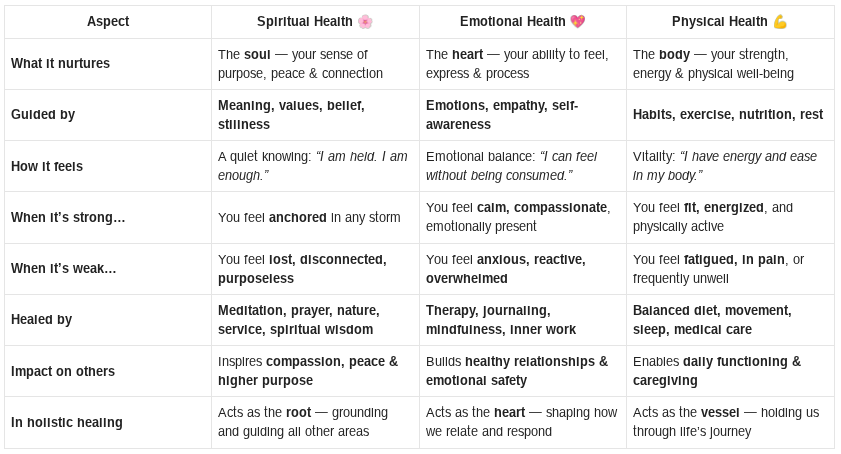
    Spiritual Health vs Emotional Health vs physical Health

    💪 Physical Health

    This is the health we can see and touch. It’s about your body — your energy, immunity, movement, nutrition, and rest. When it’s imbalanced, we feel tired, sick, or weak. It’s the outermost layer of wellness — and the most visible.

    💖 Emotional Health

    This is the health of your heart — how you process, express, and hold your emotions. Can you feel sadness without drowning in it? Can you express anger without harming others? Emotional health is the strength to feel fully and heal gently. It shapes our relationships, our reactions, and our sense of safety in the world.

    🕊️ Spiritual Health

    This is the health of your soul — your connection to purpose, peace, and the divine. It’s not about religion, but alignment — with your truth, your values, and your inner compass. It gives meaning to your suffering and depth to your joy. It’s the invisible foundation beneath your emotions and your body.


    🪔A Role Model of Spiritual Health

    The Unbreakable Spirit of Sindhutai Sapkal: The Mother of a Thousand Souls

    She was abandoned at a railway station — a young mother, barefoot, bruised, and broken.
    With nothing in her hands but pain… and a child in her womb.
    Yet in that moment of utter darkness, Sindhutai Sapkal made a choice —
    Not to let her suffering end with her,
    but to turn it into shelter for those who had even less.

    She begged on the streets,
    not for herself — but to feed the orphaned.
    She gave every ounce of her soul to children left unloved by the world,
    and became a mother to over 1,000 abandoned children,
    each one a new purpose for her battered heart.

    Sindhutai never spoke of religion,
    but she lived the purest form of spiritual health
    a life led by compassion, by forgiveness, and by the power of selfless service.
    Her peace did not come from ease,
    but from the grace of giving,
    the quiet fulfillment of lifting others from the pain she once knew too well.

    In healing others, she healed herself.
    In loving the forgotten, she found her divine calling.
    And in becoming their mother —
    she became a light for all humanity.

    Sindhutai Sapkal

    Abandoned by her husband while pregnant and left to suffer alone at a railway station, Sindhutai Sapkal turned unimaginable pain into profound purpose. Instead of becoming bitter, she chose compassion — adopting and nurturing over 1,000 abandoned children, feeding them with love she was once denied. Her greatest act of spiritual strength? Forgiving the very man who had wronged her, and welcoming him into the home she built through selfless service. In healing others, she healed herself — becoming a living embodiment of compassion, resilience, and soulful grace.


    Call to Action

    💫 A Return to the Soul

    Spiritual health isn’t about escaping life —
    It’s about living it deeply, consciously, and with love.

    When the outer world feels uncertain, come back to your inner world.
    That sacred space where you remember who you truly are —
    Not your roles, not your titles, not your fears.
    But your essence.

    A soul that came here not just to survive…
    But to awaken. To serve. To shine.

    💗Let Your Healing Become Someone’s Hope

    You were not born just to endure the storm,
    but to feel deeply, rise gently,
    and become a shelter for others in the rain.

    In the tender act of healing yourself,
    you awaken the power to heal the world —
    with your compassion,
    your quiet strength,
    your unshakable light.

    Breathe in peace. Breathe out kindness.
    Let your wounds shape wisdom.
    Let your purpose bloom in service.
    And let your soul whisper softly —
    “Begin now… someone is waiting for your light.”

    Watch my video in Hindi on spiritual health here.Read my post on holistic health here. Know the difference between Mental vs Emotional Health here.

    References: Swami Mukundananda
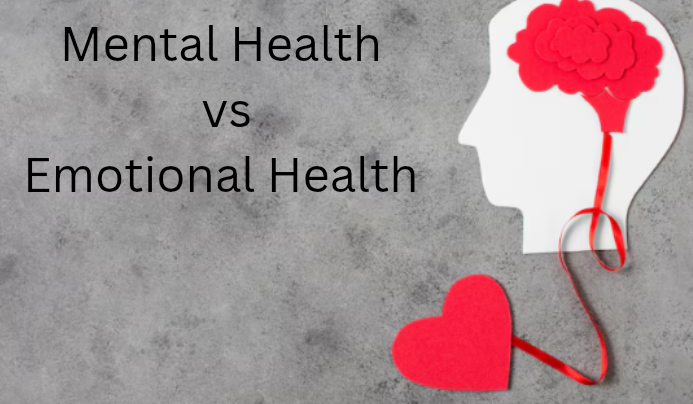
  • Mental Health vs Emotional Health: 6 Steps To Heal From Within & Rise with Purpose

    Mental Health vs Emotional Health: 6 Steps To Heal From Within & Rise with Purpose


    Emotional Health Is the Heartbeat 💗 Of Mental Well-Being

    How are they connected?

    While mental health is about how we think, focus, and cope, emotional health is about how we feel, express and connect. One cannot truly thrive without the other.

    Emotional health is actually a core part of mental health. Mental health includes your thoughts, perception, memory, and ability to reason, while emotional health focuses on your ability to feel, express, and process emotions like joy, sadness, anger, or love.Just like the mind cannot think clearly if the heart is overwhelmed, a peaceful emotional state helps your mental patterns settle and heal. Caring for your emotional health is not separate from mental health — it’s the foundation of it.


    Mental Health vs Emotional Health: How Are They Different?

    AspectMental HealthEmotional Health
    FocusThoughts, logic, cognitionFeelings, expression, awareness
    Challenge ExamplesAnxiety, depression, brain fogEmotional outbursts, numbness, detachment
    Healing PracticesTherapy, cognitive tools, meditationJournaling, emotional release, connection
    Core StrengthClarity and resilienceEmpathy and emotional balance

    There can be situations where you show good mental ability but you suppress or ignore your emotions & in the long run get drained,lost,detached, or outburst. In such cases, you might appear mentally strong — managing responsibilities, meeting deadlines, and making decisions — yet still get emotionally overwhelmed, disconnected, or reactive over a period of time. That’s because unprocessed emotions don’t disappear — they wait. And sometimes… they erupt. Lets see some real case studies of how Aarav & Riya who showed good mental health but poor emotional health were able to realize & improve their emotional health with healing practices.


    🔥 Aarav’s Story: When Unspoken Emotions Turn to Anger

    Aarav was a kind man. Quiet, reliable, and generous to those he loved. But lately, something inside him had started to unravel.

    Aarav angry on his wife

    It began with small things — snapping at his children over spilled milk, slamming the door when he couldn’t find his keys, feeling irritated with his wife for asking too many questions.
    But then came the day that broke something inside him.

    One morning, already running late for work, Aarav’s son accidentally dropped a glass on the floor. Aarav exploded — yelling louder than he ever had, his voice filled the house like a storm. His son stood frozen, eyes wide with fear. His wife rushed in, but said nothing. The silence that followed was heavier than the shouting.


    ❤‍🩹 Truth Behind the Anger

    That night, as he sat alone in the living room, the guilt hit him like a wave. He wasn’t angry because of the glass. He was angry because he felt overwhelmed. Unheard. Exhausted. Unseen.
    His outbursts weren’t about others — they were his unspoken emotions screaming for help.

    Aarav realized that he had never learned how to express pain or stress in healthy ways. As a child, he was told to “be strong,” to “man up,” to “control himself.” So he buried frustration, sadness, even grief — until those emotions turned into anger.

    But anger, he discovered, is rarely the true problem.
    It’s a symptom — a signal that something deeper needs attention.


    🌿 How Aarav Began to Heal His Emotional Health

    Healing didn’t mean suppressing his anger — it meant learning how to understand and manage it with compassion:

    1. Recognizing the Triggers
      Aarav began to notice what sparked his outbursts — feeling disrespected, ignored, or pressured. He started writing them down, not to blame, but to understand himself.
    2. Naming the Emotion Beneath the Anger
      He learned to ask himself:
      “Am I actually angry… or am I hurt? Am I scared? Am I tired?”
      Often, it was fear or sadness hiding beneath the fire.
    3. Practicing a Pause
      He started taking a deep breath before reacting — even walking away when needed. It wasn’t easy. But each pause was an act of power, not weakness.
    4. Talking with Vulnerability
      Aarav sat with his wife and shared honestly — not just his stress, but his shame, his fatigue, his fears of not being “enough.” The anger softened as the truth came out.
    5. Building Emotional Outlets
      He took up evening walks, deep breathing, and even sketching — small things that helped him release what he was holding inside.

    💗 The Transformation

    Aarav didn’t become perfect. But his home became quieter. His son laughed more freely. His wife began to hug him without hesitation.

    And for the first time in years, he began to feel peace inside — not because life got easier, but because he got more emotionally honest.


    🌈 Final Reflection

    If you struggle with anger outbursts, know this:
    You are not a bad person — you are a person in pain.
    You don’t need to suppress your emotions. You need to understand them, gently and patiently.

    Because anger isn’t the enemy. Silence is.
    And healing begins the moment we choose to listen — not just to others, but to the hidden parts of ourselves crying out for love.


    💖 A Story of How Riya Discovered the Missing Piece of Her Well-Being

    Riya was always the one everyone leaned on — smart, dependable, efficient. She handled her work with precision, kept her family organized, and rarely showed signs of stress. To the outside world, she seemed mentally strong — calm under pressure, emotionally unshakable.

    But inside, something was slowly falling apart.

    Riya lost

    Riya began to feel emotionally disconnected from her own life. She no longer found joy in the things she once loved — evening walks, her favorite music, even laughing with her children. Her heart felt dull. She couldn’t explain the occasional tears that welled up without warning. Sometimes, her chest felt heavy, and a deep sadness would wash over her like a tide she didn’t see coming.

    She kept pushing forward, thinking, “I’m just tired… maybe I need a vacation.” But even after rest, the emptiness returned.

    Over time, her emotions became harder to manage. Little things made her irritable. She withdrew from friends. She felt alone in crowded rooms. Her sleep was disturbed by racing thoughts and unspoken feelings. And worst of all, she began to doubt herself“Why can’t I just be happy? What’s wrong with me?”

    This wasn’t a breakdown. This was emotional exhaustion.
    Her mental health was intact — she could function.
    But her emotional health was quietly crumbling.


    🌿 The Turning Point

    Everything shifted when Riya attended a weekend wellness retreat. During a mindfulness session, the facilitator asked a question she wasn’t expecting:
    “How often do you feel your feelings… not analyze them, but actually feel them?”

    She paused. The answer hit her harder than she expected: “I don’t.”

    For years, she had managed life — but she hadn’t truly lived it. She had pushed away her sadness, silenced her disappointments, buried her grief — all to stay “strong.”

    And now, it was catching up with her.


    🌈 How Riya Healed Her Emotional Health

    Riya’s healing didn’t happen overnight. But she started with small, intentional steps that reconnected her with her emotional world:

    1. Journaling Without Judgment
      Every morning, she wrote down exactly how she felt — raw, unfiltered, even if it didn’t make sense. She began to see patterns: old wounds, unspoken fears, unmet needs.
    2. Naming Her Emotions
      Instead of saying “I’m fine,” she practiced saying things like “I feel overwhelmed,” “I’m anxious,” or “I’m lonely today.” Giving her feelings words gave them space to breathe.
    3. Letting Herself Cry
      For the first time in years, she allowed herself to cry — not in secret, not in shame. And she realized: tears are not weakness, they’re release.
    4. Talking to Someone Safe
      Riya reached out to a close friend, and eventually a therapist. Just being heard — without being “fixed” — helped her feel less alone.
    5. Daily Grounding with Breath & Silence
      She began a 10-minute evening ritual: deep breathing with her hand over her heart. No phone. No to-do list. Just her and her truth.
    6. Serving with Joy Again
      As her emotional energy returned, she volunteered at a local wellness group, sharing her story. Giving from a healed place filled her with purpose again.

    💗 The Healing

    Riya didn’t become perfect — she became present.
    Her emotions didn’t disappear — but they stopped controlling her.
    She became more compassionate, more patient, more alive.

    And most importantly, she learned this truth:

    Emotional health isn’t about having no pain — it’s about having the strength to feel it, and the tools to move through it with grace.


    🌿 Final Reflection

    Riya’s journey reminds us that mental health may help us survive, but emotional health helps us feel alive.
    To be whole, we must not only think clearly, but feel deeply.

    So if you find yourself functioning but not flourishing, ask yourself:
    “Have I made space for my emotions to be seen, felt, and healed?”

    Because your heart matters. And it deserves to be heard.


    Emotional Health: 6 Steps of Healing from Within and Rising with Purpose

    Emotional health is not just about controlling how we feel — it’s about understanding, accepting, and growing through our emotions.


    1. Self-Awareness Is the First Step

    The first step to begin is by becoming aware of our inner emotional patterns. Are our reactions constructive? Are we mindful of our triggers?
    Emotional health is the ability to observe our feelings without being consumed by them — to pause before we react, and to choose peace over chaos.


    2. Responding vs. Reacting:

    A Simple Shift That Transforms Emotional Health

    One of the most empowering emotional health practices is learning to respond instead of react.

    React vs Respond

    🔥 Reaction: The Automatic Outburst

    A reaction is instant, emotional, and often unconscious. It’s what happens when we feel triggered and speak or act without pausing. Whether it’s yelling in anger, shutting down in pain, or saying something we regret — reactions often leave us feeling out of control and disconnected from our true self.

    🌿 Response: The Mindful Pause

    A response, on the other hand, is grounded in awareness. It’s what happens when we pause, take a breath, and ask ourselves:

    “What am I really feeling right now? What outcome do I want from this moment?”

    This simple pause creates space between emotion and action — allowing us to act with intention rather than impulse. Responding doesn’t mean suppressing feelings. It means honoring them in a calm, conscious way.

    💖 Why It Matters

    When we respond instead of react:

    • Our relationships become more peaceful
    • We feel more in control of ourselves
    • We build inner resilience
    • And we stop letting temporary emotions create permanent damage

    In the space between trigger and action lies your greatest power. That space is the practice. That space is healing.


    3. Emotions Need to Be Channeled, Not Suppressed

    Suppressing emotions can create silent suffering. But emotional health means we channel our feelings constructively — turning pain into growth, anger into energy, and fear into courage and developing compassion to help others for the ultimate inner peace.
    By doing so, we don’t just avoid breakdowns — we build emotional strength.

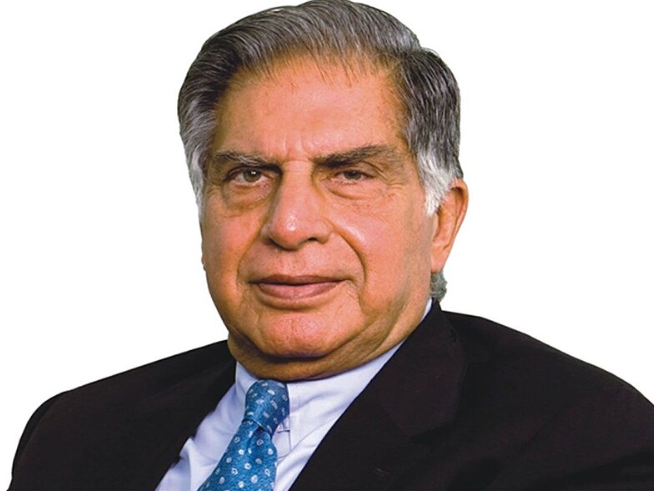
    Ratan Tata

    Learning from Rata Tata:

    A good example is of respected sir Ratan Tata.

    Late Mr. Ratan Tata is not only remembered & admired for his business acumen but also for his remarkable emotional health and inner calm. Throughout his life, he has shown that true leadership stems from empathy, humility, and grace under pressure. Whether it was choosing compassion over profit or silently supporting causes without publicity, his emotional health reflects a deep-rooted strength — the ability to stay grounded, kind, and composed even in the face of adversity. His quiet dignity reminds us that emotional balance is a true mark of strength, not weakness.

    Learn how he transformed his insult into immense growth in the video here.


    💖 The Healing Power of Compassion Starts with Feeling (not suppressing the feelings)

    In holding another’s hand through sorrow,
    our own heart finds its way to breathe.
    In wiping someone else’s tears,
    we feel our pain begin to leave.
    For every soul we help to rise,
    a quiet healing blooms inside —
    a reminder that in giving light,
    our own darkness starts to subside.

    When we rise above personal hurt and focus on serving society, helping others, and uplifting humanity, our emotional pain often transforms into something powerful — compassion. This connection to the greater good brings peace and meaning.

    Lesson from the Holy Bhagavad Gita (Mahabharata):

    I’m reminded of a powerful moment from the Bhagavad Gita, the sacred Indian epic, where Karna turns to Lord Krishna, heart heavy with sorrow and anger. He speaks of the deep injustices he’s faced — abandonment, betrayal, and suffering — and asks, “Where did I go wrong?”

    Lord Krishna’s response is profound:
    “Your suffering was meant to awaken compassion — not resentment. You were meant to rise above the pain, to transform it into healing for others, to serve humanity through your experience. That is true dharma.”

    In this divine teaching lies a timeless truth — when we use our pain to uplift others, we not only serve the world…
    we also begin to heal ourselves.

    You can watch the video of their conversation from television serial ‘Mahabharata’ here.


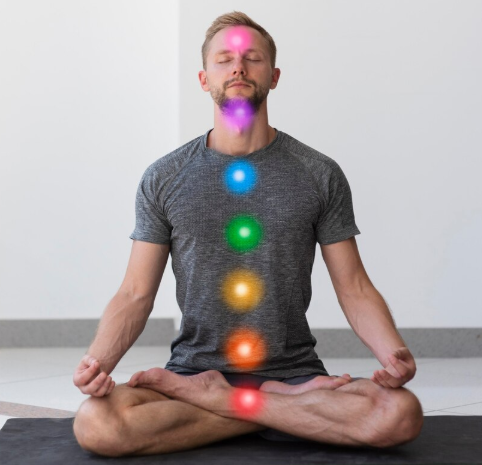
    Yoga

    4. Practice Stillness – Yoga, Meditation, Relaxation

    Practices like yoga and meditation to bring calmness and emotional clarity. In today’s fast-paced world, even 10 minutes of mindful breathing can return us to ourselves.
    This stillness isn’t just about silence — it’s about hearing what your heart truly needs.


    Detox Juice

    5. Live Simply, Eat Well, Stay Connected

    • Simple living
    • Nutritious food
    • Healthy relationships
      These choices nourish not just the body, but also the heart.

    True emotional health isn’t complicated. It often begins with the basics:


    6. Emotional Health Is a Daily Practice

    Above all, emotional wellness is a lifelong journey.
    Each day, we must:

    • Choose how we respond
    • Reflect on how we feel
    • Channel emotions into positive action
    • Stay anchored in values
    • And give back to the world around us

    It’s not about perfection. It’s about presence.


    💖 Call to Action:

    Your Emotions Matter — Start Honoring Them Today

    If you’ve been holding it all in…
    If you’ve been functioning but not feeling…
    It’s time to pause and come home to your heart.

    Emotional health isn’t about having it all together —
    It’s about learning to listen, to feel, and to heal.

    Start small:
    Write down what you’re feeling.
    Take a deep breath before reacting.
    Talk to someone who truly listens.
    Let yourself cry.
    Let yourself rest.

    Because your feelings are not a burden —
    They are messages from within, asking for care, not silence.

    Because a healthy heart is one that feels deeply, lives mindfully, and gives freely.

    💫 The journey to emotional wellness begins with one brave choice: to feel.
    Are you ready to take that step?


    💬 Mental Health Quotes (Emotional + Reflective)

    “You don’t have to control your thoughts. You just have to stop letting them control you.”
    – Dan Millman

    “What mental health needs is more sunlight, more openness, and more unconditional love.”
    – Glenn Close

    It’s okay to ask for help. Even the strongest hearts sometimes need to be held.

    “Sometimes the most productive thing you can do is rest and let your soul catch up with your body.”

    “You are not weak for needing time to heal. You are human.”

    “There is no shame in taking care of your mind. It’s a strength, not a flaw.”


    🙋‍♀️ Frequently Asked Questions (FAQ)

    ❓ What is mental health?

    Mental health refers to your overall psychological well-being, including how you think, process information, and make decisions. It includes your ability to handle stress, solve problems, and maintain focus and clarity.


    ❓ What is emotional health?

    Emotional health is your ability to recognize, express, and manage your emotions—such as anger, sadness, joy, or fear—in healthy and constructive ways.


    ❓ How is emotional health different from mental health?

    While they are closely related, mental health is more about your cognitive and thinking abilities, while emotional health is about how you manage and express feelings. Emotional health influences how you cope with challenges and relate to others.


    ❓ Can someone have good mental health but poor emotional health?

    Yes. A person may be mentally sharp and able to think clearly (good mental health) but still struggle to express emotions, deal with stress, or maintain emotional balance (poor emotional health).


    ❓ Why is understanding both important for overall well-being?

    Mental and emotional health are deeply connected. Improving both helps you handle life’s challenges with resilience, maintain healthy relationships, and experience inner peace and clarity.


    ❓ How can I improve my mental and emotional health together?

    • Practice mindfulness or meditation daily
    • Express your feelings through journaling or art
    • Build a strong support system
    • Eat a balanced, nourishing diet
    • Seek therapy or counseling when needed

    ❓ What are signs of poor mental or emotional health?

    • Chronic stress, anxiety, or sadness
    • Mood swings or emotional numbness
    • Difficulty concentrating or making decisions
    • Withdrawing from relationships
    • Feeling overwhelmed or helpless

    ❓ When should I seek help?

    If emotional or mental struggles begin to affect your daily life, relationships, or work—and you feel unable to cope—it’s wise to seek support from a therapist, counselor, or mental health professional.

    You can watch my video,(in Hindi).Read my post on holistic health here.

    References: Swami Mukundananda
  • Mental Health vs Emotional Health: 6 Steps To Heal From Within & Rise with Purpose

    Mental Health vs Emotional Health: 6 Steps To Heal From Within & Rise with Purpose


    Emotional Health Is the Heartbeat 💗 Of Mental Well-Being

    How are they connected?

    While mental health is about how we think, focus, and cope, emotional health is about how we feel, express and connect. One cannot truly thrive without the other.

    Emotional health is actually a core part of mental health. Mental health includes your thoughts, perception, memory, and ability to reason, while emotional health focuses on your ability to feel, express, and process emotions like joy, sadness, anger, or love.Just like the mind cannot think clearly if the heart is overwhelmed, a peaceful emotional state helps your mental patterns settle and heal. Caring for your emotional health is not separate from mental health — it’s the foundation of it.


    Mental Health vs Emotional Health: How Are They Different?

    AspectMental HealthEmotional Health
    FocusThoughts, logic, cognitionFeelings, expression, awareness
    Challenge ExamplesAnxiety, depression, brain fogEmotional outbursts, numbness, detachment
    Healing PracticesTherapy, cognitive tools, meditationJournaling, emotional release, connection
    Core StrengthClarity and resilienceEmpathy and emotional balance

    There can be situations where you show good mental ability but you suppress or ignore your emotions & in the long run get drained,lost,detached, or outburst. In such cases, you might appear mentally strong — managing responsibilities, meeting deadlines, and making decisions — yet still get emotionally overwhelmed, disconnected, or reactive over a period of time. That’s because unprocessed emotions don’t disappear — they wait. And sometimes… they erupt. Lets see some real case studies of how Aarav & Riya who showed good mental health but poor emotional health were able to realize & improve their emotional health with healing practices.


    🔥 Aarav’s Story: When Unspoken Emotions Turn to Anger

    Aarav was a kind man. Quiet, reliable, and generous to those he loved. But lately, something inside him had started to unravel.

    Aarav angry on his wife

    It began with small things — snapping at his children over spilled milk, slamming the door when he couldn’t find his keys, feeling irritated with his wife for asking too many questions.
    But then came the day that broke something inside him.

    One morning, already running late for work, Aarav’s son accidentally dropped a glass on the floor. Aarav exploded — yelling louder than he ever had, his voice filled the house like a storm. His son stood frozen, eyes wide with fear. His wife rushed in, but said nothing. The silence that followed was heavier than the shouting.


    ❤‍🩹 Truth Behind the Anger

    That night, as he sat alone in the living room, the guilt hit him like a wave. He wasn’t angry because of the glass. He was angry because he felt overwhelmed. Unheard. Exhausted. Unseen.
    His outbursts weren’t about others — they were his unspoken emotions screaming for help.

    Aarav realized that he had never learned how to express pain or stress in healthy ways. As a child, he was told to “be strong,” to “man up,” to “control himself.” So he buried frustration, sadness, even grief — until those emotions turned into anger.

    But anger, he discovered, is rarely the true problem.
    It’s a symptom — a signal that something deeper needs attention.


    🌿 How Aarav Began to Heal His Emotional Health

    Healing didn’t mean suppressing his anger — it meant learning how to understand and manage it with compassion:

    1. Recognizing the Triggers
      Aarav began to notice what sparked his outbursts — feeling disrespected, ignored, or pressured. He started writing them down, not to blame, but to understand himself.
    2. Naming the Emotion Beneath the Anger
      He learned to ask himself:
      “Am I actually angry… or am I hurt? Am I scared? Am I tired?”
      Often, it was fear or sadness hiding beneath the fire.
    3. Practicing a Pause
      He started taking a deep breath before reacting — even walking away when needed. It wasn’t easy. But each pause was an act of power, not weakness.
    4. Talking with Vulnerability
      Aarav sat with his wife and shared honestly — not just his stress, but his shame, his fatigue, his fears of not being “enough.” The anger softened as the truth came out.
    5. Building Emotional Outlets
      He took up evening walks, deep breathing, and even sketching — small things that helped him release what he was holding inside.

    💗 The Transformation

    Aarav didn’t become perfect. But his home became quieter. His son laughed more freely. His wife began to hug him without hesitation.

    And for the first time in years, he began to feel peace inside — not because life got easier, but because he got more emotionally honest.


    🌈 Final Reflection

    If you struggle with anger outbursts, know this:
    You are not a bad person — you are a person in pain.
    You don’t need to suppress your emotions. You need to understand them, gently and patiently.

    Because anger isn’t the enemy. Silence is.
    And healing begins the moment we choose to listen — not just to others, but to the hidden parts of ourselves crying out for love.


    💖 A Story of How Riya Discovered the Missing Piece of Her Well-Being

    Riya was always the one everyone leaned on — smart, dependable, efficient. She handled her work with precision, kept her family organized, and rarely showed signs of stress. To the outside world, she seemed mentally strong — calm under pressure, emotionally unshakable.

    But inside, something was slowly falling apart.

    Riya lost

    Riya began to feel emotionally disconnected from her own life. She no longer found joy in the things she once loved — evening walks, her favorite music, even laughing with her children. Her heart felt dull. She couldn’t explain the occasional tears that welled up without warning. Sometimes, her chest felt heavy, and a deep sadness would wash over her like a tide she didn’t see coming.

    She kept pushing forward, thinking, “I’m just tired… maybe I need a vacation.” But even after rest, the emptiness returned.

    Over time, her emotions became harder to manage. Little things made her irritable. She withdrew from friends. She felt alone in crowded rooms. Her sleep was disturbed by racing thoughts and unspoken feelings. And worst of all, she began to doubt herself“Why can’t I just be happy? What’s wrong with me?”

    This wasn’t a breakdown. This was emotional exhaustion.
    Her mental health was intact — she could function.
    But her emotional health was quietly crumbling.


    🌿 The Turning Point

    Everything shifted when Riya attended a weekend wellness retreat. During a mindfulness session, the facilitator asked a question she wasn’t expecting:
    “How often do you feel your feelings… not analyze them, but actually feel them?”

    She paused. The answer hit her harder than she expected: “I don’t.”

    For years, she had managed life — but she hadn’t truly lived it. She had pushed away her sadness, silenced her disappointments, buried her grief — all to stay “strong.”

    And now, it was catching up with her.


    🌈 How Riya Healed Her Emotional Health

    Riya’s healing didn’t happen overnight. But she started with small, intentional steps that reconnected her with her emotional world:

    1. Journaling Without Judgment
      Every morning, she wrote down exactly how she felt — raw, unfiltered, even if it didn’t make sense. She began to see patterns: old wounds, unspoken fears, unmet needs.
    2. Naming Her Emotions
      Instead of saying “I’m fine,” she practiced saying things like “I feel overwhelmed,” “I’m anxious,” or “I’m lonely today.” Giving her feelings words gave them space to breathe.
    3. Letting Herself Cry
      For the first time in years, she allowed herself to cry — not in secret, not in shame. And she realized: tears are not weakness, they’re release.
    4. Talking to Someone Safe
      Riya reached out to a close friend, and eventually a therapist. Just being heard — without being “fixed” — helped her feel less alone.
    5. Daily Grounding with Breath & Silence
      She began a 10-minute evening ritual: deep breathing with her hand over her heart. No phone. No to-do list. Just her and her truth.
    6. Serving with Joy Again
      As her emotional energy returned, she volunteered at a local wellness group, sharing her story. Giving from a healed place filled her with purpose again.

    💗 The Healing

    Riya didn’t become perfect — she became present.
    Her emotions didn’t disappear — but they stopped controlling her.
    She became more compassionate, more patient, more alive.

    And most importantly, she learned this truth:

    Emotional health isn’t about having no pain — it’s about having the strength to feel it, and the tools to move through it with grace.


    🌿 Final Reflection

    Riya’s journey reminds us that mental health may help us survive, but emotional health helps us feel alive.
    To be whole, we must not only think clearly, but feel deeply.

    So if you find yourself functioning but not flourishing, ask yourself:
    “Have I made space for my emotions to be seen, felt, and healed?”

    Because your heart matters. And it deserves to be heard.


    Emotional Health: 6 Steps of Healing from Within and Rising with Purpose

    Emotional health is not just about controlling how we feel — it’s about understanding, accepting, and growing through our emotions.


    1. Self-Awareness Is the First Step

    The first step to begin is by becoming aware of our inner emotional patterns. Are our reactions constructive? Are we mindful of our triggers?
    Emotional health is the ability to observe our feelings without being consumed by them — to pause before we react, and to choose peace over chaos.


    2. Responding vs. Reacting:

    A Simple Shift That Transforms Emotional Health

    One of the most empowering emotional health practices is learning to respond instead of react.

    React vs Respond

    🔥 Reaction: The Automatic Outburst

    A reaction is instant, emotional, and often unconscious. It’s what happens when we feel triggered and speak or act without pausing. Whether it’s yelling in anger, shutting down in pain, or saying something we regret — reactions often leave us feeling out of control and disconnected from our true self.

    🌿 Response: The Mindful Pause

    A response, on the other hand, is grounded in awareness. It’s what happens when we pause, take a breath, and ask ourselves:

    “What am I really feeling right now? What outcome do I want from this moment?”

    This simple pause creates space between emotion and action — allowing us to act with intention rather than impulse. Responding doesn’t mean suppressing feelings. It means honoring them in a calm, conscious way.

    💖 Why It Matters

    When we respond instead of react:

    • Our relationships become more peaceful
    • We feel more in control of ourselves
    • We build inner resilience
    • And we stop letting temporary emotions create permanent damage

    In the space between trigger and action lies your greatest power. That space is the practice. That space is healing.


    3. Emotions Need to Be Channeled, Not Suppressed

    Suppressing emotions can create silent suffering. But emotional health means we channel our feelings constructively — turning pain into growth, anger into energy, and fear into courage and developing compassion to help others for the ultimate inner peace.
    By doing so, we don’t just avoid breakdowns — we build emotional strength.

    Ratan Tata

    Learning from Rata Tata:

    A good example is of respected sir Ratan Tata.

    Late Mr. Ratan Tata is not only remembered & admired for his business acumen but also for his remarkable emotional health and inner calm. Throughout his life, he has shown that true leadership stems from empathy, humility, and grace under pressure. Whether it was choosing compassion over profit or silently supporting causes without publicity, his emotional health reflects a deep-rooted strength — the ability to stay grounded, kind, and composed even in the face of adversity. His quiet dignity reminds us that emotional balance is a true mark of strength, not weakness.

    Learn how he transformed his insult into immense growth in the video here.


    💖 The Healing Power of Compassion Starts with Feeling (not suppressing the feelings)

    In holding another’s hand through sorrow,
    our own heart finds its way to breathe.
    In wiping someone else’s tears,
    we feel our pain begin to leave.
    For every soul we help to rise,
    a quiet healing blooms inside —
    a reminder that in giving light,
    our own darkness starts to subside.

    When we rise above personal hurt and focus on serving society, helping others, and uplifting humanity, our emotional pain often transforms into something powerful — compassion. This connection to the greater good brings peace and meaning.

    Lesson from the Holy Bhagavad Gita (Mahabharata):

    I’m reminded of a powerful moment from the Bhagavad Gita, the sacred Indian epic, where Karna turns to Lord Krishna, heart heavy with sorrow and anger. He speaks of the deep injustices he’s faced — abandonment, betrayal, and suffering — and asks, “Where did I go wrong?”

    Lord Krishna’s response is profound:
    “Your suffering was meant to awaken compassion — not resentment. You were meant to rise above the pain, to transform it into healing for others, to serve humanity through your experience. That is true dharma.”

    In this divine teaching lies a timeless truth — when we use our pain to uplift others, we not only serve the world…
    we also begin to heal ourselves.

    You can watch the video of their conversation from television serial ‘Mahabharata’ here.


    Yoga

    4. Practice Stillness – Yoga, Meditation, Relaxation

    Practices like yoga and meditation to bring calmness and emotional clarity. In today’s fast-paced world, even 10 minutes of mindful breathing can return us to ourselves.
    This stillness isn’t just about silence — it’s about hearing what your heart truly needs.


    Detox Juice

    5. Live Simply, Eat Well, Stay Connected

    • Simple living
    • Nutritious food
    • Healthy relationships
      These choices nourish not just the body, but also the heart.

    True emotional health isn’t complicated. It often begins with the basics:


    6. Emotional Health Is a Daily Practice

    Above all, emotional wellness is a lifelong journey.
    Each day, we must:

    • Choose how we respond
    • Reflect on how we feel
    • Channel emotions into positive action
    • Stay anchored in values
    • And give back to the world around us

    It’s not about perfection. It’s about presence.


    💖 Call to Action:

    Your Emotions Matter — Start Honoring Them Today

    If you’ve been holding it all in…
    If you’ve been functioning but not feeling…
    It’s time to pause and come home to your heart.

    Emotional health isn’t about having it all together —
    It’s about learning to listen, to feel, and to heal.

    Start small:
    Write down what you’re feeling.
    Take a deep breath before reacting.
    Talk to someone who truly listens.
    Let yourself cry.
    Let yourself rest.

    Because your feelings are not a burden —
    They are messages from within, asking for care, not silence.

    Because a healthy heart is one that feels deeply, lives mindfully, and gives freely.

    💫 The journey to emotional wellness begins with one brave choice: to feel.
    Are you ready to take that step?


    💬 Mental Health Quotes (Emotional + Reflective)

    “You don’t have to control your thoughts. You just have to stop letting them control you.”
    – Dan Millman

    “What mental health needs is more sunlight, more openness, and more unconditional love.”
    – Glenn Close

    It’s okay to ask for help. Even the strongest hearts sometimes need to be held.

    “Sometimes the most productive thing you can do is rest and let your soul catch up with your body.”

    “You are not weak for needing time to heal. You are human.”

    “There is no shame in taking care of your mind. It’s a strength, not a flaw.”


    🙋‍♀️ Frequently Asked Questions (FAQ)

    ❓ What is mental health?

    Mental health refers to your overall psychological well-being, including how you think, process information, and make decisions. It includes your ability to handle stress, solve problems, and maintain focus and clarity.


    ❓ What is emotional health?

    Emotional health is your ability to recognize, express, and manage your emotions—such as anger, sadness, joy, or fear—in healthy and constructive ways.


    ❓ How is emotional health different from mental health?

    While they are closely related, mental health is more about your cognitive and thinking abilities, while emotional health is about how you manage and express feelings. Emotional health influences how you cope with challenges and relate to others.


    ❓ Can someone have good mental health but poor emotional health?

    Yes. A person may be mentally sharp and able to think clearly (good mental health) but still struggle to express emotions, deal with stress, or maintain emotional balance (poor emotional health).


    ❓ Why is understanding both important for overall well-being?

    Mental and emotional health are deeply connected. Improving both helps you handle life’s challenges with resilience, maintain healthy relationships, and experience inner peace and clarity.


    ❓ How can I improve my mental and emotional health together?

    • Practice mindfulness or meditation daily
    • Express your feelings through journaling or art
    • Build a strong support system
    • Eat a balanced, nourishing diet
    • Seek therapy or counseling when needed

    ❓ What are signs of poor mental or emotional health?

    • Chronic stress, anxiety, or sadness
    • Mood swings or emotional numbness
    • Difficulty concentrating or making decisions
    • Withdrawing from relationships
    • Feeling overwhelmed or helpless

    ❓ When should I seek help?

    If emotional or mental struggles begin to affect your daily life, relationships, or work—and you feel unable to cope—it’s wise to seek support from a therapist, counselor, or mental health professional.

    You can watch my video,(in Hindi).Read my post on holistic health here.

    References: Swami Mukundananda

  • What is Holistic Health? 4 Pillars: Why True Wellness Needs Mind, Body, Soul & Connection

    What is Holistic Health? 4 Pillars: Why True Wellness Needs Mind, Body, Soul & Connection


    My Story

    The Day I Broke Down Without a Fever..

    I remember a day not long ago. No cold, no cough, no visible illness. But I couldn’t get out of bed. I felt heavy. Not in my body, but in my heart. My thoughts raced and I felt like crying for no reason. I had chased “fitness” — counting calories, walking daily — yet here I was, stuck, drained, and lost.

    That’s when I discovered: Health is not just physical. It is emotional. It is spiritual. It is social. Its whole.


    What Is Holistic Health?

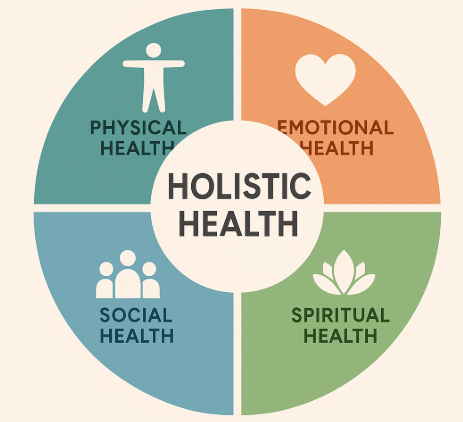
    Holistic health means looking at the whole person — body, mind, emotions, and spirit — instead of just symptoms. It’s about balance, alignment, and healing from the inside out.

    A headache might not just need a pill.
    It might need rest. Or letting go of buried anger. Or sitting in silence with your soul,realigning with your purpose of life.

    Holistic Health

    1. Emotional Health: The Body Feels What the Heart Holds

    Ever noticed how heartbreak feels like chest pain?

    Or how stress leads to stomach issues or insomnia?

    • Emotional pain, if ignored, becomes physical.
    • Anxiety raises your blood pressure.
    • Chronic sadness drains immunity.
    • Anger can inflame the liver.
    • When we suppress our feelings, our body screams through illness.

    🧠 Emotions are not separate from the body — they are lived in the body.


    What Is Emotional Health?

    Emotional health is the ability to feel, understand, express, and manage your emotions in a healthy, balanced way. It means being in tune with your feelings — without being overwhelmed or shut down by them.

    It’s not about being happy all the time. It’s about allowing yourself to feel fully — joy, sadness, anger, fear, love — and still be able to move forward with clarity and self-awareness.


    Signs of Good Emotional Health:

    • You can express your emotions without guilt or fear
    • You’re able to set healthy boundaries in relationships
    • You don’t bottle up your feelings or let them explode — you process them mindfully
    • You are self-compassionate — kind to yourself in hard times
    • You’re not afraid to ask for help when needed

    Why Emotional Health Matters:

    Unprocessed emotions don’t just “go away.” They store in the body and often lead to:

    • Headaches, fatigue, and digestive issues
    • Anxiety, depression, or emotional numbness
    • Strained relationships and poor decision-making
    • Long-term health issues due to chronic stress

    Your emotional health is directly connected to your physical and mental health. A heavy heart often leads to a tired body.


    How to Improve Emotional Health:

    • Name your feelings — journaling or talking it out helps
    • Feel without judging — it’s okay to feel sad, angry, or scared
    • Practice deep breathing during emotional overwhelm
    • Talk to someone — a friend, coach, or therapist
    • Use creative outlets like art, dance, music, or writing to release what’s inside
    • Rest and nourish your nervous system with good sleep, whole foods, and nature
    • Serve Others — and Heal Yourself
    • Learn to channelize your emotions constructively for the welfare of self,society, humanity

    Emotional health gives you the strength to stay open — to love, to grieve, to grow.
    When your heart is heard and held, your entire life softens and expands.

    Read real stories of how people improve emotional health here.


    Spiritual health doesn’t mean religion — it means connection. To your inner self. To purpose. To peace.

    When we lose meaning, we lose our will to live fully.
    Many chronic illnesses begin with a soul that feels unseen, unheard, or unloved.


    What Is Spiritual Health?

    Spiritual health is the deep sense of inner peace, purpose, and connection that guides your life — even when things outside are uncertain. It’s not about any one religion. It’s about your relationship with yourself, with life, with something greater — whether you call it God, the universe, nature, or simply your soul.

    A spiritually healthy person feels:

    • Grounded, even during chaos
    • Meaningful, even during struggle
    • Connected, even when alone

    Spiritual health is what gives you the strength to rise again after a fall. It’s the quiet knowing inside you that you’re not just a body or a mind — you are something more, something sacred.


    Signs of Spiritual Health:

    • You have a sense of purpose or direction in life
    • You practice forgiveness, letting go of resentment
    • You take time for silence, reflection, or prayer
    • You feel a deep connection to nature, humanity, or a higher power
    • You live by values, not just goals

    Why It Matters:

    Without spiritual health, even physical or emotional healing can feel empty. But with it, you gain:

    • Greater resilience in tough times
    • More compassion for yourself and others
    • Inner calm that no external situation can shake

    Spiritual Health

    How to Nurture Spiritual Health:

    • Spend quiet time alone — in nature, meditation, or prayer
    • Reflect on your values and live in alignment with them
    • Practice gratitude every day
    • Engage in creative activities that connect you to your soul
    • Help others — because service is a spiritual act

    🌿 Spiritual practices like meditation, nature walks, prayer, or chanting calm the nervous system, reduce stress hormones, and awaken healing energy.


    Spiritual health is not a destination. It’s a daily return — to truth, to stillness, to the deepest part of who you are.
    When your spirit is nourished, your entire being begins to heal.


    3. Healing Begins With Integration

    The body cannot heal while the mind is in chaos.
    The mind cannot be calm if the soul is starved.

    That’s why true healing involves:

    • Nutrition to fuel the body
    • Emotional release to clear the heart
    • Spiritual practices to strengthen the soul, live for a purpose
    • Movement & breathwork to reset the system
    • Stillness to hear your inner truth

    Every part is connected. You can’t treat just one.


    4. Stories of Holistic Healing

    Holistic Health

    💬 A woman with PCOS started mindful eating, daily sun-gazing, and journaling her emotions. Her cycles regulated — not just from food, but from healing years of self-rejection.


    Holistic Health

    💬 A man getting regular headaches,sleeping issues & sinus began breath work and forgiveness meditations. His pain reduced, his life improved, and he began to sleep deeply for the first time in years.

    These are not miracles. These are integrated approaches to health — treating causes, not just symptoms.


    5. Your Holistic Health Ritual (Start Today)

    Here’s a simple daily practice to support all dimensions of your being:

    • 🌞 Morning sunlight + 10 deep belly breaths
    • 🫖 Herbal tea with gratitude thoughts
    • 🍲 Mindful meals, eaten in silence at least once a day
    • 🧘‍♀️ 15 min body movement (yoga, dance, stretch)
    • 📓 Journal: “How do I feel emotionally today?”
    • 🙏 Night prayer or meditation: 5 minutes of stillness
    • 🤝 One social connection — call a loved one, share your heart, or simply check in on someone else
    • 🚫 Digital boundary — choose 30 minutes without screens to be fully present with people around you

    6. The Power of Social Health: Healing Through Connection

    A warm hug can calm anxiety.
    A deep conversation can lift depression.
    A sense of belonging can prevent chronic illness.

    When you feel seen, supported, and loved, your body releases healing hormones like oxytocin, which lower stress, reduce inflammation, and boost immunity.We are not meant to heal in isolation. Humans are wired for connection, and social health — the quality of our relationships — plays a powerful role in our well-being.

    Holistic Health

    But in today’s digital world, many suffer from silent loneliness — surrounded by noise, but disconnected inside. Healing begins when we start choosing authentic bonds over perfect appearances.

    🌸 Holistic health means nurturing not just your inner world, but your human connections too.


    Try This Today:

    • Call someone you love, not to talk, but to listen.
    • Join a wellness or meditation circle — even virtually.
    • Set a boundary with someone who drains your energy.
    • Volunteer or help a stranger — kindness heals both ways.

    Remember:
    The quality of your relationships directly affects the quality of your health. You are not alone in your healing journey — and you were never meant to be.


    Final Words: You Are Not Just a Body

    You are a garden — your roots are spiritual, your branches emotional, your leaves physical. You cannot bloom by watering one part.
    Healing is not a race. It is a return — to balance, to self-love, to wholeness.


    Videos:

    Watch Videos in Hindi – Emotional Health, Spiritual Health


    Call to Action:

    💚 Your Healing Begins Now

    If your heart feels heavy…
    If your mind feels tired…
    If your soul is quietly whispering there’s more to life than this — listen.

    You don’t have to walk this journey alone.
    You deserve to feel whole — not just in your body, but in your emotions, your spirit, and your relationships.

    Start today.
    Take one breath in stillness.
    Offer one act of kindness.
    Say yes to yourself.

    Let’s return to what truly matters — peace within, purpose beyond, and connection that heals.

    Join the movement of mindful living and soulful wellness.
    Because healing isn’t just about living longer —
    It’s about living deeper.

    💚 Because you are not just here to survive. You are here to thrive, in every dimension of your being.

    Learn about sedentary lifestyle here.