Blog

  • 🚨GM to Boeing to Kodak to Toyota Case Study: How Yes-Men Sink Giants & Voice Saves Them

    🚨GM to Boeing to Kodak to Toyota Case Study: How Yes-Men Sink Giants & Voice Saves Them


    Introduction


    Behind many corporate collapses lies not just bad decisions, but a culture of silence. While most businesses spend time and money on external audits, branding, and innovation — few recognize the danger posed by silent employees and agreeable managers who nod, agree, and comply, even when the business is heading toward a cliff. This blog dives deep into how such “yes-man” cultures breed stagnation, fear, and failure — and why nurturing dissent, open feedback, and critical thinking can save your company from self-destruction.


    The Hidden Cost of Silence


    Silence isn’t always golden. In boardrooms and management meetings, silence can translate to compliance, complacency, and missed warnings. Employees or managers who spot flaws, inefficiencies, or unethical practices but stay quiet due to fear, politics, or indifference enable a slow corporate death.

    • Kodak ignored internal voices urging a pivot to digital.
    • Enron thrived on a toxic culture of silence until its implosion.
    • Boeing faced catastrophic issues after employees’ concerns were overridden by executive pressure.

    Who Are the Yes-Men (and Why They Exist)

    Yes Man keeps Boss Happy


    Yes-men (or women) are individuals who prioritize appeasing superiors over expressing concerns or ideas. They often:

    • Fear retaliation or career damage.
    • See disagreement as disloyalty.
    • Work in rigid hierarchies discouraging challenge.
    • Lack psychological safety to speak freely.

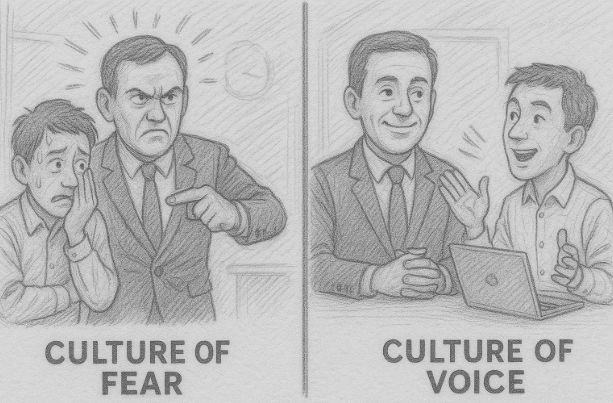
    Culture of Fear vs. Culture of Voice


    When a company penalizes dissent and rewards blind agreement:

    • Innovation dies.
    • Errors go uncorrected.
    • Toxic behaviors fester.
    • Valuable employees leave.

    Silent Employees vs. Vocal Safeguards


    While silent employees allow problems to grow unnoticed, those who raise concerns — the ethical whistleblowers, the honest analysts, the questioning minds — serve as a company’s true immune system. They detect and raise alarms before small issues turn into disasters.

    Encouraging Open Feedback: A Leadership Imperative To prevent collapse from within, leaders must:

    • Build psychological safety.
    • Encourage anonymous feedback.
    • Create regular review loops involving junior voices.
    • Recognize and reward truth-tellers.
    • Include dissent in decision-making processes.

    Case Example: Toyota


    Toyota’s “kaizen” (continuous improvement) culture allows all employees, even factory workers, to stop the production line if they notice an issue. This approach has saved billions in defects and built a culture of responsibility.


    🔷 Case Study: Toyota – Kaizen Culture & the Power of Internal Voices

    Toyota Cars

    Company: Toyota Motor Corporation
    Industry: Automotive
    Founded: 1937
    Headquarters: Toyota City, Japan


    🎯 Background:

    Toyota is globally recognized not just for its vehicles, but for pioneering “Kaizen”, a Japanese term meaning continuous improvement. This philosophy is deeply ingrained in Toyota’s corporate DNA, encouraging employees at every level—from engineers to factory floor workers—to contribute ideas, raise concerns, and stop operations if something is wrong.


    🛠️ The System: Jidoka & Andon Cord

    One of the most powerful implementations of Kaizen is the Andon Cord:

    • It’s a physical or digital mechanism any employee can pull to stop the production line.
    • If a defect or abnormality is found—even a minor one—workers are empowered to halt operations and trigger immediate investigation and support from supervisors.
    • This is part of Jidoka: building quality into the process by allowing machines and people to detect issues automatically.

    🧠 Why This Matters:

    Toyota actively listens to its employees. Factory workers are not treated as cogs in a machine, but as critical quality guardians. Every worker is seen as a stakeholder in Toyota’s brand promise.


    💡 Real-World Impact:

    • Defect Prevention: Stopping production prevents defective vehicles from reaching the customer, saving billions in recalls and reputational damage.
    • Cost Savings: Toyota’s global warranty costs remain significantly lower than many competitors due to this system.
    • Employee Morale & Ownership: Workers feel heard and responsible, increasing loyalty and innovation.
    • Faster Improvements: Continuous feedback leads to incremental innovations, such as layout optimization, reduced waste, and efficiency gains.

    📉 Case Comparison: Toyota vs. GM

    In contrast, General Motors (GM) faced massive recalls and lawsuits in the 2010s due to an ignition switch defect that engineers knew about years earlier but did not act on. The culture at GM discouraged speaking up, especially from lower ranks.

    👉 Where Toyota’s culture rewards vigilance, GM’s culture at the time punished dissent, costing them over $2 billion and loss of consumer trust.


    🔍 Case Study: General Motors – Ignition Switch Crisis

    Company: General Motors (GM)
    Industry: Automotive
    Crisis Period: 2000s–2014
    Public Source References:

    • Valukas Report (2014)
    • U.S. Congress hearings
    • New York Times, Reuters, and NPR reports

    🚨 What Happened:

    GM recalled over 2.6 million vehicles due to a defective ignition switch that could unexpectedly shut off the engine, disabling power steering, brakes, and airbags. The defect was linked to at least 124 deaths and 275 injuries (as per GM compensation fund reports).


    😷 Culture of Silence:

    According to the Valukas Report, commissioned by GM’s board:

    • Engineers and mid-level managers knew about the defect for years.
    • Repeated attempts to raise concern were either ignored or buried in bureaucracy.
    • GM had what the report called a “GM nod” (passive agreement without action) and a “GM salute” (deflecting responsibility).

    Employees feared retribution or career stagnation if they challenged leadership or escalated safety concerns.


    ⚖️ Consequences:

    • GM paid over $2 billion in fines, settlements, and recalls.
    • Several executives were fired.
    • Massive reputational damage led to a complete overhaul of safety and compliance systems.

    💡 Lesson:

    GM’s crisis wasn’t just about a faulty part—it was about a broken culture. A system where dissent is punished and responsibility is diffused can be lethal. The case underscores why empowering employees to speak up—and acting on their warnings—is a cornerstone of ethical corporate governance.


    Governance Reflection:

    Toyota proves that good governance isn’t just board-level policies—it lives on the factory floor. By embedding ethical responsiveness and operational empowerment in everyday work:

    • Risks are caught early.
    • Reputation remains strong.
    • Costs are minimized.
    • Employee trust is maximized.

    🟢 Key Takeaways for Other Companies:

    • Empower Employees: Create systems where people can speak up without fear—like Toyota’s Andon cord.
    • Listen Proactively: Feedback loops must be real, not performative.
    • Reward Integrity: Recognize those who catch issues or propose improvements.
    • Avoid Silence Culture: Don’t rely solely on leadership to spot problems.

    🚀 Summary:

    Toyota’s success isn’t accidental—it’s engineered by its people.
    By treating every employee as a quality guardian, Toyota demonstrates how a voice on the factory floor can save a company billions and uphold its brand integrity.


    ✈️ The Boeing 737 MAX Crisis:

    📌 What Happened:

    • Two Boeing 737 MAX aircraft crashed:
      • Lion Air Flight 610 (Indonesia, October 2018)
      • Ethiopian Airlines Flight 302 (March 2019)
    • 346 people died in total.

    ⚙️ Root Cause:

    • Investigations revealed that a software system called MCAS (Maneuvering Characteristics Augmentation System) was defectively designed.
    • Pilots were not properly trained on MCAS, and documentation was misleading.
    • Internal Boeing communications revealed that some employees had expressed safety concerns about MCAS and the certification process, but their warnings were ignored or dismissed under executive and commercial pressure to meet delivery deadlines.

    🧾 Official Proof & Accountability:

    U.S. Congressional Report (2020):

    • Found that Boeing “made faulty assumptions about critical technologies” and pressured regulators.
    • “Culture of concealment” identified within Boeing.

    FAA and Global Aviation Authorities:

    • Grounded the entire 737 MAX fleet for 20 months (March 2019–November 2020).

    U.S. Department of Justice (DOJ):

    • Boeing paid $2.5 billion in settlement for criminal charges of fraud related to the certification of the 737 MAX.
    • Admitted employees withheld information from the FAA.

    🚨 Catastrophic Impacts:

    • Loss of 346 lives
    • Boeing’s market value dropped by tens of billions
    • Loss of global trust in Boeing’s safety culture
    • Reputational damage still being addressed years later
    • Thousands of orders for the 737 MAX were delayed or canceled

    🔍 Sources:


    📉 Case Study: Kodak – The Cost of Ignoring Internal Innovation


    🏢 Company: Eastman Kodak Company

    Industry: Photography & Imaging
    Founded: 1888
    Peak Era: 1970s–1980s
    Downfall Milestone: Filed for bankruptcy in 2012


    📌 What Happened:

    Despite being a pioneer in photography, Kodak failed to adapt to the digital revolution—even though the technology was in its grasp.

    • In 1975, Steve Sasson, a Kodak engineer, developed the first-ever digital camera prototype.
    • Sasson presented the invention to Kodak executives, who dismissed it, fearing it would cannibalize their lucrative film business.
    • Internal teams and other engineers continued to raise concerns about Kodak’s lack of digital direction through the 1980s and 1990s.
    • But senior leadership refused to act, relying on their dominance in film.

    Key Mistakes:

    • Short-term profits > Long-term innovation: Leadership clung to film margins.
    • Suppressed dissent: Engineers and digital advocates were sidelined or unheard.
    • No structural shift: Even when Kodak eventually entered the digital market in the late ’90s, it was too late. Competitors like Canon, Sony, and Nikon dominated.

    🧨 Consequences:

    • 2012: Kodak filed for Chapter 11 bankruptcy protection.
    • It sold major parts of its patent portfolio and downsized drastically.
    • Once the gold standard in photography, Kodak became a cautionary tale.

    🧠 Lesson:

    “Kodak didn’t fail because it missed the digital wave. It failed because it ignored its own people who spotted the wave early.”

    This is a prime example where internal voices warning of change were not just ignored, but feared. A culture of denial and hierarchy led to missed transformation opportunities.


    Governance Insight:

    • True innovation requires listening to internal challengers, even if they disrupt the status quo.
    • Leadership that shuts down internal signals creates blind spots.
    • Had Kodak embraced digital when it invented it, the company could have been the Apple of imaging.

    Summary: Toyota vs GM vs Boeing vs Kodak Culture & Outcome

    GM to Boeing to Kodak

    This table highlights how culture directly affects business resilience and public reputation. Companies that encourage internal voices and action tend to adapt and thrive, while those that suppress dissent often face crises or collapse.

    Toyota vs GM vs Boeing vs Kodak

    🧭 Bonus: How Managers & Leaders Should Handle Conflicts for Improvement

    1. Create a Safe Space for Dialogue

    • Psychological safety is key. Employees should feel safe to express disagreement without fear of retaliation.
    • Avoid power-play or instant judgement.

    “Let’s explore all sides. I’m listening.” is more powerful than “That won’t work.”

    2. Listen Actively & Without Bias

    • Don’t interrupt. Allow team members to express fully.
    • Ask clarifying questions: “What makes you feel that way?”

    3. Focus on Issues, Not Personalities

    • Encourage feedback that’s about the process, not the person.
    • Example: “The approval delay slowed us down” vs “You’re always delaying things.”

    4. Encourage Constructive Dissent

    • Invite different viewpoints during discussions.
    • Assign a “devil’s advocate” in meetings to challenge groupthink safely.

    5. Acknowledge & Appreciate Feedback

    • Publicly appreciate honest inputs—even if tough.
    • Recognize whistleblowers and problem identifiers as solution enablers, not troublemakers.

    6. Collaborative Conflict Resolution

    • Let team members co-create solutions. This builds ownership.
    • Use phrases like: “How can we fix this together?”

    7. Train Managers in Emotional Intelligence

    • Empathy, self-regulation, and awareness help leaders manage tensions with maturity.

    8. Follow-Up & Take Action

    • Nothing demotivates like ignored feedback. Always close the loop.
    • Show what changed due to internal voices—transparency builds trust.

    🛡️ Conflict Managed Right = Culture of Excellence

    Organizations like Toyota encourage bottom-up suggestions and dissent. This has led to innovation, efficiency, and a culture of continuous improvement.


    Conclusion: Raise the Right Voices


    Silent teams don’t save companies. They bury problems until it’s too late. A culture that listens — truly listens — is a culture that leads. Businesses that foster open dialogue, protect whistleblowers, and respect critical thinking are more resilient, ethical, and future-ready.


    Call to Action

    • Employees: Speak up — your voice might be the one that saves your company.
    • Boards: Make active dissent a boardroom virtue, not a threat.
    • Leaders: Ask yourself — when was the last time someone disagreed with you?


    “Am I listening deeply, or just hearing?”
    Encourage feedback. Reward honesty. And remember:

    Silence can bankrupt. Truth can build. Which will your company choose?


    Read Blogs on Corporate Governance here.

    Disclaimer:
    The case studies and examples mentioned in this article are based on publicly available reports, media investigations, and corporate disclosures. The intention is to highlight the impact of corporate culture on business outcomes, not to defame or target any organization or individual. All opinions expressed are for educational and informational purposes only.

  • 🚨GM to Boeing to Kodak to Toyota Case Study: How Yes-Men Sink Giants & Voice Saves Them

    🚨GM to Boeing to Kodak to Toyota Case Study: How Yes-Men Sink Giants & Voice Saves Them


    Introduction


    Behind many corporate collapses lies not just bad decisions, but a culture of silence. While most businesses spend time and money on external audits, branding, and innovation — few recognize the danger posed by silent employees and agreeable managers who nod, agree, and comply, even when the business is heading toward a cliff. This blog dives deep into how such “yes-man” cultures breed stagnation, fear, and failure — and why nurturing dissent, open feedback, and critical thinking can save your company from self-destruction.


    The Hidden Cost of Silence


    Silence isn’t always golden. In boardrooms and management meetings, silence can translate to compliance, complacency, and missed warnings. Employees or managers who spot flaws, inefficiencies, or unethical practices but stay quiet due to fear, politics, or indifference enable a slow corporate death.

    • Kodak ignored internal voices urging a pivot to digital.
    • Enron thrived on a toxic culture of silence until its implosion.
    • Boeing faced catastrophic issues after employees’ concerns were overridden by executive pressure.

    Who Are the Yes-Men (and Why They Exist)

    Yes Man keeps Boss Happy


    Yes-men (or women) are individuals who prioritize appeasing superiors over expressing concerns or ideas. They often:

    • Fear retaliation or career damage.
    • See disagreement as disloyalty.
    • Work in rigid hierarchies discouraging challenge.
    • Lack psychological safety to speak freely.

    Culture of Fear vs. Culture of Voice


    When a company penalizes dissent and rewards blind agreement:

    • Innovation dies.
    • Errors go uncorrected.
    • Toxic behaviors fester.
    • Valuable employees leave.

    Silent Employees vs. Vocal Safeguards


    While silent employees allow problems to grow unnoticed, those who raise concerns — the ethical whistleblowers, the honest analysts, the questioning minds — serve as a company’s true immune system. They detect and raise alarms before small issues turn into disasters.

    Encouraging Open Feedback: A Leadership Imperative To prevent collapse from within, leaders must:

    • Build psychological safety.
    • Encourage anonymous feedback.
    • Create regular review loops involving junior voices.
    • Recognize and reward truth-tellers.
    • Include dissent in decision-making processes.

    Case Example: Toyota


    Toyota’s “kaizen” (continuous improvement) culture allows all employees, even factory workers, to stop the production line if they notice an issue. This approach has saved billions in defects and built a culture of responsibility.


    🔷 Case Study: Toyota – Kaizen Culture & the Power of Internal Voices

    Toyota Cars

    Company: Toyota Motor Corporation
    Industry: Automotive
    Founded: 1937
    Headquarters: Toyota City, Japan


    🎯 Background:

    Toyota is globally recognized not just for its vehicles, but for pioneering “Kaizen”, a Japanese term meaning continuous improvement. This philosophy is deeply ingrained in Toyota’s corporate DNA, encouraging employees at every level—from engineers to factory floor workers—to contribute ideas, raise concerns, and stop operations if something is wrong.


    🛠️ The System: Jidoka & Andon Cord

    One of the most powerful implementations of Kaizen is the Andon Cord:

    • It’s a physical or digital mechanism any employee can pull to stop the production line.
    • If a defect or abnormality is found—even a minor one—workers are empowered to halt operations and trigger immediate investigation and support from supervisors.
    • This is part of Jidoka: building quality into the process by allowing machines and people to detect issues automatically.

    🧠 Why This Matters:

    Toyota actively listens to its employees. Factory workers are not treated as cogs in a machine, but as critical quality guardians. Every worker is seen as a stakeholder in Toyota’s brand promise.


    💡 Real-World Impact:

    • Defect Prevention: Stopping production prevents defective vehicles from reaching the customer, saving billions in recalls and reputational damage.
    • Cost Savings: Toyota’s global warranty costs remain significantly lower than many competitors due to this system.
    • Employee Morale & Ownership: Workers feel heard and responsible, increasing loyalty and innovation.
    • Faster Improvements: Continuous feedback leads to incremental innovations, such as layout optimization, reduced waste, and efficiency gains.

    📉 Case Comparison: Toyota vs. GM

    In contrast, General Motors (GM) faced massive recalls and lawsuits in the 2010s due to an ignition switch defect that engineers knew about years earlier but did not act on. The culture at GM discouraged speaking up, especially from lower ranks.

    👉 Where Toyota’s culture rewards vigilance, GM’s culture at the time punished dissent, costing them over $2 billion and loss of consumer trust.


    🔍 Case Study: General Motors – Ignition Switch Crisis

    Company: General Motors (GM)
    Industry: Automotive
    Crisis Period: 2000s–2014
    Public Source References:

    • Valukas Report (2014)
    • U.S. Congress hearings
    • New York Times, Reuters, and NPR reports

    🚨 What Happened:

    GM recalled over 2.6 million vehicles due to a defective ignition switch that could unexpectedly shut off the engine, disabling power steering, brakes, and airbags. The defect was linked to at least 124 deaths and 275 injuries (as per GM compensation fund reports).


    😷 Culture of Silence:

    According to the Valukas Report, commissioned by GM’s board:

    • Engineers and mid-level managers knew about the defect for years.
    • Repeated attempts to raise concern were either ignored or buried in bureaucracy.
    • GM had what the report called a “GM nod” (passive agreement without action) and a “GM salute” (deflecting responsibility).

    Employees feared retribution or career stagnation if they challenged leadership or escalated safety concerns.


    ⚖️ Consequences:

    • GM paid over $2 billion in fines, settlements, and recalls.
    • Several executives were fired.
    • Massive reputational damage led to a complete overhaul of safety and compliance systems.

    💡 Lesson:

    GM’s crisis wasn’t just about a faulty part—it was about a broken culture. A system where dissent is punished and responsibility is diffused can be lethal. The case underscores why empowering employees to speak up—and acting on their warnings—is a cornerstone of ethical corporate governance.


    Governance Reflection:

    Toyota proves that good governance isn’t just board-level policies—it lives on the factory floor. By embedding ethical responsiveness and operational empowerment in everyday work:

    • Risks are caught early.
    • Reputation remains strong.
    • Costs are minimized.
    • Employee trust is maximized.

    🟢 Key Takeaways for Other Companies:

    • Empower Employees: Create systems where people can speak up without fear—like Toyota’s Andon cord.
    • Listen Proactively: Feedback loops must be real, not performative.
    • Reward Integrity: Recognize those who catch issues or propose improvements.
    • Avoid Silence Culture: Don’t rely solely on leadership to spot problems.

    🚀 Summary:

    Toyota’s success isn’t accidental—it’s engineered by its people.
    By treating every employee as a quality guardian, Toyota demonstrates how a voice on the factory floor can save a company billions and uphold its brand integrity.


    ✈️ The Boeing 737 MAX Crisis:

    📌 What Happened:

    • Two Boeing 737 MAX aircraft crashed:
      • Lion Air Flight 610 (Indonesia, October 2018)
      • Ethiopian Airlines Flight 302 (March 2019)
    • 346 people died in total.

    ⚙️ Root Cause:

    • Investigations revealed that a software system called MCAS (Maneuvering Characteristics Augmentation System) was defectively designed.
    • Pilots were not properly trained on MCAS, and documentation was misleading.
    • Internal Boeing communications revealed that some employees had expressed safety concerns about MCAS and the certification process, but their warnings were ignored or dismissed under executive and commercial pressure to meet delivery deadlines.

    🧾 Official Proof & Accountability:

    U.S. Congressional Report (2020):

    • Found that Boeing “made faulty assumptions about critical technologies” and pressured regulators.
    • “Culture of concealment” identified within Boeing.

    FAA and Global Aviation Authorities:

    • Grounded the entire 737 MAX fleet for 20 months (March 2019–November 2020).

    U.S. Department of Justice (DOJ):

    • Boeing paid $2.5 billion in settlement for criminal charges of fraud related to the certification of the 737 MAX.
    • Admitted employees withheld information from the FAA.

    🚨 Catastrophic Impacts:

    • Loss of 346 lives
    • Boeing’s market value dropped by tens of billions
    • Loss of global trust in Boeing’s safety culture
    • Reputational damage still being addressed years later
    • Thousands of orders for the 737 MAX were delayed or canceled

    🔍 Sources:


    📉 Case Study: Kodak – The Cost of Ignoring Internal Innovation


    🏢 Company: Eastman Kodak Company

    Industry: Photography & Imaging
    Founded: 1888
    Peak Era: 1970s–1980s
    Downfall Milestone: Filed for bankruptcy in 2012


    📌 What Happened:

    Despite being a pioneer in photography, Kodak failed to adapt to the digital revolution—even though the technology was in its grasp.

    • In 1975, Steve Sasson, a Kodak engineer, developed the first-ever digital camera prototype.
    • Sasson presented the invention to Kodak executives, who dismissed it, fearing it would cannibalize their lucrative film business.
    • Internal teams and other engineers continued to raise concerns about Kodak’s lack of digital direction through the 1980s and 1990s.
    • But senior leadership refused to act, relying on their dominance in film.

    Key Mistakes:

    • Short-term profits > Long-term innovation: Leadership clung to film margins.
    • Suppressed dissent: Engineers and digital advocates were sidelined or unheard.
    • No structural shift: Even when Kodak eventually entered the digital market in the late ’90s, it was too late. Competitors like Canon, Sony, and Nikon dominated.

    🧨 Consequences:

    • 2012: Kodak filed for Chapter 11 bankruptcy protection.
    • It sold major parts of its patent portfolio and downsized drastically.
    • Once the gold standard in photography, Kodak became a cautionary tale.

    🧠 Lesson:

    “Kodak didn’t fail because it missed the digital wave. It failed because it ignored its own people who spotted the wave early.”

    This is a prime example where internal voices warning of change were not just ignored, but feared. A culture of denial and hierarchy led to missed transformation opportunities.


    Governance Insight:

    • True innovation requires listening to internal challengers, even if they disrupt the status quo.
    • Leadership that shuts down internal signals creates blind spots.
    • Had Kodak embraced digital when it invented it, the company could have been the Apple of imaging.

    Summary: Toyota vs GM vs Boeing vs Kodak Culture & Outcome

    GM to Boeing to Kodak

    This table highlights how culture directly affects business resilience and public reputation. Companies that encourage internal voices and action tend to adapt and thrive, while those that suppress dissent often face crises or collapse.

    Toyota vs GM vs Boeing vs Kodak

    🧭 Bonus: How Managers & Leaders Should Handle Conflicts for Improvement

    1. Create a Safe Space for Dialogue

    • Psychological safety is key. Employees should feel safe to express disagreement without fear of retaliation.
    • Avoid power-play or instant judgement.

    “Let’s explore all sides. I’m listening.” is more powerful than “That won’t work.”

    2. Listen Actively & Without Bias

    • Don’t interrupt. Allow team members to express fully.
    • Ask clarifying questions: “What makes you feel that way?”

    3. Focus on Issues, Not Personalities

    • Encourage feedback that’s about the process, not the person.
    • Example: “The approval delay slowed us down” vs “You’re always delaying things.”

    4. Encourage Constructive Dissent

    • Invite different viewpoints during discussions.
    • Assign a “devil’s advocate” in meetings to challenge groupthink safely.

    5. Acknowledge & Appreciate Feedback

    • Publicly appreciate honest inputs—even if tough.
    • Recognize whistleblowers and problem identifiers as solution enablers, not troublemakers.

    6. Collaborative Conflict Resolution

    • Let team members co-create solutions. This builds ownership.
    • Use phrases like: “How can we fix this together?”

    7. Train Managers in Emotional Intelligence

    • Empathy, self-regulation, and awareness help leaders manage tensions with maturity.

    8. Follow-Up & Take Action

    • Nothing demotivates like ignored feedback. Always close the loop.
    • Show what changed due to internal voices—transparency builds trust.

    🛡️ Conflict Managed Right = Culture of Excellence

    Organizations like Toyota encourage bottom-up suggestions and dissent. This has led to innovation, efficiency, and a culture of continuous improvement.


    Conclusion: Raise the Right Voices


    Silent teams don’t save companies. They bury problems until it’s too late. A culture that listens — truly listens — is a culture that leads. Businesses that foster open dialogue, protect whistleblowers, and respect critical thinking are more resilient, ethical, and future-ready.


    Call to Action

    • Employees: Speak up — your voice might be the one that saves your company.
    • Boards: Make active dissent a boardroom virtue, not a threat.
    • Leaders: Ask yourself — when was the last time someone disagreed with you?


    “Am I listening deeply, or just hearing?”
    Encourage feedback. Reward honesty. And remember:

    Silence can bankrupt. Truth can build. Which will your company choose?


    Read Blogs on Corporate Governance here.

    Disclaimer:
    The case studies and examples mentioned in this article are based on publicly available reports, media investigations, and corporate disclosures. The intention is to highlight the impact of corporate culture on business outcomes, not to defame or target any organization or individual. All opinions expressed are for educational and informational purposes only.

  • 🚨GM to Boeing to Kodak to Toyota Case Study: How Yes-Men Sink Giants & Voice Saves Them

    🚨GM to Boeing to Kodak to Toyota Case Study: How Yes-Men Sink Giants & Voice Saves Them


    Introduction


    Behind many corporate collapses lies not just bad decisions, but a culture of silence. While most businesses spend time and money on external audits, branding, and innovation — few recognize the danger posed by silent employees and agreeable managers who nod, agree, and comply, even when the business is heading toward a cliff. This blog dives deep into how such “yes-man” cultures breed stagnation, fear, and failure — and why nurturing dissent, open feedback, and critical thinking can save your company from self-destruction.


    The Hidden Cost of Silence


    Silence isn’t always golden. In boardrooms and management meetings, silence can translate to compliance, complacency, and missed warnings. Employees or managers who spot flaws, inefficiencies, or unethical practices but stay quiet due to fear, politics, or indifference enable a slow corporate death.

    • Kodak ignored internal voices urging a pivot to digital.
    • Enron thrived on a toxic culture of silence until its implosion.
    • Boeing faced catastrophic issues after employees’ concerns were overridden by executive pressure.

    Who Are the Yes-Men (and Why They Exist)

    Yes Man keeps Boss Happy


    Yes-men (or women) are individuals who prioritize appeasing superiors over expressing concerns or ideas. They often:

    • Fear retaliation or career damage.
    • See disagreement as disloyalty.
    • Work in rigid hierarchies discouraging challenge.
    • Lack psychological safety to speak freely.

    Culture of Fear vs. Culture of Voice


    When a company penalizes dissent and rewards blind agreement:

    • Innovation dies.
    • Errors go uncorrected.
    • Toxic behaviors fester.
    • Valuable employees leave.

    Silent Employees vs. Vocal Safeguards


    While silent employees allow problems to grow unnoticed, those who raise concerns — the ethical whistleblowers, the honest analysts, the questioning minds — serve as a company’s true immune system. They detect and raise alarms before small issues turn into disasters.

    Encouraging Open Feedback: A Leadership Imperative To prevent collapse from within, leaders must:

    • Build psychological safety.
    • Encourage anonymous feedback.
    • Create regular review loops involving junior voices.
    • Recognize and reward truth-tellers.
    • Include dissent in decision-making processes.

    Case Example: Toyota


    Toyota’s “kaizen” (continuous improvement) culture allows all employees, even factory workers, to stop the production line if they notice an issue. This approach has saved billions in defects and built a culture of responsibility.


    🔷 Case Study: Toyota – Kaizen Culture & the Power of Internal Voices

    Toyota Cars

    Company: Toyota Motor Corporation
    Industry: Automotive
    Founded: 1937
    Headquarters: Toyota City, Japan


    🎯 Background:

    Toyota is globally recognized not just for its vehicles, but for pioneering “Kaizen”, a Japanese term meaning continuous improvement. This philosophy is deeply ingrained in Toyota’s corporate DNA, encouraging employees at every level—from engineers to factory floor workers—to contribute ideas, raise concerns, and stop operations if something is wrong.


    🛠️ The System: Jidoka & Andon Cord

    One of the most powerful implementations of Kaizen is the Andon Cord:

    • It’s a physical or digital mechanism any employee can pull to stop the production line.
    • If a defect or abnormality is found—even a minor one—workers are empowered to halt operations and trigger immediate investigation and support from supervisors.
    • This is part of Jidoka: building quality into the process by allowing machines and people to detect issues automatically.

    🧠 Why This Matters:

    Toyota actively listens to its employees. Factory workers are not treated as cogs in a machine, but as critical quality guardians. Every worker is seen as a stakeholder in Toyota’s brand promise.


    💡 Real-World Impact:

    • Defect Prevention: Stopping production prevents defective vehicles from reaching the customer, saving billions in recalls and reputational damage.
    • Cost Savings: Toyota’s global warranty costs remain significantly lower than many competitors due to this system.
    • Employee Morale & Ownership: Workers feel heard and responsible, increasing loyalty and innovation.
    • Faster Improvements: Continuous feedback leads to incremental innovations, such as layout optimization, reduced waste, and efficiency gains.

    📉 Case Comparison: Toyota vs. GM

    In contrast, General Motors (GM) faced massive recalls and lawsuits in the 2010s due to an ignition switch defect that engineers knew about years earlier but did not act on. The culture at GM discouraged speaking up, especially from lower ranks.

    👉 Where Toyota’s culture rewards vigilance, GM’s culture at the time punished dissent, costing them over $2 billion and loss of consumer trust.


    🔍 Case Study: General Motors – Ignition Switch Crisis

    Company: General Motors (GM)
    Industry: Automotive
    Crisis Period: 2000s–2014
    Public Source References:

    • Valukas Report (2014)
    • U.S. Congress hearings
    • New York Times, Reuters, and NPR reports

    🚨 What Happened:

    GM recalled over 2.6 million vehicles due to a defective ignition switch that could unexpectedly shut off the engine, disabling power steering, brakes, and airbags. The defect was linked to at least 124 deaths and 275 injuries (as per GM compensation fund reports).


    😷 Culture of Silence:

    According to the Valukas Report, commissioned by GM’s board:

    • Engineers and mid-level managers knew about the defect for years.
    • Repeated attempts to raise concern were either ignored or buried in bureaucracy.
    • GM had what the report called a “GM nod” (passive agreement without action) and a “GM salute” (deflecting responsibility).

    Employees feared retribution or career stagnation if they challenged leadership or escalated safety concerns.


    ⚖️ Consequences:

    • GM paid over $2 billion in fines, settlements, and recalls.
    • Several executives were fired.
    • Massive reputational damage led to a complete overhaul of safety and compliance systems.

    💡 Lesson:

    GM’s crisis wasn’t just about a faulty part—it was about a broken culture. A system where dissent is punished and responsibility is diffused can be lethal. The case underscores why empowering employees to speak up—and acting on their warnings—is a cornerstone of ethical corporate governance.


    Governance Reflection:

    Toyota proves that good governance isn’t just board-level policies—it lives on the factory floor. By embedding ethical responsiveness and operational empowerment in everyday work:

    • Risks are caught early.
    • Reputation remains strong.
    • Costs are minimized.
    • Employee trust is maximized.

    🟢 Key Takeaways for Other Companies:

    • Empower Employees: Create systems where people can speak up without fear—like Toyota’s Andon cord.
    • Listen Proactively: Feedback loops must be real, not performative.
    • Reward Integrity: Recognize those who catch issues or propose improvements.
    • Avoid Silence Culture: Don’t rely solely on leadership to spot problems.

    🚀 Summary:

    Toyota’s success isn’t accidental—it’s engineered by its people.
    By treating every employee as a quality guardian, Toyota demonstrates how a voice on the factory floor can save a company billions and uphold its brand integrity.


    ✈️ The Boeing 737 MAX Crisis:

    📌 What Happened:

    • Two Boeing 737 MAX aircraft crashed:
      • Lion Air Flight 610 (Indonesia, October 2018)
      • Ethiopian Airlines Flight 302 (March 2019)
    • 346 people died in total.

    ⚙️ Root Cause:

    • Investigations revealed that a software system called MCAS (Maneuvering Characteristics Augmentation System) was defectively designed.
    • Pilots were not properly trained on MCAS, and documentation was misleading.
    • Internal Boeing communications revealed that some employees had expressed safety concerns about MCAS and the certification process, but their warnings were ignored or dismissed under executive and commercial pressure to meet delivery deadlines.

    🧾 Official Proof & Accountability:

    U.S. Congressional Report (2020):

    • Found that Boeing “made faulty assumptions about critical technologies” and pressured regulators.
    • “Culture of concealment” identified within Boeing.

    FAA and Global Aviation Authorities:

    • Grounded the entire 737 MAX fleet for 20 months (March 2019–November 2020).

    U.S. Department of Justice (DOJ):

    • Boeing paid $2.5 billion in settlement for criminal charges of fraud related to the certification of the 737 MAX.
    • Admitted employees withheld information from the FAA.

    🚨 Catastrophic Impacts:

    • Loss of 346 lives
    • Boeing’s market value dropped by tens of billions
    • Loss of global trust in Boeing’s safety culture
    • Reputational damage still being addressed years later
    • Thousands of orders for the 737 MAX were delayed or canceled

    🔍 Sources:


    📉 Case Study: Kodak – The Cost of Ignoring Internal Innovation


    🏢 Company: Eastman Kodak Company

    Industry: Photography & Imaging
    Founded: 1888
    Peak Era: 1970s–1980s
    Downfall Milestone: Filed for bankruptcy in 2012


    📌 What Happened:

    Despite being a pioneer in photography, Kodak failed to adapt to the digital revolution—even though the technology was in its grasp.

    • In 1975, Steve Sasson, a Kodak engineer, developed the first-ever digital camera prototype.
    • Sasson presented the invention to Kodak executives, who dismissed it, fearing it would cannibalize their lucrative film business.
    • Internal teams and other engineers continued to raise concerns about Kodak’s lack of digital direction through the 1980s and 1990s.
    • But senior leadership refused to act, relying on their dominance in film.

    Key Mistakes:

    • Short-term profits > Long-term innovation: Leadership clung to film margins.
    • Suppressed dissent: Engineers and digital advocates were sidelined or unheard.
    • No structural shift: Even when Kodak eventually entered the digital market in the late ’90s, it was too late. Competitors like Canon, Sony, and Nikon dominated.

    🧨 Consequences:

    • 2012: Kodak filed for Chapter 11 bankruptcy protection.
    • It sold major parts of its patent portfolio and downsized drastically.
    • Once the gold standard in photography, Kodak became a cautionary tale.

    🧠 Lesson:

    “Kodak didn’t fail because it missed the digital wave. It failed because it ignored its own people who spotted the wave early.”

    This is a prime example where internal voices warning of change were not just ignored, but feared. A culture of denial and hierarchy led to missed transformation opportunities.


    Governance Insight:

    • True innovation requires listening to internal challengers, even if they disrupt the status quo.
    • Leadership that shuts down internal signals creates blind spots.
    • Had Kodak embraced digital when it invented it, the company could have been the Apple of imaging.

    Summary: Toyota vs GM vs Boeing vs Kodak Culture & Outcome

    GM to Boeing to Kodak

    This table highlights how culture directly affects business resilience and public reputation. Companies that encourage internal voices and action tend to adapt and thrive, while those that suppress dissent often face crises or collapse.

    Toyota vs GM vs Boeing vs Kodak

    🧭 Bonus: How Managers & Leaders Should Handle Conflicts for Improvement

    1. Create a Safe Space for Dialogue

    • Psychological safety is key. Employees should feel safe to express disagreement without fear of retaliation.
    • Avoid power-play or instant judgement.

    “Let’s explore all sides. I’m listening.” is more powerful than “That won’t work.”

    2. Listen Actively & Without Bias

    • Don’t interrupt. Allow team members to express fully.
    • Ask clarifying questions: “What makes you feel that way?”

    3. Focus on Issues, Not Personalities

    • Encourage feedback that’s about the process, not the person.
    • Example: “The approval delay slowed us down” vs “You’re always delaying things.”

    4. Encourage Constructive Dissent

    • Invite different viewpoints during discussions.
    • Assign a “devil’s advocate” in meetings to challenge groupthink safely.

    5. Acknowledge & Appreciate Feedback

    • Publicly appreciate honest inputs—even if tough.
    • Recognize whistleblowers and problem identifiers as solution enablers, not troublemakers.

    6. Collaborative Conflict Resolution

    • Let team members co-create solutions. This builds ownership.
    • Use phrases like: “How can we fix this together?”

    7. Train Managers in Emotional Intelligence

    • Empathy, self-regulation, and awareness help leaders manage tensions with maturity.

    8. Follow-Up & Take Action

    • Nothing demotivates like ignored feedback. Always close the loop.
    • Show what changed due to internal voices—transparency builds trust.

    🛡️ Conflict Managed Right = Culture of Excellence

    Organizations like Toyota encourage bottom-up suggestions and dissent. This has led to innovation, efficiency, and a culture of continuous improvement.


    Conclusion: Raise the Right Voices


    Silent teams don’t save companies. They bury problems until it’s too late. A culture that listens — truly listens — is a culture that leads. Businesses that foster open dialogue, protect whistleblowers, and respect critical thinking are more resilient, ethical, and future-ready.


    Call to Action

    • Employees: Speak up — your voice might be the one that saves your company.
    • Boards: Make active dissent a boardroom virtue, not a threat.
    • Leaders: Ask yourself — when was the last time someone disagreed with you?


    “Am I listening deeply, or just hearing?”
    Encourage feedback. Reward honesty. And remember:

    Silence can bankrupt. Truth can build. Which will your company choose?


    Read Blogs on Corporate Governance here.

    Disclaimer:
    The case studies and examples mentioned in this article are based on publicly available reports, media investigations, and corporate disclosures. The intention is to highlight the impact of corporate culture on business outcomes, not to defame or target any organization or individual. All opinions expressed are for educational and informational purposes only.

  • Corporate Layoffs or Poor Governance? 4 Red Flags You Need to Know

    Corporate Layoffs or Poor Governance? 4 Red Flags You Need to Know


    Introduction

    In recent years, layoffs have become a recurring headline across industries. From tech giants like Google and Amazon to startups struggling with funding winters, companies are reducing workforce under the pretext of optimization, economic uncertainty, or restructuring. But an important question arises: Are layoffs a reflection of good corporate governance? Or do they expose deeper flaws in business ethics and leadership strategy?

    This blog delves deep into the complex world of layoffs, exploring their types, causes, ethical implications, and alignment (or misalignment) with effective corporate governance practices.


    Understanding Layoffs: Types & Intent

    1. Voluntary Layoffs

    These occur when companies offer employees the option to leave in exchange for benefits or severance packages. Often used in restructuring, it allows employees to exit on mutual terms.

    Example: IBM and Intel have historically used voluntary retirement schemes (VRS) during major organizational shifts.

    2. Involuntary Layoffs

    This is the most common form where employees are terminated due to cost-cutting, automation, or redundancy.

    Example: Meta laid off thousands in 2023 citing “efficiency year” despite record profits.

    3. Mass Layoffs

    Mass terminations across departments often signal financial distress, merger integrations, or failed strategic plans.

    Example: Twitter (post Elon Musk acquisition) laid off over 50% of its global workforce.

    4. Passive Layoffs (Quiet Firing)

    Employees are indirectly pushed out by making work conditions unfavorable. Tactics include unrealistic expectations, micromanagement, and forced office return policies.

    Example: Anonymous reports in tech firms suggest subtle use of quiet firing to trim staff without formal layoffs or severance.


    Why Do Companies Resort to Layoffs?

    • Cost Reduction: Wages form a major chunk of operational costs.
    • Automation & AI: Replacing human tasks to improve efficiency.
    • Strategic Pivot: Business model changes leading to role redundancies.
    • Mergers & Acquisitions: Elimination of overlapping roles.
    • Investor Pressure: To improve margins or appease shareholders.

    Corporate Governance: What Does It Demand?

    Corporate governance is a system of rules, practices, and processes by which a company is directed and controlled. Effective governance demands:

    1. Accountability
    2. Transparency
    3. Stakeholder Welfare
    4. Ethical Conduct
    5. Long-Term Vision

    So, do layoffs—especially mass or passive ones—uphold these principles? Let’s analyze.


    Ethical Analysis of Layoffs

    When Layoffs Reflect Good Governance

    • Transparent communication with employees and public.
    • Fair severance packages and outplacement support.
    • Prioritizing alternatives first (retraining, reskilling).
    • Consulting with board, HR, and legal compliance.

    Example: Cisco provided generous exit packages and mental health support during their workforce reshuffle.

    When Layoffs Violate Governance

    • Abrupt termination with little notice.
    • Targeted layoffs without justification.
    • Disguising poor strategic planning as restructuring.
    • Passive firing to avoid legal responsibilities.

    Example: Better.com CEO’s infamous Zoom firing of 900 employees showed lack of empathy, planning, and dignity.


    Real-World Case Studies

    Tata Group (India)

    Known for ethical governance, Tata has managed transitions like Tata Steel-Europe restructuring with stakeholder dialogue and social welfare safeguards.

    WeWork

    Failure in governance and leadership transparency led to mass layoffs, poor morale, and eventual collapse of valuation.

    Salesforce

    Despite layoffs in 2023, they were handled with open letters from top leadership, enhanced severance, and internal job boards.


    Passive Layoffs: A Silent Crisis

    Quiet firing is a manipulative practice where employees are made to feel unwanted until they resign. It breaches:

    • Ethical workplace standards
    • Employee protection rights
    • Trust and morale

    Impact:

    • Increased attrition
    • Talent drain
    • Legal risk
    • Toxic work culture

    Why companies do it? To avoid severance cost and negative PR. But it’s a ticking bomb in the era of social media whistleblowing.


    💔 Story of Priya: Example of Passive Layoff

    Priya - A Working Mother

    Priya, a dedicated product manager in a reputed tech firm, had just returned from her maternity leave. Her one-year-old daughter still needed constant care, and Priya had arranged a fragile balance between work and home with the help of her elderly in-laws and a part-time nanny.

    Initially, the company had promised a hybrid work model. It was one of the reasons Priya felt confident returning. But just weeks after she resumed work, the company suddenly announced a rigid 3-days-per-week mandatory office policy. For someone managing a young child without full-time support, this shift wasn’t just inconvenient — it was destabilizing.

    When Priya raised her concern with the HR team, she expressed how difficult it was to manage full-day office work for three days a week while caring for her one-year-old child. She hoped for some empathy or flexibility—perhaps the option to work entirely from home for a while.

    But instead, the HR executive casually responded, “This is a hybrid model, Priya. You’re already getting two days at home. That’s the flexibility.”

    Priya tried to explain that hybrid work isn’t just a fixed 3-day office mandate—it’s meant to be a flexible balance between remote and on-site work, depending on an employee’s role and life circumstances. But her words fell on deaf ears.

    To make things worse, her manager began assigning her extra projects with unrealistic deadlines. Meetings were deliberately scheduled late in the evening. There were subtle remarks implying she was “no longer as committed” or had become “less productive.” Despite consistently meeting her goals, the pressure mounted, and so did the emotional toll.

    Priya felt cornered — not officially fired, but being pushed out. Her mental health suffered, and eventually, she resigned voluntarily. But it wasn’t a choice — it was a silent, passive layoff. No severance. No exit support. Just a mother forced out, because governance failed to protect her dignity and rights.


    ❌ What Kind of Governance Was This?

    This was governance in name, not in spirit. While the company may boast of DEI (Diversity, Equity, and Inclusion) policies on paper, it failed to translate values into action. The absence of:

    • Employee well-being monitoring
    • Inclusive leadership
    • Whistleblower support
    • Ethical oversight of middle management

    …resulted in the erosion of trust and talent.


    💡 What Could Priya Have Done?

    Instead of resigning silently, Priya could have:

    1. Escalated to HR formally with documentation of biased treatment.
    2. Accessed the Internal Complaints Committee (ICC) if there was any sign of harassment.
    3. Used Whistleblower Mechanisms if the company had one.
    4. Sought support through employee forums or external legal counsel.

    But the deeper question is: Why did she feel none of these were safe or effective?


    🧭 What’s the Alternative?

    Strong corporate governance includes:

    • Work-life integration policies
    • Parental support programs
    • Transparent communication
    • Accountability for indirect discrimination

    If such policies existed in action — not just in policy documents — Priya may have thrived.


    🔊 Call to Action

    📣 To Corporate Boards & Leaders:
    Governance isn’t just about audits and compliance — it’s about people. You don’t just lose employees like Priya — you lose trust, credibility, and long-term loyalty.

    📣 To Employees:
    Speak up. Document. Seek support. The culture you remain silent in is the culture you endorse.

    📣 To Policy Makers & Regulators:
    Passive layoffs are invisible wounds. It’s time to define, track, and regulate them under ethical employment norms.


    Investor Perspective: A Red Flag

    Investors often view mass layoffs as cost-saving and stock-positive in short term. But wise investors look deeper:

    • Are layoffs due to bad forecasting?
    • Is management transparent?
    • Is there a succession plan?
    • What’s employee sentiment on platforms like Glassdoor?

    Ignoring these signals can mean investing in a short-lived story.


    Employees: The Forgotten Stakeholder?

    Corporate governance traditionally focused on shareholders. Modern frameworks now include employee welfare as a key metric.

    Governance models like ESG (Environmental, Social, Governance) rate firms on:

    • Employee satisfaction
    • Layoff transparency
    • Reskilling efforts
    • Whistleblower policies

    Example: Patagonia ranks high in ESG due to people-first policies.


    Are Big Tech Giants Failing Corporate Governance?

    A Deep Dive into 2025 Layoffs


    1. Intel (2025 Layoffs, ~15% Workforce Reduction)

    As reported by Reuters, in July 2025, Intel announced plans to reduce its global workforce by approximately 15% (about 24,000 jobs), targeting a core headcount of 75,000 by year-end to streamline operations and pivot toward AI and chip innovation under new CEO Lip‑Bu Tan Reuters. Meanwhile, Intel suspended investments in new mega-fab projects in Europe and Ohio to refocus spending Bild.

    Governance Takeaway:
    The cuts were part of a public restructuring strategy. However, analysts questioned whether governance truly prioritized long-term talent retention and strategic planning over cost-cutting.


    2. Meta Platforms (Second Round in 2025, ~5% Cuts + 10,000 Roles)

    According to Reuters, Meta began a second round of layoffs in early July 2025, eliminating around 10,000 roles following its initial 5% removal of “lowest performers” in January Reuters. The first wave began in February, targeting performance-based terminations, while the company planned to rehire in critical areas like machine learning Reuters.

    Governance Takeaway:
    Meta’s process emphasized efficiency but drew scrutiny—especially over stack-ranking policies and the impact on those with parental leave or health-related absences Wikipedia.


    3. Amazon (2025 AWS Layoffs in AWS Division)

    As reported by Reuters in July 2025, Amazon cut hundreds of jobs in its Amazon Web Services (AWS) division following a strategic review of roles focusing on product and customer specialization sectors Reuters. Earlier in June 2025, other divisions—such as Books, Devices, and Healthcare—saw smaller job cuts as part of internal realignment Reuters.

    Governance Takeaway:
    While Amazon framed these adjustments as strategic optimization, critics noted the lack of clarity around employee support and raised concerns about transparency and workforce morale.


    4. Google (2025 Layoffs: Fewer than 200 Jobs)

    As reported by SF Chronicle and Business Insider via a crowdsourced Google Doc, Google cut under 200 roles across Cloud, ad sales, and Trust & Safety teams in early 2025. The company stated these cuts were part of ongoing efficiency efforts, even as it expands its Trust & Safety group and invests in AI priorities San Francisco Chronicle.

    Governance Insight:
    While the layoffs appeared small and strategic, the absence of clear communication and reliance on internal spreadsheets to track cuts raised employee anxiety and trust concerns—especially with union-led petitions calling for voluntary buyouts, severance protections, and fair performance evaluations SFGATE.


    5. Infosys (2025 Trainee Exits from Mysuru Campus)

    According to multiple public reports, Infosys laid off 755+ trainees across three rounds in February–April 2025. These layoffs followed failure to clear internal assessments despite being trained and onboarded earlier. The company offered training support and defends it adheres to contractual terms and local labor laws Business Standard.

    Governance Insight:
    Though the process was framed as merit-driven and legally compliant, critics highlighted concerns over inexperience exploitation, lack of transparency, and the ethics of testing after long delays. The rapid exits, union complaints, and labor ministry intervention suggest governance tone-deafness toward fairness and stakeholder welfare Reddit.


    📋 Governance Summary Table

    Tech Giants layoffs

    🔍 Key Takeaways for Stakeholders

    • 📈 Investors: Consider more than balance sheets—probe leadership decisions, transparency, and long-term impact.
    • 👩‍💼 Employees: Watch for repeated restructuring, lack of grievance channels, or inconsistent leadership norms.
    • 🏛️ Leaders: Layoffs should be a measure of last resort—not a culture. Strong governance includes transparency, empathy, and planning.

    Call to Action: Redefining Corporate Layoff Ethics

    For Companies:

    • Treat layoffs as last resort, not first instinct.
    • Communicate transparently and empathetically.
    • Invest in reskilling rather than replacing.
    • Publish governance scorecards publicly.

    For Investors:

    • Scrutinize leadership decisions, not just P&L sheets.
    • Ask ESG-related questions during AGM.

    For Employees:

    • Understand your rights.
    • Speak up using whistleblower policies.
    • Document communication and behavior changes.

    Conclusion

    Layoffs are sometimes inevitable, but their execution defines a company’s true values. Good corporate governance doesn’t just manage numbers, it honors people.

    Whether you’re a board member, HR leader, investor, or employee — it’s time to view layoffs not just as HR events but as governance litmus tests.

    Because lasting businesses aren’t built on stock prices, but on how they treat their people when it matters most.


    Read more blogs on corporate governance here.

    Disclaimer:
    The information presented in this article is based on publicly available news sources and reports as cited. The intent is to analyze corporate governance practices in the context of workforce management and does not intend to defame or misrepresent any company or its leadership. Readers are encouraged to refer to official company statements for verified information.

  • Corporate Layoffs or Poor Governance? 4 Red Flags You Need to Know

    Corporate Layoffs or Poor Governance? 4 Red Flags You Need to Know


    Introduction

    In recent years, layoffs have become a recurring headline across industries. From tech giants like Google and Amazon to startups struggling with funding winters, companies are reducing workforce under the pretext of optimization, economic uncertainty, or restructuring. But an important question arises: Are layoffs a reflection of good corporate governance? Or do they expose deeper flaws in business ethics and leadership strategy?

    This blog delves deep into the complex world of layoffs, exploring their types, causes, ethical implications, and alignment (or misalignment) with effective corporate governance practices.


    Understanding Layoffs: Types & Intent

    1. Voluntary Layoffs

    These occur when companies offer employees the option to leave in exchange for benefits or severance packages. Often used in restructuring, it allows employees to exit on mutual terms.

    Example: IBM and Intel have historically used voluntary retirement schemes (VRS) during major organizational shifts.

    2. Involuntary Layoffs

    This is the most common form where employees are terminated due to cost-cutting, automation, or redundancy.

    Example: Meta laid off thousands in 2023 citing “efficiency year” despite record profits.

    3. Mass Layoffs

    Mass terminations across departments often signal financial distress, merger integrations, or failed strategic plans.

    Example: Twitter (post Elon Musk acquisition) laid off over 50% of its global workforce.

    4. Passive Layoffs (Quiet Firing)

    Employees are indirectly pushed out by making work conditions unfavorable. Tactics include unrealistic expectations, micromanagement, and forced office return policies.

    Example: Anonymous reports in tech firms suggest subtle use of quiet firing to trim staff without formal layoffs or severance.


    Why Do Companies Resort to Layoffs?

    • Cost Reduction: Wages form a major chunk of operational costs.
    • Automation & AI: Replacing human tasks to improve efficiency.
    • Strategic Pivot: Business model changes leading to role redundancies.
    • Mergers & Acquisitions: Elimination of overlapping roles.
    • Investor Pressure: To improve margins or appease shareholders.

    Corporate Governance: What Does It Demand?

    Corporate governance is a system of rules, practices, and processes by which a company is directed and controlled. Effective governance demands:

    1. Accountability
    2. Transparency
    3. Stakeholder Welfare
    4. Ethical Conduct
    5. Long-Term Vision

    So, do layoffs—especially mass or passive ones—uphold these principles? Let’s analyze.


    Ethical Analysis of Layoffs

    When Layoffs Reflect Good Governance

    • Transparent communication with employees and public.
    • Fair severance packages and outplacement support.
    • Prioritizing alternatives first (retraining, reskilling).
    • Consulting with board, HR, and legal compliance.

    Example: Cisco provided generous exit packages and mental health support during their workforce reshuffle.

    When Layoffs Violate Governance

    • Abrupt termination with little notice.
    • Targeted layoffs without justification.
    • Disguising poor strategic planning as restructuring.
    • Passive firing to avoid legal responsibilities.

    Example: Better.com CEO’s infamous Zoom firing of 900 employees showed lack of empathy, planning, and dignity.


    Real-World Case Studies

    Tata Group (India)

    Known for ethical governance, Tata has managed transitions like Tata Steel-Europe restructuring with stakeholder dialogue and social welfare safeguards.

    WeWork

    Failure in governance and leadership transparency led to mass layoffs, poor morale, and eventual collapse of valuation.

    Salesforce

    Despite layoffs in 2023, they were handled with open letters from top leadership, enhanced severance, and internal job boards.


    Passive Layoffs: A Silent Crisis

    Quiet firing is a manipulative practice where employees are made to feel unwanted until they resign. It breaches:

    • Ethical workplace standards
    • Employee protection rights
    • Trust and morale

    Impact:

    • Increased attrition
    • Talent drain
    • Legal risk
    • Toxic work culture

    Why companies do it? To avoid severance cost and negative PR. But it’s a ticking bomb in the era of social media whistleblowing.


    💔 Story of Priya: Example of Passive Layoff

    Priya - A Working Mother

    Priya, a dedicated product manager in a reputed tech firm, had just returned from her maternity leave. Her one-year-old daughter still needed constant care, and Priya had arranged a fragile balance between work and home with the help of her elderly in-laws and a part-time nanny.

    Initially, the company had promised a hybrid work model. It was one of the reasons Priya felt confident returning. But just weeks after she resumed work, the company suddenly announced a rigid 3-days-per-week mandatory office policy. For someone managing a young child without full-time support, this shift wasn’t just inconvenient — it was destabilizing.

    When Priya raised her concern with the HR team, she expressed how difficult it was to manage full-day office work for three days a week while caring for her one-year-old child. She hoped for some empathy or flexibility—perhaps the option to work entirely from home for a while.

    But instead, the HR executive casually responded, “This is a hybrid model, Priya. You’re already getting two days at home. That’s the flexibility.”

    Priya tried to explain that hybrid work isn’t just a fixed 3-day office mandate—it’s meant to be a flexible balance between remote and on-site work, depending on an employee’s role and life circumstances. But her words fell on deaf ears.

    To make things worse, her manager began assigning her extra projects with unrealistic deadlines. Meetings were deliberately scheduled late in the evening. There were subtle remarks implying she was “no longer as committed” or had become “less productive.” Despite consistently meeting her goals, the pressure mounted, and so did the emotional toll.

    Priya felt cornered — not officially fired, but being pushed out. Her mental health suffered, and eventually, she resigned voluntarily. But it wasn’t a choice — it was a silent, passive layoff. No severance. No exit support. Just a mother forced out, because governance failed to protect her dignity and rights.


    ❌ What Kind of Governance Was This?

    This was governance in name, not in spirit. While the company may boast of DEI (Diversity, Equity, and Inclusion) policies on paper, it failed to translate values into action. The absence of:

    • Employee well-being monitoring
    • Inclusive leadership
    • Whistleblower support
    • Ethical oversight of middle management

    …resulted in the erosion of trust and talent.


    💡 What Could Priya Have Done?

    Instead of resigning silently, Priya could have:

    1. Escalated to HR formally with documentation of biased treatment.
    2. Accessed the Internal Complaints Committee (ICC) if there was any sign of harassment.
    3. Used Whistleblower Mechanisms if the company had one.
    4. Sought support through employee forums or external legal counsel.

    But the deeper question is: Why did she feel none of these were safe or effective?


    🧭 What’s the Alternative?

    Strong corporate governance includes:

    • Work-life integration policies
    • Parental support programs
    • Transparent communication
    • Accountability for indirect discrimination

    If such policies existed in action — not just in policy documents — Priya may have thrived.


    🔊 Call to Action

    📣 To Corporate Boards & Leaders:
    Governance isn’t just about audits and compliance — it’s about people. You don’t just lose employees like Priya — you lose trust, credibility, and long-term loyalty.

    📣 To Employees:
    Speak up. Document. Seek support. The culture you remain silent in is the culture you endorse.

    📣 To Policy Makers & Regulators:
    Passive layoffs are invisible wounds. It’s time to define, track, and regulate them under ethical employment norms.


    Investor Perspective: A Red Flag

    Investors often view mass layoffs as cost-saving and stock-positive in short term. But wise investors look deeper:

    • Are layoffs due to bad forecasting?
    • Is management transparent?
    • Is there a succession plan?
    • What’s employee sentiment on platforms like Glassdoor?

    Ignoring these signals can mean investing in a short-lived story.


    Employees: The Forgotten Stakeholder?

    Corporate governance traditionally focused on shareholders. Modern frameworks now include employee welfare as a key metric.

    Governance models like ESG (Environmental, Social, Governance) rate firms on:

    • Employee satisfaction
    • Layoff transparency
    • Reskilling efforts
    • Whistleblower policies

    Example: Patagonia ranks high in ESG due to people-first policies.


    Are Big Tech Giants Failing Corporate Governance?

    A Deep Dive into 2025 Layoffs


    1. Intel (2025 Layoffs, ~15% Workforce Reduction)

    As reported by Reuters, in July 2025, Intel announced plans to reduce its global workforce by approximately 15% (about 24,000 jobs), targeting a core headcount of 75,000 by year-end to streamline operations and pivot toward AI and chip innovation under new CEO Lip‑Bu Tan Reuters. Meanwhile, Intel suspended investments in new mega-fab projects in Europe and Ohio to refocus spending Bild.

    Governance Takeaway:
    The cuts were part of a public restructuring strategy. However, analysts questioned whether governance truly prioritized long-term talent retention and strategic planning over cost-cutting.


    2. Meta Platforms (Second Round in 2025, ~5% Cuts + 10,000 Roles)

    According to Reuters, Meta began a second round of layoffs in early July 2025, eliminating around 10,000 roles following its initial 5% removal of “lowest performers” in January Reuters. The first wave began in February, targeting performance-based terminations, while the company planned to rehire in critical areas like machine learning Reuters.

    Governance Takeaway:
    Meta’s process emphasized efficiency but drew scrutiny—especially over stack-ranking policies and the impact on those with parental leave or health-related absences Wikipedia.


    3. Amazon (2025 AWS Layoffs in AWS Division)

    As reported by Reuters in July 2025, Amazon cut hundreds of jobs in its Amazon Web Services (AWS) division following a strategic review of roles focusing on product and customer specialization sectors Reuters. Earlier in June 2025, other divisions—such as Books, Devices, and Healthcare—saw smaller job cuts as part of internal realignment Reuters.

    Governance Takeaway:
    While Amazon framed these adjustments as strategic optimization, critics noted the lack of clarity around employee support and raised concerns about transparency and workforce morale.


    4. Google (2025 Layoffs: Fewer than 200 Jobs)

    As reported by SF Chronicle and Business Insider via a crowdsourced Google Doc, Google cut under 200 roles across Cloud, ad sales, and Trust & Safety teams in early 2025. The company stated these cuts were part of ongoing efficiency efforts, even as it expands its Trust & Safety group and invests in AI priorities San Francisco Chronicle.

    Governance Insight:
    While the layoffs appeared small and strategic, the absence of clear communication and reliance on internal spreadsheets to track cuts raised employee anxiety and trust concerns—especially with union-led petitions calling for voluntary buyouts, severance protections, and fair performance evaluations SFGATE.


    5. Infosys (2025 Trainee Exits from Mysuru Campus)

    According to multiple public reports, Infosys laid off 755+ trainees across three rounds in February–April 2025. These layoffs followed failure to clear internal assessments despite being trained and onboarded earlier. The company offered training support and defends it adheres to contractual terms and local labor laws Business Standard.

    Governance Insight:
    Though the process was framed as merit-driven and legally compliant, critics highlighted concerns over inexperience exploitation, lack of transparency, and the ethics of testing after long delays. The rapid exits, union complaints, and labor ministry intervention suggest governance tone-deafness toward fairness and stakeholder welfare Reddit.


    📋 Governance Summary Table

    Tech Giants layoffs

    🔍 Key Takeaways for Stakeholders

    • 📈 Investors: Consider more than balance sheets—probe leadership decisions, transparency, and long-term impact.
    • 👩‍💼 Employees: Watch for repeated restructuring, lack of grievance channels, or inconsistent leadership norms.
    • 🏛️ Leaders: Layoffs should be a measure of last resort—not a culture. Strong governance includes transparency, empathy, and planning.

    Call to Action: Redefining Corporate Layoff Ethics

    For Companies:

    • Treat layoffs as last resort, not first instinct.
    • Communicate transparently and empathetically.
    • Invest in reskilling rather than replacing.
    • Publish governance scorecards publicly.

    For Investors:

    • Scrutinize leadership decisions, not just P&L sheets.
    • Ask ESG-related questions during AGM.

    For Employees:

    • Understand your rights.
    • Speak up using whistleblower policies.
    • Document communication and behavior changes.

    Conclusion

    Layoffs are sometimes inevitable, but their execution defines a company’s true values. Good corporate governance doesn’t just manage numbers, it honors people.

    Whether you’re a board member, HR leader, investor, or employee — it’s time to view layoffs not just as HR events but as governance litmus tests.

    Because lasting businesses aren’t built on stock prices, but on how they treat their people when it matters most.


    Read more blogs on corporate governance here.

    Disclaimer:
    The information presented in this article is based on publicly available news sources and reports as cited. The intent is to analyze corporate governance practices in the context of workforce management and does not intend to defame or misrepresent any company or its leadership. Readers are encouraged to refer to official company statements for verified information.

  • Corporate Layoffs or Poor Governance? 4 Red Flags You Need to Know

    Corporate Layoffs or Poor Governance? 4 Red Flags You Need to Know


    Introduction

    In recent years, layoffs have become a recurring headline across industries. From tech giants like Google and Amazon to startups struggling with funding winters, companies are reducing workforce under the pretext of optimization, economic uncertainty, or restructuring. But an important question arises: Are layoffs a reflection of good corporate governance? Or do they expose deeper flaws in business ethics and leadership strategy?

    This blog delves deep into the complex world of layoffs, exploring their types, causes, ethical implications, and alignment (or misalignment) with effective corporate governance practices.


    Understanding Layoffs: Types & Intent

    1. Voluntary Layoffs

    These occur when companies offer employees the option to leave in exchange for benefits or severance packages. Often used in restructuring, it allows employees to exit on mutual terms.

    Example: IBM and Intel have historically used voluntary retirement schemes (VRS) during major organizational shifts.

    2. Involuntary Layoffs

    This is the most common form where employees are terminated due to cost-cutting, automation, or redundancy.

    Example: Meta laid off thousands in 2023 citing “efficiency year” despite record profits.

    3. Mass Layoffs

    Mass terminations across departments often signal financial distress, merger integrations, or failed strategic plans.

    Example: Twitter (post Elon Musk acquisition) laid off over 50% of its global workforce.

    4. Passive Layoffs (Quiet Firing)

    Employees are indirectly pushed out by making work conditions unfavorable. Tactics include unrealistic expectations, micromanagement, and forced office return policies.

    Example: Anonymous reports in tech firms suggest subtle use of quiet firing to trim staff without formal layoffs or severance.


    Why Do Companies Resort to Layoffs?

    • Cost Reduction: Wages form a major chunk of operational costs.
    • Automation & AI: Replacing human tasks to improve efficiency.
    • Strategic Pivot: Business model changes leading to role redundancies.
    • Mergers & Acquisitions: Elimination of overlapping roles.
    • Investor Pressure: To improve margins or appease shareholders.

    Corporate Governance: What Does It Demand?

    Corporate governance is a system of rules, practices, and processes by which a company is directed and controlled. Effective governance demands:

    1. Accountability
    2. Transparency
    3. Stakeholder Welfare
    4. Ethical Conduct
    5. Long-Term Vision

    So, do layoffs—especially mass or passive ones—uphold these principles? Let’s analyze.


    Ethical Analysis of Layoffs

    When Layoffs Reflect Good Governance

    • Transparent communication with employees and public.
    • Fair severance packages and outplacement support.
    • Prioritizing alternatives first (retraining, reskilling).
    • Consulting with board, HR, and legal compliance.

    Example: Cisco provided generous exit packages and mental health support during their workforce reshuffle.

    When Layoffs Violate Governance

    • Abrupt termination with little notice.
    • Targeted layoffs without justification.
    • Disguising poor strategic planning as restructuring.
    • Passive firing to avoid legal responsibilities.

    Example: Better.com CEO’s infamous Zoom firing of 900 employees showed lack of empathy, planning, and dignity.


    Real-World Case Studies

    Tata Group (India)

    Known for ethical governance, Tata has managed transitions like Tata Steel-Europe restructuring with stakeholder dialogue and social welfare safeguards.

    WeWork

    Failure in governance and leadership transparency led to mass layoffs, poor morale, and eventual collapse of valuation.

    Salesforce

    Despite layoffs in 2023, they were handled with open letters from top leadership, enhanced severance, and internal job boards.


    Passive Layoffs: A Silent Crisis

    Quiet firing is a manipulative practice where employees are made to feel unwanted until they resign. It breaches:

    • Ethical workplace standards
    • Employee protection rights
    • Trust and morale

    Impact:

    • Increased attrition
    • Talent drain
    • Legal risk
    • Toxic work culture

    Why companies do it? To avoid severance cost and negative PR. But it’s a ticking bomb in the era of social media whistleblowing.


    💔 Story of Priya: Example of Passive Layoff

    Priya - A Working Mother

    Priya, a dedicated product manager in a reputed tech firm, had just returned from her maternity leave. Her one-year-old daughter still needed constant care, and Priya had arranged a fragile balance between work and home with the help of her elderly in-laws and a part-time nanny.

    Initially, the company had promised a hybrid work model. It was one of the reasons Priya felt confident returning. But just weeks after she resumed work, the company suddenly announced a rigid 3-days-per-week mandatory office policy. For someone managing a young child without full-time support, this shift wasn’t just inconvenient — it was destabilizing.

    When Priya raised her concern with the HR team, she expressed how difficult it was to manage full-day office work for three days a week while caring for her one-year-old child. She hoped for some empathy or flexibility—perhaps the option to work entirely from home for a while.

    But instead, the HR executive casually responded, “This is a hybrid model, Priya. You’re already getting two days at home. That’s the flexibility.”

    Priya tried to explain that hybrid work isn’t just a fixed 3-day office mandate—it’s meant to be a flexible balance between remote and on-site work, depending on an employee’s role and life circumstances. But her words fell on deaf ears.

    To make things worse, her manager began assigning her extra projects with unrealistic deadlines. Meetings were deliberately scheduled late in the evening. There were subtle remarks implying she was “no longer as committed” or had become “less productive.” Despite consistently meeting her goals, the pressure mounted, and so did the emotional toll.

    Priya felt cornered — not officially fired, but being pushed out. Her mental health suffered, and eventually, she resigned voluntarily. But it wasn’t a choice — it was a silent, passive layoff. No severance. No exit support. Just a mother forced out, because governance failed to protect her dignity and rights.


    ❌ What Kind of Governance Was This?

    This was governance in name, not in spirit. While the company may boast of DEI (Diversity, Equity, and Inclusion) policies on paper, it failed to translate values into action. The absence of:

    • Employee well-being monitoring
    • Inclusive leadership
    • Whistleblower support
    • Ethical oversight of middle management

    …resulted in the erosion of trust and talent.


    💡 What Could Priya Have Done?

    Instead of resigning silently, Priya could have:

    1. Escalated to HR formally with documentation of biased treatment.
    2. Accessed the Internal Complaints Committee (ICC) if there was any sign of harassment.
    3. Used Whistleblower Mechanisms if the company had one.
    4. Sought support through employee forums or external legal counsel.

    But the deeper question is: Why did she feel none of these were safe or effective?


    🧭 What’s the Alternative?

    Strong corporate governance includes:

    • Work-life integration policies
    • Parental support programs
    • Transparent communication
    • Accountability for indirect discrimination

    If such policies existed in action — not just in policy documents — Priya may have thrived.


    🔊 Call to Action

    📣 To Corporate Boards & Leaders:
    Governance isn’t just about audits and compliance — it’s about people. You don’t just lose employees like Priya — you lose trust, credibility, and long-term loyalty.

    📣 To Employees:
    Speak up. Document. Seek support. The culture you remain silent in is the culture you endorse.

    📣 To Policy Makers & Regulators:
    Passive layoffs are invisible wounds. It’s time to define, track, and regulate them under ethical employment norms.


    Investor Perspective: A Red Flag

    Investors often view mass layoffs as cost-saving and stock-positive in short term. But wise investors look deeper:

    • Are layoffs due to bad forecasting?
    • Is management transparent?
    • Is there a succession plan?
    • What’s employee sentiment on platforms like Glassdoor?

    Ignoring these signals can mean investing in a short-lived story.


    Employees: The Forgotten Stakeholder?

    Corporate governance traditionally focused on shareholders. Modern frameworks now include employee welfare as a key metric.

    Governance models like ESG (Environmental, Social, Governance) rate firms on:

    • Employee satisfaction
    • Layoff transparency
    • Reskilling efforts
    • Whistleblower policies

    Example: Patagonia ranks high in ESG due to people-first policies.


    Are Big Tech Giants Failing Corporate Governance?

    A Deep Dive into 2025 Layoffs


    1. Intel (2025 Layoffs, ~15% Workforce Reduction)

    As reported by Reuters, in July 2025, Intel announced plans to reduce its global workforce by approximately 15% (about 24,000 jobs), targeting a core headcount of 75,000 by year-end to streamline operations and pivot toward AI and chip innovation under new CEO Lip‑Bu Tan Reuters. Meanwhile, Intel suspended investments in new mega-fab projects in Europe and Ohio to refocus spending Bild.

    Governance Takeaway:
    The cuts were part of a public restructuring strategy. However, analysts questioned whether governance truly prioritized long-term talent retention and strategic planning over cost-cutting.


    2. Meta Platforms (Second Round in 2025, ~5% Cuts + 10,000 Roles)

    According to Reuters, Meta began a second round of layoffs in early July 2025, eliminating around 10,000 roles following its initial 5% removal of “lowest performers” in January Reuters. The first wave began in February, targeting performance-based terminations, while the company planned to rehire in critical areas like machine learning Reuters.

    Governance Takeaway:
    Meta’s process emphasized efficiency but drew scrutiny—especially over stack-ranking policies and the impact on those with parental leave or health-related absences Wikipedia.


    3. Amazon (2025 AWS Layoffs in AWS Division)

    As reported by Reuters in July 2025, Amazon cut hundreds of jobs in its Amazon Web Services (AWS) division following a strategic review of roles focusing on product and customer specialization sectors Reuters. Earlier in June 2025, other divisions—such as Books, Devices, and Healthcare—saw smaller job cuts as part of internal realignment Reuters.

    Governance Takeaway:
    While Amazon framed these adjustments as strategic optimization, critics noted the lack of clarity around employee support and raised concerns about transparency and workforce morale.


    4. Google (2025 Layoffs: Fewer than 200 Jobs)

    As reported by SF Chronicle and Business Insider via a crowdsourced Google Doc, Google cut under 200 roles across Cloud, ad sales, and Trust & Safety teams in early 2025. The company stated these cuts were part of ongoing efficiency efforts, even as it expands its Trust & Safety group and invests in AI priorities San Francisco Chronicle.

    Governance Insight:
    While the layoffs appeared small and strategic, the absence of clear communication and reliance on internal spreadsheets to track cuts raised employee anxiety and trust concerns—especially with union-led petitions calling for voluntary buyouts, severance protections, and fair performance evaluations SFGATE.


    5. Infosys (2025 Trainee Exits from Mysuru Campus)

    According to multiple public reports, Infosys laid off 755+ trainees across three rounds in February–April 2025. These layoffs followed failure to clear internal assessments despite being trained and onboarded earlier. The company offered training support and defends it adheres to contractual terms and local labor laws Business Standard.

    Governance Insight:
    Though the process was framed as merit-driven and legally compliant, critics highlighted concerns over inexperience exploitation, lack of transparency, and the ethics of testing after long delays. The rapid exits, union complaints, and labor ministry intervention suggest governance tone-deafness toward fairness and stakeholder welfare Reddit.


    📋 Governance Summary Table

    Tech Giants layoffs

    🔍 Key Takeaways for Stakeholders

    • 📈 Investors: Consider more than balance sheets—probe leadership decisions, transparency, and long-term impact.
    • 👩‍💼 Employees: Watch for repeated restructuring, lack of grievance channels, or inconsistent leadership norms.
    • 🏛️ Leaders: Layoffs should be a measure of last resort—not a culture. Strong governance includes transparency, empathy, and planning.

    Call to Action: Redefining Corporate Layoff Ethics

    For Companies:

    • Treat layoffs as last resort, not first instinct.
    • Communicate transparently and empathetically.
    • Invest in reskilling rather than replacing.
    • Publish governance scorecards publicly.

    For Investors:

    • Scrutinize leadership decisions, not just P&L sheets.
    • Ask ESG-related questions during AGM.

    For Employees:

    • Understand your rights.
    • Speak up using whistleblower policies.
    • Document communication and behavior changes.

    Conclusion

    Layoffs are sometimes inevitable, but their execution defines a company’s true values. Good corporate governance doesn’t just manage numbers, it honors people.

    Whether you’re a board member, HR leader, investor, or employee — it’s time to view layoffs not just as HR events but as governance litmus tests.

    Because lasting businesses aren’t built on stock prices, but on how they treat their people when it matters most.


    Read more blogs on corporate governance here.

    Disclaimer:
    The information presented in this article is based on publicly available news sources and reports as cited. The intent is to analyze corporate governance practices in the context of workforce management and does not intend to defame or misrepresent any company or its leadership. Readers are encouraged to refer to official company statements for verified information.

  • Corporate Layoffs or Poor Governance? 4 Red Flags You Need to Know

    Corporate Layoffs or Poor Governance? 4 Red Flags You Need to Know


    Introduction

    In recent years, layoffs have become a recurring headline across industries. From tech giants like Google and Amazon to startups struggling with funding winters, companies are reducing workforce under the pretext of optimization, economic uncertainty, or restructuring. But an important question arises: Are layoffs a reflection of good corporate governance? Or do they expose deeper flaws in business ethics and leadership strategy?

    This blog delves deep into the complex world of layoffs, exploring their types, causes, ethical implications, and alignment (or misalignment) with effective corporate governance practices.


    Understanding Layoffs: Types & Intent

    1. Voluntary Layoffs

    These occur when companies offer employees the option to leave in exchange for benefits or severance packages. Often used in restructuring, it allows employees to exit on mutual terms.

    Example: IBM and Intel have historically used voluntary retirement schemes (VRS) during major organizational shifts.

    2. Involuntary Layoffs

    This is the most common form where employees are terminated due to cost-cutting, automation, or redundancy.

    Example: Meta laid off thousands in 2023 citing “efficiency year” despite record profits.

    3. Mass Layoffs

    Mass terminations across departments often signal financial distress, merger integrations, or failed strategic plans.

    Example: Twitter (post Elon Musk acquisition) laid off over 50% of its global workforce.

    4. Passive Layoffs (Quiet Firing)

    Employees are indirectly pushed out by making work conditions unfavorable. Tactics include unrealistic expectations, micromanagement, and forced office return policies.

    Example: Anonymous reports in tech firms suggest subtle use of quiet firing to trim staff without formal layoffs or severance.


    Why Do Companies Resort to Layoffs?

    • Cost Reduction: Wages form a major chunk of operational costs.
    • Automation & AI: Replacing human tasks to improve efficiency.
    • Strategic Pivot: Business model changes leading to role redundancies.
    • Mergers & Acquisitions: Elimination of overlapping roles.
    • Investor Pressure: To improve margins or appease shareholders.

    Corporate Governance: What Does It Demand?

    Corporate governance is a system of rules, practices, and processes by which a company is directed and controlled. Effective governance demands:

    1. Accountability
    2. Transparency
    3. Stakeholder Welfare
    4. Ethical Conduct
    5. Long-Term Vision

    So, do layoffs—especially mass or passive ones—uphold these principles? Let’s analyze.


    Ethical Analysis of Layoffs

    When Layoffs Reflect Good Governance

    • Transparent communication with employees and public.
    • Fair severance packages and outplacement support.
    • Prioritizing alternatives first (retraining, reskilling).
    • Consulting with board, HR, and legal compliance.

    Example: Cisco provided generous exit packages and mental health support during their workforce reshuffle.

    When Layoffs Violate Governance

    • Abrupt termination with little notice.
    • Targeted layoffs without justification.
    • Disguising poor strategic planning as restructuring.
    • Passive firing to avoid legal responsibilities.

    Example: Better.com CEO’s infamous Zoom firing of 900 employees showed lack of empathy, planning, and dignity.


    Real-World Case Studies

    Tata Group (India)

    Known for ethical governance, Tata has managed transitions like Tata Steel-Europe restructuring with stakeholder dialogue and social welfare safeguards.

    WeWork

    Failure in governance and leadership transparency led to mass layoffs, poor morale, and eventual collapse of valuation.

    Salesforce

    Despite layoffs in 2023, they were handled with open letters from top leadership, enhanced severance, and internal job boards.


    Passive Layoffs: A Silent Crisis

    Quiet firing is a manipulative practice where employees are made to feel unwanted until they resign. It breaches:

    • Ethical workplace standards
    • Employee protection rights
    • Trust and morale

    Impact:

    • Increased attrition
    • Talent drain
    • Legal risk
    • Toxic work culture

    Why companies do it? To avoid severance cost and negative PR. But it’s a ticking bomb in the era of social media whistleblowing.


    💔 Story of Priya: Example of Passive Layoff

    Priya - A Working Mother

    Priya, a dedicated product manager in a reputed tech firm, had just returned from her maternity leave. Her one-year-old daughter still needed constant care, and Priya had arranged a fragile balance between work and home with the help of her elderly in-laws and a part-time nanny.

    Initially, the company had promised a hybrid work model. It was one of the reasons Priya felt confident returning. But just weeks after she resumed work, the company suddenly announced a rigid 3-days-per-week mandatory office policy. For someone managing a young child without full-time support, this shift wasn’t just inconvenient — it was destabilizing.

    When Priya raised her concern with the HR team, she expressed how difficult it was to manage full-day office work for three days a week while caring for her one-year-old child. She hoped for some empathy or flexibility—perhaps the option to work entirely from home for a while.

    But instead, the HR executive casually responded, “This is a hybrid model, Priya. You’re already getting two days at home. That’s the flexibility.”

    Priya tried to explain that hybrid work isn’t just a fixed 3-day office mandate—it’s meant to be a flexible balance between remote and on-site work, depending on an employee’s role and life circumstances. But her words fell on deaf ears.

    To make things worse, her manager began assigning her extra projects with unrealistic deadlines. Meetings were deliberately scheduled late in the evening. There were subtle remarks implying she was “no longer as committed” or had become “less productive.” Despite consistently meeting her goals, the pressure mounted, and so did the emotional toll.

    Priya felt cornered — not officially fired, but being pushed out. Her mental health suffered, and eventually, she resigned voluntarily. But it wasn’t a choice — it was a silent, passive layoff. No severance. No exit support. Just a mother forced out, because governance failed to protect her dignity and rights.


    ❌ What Kind of Governance Was This?

    This was governance in name, not in spirit. While the company may boast of DEI (Diversity, Equity, and Inclusion) policies on paper, it failed to translate values into action. The absence of:

    • Employee well-being monitoring
    • Inclusive leadership
    • Whistleblower support
    • Ethical oversight of middle management

    …resulted in the erosion of trust and talent.


    💡 What Could Priya Have Done?

    Instead of resigning silently, Priya could have:

    1. Escalated to HR formally with documentation of biased treatment.
    2. Accessed the Internal Complaints Committee (ICC) if there was any sign of harassment.
    3. Used Whistleblower Mechanisms if the company had one.
    4. Sought support through employee forums or external legal counsel.

    But the deeper question is: Why did she feel none of these were safe or effective?


    🧭 What’s the Alternative?

    Strong corporate governance includes:

    • Work-life integration policies
    • Parental support programs
    • Transparent communication
    • Accountability for indirect discrimination

    If such policies existed in action — not just in policy documents — Priya may have thrived.


    🔊 Call to Action

    📣 To Corporate Boards & Leaders:
    Governance isn’t just about audits and compliance — it’s about people. You don’t just lose employees like Priya — you lose trust, credibility, and long-term loyalty.

    📣 To Employees:
    Speak up. Document. Seek support. The culture you remain silent in is the culture you endorse.

    📣 To Policy Makers & Regulators:
    Passive layoffs are invisible wounds. It’s time to define, track, and regulate them under ethical employment norms.


    Investor Perspective: A Red Flag

    Investors often view mass layoffs as cost-saving and stock-positive in short term. But wise investors look deeper:

    • Are layoffs due to bad forecasting?
    • Is management transparent?
    • Is there a succession plan?
    • What’s employee sentiment on platforms like Glassdoor?

    Ignoring these signals can mean investing in a short-lived story.


    Employees: The Forgotten Stakeholder?

    Corporate governance traditionally focused on shareholders. Modern frameworks now include employee welfare as a key metric.

    Governance models like ESG (Environmental, Social, Governance) rate firms on:

    • Employee satisfaction
    • Layoff transparency
    • Reskilling efforts
    • Whistleblower policies

    Example: Patagonia ranks high in ESG due to people-first policies.


    Are Big Tech Giants Failing Corporate Governance?

    A Deep Dive into 2025 Layoffs


    1. Intel (2025 Layoffs, ~15% Workforce Reduction)

    As reported by Reuters, in July 2025, Intel announced plans to reduce its global workforce by approximately 15% (about 24,000 jobs), targeting a core headcount of 75,000 by year-end to streamline operations and pivot toward AI and chip innovation under new CEO Lip‑Bu Tan Reuters. Meanwhile, Intel suspended investments in new mega-fab projects in Europe and Ohio to refocus spending Bild.

    Governance Takeaway:
    The cuts were part of a public restructuring strategy. However, analysts questioned whether governance truly prioritized long-term talent retention and strategic planning over cost-cutting.


    2. Meta Platforms (Second Round in 2025, ~5% Cuts + 10,000 Roles)

    According to Reuters, Meta began a second round of layoffs in early July 2025, eliminating around 10,000 roles following its initial 5% removal of “lowest performers” in January Reuters. The first wave began in February, targeting performance-based terminations, while the company planned to rehire in critical areas like machine learning Reuters.

    Governance Takeaway:
    Meta’s process emphasized efficiency but drew scrutiny—especially over stack-ranking policies and the impact on those with parental leave or health-related absences Wikipedia.


    3. Amazon (2025 AWS Layoffs in AWS Division)

    As reported by Reuters in July 2025, Amazon cut hundreds of jobs in its Amazon Web Services (AWS) division following a strategic review of roles focusing on product and customer specialization sectors Reuters. Earlier in June 2025, other divisions—such as Books, Devices, and Healthcare—saw smaller job cuts as part of internal realignment Reuters.

    Governance Takeaway:
    While Amazon framed these adjustments as strategic optimization, critics noted the lack of clarity around employee support and raised concerns about transparency and workforce morale.


    4. Google (2025 Layoffs: Fewer than 200 Jobs)

    As reported by SF Chronicle and Business Insider via a crowdsourced Google Doc, Google cut under 200 roles across Cloud, ad sales, and Trust & Safety teams in early 2025. The company stated these cuts were part of ongoing efficiency efforts, even as it expands its Trust & Safety group and invests in AI priorities San Francisco Chronicle.

    Governance Insight:
    While the layoffs appeared small and strategic, the absence of clear communication and reliance on internal spreadsheets to track cuts raised employee anxiety and trust concerns—especially with union-led petitions calling for voluntary buyouts, severance protections, and fair performance evaluations SFGATE.


    5. Infosys (2025 Trainee Exits from Mysuru Campus)

    According to multiple public reports, Infosys laid off 755+ trainees across three rounds in February–April 2025. These layoffs followed failure to clear internal assessments despite being trained and onboarded earlier. The company offered training support and defends it adheres to contractual terms and local labor laws Business Standard.

    Governance Insight:
    Though the process was framed as merit-driven and legally compliant, critics highlighted concerns over inexperience exploitation, lack of transparency, and the ethics of testing after long delays. The rapid exits, union complaints, and labor ministry intervention suggest governance tone-deafness toward fairness and stakeholder welfare Reddit.


    📋 Governance Summary Table

    Tech Giants layoffs

    🔍 Key Takeaways for Stakeholders

    • 📈 Investors: Consider more than balance sheets—probe leadership decisions, transparency, and long-term impact.
    • 👩‍💼 Employees: Watch for repeated restructuring, lack of grievance channels, or inconsistent leadership norms.
    • 🏛️ Leaders: Layoffs should be a measure of last resort—not a culture. Strong governance includes transparency, empathy, and planning.

    Call to Action: Redefining Corporate Layoff Ethics

    For Companies:

    • Treat layoffs as last resort, not first instinct.
    • Communicate transparently and empathetically.
    • Invest in reskilling rather than replacing.
    • Publish governance scorecards publicly.

    For Investors:

    • Scrutinize leadership decisions, not just P&L sheets.
    • Ask ESG-related questions during AGM.

    For Employees:

    • Understand your rights.
    • Speak up using whistleblower policies.
    • Document communication and behavior changes.

    Conclusion

    Layoffs are sometimes inevitable, but their execution defines a company’s true values. Good corporate governance doesn’t just manage numbers, it honors people.

    Whether you’re a board member, HR leader, investor, or employee — it’s time to view layoffs not just as HR events but as governance litmus tests.

    Because lasting businesses aren’t built on stock prices, but on how they treat their people when it matters most.


    Read more blogs on corporate governance here.

    Disclaimer:
    The information presented in this article is based on publicly available news sources and reports as cited. The intent is to analyze corporate governance practices in the context of workforce management and does not intend to defame or misrepresent any company or its leadership. Readers are encouraged to refer to official company statements for verified information.

  • Corporate Layoffs or Poor Governance? 4 Red Flags You Need to Know

    Corporate Layoffs or Poor Governance? 4 Red Flags You Need to Know


    Introduction

    In recent years, layoffs have become a recurring headline across industries. From tech giants like Google and Amazon to startups struggling with funding winters, companies are reducing workforce under the pretext of optimization, economic uncertainty, or restructuring. But an important question arises: Are layoffs a reflection of good corporate governance? Or do they expose deeper flaws in business ethics and leadership strategy?

    This blog delves deep into the complex world of layoffs, exploring their types, causes, ethical implications, and alignment (or misalignment) with effective corporate governance practices.


    Understanding Layoffs: Types & Intent

    1. Voluntary Layoffs

    These occur when companies offer employees the option to leave in exchange for benefits or severance packages. Often used in restructuring, it allows employees to exit on mutual terms.

    Example: IBM and Intel have historically used voluntary retirement schemes (VRS) during major organizational shifts.

    2. Involuntary Layoffs

    This is the most common form where employees are terminated due to cost-cutting, automation, or redundancy.

    Example: Meta laid off thousands in 2023 citing “efficiency year” despite record profits.

    3. Mass Layoffs

    Mass terminations across departments often signal financial distress, merger integrations, or failed strategic plans.

    Example: Twitter (post Elon Musk acquisition) laid off over 50% of its global workforce.

    4. Passive Layoffs (Quiet Firing)

    Employees are indirectly pushed out by making work conditions unfavorable. Tactics include unrealistic expectations, micromanagement, and forced office return policies.

    Example: Anonymous reports in tech firms suggest subtle use of quiet firing to trim staff without formal layoffs or severance.


    Why Do Companies Resort to Layoffs?

    • Cost Reduction: Wages form a major chunk of operational costs.
    • Automation & AI: Replacing human tasks to improve efficiency.
    • Strategic Pivot: Business model changes leading to role redundancies.
    • Mergers & Acquisitions: Elimination of overlapping roles.
    • Investor Pressure: To improve margins or appease shareholders.

    Corporate Governance: What Does It Demand?

    Corporate governance is a system of rules, practices, and processes by which a company is directed and controlled. Effective governance demands:

    1. Accountability
    2. Transparency
    3. Stakeholder Welfare
    4. Ethical Conduct
    5. Long-Term Vision

    So, do layoffs—especially mass or passive ones—uphold these principles? Let’s analyze.


    Ethical Analysis of Layoffs

    When Layoffs Reflect Good Governance

    • Transparent communication with employees and public.
    • Fair severance packages and outplacement support.
    • Prioritizing alternatives first (retraining, reskilling).
    • Consulting with board, HR, and legal compliance.

    Example: Cisco provided generous exit packages and mental health support during their workforce reshuffle.

    When Layoffs Violate Governance

    • Abrupt termination with little notice.
    • Targeted layoffs without justification.
    • Disguising poor strategic planning as restructuring.
    • Passive firing to avoid legal responsibilities.

    Example: Better.com CEO’s infamous Zoom firing of 900 employees showed lack of empathy, planning, and dignity.


    Real-World Case Studies

    Tata Group (India)

    Known for ethical governance, Tata has managed transitions like Tata Steel-Europe restructuring with stakeholder dialogue and social welfare safeguards.

    WeWork

    Failure in governance and leadership transparency led to mass layoffs, poor morale, and eventual collapse of valuation.

    Salesforce

    Despite layoffs in 2023, they were handled with open letters from top leadership, enhanced severance, and internal job boards.


    Passive Layoffs: A Silent Crisis

    Quiet firing is a manipulative practice where employees are made to feel unwanted until they resign. It breaches:

    • Ethical workplace standards
    • Employee protection rights
    • Trust and morale

    Impact:

    • Increased attrition
    • Talent drain
    • Legal risk
    • Toxic work culture

    Why companies do it? To avoid severance cost and negative PR. But it’s a ticking bomb in the era of social media whistleblowing.


    💔 Story of Priya: Example of Passive Layoff

    Priya - A Working Mother

    Priya, a dedicated product manager in a reputed tech firm, had just returned from her maternity leave. Her one-year-old daughter still needed constant care, and Priya had arranged a fragile balance between work and home with the help of her elderly in-laws and a part-time nanny.

    Initially, the company had promised a hybrid work model. It was one of the reasons Priya felt confident returning. But just weeks after she resumed work, the company suddenly announced a rigid 3-days-per-week mandatory office policy. For someone managing a young child without full-time support, this shift wasn’t just inconvenient — it was destabilizing.

    When Priya raised her concern with the HR team, she expressed how difficult it was to manage full-day office work for three days a week while caring for her one-year-old child. She hoped for some empathy or flexibility—perhaps the option to work entirely from home for a while.

    But instead, the HR executive casually responded, “This is a hybrid model, Priya. You’re already getting two days at home. That’s the flexibility.”

    Priya tried to explain that hybrid work isn’t just a fixed 3-day office mandate—it’s meant to be a flexible balance between remote and on-site work, depending on an employee’s role and life circumstances. But her words fell on deaf ears.

    To make things worse, her manager began assigning her extra projects with unrealistic deadlines. Meetings were deliberately scheduled late in the evening. There were subtle remarks implying she was “no longer as committed” or had become “less productive.” Despite consistently meeting her goals, the pressure mounted, and so did the emotional toll.

    Priya felt cornered — not officially fired, but being pushed out. Her mental health suffered, and eventually, she resigned voluntarily. But it wasn’t a choice — it was a silent, passive layoff. No severance. No exit support. Just a mother forced out, because governance failed to protect her dignity and rights.


    ❌ What Kind of Governance Was This?

    This was governance in name, not in spirit. While the company may boast of DEI (Diversity, Equity, and Inclusion) policies on paper, it failed to translate values into action. The absence of:

    • Employee well-being monitoring
    • Inclusive leadership
    • Whistleblower support
    • Ethical oversight of middle management

    …resulted in the erosion of trust and talent.


    💡 What Could Priya Have Done?

    Instead of resigning silently, Priya could have:

    1. Escalated to HR formally with documentation of biased treatment.
    2. Accessed the Internal Complaints Committee (ICC) if there was any sign of harassment.
    3. Used Whistleblower Mechanisms if the company had one.
    4. Sought support through employee forums or external legal counsel.

    But the deeper question is: Why did she feel none of these were safe or effective?


    🧭 What’s the Alternative?

    Strong corporate governance includes:

    • Work-life integration policies
    • Parental support programs
    • Transparent communication
    • Accountability for indirect discrimination

    If such policies existed in action — not just in policy documents — Priya may have thrived.


    🔊 Call to Action

    📣 To Corporate Boards & Leaders:
    Governance isn’t just about audits and compliance — it’s about people. You don’t just lose employees like Priya — you lose trust, credibility, and long-term loyalty.

    📣 To Employees:
    Speak up. Document. Seek support. The culture you remain silent in is the culture you endorse.

    📣 To Policy Makers & Regulators:
    Passive layoffs are invisible wounds. It’s time to define, track, and regulate them under ethical employment norms.


    Investor Perspective: A Red Flag

    Investors often view mass layoffs as cost-saving and stock-positive in short term. But wise investors look deeper:

    • Are layoffs due to bad forecasting?
    • Is management transparent?
    • Is there a succession plan?
    • What’s employee sentiment on platforms like Glassdoor?

    Ignoring these signals can mean investing in a short-lived story.


    Employees: The Forgotten Stakeholder?

    Corporate governance traditionally focused on shareholders. Modern frameworks now include employee welfare as a key metric.

    Governance models like ESG (Environmental, Social, Governance) rate firms on:

    • Employee satisfaction
    • Layoff transparency
    • Reskilling efforts
    • Whistleblower policies

    Example: Patagonia ranks high in ESG due to people-first policies.


    Are Big Tech Giants Failing Corporate Governance?

    A Deep Dive into 2025 Layoffs


    1. Intel (2025 Layoffs, ~15% Workforce Reduction)

    As reported by Reuters, in July 2025, Intel announced plans to reduce its global workforce by approximately 15% (about 24,000 jobs), targeting a core headcount of 75,000 by year-end to streamline operations and pivot toward AI and chip innovation under new CEO Lip‑Bu Tan Reuters. Meanwhile, Intel suspended investments in new mega-fab projects in Europe and Ohio to refocus spending Bild.

    Governance Takeaway:
    The cuts were part of a public restructuring strategy. However, analysts questioned whether governance truly prioritized long-term talent retention and strategic planning over cost-cutting.


    2. Meta Platforms (Second Round in 2025, ~5% Cuts + 10,000 Roles)

    According to Reuters, Meta began a second round of layoffs in early July 2025, eliminating around 10,000 roles following its initial 5% removal of “lowest performers” in January Reuters. The first wave began in February, targeting performance-based terminations, while the company planned to rehire in critical areas like machine learning Reuters.

    Governance Takeaway:
    Meta’s process emphasized efficiency but drew scrutiny—especially over stack-ranking policies and the impact on those with parental leave or health-related absences Wikipedia.


    3. Amazon (2025 AWS Layoffs in AWS Division)

    As reported by Reuters in July 2025, Amazon cut hundreds of jobs in its Amazon Web Services (AWS) division following a strategic review of roles focusing on product and customer specialization sectors Reuters. Earlier in June 2025, other divisions—such as Books, Devices, and Healthcare—saw smaller job cuts as part of internal realignment Reuters.

    Governance Takeaway:
    While Amazon framed these adjustments as strategic optimization, critics noted the lack of clarity around employee support and raised concerns about transparency and workforce morale.


    4. Google (2025 Layoffs: Fewer than 200 Jobs)

    As reported by SF Chronicle and Business Insider via a crowdsourced Google Doc, Google cut under 200 roles across Cloud, ad sales, and Trust & Safety teams in early 2025. The company stated these cuts were part of ongoing efficiency efforts, even as it expands its Trust & Safety group and invests in AI priorities San Francisco Chronicle.

    Governance Insight:
    While the layoffs appeared small and strategic, the absence of clear communication and reliance on internal spreadsheets to track cuts raised employee anxiety and trust concerns—especially with union-led petitions calling for voluntary buyouts, severance protections, and fair performance evaluations SFGATE.


    5. Infosys (2025 Trainee Exits from Mysuru Campus)

    According to multiple public reports, Infosys laid off 755+ trainees across three rounds in February–April 2025. These layoffs followed failure to clear internal assessments despite being trained and onboarded earlier. The company offered training support and defends it adheres to contractual terms and local labor laws Business Standard.

    Governance Insight:
    Though the process was framed as merit-driven and legally compliant, critics highlighted concerns over inexperience exploitation, lack of transparency, and the ethics of testing after long delays. The rapid exits, union complaints, and labor ministry intervention suggest governance tone-deafness toward fairness and stakeholder welfare Reddit.


    📋 Governance Summary Table

    Tech Giants layoffs

    🔍 Key Takeaways for Stakeholders

    • 📈 Investors: Consider more than balance sheets—probe leadership decisions, transparency, and long-term impact.
    • 👩‍💼 Employees: Watch for repeated restructuring, lack of grievance channels, or inconsistent leadership norms.
    • 🏛️ Leaders: Layoffs should be a measure of last resort—not a culture. Strong governance includes transparency, empathy, and planning.

    Call to Action: Redefining Corporate Layoff Ethics

    For Companies:

    • Treat layoffs as last resort, not first instinct.
    • Communicate transparently and empathetically.
    • Invest in reskilling rather than replacing.
    • Publish governance scorecards publicly.

    For Investors:

    • Scrutinize leadership decisions, not just P&L sheets.
    • Ask ESG-related questions during AGM.

    For Employees:

    • Understand your rights.
    • Speak up using whistleblower policies.
    • Document communication and behavior changes.

    Conclusion

    Layoffs are sometimes inevitable, but their execution defines a company’s true values. Good corporate governance doesn’t just manage numbers, it honors people.

    Whether you’re a board member, HR leader, investor, or employee — it’s time to view layoffs not just as HR events but as governance litmus tests.

    Because lasting businesses aren’t built on stock prices, but on how they treat their people when it matters most.


    Read more blogs on corporate governance here.

    Disclaimer:
    The information presented in this article is based on publicly available news sources and reports as cited. The intent is to analyze corporate governance practices in the context of workforce management and does not intend to defame or misrepresent any company or its leadership. Readers are encouraged to refer to official company statements for verified information.

  • Corporate Layoffs or Poor Governance? 4 Red Flags You Need to Know

    Corporate Layoffs or Poor Governance? 4 Red Flags You Need to Know


    Introduction

    In recent years, layoffs have become a recurring headline across industries. From tech giants like Google and Amazon to startups struggling with funding winters, companies are reducing workforce under the pretext of optimization, economic uncertainty, or restructuring. But an important question arises: Are layoffs a reflection of good corporate governance? Or do they expose deeper flaws in business ethics and leadership strategy?

    This blog delves deep into the complex world of layoffs, exploring their types, causes, ethical implications, and alignment (or misalignment) with effective corporate governance practices.


    Understanding Layoffs: Types & Intent

    1. Voluntary Layoffs

    These occur when companies offer employees the option to leave in exchange for benefits or severance packages. Often used in restructuring, it allows employees to exit on mutual terms.

    Example: IBM and Intel have historically used voluntary retirement schemes (VRS) during major organizational shifts.

    2. Involuntary Layoffs

    This is the most common form where employees are terminated due to cost-cutting, automation, or redundancy.

    Example: Meta laid off thousands in 2023 citing “efficiency year” despite record profits.

    3. Mass Layoffs

    Mass terminations across departments often signal financial distress, merger integrations, or failed strategic plans.

    Example: Twitter (post Elon Musk acquisition) laid off over 50% of its global workforce.

    4. Passive Layoffs (Quiet Firing)

    Employees are indirectly pushed out by making work conditions unfavorable. Tactics include unrealistic expectations, micromanagement, and forced office return policies.

    Example: Anonymous reports in tech firms suggest subtle use of quiet firing to trim staff without formal layoffs or severance.


    Why Do Companies Resort to Layoffs?

    • Cost Reduction: Wages form a major chunk of operational costs.
    • Automation & AI: Replacing human tasks to improve efficiency.
    • Strategic Pivot: Business model changes leading to role redundancies.
    • Mergers & Acquisitions: Elimination of overlapping roles.
    • Investor Pressure: To improve margins or appease shareholders.

    Corporate Governance: What Does It Demand?

    Corporate governance is a system of rules, practices, and processes by which a company is directed and controlled. Effective governance demands:

    1. Accountability
    2. Transparency
    3. Stakeholder Welfare
    4. Ethical Conduct
    5. Long-Term Vision

    So, do layoffs—especially mass or passive ones—uphold these principles? Let’s analyze.


    Ethical Analysis of Layoffs

    When Layoffs Reflect Good Governance

    • Transparent communication with employees and public.
    • Fair severance packages and outplacement support.
    • Prioritizing alternatives first (retraining, reskilling).
    • Consulting with board, HR, and legal compliance.

    Example: Cisco provided generous exit packages and mental health support during their workforce reshuffle.

    When Layoffs Violate Governance

    • Abrupt termination with little notice.
    • Targeted layoffs without justification.
    • Disguising poor strategic planning as restructuring.
    • Passive firing to avoid legal responsibilities.

    Example: Better.com CEO’s infamous Zoom firing of 900 employees showed lack of empathy, planning, and dignity.


    Real-World Case Studies

    Tata Group (India)

    Known for ethical governance, Tata has managed transitions like Tata Steel-Europe restructuring with stakeholder dialogue and social welfare safeguards.

    WeWork

    Failure in governance and leadership transparency led to mass layoffs, poor morale, and eventual collapse of valuation.

    Salesforce

    Despite layoffs in 2023, they were handled with open letters from top leadership, enhanced severance, and internal job boards.


    Passive Layoffs: A Silent Crisis

    Quiet firing is a manipulative practice where employees are made to feel unwanted until they resign. It breaches:

    • Ethical workplace standards
    • Employee protection rights
    • Trust and morale

    Impact:

    • Increased attrition
    • Talent drain
    • Legal risk
    • Toxic work culture

    Why companies do it? To avoid severance cost and negative PR. But it’s a ticking bomb in the era of social media whistleblowing.


    💔 Story of Priya: Example of Passive Layoff

    Priya - A Working Mother

    Priya, a dedicated product manager in a reputed tech firm, had just returned from her maternity leave. Her one-year-old daughter still needed constant care, and Priya had arranged a fragile balance between work and home with the help of her elderly in-laws and a part-time nanny.

    Initially, the company had promised a hybrid work model. It was one of the reasons Priya felt confident returning. But just weeks after she resumed work, the company suddenly announced a rigid 3-days-per-week mandatory office policy. For someone managing a young child without full-time support, this shift wasn’t just inconvenient — it was destabilizing.

    When Priya raised her concern with the HR team, she expressed how difficult it was to manage full-day office work for three days a week while caring for her one-year-old child. She hoped for some empathy or flexibility—perhaps the option to work entirely from home for a while.

    But instead, the HR executive casually responded, “This is a hybrid model, Priya. You’re already getting two days at home. That’s the flexibility.”

    Priya tried to explain that hybrid work isn’t just a fixed 3-day office mandate—it’s meant to be a flexible balance between remote and on-site work, depending on an employee’s role and life circumstances. But her words fell on deaf ears.

    To make things worse, her manager began assigning her extra projects with unrealistic deadlines. Meetings were deliberately scheduled late in the evening. There were subtle remarks implying she was “no longer as committed” or had become “less productive.” Despite consistently meeting her goals, the pressure mounted, and so did the emotional toll.

    Priya felt cornered — not officially fired, but being pushed out. Her mental health suffered, and eventually, she resigned voluntarily. But it wasn’t a choice — it was a silent, passive layoff. No severance. No exit support. Just a mother forced out, because governance failed to protect her dignity and rights.


    ❌ What Kind of Governance Was This?

    This was governance in name, not in spirit. While the company may boast of DEI (Diversity, Equity, and Inclusion) policies on paper, it failed to translate values into action. The absence of:

    • Employee well-being monitoring
    • Inclusive leadership
    • Whistleblower support
    • Ethical oversight of middle management

    …resulted in the erosion of trust and talent.


    💡 What Could Priya Have Done?

    Instead of resigning silently, Priya could have:

    1. Escalated to HR formally with documentation of biased treatment.
    2. Accessed the Internal Complaints Committee (ICC) if there was any sign of harassment.
    3. Used Whistleblower Mechanisms if the company had one.
    4. Sought support through employee forums or external legal counsel.

    But the deeper question is: Why did she feel none of these were safe or effective?


    🧭 What’s the Alternative?

    Strong corporate governance includes:

    • Work-life integration policies
    • Parental support programs
    • Transparent communication
    • Accountability for indirect discrimination

    If such policies existed in action — not just in policy documents — Priya may have thrived.


    🔊 Call to Action

    📣 To Corporate Boards & Leaders:
    Governance isn’t just about audits and compliance — it’s about people. You don’t just lose employees like Priya — you lose trust, credibility, and long-term loyalty.

    📣 To Employees:
    Speak up. Document. Seek support. The culture you remain silent in is the culture you endorse.

    📣 To Policy Makers & Regulators:
    Passive layoffs are invisible wounds. It’s time to define, track, and regulate them under ethical employment norms.


    Investor Perspective: A Red Flag

    Investors often view mass layoffs as cost-saving and stock-positive in short term. But wise investors look deeper:

    • Are layoffs due to bad forecasting?
    • Is management transparent?
    • Is there a succession plan?
    • What’s employee sentiment on platforms like Glassdoor?

    Ignoring these signals can mean investing in a short-lived story.


    Employees: The Forgotten Stakeholder?

    Corporate governance traditionally focused on shareholders. Modern frameworks now include employee welfare as a key metric.

    Governance models like ESG (Environmental, Social, Governance) rate firms on:

    • Employee satisfaction
    • Layoff transparency
    • Reskilling efforts
    • Whistleblower policies

    Example: Patagonia ranks high in ESG due to people-first policies.


    Are Big Tech Giants Failing Corporate Governance?

    A Deep Dive into 2025 Layoffs


    1. Intel (2025 Layoffs, ~15% Workforce Reduction)

    As reported by Reuters, in July 2025, Intel announced plans to reduce its global workforce by approximately 15% (about 24,000 jobs), targeting a core headcount of 75,000 by year-end to streamline operations and pivot toward AI and chip innovation under new CEO Lip‑Bu Tan Reuters. Meanwhile, Intel suspended investments in new mega-fab projects in Europe and Ohio to refocus spending Bild.

    Governance Takeaway:
    The cuts were part of a public restructuring strategy. However, analysts questioned whether governance truly prioritized long-term talent retention and strategic planning over cost-cutting.


    2. Meta Platforms (Second Round in 2025, ~5% Cuts + 10,000 Roles)

    According to Reuters, Meta began a second round of layoffs in early July 2025, eliminating around 10,000 roles following its initial 5% removal of “lowest performers” in January Reuters. The first wave began in February, targeting performance-based terminations, while the company planned to rehire in critical areas like machine learning Reuters.

    Governance Takeaway:
    Meta’s process emphasized efficiency but drew scrutiny—especially over stack-ranking policies and the impact on those with parental leave or health-related absences Wikipedia.


    3. Amazon (2025 AWS Layoffs in AWS Division)

    As reported by Reuters in July 2025, Amazon cut hundreds of jobs in its Amazon Web Services (AWS) division following a strategic review of roles focusing on product and customer specialization sectors Reuters. Earlier in June 2025, other divisions—such as Books, Devices, and Healthcare—saw smaller job cuts as part of internal realignment Reuters.

    Governance Takeaway:
    While Amazon framed these adjustments as strategic optimization, critics noted the lack of clarity around employee support and raised concerns about transparency and workforce morale.


    4. Google (2025 Layoffs: Fewer than 200 Jobs)

    As reported by SF Chronicle and Business Insider via a crowdsourced Google Doc, Google cut under 200 roles across Cloud, ad sales, and Trust & Safety teams in early 2025. The company stated these cuts were part of ongoing efficiency efforts, even as it expands its Trust & Safety group and invests in AI priorities San Francisco Chronicle.

    Governance Insight:
    While the layoffs appeared small and strategic, the absence of clear communication and reliance on internal spreadsheets to track cuts raised employee anxiety and trust concerns—especially with union-led petitions calling for voluntary buyouts, severance protections, and fair performance evaluations SFGATE.


    5. Infosys (2025 Trainee Exits from Mysuru Campus)

    According to multiple public reports, Infosys laid off 755+ trainees across three rounds in February–April 2025. These layoffs followed failure to clear internal assessments despite being trained and onboarded earlier. The company offered training support and defends it adheres to contractual terms and local labor laws Business Standard.

    Governance Insight:
    Though the process was framed as merit-driven and legally compliant, critics highlighted concerns over inexperience exploitation, lack of transparency, and the ethics of testing after long delays. The rapid exits, union complaints, and labor ministry intervention suggest governance tone-deafness toward fairness and stakeholder welfare Reddit.


    📋 Governance Summary Table

    Tech Giants layoffs

    🔍 Key Takeaways for Stakeholders

    • 📈 Investors: Consider more than balance sheets—probe leadership decisions, transparency, and long-term impact.
    • 👩‍💼 Employees: Watch for repeated restructuring, lack of grievance channels, or inconsistent leadership norms.
    • 🏛️ Leaders: Layoffs should be a measure of last resort—not a culture. Strong governance includes transparency, empathy, and planning.

    Call to Action: Redefining Corporate Layoff Ethics

    For Companies:

    • Treat layoffs as last resort, not first instinct.
    • Communicate transparently and empathetically.
    • Invest in reskilling rather than replacing.
    • Publish governance scorecards publicly.

    For Investors:

    • Scrutinize leadership decisions, not just P&L sheets.
    • Ask ESG-related questions during AGM.

    For Employees:

    • Understand your rights.
    • Speak up using whistleblower policies.
    • Document communication and behavior changes.

    Conclusion

    Layoffs are sometimes inevitable, but their execution defines a company’s true values. Good corporate governance doesn’t just manage numbers, it honors people.

    Whether you’re a board member, HR leader, investor, or employee — it’s time to view layoffs not just as HR events but as governance litmus tests.

    Because lasting businesses aren’t built on stock prices, but on how they treat their people when it matters most.


    Read more blogs on corporate governance here.

    Disclaimer:
    The information presented in this article is based on publicly available news sources and reports as cited. The intent is to analyze corporate governance practices in the context of workforce management and does not intend to defame or misrepresent any company or its leadership. Readers are encouraged to refer to official company statements for verified information.

  • Severe Migraine? 12 Steps Guide for Fast, Natural Relief

    Severe Migraine? 12 Steps Guide for Fast, Natural Relief

    Why Women Suffer More & How You Can Manage It Naturally


    🔍 What is a Migraine?

    A migraine is more than just a headache. It’s a complex neurological condition that affects the brain and causes intense, throbbing pain, usually on one side of the head. It often comes with nausea, vomiting, sensitivity to light and sound, and can last from a few hours to several days.

    More than 1 in 7 people worldwide suffer from migraines. It is the third most prevalent illness in the world—and significantly more common in women.


    ⚠️ Migraine Symptoms You Shouldn’t Ignore

    Migraine symptoms vary from person to person but usually follow these phases:

    Man Suffering with Migraine

    1. Prodrome (1–2 days before)
      • Food cravings
      • Mood changes
      • Neck stiffness
      • Frequent yawning
    2. Aura (20–60 minutes before the headache)
      • Visual disturbances (zigzag lines, flashing lights)
      • Numbness or tingling
      • Difficulty speaking
    3. Attack (4–72 hours)
      • Intense one-sided headache
      • Throbbing or pulsating pain
      • Nausea and vomiting
      • Light/sound sensitivity
    4. Postdrome (after the headache)
      • Exhaustion
      • Brain fog
      • Weakness

    🛑 What to Do When a Severe Migraine Happens?

    Step-by-Step Relief Guide

    🔁 Ideal sequence is:

    1. Trigger control → 2. Pain relief tools → 3. Calming the brain → 4. Sleep/rest if possible

    ⚠️ Immediate Action (First 5–10 Minutes)

    Cool dark silent room - girl lying down

    1. Stop Everything — Find a Safe, Quiet, Dark Place

    • Lie down in a cool, dark, and silent room.
    • Close your eyes, reduce all sensory input (light, noise, phone, screens).
    • Tell family not to disturb you.

    2. Apply Cold Compress

    • Use an ice pack or cold cloth on your forehead, temples, or back of the neck.
    • Leave on for 15–20 minutes.
    • Cold numbs the nerves and slows blood flow to reduce throbbing.

    💊 Next 15–30 Minutes: If You Take Medicines or Remedies

    3. Take Your Prescribed Medication

    • If your doctor has advised Triptans, Naproxen, or other painkillers, take them as early in the attack as possible.
    • Do not delay, as these are more effective at the start.
    Ginger Tea

    4. Natural Remedies (If Avoiding Allopathic Medicine)

    • Drink ginger tea (1 tsp grated ginger boiled in water).
    • Inhale lavender or peppermint essential oil (put a few drops on cotton or temple).
    • Massage with coconut oil + camphor or eucalyptus oil on scalp.

    🌬️ Slow Breathing to Calm the Brain

    Brahmari Pranyama

    5. Slow Breathing Techniques

    Bhramari Pranayama

    • Close your eyes, close ears with thumbs.
    • Inhale deeply, and hum “mmmm” like a bee while exhaling slowly.
    • Do for 5–7 minutes.
    • This vibrational breath calms the vagus nerve and reduces pain perception.

    Anulom Vilom – Alternate Slow Breathing

    1. Sit comfortably or in lie down position
    2. Close your eyes and take a few deep breaths to relax.
    3. Close your right nostril with your thumb.
    4. Inhale slowly through your left nostril.
    5. Close your left nostril with your ring finger, then release your right nostril.
    6. Exhale slowly through your right nostril.
    7. Inhale through the right nostril, then close it with your thumb.
    8. Release the left nostril and exhale through it.
    9. This completes one round.
    10. Repeat for 5–10 minutes, maintaining slow, steady, and silent breathing.

    Anulom Vilom Pranayam

    💧 Hydration & Digestion

    Lemonade

    6. Sip Water with Salt-Sugar-Lemon

    • Mix a pinch of rock salt, a tsp of jaggery or raw sugar, and 1/2 lemon in water.
    • Dehydration + electrolyte imbalance can worsen migraines.
    • Avoid caffeinated drinks unless you’re used to small caffeine doses during attacks.

    7. Avoid Food Until Nausea Subsides

    • If vomiting or nausea is present, avoid food.
    • After nausea subsides, eat light, non-spicy food (boiled rice, sabudana, plain khichdi).

    🧘‍♀️ Physical & Sensory Management

    8. Foot Soak or Mustard Foot Paste

    • Soak feet in warm water + salt. It draws blood away from the head.
    • OR apply a paste of mustard powder + water to soles of feet for 15 mins (traditional remedy).

    9. Neck & Shoulder Massage

    • Ask someone to gently press around the base of the skull, neck, and shoulders.
    • Use oil infused with peppermint, eucalyptus, or camphor.

    🛌 Sleep or Rest – Don’t Force Productivity

    Sleep

    10. Try to Sleep or Deep Rest

    • Darkness and stillness calm brain inflammation.
    • Use an eye mask and noise-canceling earplugs if needed.
    • Avoid any phone, screen, or loud conversation.

    Avoid These During a Migraine Attack

    🚫 ActionWhy to Avoid
    Bright light, loud soundWorsens pain and nausea
    Strong smells or perfumesCan intensify migraine
    Heavy food, caffeine (if not regular user)Can trigger more nausea
    Head massage during severe throbbingIncreases pain due to blood flow
    Excess talking or thinkingActivates the brain too much

    After the Migraine Attack (Recovery Phase)

    11. Eat Light, Grounding Foods

    • Have warm khichdi, moong dal soup, or mashed sweet potatoes or sabudana.
    • Avoid oily, spicy, fermented or cold foods.
    Journal - Write in Diary

    12. Rest & Reflect

    • Sleep, if not done already.
    • Make an entry in your Migraine Tracker Journal:
      • What triggered it?
      • Weather? Stress? Food?
      • What helped?

    💡 Emergency Alert: When to Call a Doctor or Go to Hospital

    Call a doctor immediately if:

    • First-time migraine with severe pain or visual problems
    • Pain is sudden like a thunderclap
    • You experience loss of consciousness, confusion, or slurred speech
    • Stiff neck, high fever, or seizures

    🧘 Summary Table: Migraine Relief Actions

    ActionPurpose
    Dark room & cold compressBlock triggers, numb nerves
    Bhramari breathingCalm nervous system
    Ginger tea or lavender oilEase nausea & pain
    Feet in warm salt waterPull blood flow away from head
    Hydration & restRestore electrolyte balance and heal brain

    💥 Common Migraine Triggers

    Understanding what triggers your migraine is key to prevention. Triggers vary widely, but here are the most common ones:

    🍫 Dietary Triggers

    • Aged cheese, chocolate, processed meat (nitrates)
    • Caffeine (or caffeine withdrawal)
    • Alcohol, especially red wine
    • Citrus fruits (for some individuals)
    • MSG, aspartame, fermented or pickled foods

    🧠 Emotional Triggers

    • Stress or anxiety
    • Suppressed emotions
    • Emotional trauma or overwhelm

    🌦 Environmental & Lifestyle Triggers

    • Bright lights or loud sounds
    • Sudden changes in weather or barometric pressure
    • Skipped meals or dehydration
    • Excess screen time or poor posture
    • Strong smells (perfumes, smoke)
    • Too much or too little sleep
    • Irregular sleep patterns
    • Sleep apnea or insomnia

    👩‍⚕️ Why Are Migraines More Common in Women?

    Migraine affects three times more women than men. The main reason: hormonal fluctuations.

    🩸 Hormonal Triggers in Women

    • Estrogen drops before menstruation can trigger migraines.
    • Migraines often worsen during periods, pregnancy, or perimenopause.
    • Use of oral contraceptives or hormone therapy can also influence frequency and intensity.

    Bonus Fact: Many women experience fewer migraines after menopause due to hormonal stabilization.


    Is Migraine a Disease?

    Migraine is not “just a headache” — it’s a neurological condition that affects only certain people due to their unique brain wiring, body chemistry, and inherited sensitivity.

    Brain overreaction itself is not a disease, but in people with migraine, their brain is more sensitive and reactive than average—especially to certain triggers like light, sound, stress, or food. This is due to differences in brain wiring, chemistry, and genetics.


    Migraine Chain Reaction

    A migraine starts when something triggers the brain to overreact—like stress, lack of sleep, or certain foods. This overreaction sends a wave of abnormal electrical activity through the brain, irritating nerves and causing them to release chemicals. These chemicals cause inflammation and make the blood vessels in the brain swell. As a result, you feel a throbbing headache, often on one side, along with nausea, light and sound sensitivity, and tiredness. It’s like a chain reaction

    Migraine Chain Reaction

    🌿 How to Prevent Migraines Naturally

    ✅ Daily Lifestyle Habits

    • Follow a consistent sleep-wake cycle
    • Eat regular, balanced meals every 3–4 hours
    • Stay hydrated (at least 2.5–3 liters/day)
    • Limit screen time, use blue-light filters
    • Manage stress with yoga, mindfulness, or journaling

    🧘 Yoga & Breathing

    • Anulom Vilom (alternate nostril breathing)
    • Bhramari (humming bee breath)
    • Gentle yoga stretches for neck, spine, and shoulders

    🧂 Natural Remedies

    • Magnesium-rich foods: spinach, pumpkin seeds, bananas
    • Ginger tea for nausea and pain
    • Essential oils: lavender, peppermint (apply on temples)
    • Warm foot soaks or Epsom salt baths

    💊 Medical & Holistic Treatment Options

    1. Medications (under doctor’s guidance)

    • Abortive medications: triptans, NSAIDs (for attack phase)
    • Preventive medications: beta blockers, antidepressants, anticonvulsants

    2. Supplements

    • Magnesium (400-500 mg/day)
    • Riboflavin (Vitamin B2)
    • CoQ10
    • Feverfew or Butterbur (herbal extracts – use with caution)

    3. Alternative Therapies

    • Acupressure or acupuncture
    • Ayurveda (nasya therapy, shirodhara)
    • Biofeedback and CBT (for chronic cases)

    📝 Migraine Diary: Your Best Ally

    Journal - Write in Diary

    Track daily:

    • Sleep patterns
    • Food intake
    • Stress levels
    • Menstrual cycle
    • Environmental changes

    👉 This helps identify and eliminate triggers, customize your prevention plan, and communicate better with your doctor.


    🚨 When to See a Doctor

    • Headaches last longer than 72 hours
    • Worsening frequency or severity
    • Unusual aura or neurological symptoms
    • You need painkillers more than twice a week

    🧘‍♀️ Empowerment Note for Women

    You’re not imagining it. Hormonal migraines are real, biological, and treatable. Learning to listen to your body, align with your cycle, and balance your nervous system can transform your health.

    Remember: You’re not weak—you’re wired differently.


    📣 Final Thoughts: Can Migraines Be Cured?

    While migraines may not be permanently “cured” for everyone, many people have successfully reversed or dramatically reduced them through:

    • Natural lifestyle shifts
    • Nutrition therapy
    • Stress reduction and mind-body alignment
    • Identifying root causes (hormonal imbalance, gut health, etc.)

    📌 Call to Action

    💬 Share this blog with someone struggling in silence.
    📓 Start your Migraine Trigger Tracker today.
    🧘‍♀️ Try a 7-day migraine prevention plan with holistic health.
    ✨ Subscribe to our newsletter for monthly healing tips.


    🙋‍♀️ Frequently Asked Questions (FAQ)


    1. What is a migraine? Is it just a headache?

    No. A migraine is a neurological condition, not just a headache. It causes intense, throbbing pain (often on one side), along with nausea, vomiting, light/sound sensitivity, and fatigue. It can last from a few hours to several days and may include visual disturbances (aura) in some people.


    2. Can acidity or gas cause migraine?

    Yes. Acidity and poor digestion can trigger migraines in many people. When the stomach produces excess acid or becomes bloated, it can irritate the gut-brain axis, leading to nervous system overstimulation. This internal inflammation can activate the brain’s pain pathways. To prevent it, eat on time, avoid spicy/fried foods, stay hydrated, and support digestion with herbs like cumin, fennel, or ginger.


    3. Why do migraines affect women more than men?

    Migraines are 3x more common in women due to hormonal fluctuations, especially changes in estrogen around menstruation, pregnancy, and menopause. Hormones influence brain chemicals like serotonin and CGRP, both of which are closely tied to migraine onset.


    4. How can I naturally prevent migraines?

    Stick to regular sleep, eat balanced meals every 3–4 hours, stay hydrated, and manage stress with yoga, breathwork, or journaling. Avoid common triggers like caffeine, aged cheese, and artificial sweeteners. Gentle yoga, Anulom Vilom, and magnesium-rich foods like spinach and pumpkin seeds also help.


    5. What should I do during a migraine attack?

    Immediately move to a dark, quiet space. Use a cold compress on your head or neck, sip ginger or peppermint tea, and begin slow breathing like Bhramari. Take any prescribed medicine early in the attack. Avoid screens, loud sounds, and strong smells, and try to sleep once pain reduces.


    6. Can migraine be cured completely?

    Migraine doesn’t have a permanent medical “cure” yet, but many people can dramatically reduce or even eliminate attacks with the right mix of lifestyle changes, stress management, hormonal balance, and trigger avoidance. Some find lasting relief through Ayurveda, yoga, acupuncture, or long-term dietary changes. A holistic, personalized approach often leads to freedom from frequent or severe migraines.


    7. Can stress really trigger a migraine?

    Yes. Emotional stress can cause chemical changes in the brain, tighten neck and scalp muscles, and disturb sleep or digestion—all of which are known migraine triggers. Managing stress is one of the most effective long-term prevention tools.


    8. Should I keep a migraine diary?

    Definitely. Tracking your food, sleep, stress, screen time, and symptoms helps identify personal triggers. This empowers you to prevent future attacks and helps doctors tailor your treatment more effectively.

    Learn how to heal in Menopause here.

    Watch the video in Hindi on headaches here.

    External References:

    🔗 American Migraine FoundationWhat to Do During a Migraine Attack