Author: swatibalani@gmail.com

  • 🚨 National Emergency: Nearly 500 Daily Road Deaths in India – Call for Stricter Hit-and-Run Justice!

    🚨 National Emergency: Nearly 500 Daily Road Deaths in India – Call for Stricter Hit-and-Run Justice!


    Road Deaths: India

    It’s National Emergency -nearly 500 road deaths every day, Indian roads turn into graveyards for innocent lives. The tragedy is not just in the sheer numbers, but in the way perpetrators of hit-and-run cases escape with minimal punishment. Under the current framework, even when a life is lost, truck or car drivers who flee often face only five years imprisonment under Section 304A IPC. With the much-needed Section 106(2) of the Bharatiya Nyaya Sanhita (BNS) on hold after protests, victims and their families continue to be denied justice. Policymakers must act—five years is not enough for killing someone and running away.


    The Alarming Numbers

    • In 2022, India recorded 47,806 hit-and-run cases, resulting in 50,815 deaths—an average of six deaths every hour.
    • In 2023, in cities like Mumbai, hit-and-run crashes accounted for 38% of all road fatalities.
    • Preliminary data for 2025 already suggests a worrying upward trend, with thousands of cases being logged in the first half of the year across major cities.

    This is not just a statistic—it means hundreds of families are destroyed every single day.


    Who Are the Victims?

    The majority of hit-and-run deaths involve:

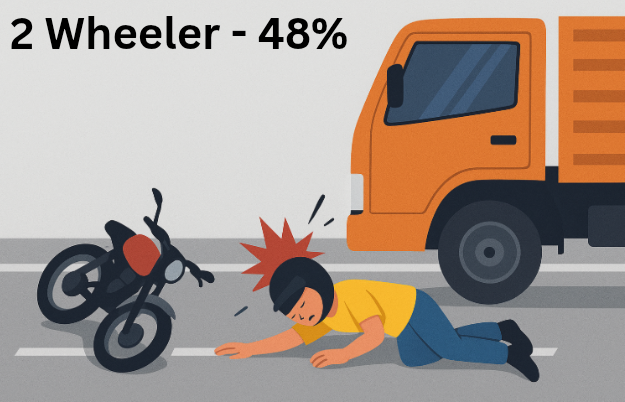
    • Two-wheeler riders: Nearly 44–48% of all victims.
    • Pedestrians: Ranging between 19–54% in various cities.
    • Others: Occupants of cars, buses, or cycles.

    Why so many two-wheelers?

    Two-wheelers dominate Indian roads, making up over 75% of registered vehicles. They are:

    • Most exposed and vulnerable: no airbags, no protective metal body.
    • Often hit by trucks and speeding cars, especially on highways and ring roads.
    • Victims of blind spots, over-speeding, and poor road design.
    • At night, poor visibility and lack of protective gear worsen the risks.

    When trucks or SUVs hit them, the result is usually fatal. And too often, the driver flees the scene, leaving a crushed bike and a lifeless rider behind. Many victims are delivery boys, daily wage earners, students, and office commuters—ordinary Indians carrying the nation’s backbone on their shoulders.


    Why Section 106(2) Was Put on Hold

    Section 106(2) of the BNS proposed stricter punishment—up to 10 years imprisonment and heavy fines for hit-and-run deaths. However, protests by truckers and transport unions forced the government to pause its implementation, citing livelihood concerns.

    But what about the livelihoods already destroyed by these deaths? A driver’s income cannot be valued higher than a victim’s life. Even 10 years is far too little compared to a life taken. If someone deliberately runs away after killing, the punishment should extend to the death penalty. Anything less sends the message that lives in India are cheap.

    The Bharatiya Nyaya Sanhita (BNS), 2023 is India’s new criminal law that came into effect on 1 July 2024, replacing the old Indian Penal Code (IPC), 1860. It was introduced by the Government of India to remove colonial-era laws and make the justice system more modern, clear, and people-friendly. The BNS has 358 sections (compared to 511 in IPC), uses simple and gender-neutral language, and adds new crimes like terrorism, organised crime, cyber fraud, mob lynching, and sexual exploitation by deceit.

    It also removes outdated provisions like sedition and introduces reforms such as community service for minor offences, higher punishments for serious crimes, and recognition of digital evidence—aiming to deliver faster and fairer justice. However, Section 106(2), which prescribes up to 10 years’ jail and fine for drivers who cause a fatal accident and then flee without reporting, has been kept on hold after protests by truckers and transport unions, who feared harassment and misuse.


    📌 Example 1 – Hit-and-run punished under 106(2)

    • A car hits a pedestrian at night.
    • The driver flees without calling an ambulance or reporting to police.
    • Under 106(2), this is treated as a serious offence with up to 10 years jail.

    📌 Example 2 – Driver stays and helps (not punished under 106(2))

    • A truck hits a motorcyclist.
    • The driver immediately calls an ambulance, informs police, and stays at the spot.
    • Even if the person dies, this driver will not face 106(2) punishment, because he took responsibility.

    Takeaway for Citizens:

    • 106(2) is meant to save lives by ensuring victims get immediate help.
    • It punishes only those who run away without reporting, not responsible drivers who try to help.

    🌍 Global Comparison – How India Lags Behind

    • United States: Hit-and-run resulting in death can lead to up to 20 years imprisonment (state laws vary, e.g., California up to 15 years, Florida up to 30 years).
    • United Kingdom: Causing death by dangerous driving (and fleeing) can bring life imprisonment.
    • Australia: Drivers who leave accident victims without help face up to 14 years imprisonment, with higher sentences if death occurs.
    • Singapore: Punishment includes up to life imprisonment and caning for fatal hit-and-run cases.

    Compared to this, India’s 5-year maximum punishment is shockingly lenient. Even with the proposed 10 years, we remain far behind global standards.


    Summary Table: Daily Road Fatalities by Country

    CountryYearAnnual DeathsEstimated Deaths Per Day
    India2024 est~180,000~493
    United States2023~40,990~112
    United Kingdom2023~1,695~5
    Germany2023~2,839~8
    Australia2024~1,300~3.6
    New Zealand2023~343~1

    Key Takeaways

    • India’s daily road fatalities (~493) far exceed those in higher-income countries—especially stark when compared to places like the US and UK.
    • This underscores the urgent need for stronger road safety measures, infrastructure improvements, and enforcement in India.

    What Must Be Done

    1. Implement Section 106(2) immediately with no dilution.
    2. Enhance punishment: Minimum 10 years imprisonment for fatal hit-and-runs—but for deliberate escape after death, capital punishment must be considered.
    3. Mandatory black-box/GPS tracking for heavy vehicles to prevent escape.
    4. Victim compensation fund, contributed by insurance + transport sector.
    5. Better road design: Dedicated two-wheeler and pedestrian safety lanes.
    6. Public awareness campaigns: To make drivers fear consequences and respect lives.

    Final Word to Policymakers

    Every day of delay costs nearing 500 Indian lives. Behind each number is a grieving family—parents who lost their child, children who lost their father, wives who lost their husbands. The pain is unbearable, and yet justice is denied.

    Five years is not justice. Ten years is not justice. Even ten years is an insult when a life has been stolen.

    Policymakers must rise above pressure from unions and vested interests. The message must be clear: if you kill and run, you cannot hide—your punishment will be as heavy as the life you took, even up to death penalty.


    🚨 Major Reasons for Road Deaths in India

    1. Over-Speeding (Top Killer)

    • Contributes to 65–70% of all road accident deaths in India.
    • High speed reduces reaction time and makes crashes far more fatal.

    2. Dangerous / Rash Driving

    • Wrong-side driving, sudden lane cuts, overtaking from left side.
    • Truck and bus drivers rushing deadlines often cause head-on crashes.

    3. Drunk Driving & Drug Influence

    • Even though enforcement has improved, alcohol- and substance-related crashes still account for 5–8% of fatalities.

    4. Distracted Driving (Mobile Phones, Earphones, GPS use)

    • Around 1 in 10 accidents now linked to phone usage.
    • Looking at WhatsApp or social media while riding/driving is becoming a silent killer.

    5. Not Wearing Helmets / Seatbelts

    • 43% of two-wheeler deaths in 2022 were due to lack of helmets.
    • Nearly 50% of car occupant deaths were due to not using seatbelts (especially rear passengers).

    6. Hit-and-Run Cases

    • Almost 30% of all road deaths in India are hit-and-run cases.
    • Trucks, buses, and speeding cars are the most common offenders.

    7. Poor Road Engineering

    • Sharp curves, potholes, unscientific speed breakers, poor signage, and badly lit junctions.
    • Many “black spots” (accident hot spots) remain unfixed for years.

    8. Heavy Vehicle Issues

    • Overloaded trucks, untrained drivers, mechanical failures (brakes, tyres).
    • Trucks running at night on highways are a major cause of two-wheeler fatalities.

    9. Pedestrian & Cyclist Neglect

    • India is not pedestrian-friendly. Lack of footpaths, zebra crossings, and underpasses leads to high pedestrian deaths.
    • Pedestrians account for ~15% of road deaths in India.

    10. Emergency Care Delay

    • Golden Hour (first 1 hour after crash) is often wasted.
    • Lack of ambulances, trauma centers, and bystander fear (police harassment) increases preventable deaths.

    📊 Snapshot (India – 2023 Data)

    • Over-speeding deaths: ~71% of fatalities
    • Driving on wrong side: ~6%
    • Use of mobile phones: ~2%
    • Drunken driving: ~3%
    • Other causes (fatigue, weather, etc.): remaining percentage

    👉 In short: speeding, lack of protective gear, poor enforcement, and bad road design are the biggest killers.


    🚓 Role of Traffic Police in Road Safety

    The traffic police play a central role in preventing accidents, saving lives, and ensuring smooth flow of vehicles. In the context of rising road accident deaths (like in 2025), their role becomes even more critical. Here’s a structured view:

    1. Enforcement of Laws

    • Enforce helmet, seatbelt, speed-limit, and drunk-driving laws.
    • Book offenders for rash driving, overloading, or dangerous overtaking.
    • Curb wrong-side driving and red-light jumping.

    2. Accident Prevention

    • Regular patrols at accident-prone spots (black spots).
    • Deployment of checkpoints on highways and ring roads.
    • Use of speed guns, CCTV, and ANPR cameras to deter violations.

    3. Emergency Response

    • First responders at accident sites.
    • Coordinate with ambulances and hospitals for the “Golden Hour” response to save lives.
    • Manage crowds and prevent mob violence against drivers.

    4. Data Collection & Analysis

    • Maintain accident data (location, time, cause, vehicle type).
    • Identify accident-prone stretches for corrective measures.
    • Share findings with city planners, NHAI, and municipal bodies.

    5. Public Awareness & Education

    • Conduct road safety campaigns in schools, colleges, and workplaces.
    • Encourage helmet use, reflective jackets, and child safety seats.
    • Promote “Don’t Drink and Drive” and “Respect Pedestrians” culture.

    6. Coordination with Other Agencies

    • Work with transport department for vehicle fitness & licensing.
    • Help city planners redesign junctions, signals, and crossings.
    • Collaborate with NGOs for safety workshops and victim support.

    7. Technology & Smart Policing

    • Use AI-based surveillance to detect violations.
    • E-challan systems for transparency.
    • GPS tracking for patrol vehicles to cover blind spots.

    ⚠️ Challenges Traffic Police Face

    • Shortage of manpower (India has ~1 traffic cop per 10,000 vehicles in many cities).
    • Lack of modern equipment in smaller towns.
    • Corruption and public perception issues.
    • Poor road infrastructure making enforcement difficult.

    ✅ Way Forward

    • Increase penalties and ensure strict enforcement without exceptions.
    • Better training and welfare for traffic personnel.
    • Adoption of smart traffic management systems.
    • Public cooperation—without citizen discipline, even the best traffic police cannot prevent accidents.

    ✅ Helmets Save Lives? How Much?
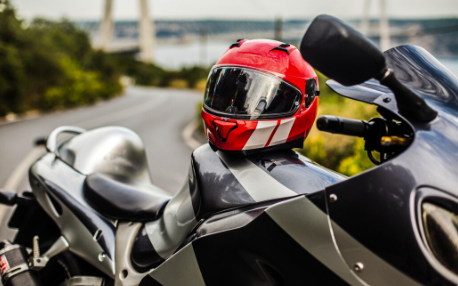
    National Emergency - Road Deaths - Helmet Protects

    A good ISI/DOT-certified helmet absorbs impact and reduces the force transmitted to the skull and brain.

    It prevents skull fractures, brain hemorrhage, and facial injuries in many crashes.

    According to WHO, wearing a helmet reduces the risk of head injury by 70% and death by 40%.


    ⚠️ Why Fatalities Can Still Occur

    1. Very High-Speed Impact
      • If a two-wheeler crashes at extreme speeds or is hit by a heavy vehicle (truck/bus), the force may exceed what a helmet can protect against.
    2. Multiple Collisions / Run-over Cases
      • In some accidents, even after the rider falls, they may get run over by another vehicle (common on highways and ring roads).
    3. Neck & Spine Injuries
      • A helmet protects the head, but not the cervical spine. Severe whiplash or neck fracture can still be fatal.
    4. Improper / Loose Strapping
      • Many riders wear helmets without fastening the chin strap. In a crash, it flies off, giving zero protection.
    5. Substandard Helmets
      • Cheap, non-ISI helmets or half-caps (so-called “designer helmets”) crack easily and don’t protect the skull properly.
    6. Side Impacts
      • A helmet mainly protects the top and front; a hard side hit (for example, against a truck bumper) can still cause brain injury.

    📊 India-Specific Data

    • About 47,000 two-wheeler riders died in India in 2022 (MoRTH data).
    • 43% of them were not wearing helmets.
    • But even among helmeted riders, fatalities occur—usually in truck/bus crashes, very high speeds, or run-over accidents.
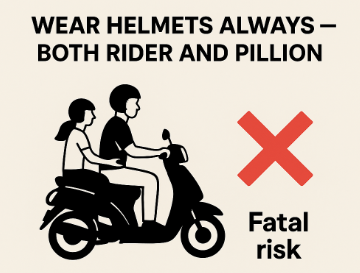
    National Emergency - Pillion - Not wearing helmet is risky

    Pillion (Back Seater) not wearing helmet is risky.

    Both Rider & Pillion should wear helmets!

    👉 Bottom line: Helmets are life-saving and must always be worn properly (full-face, ISI certified, strapped).
    But they aren’t foolproof—so speeding, drunk driving, and poor road design remain major risks even for helmeted riders.

    Read recent Sr Citizen fatal accident here. TOI references- Delhi data. 58% Sr Citizen hit-run-cases in Nagpur.


    🚛 Truck Design Risks That Cause Fatal Head Injuries

    Yes — in India, many trucks and lorries do have protruding parts or unsafe body structures that can cause fatal side-impact injuries, especially to two-wheelers and small cars:

    1. Protruding Iron Rods / Angle Irons
      • Often seen on illegally modified side walls of trucks.
      • These sharp edges act like blades when a bike or scooter brushes past → leading to severe head or chest injuries.
    2. Exposed Chassis & Axle Parts
      • Poorly maintained trucks sometimes have metal rods sticking out.
      • Even a small side swipe can throw a rider off balance into the truck’s rear tyres.
    3. Unprotected Side Underrun Areas
      • Unlike trucks in Europe/US, most Indian trucks lack side underrun protection bars (metal guards fitted to the sides to stop smaller vehicles from going underneath).
      • Without them, if a scooter or cycle hits the side, the rider can be dragged under the wheels → almost always fatal.
    4. Carrying Long Iron Rods / Pipes Without Rear Markings
      • Trucks carrying construction materials (iron rods, bamboo, poles) often have them sticking out several feet at the back or sides without red flags or lights.
      • At night, these are invisible and can pierce riders, causing instant death.
    5. Overloaded or Poorly Welded Side Panels
      • When overloaded, truck body sides sometimes bulge out, leaving sharp corners that can clip passing two-wheelers.

    🩸 Why Two-Wheeler Riders Are Most at Risk

    Head-level impact: The height of truck side panels often aligns with a biker’s head/shoulder, making head injuries common even if a helmet is worn.

    Close overtaking culture: On highways and ring roads (like Nagpur’s Ring Road), trucks unlawful overtaking from the left, brushing dangerously the bikers.

    Lack of side guards: In developed countries, side-guards are mandatory. In India, absence of these leads to “run-over” type fatalities.


    Policy Note:
    India does have a rule (CMVR 125C, Motor Vehicle Act) making side and rear underrun protection mandatory for trucks, but implementation is weak. Many older trucks and locally fabricated bodies skip it.


    🚨 Call to Action: Stopping India’s Silent Road Massacre

    1. Policymakers & Lawmakers

    • Enforce Section 106(2) of the Bharatiya Nyaya Sanhita (BNS): which mandates 7–10 years imprisonment for drivers who cause death in a hit-and-run without reporting the accident.
    • Question: Why is 106(2) currently on hold under industry pressure?human lives must come before truck lobby interests.
    • Amend 106(2) to make penalties harsher in fatal cases (life imprisonment or death penalty where gross negligence is proven).
    • Set up special road safety courts for fast-tracking hit-and-run cases.

    2. Traffic Police & Enforcement Agencies

    • Strictly implement Section 106(2) once activated — every hit-and-run must lead to a non-bailable offence.
    • Deploy checkpoints on highways and ring roads with instant accident-reporting protocols.
    • Strengthen AI-enabled CCTV and vehicle traceability systems so offenders cannot escape.

    3. Truck Owners & Transport Associations

    • Accept legal responsibility under 106(2) — companies must share liability, not just drivers.
    • Ensure no truck on the road has illegal protruding iron rods/angle irons that turn minor scrapes into instant deaths.
    • Train drivers that fleeing an accident only worsens punishment under 106(2).

    4. Media & Civil Society

    • Run campaigns explaining why Section 106(2) is critical to saving lives.
    • Ask hard questions: Why should victims’ families suffer lifelong pain while offenders walk free after just 5 years?
    • Keep spotlight on families devastated by hit-and-runs, linking their loss to weak enforcement of 106(2).

    5. Citizens & Road Users

    • Support full implementation of Section 106(2)—demand stricter justice for offenders.
    • Do not flee accident scenes — reporting is your duty and could save a life.
    • Pressure elected representatives: “Will you stand with grieving families or with the truck lobby blocking 106(2)?”
    • Ensure helmets are ISI-certified, properly strapped, not cosmetic half-caps.
    • Follow lane discipline, avoid speeding, and never drive against traffic — most two-wheeler crashes are with heavy vehicles like trucks and buses.
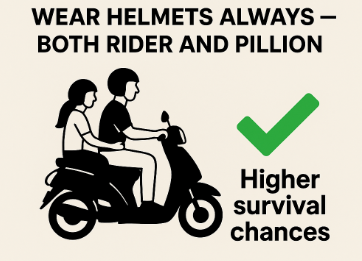
    National Emergency - Both Rider & Pillion wearing Helmets


    Wear helmets always — both rider and pillion.
    As per MoRTH data, over 70% of two-wheeler deaths in India are due to not wearing helmets.
    In 2022 alone, 46,000+ two-wheeler riders and pillion passengers died because of this negligence.


    👉 Final Appeal:
    India loses nearly 500 lives every single day in road crashes. Most are pedestrians, two-wheeler riders, and poor families who never get justice. Section 106(2) was designed to deter hit-and-runs—but it remains suspended.

    Every day of delay means dozens more families destroyed, children orphaned, women widowed, parents left alone.
    If the government is serious about valuing life, 106(2) must be enforced—and made even stricter.

    ⚖️ “A life lost cannot be replaced. Five years, ten years—even that feels less. If someone kills and flees, knowing they took a life—the law must weigh it as heavily as murder.”

  • 🚨 National Emergency: Nearly 500 Daily Road Deaths in India – Call for Stricter Hit-and-Run Justice!

    🚨 National Emergency: Nearly 500 Daily Road Deaths in India – Call for Stricter Hit-and-Run Justice!


    Road Deaths: India

    It’s National Emergency -nearly 500 road deaths every day, Indian roads turn into graveyards for innocent lives. The tragedy is not just in the sheer numbers, but in the way perpetrators of hit-and-run cases escape with minimal punishment. Under the current framework, even when a life is lost, truck or car drivers who flee often face only five years imprisonment under Section 304A IPC. With the much-needed Section 106(2) of the Bharatiya Nyaya Sanhita (BNS) on hold after protests, victims and their families continue to be denied justice. Policymakers must act—five years is not enough for killing someone and running away.


    The Alarming Numbers

    • In 2022, India recorded 47,806 hit-and-run cases, resulting in 50,815 deaths—an average of six deaths every hour.
    • In 2023, in cities like Mumbai, hit-and-run crashes accounted for 38% of all road fatalities.
    • Preliminary data for 2025 already suggests a worrying upward trend, with thousands of cases being logged in the first half of the year across major cities.

    This is not just a statistic—it means hundreds of families are destroyed every single day.


    Who Are the Victims?

    The majority of hit-and-run deaths involve:

    • Two-wheeler riders: Nearly 44–48% of all victims.
    • Pedestrians: Ranging between 19–54% in various cities.
    • Others: Occupants of cars, buses, or cycles.

    Why so many two-wheelers?

    Two-wheelers dominate Indian roads, making up over 75% of registered vehicles. They are:

    • Most exposed and vulnerable: no airbags, no protective metal body.
    • Often hit by trucks and speeding cars, especially on highways and ring roads.
    • Victims of blind spots, over-speeding, and poor road design.
    • At night, poor visibility and lack of protective gear worsen the risks.

    When trucks or SUVs hit them, the result is usually fatal. And too often, the driver flees the scene, leaving a crushed bike and a lifeless rider behind. Many victims are delivery boys, daily wage earners, students, and office commuters—ordinary Indians carrying the nation’s backbone on their shoulders.


    Why Section 106(2) Was Put on Hold

    Section 106(2) of the BNS proposed stricter punishment—up to 10 years imprisonment and heavy fines for hit-and-run deaths. However, protests by truckers and transport unions forced the government to pause its implementation, citing livelihood concerns.

    But what about the livelihoods already destroyed by these deaths? A driver’s income cannot be valued higher than a victim’s life. Even 10 years is far too little compared to a life taken. If someone deliberately runs away after killing, the punishment should extend to the death penalty. Anything less sends the message that lives in India are cheap.

    The Bharatiya Nyaya Sanhita (BNS), 2023 is India’s new criminal law that came into effect on 1 July 2024, replacing the old Indian Penal Code (IPC), 1860. It was introduced by the Government of India to remove colonial-era laws and make the justice system more modern, clear, and people-friendly. The BNS has 358 sections (compared to 511 in IPC), uses simple and gender-neutral language, and adds new crimes like terrorism, organised crime, cyber fraud, mob lynching, and sexual exploitation by deceit.

    It also removes outdated provisions like sedition and introduces reforms such as community service for minor offences, higher punishments for serious crimes, and recognition of digital evidence—aiming to deliver faster and fairer justice. However, Section 106(2), which prescribes up to 10 years’ jail and fine for drivers who cause a fatal accident and then flee without reporting, has been kept on hold after protests by truckers and transport unions, who feared harassment and misuse.


    📌 Example 1 – Hit-and-run punished under 106(2)

    • A car hits a pedestrian at night.
    • The driver flees without calling an ambulance or reporting to police.
    • Under 106(2), this is treated as a serious offence with up to 10 years jail.

    📌 Example 2 – Driver stays and helps (not punished under 106(2))

    • A truck hits a motorcyclist.
    • The driver immediately calls an ambulance, informs police, and stays at the spot.
    • Even if the person dies, this driver will not face 106(2) punishment, because he took responsibility.

    Takeaway for Citizens:

    • 106(2) is meant to save lives by ensuring victims get immediate help.
    • It punishes only those who run away without reporting, not responsible drivers who try to help.

    🌍 Global Comparison – How India Lags Behind

    • United States: Hit-and-run resulting in death can lead to up to 20 years imprisonment (state laws vary, e.g., California up to 15 years, Florida up to 30 years).
    • United Kingdom: Causing death by dangerous driving (and fleeing) can bring life imprisonment.
    • Australia: Drivers who leave accident victims without help face up to 14 years imprisonment, with higher sentences if death occurs.
    • Singapore: Punishment includes up to life imprisonment and caning for fatal hit-and-run cases.

    Compared to this, India’s 5-year maximum punishment is shockingly lenient. Even with the proposed 10 years, we remain far behind global standards.


    Summary Table: Daily Road Fatalities by Country

    CountryYearAnnual DeathsEstimated Deaths Per Day
    India2024 est~180,000~493
    United States2023~40,990~112
    United Kingdom2023~1,695~5
    Germany2023~2,839~8
    Australia2024~1,300~3.6
    New Zealand2023~343~1

    Key Takeaways

    • India’s daily road fatalities (~493) far exceed those in higher-income countries—especially stark when compared to places like the US and UK.
    • This underscores the urgent need for stronger road safety measures, infrastructure improvements, and enforcement in India.

    What Must Be Done

    1. Implement Section 106(2) immediately with no dilution.
    2. Enhance punishment: Minimum 10 years imprisonment for fatal hit-and-runs—but for deliberate escape after death, capital punishment must be considered.
    3. Mandatory black-box/GPS tracking for heavy vehicles to prevent escape.
    4. Victim compensation fund, contributed by insurance + transport sector.
    5. Better road design: Dedicated two-wheeler and pedestrian safety lanes.
    6. Public awareness campaigns: To make drivers fear consequences and respect lives.

    Final Word to Policymakers

    Every day of delay costs nearing 500 Indian lives. Behind each number is a grieving family—parents who lost their child, children who lost their father, wives who lost their husbands. The pain is unbearable, and yet justice is denied.

    Five years is not justice. Ten years is not justice. Even ten years is an insult when a life has been stolen.

    Policymakers must rise above pressure from unions and vested interests. The message must be clear: if you kill and run, you cannot hide—your punishment will be as heavy as the life you took, even up to death penalty.


    🚨 Major Reasons for Road Deaths in India

    1. Over-Speeding (Top Killer)

    • Contributes to 65–70% of all road accident deaths in India.
    • High speed reduces reaction time and makes crashes far more fatal.

    2. Dangerous / Rash Driving

    • Wrong-side driving, sudden lane cuts, overtaking from left side.
    • Truck and bus drivers rushing deadlines often cause head-on crashes.

    3. Drunk Driving & Drug Influence

    • Even though enforcement has improved, alcohol- and substance-related crashes still account for 5–8% of fatalities.

    4. Distracted Driving (Mobile Phones, Earphones, GPS use)

    • Around 1 in 10 accidents now linked to phone usage.
    • Looking at WhatsApp or social media while riding/driving is becoming a silent killer.

    5. Not Wearing Helmets / Seatbelts

    • 43% of two-wheeler deaths in 2022 were due to lack of helmets.
    • Nearly 50% of car occupant deaths were due to not using seatbelts (especially rear passengers).

    6. Hit-and-Run Cases

    • Almost 30% of all road deaths in India are hit-and-run cases.
    • Trucks, buses, and speeding cars are the most common offenders.

    7. Poor Road Engineering

    • Sharp curves, potholes, unscientific speed breakers, poor signage, and badly lit junctions.
    • Many “black spots” (accident hot spots) remain unfixed for years.

    8. Heavy Vehicle Issues

    • Overloaded trucks, untrained drivers, mechanical failures (brakes, tyres).
    • Trucks running at night on highways are a major cause of two-wheeler fatalities.

    9. Pedestrian & Cyclist Neglect

    • India is not pedestrian-friendly. Lack of footpaths, zebra crossings, and underpasses leads to high pedestrian deaths.
    • Pedestrians account for ~15% of road deaths in India.

    10. Emergency Care Delay

    • Golden Hour (first 1 hour after crash) is often wasted.
    • Lack of ambulances, trauma centers, and bystander fear (police harassment) increases preventable deaths.

    📊 Snapshot (India – 2023 Data)

    • Over-speeding deaths: ~71% of fatalities
    • Driving on wrong side: ~6%
    • Use of mobile phones: ~2%
    • Drunken driving: ~3%
    • Other causes (fatigue, weather, etc.): remaining percentage

    👉 In short: speeding, lack of protective gear, poor enforcement, and bad road design are the biggest killers.


    🚓 Role of Traffic Police in Road Safety

    The traffic police play a central role in preventing accidents, saving lives, and ensuring smooth flow of vehicles. In the context of rising road accident deaths (like in 2025), their role becomes even more critical. Here’s a structured view:

    1. Enforcement of Laws

    • Enforce helmet, seatbelt, speed-limit, and drunk-driving laws.
    • Book offenders for rash driving, overloading, or dangerous overtaking.
    • Curb wrong-side driving and red-light jumping.

    2. Accident Prevention

    • Regular patrols at accident-prone spots (black spots).
    • Deployment of checkpoints on highways and ring roads.
    • Use of speed guns, CCTV, and ANPR cameras to deter violations.

    3. Emergency Response

    • First responders at accident sites.
    • Coordinate with ambulances and hospitals for the “Golden Hour” response to save lives.
    • Manage crowds and prevent mob violence against drivers.

    4. Data Collection & Analysis

    • Maintain accident data (location, time, cause, vehicle type).
    • Identify accident-prone stretches for corrective measures.
    • Share findings with city planners, NHAI, and municipal bodies.

    5. Public Awareness & Education

    • Conduct road safety campaigns in schools, colleges, and workplaces.
    • Encourage helmet use, reflective jackets, and child safety seats.
    • Promote “Don’t Drink and Drive” and “Respect Pedestrians” culture.

    6. Coordination with Other Agencies

    • Work with transport department for vehicle fitness & licensing.
    • Help city planners redesign junctions, signals, and crossings.
    • Collaborate with NGOs for safety workshops and victim support.

    7. Technology & Smart Policing

    • Use AI-based surveillance to detect violations.
    • E-challan systems for transparency.
    • GPS tracking for patrol vehicles to cover blind spots.

    ⚠️ Challenges Traffic Police Face

    • Shortage of manpower (India has ~1 traffic cop per 10,000 vehicles in many cities).
    • Lack of modern equipment in smaller towns.
    • Corruption and public perception issues.
    • Poor road infrastructure making enforcement difficult.

    ✅ Way Forward

    • Increase penalties and ensure strict enforcement without exceptions.
    • Better training and welfare for traffic personnel.
    • Adoption of smart traffic management systems.
    • Public cooperation—without citizen discipline, even the best traffic police cannot prevent accidents.

    ✅ Helmets Save Lives? How Much?

    National Emergency - Road Deaths - Helmet Protects

    A good ISI/DOT-certified helmet absorbs impact and reduces the force transmitted to the skull and brain.

    It prevents skull fractures, brain hemorrhage, and facial injuries in many crashes.

    According to WHO, wearing a helmet reduces the risk of head injury by 70% and death by 40%.


    ⚠️ Why Fatalities Can Still Occur

    1. Very High-Speed Impact
      • If a two-wheeler crashes at extreme speeds or is hit by a heavy vehicle (truck/bus), the force may exceed what a helmet can protect against.
    2. Multiple Collisions / Run-over Cases
      • In some accidents, even after the rider falls, they may get run over by another vehicle (common on highways and ring roads).
    3. Neck & Spine Injuries
      • A helmet protects the head, but not the cervical spine. Severe whiplash or neck fracture can still be fatal.
    4. Improper / Loose Strapping
      • Many riders wear helmets without fastening the chin strap. In a crash, it flies off, giving zero protection.
    5. Substandard Helmets
      • Cheap, non-ISI helmets or half-caps (so-called “designer helmets”) crack easily and don’t protect the skull properly.
    6. Side Impacts
      • A helmet mainly protects the top and front; a hard side hit (for example, against a truck bumper) can still cause brain injury.

    📊 India-Specific Data

    • About 47,000 two-wheeler riders died in India in 2022 (MoRTH data).
    • 43% of them were not wearing helmets.
    • But even among helmeted riders, fatalities occur—usually in truck/bus crashes, very high speeds, or run-over accidents.

    National Emergency - Pillion - Not wearing helmet is risky

    Pillion (Back Seater) not wearing helmet is risky.

    Both Rider & Pillion should wear helmets!

    👉 Bottom line: Helmets are life-saving and must always be worn properly (full-face, ISI certified, strapped).
    But they aren’t foolproof—so speeding, drunk driving, and poor road design remain major risks even for helmeted riders.

    Read recent Sr Citizen fatal accident here. TOI references- Delhi data. 58% Sr Citizen hit-run-cases in Nagpur.


    🚛 Truck Design Risks That Cause Fatal Head Injuries

    Yes — in India, many trucks and lorries do have protruding parts or unsafe body structures that can cause fatal side-impact injuries, especially to two-wheelers and small cars:

    1. Protruding Iron Rods / Angle Irons
      • Often seen on illegally modified side walls of trucks.
      • These sharp edges act like blades when a bike or scooter brushes past → leading to severe head or chest injuries.
    2. Exposed Chassis & Axle Parts
      • Poorly maintained trucks sometimes have metal rods sticking out.
      • Even a small side swipe can throw a rider off balance into the truck’s rear tyres.
    3. Unprotected Side Underrun Areas
      • Unlike trucks in Europe/US, most Indian trucks lack side underrun protection bars (metal guards fitted to the sides to stop smaller vehicles from going underneath).
      • Without them, if a scooter or cycle hits the side, the rider can be dragged under the wheels → almost always fatal.
    4. Carrying Long Iron Rods / Pipes Without Rear Markings
      • Trucks carrying construction materials (iron rods, bamboo, poles) often have them sticking out several feet at the back or sides without red flags or lights.
      • At night, these are invisible and can pierce riders, causing instant death.
    5. Overloaded or Poorly Welded Side Panels
      • When overloaded, truck body sides sometimes bulge out, leaving sharp corners that can clip passing two-wheelers.

    🩸 Why Two-Wheeler Riders Are Most at Risk

    Head-level impact: The height of truck side panels often aligns with a biker’s head/shoulder, making head injuries common even if a helmet is worn.

    Close overtaking culture: On highways and ring roads (like Nagpur’s Ring Road), trucks unlawful overtaking from the left, brushing dangerously the bikers.

    Lack of side guards: In developed countries, side-guards are mandatory. In India, absence of these leads to “run-over” type fatalities.


    Policy Note:
    India does have a rule (CMVR 125C, Motor Vehicle Act) making side and rear underrun protection mandatory for trucks, but implementation is weak. Many older trucks and locally fabricated bodies skip it.


    🚨 Call to Action: Stopping India’s Silent Road Massacre

    1. Policymakers & Lawmakers

    • Enforce Section 106(2) of the Bharatiya Nyaya Sanhita (BNS): which mandates 7–10 years imprisonment for drivers who cause death in a hit-and-run without reporting the accident.
    • Question: Why is 106(2) currently on hold under industry pressure?human lives must come before truck lobby interests.
    • Amend 106(2) to make penalties harsher in fatal cases (life imprisonment or death penalty where gross negligence is proven).
    • Set up special road safety courts for fast-tracking hit-and-run cases.

    2. Traffic Police & Enforcement Agencies

    • Strictly implement Section 106(2) once activated — every hit-and-run must lead to a non-bailable offence.
    • Deploy checkpoints on highways and ring roads with instant accident-reporting protocols.
    • Strengthen AI-enabled CCTV and vehicle traceability systems so offenders cannot escape.

    3. Truck Owners & Transport Associations

    • Accept legal responsibility under 106(2) — companies must share liability, not just drivers.
    • Ensure no truck on the road has illegal protruding iron rods/angle irons that turn minor scrapes into instant deaths.
    • Train drivers that fleeing an accident only worsens punishment under 106(2).

    4. Media & Civil Society

    • Run campaigns explaining why Section 106(2) is critical to saving lives.
    • Ask hard questions: Why should victims’ families suffer lifelong pain while offenders walk free after just 5 years?
    • Keep spotlight on families devastated by hit-and-runs, linking their loss to weak enforcement of 106(2).

    5. Citizens & Road Users

    • Support full implementation of Section 106(2)—demand stricter justice for offenders.
    • Do not flee accident scenes — reporting is your duty and could save a life.
    • Pressure elected representatives: “Will you stand with grieving families or with the truck lobby blocking 106(2)?”
    • Ensure helmets are ISI-certified, properly strapped, not cosmetic half-caps.
    • Follow lane discipline, avoid speeding, and never drive against traffic — most two-wheeler crashes are with heavy vehicles like trucks and buses.
    National Emergency - Both Rider & Pillion wearing Helmets


    Wear helmets always — both rider and pillion.
    As per MoRTH data, over 70% of two-wheeler deaths in India are due to not wearing helmets.
    In 2022 alone, 46,000+ two-wheeler riders and pillion passengers died because of this negligence.


    👉 Final Appeal:
    India loses nearly 500 lives every single day in road crashes. Most are pedestrians, two-wheeler riders, and poor families who never get justice. Section 106(2) was designed to deter hit-and-runs—but it remains suspended.

    Every day of delay means dozens more families destroyed, children orphaned, women widowed, parents left alone.
    If the government is serious about valuing life, 106(2) must be enforced—and made even stricter.

    ⚖️ “A life lost cannot be replaced. Five years, ten years—even that feels less. If someone kills and flees, knowing they took a life—the law must weigh it as heavily as murder.”
  • 🚨 National Emergency: Nearly 500 Daily Road Deaths in India – Call for Stricter Hit-and-Run Justice!

    🚨 National Emergency: Nearly 500 Daily Road Deaths in India – Call for Stricter Hit-and-Run Justice!


    Road Deaths: India

    It’s National Emergency -nearly 500 road deaths every day, Indian roads turn into graveyards for innocent lives. The tragedy is not just in the sheer numbers, but in the way perpetrators of hit-and-run cases escape with minimal punishment. Under the current framework, even when a life is lost, truck or car drivers who flee often face only five years imprisonment under Section 304A IPC. With the much-needed Section 106(2) of the Bharatiya Nyaya Sanhita (BNS) on hold after protests, victims and their families continue to be denied justice. Policymakers must act—five years is not enough for killing someone and running away.


    The Alarming Numbers

    • In 2022, India recorded 47,806 hit-and-run cases, resulting in 50,815 deaths—an average of six deaths every hour.
    • In 2023, in cities like Mumbai, hit-and-run crashes accounted for 38% of all road fatalities.
    • Preliminary data for 2025 already suggests a worrying upward trend, with thousands of cases being logged in the first half of the year across major cities.

    This is not just a statistic—it means hundreds of families are destroyed every single day.


    Who Are the Victims?

    The majority of hit-and-run deaths involve:

    • Two-wheeler riders: Nearly 44–48% of all victims.
    • Pedestrians: Ranging between 19–54% in various cities.
    • Others: Occupants of cars, buses, or cycles.

    Why so many two-wheelers?

    Two-wheelers dominate Indian roads, making up over 75% of registered vehicles. They are:

    • Most exposed and vulnerable: no airbags, no protective metal body.
    • Often hit by trucks and speeding cars, especially on highways and ring roads.
    • Victims of blind spots, over-speeding, and poor road design.
    • At night, poor visibility and lack of protective gear worsen the risks.

    When trucks or SUVs hit them, the result is usually fatal. And too often, the driver flees the scene, leaving a crushed bike and a lifeless rider behind. Many victims are delivery boys, daily wage earners, students, and office commuters—ordinary Indians carrying the nation’s backbone on their shoulders.


    Why Section 106(2) Was Put on Hold

    Section 106(2) of the BNS proposed stricter punishment—up to 10 years imprisonment and heavy fines for hit-and-run deaths. However, protests by truckers and transport unions forced the government to pause its implementation, citing livelihood concerns.

    But what about the livelihoods already destroyed by these deaths? A driver’s income cannot be valued higher than a victim’s life. Even 10 years is far too little compared to a life taken. If someone deliberately runs away after killing, the punishment should extend to the death penalty. Anything less sends the message that lives in India are cheap.

    The Bharatiya Nyaya Sanhita (BNS), 2023 is India’s new criminal law that came into effect on 1 July 2024, replacing the old Indian Penal Code (IPC), 1860. It was introduced by the Government of India to remove colonial-era laws and make the justice system more modern, clear, and people-friendly. The BNS has 358 sections (compared to 511 in IPC), uses simple and gender-neutral language, and adds new crimes like terrorism, organised crime, cyber fraud, mob lynching, and sexual exploitation by deceit.

    It also removes outdated provisions like sedition and introduces reforms such as community service for minor offences, higher punishments for serious crimes, and recognition of digital evidence—aiming to deliver faster and fairer justice. However, Section 106(2), which prescribes up to 10 years’ jail and fine for drivers who cause a fatal accident and then flee without reporting, has been kept on hold after protests by truckers and transport unions, who feared harassment and misuse.


    📌 Example 1 – Hit-and-run punished under 106(2)

    • A car hits a pedestrian at night.
    • The driver flees without calling an ambulance or reporting to police.
    • Under 106(2), this is treated as a serious offence with up to 10 years jail.

    📌 Example 2 – Driver stays and helps (not punished under 106(2))

    • A truck hits a motorcyclist.
    • The driver immediately calls an ambulance, informs police, and stays at the spot.
    • Even if the person dies, this driver will not face 106(2) punishment, because he took responsibility.

    Takeaway for Citizens:

    • 106(2) is meant to save lives by ensuring victims get immediate help.
    • It punishes only those who run away without reporting, not responsible drivers who try to help.

    🌍 Global Comparison – How India Lags Behind

    • United States: Hit-and-run resulting in death can lead to up to 20 years imprisonment (state laws vary, e.g., California up to 15 years, Florida up to 30 years).
    • United Kingdom: Causing death by dangerous driving (and fleeing) can bring life imprisonment.
    • Australia: Drivers who leave accident victims without help face up to 14 years imprisonment, with higher sentences if death occurs.
    • Singapore: Punishment includes up to life imprisonment and caning for fatal hit-and-run cases.

    Compared to this, India’s 5-year maximum punishment is shockingly lenient. Even with the proposed 10 years, we remain far behind global standards.


    Summary Table: Daily Road Fatalities by Country

    CountryYearAnnual DeathsEstimated Deaths Per Day
    India2024 est~180,000~493
    United States2023~40,990~112
    United Kingdom2023~1,695~5
    Germany2023~2,839~8
    Australia2024~1,300~3.6
    New Zealand2023~343~1

    Key Takeaways

    • India’s daily road fatalities (~493) far exceed those in higher-income countries—especially stark when compared to places like the US and UK.
    • This underscores the urgent need for stronger road safety measures, infrastructure improvements, and enforcement in India.

    What Must Be Done

    1. Implement Section 106(2) immediately with no dilution.
    2. Enhance punishment: Minimum 10 years imprisonment for fatal hit-and-runs—but for deliberate escape after death, capital punishment must be considered.
    3. Mandatory black-box/GPS tracking for heavy vehicles to prevent escape.
    4. Victim compensation fund, contributed by insurance + transport sector.
    5. Better road design: Dedicated two-wheeler and pedestrian safety lanes.
    6. Public awareness campaigns: To make drivers fear consequences and respect lives.

    Final Word to Policymakers

    Every day of delay costs nearing 500 Indian lives. Behind each number is a grieving family—parents who lost their child, children who lost their father, wives who lost their husbands. The pain is unbearable, and yet justice is denied.

    Five years is not justice. Ten years is not justice. Even ten years is an insult when a life has been stolen.

    Policymakers must rise above pressure from unions and vested interests. The message must be clear: if you kill and run, you cannot hide—your punishment will be as heavy as the life you took, even up to death penalty.


    🚨 Major Reasons for Road Deaths in India

    1. Over-Speeding (Top Killer)

    • Contributes to 65–70% of all road accident deaths in India.
    • High speed reduces reaction time and makes crashes far more fatal.

    2. Dangerous / Rash Driving

    • Wrong-side driving, sudden lane cuts, overtaking from left side.
    • Truck and bus drivers rushing deadlines often cause head-on crashes.

    3. Drunk Driving & Drug Influence

    • Even though enforcement has improved, alcohol- and substance-related crashes still account for 5–8% of fatalities.

    4. Distracted Driving (Mobile Phones, Earphones, GPS use)

    • Around 1 in 10 accidents now linked to phone usage.
    • Looking at WhatsApp or social media while riding/driving is becoming a silent killer.

    5. Not Wearing Helmets / Seatbelts

    • 43% of two-wheeler deaths in 2022 were due to lack of helmets.
    • Nearly 50% of car occupant deaths were due to not using seatbelts (especially rear passengers).

    6. Hit-and-Run Cases

    • Almost 30% of all road deaths in India are hit-and-run cases.
    • Trucks, buses, and speeding cars are the most common offenders.

    7. Poor Road Engineering

    • Sharp curves, potholes, unscientific speed breakers, poor signage, and badly lit junctions.
    • Many “black spots” (accident hot spots) remain unfixed for years.

    8. Heavy Vehicle Issues

    • Overloaded trucks, untrained drivers, mechanical failures (brakes, tyres).
    • Trucks running at night on highways are a major cause of two-wheeler fatalities.

    9. Pedestrian & Cyclist Neglect

    • India is not pedestrian-friendly. Lack of footpaths, zebra crossings, and underpasses leads to high pedestrian deaths.
    • Pedestrians account for ~15% of road deaths in India.

    10. Emergency Care Delay

    • Golden Hour (first 1 hour after crash) is often wasted.
    • Lack of ambulances, trauma centers, and bystander fear (police harassment) increases preventable deaths.

    📊 Snapshot (India – 2023 Data)

    • Over-speeding deaths: ~71% of fatalities
    • Driving on wrong side: ~6%
    • Use of mobile phones: ~2%
    • Drunken driving: ~3%
    • Other causes (fatigue, weather, etc.): remaining percentage

    👉 In short: speeding, lack of protective gear, poor enforcement, and bad road design are the biggest killers.


    🚓 Role of Traffic Police in Road Safety

    The traffic police play a central role in preventing accidents, saving lives, and ensuring smooth flow of vehicles. In the context of rising road accident deaths (like in 2025), their role becomes even more critical. Here’s a structured view:

    1. Enforcement of Laws

    • Enforce helmet, seatbelt, speed-limit, and drunk-driving laws.
    • Book offenders for rash driving, overloading, or dangerous overtaking.
    • Curb wrong-side driving and red-light jumping.

    2. Accident Prevention

    • Regular patrols at accident-prone spots (black spots).
    • Deployment of checkpoints on highways and ring roads.
    • Use of speed guns, CCTV, and ANPR cameras to deter violations.

    3. Emergency Response

    • First responders at accident sites.
    • Coordinate with ambulances and hospitals for the “Golden Hour” response to save lives.
    • Manage crowds and prevent mob violence against drivers.

    4. Data Collection & Analysis

    • Maintain accident data (location, time, cause, vehicle type).
    • Identify accident-prone stretches for corrective measures.
    • Share findings with city planners, NHAI, and municipal bodies.

    5. Public Awareness & Education

    • Conduct road safety campaigns in schools, colleges, and workplaces.
    • Encourage helmet use, reflective jackets, and child safety seats.
    • Promote “Don’t Drink and Drive” and “Respect Pedestrians” culture.

    6. Coordination with Other Agencies

    • Work with transport department for vehicle fitness & licensing.
    • Help city planners redesign junctions, signals, and crossings.
    • Collaborate with NGOs for safety workshops and victim support.

    7. Technology & Smart Policing

    • Use AI-based surveillance to detect violations.
    • E-challan systems for transparency.
    • GPS tracking for patrol vehicles to cover blind spots.

    ⚠️ Challenges Traffic Police Face

    • Shortage of manpower (India has ~1 traffic cop per 10,000 vehicles in many cities).
    • Lack of modern equipment in smaller towns.
    • Corruption and public perception issues.
    • Poor road infrastructure making enforcement difficult.

    ✅ Way Forward

    • Increase penalties and ensure strict enforcement without exceptions.
    • Better training and welfare for traffic personnel.
    • Adoption of smart traffic management systems.
    • Public cooperation—without citizen discipline, even the best traffic police cannot prevent accidents.

    ✅ Helmets Save Lives? How Much?

    National Emergency - Road Deaths - Helmet Protects

    A good ISI/DOT-certified helmet absorbs impact and reduces the force transmitted to the skull and brain.

    It prevents skull fractures, brain hemorrhage, and facial injuries in many crashes.

    According to WHO, wearing a helmet reduces the risk of head injury by 70% and death by 40%.


    ⚠️ Why Fatalities Can Still Occur

    1. Very High-Speed Impact
      • If a two-wheeler crashes at extreme speeds or is hit by a heavy vehicle (truck/bus), the force may exceed what a helmet can protect against.
    2. Multiple Collisions / Run-over Cases
      • In some accidents, even after the rider falls, they may get run over by another vehicle (common on highways and ring roads).
    3. Neck & Spine Injuries
      • A helmet protects the head, but not the cervical spine. Severe whiplash or neck fracture can still be fatal.
    4. Improper / Loose Strapping
      • Many riders wear helmets without fastening the chin strap. In a crash, it flies off, giving zero protection.
    5. Substandard Helmets
      • Cheap, non-ISI helmets or half-caps (so-called “designer helmets”) crack easily and don’t protect the skull properly.
    6. Side Impacts
      • A helmet mainly protects the top and front; a hard side hit (for example, against a truck bumper) can still cause brain injury.

    📊 India-Specific Data

    • About 47,000 two-wheeler riders died in India in 2022 (MoRTH data).
    • 43% of them were not wearing helmets.
    • But even among helmeted riders, fatalities occur—usually in truck/bus crashes, very high speeds, or run-over accidents.

    National Emergency - Pillion - Not wearing helmet is risky

    Pillion (Back Seater) not wearing helmet is risky.

    Both Rider & Pillion should wear helmets!

    👉 Bottom line: Helmets are life-saving and must always be worn properly (full-face, ISI certified, strapped).
    But they aren’t foolproof—so speeding, drunk driving, and poor road design remain major risks even for helmeted riders.

    Read recent Sr Citizen fatal accident here. TOI references- Delhi data. 58% Sr Citizen hit-run-cases in Nagpur.


    🚛 Truck Design Risks That Cause Fatal Head Injuries

    Yes — in India, many trucks and lorries do have protruding parts or unsafe body structures that can cause fatal side-impact injuries, especially to two-wheelers and small cars:

    1. Protruding Iron Rods / Angle Irons
      • Often seen on illegally modified side walls of trucks.
      • These sharp edges act like blades when a bike or scooter brushes past → leading to severe head or chest injuries.
    2. Exposed Chassis & Axle Parts
      • Poorly maintained trucks sometimes have metal rods sticking out.
      • Even a small side swipe can throw a rider off balance into the truck’s rear tyres.
    3. Unprotected Side Underrun Areas
      • Unlike trucks in Europe/US, most Indian trucks lack side underrun protection bars (metal guards fitted to the sides to stop smaller vehicles from going underneath).
      • Without them, if a scooter or cycle hits the side, the rider can be dragged under the wheels → almost always fatal.
    4. Carrying Long Iron Rods / Pipes Without Rear Markings
      • Trucks carrying construction materials (iron rods, bamboo, poles) often have them sticking out several feet at the back or sides without red flags or lights.
      • At night, these are invisible and can pierce riders, causing instant death.
    5. Overloaded or Poorly Welded Side Panels
      • When overloaded, truck body sides sometimes bulge out, leaving sharp corners that can clip passing two-wheelers.

    🩸 Why Two-Wheeler Riders Are Most at Risk

    Head-level impact: The height of truck side panels often aligns with a biker’s head/shoulder, making head injuries common even if a helmet is worn.

    Close overtaking culture: On highways and ring roads (like Nagpur’s Ring Road), trucks unlawful overtaking from the left, brushing dangerously the bikers.

    Lack of side guards: In developed countries, side-guards are mandatory. In India, absence of these leads to “run-over” type fatalities.


    Policy Note:
    India does have a rule (CMVR 125C, Motor Vehicle Act) making side and rear underrun protection mandatory for trucks, but implementation is weak. Many older trucks and locally fabricated bodies skip it.


    🚨 Call to Action: Stopping India’s Silent Road Massacre

    1. Policymakers & Lawmakers

    • Enforce Section 106(2) of the Bharatiya Nyaya Sanhita (BNS): which mandates 7–10 years imprisonment for drivers who cause death in a hit-and-run without reporting the accident.
    • Question: Why is 106(2) currently on hold under industry pressure?human lives must come before truck lobby interests.
    • Amend 106(2) to make penalties harsher in fatal cases (life imprisonment or death penalty where gross negligence is proven).
    • Set up special road safety courts for fast-tracking hit-and-run cases.

    2. Traffic Police & Enforcement Agencies

    • Strictly implement Section 106(2) once activated — every hit-and-run must lead to a non-bailable offence.
    • Deploy checkpoints on highways and ring roads with instant accident-reporting protocols.
    • Strengthen AI-enabled CCTV and vehicle traceability systems so offenders cannot escape.

    3. Truck Owners & Transport Associations

    • Accept legal responsibility under 106(2) — companies must share liability, not just drivers.
    • Ensure no truck on the road has illegal protruding iron rods/angle irons that turn minor scrapes into instant deaths.
    • Train drivers that fleeing an accident only worsens punishment under 106(2).

    4. Media & Civil Society

    • Run campaigns explaining why Section 106(2) is critical to saving lives.
    • Ask hard questions: Why should victims’ families suffer lifelong pain while offenders walk free after just 5 years?
    • Keep spotlight on families devastated by hit-and-runs, linking their loss to weak enforcement of 106(2).

    5. Citizens & Road Users

    • Support full implementation of Section 106(2)—demand stricter justice for offenders.
    • Do not flee accident scenes — reporting is your duty and could save a life.
    • Pressure elected representatives: “Will you stand with grieving families or with the truck lobby blocking 106(2)?”
    • Ensure helmets are ISI-certified, properly strapped, not cosmetic half-caps.
    • Follow lane discipline, avoid speeding, and never drive against traffic — most two-wheeler crashes are with heavy vehicles like trucks and buses.
    National Emergency - Both Rider & Pillion wearing Helmets


    Wear helmets always — both rider and pillion.
    As per MoRTH data, over 70% of two-wheeler deaths in India are due to not wearing helmets.
    In 2022 alone, 46,000+ two-wheeler riders and pillion passengers died because of this negligence.


    👉 Final Appeal:
    India loses nearly 500 lives every single day in road crashes. Most are pedestrians, two-wheeler riders, and poor families who never get justice. Section 106(2) was designed to deter hit-and-runs—but it remains suspended.

    Every day of delay means dozens more families destroyed, children orphaned, women widowed, parents left alone.
    If the government is serious about valuing life, 106(2) must be enforced—and made even stricter.

    ⚖️ “A life lost cannot be replaced. Five years, ten years—even that feels less. If someone kills and flees, knowing they took a life—the law must weigh it as heavily as murder.”
  • 🚨 National Emergency: Nearly 500 Daily Road Deaths in India – Call for Stricter Hit-and-Run Justice!

    🚨 National Emergency: Nearly 500 Daily Road Deaths in India – Call for Stricter Hit-and-Run Justice!


    Road Deaths: India

    It’s National Emergency -nearly 500 road deaths every day, Indian roads turn into graveyards for innocent lives. The tragedy is not just in the sheer numbers, but in the way perpetrators of hit-and-run cases escape with minimal punishment. Under the current framework, even when a life is lost, truck or car drivers who flee often face only five years imprisonment under Section 304A IPC. With the much-needed Section 106(2) of the Bharatiya Nyaya Sanhita (BNS) on hold after protests, victims and their families continue to be denied justice. Policymakers must act—five years is not enough for killing someone and running away.


    The Alarming Numbers

    • In 2022, India recorded 47,806 hit-and-run cases, resulting in 50,815 deaths—an average of six deaths every hour.
    • In 2023, in cities like Mumbai, hit-and-run crashes accounted for 38% of all road fatalities.
    • Preliminary data for 2025 already suggests a worrying upward trend, with thousands of cases being logged in the first half of the year across major cities.

    This is not just a statistic—it means hundreds of families are destroyed every single day.


    Who Are the Victims?

    The majority of hit-and-run deaths involve:

    • Two-wheeler riders: Nearly 44–48% of all victims.
    • Pedestrians: Ranging between 19–54% in various cities.
    • Others: Occupants of cars, buses, or cycles.

    Why so many two-wheelers?

    Two-wheelers dominate Indian roads, making up over 75% of registered vehicles. They are:

    • Most exposed and vulnerable: no airbags, no protective metal body.
    • Often hit by trucks and speeding cars, especially on highways and ring roads.
    • Victims of blind spots, over-speeding, and poor road design.
    • At night, poor visibility and lack of protective gear worsen the risks.

    When trucks or SUVs hit them, the result is usually fatal. And too often, the driver flees the scene, leaving a crushed bike and a lifeless rider behind. Many victims are delivery boys, daily wage earners, students, and office commuters—ordinary Indians carrying the nation’s backbone on their shoulders.


    Why Section 106(2) Was Put on Hold

    Section 106(2) of the BNS proposed stricter punishment—up to 10 years imprisonment and heavy fines for hit-and-run deaths. However, protests by truckers and transport unions forced the government to pause its implementation, citing livelihood concerns.

    But what about the livelihoods already destroyed by these deaths? A driver’s income cannot be valued higher than a victim’s life. Even 10 years is far too little compared to a life taken. If someone deliberately runs away after killing, the punishment should extend to the death penalty. Anything less sends the message that lives in India are cheap.

    The Bharatiya Nyaya Sanhita (BNS), 2023 is India’s new criminal law that came into effect on 1 July 2024, replacing the old Indian Penal Code (IPC), 1860. It was introduced by the Government of India to remove colonial-era laws and make the justice system more modern, clear, and people-friendly. The BNS has 358 sections (compared to 511 in IPC), uses simple and gender-neutral language, and adds new crimes like terrorism, organised crime, cyber fraud, mob lynching, and sexual exploitation by deceit.

    It also removes outdated provisions like sedition and introduces reforms such as community service for minor offences, higher punishments for serious crimes, and recognition of digital evidence—aiming to deliver faster and fairer justice. However, Section 106(2), which prescribes up to 10 years’ jail and fine for drivers who cause a fatal accident and then flee without reporting, has been kept on hold after protests by truckers and transport unions, who feared harassment and misuse.


    📌 Example 1 – Hit-and-run punished under 106(2)

    • A car hits a pedestrian at night.
    • The driver flees without calling an ambulance or reporting to police.
    • Under 106(2), this is treated as a serious offence with up to 10 years jail.

    📌 Example 2 – Driver stays and helps (not punished under 106(2))

    • A truck hits a motorcyclist.
    • The driver immediately calls an ambulance, informs police, and stays at the spot.
    • Even if the person dies, this driver will not face 106(2) punishment, because he took responsibility.

    Takeaway for Citizens:

    • 106(2) is meant to save lives by ensuring victims get immediate help.
    • It punishes only those who run away without reporting, not responsible drivers who try to help.

    🌍 Global Comparison – How India Lags Behind

    • United States: Hit-and-run resulting in death can lead to up to 20 years imprisonment (state laws vary, e.g., California up to 15 years, Florida up to 30 years).
    • United Kingdom: Causing death by dangerous driving (and fleeing) can bring life imprisonment.
    • Australia: Drivers who leave accident victims without help face up to 14 years imprisonment, with higher sentences if death occurs.
    • Singapore: Punishment includes up to life imprisonment and caning for fatal hit-and-run cases.

    Compared to this, India’s 5-year maximum punishment is shockingly lenient. Even with the proposed 10 years, we remain far behind global standards.


    Summary Table: Daily Road Fatalities by Country

    CountryYearAnnual DeathsEstimated Deaths Per Day
    India2024 est~180,000~493
    United States2023~40,990~112
    United Kingdom2023~1,695~5
    Germany2023~2,839~8
    Australia2024~1,300~3.6
    New Zealand2023~343~1

    Key Takeaways

    • India’s daily road fatalities (~493) far exceed those in higher-income countries—especially stark when compared to places like the US and UK.
    • This underscores the urgent need for stronger road safety measures, infrastructure improvements, and enforcement in India.

    What Must Be Done

    1. Implement Section 106(2) immediately with no dilution.
    2. Enhance punishment: Minimum 10 years imprisonment for fatal hit-and-runs—but for deliberate escape after death, capital punishment must be considered.
    3. Mandatory black-box/GPS tracking for heavy vehicles to prevent escape.
    4. Victim compensation fund, contributed by insurance + transport sector.
    5. Better road design: Dedicated two-wheeler and pedestrian safety lanes.
    6. Public awareness campaigns: To make drivers fear consequences and respect lives.

    Final Word to Policymakers

    Every day of delay costs nearing 500 Indian lives. Behind each number is a grieving family—parents who lost their child, children who lost their father, wives who lost their husbands. The pain is unbearable, and yet justice is denied.

    Five years is not justice. Ten years is not justice. Even ten years is an insult when a life has been stolen.

    Policymakers must rise above pressure from unions and vested interests. The message must be clear: if you kill and run, you cannot hide—your punishment will be as heavy as the life you took, even up to death penalty.


    🚨 Major Reasons for Road Deaths in India

    1. Over-Speeding (Top Killer)

    • Contributes to 65–70% of all road accident deaths in India.
    • High speed reduces reaction time and makes crashes far more fatal.

    2. Dangerous / Rash Driving

    • Wrong-side driving, sudden lane cuts, overtaking from left side.
    • Truck and bus drivers rushing deadlines often cause head-on crashes.

    3. Drunk Driving & Drug Influence

    • Even though enforcement has improved, alcohol- and substance-related crashes still account for 5–8% of fatalities.

    4. Distracted Driving (Mobile Phones, Earphones, GPS use)

    • Around 1 in 10 accidents now linked to phone usage.
    • Looking at WhatsApp or social media while riding/driving is becoming a silent killer.

    5. Not Wearing Helmets / Seatbelts

    • 43% of two-wheeler deaths in 2022 were due to lack of helmets.
    • Nearly 50% of car occupant deaths were due to not using seatbelts (especially rear passengers).

    6. Hit-and-Run Cases

    • Almost 30% of all road deaths in India are hit-and-run cases.
    • Trucks, buses, and speeding cars are the most common offenders.

    7. Poor Road Engineering

    • Sharp curves, potholes, unscientific speed breakers, poor signage, and badly lit junctions.
    • Many “black spots” (accident hot spots) remain unfixed for years.

    8. Heavy Vehicle Issues

    • Overloaded trucks, untrained drivers, mechanical failures (brakes, tyres).
    • Trucks running at night on highways are a major cause of two-wheeler fatalities.

    9. Pedestrian & Cyclist Neglect

    • India is not pedestrian-friendly. Lack of footpaths, zebra crossings, and underpasses leads to high pedestrian deaths.
    • Pedestrians account for ~15% of road deaths in India.

    10. Emergency Care Delay

    • Golden Hour (first 1 hour after crash) is often wasted.
    • Lack of ambulances, trauma centers, and bystander fear (police harassment) increases preventable deaths.

    📊 Snapshot (India – 2023 Data)

    • Over-speeding deaths: ~71% of fatalities
    • Driving on wrong side: ~6%
    • Use of mobile phones: ~2%
    • Drunken driving: ~3%
    • Other causes (fatigue, weather, etc.): remaining percentage

    👉 In short: speeding, lack of protective gear, poor enforcement, and bad road design are the biggest killers.


    🚓 Role of Traffic Police in Road Safety

    The traffic police play a central role in preventing accidents, saving lives, and ensuring smooth flow of vehicles. In the context of rising road accident deaths (like in 2025), their role becomes even more critical. Here’s a structured view:

    1. Enforcement of Laws

    • Enforce helmet, seatbelt, speed-limit, and drunk-driving laws.
    • Book offenders for rash driving, overloading, or dangerous overtaking.
    • Curb wrong-side driving and red-light jumping.

    2. Accident Prevention

    • Regular patrols at accident-prone spots (black spots).
    • Deployment of checkpoints on highways and ring roads.
    • Use of speed guns, CCTV, and ANPR cameras to deter violations.

    3. Emergency Response

    • First responders at accident sites.
    • Coordinate with ambulances and hospitals for the “Golden Hour” response to save lives.
    • Manage crowds and prevent mob violence against drivers.

    4. Data Collection & Analysis

    • Maintain accident data (location, time, cause, vehicle type).
    • Identify accident-prone stretches for corrective measures.
    • Share findings with city planners, NHAI, and municipal bodies.

    5. Public Awareness & Education

    • Conduct road safety campaigns in schools, colleges, and workplaces.
    • Encourage helmet use, reflective jackets, and child safety seats.
    • Promote “Don’t Drink and Drive” and “Respect Pedestrians” culture.

    6. Coordination with Other Agencies

    • Work with transport department for vehicle fitness & licensing.
    • Help city planners redesign junctions, signals, and crossings.
    • Collaborate with NGOs for safety workshops and victim support.

    7. Technology & Smart Policing

    • Use AI-based surveillance to detect violations.
    • E-challan systems for transparency.
    • GPS tracking for patrol vehicles to cover blind spots.

    ⚠️ Challenges Traffic Police Face

    • Shortage of manpower (India has ~1 traffic cop per 10,000 vehicles in many cities).
    • Lack of modern equipment in smaller towns.
    • Corruption and public perception issues.
    • Poor road infrastructure making enforcement difficult.

    ✅ Way Forward

    • Increase penalties and ensure strict enforcement without exceptions.
    • Better training and welfare for traffic personnel.
    • Adoption of smart traffic management systems.
    • Public cooperation—without citizen discipline, even the best traffic police cannot prevent accidents.

    ✅ Helmets Save Lives? How Much?

    National Emergency - Road Deaths - Helmet Protects

    A good ISI/DOT-certified helmet absorbs impact and reduces the force transmitted to the skull and brain.

    It prevents skull fractures, brain hemorrhage, and facial injuries in many crashes.

    According to WHO, wearing a helmet reduces the risk of head injury by 70% and death by 40%.


    ⚠️ Why Fatalities Can Still Occur

    1. Very High-Speed Impact
      • If a two-wheeler crashes at extreme speeds or is hit by a heavy vehicle (truck/bus), the force may exceed what a helmet can protect against.
    2. Multiple Collisions / Run-over Cases
      • In some accidents, even after the rider falls, they may get run over by another vehicle (common on highways and ring roads).
    3. Neck & Spine Injuries
      • A helmet protects the head, but not the cervical spine. Severe whiplash or neck fracture can still be fatal.
    4. Improper / Loose Strapping
      • Many riders wear helmets without fastening the chin strap. In a crash, it flies off, giving zero protection.
    5. Substandard Helmets
      • Cheap, non-ISI helmets or half-caps (so-called “designer helmets”) crack easily and don’t protect the skull properly.
    6. Side Impacts
      • A helmet mainly protects the top and front; a hard side hit (for example, against a truck bumper) can still cause brain injury.

    📊 India-Specific Data

    • About 47,000 two-wheeler riders died in India in 2022 (MoRTH data).
    • 43% of them were not wearing helmets.
    • But even among helmeted riders, fatalities occur—usually in truck/bus crashes, very high speeds, or run-over accidents.

    National Emergency - Pillion - Not wearing helmet is risky

    Pillion (Back Seater) not wearing helmet is risky.

    Both Rider & Pillion should wear helmets!

    👉 Bottom line: Helmets are life-saving and must always be worn properly (full-face, ISI certified, strapped).
    But they aren’t foolproof—so speeding, drunk driving, and poor road design remain major risks even for helmeted riders.

    Read recent Sr Citizen fatal accident here. TOI references- Delhi data. 58% Sr Citizen hit-run-cases in Nagpur.


    🚛 Truck Design Risks That Cause Fatal Head Injuries

    Yes — in India, many trucks and lorries do have protruding parts or unsafe body structures that can cause fatal side-impact injuries, especially to two-wheelers and small cars:

    1. Protruding Iron Rods / Angle Irons
      • Often seen on illegally modified side walls of trucks.
      • These sharp edges act like blades when a bike or scooter brushes past → leading to severe head or chest injuries.
    2. Exposed Chassis & Axle Parts
      • Poorly maintained trucks sometimes have metal rods sticking out.
      • Even a small side swipe can throw a rider off balance into the truck’s rear tyres.
    3. Unprotected Side Underrun Areas
      • Unlike trucks in Europe/US, most Indian trucks lack side underrun protection bars (metal guards fitted to the sides to stop smaller vehicles from going underneath).
      • Without them, if a scooter or cycle hits the side, the rider can be dragged under the wheels → almost always fatal.
    4. Carrying Long Iron Rods / Pipes Without Rear Markings
      • Trucks carrying construction materials (iron rods, bamboo, poles) often have them sticking out several feet at the back or sides without red flags or lights.
      • At night, these are invisible and can pierce riders, causing instant death.
    5. Overloaded or Poorly Welded Side Panels
      • When overloaded, truck body sides sometimes bulge out, leaving sharp corners that can clip passing two-wheelers.

    🩸 Why Two-Wheeler Riders Are Most at Risk

    Head-level impact: The height of truck side panels often aligns with a biker’s head/shoulder, making head injuries common even if a helmet is worn.

    Close overtaking culture: On highways and ring roads (like Nagpur’s Ring Road), trucks unlawful overtaking from the left, brushing dangerously the bikers.

    Lack of side guards: In developed countries, side-guards are mandatory. In India, absence of these leads to “run-over” type fatalities.


    Policy Note:
    India does have a rule (CMVR 125C, Motor Vehicle Act) making side and rear underrun protection mandatory for trucks, but implementation is weak. Many older trucks and locally fabricated bodies skip it.


    🚨 Call to Action: Stopping India’s Silent Road Massacre

    1. Policymakers & Lawmakers

    • Enforce Section 106(2) of the Bharatiya Nyaya Sanhita (BNS): which mandates 7–10 years imprisonment for drivers who cause death in a hit-and-run without reporting the accident.
    • Question: Why is 106(2) currently on hold under industry pressure?human lives must come before truck lobby interests.
    • Amend 106(2) to make penalties harsher in fatal cases (life imprisonment or death penalty where gross negligence is proven).
    • Set up special road safety courts for fast-tracking hit-and-run cases.

    2. Traffic Police & Enforcement Agencies

    • Strictly implement Section 106(2) once activated — every hit-and-run must lead to a non-bailable offence.
    • Deploy checkpoints on highways and ring roads with instant accident-reporting protocols.
    • Strengthen AI-enabled CCTV and vehicle traceability systems so offenders cannot escape.

    3. Truck Owners & Transport Associations

    • Accept legal responsibility under 106(2) — companies must share liability, not just drivers.
    • Ensure no truck on the road has illegal protruding iron rods/angle irons that turn minor scrapes into instant deaths.
    • Train drivers that fleeing an accident only worsens punishment under 106(2).

    4. Media & Civil Society

    • Run campaigns explaining why Section 106(2) is critical to saving lives.
    • Ask hard questions: Why should victims’ families suffer lifelong pain while offenders walk free after just 5 years?
    • Keep spotlight on families devastated by hit-and-runs, linking their loss to weak enforcement of 106(2).

    5. Citizens & Road Users

    • Support full implementation of Section 106(2)—demand stricter justice for offenders.
    • Do not flee accident scenes — reporting is your duty and could save a life.
    • Pressure elected representatives: “Will you stand with grieving families or with the truck lobby blocking 106(2)?”
    • Ensure helmets are ISI-certified, properly strapped, not cosmetic half-caps.
    • Follow lane discipline, avoid speeding, and never drive against traffic — most two-wheeler crashes are with heavy vehicles like trucks and buses.
    National Emergency - Both Rider & Pillion wearing Helmets


    Wear helmets always — both rider and pillion.
    As per MoRTH data, over 70% of two-wheeler deaths in India are due to not wearing helmets.
    In 2022 alone, 46,000+ two-wheeler riders and pillion passengers died because of this negligence.


    👉 Final Appeal:
    India loses nearly 500 lives every single day in road crashes. Most are pedestrians, two-wheeler riders, and poor families who never get justice. Section 106(2) was designed to deter hit-and-runs—but it remains suspended.

    Every day of delay means dozens more families destroyed, children orphaned, women widowed, parents left alone.
    If the government is serious about valuing life, 106(2) must be enforced—and made even stricter.

    ⚖️ “A life lost cannot be replaced. Five years, ten years—even that feels less. If someone kills and flees, knowing they took a life—the law must weigh it as heavily as murder.”

  • 🚨 National Emergency: Nearly 500 Daily Road Deaths in India – Call for Stricter Hit-and-Run Justice!

    🚨 National Emergency: Nearly 500 Daily Road Deaths in India – Call for Stricter Hit-and-Run Justice!


    Road Deaths: India

    It’s National Emergency -nearly 500 road deaths every day, Indian roads turn into graveyards for innocent lives. The tragedy is not just in the sheer numbers, but in the way perpetrators of hit-and-run cases escape with minimal punishment. Under the current framework, even when a life is lost, truck or car drivers who flee often face only five years imprisonment under Section 304A IPC. With the much-needed Section 106(2) of the Bharatiya Nyaya Sanhita (BNS) on hold after protests, victims and their families continue to be denied justice. Policymakers must act—five years is not enough for killing someone and running away.


    The Alarming Numbers

    • In 2022, India recorded 47,806 hit-and-run cases, resulting in 50,815 deaths—an average of six deaths every hour.
    • In 2023, in cities like Mumbai, hit-and-run crashes accounted for 38% of all road fatalities.
    • Preliminary data for 2025 already suggests a worrying upward trend, with thousands of cases being logged in the first half of the year across major cities.

    This is not just a statistic—it means hundreds of families are destroyed every single day.


    Who Are the Victims?

    The majority of hit-and-run deaths involve:

    • Two-wheeler riders: Nearly 44–48% of all victims.
    • Pedestrians: Ranging between 19–54% in various cities.
    • Others: Occupants of cars, buses, or cycles.

    Why so many two-wheelers?

    Two-wheelers dominate Indian roads, making up over 75% of registered vehicles. They are:

    • Most exposed and vulnerable: no airbags, no protective metal body.
    • Often hit by trucks and speeding cars, especially on highways and ring roads.
    • Victims of blind spots, over-speeding, and poor road design.
    • At night, poor visibility and lack of protective gear worsen the risks.

    When trucks or SUVs hit them, the result is usually fatal. And too often, the driver flees the scene, leaving a crushed bike and a lifeless rider behind. Many victims are delivery boys, daily wage earners, students, and office commuters—ordinary Indians carrying the nation’s backbone on their shoulders.


    Why Section 106(2) Was Put on Hold

    Section 106(2) of the BNS proposed stricter punishment—up to 10 years imprisonment and heavy fines for hit-and-run deaths. However, protests by truckers and transport unions forced the government to pause its implementation, citing livelihood concerns.

    But what about the livelihoods already destroyed by these deaths? A driver’s income cannot be valued higher than a victim’s life. Even 10 years is far too little compared to a life taken. If someone deliberately runs away after killing, the punishment should extend to the death penalty. Anything less sends the message that lives in India are cheap.

    The Bharatiya Nyaya Sanhita (BNS), 2023 is India’s new criminal law that came into effect on 1 July 2024, replacing the old Indian Penal Code (IPC), 1860. It was introduced by the Government of India to remove colonial-era laws and make the justice system more modern, clear, and people-friendly. The BNS has 358 sections (compared to 511 in IPC), uses simple and gender-neutral language, and adds new crimes like terrorism, organised crime, cyber fraud, mob lynching, and sexual exploitation by deceit.

    It also removes outdated provisions like sedition and introduces reforms such as community service for minor offences, higher punishments for serious crimes, and recognition of digital evidence—aiming to deliver faster and fairer justice. However, Section 106(2), which prescribes up to 10 years’ jail and fine for drivers who cause a fatal accident and then flee without reporting, has been kept on hold after protests by truckers and transport unions, who feared harassment and misuse.


    📌 Example 1 – Hit-and-run punished under 106(2)

    • A car hits a pedestrian at night.
    • The driver flees without calling an ambulance or reporting to police.
    • Under 106(2), this is treated as a serious offence with up to 10 years jail.

    📌 Example 2 – Driver stays and helps (not punished under 106(2))

    • A truck hits a motorcyclist.
    • The driver immediately calls an ambulance, informs police, and stays at the spot.
    • Even if the person dies, this driver will not face 106(2) punishment, because he took responsibility.

    Takeaway for Citizens:

    • 106(2) is meant to save lives by ensuring victims get immediate help.
    • It punishes only those who run away without reporting, not responsible drivers who try to help.

    🌍 Global Comparison – How India Lags Behind

    • United States: Hit-and-run resulting in death can lead to up to 20 years imprisonment (state laws vary, e.g., California up to 15 years, Florida up to 30 years).
    • United Kingdom: Causing death by dangerous driving (and fleeing) can bring life imprisonment.
    • Australia: Drivers who leave accident victims without help face up to 14 years imprisonment, with higher sentences if death occurs.
    • Singapore: Punishment includes up to life imprisonment and caning for fatal hit-and-run cases.

    Compared to this, India’s 5-year maximum punishment is shockingly lenient. Even with the proposed 10 years, we remain far behind global standards.


    Summary Table: Daily Road Fatalities by Country

    CountryYearAnnual DeathsEstimated Deaths Per Day
    India2024 est~180,000~493
    United States2023~40,990~112
    United Kingdom2023~1,695~5
    Germany2023~2,839~8
    Australia2024~1,300~3.6
    New Zealand2023~343~1

    Key Takeaways

    • India’s daily road fatalities (~493) far exceed those in higher-income countries—especially stark when compared to places like the US and UK.
    • This underscores the urgent need for stronger road safety measures, infrastructure improvements, and enforcement in India.

    What Must Be Done

    1. Implement Section 106(2) immediately with no dilution.
    2. Enhance punishment: Minimum 10 years imprisonment for fatal hit-and-runs—but for deliberate escape after death, capital punishment must be considered.
    3. Mandatory black-box/GPS tracking for heavy vehicles to prevent escape.
    4. Victim compensation fund, contributed by insurance + transport sector.
    5. Better road design: Dedicated two-wheeler and pedestrian safety lanes.
    6. Public awareness campaigns: To make drivers fear consequences and respect lives.

    Final Word to Policymakers

    Every day of delay costs nearing 500 Indian lives. Behind each number is a grieving family—parents who lost their child, children who lost their father, wives who lost their husbands. The pain is unbearable, and yet justice is denied.

    Five years is not justice. Ten years is not justice. Even ten years is an insult when a life has been stolen.

    Policymakers must rise above pressure from unions and vested interests. The message must be clear: if you kill and run, you cannot hide—your punishment will be as heavy as the life you took, even up to death penalty.


    🚨 Major Reasons for Road Deaths in India

    1. Over-Speeding (Top Killer)

    • Contributes to 65–70% of all road accident deaths in India.
    • High speed reduces reaction time and makes crashes far more fatal.

    2. Dangerous / Rash Driving

    • Wrong-side driving, sudden lane cuts, overtaking from left side.
    • Truck and bus drivers rushing deadlines often cause head-on crashes.

    3. Drunk Driving & Drug Influence

    • Even though enforcement has improved, alcohol- and substance-related crashes still account for 5–8% of fatalities.

    4. Distracted Driving (Mobile Phones, Earphones, GPS use)

    • Around 1 in 10 accidents now linked to phone usage.
    • Looking at WhatsApp or social media while riding/driving is becoming a silent killer.

    5. Not Wearing Helmets / Seatbelts

    • 43% of two-wheeler deaths in 2022 were due to lack of helmets.
    • Nearly 50% of car occupant deaths were due to not using seatbelts (especially rear passengers).

    6. Hit-and-Run Cases

    • Almost 30% of all road deaths in India are hit-and-run cases.
    • Trucks, buses, and speeding cars are the most common offenders.

    7. Poor Road Engineering

    • Sharp curves, potholes, unscientific speed breakers, poor signage, and badly lit junctions.
    • Many “black spots” (accident hot spots) remain unfixed for years.

    8. Heavy Vehicle Issues

    • Overloaded trucks, untrained drivers, mechanical failures (brakes, tyres).
    • Trucks running at night on highways are a major cause of two-wheeler fatalities.

    9. Pedestrian & Cyclist Neglect

    • India is not pedestrian-friendly. Lack of footpaths, zebra crossings, and underpasses leads to high pedestrian deaths.
    • Pedestrians account for ~15% of road deaths in India.

    10. Emergency Care Delay

    • Golden Hour (first 1 hour after crash) is often wasted.
    • Lack of ambulances, trauma centers, and bystander fear (police harassment) increases preventable deaths.

    📊 Snapshot (India – 2023 Data)

    • Over-speeding deaths: ~71% of fatalities
    • Driving on wrong side: ~6%
    • Use of mobile phones: ~2%
    • Drunken driving: ~3%
    • Other causes (fatigue, weather, etc.): remaining percentage

    👉 In short: speeding, lack of protective gear, poor enforcement, and bad road design are the biggest killers.


    🚓 Role of Traffic Police in Road Safety

    The traffic police play a central role in preventing accidents, saving lives, and ensuring smooth flow of vehicles. In the context of rising road accident deaths (like in 2025), their role becomes even more critical. Here’s a structured view:

    1. Enforcement of Laws

    • Enforce helmet, seatbelt, speed-limit, and drunk-driving laws.
    • Book offenders for rash driving, overloading, or dangerous overtaking.
    • Curb wrong-side driving and red-light jumping.

    2. Accident Prevention

    • Regular patrols at accident-prone spots (black spots).
    • Deployment of checkpoints on highways and ring roads.
    • Use of speed guns, CCTV, and ANPR cameras to deter violations.

    3. Emergency Response

    • First responders at accident sites.
    • Coordinate with ambulances and hospitals for the “Golden Hour” response to save lives.
    • Manage crowds and prevent mob violence against drivers.

    4. Data Collection & Analysis

    • Maintain accident data (location, time, cause, vehicle type).
    • Identify accident-prone stretches for corrective measures.
    • Share findings with city planners, NHAI, and municipal bodies.

    5. Public Awareness & Education

    • Conduct road safety campaigns in schools, colleges, and workplaces.
    • Encourage helmet use, reflective jackets, and child safety seats.
    • Promote “Don’t Drink and Drive” and “Respect Pedestrians” culture.

    6. Coordination with Other Agencies

    • Work with transport department for vehicle fitness & licensing.
    • Help city planners redesign junctions, signals, and crossings.
    • Collaborate with NGOs for safety workshops and victim support.

    7. Technology & Smart Policing

    • Use AI-based surveillance to detect violations.
    • E-challan systems for transparency.
    • GPS tracking for patrol vehicles to cover blind spots.

    ⚠️ Challenges Traffic Police Face

    • Shortage of manpower (India has ~1 traffic cop per 10,000 vehicles in many cities).
    • Lack of modern equipment in smaller towns.
    • Corruption and public perception issues.
    • Poor road infrastructure making enforcement difficult.

    ✅ Way Forward

    • Increase penalties and ensure strict enforcement without exceptions.
    • Better training and welfare for traffic personnel.
    • Adoption of smart traffic management systems.
    • Public cooperation—without citizen discipline, even the best traffic police cannot prevent accidents.

    ✅ Helmets Save Lives? How Much?

    National Emergency - Road Deaths - Helmet Protects

    A good ISI/DOT-certified helmet absorbs impact and reduces the force transmitted to the skull and brain.

    It prevents skull fractures, brain hemorrhage, and facial injuries in many crashes.

    According to WHO, wearing a helmet reduces the risk of head injury by 70% and death by 40%.


    ⚠️ Why Fatalities Can Still Occur

    1. Very High-Speed Impact
      • If a two-wheeler crashes at extreme speeds or is hit by a heavy vehicle (truck/bus), the force may exceed what a helmet can protect against.
    2. Multiple Collisions / Run-over Cases
      • In some accidents, even after the rider falls, they may get run over by another vehicle (common on highways and ring roads).
    3. Neck & Spine Injuries
      • A helmet protects the head, but not the cervical spine. Severe whiplash or neck fracture can still be fatal.
    4. Improper / Loose Strapping
      • Many riders wear helmets without fastening the chin strap. In a crash, it flies off, giving zero protection.
    5. Substandard Helmets
      • Cheap, non-ISI helmets or half-caps (so-called “designer helmets”) crack easily and don’t protect the skull properly.
    6. Side Impacts
      • A helmet mainly protects the top and front; a hard side hit (for example, against a truck bumper) can still cause brain injury.

    📊 India-Specific Data

    • About 47,000 two-wheeler riders died in India in 2022 (MoRTH data).
    • 43% of them were not wearing helmets.
    • But even among helmeted riders, fatalities occur—usually in truck/bus crashes, very high speeds, or run-over accidents.

    National Emergency - Pillion - Not wearing helmet is risky

    Pillion (Back Seater) not wearing helmet is risky.

    Both Rider & Pillion should wear helmets!

    👉 Bottom line: Helmets are life-saving and must always be worn properly (full-face, ISI certified, strapped).
    But they aren’t foolproof—so speeding, drunk driving, and poor road design remain major risks even for helmeted riders.

    Read recent Sr Citizen fatal accident here. TOI references- Delhi data. 58% Sr Citizen hit-run-cases in Nagpur.


    🚛 Truck Design Risks That Cause Fatal Head Injuries

    Yes — in India, many trucks and lorries do have protruding parts or unsafe body structures that can cause fatal side-impact injuries, especially to two-wheelers and small cars:

    1. Protruding Iron Rods / Angle Irons
      • Often seen on illegally modified side walls of trucks.
      • These sharp edges act like blades when a bike or scooter brushes past → leading to severe head or chest injuries.
    2. Exposed Chassis & Axle Parts
      • Poorly maintained trucks sometimes have metal rods sticking out.
      • Even a small side swipe can throw a rider off balance into the truck’s rear tyres.
    3. Unprotected Side Underrun Areas
      • Unlike trucks in Europe/US, most Indian trucks lack side underrun protection bars (metal guards fitted to the sides to stop smaller vehicles from going underneath).
      • Without them, if a scooter or cycle hits the side, the rider can be dragged under the wheels → almost always fatal.
    4. Carrying Long Iron Rods / Pipes Without Rear Markings
      • Trucks carrying construction materials (iron rods, bamboo, poles) often have them sticking out several feet at the back or sides without red flags or lights.
      • At night, these are invisible and can pierce riders, causing instant death.
    5. Overloaded or Poorly Welded Side Panels
      • When overloaded, truck body sides sometimes bulge out, leaving sharp corners that can clip passing two-wheelers.

    🩸 Why Two-Wheeler Riders Are Most at Risk

    Head-level impact: The height of truck side panels often aligns with a biker’s head/shoulder, making head injuries common even if a helmet is worn.

    Close overtaking culture: On highways and ring roads (like Nagpur’s Ring Road), trucks unlawful overtaking from the left, brushing dangerously the bikers.

    Lack of side guards: In developed countries, side-guards are mandatory. In India, absence of these leads to “run-over” type fatalities.


    Policy Note:
    India does have a rule (CMVR 125C, Motor Vehicle Act) making side and rear underrun protection mandatory for trucks, but implementation is weak. Many older trucks and locally fabricated bodies skip it.


    🚨 Call to Action: Stopping India’s Silent Road Massacre

    1. Policymakers & Lawmakers

    • Enforce Section 106(2) of the Bharatiya Nyaya Sanhita (BNS): which mandates 7–10 years imprisonment for drivers who cause death in a hit-and-run without reporting the accident.
    • Question: Why is 106(2) currently on hold under industry pressure?human lives must come before truck lobby interests.
    • Amend 106(2) to make penalties harsher in fatal cases (life imprisonment or death penalty where gross negligence is proven).
    • Set up special road safety courts for fast-tracking hit-and-run cases.

    2. Traffic Police & Enforcement Agencies

    • Strictly implement Section 106(2) once activated — every hit-and-run must lead to a non-bailable offence.
    • Deploy checkpoints on highways and ring roads with instant accident-reporting protocols.
    • Strengthen AI-enabled CCTV and vehicle traceability systems so offenders cannot escape.

    3. Truck Owners & Transport Associations

    • Accept legal responsibility under 106(2) — companies must share liability, not just drivers.
    • Ensure no truck on the road has illegal protruding iron rods/angle irons that turn minor scrapes into instant deaths.
    • Train drivers that fleeing an accident only worsens punishment under 106(2).

    4. Media & Civil Society

    • Run campaigns explaining why Section 106(2) is critical to saving lives.
    • Ask hard questions: Why should victims’ families suffer lifelong pain while offenders walk free after just 5 years?
    • Keep spotlight on families devastated by hit-and-runs, linking their loss to weak enforcement of 106(2).

    5. Citizens & Road Users

    • Support full implementation of Section 106(2)—demand stricter justice for offenders.
    • Do not flee accident scenes — reporting is your duty and could save a life.
    • Pressure elected representatives: “Will you stand with grieving families or with the truck lobby blocking 106(2)?”
    • Ensure helmets are ISI-certified, properly strapped, not cosmetic half-caps.
    • Follow lane discipline, avoid speeding, and never drive against traffic — most two-wheeler crashes are with heavy vehicles like trucks and buses.
    National Emergency - Both Rider & Pillion wearing Helmets


    Wear helmets always — both rider and pillion.
    As per MoRTH data, over 70% of two-wheeler deaths in India are due to not wearing helmets.
    In 2022 alone, 46,000+ two-wheeler riders and pillion passengers died because of this negligence.


    👉 Final Appeal:
    India loses nearly 500 lives every single day in road crashes. Most are pedestrians, two-wheeler riders, and poor families who never get justice. Section 106(2) was designed to deter hit-and-runs—but it remains suspended.

    Every day of delay means dozens more families destroyed, children orphaned, women widowed, parents left alone.
    If the government is serious about valuing life, 106(2) must be enforced—and made even stricter.

    ⚖️ “A life lost cannot be replaced. Five years, ten years—even that feels less. If someone kills and flees, knowing they took a life—the law must weigh it as heavily as murder.”

  • Top 10 Office Culture Red Flags 🚩That Signals Corporate Governance Failure & Exit

    Top 10 Office Culture Red Flags 🚩That Signals Corporate Governance Failure & Exit


    Priya’s Story of a Toxic Office Culture

    When Silence Speaks Louder Than Words:

    Imagine walking into an office where the walls are painted with silence. People avoid eye contact in meetings, tough questions are swallowed, and promotions seem already decided—regardless of performance. The brightest voices leave quietly, while the long tenure enjoying complacency laugh the loudest. On the surface, it looks like “just another workplace,” but beneath it lies something far more dangerous: a culture that is quietly rotting, paving the way for governance failure.

    One Monday morning, Priya, a bright new product manager, walked into her dream job. She had ideas, energy, and a deep sense of integrity. But within weeks, she realized something was off. Her manager dismissed her suggestions in meetings, abused her in one on ones for speaking up on improvement suggestions on customer pain points. Colleagues whispered in corridors but never spoke up in front of leadership. There was a culture of fear and not of voice. Promotions seemed to go to the same “inner circle,” “yes men” regardless of performance.

    At first, Priya thought it was just “office politics.” But what she was really witnessing was the slow decay of governance values—the kind of culture that, left unchecked, topples even the biggest companies.

    History proves this: Enron wasn’t only about accounting tricks—it was about a culture where dissent was silenced. Wirecard wasn’t just about missing billions—it was about insiders protecting each other while shutting out truth-tellers.

    Office Culture of Fear vs Culture of Voice

    Top 10 Office Culture Red Flags:

    The signs are always there. They show up first in the office hallways before they hit the boardroom or the stock exchange. Here are the Top 10 Office Culture Red Flags every leader, employee, and investor should watch for.

    🚩 1. Culture of Fear: Silence Over Truth

    Priya noticed colleagues whispering in hallways but staying quiet in meetings. Speaking up carried risks—silence was safer. A culture built on fear silences accountability before numbers are ever cooked.


    🚩 2. Punishing Dissent & Different Opinions

    When Priya offered alternative ideas, she was subtly mocked and excluded from key projects. Dissent was treated as disloyalty. Meanwhile, those who conformed were fast-tracked. This mirrored how boards that punish contrarian voices fail in governance oversight.


    🚩 3. Yes-Man Culture & Unchecked Power Dynamics

    Her manager dominated conversations, rewarding those who nodded in agreement. Her manager had unchecked power, his boss was far from reach for subordinates complain. Over time, fresh perspectives disappeared, replaced by robotic yes men. A company without challengers is a company without checks and balances.


    🚩 4. Favoritism, Bias & Long-Tenured Complacency

    Priya saw senior employees—though disengaged and underqualified—rewarded purely for loyalty. Bright newcomers left frustrated. Governance failure often begins where tenure and bias outweigh merit.


    🚩 5. Managers Putting Personal Gain Over Customers

    When a pulse survey came, Priya’s manager downplayed customer pain points and instead inflated his own ratings. Personal image mattered more than customer trust. This “self before service” attitude corrodes both culture and governance.


    🚩 6. Lack of Empathy in Leadership

    Colleagues under stress were met with cold responses. Deadlines mattered more than wellbeing. Without empathy, leadership erodes loyalty and fosters quiet quitting—red flags for deeper governance cracks.


    🚩 7. Hypocrisy: Values Preached, Not Practiced

    The company preached “integrity, transparency, collaboration,” yet leaders bent rules freely. This hypocrisy normalized double standards—inside culture and outside governance.


    🚩 8. Hero Worship & Untouchable Leaders

    Executives were glorified, their mistakes brushed aside. Priya quickly learned that criticizing them was career suicide. Hero worship creates blind spots that can hide fraud in plain sight.


    🚩 9. Lack of Diversity in Thought & People

    Decisions were made by people who all thought, looked, and acted the same. All male team leads, with team leads cut from the same mold—same gender, same mindset—decisions became echo chambers instead of balanced judgments. No new ideas entered the room. Diversity is not just moral—it’s a governance safeguard.


    🚩 10. Overemphasis on Optics Over Substance

    Reports were polished, presentations glossy, surveys inflated. But the reality? Customers were unhappy and employees disengaged. Obsession with appearances is often the first step in hiding inconvenient truths.


    ✅ Solutions: Building a Healthy Office Culture

    • Encourage psychological safety → Empower employees to speak up without fear.
    • Reward merit, not blind loyalty → Build fairness into promotions and pay.
    • Foster transparency → Share data, decisions, and rationales openly.
    • Independent oversight → Culture audits by HR, internal audit, or external bodies.
    • Lead by example → Culture follows leadership; governance follows culture.
    • Diverse leadership & accountability → Include varied perspectives and enforce ethical leadership at the top.

    🚨 Call to Action

    • Leaders: Don’t just measure profits—measure culture. Toxicity today is tomorrow’s governance scandal.
    • Employees: Don’t normalize silence. Use channels to escalate concerns.
    • Investors & Regulators: Look at employee surveys, attrition trends, and whistleblower activity as early-warning signs of corporate governance risks.

    Takeaway:
    Priya’s story is not unique. Offices across the world carry these cultural red flags, often dismissed as “just politics.” But when silence, favoritism, and hero worship thrive, governance is already failing. Spotting these signs early isn’t just about fixing workplaces—it’s about protecting companies from becoming the next Enron, Satyam, or Wirecard.
    Office culture is not “soft stuff.” It is the DNA of corporate governance. Spotting red flags—silence, favoritism, hero worship, or complacency—can save companies from the next Enron, Satyam, or Wirecard.


    Best Practice Suggestion for Priya

    Dealing with a Toxic Office Culture & Managerial Abuse

    Navigating a toxic work environment—especially when your manager becomes abusive for expressing dissent—requires a balance of professionalism, self-protection, and strategic action. Here’s a best practice guide for Priya, with a sample boundary-setting message included.


    1. 🔍 Recognize and Define the Toxicity

    • Identify exactly what’s happening: verbal abuse, public shaming, micromanagement, retaliation for differing opinions.
    • Keep detailed documentation: What was said, when, and by whom.

    2. 💬 Set Clear Boundaries – Calmly and Professionally

    When a manager reacts abusively to Priya’s dissent or differing views, she should stand up for herself in a respectful yet assertive way. Here’s how she can do that:


    📩 Sample Boundary-Setting Message to Manager

    Subject: Request for Respectful Communication

    Hi [Manager’s Name],

    I’d like to follow up on our recent conversation. I understand that we may not always agree on everything, and I fully respect your position and responsibilities. However, I felt that the way the discussion unfolded — particularly the tone and language used — was unproductive and personally distressing.

    I value open, respectful dialogue and am always willing to listen and align with the team’s direction, even if I raise a different perspective initially. Disagreements are natural in any workplace, and I believe they can be handled constructively.

    Moving forward, I’d appreciate it if we could maintain a more respectful tone in our conversations, even during moments of disagreement. I’m committed to contributing positively to the team, and I hope we can foster an environment where concerns can be raised without fear of personal repercussions.

    Thank you for taking this into consideration.

    Best regards,
    Priya


    Tip: Always send boundary-setting communication in writing to create a record. Avoid emotional or accusatory language—stick to facts, impact, and expectations.


    3. 🧘‍♀️ Protect Your Mental and Emotional Health

    • Prioritize wellness: take breaks, avoid over-committing, seek professional support if needed.
    • Limit unnecessary emotional investment in toxic dynamics.

    4. 🤝 Find or Build a Support System

    • Identify trustworthy colleagues or mentors inside or outside the company.
    • Don’t go through it alone — a support system builds perspective and resilience.

    5. 🛡️ Escalate When Necessary

    • If abuse continues despite setting boundaries, escalate to HR or Employee Relations with:
      • Your documentation
      • A copy of your boundary message
      • A calm summary of repeated behavior

    6. ✍️ Prepare Your Exit Strategy (Just in Case)

    • Begin updating your resume and LinkedIn quietly.
    • Start networking and exploring roles in healthier environments.
    • Interview future employers about company culture:
      “How does leadership handle disagreement?” or
      “How does your team handle conflict or differing viewpoints?”

    7. 🚪 Exit Sign: Know When to Leave

    If Priya has tried boundary-setting, escalation, and support-seeking — but the toxicity continues to harm her well-being or career growth — leaving is a strength, not a failure.

    🧾 Finances & Exit Readiness

    • Review your monthly budget and reduce non-essential expenses.
    • Start or grow an emergency fund (even small amounts help).
    • Avoid lifestyle inflation until you’ve transitioned to a healthier role.

    🚦 Know the Signs to Exit Immediately

    If Priya experiences:

    • Health decline (physical or mental)
    • Constant anxiety, burnout, or dread
    • Harassment, bullying, or threats
      Then: Pause job search and prioritize exiting — even if without a new role.

    In Summary: Priya’s Tactical Path

    StepAction
    Document abuseKeep dated records of inappropriate incidents
    Set boundariesUse respectful written communication (sample above)
    Care for selfMental health comes before job performance
    Seek supportConnect with allies and mentors
    Escalate if neededGo to HR with facts and evidence
    Prepare exit planQuietly look for healthier opportunities

    Read our blogs on Corporate Governance here.

    Some external reads.

  • 🔎 How SAP Detects RPT – Related-Party Transactions for Internal Audit Committees

    🔎 How SAP Detects RPT – Related-Party Transactions for Internal Audit Committees


    🌍 Intro – The Hidden Deal

    What are RPTs & how SAP Detects RPTs? The Internal Audit Committee of a global manufacturing giant was reviewing quarterly reports. On paper, everything looked fine — profits were steady, expenses in check, and intercompany accounts reconciled. But one forensic expert on the team noticed something odd: a small Asian subsidiary was consistently paying more for raw materials than its peers.

    At first glance, it seemed like a local supplier issue. But when the team dug deeper using SAP Financial Compliance Management (FCM) and Group Reporting tools, the truth unraveled. The vendor receiving these inflated payments wasn’t just any supplier — it was secretly owned by a close relative of the subsidiary’s CFO.

    This was a classic Related-Party Transaction (RPT) — hidden from disclosures, designed to move money out of the company through a shell entity.

    Without SAP’s automated checks, this scheme might have stayed buried for years. But with real-time monitoring, cross-entity variance analysis, and intercompany elimination reports, the Internal Audit Committee had the evidence it needed to step in, stop the fraud, and protect shareholders.


    📌 Are RPTs Illegal?

    Related-Party Transactions (RPTs) are not illegal by themselves—but when they are undisclosed, inflated, or hidden, they become a major fraud red flag. Regulators, investors, and boards have seen cases where RPT abuse led to corporate collapses—Enron, Satyam, and Luckin Coffee are stark reminders.

    For internal audit committees, the biggest challenge is visibility:

    • Are all RPTs being reported?
    • Are transfer prices close to fair market value?
    • Are intercompany eliminations matching during consolidation?
    • Could shell entities or employees be hiding behind related vendors?

    This is where SAP S/4HANA + SAP FCM (Financial Compliance Management) + SAP BIS (Business Integrity Screening) provide the fraud shield internal audit committees need.


    🛠 How SAP Applications Detect RPT Red Flags

    1. Master Data Linkage (SAP BIS)

    • Cross-checks vendor and customer master data with HR and related entities.
    • Flags if a “supplier” is owned by a director, or if a vendor’s bank account matches an employee’s.
    • Early alerts for ghost vendors and shell companies tied to insiders.

    👉 Example: A vendor created in Europe subsidiary had its bank account tied to a board member’s cousin. BIS flagged the overlap, stopping an undisclosed RPT.

    Case Example: Undisclosed RPT Caught by SAP BIS

    A European subsidiary onboarded a new vendor that seemed legitimate at first glance. But SAP Business Integrity Screening (BIS) quickly raised an alert:

    • Trigger: The vendor’s bank account matched one already flagged in the system. External compliance data (via an integrated risk database) showed the account holder was connected to a cousin of a board member.
    • Cross-check: Since this relationship was not declared in the related-party register, the system flagged it as a potential undisclosed RPT.
    • Outcome: Forensic experts halted payments, and the internal audit committee discovered a hidden conflict of interest.

    🔍 Why it matters: The system didn’t need to “know” family ties. By matching bank accounts, tax IDs, and enriched compliance data, BIS surfaced a red flag that manual checks would have easily missed.


    2. Intercompany Elimination Reports (SAP Group Reporting + FCM)

    • When consolidating accounts, SAP automatically eliminates intercompany transactions.
    • Unmatched items show up as exceptions—possible signs of unreported RPTs.

    👉 Example: Subsidiary A reports revenue from Subsidiary B, but B has no matching purchase entry. This signals inflated intercompany revenue to boost earnings.

    Inflated Intercompany Revenue

    Subsidiary A reports that it sold goods or services to Subsidiary B, booking revenue on its books. But when forensic experts check Subsidiary B, there’s no corresponding purchase recorded.

    👉 This mismatch is a red flag: it suggests that Subsidiary A may be inflating revenue by creating fake intercompany transactions. The goal is often to boost earnings and make financial results look stronger than they really are.

    SAP Group Reporting with Financial Compliance Management (FCM) automatically flags these inconsistencies through intercompany elimination reports. By comparing both sides of the transaction, auditors can quickly spot inflated revenue that doesn’t exist in reality.


    3. Variance Analysis Across Entities

    • SAP FCM dashboards compare subsidiary-level P&L trends.
    • Outliers—like one subsidiary reporting abnormal margins due to transfer pricing—get flagged.

    👉 Example: An Asian subsidiary showed 45% margins vs. group average of 12%. Investigation revealed transfer prices set to shift profits and reduce tax.

    Abnormal Margins from Transfer Pricing

    An Asian subsidiary reported 45% profit margins, far above the group average of 12%. At first glance, this looked like strong performance, but forensic review flagged it as an outlier.

    👉 Investigation revealed that the subsidiary was using manipulated transfer prices—charging unusually high prices for goods/services to related entities. This artificially shifted profits into the Asian subsidiary, where taxes were lower, and reduced taxable income elsewhere in the group.

    SAP’s Variance Analysis and Transfer Pricing Reports in FCM automatically highlight such anomalies. By comparing margins across entities and against benchmarks, auditors can detect when transfer pricing is abused to shift profits or disguise related-party transactions.


    4. Top-Side Adjustments Tracking (SAP FCM)

    • Manual journal entries made at group close are tracked.
    • Forensic experts can see who made adjustments, when, and why.
    • Sudden “plug” entries may indicate earnings manipulation through RPT adjustments.

    👉 Example: A CFO posted late-night adjustments moving expenses from one related subsidiary to another to window-dress results.

    Suspicious Late-Night Adjustments

    A CFO repeatedly posted manual journal entries late at night, shifting expenses from one subsidiary to another. This made one entity’s results look stronger while hiding losses in another—classic window dressing.

    👉 SAP Top-Side Adjustments Tracking in FCM flagged these after-hours postings and unusual manual overrides. Forensic experts reviewed the audit trail, confirming that the adjustments lacked supporting documents and were designed to mislead stakeholders.

    Outcome: The scheme was uncovered early, preventing manipulated results from reaching investors and the audit committee.


    5. Automated Controls for SOX & Compliance

    • SAP FCM comes with pre-delivered SOX controls, many designed for related-party detection.
    • These controls check for approval workflows, segregation of duties, and unusual manual overrides.

    👉 Example: A director attempted to approve transactions with a related vendor. Pre-configured controls stopped the posting until disclosed to the audit committee.

    Blocked Related-Party Transaction

    A director tried to approve payments to a vendor connected to his family business. Since this was an undisclosed related-party transaction (RPT), SAP Financial Compliance Management (FCM) flagged it using pre-configured SOX and RPT controls.

    👉 The system automatically blocked the posting and triggered a workflow requiring disclosure to the audit committee before any approval could proceed.

    Outcome: The hidden conflict of interest was caught early, ensuring transparency and protecting the company from reputational and regulatory risk.


    🏢 Group-Level Detection of RPT Abuse

    Internal audit committees often struggle with siloed ERP data across multiple subsidiaries.

    SAP solves this with:

    • Centralized monitoring (FCM on BTP) → connects multiple group entities.
    • Entity + Group fraud lens → one suspicious vendor across subsidiaries is quickly identified.
    • Automated consolidation analytics → highlights mismatches in intercompany balances.

    👉 Shell Company Example:

    • Vendor created in Asia subsidiary.
    • Same vendor paid by Europe and Middle East subsidiaries.
    • SAP FCM detected the common bank account during group reporting—flagging it as an undisclosed RPT collusion.

    🔎 How SAP FCM Detects Undisclosed Related-Party Transactions (RPT) at Group Level

    1. Disclosed RPT Repository
      • FCM maintains (or integrates with) the central registry of disclosed related parties & approved RPTs.
      • This is usually sourced from:
        • Statutory disclosures (annual reports, Form 3CD, SOX reports, etc.)
        • Master data governance (MDG) records
        • Declarations from directors & KMPs (uploaded periodically).
    2. Transaction Monitoring Across Entities
      • FCM monitors all transactions across subsidiaries and group companies (e.g., sales, purchases, loans, guarantees, expense transfers).
      • Each transaction counterparty is checked against the disclosed RPT repository.
    3. Undisclosed RPT Red-Flag
      • If a vendor, customer, or counterparty is not present in the disclosed RPT list, but:
        • has a relationship overlap (detected via BIS, HR data, director disclosures, or beneficial ownership screening), or
        • shows suspicious intercompany flows (revenue in one entity but no matching expense in another),
          → FCM flags it as potential undisclosed RPT.
    4. Audit Trail & Workflow
      • The flagged transaction is routed to internal audit or the audit committee for review.
      • This creates a traceable workflow ensuring management can’t quietly bury or bypass it.

    🎯 Why This Matters for Internal Audit Committees

    • Regulatory Pressure: Regulators (SEBI, SEC, PCAOB) demand transparency on RPTs.
    • Investor Confidence: Hidden RPTs erode shareholder trust.
    • Board Oversight: Audit committees are accountable for approving RPTs.

    With SAP’s applications, committees get:

    • Early Detection → catching RPT abuse before financial close.
    • Transparency → dashboards showing all related-party flows.
    • Audit Trail → automated logs for investigation & reporting.

    ✅ Conclusion

    RPTs are a double-edged sword: essential in global groups, but easily misused for fraud. Forensic experts and internal audit committees can’t rely only on manual reviews or disclosures.

    With SAP S/4HANA, FCM, and BIS, organizations gain a 3-layer fraud shield that:

    • Detects hidden connections,
    • Flags unusual transactions, and
    • Ensures group-level transparency.

    👉 The result: Audit committees can confidently certify compliance, strengthen governance, and prevent RPT abuse before it damages reputation.


    🕵️‍♂️ Case Example: Unreported RPT at a Global Subsidiary

    A multinational manufacturing company had subsidiaries across Asia, Europe, and the U.S.

    🔎 Trigger in SAP FCM (Financial Compliance Management):
    Variance analysis at the group level flagged one Asian subsidiary showing unusually high raw material purchase costs compared to benchmarks.

    🔗 Cross-Check via Intercompany Elimination Reports in Group Reporting:
    System detected repeated transactions with a vendor registered in Singapore. However, these transactions were not disclosed as RPTs in statutory filings.

    💡 Deep Dive with SAP BIS (Business Integrity Screening):
    BIS matched the vendor’s ultimate beneficial ownership to a family member of the subsidiary’s CFO — classic case of a shell company created to siphon profits.

    📊 Outcome for the Internal Audit Committee:
    The automated detection allowed the Audit Committee to:

    • Flag the transactions as unreported RPTs.
    • Prevent further payments.
    • Initiate disciplinary proceedings against the management of the subsidiary.
    • Strengthen compliance with SOX Section 402 and local corporate governance laws.

    Lesson:
    Without SAP’s automated RPT detection at group level, this would have slipped through manual audits. With FCM + BIS integration, the internal audit committee had clear evidence of collusion, enabling swift corrective action.

    Call to Action

    🔹 For Internal Audit Committees

    Your role is to safeguard transparency and protect shareholder trust. Undisclosed RPTs and group-level manipulations are among the biggest governance risks—manual reviews often miss them.
    ✅ With SAP FCM, you gain real-time monitoring of internal controls.
    ✅ With SAP BIS, you detect suspicious vendors, shell companies, and laundering attempts.
    ✅ With S/4HANA Group Reporting, you reconcile intercompany mismatches and spot anomalies across subsidiaries.

    👉 Act now: Strengthen your audit charter with an integrated fraud shield that combines BIS + FCM + Group Reporting, ensuring airtight compliance with SOX, SEBI, and global governance standards.


    🔹 For Forensic Experts

    Your mission is to uncover what others miss. But ghost vendors, shell companies, and inflated intercompany revenues often slip through in complex group structures.
    💡 SAP BIS scans patterns to surface high-risk vendors and abnormal payments.
    💡 SAP FCM enforces pre-delivered controls, automates risk checks, and blocks unauthorized postings.
    💡 Group Reporting in S/4HANA highlights unmatched transactions and margin outliers at the group level.

    👉 Act now: Go beyond reactive investigations—use BIS + FCM + Group Reporting to proactively prevent fraud before it touches the financial statements.

    Read our blogs on Corporate Governance here.

    Here’s an official SAP reference you can cite to support how related-party master data and integrated screening tools like BIS and FCM work to detect undisclosed RPTs:

    • SAP Business Integrity Screening (BIS) – A fraud detection and compliance solution designed to screen business partners and uncover anomalous patterns, including undisclosed related-party relationships through master data and external risk data integration SAP.

    This reference highlights BIS’s capabilities in real-time rule-based screening, which helps identify irregularities in vendor master data—such as shared bank accounts or identifiers—that can indicate potential undisclosed Related Party Transactions.

  • SAP FCM 3-Layer Fraud Shield – A Powerful Tool for Forensic Experts to Catch Red Flags

    SAP FCM 3-Layer Fraud Shield – A Powerful Tool for Forensic Experts to Catch Red Flags

    In an era where corporate fraud schemes are increasingly sophisticated, organizations need more than just annual audits to stay ahead. Fraudsters exploit silos between business units, subsidiaries, and even geographies. A transaction that looks harmless in one entity might reveal a red flag when seen in the context of the entire corporate group.

    This is where SAP Financial Compliance Management (FCM) on SAP Business Technology Platform (BTP) steps in — delivering real-time monitoring, cross-entity analytics, and AI-driven detection to catch fraud before it bleeds value.


    Fraud Happens in Layers — FCM Detects in 3-Layer Fraud Shield

    SAP FCM works across entity-level, group-level, and SOX compliance.

    • Entity-Level Detection – spotting irregularities within a single company/subsidiary.
    • Group-Level Detection – identifying patterns that emerge only when data across all subsidiaries is connected and compared.
    • SOX Layer: Provides audit-proof evidence and strengthens external compliance.

    FCM uniquely addresses both, thanks to its integration capabilities on SAP BTP and its rule-based + AI-driven approach.


    How FCM Detects Fraud at the Entity Level

    Within an individual subsidiary, FCM can integrate directly with SAP S/4HANA Finance (FI), Materials Management (MM), and Sales & Distribution (SD) modules to perform detailed checks:

    Entity-Level Red Flag Examples

    1. Ghost Vendor Payments
      • Trigger: Payments just below approval limits.
      • Check: Bank account matches employee record in HR.
      • Impact: Stops disbursement before loss occurs.
    2. Inflated Expense Claims
      • Detects repeated expense reimbursements for the same invoice number.
    3. Manual Journal Entry Abuse
      • Flags end-of-period manual postings with unusually high amounts.
    4. Vendor–Customer Collusion
      • Matches suspicious vendor invoices with unusual customer discounts in the same period.

    🔍 Detailed Example: Duplicate Vendor Payments Across Group

    This is where fraud usually starts small, within a single company.

    • Trigger:
      A vendor submits two invoices of $50,000 each to Subsidiary A within the same week. Both invoices have slightly different invoice numbers but the same amount and purchase order reference.
    • SAP FCM Pre-defined Control:
      The Duplicate Invoice Control in FCM immediately picks this up. It automatically compares:
      • Invoice number
      • Vendor ID
      • Payment amount
      • Date ranges
    • Automation:
      The system blocks the second invoice before payment execution and sends an alert to the Accounts Payable (AP) manager via workflow.
    • Forensic Expert Check:
      The AP manager reviews vendor master data and finds the vendor’s bank account number matches an employee in HR.
      Red Flag: This is a Ghost Vendor — a fake vendor created to siphon money.

    Impact: $500K fraudulent payment was stopped at the entity level.


    How FCM Detects Fraud at the Group Level

    The real power comes when all group entities are connected to FCM via SAP BTP’s integration services, creating a central compliance hub. This allows forensic experts to detect cross-company patterns invisible to local finance teams.

    SAP Financial Compliance Management (FCM) on SAP BTP helps forensic experts by consolidating internal controls, risk monitoring, and compliance checks at the group level.

    Instead of reviewing one entity at a time, forensic experts can:

    • Monitor intercompany transactions across subsidiaries.
    • Detect duplicate vendors or shared bank accounts across group entities.
    • Flag mismatched eliminations or manual top-side adjustments during group consolidation.
    • Spot hidden related-party transactions (RPTs) that subsidiaries fail to report.

    Group-Level Red Flag Examples

    1. Shell Company Collusion
      • Trigger: New vendor in Subsidiary A and Subsidiary B, based in a high-risk country.
      • Cross-check: SD billing to this vendor; AR balances reversed the next month.
      • Outcome: Early detection of possible laundering.
    2. Duplicate Bank Accounts Across Entities
      • The same bank account is linked to multiple “different” vendors in separate subsidiaries.
    3. Inflated Intercompany Revenue
      • One entity books large intercompany sales, but the buyer doesn’t record a matching payable.
    4. Unreported Related-Party Transactions (RPT)
      • Intercompany Elimination Reports show unmatched transactions between subsidiaries.

    🕵️ Example: Shell Company Detection with SAP FCM

    📌 Scenario:

    A global trading group with subsidiaries in Asia, Europe, and the Middle East is under review.

    1. Trigger (Entity Level):
      • Subsidiary X in Asia books repeated payments to a “new vendor” flagged by BIS as high-risk (registered in a tax haven).
      • Individually, the payments look small and just under the approval threshold.
    2. Group-Level Cross-Check (via SAP FCM):
      • During group-level consolidation, SAP FCM compares vendor master data across all entities.
      • It finds the same “vendor” receiving payments from 3 different subsidiaries—all routed to one offshore bank account.
      • Variance analysis shows no matching deliveries, invoices, or inventory receipts linked to these payments.
    3. Outcome:
      • Forensic experts identify the “vendor” as a shell company, created to siphon group funds.
      • The fraud is caught because FCM connects entity-level suspicious activity into a bigger group-wide pattern—something siloed ERP systems would have missed.

    Why Group-Level FCM Works Here:

    • Entity books alone: Each subsidiary’s payments looked “normal” and below thresholds.
    • Group-level detection: Consolidation revealed that the same fake vendor was draining funds across multiple subsidiaries—classic shell company collusion.

    Takeaway:
    SAP FCM provides forensic experts with a centralized fraud lens—catching shell companies by correlating payments, vendors, and risk signals across the entire group, not just one ledger.


    How FCM Works – Detection Workflow

    Step 1 – Data Integration

    • Connect SAP and non-SAP systems from all entities.
    • Pull master data, financial transactions, and compliance logs into a single view.

    Step 2 – Real-Time Rule Checks

    • Predefined and custom rules detect anomalies in AP, AR, GL, and master data.

    Step 3 – Cross-Entity Pattern Matching

    • AI models analyze trends across entities to find complex schemes (e.g., multi-step laundering).

    Step 4 – Alert & Case Management

    • Automatic alerts sent to forensic teams.
    • Integrated investigation tracking with audit trails for legal follow-up.

    Benefits for Forensic Experts

    • Faster Detection: Catch fraud within days instead of after annual audits.
    • Higher Accuracy: Combine transactional data with master data for richer context.
    • Cross-Border Insights: Uncover patterns spread across multiple subsidiaries.
    • Audit-Ready Trails: Every detection is logged for regulatory compliance.
    • Adaptable AI Models: Continuously learns from new fraud schemes.

    Real-World Scenario

    Imagine a global manufacturing group with 10 subsidiaries. Subsidiary A approves a new supplier for machinery parts. Weeks later, Subsidiary C also makes purchases from this supplier. FCM detects:

    • Supplier’s bank account is based in a sanctioned jurisdiction.
    • Invoices are followed by credit notes from Subsidiary A.
    • No actual goods were received by either entity.

    Without group-level monitoring, these red flags might have stayed invisible.


    🧾 What is SOX?

    The Sarbanes–Oxley Act (SOX) of 2002 is a U.S. federal law passed after corporate scandals like Enron, Tyco, and WorldCom, where financial fraud led to massive investor losses.

    The law’s goal is to:

    • Protect investors from fraudulent accounting.
    • Improve accuracy and reliability of corporate disclosures.
    • Make CEOs & CFOs personally accountable for financial reporting.

    🔑 Key SOX Sections Relevant to Forensic Experts & Finance

    • Section 302: Corporate Responsibility for Financial Reports
      • CEOs & CFOs must personally certify that reports are accurate.
      • They must confirm internal controls are in place and effective.
    • Section 404: Management Assessment of Internal Controls
      • Companies must document and test internal financial controls.
      • External auditors must verify effectiveness of controls.
    • Section 409: Real-Time Issuer Disclosures
      • Companies must disclose material changes in financial condition quickly.

    📌 For forensic experts, 302 & 404 are the most critical — because weak internal controls create room for fraud.


    🔍 How SAP FCM Helps with SOX Compliance

    SAP Financial Compliance Management (FCM) is designed to automate internal control management, risk monitoring, and compliance reporting. Here’s how it maps to SOX requirements:


    1. Automated Internal Controls

    • FCM comes with predefined control libraries (SOX-ready templates) such as:
      • Segregation of Duties (SoD)
      • Duplicate invoice checks
      • Vendor-bank account monitoring
      • Manual journal entry approval

    👉 These controls ensure no single person can manipulate both recording and approval steps — reducing fraud risk.


    2. Centralized Risk & Control Monitoring (Group + Entity)

    • SOX requires documented control evidence at both entity and consolidated levels.
    • SAP FCM provides dashboards where forensic experts can see:
      • Which entities passed or failed specific controls.
      • Exceptions flagged for deeper investigation.
      • Audit trails of every control execution.

    👉 Helps in real-time monitoring across group companies — not just one entity.


    3. Audit-Ready Evidence & Documentation

    • SOX auditors demand proof that controls are designed and effective.
    • SAP FCM automatically:
      • Stores test results.
      • Logs approvals, rejections, and overrides.
      • Provides workflows showing who did what and when.

    👉 Instead of forensic experts chasing evidence manually, SAP provides a digital audit trail.


    4. Continuous Compliance (No Surprises at Year-End)

    • Traditional SOX testing is periodic (quarterly/annual). Fraud can happen in between.
    • FCM enables continuous monitoring:
      • Every vendor payment, journal entry, or intercompany transaction can be checked in real-time.
      • Forensic experts get alerts instantly — not months later.

    👉 This reduces the “fraud window” where issues go unnoticed.


    5. SOX Certification Support

    • At year-end, CFO/CEO must sign off on Section 302/404 certifications.
    • SAP FCM generates certification packages showing:
      • Which controls ran successfully.
      • Which controls failed & corrective action taken.
      • Evidence trail for auditors/regulators.

    👉 Helps top management confidently sign SOX certifications without fear of penalties.


    💡 How FCM Helps in SOX Fraud Scenario

    Scenario: A fraudster tries to bypass controls by submitting manual journal entries late at quarter close to inflate revenue.

    • Without SAP FCM:
      • Manual JEs could slip through without proper approvals.
      • Later, auditors might catch it, but company faces SOX violation fines.
    • With SAP FCM:
      • Predefined control “Manual Journal Entry Approval” blocks the entry until a senior approver signs off.
      • The system logs approver’s ID, timestamp, and reason.
      • Forensic experts see this in the risk dashboard instantly.

    ✅ Fraud is blocked, and auditors get clear evidence that controls are working → SOX compliance maintained.


    🎯 Summary: Why SAP FCM is a SOX Game-Changer for Forensic Experts

    • Entity Level: Stops small fraud (ghost vendors, duplicate invoices).
    • Group Level: Identifies patterns across subsidiaries (shell companies, collusion).
    • SOX Layer: Provides the audit-proof evidence that regulators and auditors require.

    👉 Forensic experts not only catch fraud early but also ensure the company stays compliant with SOX, avoiding fines, penalties, and reputational damage.


    The Takeaway

    Fraud detection is no longer about “checking the books” at year-end.
    With SAP FCM on SAP BTP, forensic experts have a real-time radar — not just for each entity’s activity, but for the entire group’s financial heartbeat.

    It’s not just compliance.
    It’s corporate self-defense.


    SAP BIS vs SAP FCM — Key Differences & Uses

    AspectSAP BIS (Business Integrity Screening)SAP FCM (Financial Compliance Management)
    Primary PurposeDetect suspicious business partners, transactions, and patterns in real time to prevent fraud, money laundering, and compliance breaches.Enforce financial controls, monitor compliance with policies/regulations, and detect accounting-related irregularities.
    ScopeOperational + Transactional risk screening (e.g., vendor/customer fraud, sanctions screening, AML).Financial process compliance (e.g., AP, AR, GL, intercompany transactions, closing processes).
    Best AtScreening business partners, sanction/PEP checks, watchlist integration, transaction scoring, AML alerts.Continuous monitoring of financial processes, SOX compliance, fraud detection in accounting entries, related-party monitoring.
    Data SourcesPrimarily master data (vendors, customers, bank accounts) + transactional data for screening.Primarily financial/operational transactions from ERP (SAP S/4HANA or others) + compliance controls configuration.
    When to UseWhen you need to stop bad actors before onboarding or flag high-risk transactions in real time.When you need to ensure internal financial processes are clean, compliant, and manipulation-free.
    IntegrationOften runs during vendor/customer creation or transaction execution.Runs on scheduled checks or continuous monitoring in finance processes.
    Example Detection– New vendor in high-risk country (sanctions hit)Suspicious payment routing through layered bank accounts. | – Ghost vendor payments just below approval limit.
    Unreported related-party transactions via unmatched intercompany entries. |

      How They Work Together

      • BIS catches the “who” and “where” risk (e.g., is this vendor/customer sanctioned, risky, fraudulent?).
      • FCM catches the “what” and “how” risk (e.g., are transactions being manipulated, controls bypassed?).

      In fraud prevention, BIS is your border security, FCM is your internal audit radar.


      Best Practice:
      For forensic accounting and compliance teams, use BIS for partner/transaction risk screening + FCM for financial process monitoring. Together, they close gaps that either tool alone might miss.


      Decision Matrix: SAP BIS vs FCM vs Both for Fraud Detection

      #Fraud ScenarioBISFCMWhy
      1Ghost Vendor Payments (fictitious suppliers receiving payments)BIS flags unusual payment patterns & vendor anomalies; FCM cross-checks vendor bank accounts against HR records and approval limits.
      2Shell Company Collusion (vendor from high-risk country with circular transactions)BIS screens vendor against watchlists; FCM ties financial postings with master data to detect laundering loops.
      3Inflated Intercompany Revenue (fake sales between subsidiaries)FCM’s consolidation & intercompany elimination reports flag unmatched transactions and top-side adjustments.
      4Round-Tripping (fake sales returning as capital inflows)BIS detects unusual transaction loops; FCM’s consolidation analytics reveal mismatched reporting periods.
      5Procurement Kickbacks (collusion with suppliers)BIS identifies irregular bidding patterns, unusual vendor win ratios.
      6Unapproved Related-Party Transactions (RPT)FCM detects RPT via transfer pricing deviations, unmatched intercompany records, and consolidation review.
      7Split Payments to Avoid Approval ThresholdsBIS flags repeated sub-threshold payments; FCM checks payment approvals & workflow logs.
      8False Expense ClaimsBIS uses behavioral and pattern analytics to identify repetitive inflated claims.
      9Off-Book Liabilities (hidden obligations in subsidiaries)FCM consolidation reports reveal missing liabilities in one entity but present in counterparty books.
      10High-Risk Vendor OnboardingBIS screens vendors at onboarding against PEP/sanctions lists & adverse media feeds.

      Key Takeaways

      • BIS = Front-line screening & transactional anomaly detection (real-time, pattern-based, behavioral analytics).
      • FCM = Financial close, consolidation & compliance lens (group-level financial integrity, RPT detection, and reporting validation).
      • Both = Needed when fraud spans both transactional execution and financial reporting levels.

      Read our blogs on corporate governance here.

      Official SAP Reference

      SAP Risk and Assurance Management (part of the FCM solution):
      This SAP product enables the documentation and linkage of risks and internal controls, automates both preventive and detective controls, and supports testing and issue remediation across financial processes in both on-premise and cloud environments.
      SAP

    • Uncovering Fraud: How SAP Applications Help Forensic Experts to Catch Red Flags

      Uncovering Fraud: How SAP Applications Help Forensic Experts to Catch Red Flags


      Introduction: The Invisible Threats Within ERP Systems

      Fraud in enterprise systems doesn’t announce itself with bold headlines—it slips in through small anomalies, overlooked exceptions, and cleverly disguised red flags. In large organizations, forensic experts detect these signs early to prevent financial loss, regulatory fallout, and reputational damage.

      Forensic experts are increasingly turning to SAP, the world’s most widely used ERP system, to detect early warning signs of misconduct — from financial statement manipulation to procurement fraud.

      Since SAP holds almost every transactional detail in one place — finance, procurement, HR, logistics, manufacturing — it’s a goldmine for forensic investigation when used right.

      Today’s fraud prevention tools within SAP are sophisticated, proactive, and intelligent. Forensic investigators armed with SAP S/4HANA and SAP BTP can now shift from reactive audits to real-time, AI-driven fraud detection—closing gaps, surfacing hidden collusion, and dramatically reducing loss.


      Why SAP is a Forensic Expert’s Secret Weapon

      1. Centralized Data – SAP integrates multiple modules (FI, CO, MM, SD, HR, etc.) ensuring all activities are logged in one system.
      2. Timestamped, Immutable Logs – SAP’s change logs, audit trails, and user activity histories are difficult to tamper with without leaving traces.
      3. Granular Access Tracking – Every login, data change, or approval can be tied to a user ID and time.
      4. Built-in Reporting & Analytics – Tools like SAP Audit Information System (AIS), SAP GRC, and SAP HANA analytics can run exception reports and detect anomalies in real time.

      Common Red Flags Forensic Experts Look For in SAP

      CategoryRed FlagHow SAP Helps Detect It
      ProcurementVendor created & approved by same userUser activity logs, vendor master audit trail
      PaymentsDuplicate invoicesSAP duplicate invoice reports in FI module
      Access ControlSegregation of duties violationsSAP GRC Access Control
      InventoryUnusual stock adjustmentsMM module change logs
      RevenueSales recorded without deliverySD vs. MM data reconciliation
      PayrollGhost employeesHR master data vs. attendance records

      1. Real-Time Screening with SAP Business Integrity Screening (BIS)

      SAP Business Integrity Screening (BIS) is SAP’s flagship tool for real-time fraud detection within the S/4HANA ecosystem.

      AI-Powered Anomaly Detection & Rule-Based Screening: BIS can scan high volumes of transactions instantly, applying custom rules and machine learning to identify anomalies—even unknown patterns—without drowning users in false positives.
      Reference: SAP

      Alert & Case Management: Once anomalies are detected, BIS raises alerts, allowing analysts to investigate with built-in case management, audit trails, and suppression of false alerts via machine learning.
      SAP Community

      Fine-Tuned Calibration & What-If Scenarios: BIS includes simulation capabilities to optimize thresholds and reduce unnecessary noise in a controlled way.
      SAP Community

      Use Cases in Forensic Detection:

      • Duplicate vendor invoices
      • Round-dollar payments just below approval limits
      • Payments to sanctioned entities via integrated compliance lists

      SAP BIS enables continuous monitoring for anomalies—making it the frontline of fraud detection in modern SAP environments.


      2. Integrated Fraud Framework: SAP Fraud Management & GRC

      Before BIS, SAP’s Fraud Management component integrated into its Governance, Risk, and Compliance (GRC) suite offered similar functionality—rule-based screening, predictive analysis, and embedded fraud prevention.

      • Embedded in S/4HANA: Deployed as an add-on, this module analyzes data both from S/4HANA and external systems (via APIs), enabling fraud detection tied tightly to business processes.
        SAP Community
      • Calibration & Simulation on Live Data: Fraud strategies can be tested directly on productive data using what-if simulations to enhance detection accuracy.
        SAP Community+1
      • Network Analysis for Fraud Rings: Analysts can identify clusters of suspicious transactions tied to colluding parties through fraud management’s network mapping.
        SAP Community

      BIS is essentially the evolution and expansion of this foundational SAP Fraud Management capability.


      3. Module-Level Red Flags: FI, MM, SD & Beyond

      SAP S/4HANA’s finance and logistics modules each hold clues—if monitored—for early fraud detection. Here’s how forensic teams use them:

      a) FI-AP (Accounts Payable)

      • Vendor master changes and suspicious bank accounts can be flagged. Compare vendor bank details against employee accounts.
      • Invoice splitting and duplicate payments are detected via line-item analytics or Fiori apps.

      Common Fraud Risks:

      • Duplicate invoices
      • Payments to fake vendors
      • Bank account changes before payment runs

      Key Fiori Apps for Detection:

      Fiori App NameFraud Detection Use
      Display Supplier Invoices (F0859A)Identify duplicate or suspicious invoice patterns.
      Manage Supplier Master Data (F0842A)Review vendor changes, detect fake or incomplete data.
      Display Changes to Supplier Master Data (F0716)Catch unauthorized bank account updates before payments.
      Display Supplier Line Items (F0997)Spot unusual payment timings or split payments.
      Supplier Evaluation by Price Variance (F2335)Detect inflated purchase prices.

      b) FI-AR (Accounts Receivable)

      • Large discounts, unexplained write-offs, or unusual credit term changes raise red flags—especially when tied to related parties.

      Common Fraud Risks:

      • Unauthorized write-offs
      • Fake credits or rebates
      • Credit limit manipulation

      Key Fiori Apps for Detection:

      Fiori App NameFraud Detection Use
      Manage Customer Line Items (F0998)Spot large discounts or unusual adjustments.
      Display Changes to Customer Master Data (F0717)Detect sudden credit limit increases.
      Display Customer Balances (F0996)Identify accounts with unexplained write-offs.
      Manage Dispute Cases (F0857)Investigate disputes that could hide fraud.

      c) FI-GL (General Ledger)

      • Manual journal entries posted outside working hours or by unauthorized users can point to backdated fraud or earnings manipulation.

      Common Fraud Risks:

      • Manual journal entries to manipulate results
      • Suspense account misuse
      • Out-of-hours postings

      Key Fiori Apps for Detection:

      Fiori App NameFraud Detection Use
      Manage Journal Entries (F0718A)Identify unusual manual postings.
      Display Changes to Journal Entries (F0719)Track backdated or altered entries.
      Display G/L Account Balances (F0995)Spot suspicious activity in sensitive accounts.
      Trial Balance (F0994)Compare trends for anomalies.

      d) Controlling (CO)

      • Transfer prices between cost centers or related companies that deviate significantly from benchmarks may suggest RPT abuse.

      1) Why transfer prices should be close to market price
      Yes, two related entities can technically set any transfer price they want internally — but in most jurisdictions, tax laws and accounting standards require “arm’s length” pricing for related-party transactions.

      • Arm’s length principle: The price between related parties should be the same as if they were independent, unrelated companies.
      • This is to prevent companies from shifting profits to low-tax regions or hiding losses in one entity.
      • Regulators, auditors, and forensic experts compare these prices to market benchmarks; significant deviations raise suspicion of profit shifting or manipulation.

      If transfer prices deviate without documented justification, it can be a red flag for tax evasion, earnings management, or regulatory non-compliance.

      Read more about RPT here.

      2) Is transfer pricing a Related-Party Transaction (RPT)?
      Yes — by definition, any transaction between related entities (subsidiaries, sister companies, parent-subsidiary) is an RPT.

      • All transfer pricing deals are RPTs, but not all RPTs are transfer pricing (RPTs can also include loans, asset sales, management fees, etc.).

      e) Asset Accounting (FI-AA)

      Common Fraud Risks:

      • Fake asset purchases
      • Asset disposal without approval
      • Capitalizing expenses as assets

      Key Fiori Apps for Detection:

      Fiori App NameFraud Detection Use
      Display Asset Master Data (F0968)Verify ownership and details of assets.
      Display Changes to Asset Master Data (F0969)Detect suspicious changes before disposal or sale.
      Asset Balances (F0966)Monitor sudden changes in asset values.
      Asset History Sheet (F0965)Check lifecycle history for fake acquisitions.

      f) MM (Materials Management) & SD (Sales & Distribution)

      • Phantom receipts or fake shipments become evident when SD billing lacks MM goods movement or vice versa.
      • Use embedded analytics to cross-check orders and deliveries.

      Forensic power lies in cross-module analytics—detecting ghost vendors (AP ↔ HR), fake sales (SD ↔ AR), or collusive masters (MM ↔ CO).


      Fraud Detection Matrix – SAP S/4HANA FI + Cross-Module Analytics

      Fraud TypeFI Module & Fiori AppsCross-Module Data SourcesDetection Approach
      Duplicate Vendor InvoicesDisplay Supplier Invoices (F0859A), Supplier Line Items (F0997)FI-AP + MM (PO history)Match invoice data against purchase orders and goods receipts to find duplicates.
      Vendor Bank Account ManipulationDisplay Changes to Supplier Master Data (F0716)FI-AP + HCM (Employee Bank Details)Identify vendors whose bank accounts match employees’ accounts.
      Split Payments to Bypass Approval LimitsDisplay Supplier Line Items (F0997)FI-AP + MM (PO amounts)Detect multiple small payments to the same vendor on the same day.
      Sales Without DeliveryManage Customer Line Items (F0998)FI-AR + SD (Delivery & Billing Docs)Compare billed sales with actual deliveries to detect fictitious sales.
      Unauthorized Write-OffsManage Customer Line Items (F0998), Display Journal Entries (F0718A)FI-AR + SD (Customer disputes)Identify large write-offs that lack dispute documentation.
      Journal Entry ManipulationManage Journal Entries (F0718A), Display Changes to Journal Entries (F0719)FI-GL + Controlling (CO)Detect manual postings outside business hours or by non-finance users.
      Ghost Employees in PayrollDisplay Supplier Master Data (F0842A)FI-AP + HCM (Employee Master Data)Cross-check payroll and vendor data for overlaps.
      Fake Asset PurchasesDisplay Asset Master Data (F0968), Asset History Sheet (F0965)FI-AA + MM (PO Vendor List)Identify assets purchased from non-approved or high-risk vendors.
      Price Inflation in ProcurementSupplier Evaluation by Price Variance (F2335)FI-AP + MM (Historical PO prices)Compare current prices with historical trends.
      Unauthorized Credit Limit ChangesDisplay Changes to Customer Master Data (F0717)FI-AR + SD (Sales Orders)Detect credit limit changes followed by large orders.

      4. SAP BTP & AI: Lifting Fraud Detection to the Next Level

      SAP Business Technology Platform (BTP) complements SAP S/4HANA by embedding advanced analytics, AI, and compliance capabilities:

      • Financial Compliance Management (FCM) on BTP allows real-time control monitoring across modules, alerting on fraudulent patterns like vendor/employee overlap or split invoice payments.
      • Predictive Analytics & Anomaly Detection leverages AI/ML to establish normative transaction behavior and flag deviations in real-time.
      • External Screening Integration ensures vendor/customer entities are cross-checked against sanction lists, PEP registers, and global AML databases—vital for detecting shell companies or sanctioned partners.

      Through BTP, forensic teams gain a centralized, intelligent command center for fraud detection that spans modules and external data.


      5. Consolidation-Level Oversight: Group Reporting & Review Booklets

      Fraud can happen at subsidiary level before consolidation masks it. SAP S/4HANA’s Group Reporting and Financial Review Booklets act as forensic dashboards at that level:

      • Variance Analysis Across Entities flags unusual performance fluctuations—e.g., an outlier subsidiary with inflated profit margins.Compares performance across all subsidiaries to spot outliers, like one unit suddenly showing unusually high profit margins, which could signal manipulation or hidden deals.
      • Intercompany Elimination Reports reveal unmatched transactions indicating unreported RPT.It signals possible unreported related-party transactions because legitimate inter company deals should match in both entities’ books — same amount, date, and terms. When one side records it and the other doesn’t, it could mean the transaction is being hidden to avoid disclosure rules, misstate profits, or shift funds within the group, which are common tactics in related-party fraud.
      • Top-Side Adjustments Tracking shows manual tweaks made at close—frequently a venue for manipulation.It monitors manual journal entries made at the end of the reporting period. Since these adjustments bypass normal operational postings, they can be used to artificially inflate revenue, hide expenses, or smooth earnings, making them a common spot for financial manipulation.

      By embedding anomaly detection and drill-down ability, Group Reporting turns statutory consolidation into a fraud detection platform.


      6. Real-Life Forensic Scenarios

      Here are illustrative use cases demonstrating SAP’s combined power:

      Case 1: Ghost Vendor Payments

      • Trigger: BIS flags vendor payments just below approval threshold.
      • Cross-check: FCM reveals vendor bank account matches an employee in HR.
      • Outcome: Fraud investigation halts $500K in ghost payments.

      SAP flagged several vendor payments just under the approval limit. A cross-check showed the vendor’s bank account matched an employee in HR — revealing a fake supplier used to divert funds. The fraud was stopped, saving $500K.

      Case 2: Shell Company Collusion

      • Trigger: New vendor appears; BIS screens hit high-risk country.
      • Cross-check: SD shows billing to this entity; AR balances are reversed next period.
      • Outcome: Transaction chain indicates laundering attempt caught early.

      This is a shell company collusion example because the entity was set up to appear as a legitimate business partner but had no genuine commercial activity. It acted as both vendor and customer to create fake transactions, moving money in and out through billing and receivable reversals. The goal was to “wash” illicit funds by routing them through the company’s books, a classic laundering tactic. SAP’s cross-module checks exposed this circular flow, revealing that the transactions existed only to disguise the origin of money.

      Case 3: Inflated Intercompany Revenue

      • Trigger: Group Reporting variance shows 60% margin spike in small entity.
      • Cross-check: Finance dashboard links high intercompany sales with no cost of goods sold.
      • Outcome: Front-loaded revenue manipulation detected before consolidation.

      Two related companies within the same group record big sales to each other just before quarter-end to make revenues look higher. In SAP S/4HANA, forensic checks reveal large intercompany invoices in SD but no matching goods movement in MM, and payments in FI are later reversed or offset. This “round-tripping” creates fake revenue, which SAP’s group reporting and anomaly detection can quickly flag as suspicious.


      7. Why This Approach Works

      SAP’s layered fraud detection model is powerful because it combines:

      • Real-time monitoring via BIS (fast detection)
      • Embedded fraud management controls (tight integration)
      • Cross-module analytics (holistic view)
      • AI-powered risk scoring (predictive strength)
      • Consolidation-level oversight (entity-level visibility)

      This multifaceted approach gives forensic teams an enterprise-wide fraud immune system.


      SAP BIS vs SAP FCM — Key Differences & Uses

      Here’s a clear comparison so you can see where SAP BIS (Business Integrity Screening) and SAP FCM (Financial Compliance Management) fit — and why in many cases they work together, not as “either/or.”

      AspectSAP BIS (Business Integrity Screening)SAP FCM (Financial Compliance Management)
      Primary PurposeDetect suspicious business partners, transactions, and patterns in real time to prevent fraud, money laundering, and compliance breaches.Enforce financial controls, monitor compliance with policies/regulations, and detect accounting-related irregularities.
      ScopeOperational + Transactional risk screening (e.g., vendor/customer fraud, sanctions screening, AML).Financial process compliance (e.g., AP, AR, GL, intercompany transactions, closing processes).
      Best AtScreening business partners, sanction/PEP checks, watchlist integration, transaction scoring, AML alerts.Continuous monitoring of financial processes, SOX compliance, fraud detection in accounting entries, related-party monitoring.
      Data SourcesPrimarily master data (vendors, customers, bank accounts) + transactional data for screening.Primarily financial/operational transactions from ERP (SAP S/4HANA or others) + compliance controls configuration.
      When to UseWhen you need to stop bad actors before onboarding or flag high-risk transactions in real time.When you need to ensure internal financial processes are clean, compliant, and manipulation-free.
      IntegrationOften runs during vendor/customer creation or transaction execution.Runs on scheduled checks or continuous monitoring in finance processes.
      Example Detection– New vendor in high-risk country (sanctions hit)Suspicious payment routing through layered bank accounts. | – Ghost vendor payments just below approval limit.
      Unreported related-party transactions via unmatched intercompany entries. |

      How They Work Together

      • BIS catches the “who” and “where” risk (e.g., is this vendor/customer sanctioned, risky, fraudulent?).
      • FCM catches the “what” and “how” risk (e.g., are transactions being manipulated, controls bypassed?).

      In fraud prevention, BIS is your border security, FCM is your internal audit radar.


      Best Practice:
      For forensic accounting and compliance teams, use BIS for partner/transaction risk screening + FCM for financial process monitoring. Together, they close gaps that either tool alone might miss.


      8. Best Practices for Implementation

      To implement and scale this fraud detection strategy:

      1. Start with Risk Mapping—identify critical fraud areas (AP, AR, RPT, asset accounting).
      2. Enable BIS and Fraud Management with tailored rulebooks.
      3. Cross-connect modules via custom Fiori analytics and CDS views.
      4. Deploy FCM on BTP for AI-powered anomaly detection.
      5. Embed into consolidation workflows via Review Booklets in Group Reporting.
      6. Train investigators on alert handling and case workflows.
      7. Continuously refine rules using BIS simulation and calibration.

      9. Reference Summary

      • SAP Business Integrity Screening (BIS) enables real-time, AI-driven anomaly detection with rule-based and predictive capabilities. SAP Community
      • BIS integrates alerts with case management and supports simulation for precision. SAP Community
      • SAP Fraud Management (GRC integrated) offers similar capabilities with added network analysis and live calibration. SAP Community+1
      • SAP Fraud Management (GRC integrated) offers similar capabilities with added network analysis and live calibration. SAP Community
      • SAP S/4HANA modules (FI, MM, SD, AR, CO) hold localized fraud risk points that analytics can monitor.
      • SAP BTP’s AI & Compliance tools enable cross-module and external screening, elevating forensic detection.
      • Group Reporting and Review Booklets convert consolidation processes into fraud-detection dashboards.

      Conclusion

      Fraud often hides in plain sight—but modern SAP tools shine light on suspicious patterns across business functions. When forensic experts use the integration power of SAP S/4HANA and SAP BTP, they gain:

      • Real-time detection
      • Predictive insights
      • Cross-module visibility
      • Entity-level consolidation checks
      • Audit-ready alert workflows

      This is the future of enterprise fraud prevention: powerful, proactive, and precise.

    • Uncovering Fraud: How SAP Applications Help Forensic Experts to Catch Red Flags

      Uncovering Fraud: How SAP Applications Help Forensic Experts to Catch Red Flags


      Introduction: The Invisible Threats Within ERP Systems

      Fraud in enterprise systems doesn’t announce itself with bold headlines—it slips in through small anomalies, overlooked exceptions, and cleverly disguised red flags. In large organizations, forensic experts detect these signs early to prevent financial loss, regulatory fallout, and reputational damage.

      Forensic experts are increasingly turning to SAP, the world’s most widely used ERP system, to detect early warning signs of misconduct — from financial statement manipulation to procurement fraud.

      Since SAP holds almost every transactional detail in one place — finance, procurement, HR, logistics, manufacturing — it’s a goldmine for forensic investigation when used right.

      Today’s fraud prevention tools within SAP are sophisticated, proactive, and intelligent. Forensic investigators armed with SAP S/4HANA and SAP BTP can now shift from reactive audits to real-time, AI-driven fraud detection—closing gaps, surfacing hidden collusion, and dramatically reducing loss.


      Why SAP is a Forensic Expert’s Secret Weapon

      1. Centralized Data – SAP integrates multiple modules (FI, CO, MM, SD, HR, etc.) ensuring all activities are logged in one system.
      2. Timestamped, Immutable Logs – SAP’s change logs, audit trails, and user activity histories are difficult to tamper with without leaving traces.
      3. Granular Access Tracking – Every login, data change, or approval can be tied to a user ID and time.
      4. Built-in Reporting & Analytics – Tools like SAP Audit Information System (AIS), SAP GRC, and SAP HANA analytics can run exception reports and detect anomalies in real time.

      Common Red Flags Forensic Experts Look For in SAP

      CategoryRed FlagHow SAP Helps Detect It
      ProcurementVendor created & approved by same userUser activity logs, vendor master audit trail
      PaymentsDuplicate invoicesSAP duplicate invoice reports in FI module
      Access ControlSegregation of duties violationsSAP GRC Access Control
      InventoryUnusual stock adjustmentsMM module change logs
      RevenueSales recorded without deliverySD vs. MM data reconciliation
      PayrollGhost employeesHR master data vs. attendance records

      1. Real-Time Screening with SAP Business Integrity Screening (BIS)

      SAP Business Integrity Screening (BIS) is SAP’s flagship tool for real-time fraud detection within the S/4HANA ecosystem.

      AI-Powered Anomaly Detection & Rule-Based Screening: BIS can scan high volumes of transactions instantly, applying custom rules and machine learning to identify anomalies—even unknown patterns—without drowning users in false positives.
      Reference: SAP

      Alert & Case Management: Once anomalies are detected, BIS raises alerts, allowing analysts to investigate with built-in case management, audit trails, and suppression of false alerts via machine learning.
      SAP Community

      Fine-Tuned Calibration & What-If Scenarios: BIS includes simulation capabilities to optimize thresholds and reduce unnecessary noise in a controlled way.
      SAP Community

      Use Cases in Forensic Detection:

      • Duplicate vendor invoices
      • Round-dollar payments just below approval limits
      • Payments to sanctioned entities via integrated compliance lists

      SAP BIS enables continuous monitoring for anomalies—making it the frontline of fraud detection in modern SAP environments.


      2. Integrated Fraud Framework: SAP Fraud Management & GRC

      Before BIS, SAP’s Fraud Management component integrated into its Governance, Risk, and Compliance (GRC) suite offered similar functionality—rule-based screening, predictive analysis, and embedded fraud prevention.

      • Embedded in S/4HANA: Deployed as an add-on, this module analyzes data both from S/4HANA and external systems (via APIs), enabling fraud detection tied tightly to business processes.
        SAP Community
      • Calibration & Simulation on Live Data: Fraud strategies can be tested directly on productive data using what-if simulations to enhance detection accuracy.
        SAP Community+1
      • Network Analysis for Fraud Rings: Analysts can identify clusters of suspicious transactions tied to colluding parties through fraud management’s network mapping.
        SAP Community

      BIS is essentially the evolution and expansion of this foundational SAP Fraud Management capability.


      3. Module-Level Red Flags: FI, MM, SD & Beyond

      SAP S/4HANA’s finance and logistics modules each hold clues—if monitored—for early fraud detection. Here’s how forensic teams use them:

      a) FI-AP (Accounts Payable)

      • Vendor master changes and suspicious bank accounts can be flagged. Compare vendor bank details against employee accounts.
      • Invoice splitting and duplicate payments are detected via line-item analytics or Fiori apps.

      Common Fraud Risks:

      • Duplicate invoices
      • Payments to fake vendors
      • Bank account changes before payment runs

      Key Fiori Apps for Detection:

      Fiori App NameFraud Detection Use
      Display Supplier Invoices (F0859A)Identify duplicate or suspicious invoice patterns.
      Manage Supplier Master Data (F0842A)Review vendor changes, detect fake or incomplete data.
      Display Changes to Supplier Master Data (F0716)Catch unauthorized bank account updates before payments.
      Display Supplier Line Items (F0997)Spot unusual payment timings or split payments.
      Supplier Evaluation by Price Variance (F2335)Detect inflated purchase prices.

      b) FI-AR (Accounts Receivable)

      • Large discounts, unexplained write-offs, or unusual credit term changes raise red flags—especially when tied to related parties.

      Common Fraud Risks:

      • Unauthorized write-offs
      • Fake credits or rebates
      • Credit limit manipulation

      Key Fiori Apps for Detection:

      Fiori App NameFraud Detection Use
      Manage Customer Line Items (F0998)Spot large discounts or unusual adjustments.
      Display Changes to Customer Master Data (F0717)Detect sudden credit limit increases.
      Display Customer Balances (F0996)Identify accounts with unexplained write-offs.
      Manage Dispute Cases (F0857)Investigate disputes that could hide fraud.

      c) FI-GL (General Ledger)

      • Manual journal entries posted outside working hours or by unauthorized users can point to backdated fraud or earnings manipulation.

      Common Fraud Risks:

      • Manual journal entries to manipulate results
      • Suspense account misuse
      • Out-of-hours postings

      Key Fiori Apps for Detection:

      Fiori App NameFraud Detection Use
      Manage Journal Entries (F0718A)Identify unusual manual postings.
      Display Changes to Journal Entries (F0719)Track backdated or altered entries.
      Display G/L Account Balances (F0995)Spot suspicious activity in sensitive accounts.
      Trial Balance (F0994)Compare trends for anomalies.

      d) Controlling (CO)

      • Transfer prices between cost centers or related companies that deviate significantly from benchmarks may suggest RPT abuse.

      1) Why transfer prices should be close to market price
      Yes, two related entities can technically set any transfer price they want internally — but in most jurisdictions, tax laws and accounting standards require “arm’s length” pricing for related-party transactions.

      • Arm’s length principle: The price between related parties should be the same as if they were independent, unrelated companies.
      • This is to prevent companies from shifting profits to low-tax regions or hiding losses in one entity.
      • Regulators, auditors, and forensic experts compare these prices to market benchmarks; significant deviations raise suspicion of profit shifting or manipulation.

      If transfer prices deviate without documented justification, it can be a red flag for tax evasion, earnings management, or regulatory non-compliance.

      Read more about RPT here.

      2) Is transfer pricing a Related-Party Transaction (RPT)?
      Yes — by definition, any transaction between related entities (subsidiaries, sister companies, parent-subsidiary) is an RPT.

      • All transfer pricing deals are RPTs, but not all RPTs are transfer pricing (RPTs can also include loans, asset sales, management fees, etc.).

      e) Asset Accounting (FI-AA)

      Common Fraud Risks:

      • Fake asset purchases
      • Asset disposal without approval
      • Capitalizing expenses as assets

      Key Fiori Apps for Detection:

      Fiori App NameFraud Detection Use
      Display Asset Master Data (F0968)Verify ownership and details of assets.
      Display Changes to Asset Master Data (F0969)Detect suspicious changes before disposal or sale.
      Asset Balances (F0966)Monitor sudden changes in asset values.
      Asset History Sheet (F0965)Check lifecycle history for fake acquisitions.

      f) MM (Materials Management) & SD (Sales & Distribution)

      • Phantom receipts or fake shipments become evident when SD billing lacks MM goods movement or vice versa.
      • Use embedded analytics to cross-check orders and deliveries.

      Forensic power lies in cross-module analytics—detecting ghost vendors (AP ↔ HR), fake sales (SD ↔ AR), or collusive masters (MM ↔ CO).


      Fraud Detection Matrix – SAP S/4HANA FI + Cross-Module Analytics

      Fraud TypeFI Module & Fiori AppsCross-Module Data SourcesDetection Approach
      Duplicate Vendor InvoicesDisplay Supplier Invoices (F0859A), Supplier Line Items (F0997)FI-AP + MM (PO history)Match invoice data against purchase orders and goods receipts to find duplicates.
      Vendor Bank Account ManipulationDisplay Changes to Supplier Master Data (F0716)FI-AP + HCM (Employee Bank Details)Identify vendors whose bank accounts match employees’ accounts.
      Split Payments to Bypass Approval LimitsDisplay Supplier Line Items (F0997)FI-AP + MM (PO amounts)Detect multiple small payments to the same vendor on the same day.
      Sales Without DeliveryManage Customer Line Items (F0998)FI-AR + SD (Delivery & Billing Docs)Compare billed sales with actual deliveries to detect fictitious sales.
      Unauthorized Write-OffsManage Customer Line Items (F0998), Display Journal Entries (F0718A)FI-AR + SD (Customer disputes)Identify large write-offs that lack dispute documentation.
      Journal Entry ManipulationManage Journal Entries (F0718A), Display Changes to Journal Entries (F0719)FI-GL + Controlling (CO)Detect manual postings outside business hours or by non-finance users.
      Ghost Employees in PayrollDisplay Supplier Master Data (F0842A)FI-AP + HCM (Employee Master Data)Cross-check payroll and vendor data for overlaps.
      Fake Asset PurchasesDisplay Asset Master Data (F0968), Asset History Sheet (F0965)FI-AA + MM (PO Vendor List)Identify assets purchased from non-approved or high-risk vendors.
      Price Inflation in ProcurementSupplier Evaluation by Price Variance (F2335)FI-AP + MM (Historical PO prices)Compare current prices with historical trends.
      Unauthorized Credit Limit ChangesDisplay Changes to Customer Master Data (F0717)FI-AR + SD (Sales Orders)Detect credit limit changes followed by large orders.

      4. SAP BTP & AI: Lifting Fraud Detection to the Next Level

      SAP Business Technology Platform (BTP) complements SAP S/4HANA by embedding advanced analytics, AI, and compliance capabilities:

      • Financial Compliance Management (FCM) on BTP allows real-time control monitoring across modules, alerting on fraudulent patterns like vendor/employee overlap or split invoice payments.
      • Predictive Analytics & Anomaly Detection leverages AI/ML to establish normative transaction behavior and flag deviations in real-time.
      • External Screening Integration ensures vendor/customer entities are cross-checked against sanction lists, PEP registers, and global AML databases—vital for detecting shell companies or sanctioned partners.

      Through BTP, forensic teams gain a centralized, intelligent command center for fraud detection that spans modules and external data.


      5. Consolidation-Level Oversight: Group Reporting & Review Booklets

      Fraud can happen at subsidiary level before consolidation masks it. SAP S/4HANA’s Group Reporting and Financial Review Booklets act as forensic dashboards at that level:

      • Variance Analysis Across Entities flags unusual performance fluctuations—e.g., an outlier subsidiary with inflated profit margins.Compares performance across all subsidiaries to spot outliers, like one unit suddenly showing unusually high profit margins, which could signal manipulation or hidden deals.
      • Intercompany Elimination Reports reveal unmatched transactions indicating unreported RPT.It signals possible unreported related-party transactions because legitimate inter company deals should match in both entities’ books — same amount, date, and terms. When one side records it and the other doesn’t, it could mean the transaction is being hidden to avoid disclosure rules, misstate profits, or shift funds within the group, which are common tactics in related-party fraud.
      • Top-Side Adjustments Tracking shows manual tweaks made at close—frequently a venue for manipulation.It monitors manual journal entries made at the end of the reporting period. Since these adjustments bypass normal operational postings, they can be used to artificially inflate revenue, hide expenses, or smooth earnings, making them a common spot for financial manipulation.

      By embedding anomaly detection and drill-down ability, Group Reporting turns statutory consolidation into a fraud detection platform.


      6. Real-Life Forensic Scenarios

      Here are illustrative use cases demonstrating SAP’s combined power:

      Case 1: Ghost Vendor Payments

      • Trigger: BIS flags vendor payments just below approval threshold.
      • Cross-check: FCM reveals vendor bank account matches an employee in HR.
      • Outcome: Fraud investigation halts $500K in ghost payments.

      SAP flagged several vendor payments just under the approval limit. A cross-check showed the vendor’s bank account matched an employee in HR — revealing a fake supplier used to divert funds. The fraud was stopped, saving $500K.

      Case 2: Shell Company Collusion

      • Trigger: New vendor appears; BIS screens hit high-risk country.
      • Cross-check: SD shows billing to this entity; AR balances are reversed next period.
      • Outcome: Transaction chain indicates laundering attempt caught early.

      This is a shell company collusion example because the entity was set up to appear as a legitimate business partner but had no genuine commercial activity. It acted as both vendor and customer to create fake transactions, moving money in and out through billing and receivable reversals. The goal was to “wash” illicit funds by routing them through the company’s books, a classic laundering tactic. SAP’s cross-module checks exposed this circular flow, revealing that the transactions existed only to disguise the origin of money.

      Case 3: Inflated Intercompany Revenue

      • Trigger: Group Reporting variance shows 60% margin spike in small entity.
      • Cross-check: Finance dashboard links high intercompany sales with no cost of goods sold.
      • Outcome: Front-loaded revenue manipulation detected before consolidation.

      Two related companies within the same group record big sales to each other just before quarter-end to make revenues look higher. In SAP S/4HANA, forensic checks reveal large intercompany invoices in SD but no matching goods movement in MM, and payments in FI are later reversed or offset. This “round-tripping” creates fake revenue, which SAP’s group reporting and anomaly detection can quickly flag as suspicious.


      7. Why This Approach Works

      SAP’s layered fraud detection model is powerful because it combines:

      • Real-time monitoring via BIS (fast detection)
      • Embedded fraud management controls (tight integration)
      • Cross-module analytics (holistic view)
      • AI-powered risk scoring (predictive strength)
      • Consolidation-level oversight (entity-level visibility)

      This multifaceted approach gives forensic teams an enterprise-wide fraud immune system.


      SAP BIS vs SAP FCM — Key Differences & Uses

      Here’s a clear comparison so you can see where SAP BIS (Business Integrity Screening) and SAP FCM (Financial Compliance Management) fit — and why in many cases they work together, not as “either/or.”

      AspectSAP BIS (Business Integrity Screening)SAP FCM (Financial Compliance Management)
      Primary PurposeDetect suspicious business partners, transactions, and patterns in real time to prevent fraud, money laundering, and compliance breaches.Enforce financial controls, monitor compliance with policies/regulations, and detect accounting-related irregularities.
      ScopeOperational + Transactional risk screening (e.g., vendor/customer fraud, sanctions screening, AML).Financial process compliance (e.g., AP, AR, GL, intercompany transactions, closing processes).
      Best AtScreening business partners, sanction/PEP checks, watchlist integration, transaction scoring, AML alerts.Continuous monitoring of financial processes, SOX compliance, fraud detection in accounting entries, related-party monitoring.
      Data SourcesPrimarily master data (vendors, customers, bank accounts) + transactional data for screening.Primarily financial/operational transactions from ERP (SAP S/4HANA or others) + compliance controls configuration.
      When to UseWhen you need to stop bad actors before onboarding or flag high-risk transactions in real time.When you need to ensure internal financial processes are clean, compliant, and manipulation-free.
      IntegrationOften runs during vendor/customer creation or transaction execution.Runs on scheduled checks or continuous monitoring in finance processes.
      Example Detection– New vendor in high-risk country (sanctions hit)Suspicious payment routing through layered bank accounts. | – Ghost vendor payments just below approval limit.
      Unreported related-party transactions via unmatched intercompany entries. |

      How They Work Together

      • BIS catches the “who” and “where” risk (e.g., is this vendor/customer sanctioned, risky, fraudulent?).
      • FCM catches the “what” and “how” risk (e.g., are transactions being manipulated, controls bypassed?).

      In fraud prevention, BIS is your border security, FCM is your internal audit radar.


      Best Practice:
      For forensic accounting and compliance teams, use BIS for partner/transaction risk screening + FCM for financial process monitoring. Together, they close gaps that either tool alone might miss.


      8. Best Practices for Implementation

      To implement and scale this fraud detection strategy:

      1. Start with Risk Mapping—identify critical fraud areas (AP, AR, RPT, asset accounting).
      2. Enable BIS and Fraud Management with tailored rulebooks.
      3. Cross-connect modules via custom Fiori analytics and CDS views.
      4. Deploy FCM on BTP for AI-powered anomaly detection.
      5. Embed into consolidation workflows via Review Booklets in Group Reporting.
      6. Train investigators on alert handling and case workflows.
      7. Continuously refine rules using BIS simulation and calibration.

      9. Reference Summary

      • SAP Business Integrity Screening (BIS) enables real-time, AI-driven anomaly detection with rule-based and predictive capabilities. SAP Community
      • BIS integrates alerts with case management and supports simulation for precision. SAP Community
      • SAP Fraud Management (GRC integrated) offers similar capabilities with added network analysis and live calibration. SAP Community+1
      • SAP Fraud Management (GRC integrated) offers similar capabilities with added network analysis and live calibration. SAP Community
      • SAP S/4HANA modules (FI, MM, SD, AR, CO) hold localized fraud risk points that analytics can monitor.
      • SAP BTP’s AI & Compliance tools enable cross-module and external screening, elevating forensic detection.
      • Group Reporting and Review Booklets convert consolidation processes into fraud-detection dashboards.

      Conclusion

      Fraud often hides in plain sight—but modern SAP tools shine light on suspicious patterns across business functions. When forensic experts use the integration power of SAP S/4HANA and SAP BTP, they gain:

      • Real-time detection
      • Predictive insights
      • Cross-module visibility
      • Entity-level consolidation checks
      • Audit-ready alert workflows

      This is the future of enterprise fraud prevention: powerful, proactive, and precise.