Category: Sustainability

  • ESG Red Flags  🚩 Checklist for Smart Investors

    ESG Red Flags 🚩 Checklist for Smart Investors


    🌍 Two Investors, One Choice — Profits or Principles?

    While my earlier blog covered red flags in financial statements, the post explains how to spot ESG red flags before making any investment decision.

    Ravi vs Meera – 2 Investors – 2 Stories

    Ravi sat in front of his laptop, eyes gleaming at the financial dashboard.
    The company he tracked had just reported record profits. Margins were soaring, debt was low, and every market analyst had stamped it a “Buy.”
    He smiled — “Numbers never lie.”

    ESG Red Flags - 2 Investors

    Across the same café, Meera sipped her coffee and opened the company’s ESG disclosure report.
    Her brow tightened. Green promises filled the first few pages, but deeper inside she found troubling details — carbon emissions rising, no climate risk policy, and governance lapses hidden in fine print.
    Her quiet thought echoed louder — “Numbers don’t show everything.”

    A few months later, the news broke:
    “Factory fined for pollution, shares tumble 60%.”

    Ravi’s portfolio went red overnight.
    Meera’s didn’t — she had chosen differently.

    That’s when investors began to realize:

    The real measure of value is not just profit — it’s purpose, protection, and preparedness.


    🧩 The New Financial Reality — Beyond Profit & Loss

    For decades, IFRS (International Financial Reporting Standards) helped investors make decisions based purely on financial health — revenue, profit, and balance sheets.
    But as the climate, social, and governance crises grew, those numbers became only half the story.

    Now, with IFRS S1 and IFRS S2, the world has entered a new era of sustainability-linked financial reporting — where ESG risks are no longer “optional” footnotes but material to enterprise value.


    📘 What Are IFRS, IFRS S1 & IFRS S2?

    IFRS — The Financial Foundation

    The International Financial Reporting Standards (IFRS) set global rules for preparing transparent, comparable financial statements. They ensure investors can trust the financial health of a company across borders.

    But while IFRS shows the past and present, it didn’t reveal the future risks — like climate disasters, social backlash, or governance scandals.

    That’s where the International Sustainability Standards Board (ISSB) stepped in — under the IFRS Foundation — to create two new sustainability standards:


    🌱 IFRS S1 — The Sustainability Disclosure Framework

    IFRS S1 focuses on all sustainability-related financial disclosures.
    It requires companies to explain how sustainability risks and opportunities affect enterprise value — not just in vague terms, but in measurable, auditable data.

    Key Pillars of IFRS S1:

    1. Governance: Who oversees sustainability and risk decisions at the top?
    2. Strategy: How do sustainability factors shape the company’s business model and goals?
    3. Risk Management: How are ESG and climate risks identified, assessed, and managed?
    4. Metrics & Targets: What KPIs, goals, and progress data are disclosed — and are they consistent with financial results?

    ☁️ IFRS S2 — The Climate Disclosure Framework

    IFRS S2 focuses specifically on climate-related risks and opportunities, aligning closely with the TCFD (Task Force on Climate-related Financial Disclosures) structure.

    It demands companies reveal:

    • Exposure to physical risks (like floods, heatwaves).
    • Exposure to transition risks (like carbon taxes, green regulation).
    • Greenhouse Gas Emissions (Scope 1, 2, 3) with year-on-year comparison.
    • Scenario analysis — how would your business perform in a 1.5°C vs 4°C world?
    • Targets and progress tracking toward net-zero or climate commitments.

    How Investors Should Evaluate ESG Scores Using IFRS S1 & S2

    Here’s a practical investor checklist, aligned with these standards:

    A. Governance & Oversight (IFRS S1 Core Area 1)

    • ✅ Does the board oversee sustainability and climate issues formally (committee, reports)?
    • 🚩 Red flag: “CSR cell” without board involvement or independent oversight.
    • 💡 Invest in: Firms where sustainability metrics affect executive KPIs and remuneration.

    B. Strategy Alignment (IFRS S1 Core Area 2)

    • ✅ Are sustainability and climate issues part of long-term strategic planning?
    • ✅ Are capital allocation decisions reflecting these priorities (e.g., low-carbon transition, water stewardship)?
    • 🚩 Avoid: Companies with glossy ESG reports but no CapEx evidence or KPIs linked to ESG strategy.

    • ✅ Does the company integrate climate & ESG risks in enterprise risk management (ERM)?
    • ✅ Are climate scenarios (e.g., +1.5°C vs +4°C) analysed with financial implications disclosed?
    • 🚩 Avoid: Companies declaring “net zero by 2050” but providing no risk mapping or transition plan.

    D. Metrics & Targets (IFRS S1 & S2 Core Area 4)

    • ✅ Check Scope 1, 2, 3 emissions, intensity trends, and science-based targets.
    • ✅ Verify data assurance (is it externally audited or only self-declared?).
    • ✅ Look for IFRS S2-aligned metrics — GHG intensity, climate scenario outcomes, transition finance, adaptation CapEx.
    • 🚩 Avoid: Inconsistent data or metrics that skip Scope 3; this suggests weak supply-chain transparency.

    E. Connectivity with Financials

    • ✅ Under IFRS S1, companies must show how sustainability factors affect enterprise value — this bridges ESG with financial statements.
    • ✅ Assess if sustainability data ties into management commentary, impairments, or cost forecasts.
    • 🚩 Avoid: ESG scores that are narrative-heavy but detached from the financial model or audit trail.

    F. Assurance & Credibility

    • ✅ Prefer disclosures that mention third-party assurance or alignment with IFRS S1/S2 digital taxonomy (XBRL tagging).
    • ✅ Check if ESG scores come from audited or verified data rather than voluntary self-assessment.
    • 🚩 Avoid: “ESG ratings” with unclear data lineage or unverified self-claims.

    Where to Invest

    Type of CompanyWhy
    🌿 IFRS S1/S2-aligned early adoptersTransparent, long-term focus, lower future compliance risk.
    ⚙️ Industrials showing measurable emission cuts & scenario readinessLikely to benefit from green finance, carbon-credit markets, and lower cost of capital.
    💡 Tech or service firms linking ESG KPIs with profitability (energy, water, inclusion)Indicates strong governance maturity and future resilience.
    🏦 Banks integrating climate risk in credit models (IFRS S2)Safer exposure and better alignment with green-finance flows.

    ⚠️ Where Not to Invest

    Red FlagWhy Risky
    ❌ “ESG report” without IFRS S1/S2 or TCFD mappingLow credibility — likely PR-driven, not investor-grade.
    ❌ No Scope 3 emissions or supply-chain disclosureHiding transition exposure — major risk for manufacturing & FMCG.
    ❌ Board silence on sustainability oversightWeak governance, higher risk of future regulatory non-compliance.
    ❌ No link between ESG data and financial performanceIndicates siloed ESG effort — poor future integration.
    ❌ Absence of external assuranceHigher chance of greenwashing.

    📊 Investor ESG Checklist — IFRS S1 & S2 Red Flag Guide

    Here’s what every investor should check before buying a “green” stock or fund:

    AreaWhat to Look For (Green Flags ✅)Red Flags 🚩 — Warning Signs
    Governance (S1)Board-level ESG oversight, sustainability committee with accountability, ESG linked to executive payESG handled only by PR or CSR team; no board responsibility
    Strategy Integration (S1)ESG integrated into core business and financial strategyESG goals unlinked to CapEx, no real transition plan
    Risk Management (S1 & S2)Climate & sustainability risks included in enterprise risk management; scenario analysis doneNo scenario analysis; generic climate statements
    Metrics & Targets (S1 & S2)Transparent Scope 1, 2, 3 data; science-based targets; progress reports“Data not available”; changing KPIs; unaudited data
    Financial Linkage (S1)ESG risks reflected in financial valuation, impairment, MD&AESG report detached from financial statements
    Climate Specifics (S2)Clear transition plan; emissions reduction timeline; TCFD-aligned“Carbon neutral” claims without data or targets
    Assurance & Data QualityThird-party verification; XBRL-tagged disclosuresSelf-declared ESG claims; no assurance
    Supply Chain & Social ImpactSupplier ESG transparency; labor and ethics metrics“Out of scope” disclaimers; social risks ignored

    How to Practically Use ESG Scores

    1. Check ESG scores from rating agencies (MSCI, Sustainalytics, Refinitiv) — but cross-verify with IFRS S1/S2 disclosures.
    2. Read the company’s integrated report — IFRS S1/S2 data should be there (not just sustainability report).
    3. Assess trend over time — are emissions decreasing, assurance increasing, targets tightening?
    4. Look for IFRS S1/S2 “connectivity” — ESG risks linked to financial statements → best predictor of future resilience.
    5. Compare peers — companies with S1/S2 compliance will likely outperform laggards once ESG disclosure becomes mandatory globally.

    Investor Call-to-Action

    The next decade will separate ethical profitability from unsustainable growth.
    Regulators are watching. Consumers are choosing consciously.
    And investors — like you — are the true force behind this transformation.

    • 🟢 Reward transparency — invest in companies embracing IFRS S1/S2 early.
    • 🔴 Exit greenwashers — if disclosures are vague, unaudited, or unlinked to finances, it’s a ticking bomb.
    • ⚙️ Engage actively — ask your fund manager whether your portfolio companies align with IFRS S1/S2.
    • 🌍 Think generationally — investing in sustainable firms isn’t charity; it’s risk management for your children’s economy.

    Because tomorrow’s wealth will belong to those who invest in accountability, not illusion.


    💬 “Profit builds companies. Purpose builds legacies.”

    Here’s a reference link that provides insights into ESG red flags for investors:

    • “ESG Disclosures: The Red Flags Investors Look For” – This article discusses key indicators that investors should be aware of when evaluating a company’s ESG disclosures, such as excessive qualitative information without quantitative data and the presence of numerous case studies and pictures, which may signal a lack of substantive ESG practices. governance-intelligence.com

  • ESG & IFRS: Why Profits Alone Are Dangerous

    ESG & IFRS: Why Profits Alone Are Dangerous


    🌍 When Numbers Found a Conscience: The Story of ESG and IFRS

    Once upon a time, the world of finance was ruled purely by numbers — profits, losses, and percentages dancing across balance sheets. Companies were measured by how much they earned, not how much they cared.

    That’s when ESGEnvironmental, Social, and Governance — entered the story.
    It wasn’t just another corporate buzzword. It was a promise — to look beyond the balance sheet, to count the air we breathe, the hands that build our dreams, and the ethics that guide boardrooms.

    Global Warming - Forest burning

    Then came a quiet awakening. Forests were burning, oceans were choking, and workers were crying for dignity behind the glitter of corporate success. The world began asking a new kind of question — “What is the cost of growth if it leaves the planet poorer?”

    But caring without clarity often breeds confusion. Everyone began talking about sustainability, yet no two reports spoke the same language. Investors were lost, comparing apples to oceans.

    That’s when IFRSInternational Financial Reporting Standards — stepped in through its new International Sustainability Standards Board (ISSB).
    It offered a common voice, a global grammar for sustainability — ensuring that when a company in India or Italy speaks of climate risk or social impact, the world understands it in the same way.

    Together, ESG and IFRS are rewriting the story of business — from one driven by quarterly profits to one measured by lasting purpose.

    It’s not just about reporting anymore.
    It’s about responsibility.
    It’s about telling the truth — in numbers and in values.


    🌱 What Exactly Is ESG?

    ESG

    ESG stands for Environmental, Social, and Governance — the three pillars that define how responsibly a company operates.

    1. Environmental: How does a company impact the planet? (carbon emissions, waste, energy use, water conservation)
    2. Social: How does it treat its people and community? (fair wages, gender equality, worker safety, customer privacy)
    3. Governance: How ethically is it managed? (transparency, board diversity, anti-corruption, executive accountability)

    ESG isn’t charity. It’s strategy.
    Investors now look at ESG scores the way they once looked at profit margins — as a sign of resilience, integrity, and long-term value.


    🌏 Why ESG Reporting Matters Now

    Because the world has changed.
    Consumers care about clean products. Investors care about ethical profits. And employees care about working for purpose-driven companies.

    When a company reports transparently on its ESG impact, it’s not just filing paperwork — it’s earning trust.

    Governments, too, are stepping up:

    • India introduced BRSR (Business Responsibility and Sustainability Report) for top-listed firms.
    • Europe made ESG mandatory under CSRD and ESRS.
    • UK, Australia, Japan, and others are aligning their systems with IFRS S1 and S2.

    This global convergence means one thing: the age of voluntary sustainability reporting is ending.
    The age of verified, standardized, and comparable ESG reporting has begun.


    🌍 Understanding IFRS, ISSB, and the New Era of Sustainability Reporting (IFRS S1 & S2)

    💡 What is IFRS?

    IFRS stands for International Financial Reporting Standards — a set of globally accepted accounting rules issued by the IFRS Foundation.
    They ensure that a company’s financial statements are consistent, transparent, and comparable across countries.

    Before IFRS, every nation had its own accounting rules, making it difficult for investors and regulators to compare companies globally. IFRS changed that — it created a common financial language for the world.

    Now, the same global organization is doing the same thing for sustainability.


    🌱 What is ISSB?

    In 2021, the IFRS Foundation launched the ISSB — International Sustainability Standards Board.
    Its mission: to develop a single, global baseline for sustainability reporting, similar to how IFRS unified financial reporting.

    The ISSB consolidates earlier frameworks like:

    • SASB (Sustainability Accounting Standards Board)
    • TCFD (Task Force on Climate-related Financial Disclosures)
    • CDSB (Climate Disclosure Standards Board)
    • IIRC (International Integrated Reporting Council)

    This means companies now have one structured, comparable way to report their ESG (Environmental, Social & Governance) impacts.


    📘 The Two Cornerstones: IFRS S1 & IFRS S2

    In June 2023, the ISSB released its first two sustainability standards — IFRS S1 and IFRS S2 — marking a historic shift in how the world views corporate reporting.

    • Sets the foundation for sustainability reporting.
    • Requires companies to disclose all sustainability-related risks and opportunities that could affect their future financial performance.
    • Covers governance, strategy, risk management, and metrics across environmental and social topics.
    • Essentially: “Tell investors how sustainability issues could impact your bottom line.”
    • Focuses specifically on climate risks.
    • Builds on the TCFD framework (governance, strategy, risk, metrics & targets).
    • Requires disclosure of:
      • GHG emissions (Scope 1, 2, 3)
      • Climate resilience analysis (scenario planning)
      • Transition plans for a low-carbon economy
      • Carbon offsets and targets

    Together, IFRS S1 and S2 bring sustainability reporting to the same level of credibility and structure as financial reporting.


    Steps to Implement IFRS S1 & S2 in Your Company

    1. Scope Your Entities
      • Identify legal entities, subsidiaries, and operations in scope.
    2. Conduct Materiality Assessment
      • Evaluate ESG risks and opportunities for financial materiality.
      • Focus on what affects investor decisions.
    3. Map Current Disclosures
      • Compare current ESG, sustainability, or CSR reports to S1/S2 requirements.
    4. Develop Metrics & Data Collection Systems
      • Set up reporting processes for GHG, water, waste, diversity, governance metrics.
    5. Integrate Into Risk Management
      • Embed ESG and climate risk processes into overall enterprise risk management.
    6. Set Targets & Scenario Analysis
      • Establish short-, medium-, and long-term sustainability goals.
      • Conduct scenario analysis for climate risks (S2).
    7. Prepare Governance Documentation
      • Document board oversight, management responsibilities, and internal review processes.
    8. Assurance & Audit Readiness
      • Ensure data integrity, traceability, and internal controls for third-party assurance.
    9. Digital Reporting
      • Prepare for digital tagging/XBRL if required by local regulators or stock exchanges.

    Benefits of Adopting IFRS S1 & S2

    • Investor Confidence: Transparent, comparable, and decision-useful ESG information.
    • Regulatory Alignment: Easier compliance with evolving national ESG rules (CSRD, BRSR, UK SRS).
    • Risk Mitigation: Early identification of ESG and climate risks that affect business value.
    • Long-term Value Creation: Aligns corporate strategy with sustainable growth and future-proofing.

    Key Takeaways for Companies

    • IFRS S1: Provides the general sustainability disclosure framework.
    • IFRS S2: Provides climate-specific disclosure requirements.
    • Materiality: Focus on financial impact for investors.
    • Governance & Metrics: Strong oversight, clear metrics, measurable targets.
    • Integration: Sustainability reporting should be part of risk management and strategic planning.

    12-Month IFRS S1 & S2 Implementation Roadmap for Companies

    ESG - IFRS S1 & S2

    MonthKey ActivityOwner / TeamDeliverable / OutputNotes / Sample Metrics
    0–1Project kick-off & governance setupCEO / CFO / Sustainability HeadSteering committee, project charterAssign ESG project lead; define board oversight roles
    1–2Entity scoping & stakeholder mappingFinance & Legal TeamsList of entities, subsidiaries, and in-scope operationsMap local reporting obligations (CSRD, BRSR, UK SRS, etc.)
    2–3Materiality assessment (financial focus)ESG / Risk TeamMateriality matrixFocus on investor-relevant ESG risks & opportunities
    3–4Current disclosure gap analysisSustainability & Finance TeamsGap report vs IFRS S1/S2Compare existing ESG, CSR, BRSR, or CDP reports
    4–5Define metrics & data collection planSustainability + ITMetric list & data sourcesSample: Scope 1–3 GHG emissions, water usage, employee diversity, governance KPIs
    5–6Set targets & scenario analysisStrategy & Risk TeamsShort, medium, long-term ESG & climate targetsClimate: 2°C scenario analysis; emission reduction targets; social & governance goals
    6–7Integrate ESG into risk managementRisk ManagementUpdated ERM frameworkInclude ESG and climate risk registers; mitigation plans
    7–8Develop disclosure templatesFinance + SustainabilityDraft IFRS S1 & S2 disclosure templatesBoard review of templates for clarity & completeness
    8–9Internal data validation & controlsInternal Audit / ESG TeamData validation checklist & control documentationEnsure data accuracy, traceability, and completeness
    9–10Board approval & management reviewBoard / CEO / CFOApproved ESG & climate disclosure frameworkGovernance sign-off required for external reporting
    10–11External assurance preparationInternal Audit + External AuditorAssurance plan & evidence packIdentify third-party assurance provider; prepare supporting documents
    11–12Final disclosures & digital reporting readinessSustainability + ITIFRS S1 & S2 compliant reportsPrepare for XBRL/digital tagging if required; finalize metrics and narratives
    OngoingMonitoring & continuous improvementESG / Risk / Finance TeamsUpdated dashboards & KPIsQuarterly reviews; update targets; incorporate new regulations

    Sample Metrics to Track (IFRS S1 & S2 Aligned)

    CategorySample MetricsNotes
    EnvironmentalScope 1, 2, 3 emissions, energy consumption, water usage, waste recycledAlign with GHG Protocol; climate targets per S2
    SocialEmployee diversity, gender ratio, safety incidents, community investmentTrack both qualitative and quantitative metrics
    GovernanceBoard diversity, ESG oversight, anti-corruption policies, compliance incidentsEnsure documentation & transparency
    Climate-specific (S2)Scenario analysis results, climate risk exposure, transition plan progressInclude financial impact estimates

    Tips for Success

    1. Cross-functional collaboration: Sustainability, Finance, Risk, IT, and Legal must work together.
    2. Board engagement: Early involvement ensures credibility and accountability.
    3. Centralized data system: Prevents inconsistencies and supports assurance.
    4. Continuous review: IFRS S1 & S2 evolve; update reporting annually.

    This roadmap allows companies to start small but plan strategically for full IFRS S1 & S2 alignment within 12 months.


    🌎 Why It Matters

    • Investors can now compare sustainability performance globally, like financial statements.
    • Companies gain trust through transparent, data-backed ESG disclosures.
    • Regulators can align local frameworks (like India’s BRSR, Europe’s CSRD) with a common international baseline.

    In short:

    IFRS built the language of finance.
    ISSB is building the language of sustainability.


    💚 A New Language of Trust

    Imagine a future where every company’s ESG report is as reliable as its annual financial statement.
    Where an investor doesn’t need to guess which company truly walks the talk on climate.
    Where profits and purpose finally speak the same language.

    That’s the vision behind IFRS-led ESG reporting — to give sustainability the credibility it deserves and make it an inseparable part of business success.

    Because in the end, numbers mean little without conscience.
    And conscience means little without clarity.


    A Call for Conscious Capitalism

    The story of ESG and IFRS isn’t just about balance sheets and boardrooms — it’s about the kind of world we choose to build together.

    Every number in a sustainability report represents something real: a child breathing cleaner air, a worker treated with dignity, a forest spared for another generation. 🌱

    The IFRS S1 and S2 standards have given companies a new compass — one that points not just toward profit, but toward purpose with proof.
    Now, it’s up to us — investors, consumers, and citizens — to follow that compass with courage.


    💼 If You’re an Investor

    Before the next stock pick or fund switch, look beyond earnings.
    Ask: What kind of world is my money creating?
    Check for companies aligned with IFRS S1 & S2 or strong ESG scores.
    Because true growth isn’t measured by quarterly returns — it’s measured by the future those returns make possible.

    📈 Invest where transparency meets responsibility.
    Support businesses that are building trust, not just wealth.


    🛒 If You’re a Consumer

    Every purchase tells a story.
    When you choose a product made ethically or a brand that reports honestly, you cast a silent vote for a better tomorrow.

    🌾 Choose with conscience.
    Read sustainability labels, follow ESG disclosures, and share responsible brands.

    Because when billions of small choices lean toward good, entire economies shift.


    🌏 Our Shared Future

    The next generation will not ask how much we earned — they will ask how well we cared.
    Let’s ensure that when they look back, they see a time when numbers found a conscience — and humanity found its balance. 💚

    Reference

    For authoritative information on IFRS S1 and S2, you can refer to the IFRS Foundation’s official standards navigator:

    • IFRS S1: General Requirements for Disclosure of Sustainability-related Financial Information
      This standard outlines the general requirements for disclosing sustainability-related financial information, aiming to provide users with useful insights into an entity’s sustainability-related risks and opportunities. IFRS
    • IFRS S2: Climate-related Disclosures
      This standard focuses on the disclosure of climate-related risks and opportunities, building upon the requirements of IFRS S1, and is designed to be used in conjunction with it. IFRS

    Both standards are effective for annual reporting periods beginning on or after 1 January 2024, with earlier application permitted if IFRS S2 is also applied. IFRS

    Read our blogs on corporate governance here.

  • ESG & IFRS: Why Profits Alone Are Dangerous

    ESG & IFRS: Why Profits Alone Are Dangerous


    🌍 When Numbers Found a Conscience: The Story of ESG and IFRS

    Once upon a time, the world of finance was ruled purely by numbers — profits, losses, and percentages dancing across balance sheets. Companies were measured by how much they earned, not how much they cared.

    That’s when ESGEnvironmental, Social, and Governance — entered the story.
    It wasn’t just another corporate buzzword. It was a promise — to look beyond the balance sheet, to count the air we breathe, the hands that build our dreams, and the ethics that guide boardrooms.

    Global Warming - Forest burning

    Then came a quiet awakening. Forests were burning, oceans were choking, and workers were crying for dignity behind the glitter of corporate success. The world began asking a new kind of question — “What is the cost of growth if it leaves the planet poorer?”

    But caring without clarity often breeds confusion. Everyone began talking about sustainability, yet no two reports spoke the same language. Investors were lost, comparing apples to oceans.

    That’s when IFRSInternational Financial Reporting Standards — stepped in through its new International Sustainability Standards Board (ISSB).
    It offered a common voice, a global grammar for sustainability — ensuring that when a company in India or Italy speaks of climate risk or social impact, the world understands it in the same way.

    Together, ESG and IFRS are rewriting the story of business — from one driven by quarterly profits to one measured by lasting purpose.

    It’s not just about reporting anymore.
    It’s about responsibility.
    It’s about telling the truth — in numbers and in values.


    🌱 What Exactly Is ESG?

    ESG

    ESG stands for Environmental, Social, and Governance — the three pillars that define how responsibly a company operates.

    1. Environmental: How does a company impact the planet? (carbon emissions, waste, energy use, water conservation)
    2. Social: How does it treat its people and community? (fair wages, gender equality, worker safety, customer privacy)
    3. Governance: How ethically is it managed? (transparency, board diversity, anti-corruption, executive accountability)

    ESG isn’t charity. It’s strategy.
    Investors now look at ESG scores the way they once looked at profit margins — as a sign of resilience, integrity, and long-term value.


    🌏 Why ESG Reporting Matters Now

    Because the world has changed.
    Consumers care about clean products. Investors care about ethical profits. And employees care about working for purpose-driven companies.

    When a company reports transparently on its ESG impact, it’s not just filing paperwork — it’s earning trust.

    Governments, too, are stepping up:

    • India introduced BRSR (Business Responsibility and Sustainability Report) for top-listed firms.
    • Europe made ESG mandatory under CSRD and ESRS.
    • UK, Australia, Japan, and others are aligning their systems with IFRS S1 and S2.

    This global convergence means one thing: the age of voluntary sustainability reporting is ending.
    The age of verified, standardized, and comparable ESG reporting has begun.


    🌍 Understanding IFRS, ISSB, and the New Era of Sustainability Reporting (IFRS S1 & S2)

    💡 What is IFRS?

    IFRS stands for International Financial Reporting Standards — a set of globally accepted accounting rules issued by the IFRS Foundation.
    They ensure that a company’s financial statements are consistent, transparent, and comparable across countries.

    Before IFRS, every nation had its own accounting rules, making it difficult for investors and regulators to compare companies globally. IFRS changed that — it created a common financial language for the world.

    Now, the same global organization is doing the same thing for sustainability.


    🌱 What is ISSB?

    In 2021, the IFRS Foundation launched the ISSB — International Sustainability Standards Board.
    Its mission: to develop a single, global baseline for sustainability reporting, similar to how IFRS unified financial reporting.

    The ISSB consolidates earlier frameworks like:

    • SASB (Sustainability Accounting Standards Board)
    • TCFD (Task Force on Climate-related Financial Disclosures)
    • CDSB (Climate Disclosure Standards Board)
    • IIRC (International Integrated Reporting Council)

    This means companies now have one structured, comparable way to report their ESG (Environmental, Social & Governance) impacts.


    📘 The Two Cornerstones: IFRS S1 & IFRS S2

    In June 2023, the ISSB released its first two sustainability standards — IFRS S1 and IFRS S2 — marking a historic shift in how the world views corporate reporting.

    • Sets the foundation for sustainability reporting.
    • Requires companies to disclose all sustainability-related risks and opportunities that could affect their future financial performance.
    • Covers governance, strategy, risk management, and metrics across environmental and social topics.
    • Essentially: “Tell investors how sustainability issues could impact your bottom line.”
    • Focuses specifically on climate risks.
    • Builds on the TCFD framework (governance, strategy, risk, metrics & targets).
    • Requires disclosure of:
      • GHG emissions (Scope 1, 2, 3)
      • Climate resilience analysis (scenario planning)
      • Transition plans for a low-carbon economy
      • Carbon offsets and targets

    Together, IFRS S1 and S2 bring sustainability reporting to the same level of credibility and structure as financial reporting.


    Steps to Implement IFRS S1 & S2 in Your Company

    1. Scope Your Entities
      • Identify legal entities, subsidiaries, and operations in scope.
    2. Conduct Materiality Assessment
      • Evaluate ESG risks and opportunities for financial materiality.
      • Focus on what affects investor decisions.
    3. Map Current Disclosures
      • Compare current ESG, sustainability, or CSR reports to S1/S2 requirements.
    4. Develop Metrics & Data Collection Systems
      • Set up reporting processes for GHG, water, waste, diversity, governance metrics.
    5. Integrate Into Risk Management
      • Embed ESG and climate risk processes into overall enterprise risk management.
    6. Set Targets & Scenario Analysis
      • Establish short-, medium-, and long-term sustainability goals.
      • Conduct scenario analysis for climate risks (S2).
    7. Prepare Governance Documentation
      • Document board oversight, management responsibilities, and internal review processes.
    8. Assurance & Audit Readiness
      • Ensure data integrity, traceability, and internal controls for third-party assurance.
    9. Digital Reporting
      • Prepare for digital tagging/XBRL if required by local regulators or stock exchanges.

    Benefits of Adopting IFRS S1 & S2

    • Investor Confidence: Transparent, comparable, and decision-useful ESG information.
    • Regulatory Alignment: Easier compliance with evolving national ESG rules (CSRD, BRSR, UK SRS).
    • Risk Mitigation: Early identification of ESG and climate risks that affect business value.
    • Long-term Value Creation: Aligns corporate strategy with sustainable growth and future-proofing.

    Key Takeaways for Companies

    • IFRS S1: Provides the general sustainability disclosure framework.
    • IFRS S2: Provides climate-specific disclosure requirements.
    • Materiality: Focus on financial impact for investors.
    • Governance & Metrics: Strong oversight, clear metrics, measurable targets.
    • Integration: Sustainability reporting should be part of risk management and strategic planning.

    12-Month IFRS S1 & S2 Implementation Roadmap for Companies

    ESG - IFRS S1 & S2

    MonthKey ActivityOwner / TeamDeliverable / OutputNotes / Sample Metrics
    0–1Project kick-off & governance setupCEO / CFO / Sustainability HeadSteering committee, project charterAssign ESG project lead; define board oversight roles
    1–2Entity scoping & stakeholder mappingFinance & Legal TeamsList of entities, subsidiaries, and in-scope operationsMap local reporting obligations (CSRD, BRSR, UK SRS, etc.)
    2–3Materiality assessment (financial focus)ESG / Risk TeamMateriality matrixFocus on investor-relevant ESG risks & opportunities
    3–4Current disclosure gap analysisSustainability & Finance TeamsGap report vs IFRS S1/S2Compare existing ESG, CSR, BRSR, or CDP reports
    4–5Define metrics & data collection planSustainability + ITMetric list & data sourcesSample: Scope 1–3 GHG emissions, water usage, employee diversity, governance KPIs
    5–6Set targets & scenario analysisStrategy & Risk TeamsShort, medium, long-term ESG & climate targetsClimate: 2°C scenario analysis; emission reduction targets; social & governance goals
    6–7Integrate ESG into risk managementRisk ManagementUpdated ERM frameworkInclude ESG and climate risk registers; mitigation plans
    7–8Develop disclosure templatesFinance + SustainabilityDraft IFRS S1 & S2 disclosure templatesBoard review of templates for clarity & completeness
    8–9Internal data validation & controlsInternal Audit / ESG TeamData validation checklist & control documentationEnsure data accuracy, traceability, and completeness
    9–10Board approval & management reviewBoard / CEO / CFOApproved ESG & climate disclosure frameworkGovernance sign-off required for external reporting
    10–11External assurance preparationInternal Audit + External AuditorAssurance plan & evidence packIdentify third-party assurance provider; prepare supporting documents
    11–12Final disclosures & digital reporting readinessSustainability + ITIFRS S1 & S2 compliant reportsPrepare for XBRL/digital tagging if required; finalize metrics and narratives
    OngoingMonitoring & continuous improvementESG / Risk / Finance TeamsUpdated dashboards & KPIsQuarterly reviews; update targets; incorporate new regulations

    Sample Metrics to Track (IFRS S1 & S2 Aligned)

    CategorySample MetricsNotes
    EnvironmentalScope 1, 2, 3 emissions, energy consumption, water usage, waste recycledAlign with GHG Protocol; climate targets per S2
    SocialEmployee diversity, gender ratio, safety incidents, community investmentTrack both qualitative and quantitative metrics
    GovernanceBoard diversity, ESG oversight, anti-corruption policies, compliance incidentsEnsure documentation & transparency
    Climate-specific (S2)Scenario analysis results, climate risk exposure, transition plan progressInclude financial impact estimates

    Tips for Success

    1. Cross-functional collaboration: Sustainability, Finance, Risk, IT, and Legal must work together.
    2. Board engagement: Early involvement ensures credibility and accountability.
    3. Centralized data system: Prevents inconsistencies and supports assurance.
    4. Continuous review: IFRS S1 & S2 evolve; update reporting annually.

    This roadmap allows companies to start small but plan strategically for full IFRS S1 & S2 alignment within 12 months.


    🌎 Why It Matters

    • Investors can now compare sustainability performance globally, like financial statements.
    • Companies gain trust through transparent, data-backed ESG disclosures.
    • Regulators can align local frameworks (like India’s BRSR, Europe’s CSRD) with a common international baseline.

    In short:

    IFRS built the language of finance.
    ISSB is building the language of sustainability.


    💚 A New Language of Trust

    Imagine a future where every company’s ESG report is as reliable as its annual financial statement.
    Where an investor doesn’t need to guess which company truly walks the talk on climate.
    Where profits and purpose finally speak the same language.

    That’s the vision behind IFRS-led ESG reporting — to give sustainability the credibility it deserves and make it an inseparable part of business success.

    Because in the end, numbers mean little without conscience.
    And conscience means little without clarity.


    A Call for Conscious Capitalism

    The story of ESG and IFRS isn’t just about balance sheets and boardrooms — it’s about the kind of world we choose to build together.

    Every number in a sustainability report represents something real: a child breathing cleaner air, a worker treated with dignity, a forest spared for another generation. 🌱

    The IFRS S1 and S2 standards have given companies a new compass — one that points not just toward profit, but toward purpose with proof.
    Now, it’s up to us — investors, consumers, and citizens — to follow that compass with courage.


    💼 If You’re an Investor

    Before the next stock pick or fund switch, look beyond earnings.
    Ask: What kind of world is my money creating?
    Check for companies aligned with IFRS S1 & S2 or strong ESG scores.
    Because true growth isn’t measured by quarterly returns — it’s measured by the future those returns make possible.

    📈 Invest where transparency meets responsibility.
    Support businesses that are building trust, not just wealth.


    🛒 If You’re a Consumer

    Every purchase tells a story.
    When you choose a product made ethically or a brand that reports honestly, you cast a silent vote for a better tomorrow.

    🌾 Choose with conscience.
    Read sustainability labels, follow ESG disclosures, and share responsible brands.

    Because when billions of small choices lean toward good, entire economies shift.


    🌏 Our Shared Future

    The next generation will not ask how much we earned — they will ask how well we cared.
    Let’s ensure that when they look back, they see a time when numbers found a conscience — and humanity found its balance. 💚

    Reference

    For authoritative information on IFRS S1 and S2, you can refer to the IFRS Foundation’s official standards navigator:

    • IFRS S1: General Requirements for Disclosure of Sustainability-related Financial Information
      This standard outlines the general requirements for disclosing sustainability-related financial information, aiming to provide users with useful insights into an entity’s sustainability-related risks and opportunities. IFRS
    • IFRS S2: Climate-related Disclosures
      This standard focuses on the disclosure of climate-related risks and opportunities, building upon the requirements of IFRS S1, and is designed to be used in conjunction with it. IFRS

    Both standards are effective for annual reporting periods beginning on or after 1 January 2024, with earlier application permitted if IFRS S2 is also applied. IFRS

    Read our blogs on corporate governance here.

  • Green Dassehra: How to Burn the 10 Heads of Ravana in Modern Life

    Green Dassehra: How to Burn the 10 Heads of Ravana in Modern Life


    The Story Behind Dassehra

    Dassara, also known as Vijayadashami, is one of India’s most celebrated festivals. At its heart, it is about the victory of good over evil. Two main legends are associated with it:


    1. Lord Rama and Ravana – The Ramayana Story

    • Ravana, the mighty king of Lanka, kidnapped Sita, the wife of Lord Rama.
    • Rama, along with his brother Lakshmana and the devoted Hanuman, waged a fierce battle to rescue her.
    • After days of war, Rama finally shot the fatal arrow that killed Ravana on the tenth day of battle — Vijayadashami.
    • This victory symbolized the triumph of righteousness (dharma) over arrogance, lies, and evil.
    Ravana Effigacy

    👉 This is why, in North India, huge effigies of Ravana, Kumbhakarna, and Meghnath are burnt every Dassara, reminding people that evil — no matter how strong — will ultimately fall.


    2. Goddess Durga and Mahishasura – The Devi Story

    • According to another tradition, a powerful demon named Mahishasura terrorized heaven and earth.
    • None of the gods could defeat him, so they combined their powers to create Goddess Durga.
    • After a fierce nine-day battle, Durga finally killed Mahishasura on the tenth day.
    • This day came to be known as Vijayadashami, marking the victory of divine feminine power over evil.
    Durga Pooja

    👉 This is why, in Bengal and eastern India, Dassara is the grand finale of Durga Puja, where idols of Goddess Durga are immersed in rivers after days of worship.


    The Deeper Message

    Both stories, though different, carry the same truth:

    • Evil may appear powerful for a while, but it never lasts.
    • Courage, truth, and goodness always prevail in the end.

    How Dassehra is Celebrated Across India

    Though Dassara symbolizes the triumph of good over evil, the celebrations vary from region to region, each carrying its own flavor, culture, and traditions.

    1. North India – Ramlila & Burning of Ravana Effigies

    Ravana Effigy

    • The Ramayana story is staged as Ramlila plays in towns and villages.
    • The climax happens on Dassara when gigantic effigies of Ravana, Kumbhakarna, and Meghnath — stuffed with firecrackers — are set ablaze.
    • Delhi, Uttar Pradesh, Haryana, and Punjab are famous for these grand shows.

    2. West Bengal – End of Durga Puja


    Dassara coincides with the last day of Durga Puja, when Goddess Durga’s victory over Mahishasura is celebrated.


    On Vijayadashami, beautifully decorated idols of Durga are taken in procession and immersed in rivers or seas.


    Women perform the ritual of Sindoor Khela (smearing vermillion on each other) before bidding farewell to the Goddess.

    Durga Pooja

    3. Mysuru, Karnataka – Royal Dasara

    Mysore Dasara

    • Known as Mysuru Dasara, it is the state festival of Karnataka.
    • The highlight is the grand procession (Jamboo Savari), led by decorated elephants carrying the idol of Goddess Chamundeshwari.
    • The Mysore Palace is illuminated with 100,000+ lights — a breathtaking sight.

    4. Gujarat – Garba & Dandiya Nights

    Navratri - Garba Dance

    • In Gujarat, Dassara falls on the last day of Navratri, which is celebrated with nine nights of Garba and Dandiya Raas dances.
    • On Vijayadashami, people perform shastra puja (worship of tools, weapons, or instruments of work).

    5. Maharashtra – Shami Tree & Exchange of Gold Leaves

    • People worship the Shami tree, recalling the story of the Pandavas hiding their weapons in it during exile.
    • Families exchange Apta tree leaves, symbolizing gold, and greet each other with prosperity wishes.

    6. Tamil Nadu & Southern States – Saraswati & Ayudha Puja

    • In Tamil Nadu, Andhra Pradesh, and Kerala, Dassara is part of Navratri Golu (doll festival).
    • On Vijayadashami, Ayudha Puja is performed — tools, vehicles, books, and instruments are cleaned, decorated, and worshipped.
    • Children are often initiated into learning (Vidyarambham) on this auspicious day.

    7. Himachal Pradesh – Kullu Dussehra

    • Celebrated for a whole week after Vijayadashami.
    • Local deities from nearby villages are brought in procession to Kullu, where they join the main idol of Lord Raghunathji.
    • Instead of burning effigies, a symbolic sacrifice of evil is performed.

    8. Odisha & Eastern States

    • Celebrated as the victory of Durga over Mahishasura, with processions and immersion ceremonies similar to Bengal.
    • The Shami tree and Jammi puja are also observed in some regions.

    Common Thread

    Despite the regional variations, the essence of Dassara remains the same:

    • Victory of truth over lies
    • Triumph of good over evil
    • Reminder to burn our inner Ravanas

    The Story of the Inner Ravana

    A young boy, Ravi, once asked his grandfather why people burn Ravana every year. The old man smiled and said,
    “Ravana’s ten heads are not just in stories. They represent anger, greed, jealousy, ego, laziness, and other bad habits we all carry. Burning the effigy outside is easy. Burning the Ravana inside is the true victory.”

    That night Ravi thought about it. When he shouted at his sister — that was anger. When he lied about his homework — that was dishonesty. When he refused to share toys — that was greed. Slowly, he understood that every good choice he made was like cutting off one of Ravana’s heads within him.


    The 10 Heads of Ravana in Modern Life

    Here’s what Ravana’s heads look like today — and how we can “burn” them:

    Ravana’s Head (Symbolic)Modern Habit / EvilHow to Burn It (Simple Action)
    AngerShouting, hurting othersPause, breathe, respond calmly
    GreedAlways wanting more money/thingsPractice gratitude, share with others
    Attachment (Moha)Over-possessivenessLearn to let go, give space
    Pride (Ahankara)Ego, “I am always right”Be humble, accept mistakes
    JealousyComparing with othersFocus on your growth, celebrate others
    SelfishnessThinking only of selfDo a kind act daily without expecting return
    Lust / DesireCraving pleasures without controlPractice balance and discipline
    LazinessProcrastination, wasting timeStart small — just begin
    DishonestyLying, cheatingSpeak truth in small matters
    Fear / DoubtLack of confidenceRecall past wins, take one brave step

    Why This Matters Today

    In modern life, evil is less about demons and more about habits, temptations, and negative patterns that pull us down. The Dassara festival reminds us that no matter how strong these inner demons seem, they can be defeated with self-awareness, discipline, and courage.


    A Personal Dassehra Ritual

    This year, don’t just enjoy the fireworks. Write down one “head of Ravana” you want to burn within yourself. It could be anger, fear, laziness, or dishonesty. Consciously work on it every day — and by the next Dassara, you’ll be lighter, stronger, and more victorious.

    True victory is not watching Ravana burn outside but ensuring he no longer rules inside us.


    Empowering Women

    Dassara is not only about Rama’s victory over Ravana but also about the powerful role women played in shaping the epic. From Sita’s courage and dignity in adversity, to Shabari’s devotion that broke barriers of caste and status, to Mandodari’s wisdom in advising Ravana against arrogance — the Ramayana highlights women as carriers of strength, faith, and wisdom.

    In today’s world, we see the same spirit in women who rise as entrepreneurs, leaders, scientists, and changemakers, overcoming challenges of inequality and bias. Just as Sita stood unshaken in Ravana’s captivity, modern women show resilience in boardrooms, classrooms, and communities. This Dassara, as we burn the Ravana within, let us also commit to empowering women so their voices and leadership can help defeat the evils of discrimination, violence, and injustice.


    Green Dassehra

    Burn the Ravana Inside — Not the Air Outside

    This Dassara, let’s make our victory over evil also a victory for the planet. Firecrackers and smoky effigies fill the air with noise and pollution that lingers long after the fireworks fade. The real triumph — the one that lasts — is when we burn the Ravana inside us: anger, greed, pride, jealousy. Celebrate with joy, but leave cleaner air and kinder hearts for everyone.


    Why Go Green?

    • Firecrackers increase air and noise pollution and harm children, elders, pets, and people with respiratory issues.
    • Traditional effigies can use non-biodegradable materials that pollute when burned.
    • A quieter, cleaner celebration spreads joy without collateral harm.

    7 Ways to Celebrate Green Dassehra 🌱

    Green Dassara
    Green Dassara
    Green Dassara
    Green Dassara
    1. Eco-Friendly Effigies
      Build Ravana effigies from straw, bamboo, and paper instead of plastic or thermocol. Avoid firecrackers — let symbolic burning be smoke-free.
    2. Community Pledges
      Instead of crackers, gather as a community and write down one bad habit (anger, jealousy, greed) on paper. Burn these small notes safely, symbolizing the destruction of inner Ravanas.
    3. Plant a Tree for Ravana
      For every Ravana effigy, plant trees as a mark of renewal and victory of life over destruction.
    4. Storytelling & Ramlila Plays
      Organize street plays or short skits that highlight the story of Rama, Sita, and Ravana — spreading wisdom without pollution.
    5. Light Over Smoke
      Decorate with diyas, lanterns, or LED lights instead of smoky fireworks.
    6. Sweets, Not Smoke
      Share eco-friendly gifts, homemade sweets, or local crafts to spread joy while supporting artisans.
    7. Teach Children the True Spirit
      Encourage kids to dress as Rama, Sita, Hanuman and perform plays — instilling values of courage, truth, and kindness.

    Dassara, Dashera, Vijayadashmi
    Green Dassara
    Green Dassara

    The Real Ravana to Burn 🔥

    Ravana is not just an effigy — he lives inside us in the form of ego, anger, greed, jealousy, and pride. The real victory is when we burn these negative qualities and let kindness, honesty, and compassion win.


    🌏 A Festival of Victory, A Future of Responsibility

    By celebrating a Green Dassara, we pass on cleaner air, quieter nights, and stronger values to the next generation. The message of the festival remains the same — good will always overcome evil — but this time, good also means making choices that protect our planet.

    This year, let’s not just burn Ravana outside.
    Let’s burn the Ravana within — and let the earth breathe easy. 🌿

    Read our blogs on holistic health & wellness here.


    👉 Kid-Friendly Ramayana Summary

    Ramayana: The Story of Rama, Sita & the Triumph of Good
    Source: FirstCry – The Ramayana Story For Children With Moral FirstCry
    (Another version: EuroKids — Story Summary eurokidsindia.com)

  • Green Dassehra: How to Burn the 10 Heads of Ravana in Modern Life

    Green Dassehra: How to Burn the 10 Heads of Ravana in Modern Life


    The Story Behind Dassehra

    Dassara, also known as Vijayadashami, is one of India’s most celebrated festivals. At its heart, it is about the victory of good over evil. Two main legends are associated with it:


    1. Lord Rama and Ravana – The Ramayana Story

    • Ravana, the mighty king of Lanka, kidnapped Sita, the wife of Lord Rama.
    • Rama, along with his brother Lakshmana and the devoted Hanuman, waged a fierce battle to rescue her.
    • After days of war, Rama finally shot the fatal arrow that killed Ravana on the tenth day of battle — Vijayadashami.
    • This victory symbolized the triumph of righteousness (dharma) over arrogance, lies, and evil.
    Ravana Effigacy

    👉 This is why, in North India, huge effigies of Ravana, Kumbhakarna, and Meghnath are burnt every Dassara, reminding people that evil — no matter how strong — will ultimately fall.


    2. Goddess Durga and Mahishasura – The Devi Story

    • According to another tradition, a powerful demon named Mahishasura terrorized heaven and earth.
    • None of the gods could defeat him, so they combined their powers to create Goddess Durga.
    • After a fierce nine-day battle, Durga finally killed Mahishasura on the tenth day.
    • This day came to be known as Vijayadashami, marking the victory of divine feminine power over evil.
    Durga Pooja

    👉 This is why, in Bengal and eastern India, Dassara is the grand finale of Durga Puja, where idols of Goddess Durga are immersed in rivers after days of worship.


    The Deeper Message

    Both stories, though different, carry the same truth:

    • Evil may appear powerful for a while, but it never lasts.
    • Courage, truth, and goodness always prevail in the end.

    How Dassehra is Celebrated Across India

    Though Dassara symbolizes the triumph of good over evil, the celebrations vary from region to region, each carrying its own flavor, culture, and traditions.

    1. North India – Ramlila & Burning of Ravana Effigies

    Ravana Effigy

    • The Ramayana story is staged as Ramlila plays in towns and villages.
    • The climax happens on Dassara when gigantic effigies of Ravana, Kumbhakarna, and Meghnath — stuffed with firecrackers — are set ablaze.
    • Delhi, Uttar Pradesh, Haryana, and Punjab are famous for these grand shows.

    2. West Bengal – End of Durga Puja


    Dassara coincides with the last day of Durga Puja, when Goddess Durga’s victory over Mahishasura is celebrated.


    On Vijayadashami, beautifully decorated idols of Durga are taken in procession and immersed in rivers or seas.


    Women perform the ritual of Sindoor Khela (smearing vermillion on each other) before bidding farewell to the Goddess.

    Durga Pooja

    3. Mysuru, Karnataka – Royal Dasara

    Mysore Dasara

    • Known as Mysuru Dasara, it is the state festival of Karnataka.
    • The highlight is the grand procession (Jamboo Savari), led by decorated elephants carrying the idol of Goddess Chamundeshwari.
    • The Mysore Palace is illuminated with 100,000+ lights — a breathtaking sight.

    4. Gujarat – Garba & Dandiya Nights

    Navratri - Garba Dance

    • In Gujarat, Dassara falls on the last day of Navratri, which is celebrated with nine nights of Garba and Dandiya Raas dances.
    • On Vijayadashami, people perform shastra puja (worship of tools, weapons, or instruments of work).

    5. Maharashtra – Shami Tree & Exchange of Gold Leaves

    • People worship the Shami tree, recalling the story of the Pandavas hiding their weapons in it during exile.
    • Families exchange Apta tree leaves, symbolizing gold, and greet each other with prosperity wishes.

    6. Tamil Nadu & Southern States – Saraswati & Ayudha Puja

    • In Tamil Nadu, Andhra Pradesh, and Kerala, Dassara is part of Navratri Golu (doll festival).
    • On Vijayadashami, Ayudha Puja is performed — tools, vehicles, books, and instruments are cleaned, decorated, and worshipped.
    • Children are often initiated into learning (Vidyarambham) on this auspicious day.

    7. Himachal Pradesh – Kullu Dussehra

    • Celebrated for a whole week after Vijayadashami.
    • Local deities from nearby villages are brought in procession to Kullu, where they join the main idol of Lord Raghunathji.
    • Instead of burning effigies, a symbolic sacrifice of evil is performed.

    8. Odisha & Eastern States

    • Celebrated as the victory of Durga over Mahishasura, with processions and immersion ceremonies similar to Bengal.
    • The Shami tree and Jammi puja are also observed in some regions.

    Common Thread

    Despite the regional variations, the essence of Dassara remains the same:

    • Victory of truth over lies
    • Triumph of good over evil
    • Reminder to burn our inner Ravanas

    The Story of the Inner Ravana

    A young boy, Ravi, once asked his grandfather why people burn Ravana every year. The old man smiled and said,
    “Ravana’s ten heads are not just in stories. They represent anger, greed, jealousy, ego, laziness, and other bad habits we all carry. Burning the effigy outside is easy. Burning the Ravana inside is the true victory.”

    That night Ravi thought about it. When he shouted at his sister — that was anger. When he lied about his homework — that was dishonesty. When he refused to share toys — that was greed. Slowly, he understood that every good choice he made was like cutting off one of Ravana’s heads within him.


    The 10 Heads of Ravana in Modern Life

    Here’s what Ravana’s heads look like today — and how we can “burn” them:

    Ravana’s Head (Symbolic)Modern Habit / EvilHow to Burn It (Simple Action)
    AngerShouting, hurting othersPause, breathe, respond calmly
    GreedAlways wanting more money/thingsPractice gratitude, share with others
    Attachment (Moha)Over-possessivenessLearn to let go, give space
    Pride (Ahankara)Ego, “I am always right”Be humble, accept mistakes
    JealousyComparing with othersFocus on your growth, celebrate others
    SelfishnessThinking only of selfDo a kind act daily without expecting return
    Lust / DesireCraving pleasures without controlPractice balance and discipline
    LazinessProcrastination, wasting timeStart small — just begin
    DishonestyLying, cheatingSpeak truth in small matters
    Fear / DoubtLack of confidenceRecall past wins, take one brave step

    Why This Matters Today

    In modern life, evil is less about demons and more about habits, temptations, and negative patterns that pull us down. The Dassara festival reminds us that no matter how strong these inner demons seem, they can be defeated with self-awareness, discipline, and courage.


    A Personal Dassehra Ritual

    This year, don’t just enjoy the fireworks. Write down one “head of Ravana” you want to burn within yourself. It could be anger, fear, laziness, or dishonesty. Consciously work on it every day — and by the next Dassara, you’ll be lighter, stronger, and more victorious.

    True victory is not watching Ravana burn outside but ensuring he no longer rules inside us.


    Empowering Women

    Dassara is not only about Rama’s victory over Ravana but also about the powerful role women played in shaping the epic. From Sita’s courage and dignity in adversity, to Shabari’s devotion that broke barriers of caste and status, to Mandodari’s wisdom in advising Ravana against arrogance — the Ramayana highlights women as carriers of strength, faith, and wisdom.

    In today’s world, we see the same spirit in women who rise as entrepreneurs, leaders, scientists, and changemakers, overcoming challenges of inequality and bias. Just as Sita stood unshaken in Ravana’s captivity, modern women show resilience in boardrooms, classrooms, and communities. This Dassara, as we burn the Ravana within, let us also commit to empowering women so their voices and leadership can help defeat the evils of discrimination, violence, and injustice.


    Green Dassehra

    Burn the Ravana Inside — Not the Air Outside

    This Dassara, let’s make our victory over evil also a victory for the planet. Firecrackers and smoky effigies fill the air with noise and pollution that lingers long after the fireworks fade. The real triumph — the one that lasts — is when we burn the Ravana inside us: anger, greed, pride, jealousy. Celebrate with joy, but leave cleaner air and kinder hearts for everyone.


    Why Go Green?

    • Firecrackers increase air and noise pollution and harm children, elders, pets, and people with respiratory issues.
    • Traditional effigies can use non-biodegradable materials that pollute when burned.
    • A quieter, cleaner celebration spreads joy without collateral harm.

    7 Ways to Celebrate Green Dassehra 🌱

    Green Dassara
    Green Dassara
    Green Dassara
    Green Dassara
    1. Eco-Friendly Effigies
      Build Ravana effigies from straw, bamboo, and paper instead of plastic or thermocol. Avoid firecrackers — let symbolic burning be smoke-free.
    2. Community Pledges
      Instead of crackers, gather as a community and write down one bad habit (anger, jealousy, greed) on paper. Burn these small notes safely, symbolizing the destruction of inner Ravanas.
    3. Plant a Tree for Ravana
      For every Ravana effigy, plant trees as a mark of renewal and victory of life over destruction.
    4. Storytelling & Ramlila Plays
      Organize street plays or short skits that highlight the story of Rama, Sita, and Ravana — spreading wisdom without pollution.
    5. Light Over Smoke
      Decorate with diyas, lanterns, or LED lights instead of smoky fireworks.
    6. Sweets, Not Smoke
      Share eco-friendly gifts, homemade sweets, or local crafts to spread joy while supporting artisans.
    7. Teach Children the True Spirit
      Encourage kids to dress as Rama, Sita, Hanuman and perform plays — instilling values of courage, truth, and kindness.

    Dassara, Dashera, Vijayadashmi
    Green Dassara
    Green Dassara

    The Real Ravana to Burn 🔥

    Ravana is not just an effigy — he lives inside us in the form of ego, anger, greed, jealousy, and pride. The real victory is when we burn these negative qualities and let kindness, honesty, and compassion win.


    🌏 A Festival of Victory, A Future of Responsibility

    By celebrating a Green Dassara, we pass on cleaner air, quieter nights, and stronger values to the next generation. The message of the festival remains the same — good will always overcome evil — but this time, good also means making choices that protect our planet.

    This year, let’s not just burn Ravana outside.
    Let’s burn the Ravana within — and let the earth breathe easy. 🌿

    Read our blogs on holistic health & wellness here.


    👉 Kid-Friendly Ramayana Summary

    Ramayana: The Story of Rama, Sita & the Triumph of Good
    Source: FirstCry – The Ramayana Story For Children With Moral FirstCry
    (Another version: EuroKids — Story Summary eurokidsindia.com)

  • Green Dassehra: How to Burn the 10 Heads of Ravana in Modern Life

    Green Dassehra: How to Burn the 10 Heads of Ravana in Modern Life


    The Story Behind Dassehra

    Dassara, also known as Vijayadashami, is one of India’s most celebrated festivals. At its heart, it is about the victory of good over evil. Two main legends are associated with it:


    1. Lord Rama and Ravana – The Ramayana Story

    • Ravana, the mighty king of Lanka, kidnapped Sita, the wife of Lord Rama.
    • Rama, along with his brother Lakshmana and the devoted Hanuman, waged a fierce battle to rescue her.
    • After days of war, Rama finally shot the fatal arrow that killed Ravana on the tenth day of battle — Vijayadashami.
    • This victory symbolized the triumph of righteousness (dharma) over arrogance, lies, and evil.
    Ravana Effigacy

    👉 This is why, in North India, huge effigies of Ravana, Kumbhakarna, and Meghnath are burnt every Dassara, reminding people that evil — no matter how strong — will ultimately fall.


    2. Goddess Durga and Mahishasura – The Devi Story

    • According to another tradition, a powerful demon named Mahishasura terrorized heaven and earth.
    • None of the gods could defeat him, so they combined their powers to create Goddess Durga.
    • After a fierce nine-day battle, Durga finally killed Mahishasura on the tenth day.
    • This day came to be known as Vijayadashami, marking the victory of divine feminine power over evil.
    Durga Pooja

    👉 This is why, in Bengal and eastern India, Dassara is the grand finale of Durga Puja, where idols of Goddess Durga are immersed in rivers after days of worship.


    The Deeper Message

    Both stories, though different, carry the same truth:

    • Evil may appear powerful for a while, but it never lasts.
    • Courage, truth, and goodness always prevail in the end.

    How Dassehra is Celebrated Across India

    Though Dassara symbolizes the triumph of good over evil, the celebrations vary from region to region, each carrying its own flavor, culture, and traditions.

    1. North India – Ramlila & Burning of Ravana Effigies

    Ravana Effigy

    • The Ramayana story is staged as Ramlila plays in towns and villages.
    • The climax happens on Dassara when gigantic effigies of Ravana, Kumbhakarna, and Meghnath — stuffed with firecrackers — are set ablaze.
    • Delhi, Uttar Pradesh, Haryana, and Punjab are famous for these grand shows.

    2. West Bengal – End of Durga Puja


    Dassara coincides with the last day of Durga Puja, when Goddess Durga’s victory over Mahishasura is celebrated.


    On Vijayadashami, beautifully decorated idols of Durga are taken in procession and immersed in rivers or seas.


    Women perform the ritual of Sindoor Khela (smearing vermillion on each other) before bidding farewell to the Goddess.

    Durga Pooja

    3. Mysuru, Karnataka – Royal Dasara

    Mysore Dasara

    • Known as Mysuru Dasara, it is the state festival of Karnataka.
    • The highlight is the grand procession (Jamboo Savari), led by decorated elephants carrying the idol of Goddess Chamundeshwari.
    • The Mysore Palace is illuminated with 100,000+ lights — a breathtaking sight.

    4. Gujarat – Garba & Dandiya Nights

    Navratri - Garba Dance

    • In Gujarat, Dassara falls on the last day of Navratri, which is celebrated with nine nights of Garba and Dandiya Raas dances.
    • On Vijayadashami, people perform shastra puja (worship of tools, weapons, or instruments of work).

    5. Maharashtra – Shami Tree & Exchange of Gold Leaves

    • People worship the Shami tree, recalling the story of the Pandavas hiding their weapons in it during exile.
    • Families exchange Apta tree leaves, symbolizing gold, and greet each other with prosperity wishes.

    6. Tamil Nadu & Southern States – Saraswati & Ayudha Puja

    • In Tamil Nadu, Andhra Pradesh, and Kerala, Dassara is part of Navratri Golu (doll festival).
    • On Vijayadashami, Ayudha Puja is performed — tools, vehicles, books, and instruments are cleaned, decorated, and worshipped.
    • Children are often initiated into learning (Vidyarambham) on this auspicious day.

    7. Himachal Pradesh – Kullu Dussehra

    • Celebrated for a whole week after Vijayadashami.
    • Local deities from nearby villages are brought in procession to Kullu, where they join the main idol of Lord Raghunathji.
    • Instead of burning effigies, a symbolic sacrifice of evil is performed.

    8. Odisha & Eastern States

    • Celebrated as the victory of Durga over Mahishasura, with processions and immersion ceremonies similar to Bengal.
    • The Shami tree and Jammi puja are also observed in some regions.

    Common Thread

    Despite the regional variations, the essence of Dassara remains the same:

    • Victory of truth over lies
    • Triumph of good over evil
    • Reminder to burn our inner Ravanas

    The Story of the Inner Ravana

    A young boy, Ravi, once asked his grandfather why people burn Ravana every year. The old man smiled and said,
    “Ravana’s ten heads are not just in stories. They represent anger, greed, jealousy, ego, laziness, and other bad habits we all carry. Burning the effigy outside is easy. Burning the Ravana inside is the true victory.”

    That night Ravi thought about it. When he shouted at his sister — that was anger. When he lied about his homework — that was dishonesty. When he refused to share toys — that was greed. Slowly, he understood that every good choice he made was like cutting off one of Ravana’s heads within him.


    The 10 Heads of Ravana in Modern Life

    Here’s what Ravana’s heads look like today — and how we can “burn” them:

    Ravana’s Head (Symbolic)Modern Habit / EvilHow to Burn It (Simple Action)
    AngerShouting, hurting othersPause, breathe, respond calmly
    GreedAlways wanting more money/thingsPractice gratitude, share with others
    Attachment (Moha)Over-possessivenessLearn to let go, give space
    Pride (Ahankara)Ego, “I am always right”Be humble, accept mistakes
    JealousyComparing with othersFocus on your growth, celebrate others
    SelfishnessThinking only of selfDo a kind act daily without expecting return
    Lust / DesireCraving pleasures without controlPractice balance and discipline
    LazinessProcrastination, wasting timeStart small — just begin
    DishonestyLying, cheatingSpeak truth in small matters
    Fear / DoubtLack of confidenceRecall past wins, take one brave step

    Why This Matters Today

    In modern life, evil is less about demons and more about habits, temptations, and negative patterns that pull us down. The Dassara festival reminds us that no matter how strong these inner demons seem, they can be defeated with self-awareness, discipline, and courage.


    A Personal Dassehra Ritual

    This year, don’t just enjoy the fireworks. Write down one “head of Ravana” you want to burn within yourself. It could be anger, fear, laziness, or dishonesty. Consciously work on it every day — and by the next Dassara, you’ll be lighter, stronger, and more victorious.

    True victory is not watching Ravana burn outside but ensuring he no longer rules inside us.


    Empowering Women

    Dassara is not only about Rama’s victory over Ravana but also about the powerful role women played in shaping the epic. From Sita’s courage and dignity in adversity, to Shabari’s devotion that broke barriers of caste and status, to Mandodari’s wisdom in advising Ravana against arrogance — the Ramayana highlights women as carriers of strength, faith, and wisdom.

    In today’s world, we see the same spirit in women who rise as entrepreneurs, leaders, scientists, and changemakers, overcoming challenges of inequality and bias. Just as Sita stood unshaken in Ravana’s captivity, modern women show resilience in boardrooms, classrooms, and communities. This Dassara, as we burn the Ravana within, let us also commit to empowering women so their voices and leadership can help defeat the evils of discrimination, violence, and injustice.


    Green Dassehra

    Burn the Ravana Inside — Not the Air Outside

    This Dassara, let’s make our victory over evil also a victory for the planet. Firecrackers and smoky effigies fill the air with noise and pollution that lingers long after the fireworks fade. The real triumph — the one that lasts — is when we burn the Ravana inside us: anger, greed, pride, jealousy. Celebrate with joy, but leave cleaner air and kinder hearts for everyone.


    Why Go Green?

    • Firecrackers increase air and noise pollution and harm children, elders, pets, and people with respiratory issues.
    • Traditional effigies can use non-biodegradable materials that pollute when burned.
    • A quieter, cleaner celebration spreads joy without collateral harm.

    7 Ways to Celebrate Green Dassehra 🌱

    Green Dassara
    Green Dassara
    Green Dassara
    Green Dassara
    1. Eco-Friendly Effigies
      Build Ravana effigies from straw, bamboo, and paper instead of plastic or thermocol. Avoid firecrackers — let symbolic burning be smoke-free.
    2. Community Pledges
      Instead of crackers, gather as a community and write down one bad habit (anger, jealousy, greed) on paper. Burn these small notes safely, symbolizing the destruction of inner Ravanas.
    3. Plant a Tree for Ravana
      For every Ravana effigy, plant trees as a mark of renewal and victory of life over destruction.
    4. Storytelling & Ramlila Plays
      Organize street plays or short skits that highlight the story of Rama, Sita, and Ravana — spreading wisdom without pollution.
    5. Light Over Smoke
      Decorate with diyas, lanterns, or LED lights instead of smoky fireworks.
    6. Sweets, Not Smoke
      Share eco-friendly gifts, homemade sweets, or local crafts to spread joy while supporting artisans.
    7. Teach Children the True Spirit
      Encourage kids to dress as Rama, Sita, Hanuman and perform plays — instilling values of courage, truth, and kindness.

    Dassara, Dashera, Vijayadashmi
    Green Dassara
    Green Dassara

    The Real Ravana to Burn 🔥

    Ravana is not just an effigy — he lives inside us in the form of ego, anger, greed, jealousy, and pride. The real victory is when we burn these negative qualities and let kindness, honesty, and compassion win.


    🌏 A Festival of Victory, A Future of Responsibility

    By celebrating a Green Dassara, we pass on cleaner air, quieter nights, and stronger values to the next generation. The message of the festival remains the same — good will always overcome evil — but this time, good also means making choices that protect our planet.

    This year, let’s not just burn Ravana outside.
    Let’s burn the Ravana within — and let the earth breathe easy. 🌿

    Read our blogs on holistic health & wellness here.


    👉 Kid-Friendly Ramayana Summary

    Ramayana: The Story of Rama, Sita & the Triumph of Good
    Source: FirstCry – The Ramayana Story For Children With Moral FirstCry
    (Another version: EuroKids — Story Summary eurokidsindia.com)

  • 🚨 National Emergency: Nearly 500 Daily Road Deaths in India – Call for Stricter Hit-and-Run Justice!

    🚨 National Emergency: Nearly 500 Daily Road Deaths in India – Call for Stricter Hit-and-Run Justice!


    Road Deaths: India

    It’s National Emergency -nearly 500 road deaths every day, Indian roads turn into graveyards for innocent lives. The tragedy is not just in the sheer numbers, but in the way perpetrators of hit-and-run cases escape with minimal punishment. Under the current framework, even when a life is lost, truck or car drivers who flee often face only five years imprisonment under Section 304A IPC. With the much-needed Section 106(2) of the Bharatiya Nyaya Sanhita (BNS) on hold after protests, victims and their families continue to be denied justice. Policymakers must act—five years is not enough for killing someone and running away.


    The Alarming Numbers

    • In 2022, India recorded 47,806 hit-and-run cases, resulting in 50,815 deaths—an average of six deaths every hour.
    • In 2023, in cities like Mumbai, hit-and-run crashes accounted for 38% of all road fatalities.
    • Preliminary data for 2025 already suggests a worrying upward trend, with thousands of cases being logged in the first half of the year across major cities.

    This is not just a statistic—it means hundreds of families are destroyed every single day.


    Who Are the Victims?

    The majority of hit-and-run deaths involve:

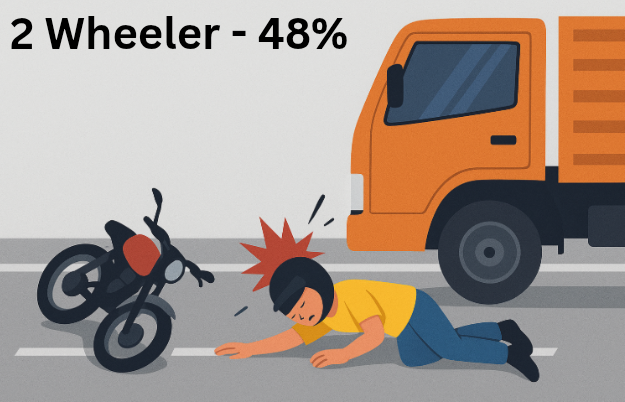
    • Two-wheeler riders: Nearly 44–48% of all victims.
    • Pedestrians: Ranging between 19–54% in various cities.
    • Others: Occupants of cars, buses, or cycles.

    Why so many two-wheelers?

    Two-wheelers dominate Indian roads, making up over 75% of registered vehicles. They are:

    • Most exposed and vulnerable: no airbags, no protective metal body.
    • Often hit by trucks and speeding cars, especially on highways and ring roads.
    • Victims of blind spots, over-speeding, and poor road design.
    • At night, poor visibility and lack of protective gear worsen the risks.

    When trucks or SUVs hit them, the result is usually fatal. And too often, the driver flees the scene, leaving a crushed bike and a lifeless rider behind. Many victims are delivery boys, daily wage earners, students, and office commuters—ordinary Indians carrying the nation’s backbone on their shoulders.


    Why Section 106(2) Was Put on Hold

    Section 106(2) of the BNS proposed stricter punishment—up to 10 years imprisonment and heavy fines for hit-and-run deaths. However, protests by truckers and transport unions forced the government to pause its implementation, citing livelihood concerns.

    But what about the livelihoods already destroyed by these deaths? A driver’s income cannot be valued higher than a victim’s life. Even 10 years is far too little compared to a life taken. If someone deliberately runs away after killing, the punishment should extend to the death penalty. Anything less sends the message that lives in India are cheap.

    The Bharatiya Nyaya Sanhita (BNS), 2023 is India’s new criminal law that came into effect on 1 July 2024, replacing the old Indian Penal Code (IPC), 1860. It was introduced by the Government of India to remove colonial-era laws and make the justice system more modern, clear, and people-friendly. The BNS has 358 sections (compared to 511 in IPC), uses simple and gender-neutral language, and adds new crimes like terrorism, organised crime, cyber fraud, mob lynching, and sexual exploitation by deceit.

    It also removes outdated provisions like sedition and introduces reforms such as community service for minor offences, higher punishments for serious crimes, and recognition of digital evidence—aiming to deliver faster and fairer justice. However, Section 106(2), which prescribes up to 10 years’ jail and fine for drivers who cause a fatal accident and then flee without reporting, has been kept on hold after protests by truckers and transport unions, who feared harassment and misuse.


    📌 Example 1 – Hit-and-run punished under 106(2)

    • A car hits a pedestrian at night.
    • The driver flees without calling an ambulance or reporting to police.
    • Under 106(2), this is treated as a serious offence with up to 10 years jail.

    📌 Example 2 – Driver stays and helps (not punished under 106(2))

    • A truck hits a motorcyclist.
    • The driver immediately calls an ambulance, informs police, and stays at the spot.
    • Even if the person dies, this driver will not face 106(2) punishment, because he took responsibility.

    Takeaway for Citizens:

    • 106(2) is meant to save lives by ensuring victims get immediate help.
    • It punishes only those who run away without reporting, not responsible drivers who try to help.

    🌍 Global Comparison – How India Lags Behind

    • United States: Hit-and-run resulting in death can lead to up to 20 years imprisonment (state laws vary, e.g., California up to 15 years, Florida up to 30 years).
    • United Kingdom: Causing death by dangerous driving (and fleeing) can bring life imprisonment.
    • Australia: Drivers who leave accident victims without help face up to 14 years imprisonment, with higher sentences if death occurs.
    • Singapore: Punishment includes up to life imprisonment and caning for fatal hit-and-run cases.

    Compared to this, India’s 5-year maximum punishment is shockingly lenient. Even with the proposed 10 years, we remain far behind global standards.


    Summary Table: Daily Road Fatalities by Country

    CountryYearAnnual DeathsEstimated Deaths Per Day
    India2024 est~180,000~493
    United States2023~40,990~112
    United Kingdom2023~1,695~5
    Germany2023~2,839~8
    Australia2024~1,300~3.6
    New Zealand2023~343~1

    Key Takeaways

    • India’s daily road fatalities (~493) far exceed those in higher-income countries—especially stark when compared to places like the US and UK.
    • This underscores the urgent need for stronger road safety measures, infrastructure improvements, and enforcement in India.

    What Must Be Done

    1. Implement Section 106(2) immediately with no dilution.
    2. Enhance punishment: Minimum 10 years imprisonment for fatal hit-and-runs—but for deliberate escape after death, capital punishment must be considered.
    3. Mandatory black-box/GPS tracking for heavy vehicles to prevent escape.
    4. Victim compensation fund, contributed by insurance + transport sector.
    5. Better road design: Dedicated two-wheeler and pedestrian safety lanes.
    6. Public awareness campaigns: To make drivers fear consequences and respect lives.

    Final Word to Policymakers

    Every day of delay costs nearing 500 Indian lives. Behind each number is a grieving family—parents who lost their child, children who lost their father, wives who lost their husbands. The pain is unbearable, and yet justice is denied.

    Five years is not justice. Ten years is not justice. Even ten years is an insult when a life has been stolen.

    Policymakers must rise above pressure from unions and vested interests. The message must be clear: if you kill and run, you cannot hide—your punishment will be as heavy as the life you took, even up to death penalty.


    🚨 Major Reasons for Road Deaths in India

    1. Over-Speeding (Top Killer)

    • Contributes to 65–70% of all road accident deaths in India.
    • High speed reduces reaction time and makes crashes far more fatal.

    2. Dangerous / Rash Driving

    • Wrong-side driving, sudden lane cuts, overtaking from left side.
    • Truck and bus drivers rushing deadlines often cause head-on crashes.

    3. Drunk Driving & Drug Influence

    • Even though enforcement has improved, alcohol- and substance-related crashes still account for 5–8% of fatalities.

    4. Distracted Driving (Mobile Phones, Earphones, GPS use)

    • Around 1 in 10 accidents now linked to phone usage.
    • Looking at WhatsApp or social media while riding/driving is becoming a silent killer.

    5. Not Wearing Helmets / Seatbelts

    • 43% of two-wheeler deaths in 2022 were due to lack of helmets.
    • Nearly 50% of car occupant deaths were due to not using seatbelts (especially rear passengers).

    6. Hit-and-Run Cases

    • Almost 30% of all road deaths in India are hit-and-run cases.
    • Trucks, buses, and speeding cars are the most common offenders.

    7. Poor Road Engineering

    • Sharp curves, potholes, unscientific speed breakers, poor signage, and badly lit junctions.
    • Many “black spots” (accident hot spots) remain unfixed for years.

    8. Heavy Vehicle Issues

    • Overloaded trucks, untrained drivers, mechanical failures (brakes, tyres).
    • Trucks running at night on highways are a major cause of two-wheeler fatalities.

    9. Pedestrian & Cyclist Neglect

    • India is not pedestrian-friendly. Lack of footpaths, zebra crossings, and underpasses leads to high pedestrian deaths.
    • Pedestrians account for ~15% of road deaths in India.

    10. Emergency Care Delay

    • Golden Hour (first 1 hour after crash) is often wasted.
    • Lack of ambulances, trauma centers, and bystander fear (police harassment) increases preventable deaths.

    📊 Snapshot (India – 2023 Data)

    • Over-speeding deaths: ~71% of fatalities
    • Driving on wrong side: ~6%
    • Use of mobile phones: ~2%
    • Drunken driving: ~3%
    • Other causes (fatigue, weather, etc.): remaining percentage

    👉 In short: speeding, lack of protective gear, poor enforcement, and bad road design are the biggest killers.


    🚓 Role of Traffic Police in Road Safety

    The traffic police play a central role in preventing accidents, saving lives, and ensuring smooth flow of vehicles. In the context of rising road accident deaths (like in 2025), their role becomes even more critical. Here’s a structured view:

    1. Enforcement of Laws

    • Enforce helmet, seatbelt, speed-limit, and drunk-driving laws.
    • Book offenders for rash driving, overloading, or dangerous overtaking.
    • Curb wrong-side driving and red-light jumping.

    2. Accident Prevention

    • Regular patrols at accident-prone spots (black spots).
    • Deployment of checkpoints on highways and ring roads.
    • Use of speed guns, CCTV, and ANPR cameras to deter violations.

    3. Emergency Response

    • First responders at accident sites.
    • Coordinate with ambulances and hospitals for the “Golden Hour” response to save lives.
    • Manage crowds and prevent mob violence against drivers.

    4. Data Collection & Analysis

    • Maintain accident data (location, time, cause, vehicle type).
    • Identify accident-prone stretches for corrective measures.
    • Share findings with city planners, NHAI, and municipal bodies.

    5. Public Awareness & Education

    • Conduct road safety campaigns in schools, colleges, and workplaces.
    • Encourage helmet use, reflective jackets, and child safety seats.
    • Promote “Don’t Drink and Drive” and “Respect Pedestrians” culture.

    6. Coordination with Other Agencies

    • Work with transport department for vehicle fitness & licensing.
    • Help city planners redesign junctions, signals, and crossings.
    • Collaborate with NGOs for safety workshops and victim support.

    7. Technology & Smart Policing

    • Use AI-based surveillance to detect violations.
    • E-challan systems for transparency.
    • GPS tracking for patrol vehicles to cover blind spots.

    ⚠️ Challenges Traffic Police Face

    • Shortage of manpower (India has ~1 traffic cop per 10,000 vehicles in many cities).
    • Lack of modern equipment in smaller towns.
    • Corruption and public perception issues.
    • Poor road infrastructure making enforcement difficult.

    ✅ Way Forward

    • Increase penalties and ensure strict enforcement without exceptions.
    • Better training and welfare for traffic personnel.
    • Adoption of smart traffic management systems.
    • Public cooperation—without citizen discipline, even the best traffic police cannot prevent accidents.

    ✅ Helmets Save Lives? How Much?

    National Emergency - Road Deaths - Helmet Protects

    A good ISI/DOT-certified helmet absorbs impact and reduces the force transmitted to the skull and brain.

    It prevents skull fractures, brain hemorrhage, and facial injuries in many crashes.

    According to WHO, wearing a helmet reduces the risk of head injury by 70% and death by 40%.


    ⚠️ Why Fatalities Can Still Occur

    1. Very High-Speed Impact
      • If a two-wheeler crashes at extreme speeds or is hit by a heavy vehicle (truck/bus), the force may exceed what a helmet can protect against.
    2. Multiple Collisions / Run-over Cases
      • In some accidents, even after the rider falls, they may get run over by another vehicle (common on highways and ring roads).
    3. Neck & Spine Injuries
      • A helmet protects the head, but not the cervical spine. Severe whiplash or neck fracture can still be fatal.
    4. Improper / Loose Strapping
      • Many riders wear helmets without fastening the chin strap. In a crash, it flies off, giving zero protection.
    5. Substandard Helmets
      • Cheap, non-ISI helmets or half-caps (so-called “designer helmets”) crack easily and don’t protect the skull properly.
    6. Side Impacts
      • A helmet mainly protects the top and front; a hard side hit (for example, against a truck bumper) can still cause brain injury.

    📊 India-Specific Data

    • About 47,000 two-wheeler riders died in India in 2022 (MoRTH data).
    • 43% of them were not wearing helmets.
    • But even among helmeted riders, fatalities occur—usually in truck/bus crashes, very high speeds, or run-over accidents.

    National Emergency - Pillion - Not wearing helmet is risky

    Pillion (Back Seater) not wearing helmet is risky.

    Both Rider & Pillion should wear helmets!

    👉 Bottom line: Helmets are life-saving and must always be worn properly (full-face, ISI certified, strapped).
    But they aren’t foolproof—so speeding, drunk driving, and poor road design remain major risks even for helmeted riders.

    Read recent Sr Citizen fatal accident here. TOI references- Delhi data. 58% Sr Citizen hit-run-cases in Nagpur.


    🚛 Truck Design Risks That Cause Fatal Head Injuries

    Yes — in India, many trucks and lorries do have protruding parts or unsafe body structures that can cause fatal side-impact injuries, especially to two-wheelers and small cars:

    1. Protruding Iron Rods / Angle Irons
      • Often seen on illegally modified side walls of trucks.
      • These sharp edges act like blades when a bike or scooter brushes past → leading to severe head or chest injuries.
    2. Exposed Chassis & Axle Parts
      • Poorly maintained trucks sometimes have metal rods sticking out.
      • Even a small side swipe can throw a rider off balance into the truck’s rear tyres.
    3. Unprotected Side Underrun Areas
      • Unlike trucks in Europe/US, most Indian trucks lack side underrun protection bars (metal guards fitted to the sides to stop smaller vehicles from going underneath).
      • Without them, if a scooter or cycle hits the side, the rider can be dragged under the wheels → almost always fatal.
    4. Carrying Long Iron Rods / Pipes Without Rear Markings
      • Trucks carrying construction materials (iron rods, bamboo, poles) often have them sticking out several feet at the back or sides without red flags or lights.
      • At night, these are invisible and can pierce riders, causing instant death.
    5. Overloaded or Poorly Welded Side Panels
      • When overloaded, truck body sides sometimes bulge out, leaving sharp corners that can clip passing two-wheelers.

    🩸 Why Two-Wheeler Riders Are Most at Risk

    Head-level impact: The height of truck side panels often aligns with a biker’s head/shoulder, making head injuries common even if a helmet is worn.

    Close overtaking culture: On highways and ring roads (like Nagpur’s Ring Road), trucks unlawful overtaking from the left, brushing dangerously the bikers.

    Lack of side guards: In developed countries, side-guards are mandatory. In India, absence of these leads to “run-over” type fatalities.


    Policy Note:
    India does have a rule (CMVR 125C, Motor Vehicle Act) making side and rear underrun protection mandatory for trucks, but implementation is weak. Many older trucks and locally fabricated bodies skip it.


    🚨 Call to Action: Stopping India’s Silent Road Massacre

    1. Policymakers & Lawmakers

    • Enforce Section 106(2) of the Bharatiya Nyaya Sanhita (BNS): which mandates 7–10 years imprisonment for drivers who cause death in a hit-and-run without reporting the accident.
    • Question: Why is 106(2) currently on hold under industry pressure?human lives must come before truck lobby interests.
    • Amend 106(2) to make penalties harsher in fatal cases (life imprisonment or death penalty where gross negligence is proven).
    • Set up special road safety courts for fast-tracking hit-and-run cases.

    2. Traffic Police & Enforcement Agencies

    • Strictly implement Section 106(2) once activated — every hit-and-run must lead to a non-bailable offence.
    • Deploy checkpoints on highways and ring roads with instant accident-reporting protocols.
    • Strengthen AI-enabled CCTV and vehicle traceability systems so offenders cannot escape.

    3. Truck Owners & Transport Associations

    • Accept legal responsibility under 106(2) — companies must share liability, not just drivers.
    • Ensure no truck on the road has illegal protruding iron rods/angle irons that turn minor scrapes into instant deaths.
    • Train drivers that fleeing an accident only worsens punishment under 106(2).

    4. Media & Civil Society

    • Run campaigns explaining why Section 106(2) is critical to saving lives.
    • Ask hard questions: Why should victims’ families suffer lifelong pain while offenders walk free after just 5 years?
    • Keep spotlight on families devastated by hit-and-runs, linking their loss to weak enforcement of 106(2).

    5. Citizens & Road Users

    • Support full implementation of Section 106(2)—demand stricter justice for offenders.
    • Do not flee accident scenes — reporting is your duty and could save a life.
    • Pressure elected representatives: “Will you stand with grieving families or with the truck lobby blocking 106(2)?”
    • Ensure helmets are ISI-certified, properly strapped, not cosmetic half-caps.
    • Follow lane discipline, avoid speeding, and never drive against traffic — most two-wheeler crashes are with heavy vehicles like trucks and buses.
    National Emergency - Both Rider & Pillion wearing Helmets


    Wear helmets always — both rider and pillion.
    As per MoRTH data, over 70% of two-wheeler deaths in India are due to not wearing helmets.
    In 2022 alone, 46,000+ two-wheeler riders and pillion passengers died because of this negligence.


    👉 Final Appeal:
    India loses nearly 500 lives every single day in road crashes. Most are pedestrians, two-wheeler riders, and poor families who never get justice. Section 106(2) was designed to deter hit-and-runs—but it remains suspended.

    Every day of delay means dozens more families destroyed, children orphaned, women widowed, parents left alone.
    If the government is serious about valuing life, 106(2) must be enforced—and made even stricter.

    ⚖️ “A life lost cannot be replaced. Five years, ten years—even that feels less. If someone kills and flees, knowing they took a life—the law must weigh it as heavily as murder.”

  • 🚨 National Emergency: Nearly 500 Daily Road Deaths in India – Call for Stricter Hit-and-Run Justice!

    🚨 National Emergency: Nearly 500 Daily Road Deaths in India – Call for Stricter Hit-and-Run Justice!


    Road Deaths: India

    It’s National Emergency -nearly 500 road deaths every day, Indian roads turn into graveyards for innocent lives. The tragedy is not just in the sheer numbers, but in the way perpetrators of hit-and-run cases escape with minimal punishment. Under the current framework, even when a life is lost, truck or car drivers who flee often face only five years imprisonment under Section 304A IPC. With the much-needed Section 106(2) of the Bharatiya Nyaya Sanhita (BNS) on hold after protests, victims and their families continue to be denied justice. Policymakers must act—five years is not enough for killing someone and running away.


    The Alarming Numbers

    • In 2022, India recorded 47,806 hit-and-run cases, resulting in 50,815 deaths—an average of six deaths every hour.
    • In 2023, in cities like Mumbai, hit-and-run crashes accounted for 38% of all road fatalities.
    • Preliminary data for 2025 already suggests a worrying upward trend, with thousands of cases being logged in the first half of the year across major cities.

    This is not just a statistic—it means hundreds of families are destroyed every single day.


    Who Are the Victims?

    The majority of hit-and-run deaths involve:

    • Two-wheeler riders: Nearly 44–48% of all victims.
    • Pedestrians: Ranging between 19–54% in various cities.
    • Others: Occupants of cars, buses, or cycles.

    Why so many two-wheelers?

    Two-wheelers dominate Indian roads, making up over 75% of registered vehicles. They are:

    • Most exposed and vulnerable: no airbags, no protective metal body.
    • Often hit by trucks and speeding cars, especially on highways and ring roads.
    • Victims of blind spots, over-speeding, and poor road design.
    • At night, poor visibility and lack of protective gear worsen the risks.

    When trucks or SUVs hit them, the result is usually fatal. And too often, the driver flees the scene, leaving a crushed bike and a lifeless rider behind. Many victims are delivery boys, daily wage earners, students, and office commuters—ordinary Indians carrying the nation’s backbone on their shoulders.


    Why Section 106(2) Was Put on Hold

    Section 106(2) of the BNS proposed stricter punishment—up to 10 years imprisonment and heavy fines for hit-and-run deaths. However, protests by truckers and transport unions forced the government to pause its implementation, citing livelihood concerns.

    But what about the livelihoods already destroyed by these deaths? A driver’s income cannot be valued higher than a victim’s life. Even 10 years is far too little compared to a life taken. If someone deliberately runs away after killing, the punishment should extend to the death penalty. Anything less sends the message that lives in India are cheap.

    The Bharatiya Nyaya Sanhita (BNS), 2023 is India’s new criminal law that came into effect on 1 July 2024, replacing the old Indian Penal Code (IPC), 1860. It was introduced by the Government of India to remove colonial-era laws and make the justice system more modern, clear, and people-friendly. The BNS has 358 sections (compared to 511 in IPC), uses simple and gender-neutral language, and adds new crimes like terrorism, organised crime, cyber fraud, mob lynching, and sexual exploitation by deceit.

    It also removes outdated provisions like sedition and introduces reforms such as community service for minor offences, higher punishments for serious crimes, and recognition of digital evidence—aiming to deliver faster and fairer justice. However, Section 106(2), which prescribes up to 10 years’ jail and fine for drivers who cause a fatal accident and then flee without reporting, has been kept on hold after protests by truckers and transport unions, who feared harassment and misuse.


    📌 Example 1 – Hit-and-run punished under 106(2)

    • A car hits a pedestrian at night.
    • The driver flees without calling an ambulance or reporting to police.
    • Under 106(2), this is treated as a serious offence with up to 10 years jail.

    📌 Example 2 – Driver stays and helps (not punished under 106(2))

    • A truck hits a motorcyclist.
    • The driver immediately calls an ambulance, informs police, and stays at the spot.
    • Even if the person dies, this driver will not face 106(2) punishment, because he took responsibility.

    Takeaway for Citizens:

    • 106(2) is meant to save lives by ensuring victims get immediate help.
    • It punishes only those who run away without reporting, not responsible drivers who try to help.

    🌍 Global Comparison – How India Lags Behind

    • United States: Hit-and-run resulting in death can lead to up to 20 years imprisonment (state laws vary, e.g., California up to 15 years, Florida up to 30 years).
    • United Kingdom: Causing death by dangerous driving (and fleeing) can bring life imprisonment.
    • Australia: Drivers who leave accident victims without help face up to 14 years imprisonment, with higher sentences if death occurs.
    • Singapore: Punishment includes up to life imprisonment and caning for fatal hit-and-run cases.

    Compared to this, India’s 5-year maximum punishment is shockingly lenient. Even with the proposed 10 years, we remain far behind global standards.


    Summary Table: Daily Road Fatalities by Country

    CountryYearAnnual DeathsEstimated Deaths Per Day
    India2024 est~180,000~493
    United States2023~40,990~112
    United Kingdom2023~1,695~5
    Germany2023~2,839~8
    Australia2024~1,300~3.6
    New Zealand2023~343~1

    Key Takeaways

    • India’s daily road fatalities (~493) far exceed those in higher-income countries—especially stark when compared to places like the US and UK.
    • This underscores the urgent need for stronger road safety measures, infrastructure improvements, and enforcement in India.

    What Must Be Done

    1. Implement Section 106(2) immediately with no dilution.
    2. Enhance punishment: Minimum 10 years imprisonment for fatal hit-and-runs—but for deliberate escape after death, capital punishment must be considered.
    3. Mandatory black-box/GPS tracking for heavy vehicles to prevent escape.
    4. Victim compensation fund, contributed by insurance + transport sector.
    5. Better road design: Dedicated two-wheeler and pedestrian safety lanes.
    6. Public awareness campaigns: To make drivers fear consequences and respect lives.

    Final Word to Policymakers

    Every day of delay costs nearing 500 Indian lives. Behind each number is a grieving family—parents who lost their child, children who lost their father, wives who lost their husbands. The pain is unbearable, and yet justice is denied.

    Five years is not justice. Ten years is not justice. Even ten years is an insult when a life has been stolen.

    Policymakers must rise above pressure from unions and vested interests. The message must be clear: if you kill and run, you cannot hide—your punishment will be as heavy as the life you took, even up to death penalty.


    🚨 Major Reasons for Road Deaths in India

    1. Over-Speeding (Top Killer)

    • Contributes to 65–70% of all road accident deaths in India.
    • High speed reduces reaction time and makes crashes far more fatal.

    2. Dangerous / Rash Driving

    • Wrong-side driving, sudden lane cuts, overtaking from left side.
    • Truck and bus drivers rushing deadlines often cause head-on crashes.

    3. Drunk Driving & Drug Influence

    • Even though enforcement has improved, alcohol- and substance-related crashes still account for 5–8% of fatalities.

    4. Distracted Driving (Mobile Phones, Earphones, GPS use)

    • Around 1 in 10 accidents now linked to phone usage.
    • Looking at WhatsApp or social media while riding/driving is becoming a silent killer.

    5. Not Wearing Helmets / Seatbelts

    • 43% of two-wheeler deaths in 2022 were due to lack of helmets.
    • Nearly 50% of car occupant deaths were due to not using seatbelts (especially rear passengers).

    6. Hit-and-Run Cases

    • Almost 30% of all road deaths in India are hit-and-run cases.
    • Trucks, buses, and speeding cars are the most common offenders.

    7. Poor Road Engineering

    • Sharp curves, potholes, unscientific speed breakers, poor signage, and badly lit junctions.
    • Many “black spots” (accident hot spots) remain unfixed for years.

    8. Heavy Vehicle Issues

    • Overloaded trucks, untrained drivers, mechanical failures (brakes, tyres).
    • Trucks running at night on highways are a major cause of two-wheeler fatalities.

    9. Pedestrian & Cyclist Neglect

    • India is not pedestrian-friendly. Lack of footpaths, zebra crossings, and underpasses leads to high pedestrian deaths.
    • Pedestrians account for ~15% of road deaths in India.

    10. Emergency Care Delay

    • Golden Hour (first 1 hour after crash) is often wasted.
    • Lack of ambulances, trauma centers, and bystander fear (police harassment) increases preventable deaths.

    📊 Snapshot (India – 2023 Data)

    • Over-speeding deaths: ~71% of fatalities
    • Driving on wrong side: ~6%
    • Use of mobile phones: ~2%
    • Drunken driving: ~3%
    • Other causes (fatigue, weather, etc.): remaining percentage

    👉 In short: speeding, lack of protective gear, poor enforcement, and bad road design are the biggest killers.


    🚓 Role of Traffic Police in Road Safety

    The traffic police play a central role in preventing accidents, saving lives, and ensuring smooth flow of vehicles. In the context of rising road accident deaths (like in 2025), their role becomes even more critical. Here’s a structured view:

    1. Enforcement of Laws

    • Enforce helmet, seatbelt, speed-limit, and drunk-driving laws.
    • Book offenders for rash driving, overloading, or dangerous overtaking.
    • Curb wrong-side driving and red-light jumping.

    2. Accident Prevention

    • Regular patrols at accident-prone spots (black spots).
    • Deployment of checkpoints on highways and ring roads.
    • Use of speed guns, CCTV, and ANPR cameras to deter violations.

    3. Emergency Response

    • First responders at accident sites.
    • Coordinate with ambulances and hospitals for the “Golden Hour” response to save lives.
    • Manage crowds and prevent mob violence against drivers.

    4. Data Collection & Analysis

    • Maintain accident data (location, time, cause, vehicle type).
    • Identify accident-prone stretches for corrective measures.
    • Share findings with city planners, NHAI, and municipal bodies.

    5. Public Awareness & Education

    • Conduct road safety campaigns in schools, colleges, and workplaces.
    • Encourage helmet use, reflective jackets, and child safety seats.
    • Promote “Don’t Drink and Drive” and “Respect Pedestrians” culture.

    6. Coordination with Other Agencies

    • Work with transport department for vehicle fitness & licensing.
    • Help city planners redesign junctions, signals, and crossings.
    • Collaborate with NGOs for safety workshops and victim support.

    7. Technology & Smart Policing

    • Use AI-based surveillance to detect violations.
    • E-challan systems for transparency.
    • GPS tracking for patrol vehicles to cover blind spots.

    ⚠️ Challenges Traffic Police Face

    • Shortage of manpower (India has ~1 traffic cop per 10,000 vehicles in many cities).
    • Lack of modern equipment in smaller towns.
    • Corruption and public perception issues.
    • Poor road infrastructure making enforcement difficult.

    ✅ Way Forward

    • Increase penalties and ensure strict enforcement without exceptions.
    • Better training and welfare for traffic personnel.
    • Adoption of smart traffic management systems.
    • Public cooperation—without citizen discipline, even the best traffic police cannot prevent accidents.

    ✅ Helmets Save Lives? How Much?

    National Emergency - Road Deaths - Helmet Protects

    A good ISI/DOT-certified helmet absorbs impact and reduces the force transmitted to the skull and brain.

    It prevents skull fractures, brain hemorrhage, and facial injuries in many crashes.

    According to WHO, wearing a helmet reduces the risk of head injury by 70% and death by 40%.


    ⚠️ Why Fatalities Can Still Occur

    1. Very High-Speed Impact
      • If a two-wheeler crashes at extreme speeds or is hit by a heavy vehicle (truck/bus), the force may exceed what a helmet can protect against.
    2. Multiple Collisions / Run-over Cases
      • In some accidents, even after the rider falls, they may get run over by another vehicle (common on highways and ring roads).
    3. Neck & Spine Injuries
      • A helmet protects the head, but not the cervical spine. Severe whiplash or neck fracture can still be fatal.
    4. Improper / Loose Strapping
      • Many riders wear helmets without fastening the chin strap. In a crash, it flies off, giving zero protection.
    5. Substandard Helmets
      • Cheap, non-ISI helmets or half-caps (so-called “designer helmets”) crack easily and don’t protect the skull properly.
    6. Side Impacts
      • A helmet mainly protects the top and front; a hard side hit (for example, against a truck bumper) can still cause brain injury.

    📊 India-Specific Data

    • About 47,000 two-wheeler riders died in India in 2022 (MoRTH data).
    • 43% of them were not wearing helmets.
    • But even among helmeted riders, fatalities occur—usually in truck/bus crashes, very high speeds, or run-over accidents.

    National Emergency - Pillion - Not wearing helmet is risky

    Pillion (Back Seater) not wearing helmet is risky.

    Both Rider & Pillion should wear helmets!

    👉 Bottom line: Helmets are life-saving and must always be worn properly (full-face, ISI certified, strapped).
    But they aren’t foolproof—so speeding, drunk driving, and poor road design remain major risks even for helmeted riders.

    Read recent Sr Citizen fatal accident here. TOI references- Delhi data. 58% Sr Citizen hit-run-cases in Nagpur.


    🚛 Truck Design Risks That Cause Fatal Head Injuries

    Yes — in India, many trucks and lorries do have protruding parts or unsafe body structures that can cause fatal side-impact injuries, especially to two-wheelers and small cars:

    1. Protruding Iron Rods / Angle Irons
      • Often seen on illegally modified side walls of trucks.
      • These sharp edges act like blades when a bike or scooter brushes past → leading to severe head or chest injuries.
    2. Exposed Chassis & Axle Parts
      • Poorly maintained trucks sometimes have metal rods sticking out.
      • Even a small side swipe can throw a rider off balance into the truck’s rear tyres.
    3. Unprotected Side Underrun Areas
      • Unlike trucks in Europe/US, most Indian trucks lack side underrun protection bars (metal guards fitted to the sides to stop smaller vehicles from going underneath).
      • Without them, if a scooter or cycle hits the side, the rider can be dragged under the wheels → almost always fatal.
    4. Carrying Long Iron Rods / Pipes Without Rear Markings
      • Trucks carrying construction materials (iron rods, bamboo, poles) often have them sticking out several feet at the back or sides without red flags or lights.
      • At night, these are invisible and can pierce riders, causing instant death.
    5. Overloaded or Poorly Welded Side Panels
      • When overloaded, truck body sides sometimes bulge out, leaving sharp corners that can clip passing two-wheelers.

    🩸 Why Two-Wheeler Riders Are Most at Risk

    Head-level impact: The height of truck side panels often aligns with a biker’s head/shoulder, making head injuries common even if a helmet is worn.

    Close overtaking culture: On highways and ring roads (like Nagpur’s Ring Road), trucks unlawful overtaking from the left, brushing dangerously the bikers.

    Lack of side guards: In developed countries, side-guards are mandatory. In India, absence of these leads to “run-over” type fatalities.


    Policy Note:
    India does have a rule (CMVR 125C, Motor Vehicle Act) making side and rear underrun protection mandatory for trucks, but implementation is weak. Many older trucks and locally fabricated bodies skip it.


    🚨 Call to Action: Stopping India’s Silent Road Massacre

    1. Policymakers & Lawmakers

    • Enforce Section 106(2) of the Bharatiya Nyaya Sanhita (BNS): which mandates 7–10 years imprisonment for drivers who cause death in a hit-and-run without reporting the accident.
    • Question: Why is 106(2) currently on hold under industry pressure?human lives must come before truck lobby interests.
    • Amend 106(2) to make penalties harsher in fatal cases (life imprisonment or death penalty where gross negligence is proven).
    • Set up special road safety courts for fast-tracking hit-and-run cases.

    2. Traffic Police & Enforcement Agencies

    • Strictly implement Section 106(2) once activated — every hit-and-run must lead to a non-bailable offence.
    • Deploy checkpoints on highways and ring roads with instant accident-reporting protocols.
    • Strengthen AI-enabled CCTV and vehicle traceability systems so offenders cannot escape.

    3. Truck Owners & Transport Associations

    • Accept legal responsibility under 106(2) — companies must share liability, not just drivers.
    • Ensure no truck on the road has illegal protruding iron rods/angle irons that turn minor scrapes into instant deaths.
    • Train drivers that fleeing an accident only worsens punishment under 106(2).

    4. Media & Civil Society

    • Run campaigns explaining why Section 106(2) is critical to saving lives.
    • Ask hard questions: Why should victims’ families suffer lifelong pain while offenders walk free after just 5 years?
    • Keep spotlight on families devastated by hit-and-runs, linking their loss to weak enforcement of 106(2).

    5. Citizens & Road Users

    • Support full implementation of Section 106(2)—demand stricter justice for offenders.
    • Do not flee accident scenes — reporting is your duty and could save a life.
    • Pressure elected representatives: “Will you stand with grieving families or with the truck lobby blocking 106(2)?”
    • Ensure helmets are ISI-certified, properly strapped, not cosmetic half-caps.
    • Follow lane discipline, avoid speeding, and never drive against traffic — most two-wheeler crashes are with heavy vehicles like trucks and buses.
    National Emergency - Both Rider & Pillion wearing Helmets


    Wear helmets always — both rider and pillion.
    As per MoRTH data, over 70% of two-wheeler deaths in India are due to not wearing helmets.
    In 2022 alone, 46,000+ two-wheeler riders and pillion passengers died because of this negligence.


    👉 Final Appeal:
    India loses nearly 500 lives every single day in road crashes. Most are pedestrians, two-wheeler riders, and poor families who never get justice. Section 106(2) was designed to deter hit-and-runs—but it remains suspended.

    Every day of delay means dozens more families destroyed, children orphaned, women widowed, parents left alone.
    If the government is serious about valuing life, 106(2) must be enforced—and made even stricter.

    ⚖️ “A life lost cannot be replaced. Five years, ten years—even that feels less. If someone kills and flees, knowing they took a life—the law must weigh it as heavily as murder.”

  • 🚨 National Emergency: Nearly 500 Daily Road Deaths in India – Call for Stricter Hit-and-Run Justice!

    🚨 National Emergency: Nearly 500 Daily Road Deaths in India – Call for Stricter Hit-and-Run Justice!


    Road Deaths: India

    It’s National Emergency -nearly 500 road deaths every day, Indian roads turn into graveyards for innocent lives. The tragedy is not just in the sheer numbers, but in the way perpetrators of hit-and-run cases escape with minimal punishment. Under the current framework, even when a life is lost, truck or car drivers who flee often face only five years imprisonment under Section 304A IPC. With the much-needed Section 106(2) of the Bharatiya Nyaya Sanhita (BNS) on hold after protests, victims and their families continue to be denied justice. Policymakers must act—five years is not enough for killing someone and running away.


    The Alarming Numbers

    • In 2022, India recorded 47,806 hit-and-run cases, resulting in 50,815 deaths—an average of six deaths every hour.
    • In 2023, in cities like Mumbai, hit-and-run crashes accounted for 38% of all road fatalities.
    • Preliminary data for 2025 already suggests a worrying upward trend, with thousands of cases being logged in the first half of the year across major cities.

    This is not just a statistic—it means hundreds of families are destroyed every single day.


    Who Are the Victims?

    The majority of hit-and-run deaths involve:

    • Two-wheeler riders: Nearly 44–48% of all victims.
    • Pedestrians: Ranging between 19–54% in various cities.
    • Others: Occupants of cars, buses, or cycles.

    Why so many two-wheelers?

    Two-wheelers dominate Indian roads, making up over 75% of registered vehicles. They are:

    • Most exposed and vulnerable: no airbags, no protective metal body.
    • Often hit by trucks and speeding cars, especially on highways and ring roads.
    • Victims of blind spots, over-speeding, and poor road design.
    • At night, poor visibility and lack of protective gear worsen the risks.

    When trucks or SUVs hit them, the result is usually fatal. And too often, the driver flees the scene, leaving a crushed bike and a lifeless rider behind. Many victims are delivery boys, daily wage earners, students, and office commuters—ordinary Indians carrying the nation’s backbone on their shoulders.


    Why Section 106(2) Was Put on Hold

    Section 106(2) of the BNS proposed stricter punishment—up to 10 years imprisonment and heavy fines for hit-and-run deaths. However, protests by truckers and transport unions forced the government to pause its implementation, citing livelihood concerns.

    But what about the livelihoods already destroyed by these deaths? A driver’s income cannot be valued higher than a victim’s life. Even 10 years is far too little compared to a life taken. If someone deliberately runs away after killing, the punishment should extend to the death penalty. Anything less sends the message that lives in India are cheap.

    The Bharatiya Nyaya Sanhita (BNS), 2023 is India’s new criminal law that came into effect on 1 July 2024, replacing the old Indian Penal Code (IPC), 1860. It was introduced by the Government of India to remove colonial-era laws and make the justice system more modern, clear, and people-friendly. The BNS has 358 sections (compared to 511 in IPC), uses simple and gender-neutral language, and adds new crimes like terrorism, organised crime, cyber fraud, mob lynching, and sexual exploitation by deceit.

    It also removes outdated provisions like sedition and introduces reforms such as community service for minor offences, higher punishments for serious crimes, and recognition of digital evidence—aiming to deliver faster and fairer justice. However, Section 106(2), which prescribes up to 10 years’ jail and fine for drivers who cause a fatal accident and then flee without reporting, has been kept on hold after protests by truckers and transport unions, who feared harassment and misuse.


    📌 Example 1 – Hit-and-run punished under 106(2)

    • A car hits a pedestrian at night.
    • The driver flees without calling an ambulance or reporting to police.
    • Under 106(2), this is treated as a serious offence with up to 10 years jail.

    📌 Example 2 – Driver stays and helps (not punished under 106(2))

    • A truck hits a motorcyclist.
    • The driver immediately calls an ambulance, informs police, and stays at the spot.
    • Even if the person dies, this driver will not face 106(2) punishment, because he took responsibility.

    Takeaway for Citizens:

    • 106(2) is meant to save lives by ensuring victims get immediate help.
    • It punishes only those who run away without reporting, not responsible drivers who try to help.

    🌍 Global Comparison – How India Lags Behind

    • United States: Hit-and-run resulting in death can lead to up to 20 years imprisonment (state laws vary, e.g., California up to 15 years, Florida up to 30 years).
    • United Kingdom: Causing death by dangerous driving (and fleeing) can bring life imprisonment.
    • Australia: Drivers who leave accident victims without help face up to 14 years imprisonment, with higher sentences if death occurs.
    • Singapore: Punishment includes up to life imprisonment and caning for fatal hit-and-run cases.

    Compared to this, India’s 5-year maximum punishment is shockingly lenient. Even with the proposed 10 years, we remain far behind global standards.


    Summary Table: Daily Road Fatalities by Country

    CountryYearAnnual DeathsEstimated Deaths Per Day
    India2024 est~180,000~493
    United States2023~40,990~112
    United Kingdom2023~1,695~5
    Germany2023~2,839~8
    Australia2024~1,300~3.6
    New Zealand2023~343~1

    Key Takeaways

    • India’s daily road fatalities (~493) far exceed those in higher-income countries—especially stark when compared to places like the US and UK.
    • This underscores the urgent need for stronger road safety measures, infrastructure improvements, and enforcement in India.

    What Must Be Done

    1. Implement Section 106(2) immediately with no dilution.
    2. Enhance punishment: Minimum 10 years imprisonment for fatal hit-and-runs—but for deliberate escape after death, capital punishment must be considered.
    3. Mandatory black-box/GPS tracking for heavy vehicles to prevent escape.
    4. Victim compensation fund, contributed by insurance + transport sector.
    5. Better road design: Dedicated two-wheeler and pedestrian safety lanes.
    6. Public awareness campaigns: To make drivers fear consequences and respect lives.

    Final Word to Policymakers

    Every day of delay costs nearing 500 Indian lives. Behind each number is a grieving family—parents who lost their child, children who lost their father, wives who lost their husbands. The pain is unbearable, and yet justice is denied.

    Five years is not justice. Ten years is not justice. Even ten years is an insult when a life has been stolen.

    Policymakers must rise above pressure from unions and vested interests. The message must be clear: if you kill and run, you cannot hide—your punishment will be as heavy as the life you took, even up to death penalty.


    🚨 Major Reasons for Road Deaths in India

    1. Over-Speeding (Top Killer)

    • Contributes to 65–70% of all road accident deaths in India.
    • High speed reduces reaction time and makes crashes far more fatal.

    2. Dangerous / Rash Driving

    • Wrong-side driving, sudden lane cuts, overtaking from left side.
    • Truck and bus drivers rushing deadlines often cause head-on crashes.

    3. Drunk Driving & Drug Influence

    • Even though enforcement has improved, alcohol- and substance-related crashes still account for 5–8% of fatalities.

    4. Distracted Driving (Mobile Phones, Earphones, GPS use)

    • Around 1 in 10 accidents now linked to phone usage.
    • Looking at WhatsApp or social media while riding/driving is becoming a silent killer.

    5. Not Wearing Helmets / Seatbelts

    • 43% of two-wheeler deaths in 2022 were due to lack of helmets.
    • Nearly 50% of car occupant deaths were due to not using seatbelts (especially rear passengers).

    6. Hit-and-Run Cases

    • Almost 30% of all road deaths in India are hit-and-run cases.
    • Trucks, buses, and speeding cars are the most common offenders.

    7. Poor Road Engineering

    • Sharp curves, potholes, unscientific speed breakers, poor signage, and badly lit junctions.
    • Many “black spots” (accident hot spots) remain unfixed for years.

    8. Heavy Vehicle Issues

    • Overloaded trucks, untrained drivers, mechanical failures (brakes, tyres).
    • Trucks running at night on highways are a major cause of two-wheeler fatalities.

    9. Pedestrian & Cyclist Neglect

    • India is not pedestrian-friendly. Lack of footpaths, zebra crossings, and underpasses leads to high pedestrian deaths.
    • Pedestrians account for ~15% of road deaths in India.

    10. Emergency Care Delay

    • Golden Hour (first 1 hour after crash) is often wasted.
    • Lack of ambulances, trauma centers, and bystander fear (police harassment) increases preventable deaths.

    📊 Snapshot (India – 2023 Data)

    • Over-speeding deaths: ~71% of fatalities
    • Driving on wrong side: ~6%
    • Use of mobile phones: ~2%
    • Drunken driving: ~3%
    • Other causes (fatigue, weather, etc.): remaining percentage

    👉 In short: speeding, lack of protective gear, poor enforcement, and bad road design are the biggest killers.


    🚓 Role of Traffic Police in Road Safety

    The traffic police play a central role in preventing accidents, saving lives, and ensuring smooth flow of vehicles. In the context of rising road accident deaths (like in 2025), their role becomes even more critical. Here’s a structured view:

    1. Enforcement of Laws

    • Enforce helmet, seatbelt, speed-limit, and drunk-driving laws.
    • Book offenders for rash driving, overloading, or dangerous overtaking.
    • Curb wrong-side driving and red-light jumping.

    2. Accident Prevention

    • Regular patrols at accident-prone spots (black spots).
    • Deployment of checkpoints on highways and ring roads.
    • Use of speed guns, CCTV, and ANPR cameras to deter violations.

    3. Emergency Response

    • First responders at accident sites.
    • Coordinate with ambulances and hospitals for the “Golden Hour” response to save lives.
    • Manage crowds and prevent mob violence against drivers.

    4. Data Collection & Analysis

    • Maintain accident data (location, time, cause, vehicle type).
    • Identify accident-prone stretches for corrective measures.
    • Share findings with city planners, NHAI, and municipal bodies.

    5. Public Awareness & Education

    • Conduct road safety campaigns in schools, colleges, and workplaces.
    • Encourage helmet use, reflective jackets, and child safety seats.
    • Promote “Don’t Drink and Drive” and “Respect Pedestrians” culture.

    6. Coordination with Other Agencies

    • Work with transport department for vehicle fitness & licensing.
    • Help city planners redesign junctions, signals, and crossings.
    • Collaborate with NGOs for safety workshops and victim support.

    7. Technology & Smart Policing

    • Use AI-based surveillance to detect violations.
    • E-challan systems for transparency.
    • GPS tracking for patrol vehicles to cover blind spots.

    ⚠️ Challenges Traffic Police Face

    • Shortage of manpower (India has ~1 traffic cop per 10,000 vehicles in many cities).
    • Lack of modern equipment in smaller towns.
    • Corruption and public perception issues.
    • Poor road infrastructure making enforcement difficult.

    ✅ Way Forward

    • Increase penalties and ensure strict enforcement without exceptions.
    • Better training and welfare for traffic personnel.
    • Adoption of smart traffic management systems.
    • Public cooperation—without citizen discipline, even the best traffic police cannot prevent accidents.

    ✅ Helmets Save Lives? How Much?

    National Emergency - Road Deaths - Helmet Protects

    A good ISI/DOT-certified helmet absorbs impact and reduces the force transmitted to the skull and brain.

    It prevents skull fractures, brain hemorrhage, and facial injuries in many crashes.

    According to WHO, wearing a helmet reduces the risk of head injury by 70% and death by 40%.


    ⚠️ Why Fatalities Can Still Occur

    1. Very High-Speed Impact
      • If a two-wheeler crashes at extreme speeds or is hit by a heavy vehicle (truck/bus), the force may exceed what a helmet can protect against.
    2. Multiple Collisions / Run-over Cases
      • In some accidents, even after the rider falls, they may get run over by another vehicle (common on highways and ring roads).
    3. Neck & Spine Injuries
      • A helmet protects the head, but not the cervical spine. Severe whiplash or neck fracture can still be fatal.
    4. Improper / Loose Strapping
      • Many riders wear helmets without fastening the chin strap. In a crash, it flies off, giving zero protection.
    5. Substandard Helmets
      • Cheap, non-ISI helmets or half-caps (so-called “designer helmets”) crack easily and don’t protect the skull properly.
    6. Side Impacts
      • A helmet mainly protects the top and front; a hard side hit (for example, against a truck bumper) can still cause brain injury.

    📊 India-Specific Data

    • About 47,000 two-wheeler riders died in India in 2022 (MoRTH data).
    • 43% of them were not wearing helmets.
    • But even among helmeted riders, fatalities occur—usually in truck/bus crashes, very high speeds, or run-over accidents.

    National Emergency - Pillion - Not wearing helmet is risky

    Pillion (Back Seater) not wearing helmet is risky.

    Both Rider & Pillion should wear helmets!

    👉 Bottom line: Helmets are life-saving and must always be worn properly (full-face, ISI certified, strapped).
    But they aren’t foolproof—so speeding, drunk driving, and poor road design remain major risks even for helmeted riders.

    Read recent Sr Citizen fatal accident here. TOI references- Delhi data. 58% Sr Citizen hit-run-cases in Nagpur.


    🚛 Truck Design Risks That Cause Fatal Head Injuries

    Yes — in India, many trucks and lorries do have protruding parts or unsafe body structures that can cause fatal side-impact injuries, especially to two-wheelers and small cars:

    1. Protruding Iron Rods / Angle Irons
      • Often seen on illegally modified side walls of trucks.
      • These sharp edges act like blades when a bike or scooter brushes past → leading to severe head or chest injuries.
    2. Exposed Chassis & Axle Parts
      • Poorly maintained trucks sometimes have metal rods sticking out.
      • Even a small side swipe can throw a rider off balance into the truck’s rear tyres.
    3. Unprotected Side Underrun Areas
      • Unlike trucks in Europe/US, most Indian trucks lack side underrun protection bars (metal guards fitted to the sides to stop smaller vehicles from going underneath).
      • Without them, if a scooter or cycle hits the side, the rider can be dragged under the wheels → almost always fatal.
    4. Carrying Long Iron Rods / Pipes Without Rear Markings
      • Trucks carrying construction materials (iron rods, bamboo, poles) often have them sticking out several feet at the back or sides without red flags or lights.
      • At night, these are invisible and can pierce riders, causing instant death.
    5. Overloaded or Poorly Welded Side Panels
      • When overloaded, truck body sides sometimes bulge out, leaving sharp corners that can clip passing two-wheelers.

    🩸 Why Two-Wheeler Riders Are Most at Risk

    Head-level impact: The height of truck side panels often aligns with a biker’s head/shoulder, making head injuries common even if a helmet is worn.

    Close overtaking culture: On highways and ring roads (like Nagpur’s Ring Road), trucks unlawful overtaking from the left, brushing dangerously the bikers.

    Lack of side guards: In developed countries, side-guards are mandatory. In India, absence of these leads to “run-over” type fatalities.


    Policy Note:
    India does have a rule (CMVR 125C, Motor Vehicle Act) making side and rear underrun protection mandatory for trucks, but implementation is weak. Many older trucks and locally fabricated bodies skip it.


    🚨 Call to Action: Stopping India’s Silent Road Massacre

    1. Policymakers & Lawmakers

    • Enforce Section 106(2) of the Bharatiya Nyaya Sanhita (BNS): which mandates 7–10 years imprisonment for drivers who cause death in a hit-and-run without reporting the accident.
    • Question: Why is 106(2) currently on hold under industry pressure?human lives must come before truck lobby interests.
    • Amend 106(2) to make penalties harsher in fatal cases (life imprisonment or death penalty where gross negligence is proven).
    • Set up special road safety courts for fast-tracking hit-and-run cases.

    2. Traffic Police & Enforcement Agencies

    • Strictly implement Section 106(2) once activated — every hit-and-run must lead to a non-bailable offence.
    • Deploy checkpoints on highways and ring roads with instant accident-reporting protocols.
    • Strengthen AI-enabled CCTV and vehicle traceability systems so offenders cannot escape.

    3. Truck Owners & Transport Associations

    • Accept legal responsibility under 106(2) — companies must share liability, not just drivers.
    • Ensure no truck on the road has illegal protruding iron rods/angle irons that turn minor scrapes into instant deaths.
    • Train drivers that fleeing an accident only worsens punishment under 106(2).

    4. Media & Civil Society

    • Run campaigns explaining why Section 106(2) is critical to saving lives.
    • Ask hard questions: Why should victims’ families suffer lifelong pain while offenders walk free after just 5 years?
    • Keep spotlight on families devastated by hit-and-runs, linking their loss to weak enforcement of 106(2).

    5. Citizens & Road Users

    • Support full implementation of Section 106(2)—demand stricter justice for offenders.
    • Do not flee accident scenes — reporting is your duty and could save a life.
    • Pressure elected representatives: “Will you stand with grieving families or with the truck lobby blocking 106(2)?”
    • Ensure helmets are ISI-certified, properly strapped, not cosmetic half-caps.
    • Follow lane discipline, avoid speeding, and never drive against traffic — most two-wheeler crashes are with heavy vehicles like trucks and buses.
    National Emergency - Both Rider & Pillion wearing Helmets


    Wear helmets always — both rider and pillion.
    As per MoRTH data, over 70% of two-wheeler deaths in India are due to not wearing helmets.
    In 2022 alone, 46,000+ two-wheeler riders and pillion passengers died because of this negligence.


    👉 Final Appeal:
    India loses nearly 500 lives every single day in road crashes. Most are pedestrians, two-wheeler riders, and poor families who never get justice. Section 106(2) was designed to deter hit-and-runs—but it remains suspended.

    Every day of delay means dozens more families destroyed, children orphaned, women widowed, parents left alone.
    If the government is serious about valuing life, 106(2) must be enforced—and made even stricter.

    ⚖️ “A life lost cannot be replaced. Five years, ten years—even that feels less. If someone kills and flees, knowing they took a life—the law must weigh it as heavily as murder.”

  • 🚨 National Emergency: Nearly 500 Daily Road Deaths in India – Call for Stricter Hit-and-Run Justice!

    🚨 National Emergency: Nearly 500 Daily Road Deaths in India – Call for Stricter Hit-and-Run Justice!


    Road Deaths: India

    It’s National Emergency -nearly 500 road deaths every day, Indian roads turn into graveyards for innocent lives. The tragedy is not just in the sheer numbers, but in the way perpetrators of hit-and-run cases escape with minimal punishment. Under the current framework, even when a life is lost, truck or car drivers who flee often face only five years imprisonment under Section 304A IPC. With the much-needed Section 106(2) of the Bharatiya Nyaya Sanhita (BNS) on hold after protests, victims and their families continue to be denied justice. Policymakers must act—five years is not enough for killing someone and running away.


    The Alarming Numbers

    • In 2022, India recorded 47,806 hit-and-run cases, resulting in 50,815 deaths—an average of six deaths every hour.
    • In 2023, in cities like Mumbai, hit-and-run crashes accounted for 38% of all road fatalities.
    • Preliminary data for 2025 already suggests a worrying upward trend, with thousands of cases being logged in the first half of the year across major cities.

    This is not just a statistic—it means hundreds of families are destroyed every single day.


    Who Are the Victims?

    The majority of hit-and-run deaths involve:

    • Two-wheeler riders: Nearly 44–48% of all victims.
    • Pedestrians: Ranging between 19–54% in various cities.
    • Others: Occupants of cars, buses, or cycles.

    Why so many two-wheelers?

    Two-wheelers dominate Indian roads, making up over 75% of registered vehicles. They are:

    • Most exposed and vulnerable: no airbags, no protective metal body.
    • Often hit by trucks and speeding cars, especially on highways and ring roads.
    • Victims of blind spots, over-speeding, and poor road design.
    • At night, poor visibility and lack of protective gear worsen the risks.

    When trucks or SUVs hit them, the result is usually fatal. And too often, the driver flees the scene, leaving a crushed bike and a lifeless rider behind. Many victims are delivery boys, daily wage earners, students, and office commuters—ordinary Indians carrying the nation’s backbone on their shoulders.


    Why Section 106(2) Was Put on Hold

    Section 106(2) of the BNS proposed stricter punishment—up to 10 years imprisonment and heavy fines for hit-and-run deaths. However, protests by truckers and transport unions forced the government to pause its implementation, citing livelihood concerns.

    But what about the livelihoods already destroyed by these deaths? A driver’s income cannot be valued higher than a victim’s life. Even 10 years is far too little compared to a life taken. If someone deliberately runs away after killing, the punishment should extend to the death penalty. Anything less sends the message that lives in India are cheap.

    The Bharatiya Nyaya Sanhita (BNS), 2023 is India’s new criminal law that came into effect on 1 July 2024, replacing the old Indian Penal Code (IPC), 1860. It was introduced by the Government of India to remove colonial-era laws and make the justice system more modern, clear, and people-friendly. The BNS has 358 sections (compared to 511 in IPC), uses simple and gender-neutral language, and adds new crimes like terrorism, organised crime, cyber fraud, mob lynching, and sexual exploitation by deceit.

    It also removes outdated provisions like sedition and introduces reforms such as community service for minor offences, higher punishments for serious crimes, and recognition of digital evidence—aiming to deliver faster and fairer justice. However, Section 106(2), which prescribes up to 10 years’ jail and fine for drivers who cause a fatal accident and then flee without reporting, has been kept on hold after protests by truckers and transport unions, who feared harassment and misuse.


    📌 Example 1 – Hit-and-run punished under 106(2)

    • A car hits a pedestrian at night.
    • The driver flees without calling an ambulance or reporting to police.
    • Under 106(2), this is treated as a serious offence with up to 10 years jail.

    📌 Example 2 – Driver stays and helps (not punished under 106(2))

    • A truck hits a motorcyclist.
    • The driver immediately calls an ambulance, informs police, and stays at the spot.
    • Even if the person dies, this driver will not face 106(2) punishment, because he took responsibility.

    Takeaway for Citizens:

    • 106(2) is meant to save lives by ensuring victims get immediate help.
    • It punishes only those who run away without reporting, not responsible drivers who try to help.

    🌍 Global Comparison – How India Lags Behind

    • United States: Hit-and-run resulting in death can lead to up to 20 years imprisonment (state laws vary, e.g., California up to 15 years, Florida up to 30 years).
    • United Kingdom: Causing death by dangerous driving (and fleeing) can bring life imprisonment.
    • Australia: Drivers who leave accident victims without help face up to 14 years imprisonment, with higher sentences if death occurs.
    • Singapore: Punishment includes up to life imprisonment and caning for fatal hit-and-run cases.

    Compared to this, India’s 5-year maximum punishment is shockingly lenient. Even with the proposed 10 years, we remain far behind global standards.


    Summary Table: Daily Road Fatalities by Country

    CountryYearAnnual DeathsEstimated Deaths Per Day
    India2024 est~180,000~493
    United States2023~40,990~112
    United Kingdom2023~1,695~5
    Germany2023~2,839~8
    Australia2024~1,300~3.6
    New Zealand2023~343~1

    Key Takeaways

    • India’s daily road fatalities (~493) far exceed those in higher-income countries—especially stark when compared to places like the US and UK.
    • This underscores the urgent need for stronger road safety measures, infrastructure improvements, and enforcement in India.

    What Must Be Done

    1. Implement Section 106(2) immediately with no dilution.
    2. Enhance punishment: Minimum 10 years imprisonment for fatal hit-and-runs—but for deliberate escape after death, capital punishment must be considered.
    3. Mandatory black-box/GPS tracking for heavy vehicles to prevent escape.
    4. Victim compensation fund, contributed by insurance + transport sector.
    5. Better road design: Dedicated two-wheeler and pedestrian safety lanes.
    6. Public awareness campaigns: To make drivers fear consequences and respect lives.

    Final Word to Policymakers

    Every day of delay costs nearing 500 Indian lives. Behind each number is a grieving family—parents who lost their child, children who lost their father, wives who lost their husbands. The pain is unbearable, and yet justice is denied.

    Five years is not justice. Ten years is not justice. Even ten years is an insult when a life has been stolen.

    Policymakers must rise above pressure from unions and vested interests. The message must be clear: if you kill and run, you cannot hide—your punishment will be as heavy as the life you took, even up to death penalty.


    🚨 Major Reasons for Road Deaths in India

    1. Over-Speeding (Top Killer)

    • Contributes to 65–70% of all road accident deaths in India.
    • High speed reduces reaction time and makes crashes far more fatal.

    2. Dangerous / Rash Driving

    • Wrong-side driving, sudden lane cuts, overtaking from left side.
    • Truck and bus drivers rushing deadlines often cause head-on crashes.

    3. Drunk Driving & Drug Influence

    • Even though enforcement has improved, alcohol- and substance-related crashes still account for 5–8% of fatalities.

    4. Distracted Driving (Mobile Phones, Earphones, GPS use)

    • Around 1 in 10 accidents now linked to phone usage.
    • Looking at WhatsApp or social media while riding/driving is becoming a silent killer.

    5. Not Wearing Helmets / Seatbelts

    • 43% of two-wheeler deaths in 2022 were due to lack of helmets.
    • Nearly 50% of car occupant deaths were due to not using seatbelts (especially rear passengers).

    6. Hit-and-Run Cases

    • Almost 30% of all road deaths in India are hit-and-run cases.
    • Trucks, buses, and speeding cars are the most common offenders.

    7. Poor Road Engineering

    • Sharp curves, potholes, unscientific speed breakers, poor signage, and badly lit junctions.
    • Many “black spots” (accident hot spots) remain unfixed for years.

    8. Heavy Vehicle Issues

    • Overloaded trucks, untrained drivers, mechanical failures (brakes, tyres).
    • Trucks running at night on highways are a major cause of two-wheeler fatalities.

    9. Pedestrian & Cyclist Neglect

    • India is not pedestrian-friendly. Lack of footpaths, zebra crossings, and underpasses leads to high pedestrian deaths.
    • Pedestrians account for ~15% of road deaths in India.

    10. Emergency Care Delay

    • Golden Hour (first 1 hour after crash) is often wasted.
    • Lack of ambulances, trauma centers, and bystander fear (police harassment) increases preventable deaths.

    📊 Snapshot (India – 2023 Data)

    • Over-speeding deaths: ~71% of fatalities
    • Driving on wrong side: ~6%
    • Use of mobile phones: ~2%
    • Drunken driving: ~3%
    • Other causes (fatigue, weather, etc.): remaining percentage

    👉 In short: speeding, lack of protective gear, poor enforcement, and bad road design are the biggest killers.


    🚓 Role of Traffic Police in Road Safety

    The traffic police play a central role in preventing accidents, saving lives, and ensuring smooth flow of vehicles. In the context of rising road accident deaths (like in 2025), their role becomes even more critical. Here’s a structured view:

    1. Enforcement of Laws

    • Enforce helmet, seatbelt, speed-limit, and drunk-driving laws.
    • Book offenders for rash driving, overloading, or dangerous overtaking.
    • Curb wrong-side driving and red-light jumping.

    2. Accident Prevention

    • Regular patrols at accident-prone spots (black spots).
    • Deployment of checkpoints on highways and ring roads.
    • Use of speed guns, CCTV, and ANPR cameras to deter violations.

    3. Emergency Response

    • First responders at accident sites.
    • Coordinate with ambulances and hospitals for the “Golden Hour” response to save lives.
    • Manage crowds and prevent mob violence against drivers.

    4. Data Collection & Analysis

    • Maintain accident data (location, time, cause, vehicle type).
    • Identify accident-prone stretches for corrective measures.
    • Share findings with city planners, NHAI, and municipal bodies.

    5. Public Awareness & Education

    • Conduct road safety campaigns in schools, colleges, and workplaces.
    • Encourage helmet use, reflective jackets, and child safety seats.
    • Promote “Don’t Drink and Drive” and “Respect Pedestrians” culture.

    6. Coordination with Other Agencies

    • Work with transport department for vehicle fitness & licensing.
    • Help city planners redesign junctions, signals, and crossings.
    • Collaborate with NGOs for safety workshops and victim support.

    7. Technology & Smart Policing

    • Use AI-based surveillance to detect violations.
    • E-challan systems for transparency.
    • GPS tracking for patrol vehicles to cover blind spots.

    ⚠️ Challenges Traffic Police Face

    • Shortage of manpower (India has ~1 traffic cop per 10,000 vehicles in many cities).
    • Lack of modern equipment in smaller towns.
    • Corruption and public perception issues.
    • Poor road infrastructure making enforcement difficult.

    ✅ Way Forward

    • Increase penalties and ensure strict enforcement without exceptions.
    • Better training and welfare for traffic personnel.
    • Adoption of smart traffic management systems.
    • Public cooperation—without citizen discipline, even the best traffic police cannot prevent accidents.

    ✅ Helmets Save Lives? How Much?

    National Emergency - Road Deaths - Helmet Protects

    A good ISI/DOT-certified helmet absorbs impact and reduces the force transmitted to the skull and brain.

    It prevents skull fractures, brain hemorrhage, and facial injuries in many crashes.

    According to WHO, wearing a helmet reduces the risk of head injury by 70% and death by 40%.


    ⚠️ Why Fatalities Can Still Occur

    1. Very High-Speed Impact
      • If a two-wheeler crashes at extreme speeds or is hit by a heavy vehicle (truck/bus), the force may exceed what a helmet can protect against.
    2. Multiple Collisions / Run-over Cases
      • In some accidents, even after the rider falls, they may get run over by another vehicle (common on highways and ring roads).
    3. Neck & Spine Injuries
      • A helmet protects the head, but not the cervical spine. Severe whiplash or neck fracture can still be fatal.
    4. Improper / Loose Strapping
      • Many riders wear helmets without fastening the chin strap. In a crash, it flies off, giving zero protection.
    5. Substandard Helmets
      • Cheap, non-ISI helmets or half-caps (so-called “designer helmets”) crack easily and don’t protect the skull properly.
    6. Side Impacts
      • A helmet mainly protects the top and front; a hard side hit (for example, against a truck bumper) can still cause brain injury.

    📊 India-Specific Data

    • About 47,000 two-wheeler riders died in India in 2022 (MoRTH data).
    • 43% of them were not wearing helmets.
    • But even among helmeted riders, fatalities occur—usually in truck/bus crashes, very high speeds, or run-over accidents.

    National Emergency - Pillion - Not wearing helmet is risky

    Pillion (Back Seater) not wearing helmet is risky.

    Both Rider & Pillion should wear helmets!

    👉 Bottom line: Helmets are life-saving and must always be worn properly (full-face, ISI certified, strapped).
    But they aren’t foolproof—so speeding, drunk driving, and poor road design remain major risks even for helmeted riders.

    Read recent Sr Citizen fatal accident here. TOI references- Delhi data. 58% Sr Citizen hit-run-cases in Nagpur.


    🚛 Truck Design Risks That Cause Fatal Head Injuries

    Yes — in India, many trucks and lorries do have protruding parts or unsafe body structures that can cause fatal side-impact injuries, especially to two-wheelers and small cars:

    1. Protruding Iron Rods / Angle Irons
      • Often seen on illegally modified side walls of trucks.
      • These sharp edges act like blades when a bike or scooter brushes past → leading to severe head or chest injuries.
    2. Exposed Chassis & Axle Parts
      • Poorly maintained trucks sometimes have metal rods sticking out.
      • Even a small side swipe can throw a rider off balance into the truck’s rear tyres.
    3. Unprotected Side Underrun Areas
      • Unlike trucks in Europe/US, most Indian trucks lack side underrun protection bars (metal guards fitted to the sides to stop smaller vehicles from going underneath).
      • Without them, if a scooter or cycle hits the side, the rider can be dragged under the wheels → almost always fatal.
    4. Carrying Long Iron Rods / Pipes Without Rear Markings
      • Trucks carrying construction materials (iron rods, bamboo, poles) often have them sticking out several feet at the back or sides without red flags or lights.
      • At night, these are invisible and can pierce riders, causing instant death.
    5. Overloaded or Poorly Welded Side Panels
      • When overloaded, truck body sides sometimes bulge out, leaving sharp corners that can clip passing two-wheelers.

    🩸 Why Two-Wheeler Riders Are Most at Risk

    Head-level impact: The height of truck side panels often aligns with a biker’s head/shoulder, making head injuries common even if a helmet is worn.

    Close overtaking culture: On highways and ring roads (like Nagpur’s Ring Road), trucks unlawful overtaking from the left, brushing dangerously the bikers.

    Lack of side guards: In developed countries, side-guards are mandatory. In India, absence of these leads to “run-over” type fatalities.


    Policy Note:
    India does have a rule (CMVR 125C, Motor Vehicle Act) making side and rear underrun protection mandatory for trucks, but implementation is weak. Many older trucks and locally fabricated bodies skip it.


    🚨 Call to Action: Stopping India’s Silent Road Massacre

    1. Policymakers & Lawmakers

    • Enforce Section 106(2) of the Bharatiya Nyaya Sanhita (BNS): which mandates 7–10 years imprisonment for drivers who cause death in a hit-and-run without reporting the accident.
    • Question: Why is 106(2) currently on hold under industry pressure?human lives must come before truck lobby interests.
    • Amend 106(2) to make penalties harsher in fatal cases (life imprisonment or death penalty where gross negligence is proven).
    • Set up special road safety courts for fast-tracking hit-and-run cases.

    2. Traffic Police & Enforcement Agencies

    • Strictly implement Section 106(2) once activated — every hit-and-run must lead to a non-bailable offence.
    • Deploy checkpoints on highways and ring roads with instant accident-reporting protocols.
    • Strengthen AI-enabled CCTV and vehicle traceability systems so offenders cannot escape.

    3. Truck Owners & Transport Associations

    • Accept legal responsibility under 106(2) — companies must share liability, not just drivers.
    • Ensure no truck on the road has illegal protruding iron rods/angle irons that turn minor scrapes into instant deaths.
    • Train drivers that fleeing an accident only worsens punishment under 106(2).

    4. Media & Civil Society

    • Run campaigns explaining why Section 106(2) is critical to saving lives.
    • Ask hard questions: Why should victims’ families suffer lifelong pain while offenders walk free after just 5 years?
    • Keep spotlight on families devastated by hit-and-runs, linking their loss to weak enforcement of 106(2).

    5. Citizens & Road Users

    • Support full implementation of Section 106(2)—demand stricter justice for offenders.
    • Do not flee accident scenes — reporting is your duty and could save a life.
    • Pressure elected representatives: “Will you stand with grieving families or with the truck lobby blocking 106(2)?”
    • Ensure helmets are ISI-certified, properly strapped, not cosmetic half-caps.
    • Follow lane discipline, avoid speeding, and never drive against traffic — most two-wheeler crashes are with heavy vehicles like trucks and buses.
    National Emergency - Both Rider & Pillion wearing Helmets


    Wear helmets always — both rider and pillion.
    As per MoRTH data, over 70% of two-wheeler deaths in India are due to not wearing helmets.
    In 2022 alone, 46,000+ two-wheeler riders and pillion passengers died because of this negligence.


    👉 Final Appeal:
    India loses nearly 500 lives every single day in road crashes. Most are pedestrians, two-wheeler riders, and poor families who never get justice. Section 106(2) was designed to deter hit-and-runs—but it remains suspended.

    Every day of delay means dozens more families destroyed, children orphaned, women widowed, parents left alone.
    If the government is serious about valuing life, 106(2) must be enforced—and made even stricter.

    ⚖️ “A life lost cannot be replaced. Five years, ten years—even that feels less. If someone kills and flees, knowing they took a life—the law must weigh it as heavily as murder.”