Category: Sustainability

  • 🌍 How Companies Extract ESG Reports Using SAP Sustainability Control Tower (SCT)

    🌍 How Companies Extract ESG Reports Using SAP Sustainability Control Tower (SCT)

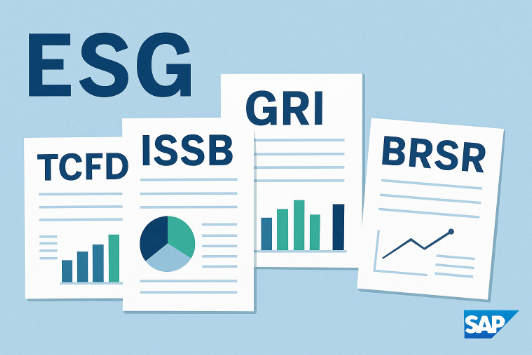
    This includes setup, configuration, framework activation, mapping, data integration, consolidation, and report extraction for BRSR, GRI, ISSB, GHG Protocol, and TCFD.

    Table of Contents


    WHY ESG REPORTING IS NO LONGER OPTIONAL

    Across industries—from manufacturing and energy to retail and BFSI—ESG reporting has shifted from a boardroom afterthought to a business-critical requirement.

    Regulators require BRSR, global investors request GRI and ISSB, and customers demand transparent emissions and supply-chain sustainability.

    But as companies begin their ESG journeys, they quickly realize:

    Spreadsheets break. Data is scattered. Assurance is impossible. Reporting becomes chaos.

    This is why global and Indian enterprises with SAP landscapes increasingly adopt SAP Sustainability Control Tower (SCT) as their ESG reporting backbone.

    This blog provides a comprehensive roadmap, detailed configuration steps, and real extraction workflows for ESG frameworks using SAP SCT.


    🏗️ SECTION 1 — WHAT IS SAP SUSTAINABILITY CONTROL TOWER (SCT)?

    SAP SCT is a cloud-based ESG reporting platform that:

    Integrates SAP & non-SAP systems

    Energy, waste, HR, finance, procurement, emissions, EHS, logistics

    Centralizes all sustainability metrics

    Environmental, Social, Governance indicators from multiple frameworks

    Provides pre-built frameworks

    • BRSR (India)
    • GRI
    • ISSB S1 & S2
    • GHG Protocol
    • TCFD
    • SASB
    • EU CSRD ESG metrics

    Delivers audit-ready reporting

    Built-in approvals, versioning, lineage, data quality checks

    Supports automated extraction

    PDF, Excel, Word, dashboard & API output

    Many companies adopt SCT because it becomes the “single source of truth” for sustainability reporting across regulatory, voluntary, and investor frameworks.


    🚀 SECTION 2 — THE COMPLETE ROADMAP FOR ESG REPORT EXTRACTION USING SCT

    Below is the recommended end-to-end implementation journey:


    PHASE 1 — Foundation Setup

    1. Define ESG Reporting Scope

    Identify which frameworks are relevant:

    • Mandatory: BRSR
    • Voluntary: GRI
    • Investor-driven: ISSB, SASB
    • Climate-risk: TCFD
    • Carbon: GHG Protocol

    2. Create Unified ESG Data Dictionary

    For each KPI define:

    • Metric description
    • Methodology
    • Unit
    • Frequency
    • Source system
    • Data owner
    • Calculation rules
    • Assurance controls

    This becomes your “ESG Bible”.

    3. Perform Materiality Assessment

    • Identify key topics relevant to stakeholders
    • Supports GRI, ISSB, and BRSR Leadership reporting

    PHASE 2 — System Integration

    4. Integrate Core SAP Systems

    SCT integrates with:

    • SAP S/4HANA → procurement, energy, materials
    • SAP EHS → incidents, waste, compliance
    • SAP SuccessFactors → attrition, diversity, training
    • SAP Ariba → suppliers, Scope 3 inputs
    • SAP Concur/Travel → business travel emissions
    • SAP PaPM → sustainability allocations
    • SAP Analytics Cloud (SAC) → dashboards

    5. Connect Non-SAP Systems

    Via:

    • CSV uploads
    • APIs
    • Excel templates
    • Partner connectors

    PHASE 3 — ESG Framework Activation & Configuration

    This is where SCT becomes powerful.

    Each ESG framework must be activated and mapped.


    🌿 SECTION 3 — DETAILED SAP SCT SETUP & CONFIGURATION STEPS

    Below are the step-by-step configurations to extract BRSR, GRI, ISSB, GHG Protocol, and TCFD reports.


    A. CONFIGURATION STEPS FOR BRSR IN SAP SCT

    Step 1 — Activate BRSR Framework

    Navigate to:
    Governance → Framework Management → Add Framework → Select BRSR

    SCT loads all indicators for:

    • Essential indicators
    • Leadership indicators

    Step 2 — Understand the Preloaded BRSR ESG Structure

    SCT provides:

    • KPI definitions
    • Data types (qualitative/quantitative)
    • Disclosure dependencies
    • Calculation logic where relevant

    Step 3 — Create BRSR Data Model

    Using your ESG dictionary:

    • Map BRSR KPIs to SAP fields
    • Define custom KPIs if unique to your operations

    Step 4 — Map Data Sources

    For example:

    BRSR IndicatorSAP Source System
    EnergySAP PP/PM/MM
    EmissionsSAP EHS / SAP Environment Management
    WorkforceSAP HR / SuccessFactors
    CSR SpendSAP Finance
    Supplier DataSAP Ariba

    Step 5 — Assign Data Owners

    Plant-level → BU-level → Group-level
    Setup workflows for approval and evidence uploads.

    Step 6 — Set Validation Rules

    Examples:

    • Mandatory fields
    • Thresholds
    • Year-over-year deviation alerts

    Step 7 — Import Qualitative Data

    Policies, governance, strategy, grievance redressal.

    Step 8 — Run Consolidation Engine

    SCT aggregates data across:

    • Plants
    • Business units
    • Countries
    • Reporting entities

    Step 9 — Generate BRSR Report

    Exports available:

    • PDF
    • Excel
    • MS Word
    • API for integration

    B. CONFIGURATION STEPS FOR GRI IN SAP SCT

    Step 1 — Activate GRI Framework

    Framework Management → Add Framework → Choose “GRI 2021”

    Step 2 — Select Material Topics

    Based on:

    • Impact materiality
    • Financial materiality
    • Stakeholder expectations

    Step 3 — Define “Disclosure Responsibility Matrix”

    Map each GRI disclosure to:

    • System source
    • Process owner
    • Reviewer
    • Approver

    Step 4 — Connect SAP & non-SAP Data

    Examples:

    GRI TopicMetricSource
    302EnergySAP PP
    305EmissionsSAP EHS
    401EmploymentSAP HR
    403SafetySAP EHS & Safety Suite

    Step 5 — Configure Narrative Sections

    SCT allows text blocks for:

    • Management approach
    • Eco-system impacts
    • Supply chain disclosures
    • Stakeholder engagement

    Step 6 — Generate GRI Report

    SCT creates a draft report with:

    • Coverage map
    • Missing disclosure log
    • Data lineage

    C. CONFIGURATION STEPS FOR ISSB S1 & S2

    ISSB requires deeper financial linkage.

    Step 1 — Activate ISSB S1 & S2

    Framework Management → Add Framework → Select ISSB

    Step 2 — Map Financial Materiality KPIs

    Examples:

    ISSB RequirementSAP Source
    Climate riskSAP PaPM / Finance
    Emissions pathwaysSAP EHS
    Industry KPIsSAP ERP
    Value chain impactSAP Ariba

    Step 3 — Set Up Climate Scenario Models

    Upload data such as:

    • 1.5°C scenario
    • 2°C transition risks
    • Physical risk maps

    Step 4 — Configure Impact Calculations

    Using SAP Profitability & Performance Management (PaPM) when applicable.

    Step 5 — Run Consolidation & Generate ISSB Report


    D. GHG PROTOCOL CONFIGURATION IN SCT

    Step 1 — Set Organizational Boundaries

    • Control approach
    • Equity share approach

    Step 2 — Activity Data Integration

    Scopewise:

    Scope 1: fuels, refrigerants
    Scope 2: electricity, district heating
    Scope 3: logistics, procurement, employee commuting, capex

    Step 3 — Emission Factor Mapping

    Source emission factors from:

    • DEFRA
    • IPCC
    • GHG Protocol
    • Supplier-provided

    Step 4 — Consolidation

    Entity → Region → Group

    Step 5 — Export Emissions Report


    E. TCFD CONFIGURATION IN SCT

    Step 1 — Governance Setup

    Assign board/management roles.

    Step 2 — Strategy Input

    Upload climate transition plans, risk maps, policy exposure.

    Step 3 — Risk & Opportunity Matrix

    Define:

    • Physical risks
    • Transition risks
    • Time horizons

    Step 4 — Metrics & Targets Mapping

    Often sourced from GHG, finance, ERP.

    Step 5 — TCFD Report Export


    🌍 SECTION 4 — HOW COMPANIES USE SCT IN REAL ESG REPORTING CYCLES

    While we avoid naming individual organizations, we can safely state:

    Many large enterprises running SAP S/4HANA adopt SCT

    Because ERP, EHS, HR, Ariba, SCM data already sits inside SAP.

    Manufacturing firms use it for BRSR & GRI

    Data comes from energy meters, waste registers, safety logs.

    Conglomerates adopt SCT for ISSB

    Because ISSB requires close linkage between sustainability and financial impacts.

    Global companies use SCT for automation

    Generated reports have audit trails, versioning, and workflow approvals.


    🧭 SECTION 5 — END-TO-END SAP SCT IMPLEMENTATION TIMELINE

    A typical 12–16 week roadmap:

    Phase 0 (Week 1–2): Discovery

    • Reporting requirements
    • Framework selection
    • System landscape analysis

    Phase 1 (Week 3–6): Configuration

    • Framework activation
    • KPI mapping
    • Data model design
    • Controls & validation setup

    Phase 2 (Week 7–10): Integration

    • SAP ERP, EHS, HRMS, Ariba
    • Non-SAP connectors
    • Supplier data integration

    Phase 3 (Week 11–14): Data Load + Testing

    • Historical data upload
    • Quality check
    • Auditor review

    Phase 4 (Week 15–16): Reporting

    • BRSR
    • GRI
    • ISSB
    • GHG emissions
    • Board dashboards

    🟢 SECTION 6 — BENEFITS OF USING SAP SCT FOR ESG REPORTING

    Regulatory Compliance

    BRSR, GRI, ISSB, GHG, TCFD supported by default.

    Automated Data Collection

    No spreadsheets, no email chaos.

    Real-Time Dashboards

    For plant, BU, and group-level insights.

    Assurance Ready

    Evidence, audit trails, role-based approvals.

    ✔ Finance Integration

    Crucial for ISSB and climate financial risk reporting.

    Repeatable, Scalable Reporting

    Annual reports become faster and more accurate.


    🌈 CONCLUSION — FROM CHAOS TO CLARITY

    In the rapidly changing ESG landscape, companies cannot rely on manual reporting. They need:

    • A unified data model
    • Automated data flows
    • Integrated systems
    • Assurance-ready processes
    • Multi-framework reporting
    • Real-time dashboards

    SAP Sustainability Control Tower (SCT) provides all of this—bringing order, structure, and confidence to ESG transformation.

    BRSR ensures regulatory trust.
    GRI ensures global comparability.
    ISSB ensures investor credibility.

    Together, they shape how the world sees your company.


    🚀 Call to Action: Turn ESG Complexity Into Clarity

    If your ESG reporting still feels like a maze of metrics, scattered spreadsheets, and last-minute compliance pressure — you’re not alone. Every company begins in chaos. What matters is the roadmap you choose next.

    Whether you’re building BRSR for the first time, aligning with GRI, or preparing for ISSB’s finance-grade disclosures, the journey doesn’t have to be overwhelming. With the right architecture, the right processes, and the right tools — sustainability reporting becomes repeatable, audit-ready, and decision-driven.

    If you want to:
    ✔ Design an ESG reporting blueprint
    ✔ Map metrics across BRSR/GRI/ISSB
    ✔ Implement or optimize SAP SCT
    ✔ Build an integrated data pipeline
    ✔ Make your sustainability data as reliable as your financials

    Let’s talk.
    Together, we can turn turbulent reporting demands into an opportunity for transformation, resilience, and leadership.

    Your ESG clarity starts today.

    Read more blogs on ESG here.

    Here are two specific links to get you started:

    • SAP Help Portal: “Sustainability Control Tower” documentation — help.sap.com
    • SAP Community: SCT Implementation Tips & Updates — community.sap.com
  • 🌍 How Companies Extract ESG Reports Using SAP Sustainability Control Tower (SCT)

    🌍 How Companies Extract ESG Reports Using SAP Sustainability Control Tower (SCT)

    This includes setup, configuration, framework activation, mapping, data integration, consolidation, and report extraction for BRSR, GRI, ISSB, GHG Protocol, and TCFD.

    Table of Contents


    WHY ESG REPORTING IS NO LONGER OPTIONAL

    Across industries—from manufacturing and energy to retail and BFSI—ESG reporting has shifted from a boardroom afterthought to a business-critical requirement.

    Regulators require BRSR, global investors request GRI and ISSB, and customers demand transparent emissions and supply-chain sustainability.

    But as companies begin their ESG journeys, they quickly realize:

    Spreadsheets break. Data is scattered. Assurance is impossible. Reporting becomes chaos.

    This is why global and Indian enterprises with SAP landscapes increasingly adopt SAP Sustainability Control Tower (SCT) as their ESG reporting backbone.

    This blog provides a comprehensive roadmap, detailed configuration steps, and real extraction workflows for ESG frameworks using SAP SCT.


    🏗️ SECTION 1 — WHAT IS SAP SUSTAINABILITY CONTROL TOWER (SCT)?

    SAP SCT is a cloud-based ESG reporting platform that:

    Integrates SAP & non-SAP systems

    Energy, waste, HR, finance, procurement, emissions, EHS, logistics

    Centralizes all sustainability metrics

    Environmental, Social, Governance indicators from multiple frameworks

    Provides pre-built frameworks

    • BRSR (India)
    • GRI
    • ISSB S1 & S2
    • GHG Protocol
    • TCFD
    • SASB
    • EU CSRD ESG metrics

    Delivers audit-ready reporting

    Built-in approvals, versioning, lineage, data quality checks

    Supports automated extraction

    PDF, Excel, Word, dashboard & API output

    Many companies adopt SCT because it becomes the “single source of truth” for sustainability reporting across regulatory, voluntary, and investor frameworks.


    🚀 SECTION 2 — THE COMPLETE ROADMAP FOR ESG REPORT EXTRACTION USING SCT

    Below is the recommended end-to-end implementation journey:


    PHASE 1 — Foundation Setup

    1. Define ESG Reporting Scope

    Identify which frameworks are relevant:

    • Mandatory: BRSR
    • Voluntary: GRI
    • Investor-driven: ISSB, SASB
    • Climate-risk: TCFD
    • Carbon: GHG Protocol

    2. Create Unified ESG Data Dictionary

    For each KPI define:

    • Metric description
    • Methodology
    • Unit
    • Frequency
    • Source system
    • Data owner
    • Calculation rules
    • Assurance controls

    This becomes your “ESG Bible”.

    3. Perform Materiality Assessment

    • Identify key topics relevant to stakeholders
    • Supports GRI, ISSB, and BRSR Leadership reporting

    PHASE 2 — System Integration

    4. Integrate Core SAP Systems

    SCT integrates with:

    • SAP S/4HANA → procurement, energy, materials
    • SAP EHS → incidents, waste, compliance
    • SAP SuccessFactors → attrition, diversity, training
    • SAP Ariba → suppliers, Scope 3 inputs
    • SAP Concur/Travel → business travel emissions
    • SAP PaPM → sustainability allocations
    • SAP Analytics Cloud (SAC) → dashboards

    5. Connect Non-SAP Systems

    Via:

    • CSV uploads
    • APIs
    • Excel templates
    • Partner connectors

    PHASE 3 — ESG Framework Activation & Configuration

    This is where SCT becomes powerful.

    Each ESG framework must be activated and mapped.


    🌿 SECTION 3 — DETAILED SAP SCT SETUP & CONFIGURATION STEPS

    Below are the step-by-step configurations to extract BRSR, GRI, ISSB, GHG Protocol, and TCFD reports.


    A. CONFIGURATION STEPS FOR BRSR IN SAP SCT

    Step 1 — Activate BRSR Framework

    Navigate to:
    Governance → Framework Management → Add Framework → Select BRSR

    SCT loads all indicators for:

    • Essential indicators
    • Leadership indicators

    Step 2 — Understand the Preloaded BRSR ESG Structure

    SCT provides:

    • KPI definitions
    • Data types (qualitative/quantitative)
    • Disclosure dependencies
    • Calculation logic where relevant

    Step 3 — Create BRSR Data Model

    Using your ESG dictionary:

    • Map BRSR KPIs to SAP fields
    • Define custom KPIs if unique to your operations

    Step 4 — Map Data Sources

    For example:

    BRSR IndicatorSAP Source System
    EnergySAP PP/PM/MM
    EmissionsSAP EHS / SAP Environment Management
    WorkforceSAP HR / SuccessFactors
    CSR SpendSAP Finance
    Supplier DataSAP Ariba

    Step 5 — Assign Data Owners

    Plant-level → BU-level → Group-level
    Setup workflows for approval and evidence uploads.

    Step 6 — Set Validation Rules

    Examples:

    • Mandatory fields
    • Thresholds
    • Year-over-year deviation alerts

    Step 7 — Import Qualitative Data

    Policies, governance, strategy, grievance redressal.

    Step 8 — Run Consolidation Engine

    SCT aggregates data across:

    • Plants
    • Business units
    • Countries
    • Reporting entities

    Step 9 — Generate BRSR Report

    Exports available:

    • PDF
    • Excel
    • MS Word
    • API for integration

    B. CONFIGURATION STEPS FOR GRI IN SAP SCT

    Step 1 — Activate GRI Framework

    Framework Management → Add Framework → Choose “GRI 2021”

    Step 2 — Select Material Topics

    Based on:

    • Impact materiality
    • Financial materiality
    • Stakeholder expectations

    Step 3 — Define “Disclosure Responsibility Matrix”

    Map each GRI disclosure to:

    • System source
    • Process owner
    • Reviewer
    • Approver

    Step 4 — Connect SAP & non-SAP Data

    Examples:

    GRI TopicMetricSource
    302EnergySAP PP
    305EmissionsSAP EHS
    401EmploymentSAP HR
    403SafetySAP EHS & Safety Suite

    Step 5 — Configure Narrative Sections

    SCT allows text blocks for:

    • Management approach
    • Eco-system impacts
    • Supply chain disclosures
    • Stakeholder engagement

    Step 6 — Generate GRI Report

    SCT creates a draft report with:

    • Coverage map
    • Missing disclosure log
    • Data lineage

    C. CONFIGURATION STEPS FOR ISSB S1 & S2

    ISSB requires deeper financial linkage.

    Step 1 — Activate ISSB S1 & S2

    Framework Management → Add Framework → Select ISSB

    Step 2 — Map Financial Materiality KPIs

    Examples:

    ISSB RequirementSAP Source
    Climate riskSAP PaPM / Finance
    Emissions pathwaysSAP EHS
    Industry KPIsSAP ERP
    Value chain impactSAP Ariba

    Step 3 — Set Up Climate Scenario Models

    Upload data such as:

    • 1.5°C scenario
    • 2°C transition risks
    • Physical risk maps

    Step 4 — Configure Impact Calculations

    Using SAP Profitability & Performance Management (PaPM) when applicable.

    Step 5 — Run Consolidation & Generate ISSB Report


    D. GHG PROTOCOL CONFIGURATION IN SCT

    Step 1 — Set Organizational Boundaries

    • Control approach
    • Equity share approach

    Step 2 — Activity Data Integration

    Scopewise:

    Scope 1: fuels, refrigerants
    Scope 2: electricity, district heating
    Scope 3: logistics, procurement, employee commuting, capex

    Step 3 — Emission Factor Mapping

    Source emission factors from:

    • DEFRA
    • IPCC
    • GHG Protocol
    • Supplier-provided

    Step 4 — Consolidation

    Entity → Region → Group

    Step 5 — Export Emissions Report


    E. TCFD CONFIGURATION IN SCT

    Step 1 — Governance Setup

    Assign board/management roles.

    Step 2 — Strategy Input

    Upload climate transition plans, risk maps, policy exposure.

    Step 3 — Risk & Opportunity Matrix

    Define:

    • Physical risks
    • Transition risks
    • Time horizons

    Step 4 — Metrics & Targets Mapping

    Often sourced from GHG, finance, ERP.

    Step 5 — TCFD Report Export


    🌍 SECTION 4 — HOW COMPANIES USE SCT IN REAL ESG REPORTING CYCLES

    While we avoid naming individual organizations, we can safely state:

    Many large enterprises running SAP S/4HANA adopt SCT

    Because ERP, EHS, HR, Ariba, SCM data already sits inside SAP.

    Manufacturing firms use it for BRSR & GRI

    Data comes from energy meters, waste registers, safety logs.

    Conglomerates adopt SCT for ISSB

    Because ISSB requires close linkage between sustainability and financial impacts.

    Global companies use SCT for automation

    Generated reports have audit trails, versioning, and workflow approvals.


    🧭 SECTION 5 — END-TO-END SAP SCT IMPLEMENTATION TIMELINE

    A typical 12–16 week roadmap:

    Phase 0 (Week 1–2): Discovery

    • Reporting requirements
    • Framework selection
    • System landscape analysis

    Phase 1 (Week 3–6): Configuration

    • Framework activation
    • KPI mapping
    • Data model design
    • Controls & validation setup

    Phase 2 (Week 7–10): Integration

    • SAP ERP, EHS, HRMS, Ariba
    • Non-SAP connectors
    • Supplier data integration

    Phase 3 (Week 11–14): Data Load + Testing

    • Historical data upload
    • Quality check
    • Auditor review

    Phase 4 (Week 15–16): Reporting

    • BRSR
    • GRI
    • ISSB
    • GHG emissions
    • Board dashboards

    🟢 SECTION 6 — BENEFITS OF USING SAP SCT FOR ESG REPORTING

    Regulatory Compliance

    BRSR, GRI, ISSB, GHG, TCFD supported by default.

    Automated Data Collection

    No spreadsheets, no email chaos.

    Real-Time Dashboards

    For plant, BU, and group-level insights.

    Assurance Ready

    Evidence, audit trails, role-based approvals.

    ✔ Finance Integration

    Crucial for ISSB and climate financial risk reporting.

    Repeatable, Scalable Reporting

    Annual reports become faster and more accurate.


    🌈 CONCLUSION — FROM CHAOS TO CLARITY

    In the rapidly changing ESG landscape, companies cannot rely on manual reporting. They need:

    • A unified data model
    • Automated data flows
    • Integrated systems
    • Assurance-ready processes
    • Multi-framework reporting
    • Real-time dashboards

    SAP Sustainability Control Tower (SCT) provides all of this—bringing order, structure, and confidence to ESG transformation.

    BRSR ensures regulatory trust.
    GRI ensures global comparability.
    ISSB ensures investor credibility.

    Together, they shape how the world sees your company.


    🚀 Call to Action: Turn ESG Complexity Into Clarity

    If your ESG reporting still feels like a maze of metrics, scattered spreadsheets, and last-minute compliance pressure — you’re not alone. Every company begins in chaos. What matters is the roadmap you choose next.

    Whether you’re building BRSR for the first time, aligning with GRI, or preparing for ISSB’s finance-grade disclosures, the journey doesn’t have to be overwhelming. With the right architecture, the right processes, and the right tools — sustainability reporting becomes repeatable, audit-ready, and decision-driven.

    If you want to:
    ✔ Design an ESG reporting blueprint
    ✔ Map metrics across BRSR/GRI/ISSB
    ✔ Implement or optimize SAP SCT
    ✔ Build an integrated data pipeline
    ✔ Make your sustainability data as reliable as your financials

    Let’s talk.
    Together, we can turn turbulent reporting demands into an opportunity for transformation, resilience, and leadership.

    Your ESG clarity starts today.

    Read more blogs on ESG here.

    Here are two specific links to get you started:

    • SAP Help Portal: “Sustainability Control Tower” documentation — help.sap.com
    • SAP Community: SCT Implementation Tips & Updates — community.sap.com

  • 🌍 How Companies Extract ESG Reports Using SAP Sustainability Control Tower (SCT)

    🌍 How Companies Extract ESG Reports Using SAP Sustainability Control Tower (SCT)

    This includes setup, configuration, framework activation, mapping, data integration, consolidation, and report extraction for BRSR, GRI, ISSB, GHG Protocol, and TCFD.

    Table of Contents


    WHY ESG REPORTING IS NO LONGER OPTIONAL

    Across industries—from manufacturing and energy to retail and BFSI—ESG reporting has shifted from a boardroom afterthought to a business-critical requirement.

    Regulators require BRSR, global investors request GRI and ISSB, and customers demand transparent emissions and supply-chain sustainability.

    But as companies begin their ESG journeys, they quickly realize:

    Spreadsheets break. Data is scattered. Assurance is impossible. Reporting becomes chaos.

    This is why global and Indian enterprises with SAP landscapes increasingly adopt SAP Sustainability Control Tower (SCT) as their ESG reporting backbone.

    This blog provides a comprehensive roadmap, detailed configuration steps, and real extraction workflows for ESG frameworks using SAP SCT.


    🏗️ SECTION 1 — WHAT IS SAP SUSTAINABILITY CONTROL TOWER (SCT)?

    SAP SCT is a cloud-based ESG reporting platform that:

    Integrates SAP & non-SAP systems

    Energy, waste, HR, finance, procurement, emissions, EHS, logistics

    Centralizes all sustainability metrics

    Environmental, Social, Governance indicators from multiple frameworks

    Provides pre-built frameworks

    • BRSR (India)
    • GRI
    • ISSB S1 & S2
    • GHG Protocol
    • TCFD
    • SASB
    • EU CSRD ESG metrics

    Delivers audit-ready reporting

    Built-in approvals, versioning, lineage, data quality checks

    Supports automated extraction

    PDF, Excel, Word, dashboard & API output

    Many companies adopt SCT because it becomes the “single source of truth” for sustainability reporting across regulatory, voluntary, and investor frameworks.


    🚀 SECTION 2 — THE COMPLETE ROADMAP FOR ESG REPORT EXTRACTION USING SCT

    Below is the recommended end-to-end implementation journey:


    PHASE 1 — Foundation Setup

    1. Define ESG Reporting Scope

    Identify which frameworks are relevant:

    • Mandatory: BRSR
    • Voluntary: GRI
    • Investor-driven: ISSB, SASB
    • Climate-risk: TCFD
    • Carbon: GHG Protocol

    2. Create Unified ESG Data Dictionary

    For each KPI define:

    • Metric description
    • Methodology
    • Unit
    • Frequency
    • Source system
    • Data owner
    • Calculation rules
    • Assurance controls

    This becomes your “ESG Bible”.

    3. Perform Materiality Assessment

    • Identify key topics relevant to stakeholders
    • Supports GRI, ISSB, and BRSR Leadership reporting

    PHASE 2 — System Integration

    4. Integrate Core SAP Systems

    SCT integrates with:

    • SAP S/4HANA → procurement, energy, materials
    • SAP EHS → incidents, waste, compliance
    • SAP SuccessFactors → attrition, diversity, training
    • SAP Ariba → suppliers, Scope 3 inputs
    • SAP Concur/Travel → business travel emissions
    • SAP PaPM → sustainability allocations
    • SAP Analytics Cloud (SAC) → dashboards

    5. Connect Non-SAP Systems

    Via:

    • CSV uploads
    • APIs
    • Excel templates
    • Partner connectors

    PHASE 3 — ESG Framework Activation & Configuration

    This is where SCT becomes powerful.

    Each ESG framework must be activated and mapped.


    🌿 SECTION 3 — DETAILED SAP SCT SETUP & CONFIGURATION STEPS

    Below are the step-by-step configurations to extract BRSR, GRI, ISSB, GHG Protocol, and TCFD reports.


    A. CONFIGURATION STEPS FOR BRSR IN SAP SCT

    Step 1 — Activate BRSR Framework

    Navigate to:
    Governance → Framework Management → Add Framework → Select BRSR

    SCT loads all indicators for:

    • Essential indicators
    • Leadership indicators

    Step 2 — Understand the Preloaded BRSR ESG Structure

    SCT provides:

    • KPI definitions
    • Data types (qualitative/quantitative)
    • Disclosure dependencies
    • Calculation logic where relevant

    Step 3 — Create BRSR Data Model

    Using your ESG dictionary:

    • Map BRSR KPIs to SAP fields
    • Define custom KPIs if unique to your operations

    Step 4 — Map Data Sources

    For example:

    BRSR IndicatorSAP Source System
    EnergySAP PP/PM/MM
    EmissionsSAP EHS / SAP Environment Management
    WorkforceSAP HR / SuccessFactors
    CSR SpendSAP Finance
    Supplier DataSAP Ariba

    Step 5 — Assign Data Owners

    Plant-level → BU-level → Group-level
    Setup workflows for approval and evidence uploads.

    Step 6 — Set Validation Rules

    Examples:

    • Mandatory fields
    • Thresholds
    • Year-over-year deviation alerts

    Step 7 — Import Qualitative Data

    Policies, governance, strategy, grievance redressal.

    Step 8 — Run Consolidation Engine

    SCT aggregates data across:

    • Plants
    • Business units
    • Countries
    • Reporting entities

    Step 9 — Generate BRSR Report

    Exports available:

    • PDF
    • Excel
    • MS Word
    • API for integration

    B. CONFIGURATION STEPS FOR GRI IN SAP SCT

    Step 1 — Activate GRI Framework

    Framework Management → Add Framework → Choose “GRI 2021”

    Step 2 — Select Material Topics

    Based on:

    • Impact materiality
    • Financial materiality
    • Stakeholder expectations

    Step 3 — Define “Disclosure Responsibility Matrix”

    Map each GRI disclosure to:

    • System source
    • Process owner
    • Reviewer
    • Approver

    Step 4 — Connect SAP & non-SAP Data

    Examples:

    GRI TopicMetricSource
    302EnergySAP PP
    305EmissionsSAP EHS
    401EmploymentSAP HR
    403SafetySAP EHS & Safety Suite

    Step 5 — Configure Narrative Sections

    SCT allows text blocks for:

    • Management approach
    • Eco-system impacts
    • Supply chain disclosures
    • Stakeholder engagement

    Step 6 — Generate GRI Report

    SCT creates a draft report with:

    • Coverage map
    • Missing disclosure log
    • Data lineage

    C. CONFIGURATION STEPS FOR ISSB S1 & S2

    ISSB requires deeper financial linkage.

    Step 1 — Activate ISSB S1 & S2

    Framework Management → Add Framework → Select ISSB

    Step 2 — Map Financial Materiality KPIs

    Examples:

    ISSB RequirementSAP Source
    Climate riskSAP PaPM / Finance
    Emissions pathwaysSAP EHS
    Industry KPIsSAP ERP
    Value chain impactSAP Ariba

    Step 3 — Set Up Climate Scenario Models

    Upload data such as:

    • 1.5°C scenario
    • 2°C transition risks
    • Physical risk maps

    Step 4 — Configure Impact Calculations

    Using SAP Profitability & Performance Management (PaPM) when applicable.

    Step 5 — Run Consolidation & Generate ISSB Report


    D. GHG PROTOCOL CONFIGURATION IN SCT

    Step 1 — Set Organizational Boundaries

    • Control approach
    • Equity share approach

    Step 2 — Activity Data Integration

    Scopewise:

    Scope 1: fuels, refrigerants
    Scope 2: electricity, district heating
    Scope 3: logistics, procurement, employee commuting, capex

    Step 3 — Emission Factor Mapping

    Source emission factors from:

    • DEFRA
    • IPCC
    • GHG Protocol
    • Supplier-provided

    Step 4 — Consolidation

    Entity → Region → Group

    Step 5 — Export Emissions Report


    E. TCFD CONFIGURATION IN SCT

    Step 1 — Governance Setup

    Assign board/management roles.

    Step 2 — Strategy Input

    Upload climate transition plans, risk maps, policy exposure.

    Step 3 — Risk & Opportunity Matrix

    Define:

    • Physical risks
    • Transition risks
    • Time horizons

    Step 4 — Metrics & Targets Mapping

    Often sourced from GHG, finance, ERP.

    Step 5 — TCFD Report Export


    🌍 SECTION 4 — HOW COMPANIES USE SCT IN REAL ESG REPORTING CYCLES

    While we avoid naming individual organizations, we can safely state:

    Many large enterprises running SAP S/4HANA adopt SCT

    Because ERP, EHS, HR, Ariba, SCM data already sits inside SAP.

    Manufacturing firms use it for BRSR & GRI

    Data comes from energy meters, waste registers, safety logs.

    Conglomerates adopt SCT for ISSB

    Because ISSB requires close linkage between sustainability and financial impacts.

    Global companies use SCT for automation

    Generated reports have audit trails, versioning, and workflow approvals.


    🧭 SECTION 5 — END-TO-END SAP SCT IMPLEMENTATION TIMELINE

    A typical 12–16 week roadmap:

    Phase 0 (Week 1–2): Discovery

    • Reporting requirements
    • Framework selection
    • System landscape analysis

    Phase 1 (Week 3–6): Configuration

    • Framework activation
    • KPI mapping
    • Data model design
    • Controls & validation setup

    Phase 2 (Week 7–10): Integration

    • SAP ERP, EHS, HRMS, Ariba
    • Non-SAP connectors
    • Supplier data integration

    Phase 3 (Week 11–14): Data Load + Testing

    • Historical data upload
    • Quality check
    • Auditor review

    Phase 4 (Week 15–16): Reporting

    • BRSR
    • GRI
    • ISSB
    • GHG emissions
    • Board dashboards

    🟢 SECTION 6 — BENEFITS OF USING SAP SCT FOR ESG REPORTING

    Regulatory Compliance

    BRSR, GRI, ISSB, GHG, TCFD supported by default.

    Automated Data Collection

    No spreadsheets, no email chaos.

    Real-Time Dashboards

    For plant, BU, and group-level insights.

    Assurance Ready

    Evidence, audit trails, role-based approvals.

    ✔ Finance Integration

    Crucial for ISSB and climate financial risk reporting.

    Repeatable, Scalable Reporting

    Annual reports become faster and more accurate.


    🌈 CONCLUSION — FROM CHAOS TO CLARITY

    In the rapidly changing ESG landscape, companies cannot rely on manual reporting. They need:

    • A unified data model
    • Automated data flows
    • Integrated systems
    • Assurance-ready processes
    • Multi-framework reporting
    • Real-time dashboards

    SAP Sustainability Control Tower (SCT) provides all of this—bringing order, structure, and confidence to ESG transformation.

    BRSR ensures regulatory trust.
    GRI ensures global comparability.
    ISSB ensures investor credibility.

    Together, they shape how the world sees your company.


    🚀 Call to Action: Turn ESG Complexity Into Clarity

    If your ESG reporting still feels like a maze of metrics, scattered spreadsheets, and last-minute compliance pressure — you’re not alone. Every company begins in chaos. What matters is the roadmap you choose next.

    Whether you’re building BRSR for the first time, aligning with GRI, or preparing for ISSB’s finance-grade disclosures, the journey doesn’t have to be overwhelming. With the right architecture, the right processes, and the right tools — sustainability reporting becomes repeatable, audit-ready, and decision-driven.

    If you want to:
    ✔ Design an ESG reporting blueprint
    ✔ Map metrics across BRSR/GRI/ISSB
    ✔ Implement or optimize SAP SCT
    ✔ Build an integrated data pipeline
    ✔ Make your sustainability data as reliable as your financials

    Let’s talk.
    Together, we can turn turbulent reporting demands into an opportunity for transformation, resilience, and leadership.

    Your ESG clarity starts today.

    Read more blogs on ESG here.

    Here are two specific links to get you started:

    • SAP Help Portal: “Sustainability Control Tower” documentation — help.sap.com
    • SAP Community: SCT Implementation Tips & Updates — community.sap.com
  • 🌍 How Companies Extract ESG Reports Using SAP Sustainability Control Tower (SCT)

    🌍 How Companies Extract ESG Reports Using SAP Sustainability Control Tower (SCT)

    This includes setup, configuration, framework activation, mapping, data integration, consolidation, and report extraction for BRSR, GRI, ISSB, GHG Protocol, and TCFD.

    Table of Contents


    WHY ESG REPORTING IS NO LONGER OPTIONAL

    Across industries—from manufacturing and energy to retail and BFSI—ESG reporting has shifted from a boardroom afterthought to a business-critical requirement.

    Regulators require BRSR, global investors request GRI and ISSB, and customers demand transparent emissions and supply-chain sustainability.

    But as companies begin their ESG journeys, they quickly realize:

    Spreadsheets break. Data is scattered. Assurance is impossible. Reporting becomes chaos.

    This is why global and Indian enterprises with SAP landscapes increasingly adopt SAP Sustainability Control Tower (SCT) as their ESG reporting backbone.

    This blog provides a comprehensive roadmap, detailed configuration steps, and real extraction workflows for ESG frameworks using SAP SCT.


    🏗️ SECTION 1 — WHAT IS SAP SUSTAINABILITY CONTROL TOWER (SCT)?

    SAP SCT is a cloud-based ESG reporting platform that:

    Integrates SAP & non-SAP systems

    Energy, waste, HR, finance, procurement, emissions, EHS, logistics

    Centralizes all sustainability metrics

    Environmental, Social, Governance indicators from multiple frameworks

    Provides pre-built frameworks

    • BRSR (India)
    • GRI
    • ISSB S1 & S2
    • GHG Protocol
    • TCFD
    • SASB
    • EU CSRD ESG metrics

    Delivers audit-ready reporting

    Built-in approvals, versioning, lineage, data quality checks

    Supports automated extraction

    PDF, Excel, Word, dashboard & API output

    Many companies adopt SCT because it becomes the “single source of truth” for sustainability reporting across regulatory, voluntary, and investor frameworks.


    🚀 SECTION 2 — THE COMPLETE ROADMAP FOR ESG REPORT EXTRACTION USING SCT

    Below is the recommended end-to-end implementation journey:


    PHASE 1 — Foundation Setup

    1. Define ESG Reporting Scope

    Identify which frameworks are relevant:

    • Mandatory: BRSR
    • Voluntary: GRI
    • Investor-driven: ISSB, SASB
    • Climate-risk: TCFD
    • Carbon: GHG Protocol

    2. Create Unified ESG Data Dictionary

    For each KPI define:

    • Metric description
    • Methodology
    • Unit
    • Frequency
    • Source system
    • Data owner
    • Calculation rules
    • Assurance controls

    This becomes your “ESG Bible”.

    3. Perform Materiality Assessment

    • Identify key topics relevant to stakeholders
    • Supports GRI, ISSB, and BRSR Leadership reporting

    PHASE 2 — System Integration

    4. Integrate Core SAP Systems

    SCT integrates with:

    • SAP S/4HANA → procurement, energy, materials
    • SAP EHS → incidents, waste, compliance
    • SAP SuccessFactors → attrition, diversity, training
    • SAP Ariba → suppliers, Scope 3 inputs
    • SAP Concur/Travel → business travel emissions
    • SAP PaPM → sustainability allocations
    • SAP Analytics Cloud (SAC) → dashboards

    5. Connect Non-SAP Systems

    Via:

    • CSV uploads
    • APIs
    • Excel templates
    • Partner connectors

    PHASE 3 — ESG Framework Activation & Configuration

    This is where SCT becomes powerful.

    Each ESG framework must be activated and mapped.


    🌿 SECTION 3 — DETAILED SAP SCT SETUP & CONFIGURATION STEPS

    Below are the step-by-step configurations to extract BRSR, GRI, ISSB, GHG Protocol, and TCFD reports.


    A. CONFIGURATION STEPS FOR BRSR IN SAP SCT

    Step 1 — Activate BRSR Framework

    Navigate to:
    Governance → Framework Management → Add Framework → Select BRSR

    SCT loads all indicators for:

    • Essential indicators
    • Leadership indicators

    Step 2 — Understand the Preloaded BRSR ESG Structure

    SCT provides:

    • KPI definitions
    • Data types (qualitative/quantitative)
    • Disclosure dependencies
    • Calculation logic where relevant

    Step 3 — Create BRSR Data Model

    Using your ESG dictionary:

    • Map BRSR KPIs to SAP fields
    • Define custom KPIs if unique to your operations

    Step 4 — Map Data Sources

    For example:

    BRSR IndicatorSAP Source System
    EnergySAP PP/PM/MM
    EmissionsSAP EHS / SAP Environment Management
    WorkforceSAP HR / SuccessFactors
    CSR SpendSAP Finance
    Supplier DataSAP Ariba

    Step 5 — Assign Data Owners

    Plant-level → BU-level → Group-level
    Setup workflows for approval and evidence uploads.

    Step 6 — Set Validation Rules

    Examples:

    • Mandatory fields
    • Thresholds
    • Year-over-year deviation alerts

    Step 7 — Import Qualitative Data

    Policies, governance, strategy, grievance redressal.

    Step 8 — Run Consolidation Engine

    SCT aggregates data across:

    • Plants
    • Business units
    • Countries
    • Reporting entities

    Step 9 — Generate BRSR Report

    Exports available:

    • PDF
    • Excel
    • MS Word
    • API for integration

    B. CONFIGURATION STEPS FOR GRI IN SAP SCT

    Step 1 — Activate GRI Framework

    Framework Management → Add Framework → Choose “GRI 2021”

    Step 2 — Select Material Topics

    Based on:

    • Impact materiality
    • Financial materiality
    • Stakeholder expectations

    Step 3 — Define “Disclosure Responsibility Matrix”

    Map each GRI disclosure to:

    • System source
    • Process owner
    • Reviewer
    • Approver

    Step 4 — Connect SAP & non-SAP Data

    Examples:

    GRI TopicMetricSource
    302EnergySAP PP
    305EmissionsSAP EHS
    401EmploymentSAP HR
    403SafetySAP EHS & Safety Suite

    Step 5 — Configure Narrative Sections

    SCT allows text blocks for:

    • Management approach
    • Eco-system impacts
    • Supply chain disclosures
    • Stakeholder engagement

    Step 6 — Generate GRI Report

    SCT creates a draft report with:

    • Coverage map
    • Missing disclosure log
    • Data lineage

    C. CONFIGURATION STEPS FOR ISSB S1 & S2

    ISSB requires deeper financial linkage.

    Step 1 — Activate ISSB S1 & S2

    Framework Management → Add Framework → Select ISSB

    Step 2 — Map Financial Materiality KPIs

    Examples:

    ISSB RequirementSAP Source
    Climate riskSAP PaPM / Finance
    Emissions pathwaysSAP EHS
    Industry KPIsSAP ERP
    Value chain impactSAP Ariba

    Step 3 — Set Up Climate Scenario Models

    Upload data such as:

    • 1.5°C scenario
    • 2°C transition risks
    • Physical risk maps

    Step 4 — Configure Impact Calculations

    Using SAP Profitability & Performance Management (PaPM) when applicable.

    Step 5 — Run Consolidation & Generate ISSB Report


    D. GHG PROTOCOL CONFIGURATION IN SCT

    Step 1 — Set Organizational Boundaries

    • Control approach
    • Equity share approach

    Step 2 — Activity Data Integration

    Scopewise:

    Scope 1: fuels, refrigerants
    Scope 2: electricity, district heating
    Scope 3: logistics, procurement, employee commuting, capex

    Step 3 — Emission Factor Mapping

    Source emission factors from:

    • DEFRA
    • IPCC
    • GHG Protocol
    • Supplier-provided

    Step 4 — Consolidation

    Entity → Region → Group

    Step 5 — Export Emissions Report


    E. TCFD CONFIGURATION IN SCT

    Step 1 — Governance Setup

    Assign board/management roles.

    Step 2 — Strategy Input

    Upload climate transition plans, risk maps, policy exposure.

    Step 3 — Risk & Opportunity Matrix

    Define:

    • Physical risks
    • Transition risks
    • Time horizons

    Step 4 — Metrics & Targets Mapping

    Often sourced from GHG, finance, ERP.

    Step 5 — TCFD Report Export


    🌍 SECTION 4 — HOW COMPANIES USE SCT IN REAL ESG REPORTING CYCLES

    While we avoid naming individual organizations, we can safely state:

    Many large enterprises running SAP S/4HANA adopt SCT

    Because ERP, EHS, HR, Ariba, SCM data already sits inside SAP.

    Manufacturing firms use it for BRSR & GRI

    Data comes from energy meters, waste registers, safety logs.

    Conglomerates adopt SCT for ISSB

    Because ISSB requires close linkage between sustainability and financial impacts.

    Global companies use SCT for automation

    Generated reports have audit trails, versioning, and workflow approvals.


    🧭 SECTION 5 — END-TO-END SAP SCT IMPLEMENTATION TIMELINE

    A typical 12–16 week roadmap:

    Phase 0 (Week 1–2): Discovery

    • Reporting requirements
    • Framework selection
    • System landscape analysis

    Phase 1 (Week 3–6): Configuration

    • Framework activation
    • KPI mapping
    • Data model design
    • Controls & validation setup

    Phase 2 (Week 7–10): Integration

    • SAP ERP, EHS, HRMS, Ariba
    • Non-SAP connectors
    • Supplier data integration

    Phase 3 (Week 11–14): Data Load + Testing

    • Historical data upload
    • Quality check
    • Auditor review

    Phase 4 (Week 15–16): Reporting

    • BRSR
    • GRI
    • ISSB
    • GHG emissions
    • Board dashboards

    🟢 SECTION 6 — BENEFITS OF USING SAP SCT FOR ESG REPORTING

    Regulatory Compliance

    BRSR, GRI, ISSB, GHG, TCFD supported by default.

    Automated Data Collection

    No spreadsheets, no email chaos.

    Real-Time Dashboards

    For plant, BU, and group-level insights.

    Assurance Ready

    Evidence, audit trails, role-based approvals.

    ✔ Finance Integration

    Crucial for ISSB and climate financial risk reporting.

    Repeatable, Scalable Reporting

    Annual reports become faster and more accurate.


    🌈 CONCLUSION — FROM CHAOS TO CLARITY

    In the rapidly changing ESG landscape, companies cannot rely on manual reporting. They need:

    • A unified data model
    • Automated data flows
    • Integrated systems
    • Assurance-ready processes
    • Multi-framework reporting
    • Real-time dashboards

    SAP Sustainability Control Tower (SCT) provides all of this—bringing order, structure, and confidence to ESG transformation.

    BRSR ensures regulatory trust.
    GRI ensures global comparability.
    ISSB ensures investor credibility.

    Together, they shape how the world sees your company.


    🚀 Call to Action: Turn ESG Complexity Into Clarity

    If your ESG reporting still feels like a maze of metrics, scattered spreadsheets, and last-minute compliance pressure — you’re not alone. Every company begins in chaos. What matters is the roadmap you choose next.

    Whether you’re building BRSR for the first time, aligning with GRI, or preparing for ISSB’s finance-grade disclosures, the journey doesn’t have to be overwhelming. With the right architecture, the right processes, and the right tools — sustainability reporting becomes repeatable, audit-ready, and decision-driven.

    If you want to:
    ✔ Design an ESG reporting blueprint
    ✔ Map metrics across BRSR/GRI/ISSB
    ✔ Implement or optimize SAP SCT
    ✔ Build an integrated data pipeline
    ✔ Make your sustainability data as reliable as your financials

    Let’s talk.
    Together, we can turn turbulent reporting demands into an opportunity for transformation, resilience, and leadership.

    Your ESG clarity starts today.

    Read more blogs on ESG here.

    Here are two specific links to get you started:

    • SAP Help Portal: “Sustainability Control Tower” documentation — help.sap.com
    • SAP Community: SCT Implementation Tips & Updates — community.sap.com
  • The Implementation Crisis: Why ESG Strategy Dies in Execution

    The Implementation Crisis: Why ESG Strategy Dies in Execution


    ESG Failure: The Reality Behind Glossy Events

    They unveiled it like a masterpiece. A glossy ESG report, polished to perfection — shimmering targets, elegant charts, bold claims: “Net-zero by 2040.” “50% renewables by 2030.” Investors nodded approvingly. Customers applauded the ambition. Employees felt proud to share it on LinkedIn.

    But later that same afternoon, the real story surfaced.

    In procurement, the cheapest supplier won — despite poor ESG compliance.
    In R&D, sustainable product budgets were quietly cut.
    In HR, diversity goals didn’t even make it to performance reviews.

    The company that looked ESG-ready on paper wasn’t ESG-ready in practice.

    This is the ESG Implementation Crisis.

    And the numbers prove it.
    McKinsey’s 2022 global study shows that while 87% of companies publish ESG commitments, only 34% integrate them into daily operations — and just 11% deliver measurable improvements. On average, it takes 4.7 years for companies to move from promise to real execution.

    India faces the same gap. According to the 2023 CII–EY Survey:

    • 78% of companies have ESG policies,
    • but only 23% tie them to executive pay,
    • only 31% review ESG in quarterly business meetings,
    • and just 19% have met their interim targets.

    The truth is undeniable:
    ESG isn’t dying at the strategy table — it’s dying in execution.

    Every CEO today knows how to announce ESG commitments.
    Very few know how to execute them.

    The real crisis in ESG isn’t lack of strategy.
    It’s what happens after the strategy presentation ends and the business has to implement it.

    Below is a clear, engaging breakdown of why ESG execution fails — with widely reported real-world examples from globally recognized companies.


    1. Strategy–Execution Disconnect

    When bold commitments never reach the shop floor.

    Story: Starbucks & the Reusable Cup Problem

    Starbucks made strong commitments to reduce waste and increase reusable cup adoption.
    But stores lacked:

    • washing/cleaning infrastructure
    • operational workflows
    • staff training
    • queue-management processes
    • customer incentives

    The result?
    Reusable cup usage remained extremely low, and Starbucks had to repeatedly delay targets.

    Lesson:
    If operations teams can’t execute it, the strategy is just a press release.


    Story: Large Energy Companies’ Net-Zero Plans Without Capex Shifts

    Many oil & gas companies published net-zero commitments,
    but continued allocating over 90% of capital expenditure to traditional fossil projects.
    Because capital allocation didn’t change, emissions trajectories didn’t change either.

    Lesson:
    If budgets don’t reflect ESG goals, the strategy has already failed.


    2. Resource Starvation

    Where ideas are big, but budgets are tiny.

    Story: Global Fashion Brands & Sustainable Collections

    Many apparel giants introduced “sustainable collections” using eco-fabrics.
    But suppliers reported:

    • no funding for traceability systems
    • no budget for cleaner dyes
    • no support for material transitions

    Without financial backing, sustainability stayed a marketing initiative — not a supply chain transformation.

    Lesson:
    Sustainability without funding = greenwashing risk.


    Story: Major Quick-Commerce Companies & Electric Delivery Fleets

    Food and grocery delivery companies committed to shifting delivery fleets to electric vehicles.
    But gig-workers reported:

    • no charging infrastructure
    • no battery replacement support
    • no EV lease incentives

    The plan depended entirely on individuals bearing the cost.

    Lesson:
    ESG dies when execution depends on people who were never resourced for it.


    3. The Accountability Vacuum

    When ESG tasks exist, but no one truly owns the outcome.

    Story: Large Banks & Responsible Lending Promises

    Several global banks announced responsible lending frameworks,
    but loan officers continued using legacy credit scoring,
    because no one changed performance metrics or incentives.

    So sustainability criteria never entered loan decisions.

    Lesson:
    If rewards don’t change, behaviors won’t change.


    Story: Global Retailers & Labor Standards

    Retailers published ethical sourcing standards,
    but responsibility was split across:

    • sustainability teams
    • compliance teams
    • procurement
    • factory auditors
    • external certifiers

    Because every team owned a “piece,”
    no single leader owned the outcome.

    Social audits improved on paper but not in practice.

    Lesson:
    Accountability must be single-point, not fragmentary.


    4. Measurement Theater

    When companies measure everything—except real impact.

    Story: Food & Beverage Companies & “Recycle-Ready” Packaging

    FMCG companies launched “100% recyclable packaging.”
    But municipal recycling systems in many regions could NOT process these formats.
    Technically recyclable ≠ actually recycled.

    The company reported progress.
    Customers saw no change in waste.

    Lesson:
    The wrong metric creates the wrong reality.


    Story: Tech Platforms & Safety Metrics

    Big tech platforms publish extensive sustainability and community-impact reports.
    But safety and well-being issues persist because internal metrics emphasize engagement,
    not user well-being.

    Lesson:
    When KPIs ignore real-world impact, ESG becomes a reporting exercise.


    5. Cultural Resistance & Passive Non-Compliance

    When the organization quietly refuses to change.

    Story: Restaurant Chains & Waste Reduction Plans

    Fast-food companies pledged to reduce packaging and food waste.
    But many franchise owners resisted:

    • new waste sorting stages
    • compostable packaging
    • local sustainability rules
      because these added cost and slowed service speed.

    The corporate commitment never survived frontline resistance.

    Lesson:
    Culture beats policy every single day.


    Story: Manufacturing Firms & Safety Culture

    Hundreds of manufacturers globally promote “zero harm” cultures,
    but frontline employees report production pressure outweighing safety norms.
    This leads to near-misses, unreported incidents, and compliance gaps.

    Lesson:
    Values do not matter if daily behavior contradicts them.


    The Real Reason ESG Dies: Organizations Don’t Change Their Operating System

    Every failed ESG strategy has one thing in common:

    The company tried to change outcomes
    without changing how decisions, budgets, incentives, and behaviors work.

    Real ESG execution requires redesigning:

    • Capex decisions
    • Procurement rules
    • Leadership KPIs
    • Operational SOPs
    • Cultural norms
    • Measurement systems

    ESG isn’t a policy.
    It’s an operating model.


    🚨 Call to Action: Before ESG Fails Your Business

    ESG failures don’t destroy companies overnight.
    They destroy them quietly — through stalled execution, misaligned incentives, reputational damage, and billions in stranded investments.

    If your strategy isn’t embedded in operations, it isn’t a strategy. It’s a liability waiting to hit your balance sheet.

    Now is the time to act. Not next quarter. Not after the next board meeting. Today.

    Here’s what your leadership team must do immediately:

    1. Audit your ESG–execution gap
      Identify where ambition is not matched with budgets, incentives, data, or governance.
    2. Rewire how decisions get made
      ESG must shape capital allocation, procurement rules, product development, and risk appetite — not just reporting.
    3. Build accountability that bites
      Tie KPIs, bonuses, and operational targets directly to ESG outcomes.
      No accountability = no implementation.
    4. Equip your teams with resources to deliver
      Strategy without funding is not a strategy — it’s a public-relations risk.
    5. Fix culture before culture kills your ESG
      Train, incentivize, and align frontline managers.
      ESG fails when they quietly resist.

    🔥 Act Now: Turn ESG from Reporting Burden into Competitive Advantage

    Most companies treat ESG as compliance.
    The winners treat it as operational strategy — and they are already pulling ahead in:

    • customer trust
    • access to capital
    • supply-chain resilience
    • regulatory readiness
    • talent retention
    • valuation multiples

    Which side of history will your company be on?

    👉 If your ESG strategy is stuck on PowerPoint, let’s turn it into execution.
    Let’s build systems, not slogans.
    Let’s operationalize ESG before the next disruption hits.


    💼 Work With Us: ESG Execution That Actually Works

    If your organisation is facing:

    • ambitious targets without roadmaps,
    • scattered ownership,
    • strained resources,
    • unclear KPIs,
    • or cultural resistance…

    then you’re already in the “Implementation Crisis” zone.

    You don’t need another report.
    You need a partner who can translate ESG into budgets, SOPs, incentives, and real operational change.

    📩 Reach out for a consultation on ESG execution, risk transformation, and sustainable strategy integration.
    Let’s turn your turbulence into competitive advantage.

    Read more blogs here.

    🔍 Public References for ESG Implementation Failures

    Example from BlogPublic Reference / Source
    Starbucks – Reusable Cup Implementation IssuesCNBC: “Starbucks has a coffee-cup climate issue as mobile, drive-thru booms” — shows that despite reusable-cup goals, most sales still come in disposables. CNBC
    Fortune: “Starbucks wants to eliminate disposable cups by 2030 — but only 1.2% of sales were in reusable ones in 2022.” Fortune
    BP – Pullback on Green Investment / Shift Back to Fossil FuelsLivemint: “BP slashes ‘net zero’ renewable energy spending by $5 billion … turns to fossil fuels” mint
    Economic Times: “BP walks back on renewable investment, to scale up fossil fuel production” The Economic Times
    NetZeroInvestor: “BP to ramp up fossil fuel production and slash renewables” netzeroinvestor.net
    Banks / Financial Institutions Funding Fossil Fuels Despite Net-Zero PledgesThe Guardian: “Banks still investing heavily in fossil fuels despite net zero pledges” The Guardian
    NetZeroInvestor: “Banks ramp up fossil fuel funding in defiance of net zero pledges” netzeroinvestor.net
  • The Implementation Crisis: Why ESG Strategy Dies in Execution

    The Implementation Crisis: Why ESG Strategy Dies in Execution


    ESG Failure: The Reality Behind Glossy Events

    They unveiled it like a masterpiece. A glossy ESG report, polished to perfection — shimmering targets, elegant charts, bold claims: “Net-zero by 2040.” “50% renewables by 2030.” Investors nodded approvingly. Customers applauded the ambition. Employees felt proud to share it on LinkedIn.

    But later that same afternoon, the real story surfaced.

    In procurement, the cheapest supplier won — despite poor ESG compliance.
    In R&D, sustainable product budgets were quietly cut.
    In HR, diversity goals didn’t even make it to performance reviews.

    The company that looked ESG-ready on paper wasn’t ESG-ready in practice.

    This is the ESG Implementation Crisis.

    And the numbers prove it.
    McKinsey’s 2022 global study shows that while 87% of companies publish ESG commitments, only 34% integrate them into daily operations — and just 11% deliver measurable improvements. On average, it takes 4.7 years for companies to move from promise to real execution.

    India faces the same gap. According to the 2023 CII–EY Survey:

    • 78% of companies have ESG policies,
    • but only 23% tie them to executive pay,
    • only 31% review ESG in quarterly business meetings,
    • and just 19% have met their interim targets.

    The truth is undeniable:
    ESG isn’t dying at the strategy table — it’s dying in execution.

    Every CEO today knows how to announce ESG commitments.
    Very few know how to execute them.

    The real crisis in ESG isn’t lack of strategy.
    It’s what happens after the strategy presentation ends and the business has to implement it.

    Below is a clear, engaging breakdown of why ESG execution fails — with widely reported real-world examples from globally recognized companies.


    1. Strategy–Execution Disconnect

    When bold commitments never reach the shop floor.

    Story: Starbucks & the Reusable Cup Problem

    Starbucks made strong commitments to reduce waste and increase reusable cup adoption.
    But stores lacked:

    • washing/cleaning infrastructure
    • operational workflows
    • staff training
    • queue-management processes
    • customer incentives

    The result?
    Reusable cup usage remained extremely low, and Starbucks had to repeatedly delay targets.

    Lesson:
    If operations teams can’t execute it, the strategy is just a press release.


    Story: Large Energy Companies’ Net-Zero Plans Without Capex Shifts

    Many oil & gas companies published net-zero commitments,
    but continued allocating over 90% of capital expenditure to traditional fossil projects.
    Because capital allocation didn’t change, emissions trajectories didn’t change either.

    Lesson:
    If budgets don’t reflect ESG goals, the strategy has already failed.


    2. Resource Starvation

    Where ideas are big, but budgets are tiny.

    Story: Global Fashion Brands & Sustainable Collections

    Many apparel giants introduced “sustainable collections” using eco-fabrics.
    But suppliers reported:

    • no funding for traceability systems
    • no budget for cleaner dyes
    • no support for material transitions

    Without financial backing, sustainability stayed a marketing initiative — not a supply chain transformation.

    Lesson:
    Sustainability without funding = greenwashing risk.


    Story: Major Quick-Commerce Companies & Electric Delivery Fleets

    Food and grocery delivery companies committed to shifting delivery fleets to electric vehicles.
    But gig-workers reported:

    • no charging infrastructure
    • no battery replacement support
    • no EV lease incentives

    The plan depended entirely on individuals bearing the cost.

    Lesson:
    ESG dies when execution depends on people who were never resourced for it.


    3. The Accountability Vacuum

    When ESG tasks exist, but no one truly owns the outcome.

    Story: Large Banks & Responsible Lending Promises

    Several global banks announced responsible lending frameworks,
    but loan officers continued using legacy credit scoring,
    because no one changed performance metrics or incentives.

    So sustainability criteria never entered loan decisions.

    Lesson:
    If rewards don’t change, behaviors won’t change.


    Story: Global Retailers & Labor Standards

    Retailers published ethical sourcing standards,
    but responsibility was split across:

    • sustainability teams
    • compliance teams
    • procurement
    • factory auditors
    • external certifiers

    Because every team owned a “piece,”
    no single leader owned the outcome.

    Social audits improved on paper but not in practice.

    Lesson:
    Accountability must be single-point, not fragmentary.


    4. Measurement Theater

    When companies measure everything—except real impact.

    Story: Food & Beverage Companies & “Recycle-Ready” Packaging

    FMCG companies launched “100% recyclable packaging.”
    But municipal recycling systems in many regions could NOT process these formats.
    Technically recyclable ≠ actually recycled.

    The company reported progress.
    Customers saw no change in waste.

    Lesson:
    The wrong metric creates the wrong reality.


    Story: Tech Platforms & Safety Metrics

    Big tech platforms publish extensive sustainability and community-impact reports.
    But safety and well-being issues persist because internal metrics emphasize engagement,
    not user well-being.

    Lesson:
    When KPIs ignore real-world impact, ESG becomes a reporting exercise.


    5. Cultural Resistance & Passive Non-Compliance

    When the organization quietly refuses to change.

    Story: Restaurant Chains & Waste Reduction Plans

    Fast-food companies pledged to reduce packaging and food waste.
    But many franchise owners resisted:

    • new waste sorting stages
    • compostable packaging
    • local sustainability rules
      because these added cost and slowed service speed.

    The corporate commitment never survived frontline resistance.

    Lesson:
    Culture beats policy every single day.


    Story: Manufacturing Firms & Safety Culture

    Hundreds of manufacturers globally promote “zero harm” cultures,
    but frontline employees report production pressure outweighing safety norms.
    This leads to near-misses, unreported incidents, and compliance gaps.

    Lesson:
    Values do not matter if daily behavior contradicts them.


    The Real Reason ESG Dies: Organizations Don’t Change Their Operating System

    Every failed ESG strategy has one thing in common:

    The company tried to change outcomes
    without changing how decisions, budgets, incentives, and behaviors work.

    Real ESG execution requires redesigning:

    • Capex decisions
    • Procurement rules
    • Leadership KPIs
    • Operational SOPs
    • Cultural norms
    • Measurement systems

    ESG isn’t a policy.
    It’s an operating model.


    🚨 Call to Action: Before ESG Fails Your Business

    ESG failures don’t destroy companies overnight.
    They destroy them quietly — through stalled execution, misaligned incentives, reputational damage, and billions in stranded investments.

    If your strategy isn’t embedded in operations, it isn’t a strategy. It’s a liability waiting to hit your balance sheet.

    Now is the time to act. Not next quarter. Not after the next board meeting. Today.

    Here’s what your leadership team must do immediately:

    1. Audit your ESG–execution gap
      Identify where ambition is not matched with budgets, incentives, data, or governance.
    2. Rewire how decisions get made
      ESG must shape capital allocation, procurement rules, product development, and risk appetite — not just reporting.
    3. Build accountability that bites
      Tie KPIs, bonuses, and operational targets directly to ESG outcomes.
      No accountability = no implementation.
    4. Equip your teams with resources to deliver
      Strategy without funding is not a strategy — it’s a public-relations risk.
    5. Fix culture before culture kills your ESG
      Train, incentivize, and align frontline managers.
      ESG fails when they quietly resist.

    🔥 Act Now: Turn ESG from Reporting Burden into Competitive Advantage

    Most companies treat ESG as compliance.
    The winners treat it as operational strategy — and they are already pulling ahead in:

    • customer trust
    • access to capital
    • supply-chain resilience
    • regulatory readiness
    • talent retention
    • valuation multiples

    Which side of history will your company be on?

    👉 If your ESG strategy is stuck on PowerPoint, let’s turn it into execution.
    Let’s build systems, not slogans.
    Let’s operationalize ESG before the next disruption hits.


    💼 Work With Us: ESG Execution That Actually Works

    If your organisation is facing:

    • ambitious targets without roadmaps,
    • scattered ownership,
    • strained resources,
    • unclear KPIs,
    • or cultural resistance…

    then you’re already in the “Implementation Crisis” zone.

    You don’t need another report.
    You need a partner who can translate ESG into budgets, SOPs, incentives, and real operational change.

    📩 Reach out for a consultation on ESG execution, risk transformation, and sustainable strategy integration.
    Let’s turn your turbulence into competitive advantage.

    Read more blogs here.

    🔍 Public References for ESG Implementation Failures

    Example from BlogPublic Reference / Source
    Starbucks – Reusable Cup Implementation IssuesCNBC: “Starbucks has a coffee-cup climate issue as mobile, drive-thru booms” — shows that despite reusable-cup goals, most sales still come in disposables. CNBC
    Fortune: “Starbucks wants to eliminate disposable cups by 2030 — but only 1.2% of sales were in reusable ones in 2022.” Fortune
    BP – Pullback on Green Investment / Shift Back to Fossil FuelsLivemint: “BP slashes ‘net zero’ renewable energy spending by $5 billion … turns to fossil fuels” mint
    Economic Times: “BP walks back on renewable investment, to scale up fossil fuel production” The Economic Times
    NetZeroInvestor: “BP to ramp up fossil fuel production and slash renewables” netzeroinvestor.net
    Banks / Financial Institutions Funding Fossil Fuels Despite Net-Zero PledgesThe Guardian: “Banks still investing heavily in fossil fuels despite net zero pledges” The Guardian
    NetZeroInvestor: “Banks ramp up fossil fuel funding in defiance of net zero pledges” netzeroinvestor.net
  • The Implementation Crisis: Why ESG Strategy Dies in Execution

    The Implementation Crisis: Why ESG Strategy Dies in Execution


    ESG Failure: The Reality Behind Glossy Events

    They unveiled it like a masterpiece. A glossy ESG report, polished to perfection — shimmering targets, elegant charts, bold claims: “Net-zero by 2040.” “50% renewables by 2030.” Investors nodded approvingly. Customers applauded the ambition. Employees felt proud to share it on LinkedIn.

    But later that same afternoon, the real story surfaced.

    In procurement, the cheapest supplier won — despite poor ESG compliance.
    In R&D, sustainable product budgets were quietly cut.
    In HR, diversity goals didn’t even make it to performance reviews.

    The company that looked ESG-ready on paper wasn’t ESG-ready in practice.

    This is the ESG Implementation Crisis.

    And the numbers prove it.
    McKinsey’s 2022 global study shows that while 87% of companies publish ESG commitments, only 34% integrate them into daily operations — and just 11% deliver measurable improvements. On average, it takes 4.7 years for companies to move from promise to real execution.

    India faces the same gap. According to the 2023 CII–EY Survey:

    • 78% of companies have ESG policies,
    • but only 23% tie them to executive pay,
    • only 31% review ESG in quarterly business meetings,
    • and just 19% have met their interim targets.

    The truth is undeniable:
    ESG isn’t dying at the strategy table — it’s dying in execution.

    Every CEO today knows how to announce ESG commitments.
    Very few know how to execute them.

    The real crisis in ESG isn’t lack of strategy.
    It’s what happens after the strategy presentation ends and the business has to implement it.

    Below is a clear, engaging breakdown of why ESG execution fails — with widely reported real-world examples from globally recognized companies.


    1. Strategy–Execution Disconnect

    When bold commitments never reach the shop floor.

    Story: Starbucks & the Reusable Cup Problem

    Starbucks made strong commitments to reduce waste and increase reusable cup adoption.
    But stores lacked:

    • washing/cleaning infrastructure
    • operational workflows
    • staff training
    • queue-management processes
    • customer incentives

    The result?
    Reusable cup usage remained extremely low, and Starbucks had to repeatedly delay targets.

    Lesson:
    If operations teams can’t execute it, the strategy is just a press release.


    Story: Large Energy Companies’ Net-Zero Plans Without Capex Shifts

    Many oil & gas companies published net-zero commitments,
    but continued allocating over 90% of capital expenditure to traditional fossil projects.
    Because capital allocation didn’t change, emissions trajectories didn’t change either.

    Lesson:
    If budgets don’t reflect ESG goals, the strategy has already failed.


    2. Resource Starvation

    Where ideas are big, but budgets are tiny.

    Story: Global Fashion Brands & Sustainable Collections

    Many apparel giants introduced “sustainable collections” using eco-fabrics.
    But suppliers reported:

    • no funding for traceability systems
    • no budget for cleaner dyes
    • no support for material transitions

    Without financial backing, sustainability stayed a marketing initiative — not a supply chain transformation.

    Lesson:
    Sustainability without funding = greenwashing risk.


    Story: Major Quick-Commerce Companies & Electric Delivery Fleets

    Food and grocery delivery companies committed to shifting delivery fleets to electric vehicles.
    But gig-workers reported:

    • no charging infrastructure
    • no battery replacement support
    • no EV lease incentives

    The plan depended entirely on individuals bearing the cost.

    Lesson:
    ESG dies when execution depends on people who were never resourced for it.


    3. The Accountability Vacuum

    When ESG tasks exist, but no one truly owns the outcome.

    Story: Large Banks & Responsible Lending Promises

    Several global banks announced responsible lending frameworks,
    but loan officers continued using legacy credit scoring,
    because no one changed performance metrics or incentives.

    So sustainability criteria never entered loan decisions.

    Lesson:
    If rewards don’t change, behaviors won’t change.


    Story: Global Retailers & Labor Standards

    Retailers published ethical sourcing standards,
    but responsibility was split across:

    • sustainability teams
    • compliance teams
    • procurement
    • factory auditors
    • external certifiers

    Because every team owned a “piece,”
    no single leader owned the outcome.

    Social audits improved on paper but not in practice.

    Lesson:
    Accountability must be single-point, not fragmentary.


    4. Measurement Theater

    When companies measure everything—except real impact.

    Story: Food & Beverage Companies & “Recycle-Ready” Packaging

    FMCG companies launched “100% recyclable packaging.”
    But municipal recycling systems in many regions could NOT process these formats.
    Technically recyclable ≠ actually recycled.

    The company reported progress.
    Customers saw no change in waste.

    Lesson:
    The wrong metric creates the wrong reality.


    Story: Tech Platforms & Safety Metrics

    Big tech platforms publish extensive sustainability and community-impact reports.
    But safety and well-being issues persist because internal metrics emphasize engagement,
    not user well-being.

    Lesson:
    When KPIs ignore real-world impact, ESG becomes a reporting exercise.


    5. Cultural Resistance & Passive Non-Compliance

    When the organization quietly refuses to change.

    Story: Restaurant Chains & Waste Reduction Plans

    Fast-food companies pledged to reduce packaging and food waste.
    But many franchise owners resisted:

    • new waste sorting stages
    • compostable packaging
    • local sustainability rules
      because these added cost and slowed service speed.

    The corporate commitment never survived frontline resistance.

    Lesson:
    Culture beats policy every single day.


    Story: Manufacturing Firms & Safety Culture

    Hundreds of manufacturers globally promote “zero harm” cultures,
    but frontline employees report production pressure outweighing safety norms.
    This leads to near-misses, unreported incidents, and compliance gaps.

    Lesson:
    Values do not matter if daily behavior contradicts them.


    The Real Reason ESG Dies: Organizations Don’t Change Their Operating System

    Every failed ESG strategy has one thing in common:

    The company tried to change outcomes
    without changing how decisions, budgets, incentives, and behaviors work.

    Real ESG execution requires redesigning:

    • Capex decisions
    • Procurement rules
    • Leadership KPIs
    • Operational SOPs
    • Cultural norms
    • Measurement systems

    ESG isn’t a policy.
    It’s an operating model.


    🚨 Call to Action: Before ESG Fails Your Business

    ESG failures don’t destroy companies overnight.
    They destroy them quietly — through stalled execution, misaligned incentives, reputational damage, and billions in stranded investments.

    If your strategy isn’t embedded in operations, it isn’t a strategy. It’s a liability waiting to hit your balance sheet.

    Now is the time to act. Not next quarter. Not after the next board meeting. Today.

    Here’s what your leadership team must do immediately:

    1. Audit your ESG–execution gap
      Identify where ambition is not matched with budgets, incentives, data, or governance.
    2. Rewire how decisions get made
      ESG must shape capital allocation, procurement rules, product development, and risk appetite — not just reporting.
    3. Build accountability that bites
      Tie KPIs, bonuses, and operational targets directly to ESG outcomes.
      No accountability = no implementation.
    4. Equip your teams with resources to deliver
      Strategy without funding is not a strategy — it’s a public-relations risk.
    5. Fix culture before culture kills your ESG
      Train, incentivize, and align frontline managers.
      ESG fails when they quietly resist.

    🔥 Act Now: Turn ESG from Reporting Burden into Competitive Advantage

    Most companies treat ESG as compliance.
    The winners treat it as operational strategy — and they are already pulling ahead in:

    • customer trust
    • access to capital
    • supply-chain resilience
    • regulatory readiness
    • talent retention
    • valuation multiples

    Which side of history will your company be on?

    👉 If your ESG strategy is stuck on PowerPoint, let’s turn it into execution.
    Let’s build systems, not slogans.
    Let’s operationalize ESG before the next disruption hits.


    💼 Work With Us: ESG Execution That Actually Works

    If your organisation is facing:

    • ambitious targets without roadmaps,
    • scattered ownership,
    • strained resources,
    • unclear KPIs,
    • or cultural resistance…

    then you’re already in the “Implementation Crisis” zone.

    You don’t need another report.
    You need a partner who can translate ESG into budgets, SOPs, incentives, and real operational change.

    📩 Reach out for a consultation on ESG execution, risk transformation, and sustainable strategy integration.
    Let’s turn your turbulence into competitive advantage.

    Read more blogs here.

    🔍 Public References for ESG Implementation Failures

    Example from BlogPublic Reference / Source
    Starbucks – Reusable Cup Implementation IssuesCNBC: “Starbucks has a coffee-cup climate issue as mobile, drive-thru booms” — shows that despite reusable-cup goals, most sales still come in disposables. CNBC
    Fortune: “Starbucks wants to eliminate disposable cups by 2030 — but only 1.2% of sales were in reusable ones in 2022.” Fortune
    BP – Pullback on Green Investment / Shift Back to Fossil FuelsLivemint: “BP slashes ‘net zero’ renewable energy spending by $5 billion … turns to fossil fuels” mint
    Economic Times: “BP walks back on renewable investment, to scale up fossil fuel production” The Economic Times
    NetZeroInvestor: “BP to ramp up fossil fuel production and slash renewables” netzeroinvestor.net
    Banks / Financial Institutions Funding Fossil Fuels Despite Net-Zero PledgesThe Guardian: “Banks still investing heavily in fossil fuels despite net zero pledges” The Guardian
    NetZeroInvestor: “Banks ramp up fossil fuel funding in defiance of net zero pledges” netzeroinvestor.net
  • The Implementation Crisis: Why ESG Strategy Dies in Execution

    The Implementation Crisis: Why ESG Strategy Dies in Execution


    ESG Failure: The Reality Behind Glossy Events

    They unveiled it like a masterpiece. A glossy ESG report, polished to perfection — shimmering targets, elegant charts, bold claims: “Net-zero by 2040.” “50% renewables by 2030.” Investors nodded approvingly. Customers applauded the ambition. Employees felt proud to share it on LinkedIn.

    But later that same afternoon, the real story surfaced.

    In procurement, the cheapest supplier won — despite poor ESG compliance.
    In R&D, sustainable product budgets were quietly cut.
    In HR, diversity goals didn’t even make it to performance reviews.

    The company that looked ESG-ready on paper wasn’t ESG-ready in practice.

    This is the ESG Implementation Crisis.

    And the numbers prove it.
    McKinsey’s 2022 global study shows that while 87% of companies publish ESG commitments, only 34% integrate them into daily operations — and just 11% deliver measurable improvements. On average, it takes 4.7 years for companies to move from promise to real execution.

    India faces the same gap. According to the 2023 CII–EY Survey:

    • 78% of companies have ESG policies,
    • but only 23% tie them to executive pay,
    • only 31% review ESG in quarterly business meetings,
    • and just 19% have met their interim targets.

    The truth is undeniable:
    ESG isn’t dying at the strategy table — it’s dying in execution.

    Every CEO today knows how to announce ESG commitments.
    Very few know how to execute them.

    The real crisis in ESG isn’t lack of strategy.
    It’s what happens after the strategy presentation ends and the business has to implement it.

    Below is a clear, engaging breakdown of why ESG execution fails — with widely reported real-world examples from globally recognized companies.


    1. Strategy–Execution Disconnect

    When bold commitments never reach the shop floor.

    Story: Starbucks & the Reusable Cup Problem

    Starbucks made strong commitments to reduce waste and increase reusable cup adoption.
    But stores lacked:

    • washing/cleaning infrastructure
    • operational workflows
    • staff training
    • queue-management processes
    • customer incentives

    The result?
    Reusable cup usage remained extremely low, and Starbucks had to repeatedly delay targets.

    Lesson:
    If operations teams can’t execute it, the strategy is just a press release.


    Story: Large Energy Companies’ Net-Zero Plans Without Capex Shifts

    Many oil & gas companies published net-zero commitments,
    but continued allocating over 90% of capital expenditure to traditional fossil projects.
    Because capital allocation didn’t change, emissions trajectories didn’t change either.

    Lesson:
    If budgets don’t reflect ESG goals, the strategy has already failed.


    2. Resource Starvation

    Where ideas are big, but budgets are tiny.

    Story: Global Fashion Brands & Sustainable Collections

    Many apparel giants introduced “sustainable collections” using eco-fabrics.
    But suppliers reported:

    • no funding for traceability systems
    • no budget for cleaner dyes
    • no support for material transitions

    Without financial backing, sustainability stayed a marketing initiative — not a supply chain transformation.

    Lesson:
    Sustainability without funding = greenwashing risk.


    Story: Major Quick-Commerce Companies & Electric Delivery Fleets

    Food and grocery delivery companies committed to shifting delivery fleets to electric vehicles.
    But gig-workers reported:

    • no charging infrastructure
    • no battery replacement support
    • no EV lease incentives

    The plan depended entirely on individuals bearing the cost.

    Lesson:
    ESG dies when execution depends on people who were never resourced for it.


    3. The Accountability Vacuum

    When ESG tasks exist, but no one truly owns the outcome.

    Story: Large Banks & Responsible Lending Promises

    Several global banks announced responsible lending frameworks,
    but loan officers continued using legacy credit scoring,
    because no one changed performance metrics or incentives.

    So sustainability criteria never entered loan decisions.

    Lesson:
    If rewards don’t change, behaviors won’t change.


    Story: Global Retailers & Labor Standards

    Retailers published ethical sourcing standards,
    but responsibility was split across:

    • sustainability teams
    • compliance teams
    • procurement
    • factory auditors
    • external certifiers

    Because every team owned a “piece,”
    no single leader owned the outcome.

    Social audits improved on paper but not in practice.

    Lesson:
    Accountability must be single-point, not fragmentary.


    4. Measurement Theater

    When companies measure everything—except real impact.

    Story: Food & Beverage Companies & “Recycle-Ready” Packaging

    FMCG companies launched “100% recyclable packaging.”
    But municipal recycling systems in many regions could NOT process these formats.
    Technically recyclable ≠ actually recycled.

    The company reported progress.
    Customers saw no change in waste.

    Lesson:
    The wrong metric creates the wrong reality.


    Story: Tech Platforms & Safety Metrics

    Big tech platforms publish extensive sustainability and community-impact reports.
    But safety and well-being issues persist because internal metrics emphasize engagement,
    not user well-being.

    Lesson:
    When KPIs ignore real-world impact, ESG becomes a reporting exercise.


    5. Cultural Resistance & Passive Non-Compliance

    When the organization quietly refuses to change.

    Story: Restaurant Chains & Waste Reduction Plans

    Fast-food companies pledged to reduce packaging and food waste.
    But many franchise owners resisted:

    • new waste sorting stages
    • compostable packaging
    • local sustainability rules
      because these added cost and slowed service speed.

    The corporate commitment never survived frontline resistance.

    Lesson:
    Culture beats policy every single day.


    Story: Manufacturing Firms & Safety Culture

    Hundreds of manufacturers globally promote “zero harm” cultures,
    but frontline employees report production pressure outweighing safety norms.
    This leads to near-misses, unreported incidents, and compliance gaps.

    Lesson:
    Values do not matter if daily behavior contradicts them.


    The Real Reason ESG Dies: Organizations Don’t Change Their Operating System

    Every failed ESG strategy has one thing in common:

    The company tried to change outcomes
    without changing how decisions, budgets, incentives, and behaviors work.

    Real ESG execution requires redesigning:

    • Capex decisions
    • Procurement rules
    • Leadership KPIs
    • Operational SOPs
    • Cultural norms
    • Measurement systems

    ESG isn’t a policy.
    It’s an operating model.


    🚨 Call to Action: Before ESG Fails Your Business

    ESG failures don’t destroy companies overnight.
    They destroy them quietly — through stalled execution, misaligned incentives, reputational damage, and billions in stranded investments.

    If your strategy isn’t embedded in operations, it isn’t a strategy. It’s a liability waiting to hit your balance sheet.

    Now is the time to act. Not next quarter. Not after the next board meeting. Today.

    Here’s what your leadership team must do immediately:

    1. Audit your ESG–execution gap
      Identify where ambition is not matched with budgets, incentives, data, or governance.
    2. Rewire how decisions get made
      ESG must shape capital allocation, procurement rules, product development, and risk appetite — not just reporting.
    3. Build accountability that bites
      Tie KPIs, bonuses, and operational targets directly to ESG outcomes.
      No accountability = no implementation.
    4. Equip your teams with resources to deliver
      Strategy without funding is not a strategy — it’s a public-relations risk.
    5. Fix culture before culture kills your ESG
      Train, incentivize, and align frontline managers.
      ESG fails when they quietly resist.

    🔥 Act Now: Turn ESG from Reporting Burden into Competitive Advantage

    Most companies treat ESG as compliance.
    The winners treat it as operational strategy — and they are already pulling ahead in:

    • customer trust
    • access to capital
    • supply-chain resilience
    • regulatory readiness
    • talent retention
    • valuation multiples

    Which side of history will your company be on?

    👉 If your ESG strategy is stuck on PowerPoint, let’s turn it into execution.
    Let’s build systems, not slogans.
    Let’s operationalize ESG before the next disruption hits.


    💼 Work With Us: ESG Execution That Actually Works

    If your organisation is facing:

    • ambitious targets without roadmaps,
    • scattered ownership,
    • strained resources,
    • unclear KPIs,
    • or cultural resistance…

    then you’re already in the “Implementation Crisis” zone.

    You don’t need another report.
    You need a partner who can translate ESG into budgets, SOPs, incentives, and real operational change.

    📩 Reach out for a consultation on ESG execution, risk transformation, and sustainable strategy integration.
    Let’s turn your turbulence into competitive advantage.

    Read more blogs here.

    🔍 Public References for ESG Implementation Failures

    Example from BlogPublic Reference / Source
    Starbucks – Reusable Cup Implementation IssuesCNBC: “Starbucks has a coffee-cup climate issue as mobile, drive-thru booms” — shows that despite reusable-cup goals, most sales still come in disposables. CNBC
    Fortune: “Starbucks wants to eliminate disposable cups by 2030 — but only 1.2% of sales were in reusable ones in 2022.” Fortune
    BP – Pullback on Green Investment / Shift Back to Fossil FuelsLivemint: “BP slashes ‘net zero’ renewable energy spending by $5 billion … turns to fossil fuels” mint
    Economic Times: “BP walks back on renewable investment, to scale up fossil fuel production” The Economic Times
    NetZeroInvestor: “BP to ramp up fossil fuel production and slash renewables” netzeroinvestor.net
    Banks / Financial Institutions Funding Fossil Fuels Despite Net-Zero PledgesThe Guardian: “Banks still investing heavily in fossil fuels despite net zero pledges” The Guardian
    NetZeroInvestor: “Banks ramp up fossil fuel funding in defiance of net zero pledges” netzeroinvestor.net
  • **ESG Isn’t Reporting — It’s Business Strategy

    **ESG Isn’t Reporting — It’s Business Strategy

    How ESG Strategy transforms business when integrated with Investment, Operations, Innovation & Risk**

    For years, companies treated ESG like an annual chore — a report to file, a score to chase, a disclosure to polish.
    But the companies winning today aren’t the ones with the thickest sustainability reports.

    They’re the ones that realized something far bigger:

    ESG isn’t reporting.
    ESG is how modern businesses make decisions.

    When ESG Strategy becomes part of capital allocation, supply chains, product design, and risk management, companies don’t become “more compliant.”
    They become more competitive, more profitable, and more resilient.

    Here are four stories that show how ESG reshapes the engines of business.


    **Integrating ESG Strategy into Business & Operations

    4 Stories That Prove ESG Is Strategic, Not Cosmetic**

    **1) Capital Allocation

    Ørsted’s £48 Billion Transformation**

    In 2009, Ørsted faced a defining crossroads.
    Its North Sea fossil fuel reserves were declining, and the financially “rational” choice — according to every traditional DCF model — was to invest $15–20 billion to squeeze out more oil and gas.

    But the company did something revolutionary:
    It integrated climate transition risk, carbon price scenarios, stranded asset exposure, customer preference shifts, technology learning curves, and green financing advantages directly into its investment decisions.

    Suddenly, fossil fuels looked like the riskier bet.

    Against market expectations, Ørsted divested fossil assets and invested £48 billion into offshore wind. The stock dropped 15%. Analysts mocked the decision.

    Yet from 2009–2024:

    • Stock price ↑ 380%
    • ROIC on renewables: 12–14%
    • Avoided €8–12B in stranded asset write-downs
    • Market cap grew from $8B → $45B
    • Cost of capital ↓ 200 bps

    This is what happens when ESG stops being a report and becomes part of capital allocation logic.


    **2) Supply Chain

    Interface’s Mission Zero**

    In the mid-1990s, Interface — the world’s largest modular carpet company — uncovered a painful truth:
    Their biggest environmental impact wasn’t in logistics or packaging. It was in materials, which accounted for 65% of their total footprint.

    Instead of issuing stricter supplier guidelines, Interface reimagined the entire procurement model:

    They collaborated instead of policing.

    • Shared engineering and sustainability expertise
    • Provided advance payments for new technologies
    • Offered long-term contracts to justify supplier investments
    • Built joint development partnerships

    They invested in circularity.

    Interface spent $50 million creating its ReEntry recycling program, allowing old carpets to be returned, broken down, and reused. By 2015, carpets contained 40% recycled content, which was cheaper and required 88% less energy than virgin materials.

    The results were extraordinary:

    • Material costs ↓ 22%
    • Defect rates ↓ 35%
    • Supply disruptions ↓ 45%
    • Environmental footprint ↓ 65%
    • Revenue ↑ 40%

    ESG in the supply chain isn’t about audits — it’s about designing economic and environmental resilience.


    **3) Product Design & Innovation Integration with ESG

    Tesla’s ESG-First Innovation Architecture**

    Traditional automakers approached EVs as a regulatory checkbox.
    Tesla approached EVs as a superior technology platform.

    Instead of asking, “How do we meet emissions rules?” Tesla asked:
    “How can sustainability unlock performance, efficiency, and new business models?”

    That mindset changed everything.

    Tesla’s ESG-driven innovation included:

    • Electric powertrains with supercar acceleration
    • A software-defined vehicle enabling OTA updates
    • Integration with home energy, solar, and storage
    • A charging ecosystem that made EV ownership seamless
    • R&D investment at 10–15% of revenue (vs. 3–5% at legacy OEMs)

    The result?
    Tesla became the most valuable automaker in the world — at one point valued more than the next 10 automakers combined, despite producing fewer vehicles.

    Why?
    Because its ESG-first design created a fundamentally better product.

    Sustainability wasn’t a constraint. It was the catalyst.


    **4) Risk Management Integration with ESG

    PG&E’s $30 Billion Collapse**

    If Ørsted shows the upside of ESG integration, PG&E shows the catastrophic downside of ignoring it.

    Operating in wildfire-prone California, PG&E had years of data showing increasing climate risk.
    But climate remained stuck in sustainability reports, not in the core risk management system.

    ESG risk lived in silos:

    • Climate analysis existed only in the sustainability team
    • The Board’s risk committee relied on historical data, not forward climate projections
    • Capital spending favored reliability metrics, not resilience
    • Safety culture focused on minor OSHA violations instead of catastrophic system failures

    On November 8, 2018, a nearly 100-year-old transmission line sparked the Camp Fire.

    The consequences:

    • 85 fatalities
    • A town destroyed
    • $30 billion in financial liability
    • 85% stock value wiped out
    • Bankruptcy
    • Criminal prosecution

    All because ESG risk never influenced strategic decisions, investments, or asset replacement priorities.

    ESG isn’t reporting — it’s risk prevention.


    The Real Message for Leaders

    These four stories point to one truth:

    ESG isn’t a communications exercise.
    It is a business model choice.

    Companies that integrate ESG into their strategy and operations outperform because they:

    • Invest better
    • Innovate faster
    • Build stronger supply chains
    • Avoid catastrophic risks
    • Win customer trust
    • Attract cheaper capital

    ESG doesn’t create moral advantage.
    It creates competitive advantage.


    Take the Lead: Turn ESG Into Your Business Advantage

    Ørsted transformed its future by reallocating capital.
    Interface rebuilt its supply chain into a competitive moat.
    Tesla used ESG to unlock world-changing innovation.
    PG&E showed the deadly cost of ignoring ESG risk.

    Your business now faces the same crossroads.
    The question isn’t “Should we do ESG?”
    It’s “Will we integrate ESG deeply enough to stay competitive?”

    If you’re ready to:
    ✅ Rewire capital allocation for long-term value
    ✅ Build resilient, future-ready supply chains
    ✅ Turn sustainability into product innovation
    ✅ Strengthen risk management before disruptions strike

    Then it’s time to act.

    → Let’s build your ESG Integration Roadmap.

    Whether you need a full strategy redesign, a specific transformation program, or board-level advisory, we help you turn ESG from a compliance burden into a growth engine and resilience shield.

    → Connect with us to start your ESG transformation.

    Your next competitive leap could start with one conversation.

    Here are some reference links for the four corporate ESG-integration stories mentioned in the blog:

    StoryReference
    Ørsted – Capital Allocation / TransformationIMD case study: “Ørsted: On the path to net zero” IMD
    Ørsted’s own white paper on its green transformation Ørsted
    Interface – Supply Chain / Mission ZeroGuardian article: “Interface is a carpet-tile revolutionary” The Guardian
    RSM (Rotterdam) SDG case: “Interface: Creating a Climate Fit for Life through Carpet Tiles” RSM
    UNFCCC summary: “From Mission Zero to Climate Take Back” UNFCCC
    PG&E – Risk Management / Wildfire RiskSustainalytics ESG research blog: “Risk Exposure in a Changing Climate: The Story of PG&E” sustainalytics.com
    Columbia Law School climate risk report: “Climate Risk in the Electricity Sector” Sabin Center for Climate Change Law

    Read more blogs on ESG here.

  • ESG Stories of Turbulence, Turnaround & Outcome – 10 Inspiring  Real World Examples

    ESG Stories of Turbulence, Turnaround & Outcome – 10 Inspiring Real World Examples


    ESG Stories

    How India’s Largest Companies Turn ESG Chaos Into Competitive Power.

    If you think ESG is just reporting checklists, think again. For India’s corporate giants, ESG has become a battlefield—where reputation can crumble in a day, but trust, value and resilience are rebuilt over years. These stories of turbulence and turnaround prove one truth:

    ESG is not about compliance. ESG is about survival. And transformation.

    Below are India’s most compelling journeys—companies that stumbled, struggled, and then used ESG to rise stronger than before.


    1. ITC — From Tobacco Anxiety to Sustainability Leadership

    There was a time when ITC was defined by one uncomfortable reality: its core business was tobacco. Investors were skeptical. Social perception was negative. Global ESG ratings consistently flagged the company.

    But over the last decade, ITC proved what a purpose-driven pivot looks like.

    The Turbulence

    • Accused of being “over-dependent on cigarettes.”
    • Investors questioning long-term value.
    • Limited recognition for its massive agri & sustainability initiatives.

    The Turnaround

    ITC built a multi-decade ESG transformation that silently changed everything:

    • 100% solid waste recycling in multiple factories.
    • India’s first major FMCG with plastic-neutral status.
    • Watershed development covering millions of acres.
    • Renewable energy powering manufacturing clusters.

    Their ESG roadmap created a new identity:

    “From a tobacco company to India’s most sustainable conglomerate.”

    Outcome

    • Stronger global investor profile.
    • Higher resilience due to diversified green businesses.
    • Surpassed peers in ESG scores & sustainability indices.

    2. Vedanta — From Crisis Headlines to Responsible Mining

    No company in India has faced ESG turbulence like Vedanta.

    The Turbulence

    • Protests related to the Tuticorin plant.
    • Environmental and community criticisms.
    • Intense media scrutiny and investor concern.

    For some companies, such pressure destroys morale.
    For Vedanta, it became a mirror—and a catalyst.

    The Turnaround

    Vedanta rebuilt its ESG foundation:

    • Net-zero commitment by 2050 (Scope 1 & 2).
    • One of India’s largest ESG-linked financing programs.
    • Robust community welfare, women empowerment, health & livelihood initiatives.
    • Tailings dam safety upgrades aligned with global best practices.

    Outcome

    • Re-entry into global investment portfolios.
    • Continuous upgrade in ESG ratings.
    • Strengthened social license to operate.

    Vedanta’s story shows:

    ESG doesn’t erase history. ESG rewrites the future.


    3. Tata Steel — The Benchmark for Responsible Steelmaking

    Tata Steel is the classic case study in ESG excellence.

    The Turbulence

    • Global steel volatility.
    • Heavy emissions footprint.
    • High expectations as India’s most iconic industrial brand.

    The Turnaround

    While others debated carbon cost, Tata Steel moved with bold intent:

    • Hydrogen-based steel pilots.
    • Circular economy: recycling scrap into high-grade steel.
    • Top global safety standards.
    • Industry-leading community development in Jamshedpur & Kalinganagar.

    Outcome

    • Consistently in the Global Top 10 for steel ESG rankings.
    • Preferred by global supply chains with net-zero commitments.
    • Massive operational efficiency gains through energy transition.

    Tata Steel demonstrates:

    ESG leadership is not charity—it’s competitive advantage.


    4. Hindustan Unilever (HUL) — When Purpose Became a Profit Engine

    If any Indian corporate made ESG mainstream, it’s HUL.

    The Turbulence

    • Packaging waste criticism.
    • High water usage for FMCG manufacturing.
    • Pressure to shift to circularity.

    The Turnaround

    HUL built a fully integrated sustainability model:

    • Plastic take-back & recycling at national scale.
    • Water-positive factories in multiple locations.
    • Inclusive sourcing and rural empowerment through Shakti Ammas.
    • Aggressive Scope 1 & 2 decarbonization roadmap.

    Outcome

    • Massive brand trust uplift.
    • Lead position in global ESG benchmarks.
    • Growth driven by sustainable products.

    HUL proves:

    Consumers reward brands that protect both people & the planet.


    5. Mahindra Group — India’s Climate Leadership Pioneer

    Mahindra didn’t wait for global pressure—they moved early.

    The Turbulence

    • Auto sector emissions scrutiny.
    • Investor pressure post global EV disruptions.
    • Need to transform a 70-year-old brand.

    The Turnaround

    Mahindra executed India’s first true climate leadership model:

    • First Indian company with a science-based target (SBTi).
    • Early investment in electric mobility (Mahindra Electric).
    • Carbon pricing at internal corporate level (₹1,500 per ton).
    • Large-scale renewable energy adoption.

    Outcome

    • Attracted sustainability-linked loans.
    • Became a favorite for ESG funds.
    • Reinforced reputation as India’s most future-ready conglomerate.

    This is what vision before compulsion looks like.


    6. Bharat Forge — The Green Reinvention of a Heavy Engineering Giant

    Bharat Forge faced a classic challenge:
    “How does a heavy engineering company become ESG-positive?”

    The Turbulence

    • Steel-intensive, carbon-heavy processes.
    • High energy consumption.
    • Global OEMs pushing for green supply chains.

    The Turnaround

    Bharat Forge redesigned its identity:

    • Shift to electric vehicle components (axles, chassis, lightweight systems).
    • Investment in renewable energy across plants.
    • Focus on green forging technologies that reduce energy use.
    • Strong governance & transparency improvements.

    Outcome

    • Preferred supplier for global EV OEMs.
    • Higher operational efficiency with lower carbon cost.
    • Strong ESG visibility with investors.

    Bharat Forge shows how traditional industries can leapfrog into clean tech.


    7. L&T — From Compliance to Value Creation

    L&T’s ESG acceleration is a masterclass.

    The Turbulence

    • Massive construction footprint.
    • Energy & emissions heavy EPC projects.
    • Complex supply chain & contractor ecosystem.

    The Turnaround

    L&T embraced ESG across the value chain:

    • Green buildings & clean energy infra across India.
    • Renewable EPC leadership.
    • Strong BRSR & integrated reporting practices.
    • Large investment in skilling, safety & worker welfare.

    Outcome

    • Among the top infrastructure companies in global ESG rankings.
    • Strong ability to win climate-resilient projects worldwide.
    • Re-rating by long-term ESG investors.

    8. Infosys — When Carbon Neutral Became a Culture

    Infosys is one of India’s earliest ESG champions.

    The Turbulence

    • Rising carbon footprint from global operations.
    • High energy consumption due to data centers & campuses.
    • Investor push for transparency in supply chain.

    The Turnaround

    Infosys executed one of the most respected ESG transitions:

    • Carbon neutral since 2020.
    • One of the world’s most energy-efficient campuses.
    • Shift to 100% renewables.
    • Deep digital skilling for communities.

    Outcome

    • Global admiration as an ESG-first IT company.
    • Consistently high ESG scores.
    • Competitive advantage in green digital transformation projects.

    Infosys didn’t follow ESG—it shaped ESG.


    9. JSW Steel — Turning a Carbon-Heavy Sector Into a Green Watchpoint

    JSW Steel is proof that even the hardest-to-abate sectors can rewrite their story.

    The Turbulence

    • Steel production labelled as high-carbon.
    • Investor & NGO scrutiny.
    • Pressure from global buyers demanding green steel.

    The Turnaround

    JSW accelerated a clean transition:

    • Massive renewable energy integration.
    • Carbon capture pilot projects.
    • Waste-heat recovery systems across plants.
    • Social programs for education, skill-building & health.

    Outcome

    • Improved ESG ratings across CRISIL, MSCI, Sustainalytics.
    • Strong acceptance in international green supply chains.
    • Operational cost savings and brand uplift.

    10. HDFC Bank — Governance, Trust & Community Leadership

    In banking, ESG is all about trust.

    The Turbulence

    • Regulatory scrutiny at various points.
    • Need to build stronger disclosures.
    • Climate-risk expectations from global investors.

    The Turnaround

    HDFC Bank expanded its ESG impact:

    • One of India’s largest CSR footprints.
    • Rural empowerment & microfinance access.
    • Strong focus on governance, transparency & risk culture.
    • Sustainable finance frameworks for green loans & bonds.

    Outcome

    • Among the most trusted banking ESG profiles in Asia.
    • Positive global investor sentiment.
    • Strong alignment with RBI’s emerging climate guidelines.

    🌱 The Invisible Thread Behind Every Turnaround: The ESG Roadmap

    Across ITC, Vedanta, Tata Steel, HUL, Mahindra, L&T, Infosys, JSW Steel & HDFC Bank—one theme appears again and again:

    ESG roadmaps aren’t documents. They are decisions.
    Not reporting frameworks, but transformation frameworks.

    A consistent pattern repeats:

    1. Phase 1 – Foundation: Materiality, baseline, governance.
    2. Phase 2 – Data & Technology: Systems, automation, real-time metrics.
    3. Phase 3 – Strategy: Targets, pathway, business alignment.
    4. Phase 4 – Reporting & Assurance: BRSR, GRI, ISSB, third-party checks.
    5. Phase 5 – Continuous Improvement: Innovation, green finance, future-proofing.

    Every company above followed these steps—some slowly, some aggressively—but all emerged stronger.


    💡 The Real Lesson: ESG Is Not a Cost. ESG Is a Catalyst.

    These stories teach us:

    • ESG protects companies during crises.
    • ESG attracts global capital—ESG-linked bonds, sustainability loans, green investors.
    • ESG builds brand trust.
    • ESG drives operational savings & innovation.
    • ESG secures long-term competitiveness.

    India’s corporate transformation is not happening on spreadsheets.
    It’s happening in boardrooms, factories, fields, communities, and supply chains—every day.


    🔥 Final Thought

    If these giants can change their trajectory with ESG, so can any company—big or small.

    ESG is no longer about being good. It is about staying relevant.
    It is about resilience.
    It is about leadership.


    🗣Call to Action

    Transform Turbulence Into Opportunity

    Every organisation faces turbulence — only a few turn it into competitive advantage.
    If you’re ready to turn ESG risks into growth and resilience, we’re here to guide you.
    👉 Contact us today to begin your sustainability transformation.

    Read more blogs on sustainability here.

    Some references –

    Tata Steel ESG Indicators & Net-Zero Goals — Tata Steel Annual Report ESG Goals tatasteel.com