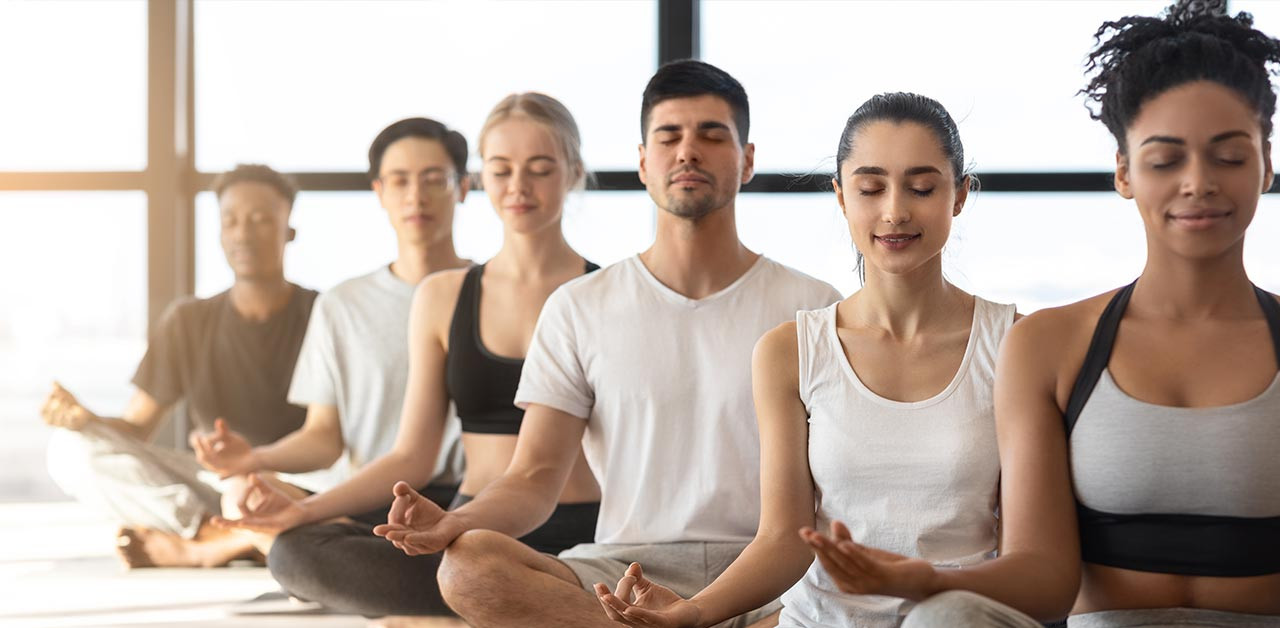
There is a quiet moment hidden inside every noisy day. A sacred pause where the heart remembers how to be still.
Celebrated worldwide on 21st December, World Meditation Day marks a powerful global pause, reminding us that true peace begins within.
World Meditation Day is not just a date on a calendar — it is an invitation.
To stop. To breathe. To come home to yourself.
In a world that celebrates speed, meditation honors stillness. In a time that rewards noise, it teaches silence. And in lives filled with endless doing, it gently reminds us how to simply be.
🧘♂️ What Is Meditation?
Meditation is the practice of training the mind to be aware, calm, and present.
It is not about forcing thoughts to stop. It is about watching them without being carried away.
You may focus on:
the breath 🌬️
a word or mantra 🕉️
a sound 🔔
or just awareness itself 🌿
Slowly, the mind learns to settle. And in that settling, we discover something precious: a quiet space within that is untouched by stress, fear, or noise.
Meditation helps us:
reduce anxiety and stress
improve focus and clarity
build emotional balance
grow compassion — for others and ourselves
More than a technique, meditation becomes a way of living — responding instead of reacting, choosing calm over chaos.
📜 Ancient Roots of a Timeless Practice
Meditation is as old as human seeking itself.
Its roots lie in:
🇮🇳 India (1500–500 BCE) — Vedas and Upanishads spoke of dhyāna, deep contemplation.
🧘 Buddhism (6th century BCE) — the Buddha taught meditation to end suffering and awaken wisdom.
🕉️ Yoga traditions — Patanjali described meditation as a path to self-realization.
🇨🇳 Daoism & Zen — stillness and natural awareness.
✝️ Christian mysticism, ☪️ Sufi practices, and other traditions — silent prayer and remembrance.
Across cultures and centuries, the purpose was the same: to understand the mind and touch a deeper truth within.
In the modern age, teachers carried meditation to the world, and science began to validate what sages already knew — that meditation heals the mind and strengthens the heart.
🌍 The Storm Outside, the Silence Within
We live fast.
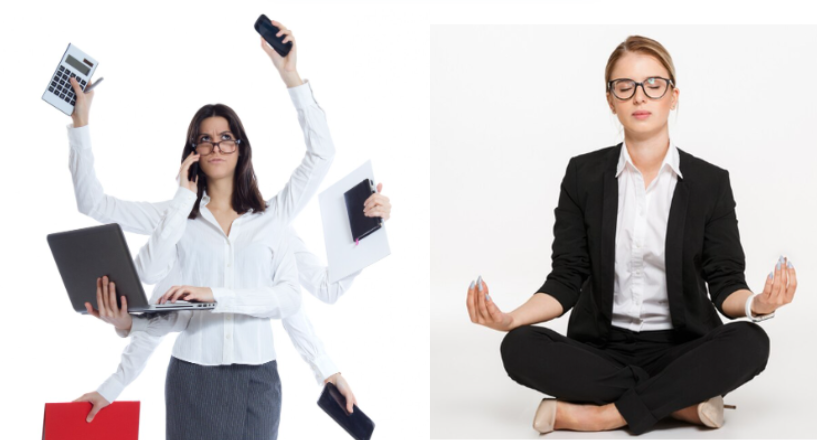
We wake to alarms, scroll through worries, rush through traffic, chase deadlines, carry expectations. By night, the body is tired — but the mind is louder than ever.
We look fine. We perform well. Yet inside, many whisper: “I just want peace.”
Meditation doesn’t promise to change the world outside. It changes the world inside you — and then, everything outside begins to feel different.
🗓️ World Meditation Day: History & Meaning
World Meditation Day is observed on 21st December, the day of the Winter Solstice — the shortest day and longest night in the Northern Hemisphere.
🌞 Why this day? Across ancient cultures, the solstice symbolized:
turning inward
reflection
rebirth of light after darkness
Meditating on this day represents humanity’s collective return from outer noise to inner light.
🌐 How it began In recent decades, spiritual organizations and meditation communities began organizing global meditations on December 21 for peace and harmony. Over time, it became widely known as World Meditation Day.
It is:
a people’s movement, not tied to one religion
recognized and supported by the United Nations as a day to promote peace and well-being
embraced worldwide as a symbol of collective stillness and unity
The belief is simple yet powerful: 🕊️ When many hearts become calm together, the world feels it.
🌍 When Millions Breathe Together
Imagine this…
Across cities and villages, in homes, halls, temples, and parks — millions close their eyes at the same moment.
Different lives. Different languages. One shared rhythm: the breath.
Inhale — hope. Exhale — fear.
For a few moments, the world is not divided by borders or beliefs. It is united by presence.
That is the spirit of World Meditation Day.
🌼 How to Meditate: A Simple Guide for Everyone
You don’t need perfect silence. You don’t need special clothes. You don’t need an empty mind.
You only need willingness.
Here’s a simple way to begin:
🪷 1. Find a quiet place
Sit on a chair or floor. Keep your back comfortably straight. Hands on your lap. Eyes gently closed.
🌬️ 2. Bring attention to your breath
Notice the air going in… and out. Don’t change it. Just feel it.
🧠 3. Let thoughts come and go
Your mind will wander — that’s natural. When you notice it, gently bring attention back to the breath. No judgment. No forcing.
⏳ 4. Start small
Begin with 5 minutes a day. Slowly increase to 10, 15, or 20 minutes.
❤️ 5. End with gratitude
Before opening your eyes, take a moment to feel thankful — for this pause, for this breath, for yourself.
🕯️ That’s it. That is meditation.
🌿 A few gentle tips:
Be regular — same time daily if possible.
Morning or before sleep works best.
If sitting is hard, you can lie down (but stay alert).
You may silently repeat a word like peace or so-hum.
Some days will feel calm, others restless — both are okay.
Meditation is not about having a “good session.” It is about showing up.
🔥 From Survival to Living
Many of us are not really living. We are surviving.
Surviving stress. Surviving expectations. Surviving one more week.
Meditation doesn’t remove responsibilities. It changes how you carry them.
You move from reacting to responding. From rushing to choosing. From surviving to truly living.
🕊️ A Message for the Tired Heart
If your heart feels heavy today, remember:
You don’t have to fix everything now. You don’t have to be strong every moment.
Just sit. Place a hand on your heart. Feel one breath… then another.
Healing doesn’t always roar. Sometimes, it whispers.
🌞 Not Just One Day
World Meditation Day is not meant to be remembered once a year. It is meant to plant a seed.
Five quiet minutes each morning. One deep breath before reacting. A pause before sleep.
Let meditation become not an event — but a way of life.
🌺 Closing: The World Begins With You
The world doesn’t change when noise increases. It changes when awareness grows.
So today, before trying to fix the world outside, sit quietly and meet the world within.
Close your eyes. Take a deep breath.
And remember:
🕯️ You are the calm the world has been waiting for.
🌍 A Call to Action: Let Us Breathe Together
On this World Meditation Day, this is not just a message to read — it is an invitation to act.
To the student racing for the future. To the professional drowning in deadlines. To the parent carrying silent worries. To the leader making hard decisions. To anyone whose heart feels heavy or restless…
🕊️ Pause. Just for a few minutes.
Sit where you are. Close your eyes. Take ten slow breaths.
Not tomorrow. Not when life becomes easier. Now.
Because the world doesn’t need more noise. It needs more presence.
🤝 If You Find Peace, Pass It On
If meditation brings you even a moment of calm today:
Share it with your family — sit together for 5 minutes.
Offer it to your workplace — begin one meeting with a minute of silence.
Teach it to a child — show them how to breathe before reacting.
Gift it to a friend — invite them to pause with you.
🌱 Let peace spread person to person, breath to breath.
You don’t need a stage. You don’t need a title. You only need intention.
🔔 Make It a Promise to Yourself
Before this day ends, make one simple promise:
“I will give myself a few minutes of silence every day.”
Put it on your calendar. Set a gentle reminder. Treat it like you would any important meeting.
Because this meeting is with the most important person in your life — you.
🌺 For One Day, Let the World Choose Stillness
Imagine if today:
fewer harsh words were spoken,
fewer angry messages were sent,
fewer hearts felt alone.
All because millions chose to pause.
🕯️ Be one of them.
Let this World Meditation Day not pass like any other date. Let it become the day you chose awareness over autopilot, peace over pressure, presence over panic.
🌞 Start Now
Right after reading this, don’t scroll.
Sit. Close your eyes. Breathe in slowly… and out gently.
Do it for one minute. Then two. Then five.
And know this:
🕊️ Every calm breath you take makes the world a little kinder.
👉 Official UN observance page for World Meditation Day – information about the day, its purpose, and recognition by the United Nations General Assembly. World Meditation Day – United Nations official page
There is a quiet moment hidden inside every noisy day. A sacred pause where the heart remembers how to be still.
Celebrated worldwide on 21st December, World Meditation Day marks a powerful global pause, reminding us that true peace begins within.
World Meditation Day is not just a date on a calendar — it is an invitation.
To stop. To breathe. To come home to yourself.
In a world that celebrates speed, meditation honors stillness. In a time that rewards noise, it teaches silence. And in lives filled with endless doing, it gently reminds us how to simply be.
🧘♂️ What Is Meditation?
Meditation is the practice of training the mind to be aware, calm, and present.
It is not about forcing thoughts to stop. It is about watching them without being carried away.
You may focus on:
the breath 🌬️
a word or mantra 🕉️
a sound 🔔
or just awareness itself 🌿
Slowly, the mind learns to settle. And in that settling, we discover something precious: a quiet space within that is untouched by stress, fear, or noise.
Meditation helps us:
reduce anxiety and stress
improve focus and clarity
build emotional balance
grow compassion — for others and ourselves
More than a technique, meditation becomes a way of living — responding instead of reacting, choosing calm over chaos.
📜 Ancient Roots of a Timeless Practice
Meditation is as old as human seeking itself.
Its roots lie in:
🇮🇳 India (1500–500 BCE) — Vedas and Upanishads spoke of dhyāna, deep contemplation.
🧘 Buddhism (6th century BCE) — the Buddha taught meditation to end suffering and awaken wisdom.
🕉️ Yoga traditions — Patanjali described meditation as a path to self-realization.
🇨🇳 Daoism & Zen — stillness and natural awareness.
✝️ Christian mysticism, ☪️ Sufi practices, and other traditions — silent prayer and remembrance.
Across cultures and centuries, the purpose was the same: to understand the mind and touch a deeper truth within.
In the modern age, teachers carried meditation to the world, and science began to validate what sages already knew — that meditation heals the mind and strengthens the heart.
🌍 The Storm Outside, the Silence Within
We live fast.
We wake to alarms, scroll through worries, rush through traffic, chase deadlines, carry expectations. By night, the body is tired — but the mind is louder than ever.
We look fine. We perform well. Yet inside, many whisper: “I just want peace.”
Meditation doesn’t promise to change the world outside. It changes the world inside you — and then, everything outside begins to feel different.
🗓️ World Meditation Day: History & Meaning
World Meditation Day is observed on 21st December, the day of the Winter Solstice — the shortest day and longest night in the Northern Hemisphere.
🌞 Why this day? Across ancient cultures, the solstice symbolized:
turning inward
reflection
rebirth of light after darkness
Meditating on this day represents humanity’s collective return from outer noise to inner light.
🌐 How it began In recent decades, spiritual organizations and meditation communities began organizing global meditations on December 21 for peace and harmony. Over time, it became widely known as World Meditation Day.
It is:
a people’s movement, not tied to one religion
recognized and supported by the United Nations as a day to promote peace and well-being
embraced worldwide as a symbol of collective stillness and unity
The belief is simple yet powerful: 🕊️ When many hearts become calm together, the world feels it.
🌍 When Millions Breathe Together
Imagine this…
Across cities and villages, in homes, halls, temples, and parks — millions close their eyes at the same moment.
Different lives. Different languages. One shared rhythm: the breath.
Inhale — hope. Exhale — fear.
For a few moments, the world is not divided by borders or beliefs. It is united by presence.
That is the spirit of World Meditation Day.
🌼 How to Meditate: A Simple Guide for Everyone
You don’t need perfect silence. You don’t need special clothes. You don’t need an empty mind.
You only need willingness.
Here’s a simple way to begin:
🪷 1. Find a quiet place
Sit on a chair or floor. Keep your back comfortably straight. Hands on your lap. Eyes gently closed.
🌬️ 2. Bring attention to your breath
Notice the air going in… and out. Don’t change it. Just feel it.
🧠 3. Let thoughts come and go
Your mind will wander — that’s natural. When you notice it, gently bring attention back to the breath. No judgment. No forcing.
⏳ 4. Start small
Begin with 5 minutes a day. Slowly increase to 10, 15, or 20 minutes.
❤️ 5. End with gratitude
Before opening your eyes, take a moment to feel thankful — for this pause, for this breath, for yourself.
🕯️ That’s it. That is meditation.
🌿 A few gentle tips:
Be regular — same time daily if possible.
Morning or before sleep works best.
If sitting is hard, you can lie down (but stay alert).
You may silently repeat a word like peace or so-hum.
Some days will feel calm, others restless — both are okay.
Meditation is not about having a “good session.” It is about showing up.
🔥 From Survival to Living
Many of us are not really living. We are surviving.
Surviving stress. Surviving expectations. Surviving one more week.
Meditation doesn’t remove responsibilities. It changes how you carry them.
You move from reacting to responding. From rushing to choosing. From surviving to truly living.
🕊️ A Message for the Tired Heart
If your heart feels heavy today, remember:
You don’t have to fix everything now. You don’t have to be strong every moment.
Just sit. Place a hand on your heart. Feel one breath… then another.
Healing doesn’t always roar. Sometimes, it whispers.
🌞 Not Just One Day
World Meditation Day is not meant to be remembered once a year. It is meant to plant a seed.
Five quiet minutes each morning. One deep breath before reacting. A pause before sleep.
Let meditation become not an event — but a way of life.
🌺 Closing: The World Begins With You
The world doesn’t change when noise increases. It changes when awareness grows.
So today, before trying to fix the world outside, sit quietly and meet the world within.
Close your eyes. Take a deep breath.
And remember:
🕯️ You are the calm the world has been waiting for.
🌍 A Call to Action: Let Us Breathe Together
On this World Meditation Day, this is not just a message to read — it is an invitation to act.
To the student racing for the future. To the professional drowning in deadlines. To the parent carrying silent worries. To the leader making hard decisions. To anyone whose heart feels heavy or restless…
🕊️ Pause. Just for a few minutes.
Sit where you are. Close your eyes. Take ten slow breaths.
Not tomorrow. Not when life becomes easier. Now.
Because the world doesn’t need more noise. It needs more presence.
🤝 If You Find Peace, Pass It On
If meditation brings you even a moment of calm today:
Share it with your family — sit together for 5 minutes.
Offer it to your workplace — begin one meeting with a minute of silence.
Teach it to a child — show them how to breathe before reacting.
Gift it to a friend — invite them to pause with you.
🌱 Let peace spread person to person, breath to breath.
You don’t need a stage. You don’t need a title. You only need intention.
🔔 Make It a Promise to Yourself
Before this day ends, make one simple promise:
“I will give myself a few minutes of silence every day.”
Put it on your calendar. Set a gentle reminder. Treat it like you would any important meeting.
Because this meeting is with the most important person in your life — you.
🌺 For One Day, Let the World Choose Stillness
Imagine if today:
fewer harsh words were spoken,
fewer angry messages were sent,
fewer hearts felt alone.
All because millions chose to pause.
🕯️ Be one of them.
Let this World Meditation Day not pass like any other date. Let it become the day you chose awareness over autopilot, peace over pressure, presence over panic.
🌞 Start Now
Right after reading this, don’t scroll.
Sit. Close your eyes. Breathe in slowly… and out gently.
Do it for one minute. Then two. Then five.
And know this:
🕊️ Every calm breath you take makes the world a little kinder.
👉 Official UN observance page for World Meditation Day – information about the day, its purpose, and recognition by the United Nations General Assembly. World Meditation Day – United Nations official page
Shikha, a busy professional, often felt like she was running a race she hadn’t signed up for. Constant deadlines, endless screen time, and sleepless nights left her anxious and drained. Even her weekends didn’t bring rest—her mind just wouldn’t slow down.
One day, she heard of some yoga sessions in her office on International Yoga Day. The yoga teacher introduced her to pranayama—the yogic art of conscious breathing. “Just the breath?” Shikha thought skeptically. But what started as an experiment slowly turned into her path to calmness, balance, and renewed energy.
🧠 Step 1: Understanding the Nervous System (SNS vs PNS)
How the Nervous System is Divided:
Central Nervous System (CNS)
Made of the brain and spinal cord.
It’s the control center of the body.
Peripheral Nervous System (PNS)
All the nerves that branch out from the spinal cord to the rest of the body.
Within this, we have:
Somatic Nervous System → controls voluntary movements (like walking, typing).
Think of them like two different “wiring systems” running through the same body, always working in balance.
The Yoga teacher explained:
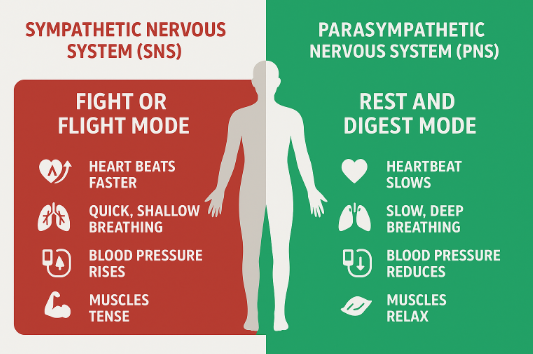
Sympathetic Nervous System (SNS) → The body’s accelerator, triggering fight-or-flight. It keeps us alert but also restless if always “on.”
Parasympathetic Nervous System (PNS) → The body’s brake, bringing rest-and-digest. It heals, restores, and calms.
⚡ Sympathetic Nervous System (SNS) – “Fight or Flight Mode”
The SNS is like your body’s alarm system. When SNS is active, your body prepares for quick action. It releases hormones like:
Adrenaline (Epinephrine) – from adrenal glands → increases heart rate, blood pressure, and energy.
Noradrenaline (Norepinephrine) – from nerve endings → sharpens alertness, sends blood to muscles.
Cortisol (stress hormone, via HPA axis) – raises blood sugar, reduces digestion, weakens immunity if chronic.
Neurotransmitter: Mainly norepinephrine.
What happens when SNS is active?
Heart beats faster ❤️
Breathing becomes quick and shallow 😮💨
Blood pressure rises 🔺
Muscles get tense 💪
Digestion slows down 🍽️🚫
👉 This is useful in emergencies (like running from danger), but if the SNS stays active all the time (due to modern stress, deadlines, worries), it causes:
Anxiety and restlessness
High blood pressure
Poor digestion and acidity
Insomnia
Weaker immunity
🌿 Parasympathetic Nervous System (PNS) – “Rest and Digest Mode”
The PNS is like your body’s healing system. It mainly releases hormones like:
Acetylcholine (ACh) – the key calming neurotransmitter.
Most people today are “stuck” in SNS overdrive (stress mode). Pranayama, AUM chanting, and meditation activate the PNS, helping the body return to balance.
In simple terms:
Too much SNS = disease, tension, burnout.
Balanced SNS + PNS = health, energy, and peace.
Shikha realized she was stuck in SNS overdrive, which explained her racing thoughts, shallow breath, and sleepless nights. Pranayama, her teacher said, was the switch to rebalance both systems.
⚖️ In health → SNS and PNS balance each other. 🚨 In stress → SNS dominates. 🌿 In relaxation (yoga, pranayama, meditation) → PNS takes over.
Best Time for Pranayama
Early morning (Brahma Muhurta, around 4:30–6:00 am) is considered the most powerful time — the air is fresh, the mind is calm, and the stomach is empty.
If morning isn’t possible, late evening (sunset, after 2–3 hours of a light meal) is the next best option.
🌿 Step 2: First Encounter – Finding Balance with Anulom Vilom
Shikha’s first practice was Anulom Vilom (alternate nostril breathing). She sat quietly, inhaled through one nostril, exhaled through the other, and repeated. Slowly, her breath deepened, and her mind became lighter.
Effect on her body: Heartbeat slowed, thoughts calmed.
Benefit: Balanced SNS & PNS, reduced anxiety.
“This feels like pressing the reset button,” she thought.
🔥 Step 3: Boosting Energy with Kapalabhati & Bhastrika
On mornings when Shikha felt dull and foggy, her teacher introduced her to Kapalabhati (rapid cleansing breath) and Bhastrika (bellows breath).
At first, she giggled at the forceful breathing, but soon she felt heat rising in her body, her mind becoming sharper, and her lungs expanding with new strength.
Effect on her body: SNS activated briefly → metabolism boosted.
Benefit: More energy, detoxification, better digestion.
Now, instead of extra coffee, Shikha had a natural energy shot.
🌙 Step 4: Calming with Chandra Bhedana & Bhramari
After hectic workdays, Shikha turned to Chandra Bhedana (left nostril breathing) and Bhramari (humming bee breath).
The gentle hum of Bhramari filled her head with soothing vibrations, washing away the noise of the day.
Effect on her body: Vagus nerve stimulated → PNS activated.
During summer, when heat and irritability rose, Shikha practiced Sheetali (cooling breath through rolled tongue) and Sheetkari (hissing breath through teeth).
Effect on her body: Temperature lowered, calmness restored.
One day, her teacher asked her to end her session with AUM chanting. Shikha inhaled deeply, and as she exhaled “A-U-M,” the vibrations traveled through her chest, throat, and head. She felt grounded, connected, and peaceful.
Effect on her body: Long exhalation → PNS dominance.
Benefit: Deep relaxation, emotional stability, inner clarity.
It became her favorite ritual—like coming home to herself.
🌸 What is AUM (OM)?
AUM (or OM) is one of the oldest sounds in the world. In yoga, it is called the sound of the universe. When we chant AUM, our whole body feels the vibration, like a gentle inner massage.
It has 3 parts:
A – the sound from the throat (like “aaa”), linked to our waking state.
U – the sound rolling in the middle of the mouth (like “ooo”), linked to our dream state.
M – the humming sound from the lips (like “mmm”), linked to deep sleep.
The silence after AUM is the state of peace.
🌬️ Benefits of AUM Chanting
🧘 Mind
Calms stress and anxiety.
Makes the mind quiet and focused.
Helps you sleep better.
❤️ Body
The humming “Mmmm” relaxes the nerves.
Slows down heartbeat and reduces blood pressure.
Improves breathing and lung strength.
🌿 Inner Peace
Increases positive energy.
Helps in meditation and mindfulness.
Gives a feeling of peace, balance, and connection.
👉 Just sit comfortably, close your eyes, take a deep breath, and chant AUM slowly 5–7 times. You’ll feel lighter, calmer, and more centered.
🌍 Scientific Backing Shikha Found
Curious, Shikha researched and found that studies show pranayama:
Lowers blood pressure & cortisol.
Improves sleep quality and mental health.
Enhances heart rate variability (HRV)—a marker of nervous system balance.
Sun → Healing: Chandra Bhedana, Bhramari, Sheetali + long AUM chanting (15 min)
✨ Shikha’s Transformation
Weeks later, Shikha noticed the changes:
She was calmer at work, even under pressure.
Her sleep improved, and morning headaches disappeared.
She felt more energized without depending on caffeine.
Most importantly, she learned how to control stress—with her own breath.
🌟 Conclusion
Pranayama is more than a breathing exercise—it’s a science of nervous system balance, a therapy for stress, and a path to inner peace.
Just like Shikha, we can all find healing and clarity through conscious breathing. Ten minutes a day is all it takes to transform stress into calm, fatigue into energy, and restlessness into peace.
So the next time life feels overwhelming, pause… close your eyes… inhale deeply… and let your breath be your guide. 🕉️
🚀 Take Your First Step Today
Like Shikha, you don’t need hours of practice—just 5 to 10 minutes daily can make a noticeable difference. Start simple:
Day 1: Try 5 minutes of Anulom Vilom.
Day 2: Add 5 rounds of AUM chanting.
Day 3 onwards: Slowly explore other pranayamas.
✨ Within a week, you’ll begin to feel calmer, sleep better, and carry more energy into your day.
👉 Ready to experience it yourself?
Start your 7-day Pranayama challenge today—set aside just 10 minutes each morning.
Notice the shift in your mind, body, and emotions.
Share your journey with friends or family—invite them to join and breathe better together.
Remember: Your breath is your most powerful healer. All you have to do is use it. 🌬️🧘
Types of Pranayama & Benefits
1. Anulom Vilom (Alternate Nostril Breathing)
How: Breathe in through one nostril, out through the other, alternate.
Benefits: Balances left (Ida) & right (Pingala) energies, calms mind, reduces anxiety, improves focus, balances SNS & PNS.
2. Nadi Shodhana (Channel Purification)
How: Similar to Anulom Vilom but with breath retention (kumbhaka).
Benefits: Cleanses energy channels, improves concentration, reduces stress, stabilizes emotions.
Practice on an empty stomach, preferably early morning.
People with heart problems, high BP, pregnancy, or medical conditions should practice under guidance.
Further Reading
For scientific evidence on pranayama’s impact on the nervous system and health: Effect of Pranayama on Stress and Cardiovascular Health – National Library of Medicine.
Common Yoga Protocol — Ministry of External Affairs, Government of India This official booklet outlines pranayama techniques like Anulom Vilom (alternate nostril breathing) and Bhramari as essential components of yoga for holistic health. MEA India
Shikha, a busy professional, often felt like she was running a race she hadn’t signed up for. Constant deadlines, endless screen time, and sleepless nights left her anxious and drained. Even her weekends didn’t bring rest—her mind just wouldn’t slow down.
One day, she heard of some yoga sessions in her office on International Yoga Day. The yoga teacher introduced her to pranayama—the yogic art of conscious breathing. “Just the breath?” Shikha thought skeptically. But what started as an experiment slowly turned into her path to calmness, balance, and renewed energy.
🧠 Step 1: Understanding the Nervous System (SNS vs PNS)
How the Nervous System is Divided:
Central Nervous System (CNS)
Made of the brain and spinal cord.
It’s the control center of the body.
Peripheral Nervous System (PNS)
All the nerves that branch out from the spinal cord to the rest of the body.
Within this, we have:
Somatic Nervous System → controls voluntary movements (like walking, typing).
Think of them like two different “wiring systems” running through the same body, always working in balance.
The Yoga teacher explained:
Sympathetic Nervous System (SNS) → The body’s accelerator, triggering fight-or-flight. It keeps us alert but also restless if always “on.”
Parasympathetic Nervous System (PNS) → The body’s brake, bringing rest-and-digest. It heals, restores, and calms.
⚡ Sympathetic Nervous System (SNS) – “Fight or Flight Mode”
The SNS is like your body’s alarm system. When SNS is active, your body prepares for quick action. It releases hormones like:
Adrenaline (Epinephrine) – from adrenal glands → increases heart rate, blood pressure, and energy.
Noradrenaline (Norepinephrine) – from nerve endings → sharpens alertness, sends blood to muscles.
Cortisol (stress hormone, via HPA axis) – raises blood sugar, reduces digestion, weakens immunity if chronic.
Neurotransmitter: Mainly norepinephrine.
What happens when SNS is active?
Heart beats faster ❤️
Breathing becomes quick and shallow 😮💨
Blood pressure rises 🔺
Muscles get tense 💪
Digestion slows down 🍽️🚫
👉 This is useful in emergencies (like running from danger), but if the SNS stays active all the time (due to modern stress, deadlines, worries), it causes:
Anxiety and restlessness
High blood pressure
Poor digestion and acidity
Insomnia
Weaker immunity
🌿 Parasympathetic Nervous System (PNS) – “Rest and Digest Mode”
The PNS is like your body’s healing system. It mainly releases hormones like:
Acetylcholine (ACh) – the key calming neurotransmitter.
Most people today are “stuck” in SNS overdrive (stress mode). Pranayama, AUM chanting, and meditation activate the PNS, helping the body return to balance.
In simple terms:
Too much SNS = disease, tension, burnout.
Balanced SNS + PNS = health, energy, and peace.
Shikha realized she was stuck in SNS overdrive, which explained her racing thoughts, shallow breath, and sleepless nights. Pranayama, her teacher said, was the switch to rebalance both systems.
⚖️ In health → SNS and PNS balance each other. 🚨 In stress → SNS dominates. 🌿 In relaxation (yoga, pranayama, meditation) → PNS takes over.
Best Time for Pranayama
Early morning (Brahma Muhurta, around 4:30–6:00 am) is considered the most powerful time — the air is fresh, the mind is calm, and the stomach is empty.
If morning isn’t possible, late evening (sunset, after 2–3 hours of a light meal) is the next best option.
🌿 Step 2: First Encounter – Finding Balance with Anulom Vilom
Shikha’s first practice was Anulom Vilom (alternate nostril breathing). She sat quietly, inhaled through one nostril, exhaled through the other, and repeated. Slowly, her breath deepened, and her mind became lighter.
Effect on her body: Heartbeat slowed, thoughts calmed.
Benefit: Balanced SNS & PNS, reduced anxiety.
“This feels like pressing the reset button,” she thought.
🔥 Step 3: Boosting Energy with Kapalabhati & Bhastrika
On mornings when Shikha felt dull and foggy, her teacher introduced her to Kapalabhati (rapid cleansing breath) and Bhastrika (bellows breath).
At first, she giggled at the forceful breathing, but soon she felt heat rising in her body, her mind becoming sharper, and her lungs expanding with new strength.
Effect on her body: SNS activated briefly → metabolism boosted.
Benefit: More energy, detoxification, better digestion.
Now, instead of extra coffee, Shikha had a natural energy shot.
🌙 Step 4: Calming with Chandra Bhedana & Bhramari
After hectic workdays, Shikha turned to Chandra Bhedana (left nostril breathing) and Bhramari (humming bee breath).
The gentle hum of Bhramari filled her head with soothing vibrations, washing away the noise of the day.
Effect on her body: Vagus nerve stimulated → PNS activated.
During summer, when heat and irritability rose, Shikha practiced Sheetali (cooling breath through rolled tongue) and Sheetkari (hissing breath through teeth).
Effect on her body: Temperature lowered, calmness restored.
One day, her teacher asked her to end her session with AUM chanting. Shikha inhaled deeply, and as she exhaled “A-U-M,” the vibrations traveled through her chest, throat, and head. She felt grounded, connected, and peaceful.
Effect on her body: Long exhalation → PNS dominance.
Benefit: Deep relaxation, emotional stability, inner clarity.
It became her favorite ritual—like coming home to herself.
🌸 What is AUM (OM)?
AUM (or OM) is one of the oldest sounds in the world. In yoga, it is called the sound of the universe. When we chant AUM, our whole body feels the vibration, like a gentle inner massage.
It has 3 parts:
A – the sound from the throat (like “aaa”), linked to our waking state.
U – the sound rolling in the middle of the mouth (like “ooo”), linked to our dream state.
M – the humming sound from the lips (like “mmm”), linked to deep sleep.
The silence after AUM is the state of peace.
🌬️ Benefits of AUM Chanting
🧘 Mind
Calms stress and anxiety.
Makes the mind quiet and focused.
Helps you sleep better.
❤️ Body
The humming “Mmmm” relaxes the nerves.
Slows down heartbeat and reduces blood pressure.
Improves breathing and lung strength.
🌿 Inner Peace
Increases positive energy.
Helps in meditation and mindfulness.
Gives a feeling of peace, balance, and connection.
👉 Just sit comfortably, close your eyes, take a deep breath, and chant AUM slowly 5–7 times. You’ll feel lighter, calmer, and more centered.
🌍 Scientific Backing Shikha Found
Curious, Shikha researched and found that studies show pranayama:
Lowers blood pressure & cortisol.
Improves sleep quality and mental health.
Enhances heart rate variability (HRV)—a marker of nervous system balance.
Sun → Healing: Chandra Bhedana, Bhramari, Sheetali + long AUM chanting (15 min)
✨ Shikha’s Transformation
Weeks later, Shikha noticed the changes:
She was calmer at work, even under pressure.
Her sleep improved, and morning headaches disappeared.
She felt more energized without depending on caffeine.
Most importantly, she learned how to control stress—with her own breath.
🌟 Conclusion
Pranayama is more than a breathing exercise—it’s a science of nervous system balance, a therapy for stress, and a path to inner peace.
Just like Shikha, we can all find healing and clarity through conscious breathing. Ten minutes a day is all it takes to transform stress into calm, fatigue into energy, and restlessness into peace.
So the next time life feels overwhelming, pause… close your eyes… inhale deeply… and let your breath be your guide. 🕉️
🚀 Take Your First Step Today
Like Shikha, you don’t need hours of practice—just 5 to 10 minutes daily can make a noticeable difference. Start simple:
Day 1: Try 5 minutes of Anulom Vilom.
Day 2: Add 5 rounds of AUM chanting.
Day 3 onwards: Slowly explore other pranayamas.
✨ Within a week, you’ll begin to feel calmer, sleep better, and carry more energy into your day.
👉 Ready to experience it yourself?
Start your 7-day Pranayama challenge today—set aside just 10 minutes each morning.
Notice the shift in your mind, body, and emotions.
Share your journey with friends or family—invite them to join and breathe better together.
Remember: Your breath is your most powerful healer. All you have to do is use it. 🌬️🧘
Types of Pranayama & Benefits
1. Anulom Vilom (Alternate Nostril Breathing)
How: Breathe in through one nostril, out through the other, alternate.
Benefits: Balances left (Ida) & right (Pingala) energies, calms mind, reduces anxiety, improves focus, balances SNS & PNS.
2. Nadi Shodhana (Channel Purification)
How: Similar to Anulom Vilom but with breath retention (kumbhaka).
Benefits: Cleanses energy channels, improves concentration, reduces stress, stabilizes emotions.
Practice on an empty stomach, preferably early morning.
People with heart problems, high BP, pregnancy, or medical conditions should practice under guidance.
Further Reading
For scientific evidence on pranayama’s impact on the nervous system and health: Effect of Pranayama on Stress and Cardiovascular Health – National Library of Medicine.
Common Yoga Protocol — Ministry of External Affairs, Government of India This official booklet outlines pranayama techniques like Anulom Vilom (alternate nostril breathing) and Bhramari as essential components of yoga for holistic health. MEA India
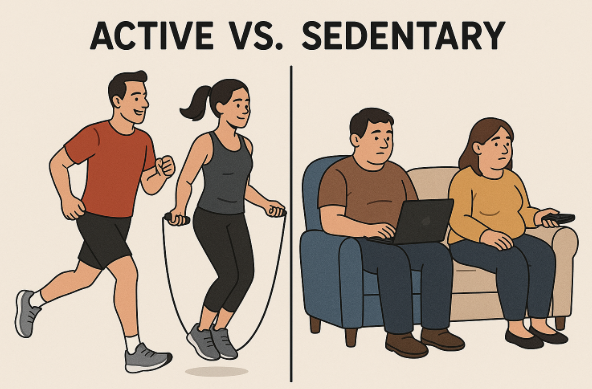
Every morning at 6 a.m., Ganesh laces up his shoes and heads out for a brisk walk. Rain or shine, he spends just 30 minutes moving his body — sometimes walking, sometimes doing simple stretches and push-ups. Over the years, his friends noticed something remarkable: Ganesh rarely falls sick, he looks younger than his age, and his energy keeps him cheerful all day.
On the other hand, his childhood friend Rajesh chooses extra sleep over exercise. Rushing straight from bed to office, his days are filled with tiredness, back pain, and constant stress. By the time evening comes, he’s too exhausted to play with his kids. Slowly, weight gain, tummy out, high blood pressure, and poor sleep became part of his life.By 45, borderline diabetes knocked at his door. He brushed it aside.
Then one morning, without warning, Rajesh suffered his first stroke. Lying in the hospital bed, he realized how years of ignoring his body had caught up with him. That moment became an eye-opener — for Rajesh, his family, and everyone who loved him.
👉 Two friends, same age, same background — yet their lives look completely different. The only difference? One made exercise a daily habit, the other did not.
✅ If You Exercise Daily
Body Benefits
Stronger heart & lungs → lowers risk of heart disease, high BP, stroke.
Weight gain → especially belly fat, which is linked to many diseases.
Mind Consequences
More stress, irritability, anxiety.
Poor sleep (difficulty falling or staying asleep).
Reduced concentration and productivity.
Long-Term Risks
Higher chances of lifestyle diseases (heart attack, diabetes, stroke, arthritis).
Faster biological aging.
Lower quality of life and reduced life expectancy.
📌 In short: Daily exercise is like putting money in your “health savings account.” Skipping it daily is like withdrawing health bit by bit until you go into “debt.”
How It Works
🫀 Heart & Circulation (Cardiovascular Benefits)
How it works: When you exercise, your heart rate increases → heart pumps more blood → blood vessels widen (vasodilation) → circulation improves.
Benefit: The heart muscle gets stronger, blood pressure drops, cholesterol balance improves, and arteries stay flexible.
Result: Lower risk of heart attack, stroke, and hypertension.
🫁 Lungs & Breathing (Respiratory Benefits)
How it works: Exercise makes you breathe deeper and faster → lungs take in more oxygen → oxygen travels via blood to muscles and organs.
How it works: Exercise puts stress on muscles & bones → they adapt by growing stronger.
Benefit: Muscles get bigger and toned, bones build more density, joints stay flexible.
Result: Better posture, reduced risk of fractures, less joint pain, stronger daily movement.
🧪 Metabolism & Hormones (Endocrine Benefits)
How it works: Exercise uses glucose (sugar) for energy → reduces blood sugar → makes insulin work better. Hormones like endorphins (happiness), testosterone, and growth hormone increase.
Result: Easier weight control, fewer mood swings, more energy.
🛡️ Immune System
How it works: Movement increases circulation → white blood cells move faster through the body → immune system spots and kills germs quickly.
Benefit: Stronger defense against infections, lower chronic inflammation.
Result: Fewer colds, faster recovery, long-term protection against diseases.
🧠 Brain & Nerves
How it works: Exercise boosts blood flow to the brain → delivers oxygen and nutrients → stimulates growth of new nerve connections (neuroplasticity).
Benefit: Better memory, focus, creativity, and mental health.
Result: Lower risk of depression, Alzheimer’s, anxiety.
⚡ Energy & Aging
How it works: Exercise builds more mitochondria in cells (your body’s “power plants”) → more efficient energy production.
Benefit: Less fatigue, more stamina for daily life.
Result: Slows down aging, makes you look and feel younger.
📌 Simple Analogy: Exercise is like charging your phone daily ⚡. If you don’t charge, it drains out. If you keep charging (exercise), your body runs at full power — heart pumps better, brain works sharper, muscles stay strong, and immunity stays active.
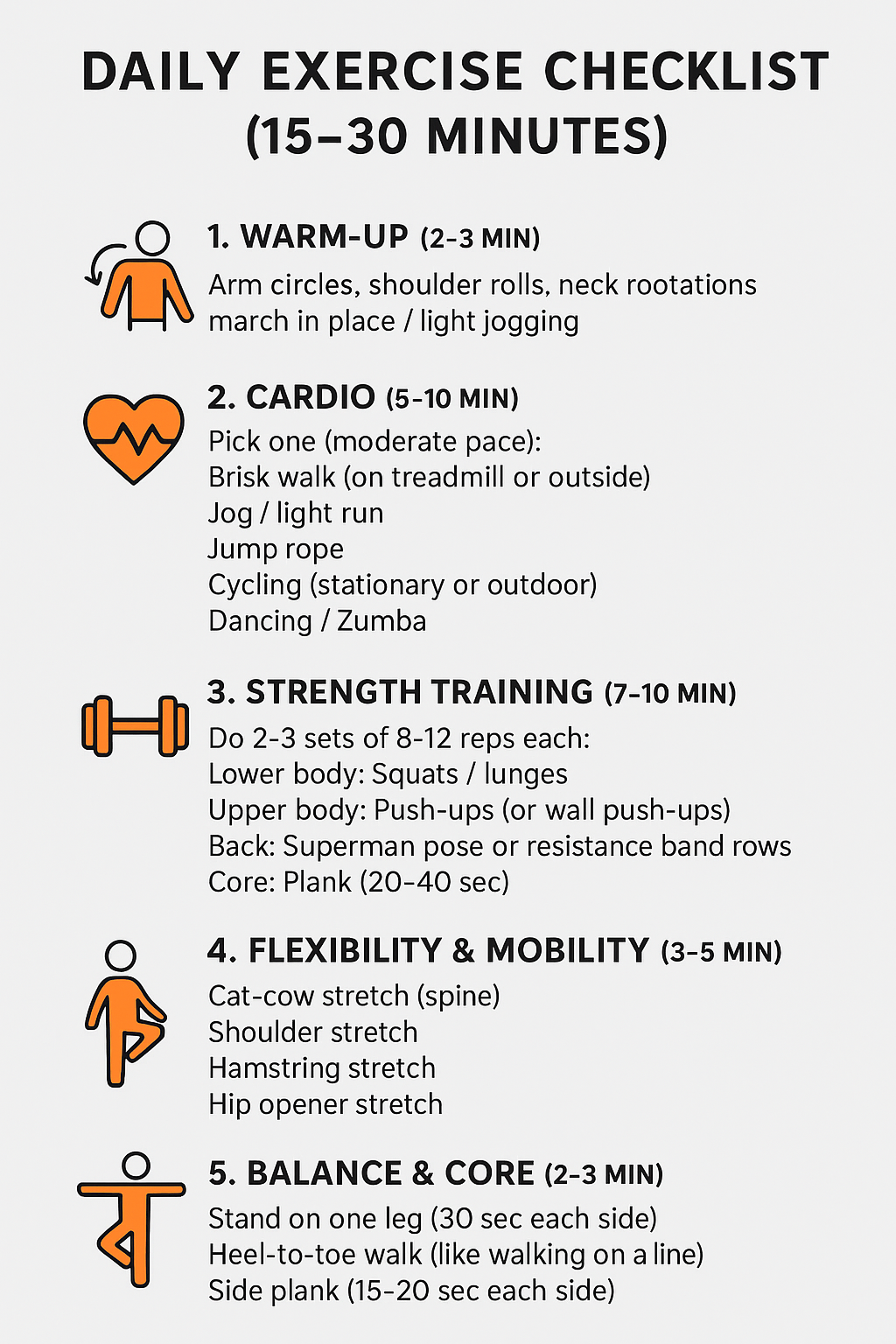
✅ How Much Exercise is Good Daily?
For General Health (WHO & American Heart Association guidelines):
150 minutes of moderate exercise per week → ~30 minutes per day, 5 days a week. OR
75 minutes of vigorous exercise per week → ~15–20 minutes per day, 5 days a week.
15 min version: Warm-up → 5 min cardio → 5 min strength → 5 min stretch/cool-down.
30 min version: Do all sections fully for a balanced routine.
📌 Pro Tips:
Aim for 5–6 days/week.
Mix it up to avoid boredom (walk one day, cycle another, dance another).
Add music or a podcast to make it fun.
Call to Action
💡 Your health is in your hands. Don’t wait for a warning sign like Rajesh — start today like Ganesh. Even 15–30 minutes of daily exercise can transform your heart, lungs, body, and mind, and gift you a longer, healthier life.
👉 Take the first step right now:
Go for a brisk 10-minute walk.
Do 10 squats or push-ups.
Stretch your body and breathe deeply.
✨ Small steps today become a powerful routine tomorrow. Your future self will thank you.
Reference WHO guidelines. Read more blogs on Yoga & Exercises here.
Health Beyond Exercise
Exercise is powerful — but lasting wellness comes from a holistic balance. ✅ Move your body daily ✅ Eat nourishing fresh natural food, whole foods, read details in blogs here. ✅ Manage stress with calm practices ✅ Care for emotional health ✅ Cultivate spiritual well-being
🚫 Avoid smoking, alcohol, and junk “sin foods” that damage heart, lungs, and immunity
✨ Balance in body, mind, and lifestyle is the real medicine for a long, vibrant life.
✨ Together, these habits not only prevent disease but also create a vibrant, meaningful, and long life.
Every morning at 6 a.m., Ganesh laces up his shoes and heads out for a brisk walk. Rain or shine, he spends just 30 minutes moving his body — sometimes walking, sometimes doing simple stretches and push-ups. Over the years, his friends noticed something remarkable: Ganesh rarely falls sick, he looks younger than his age, and his energy keeps him cheerful all day.
On the other hand, his childhood friend Rajesh chooses extra sleep over exercise. Rushing straight from bed to office, his days are filled with tiredness, back pain, and constant stress. By the time evening comes, he’s too exhausted to play with his kids. Slowly, weight gain, tummy out, high blood pressure, and poor sleep became part of his life.By 45, borderline diabetes knocked at his door. He brushed it aside.
Then one morning, without warning, Rajesh suffered his first stroke. Lying in the hospital bed, he realized how years of ignoring his body had caught up with him. That moment became an eye-opener — for Rajesh, his family, and everyone who loved him.
👉 Two friends, same age, same background — yet their lives look completely different. The only difference? One made exercise a daily habit, the other did not.
✅ If You Exercise Daily
Body Benefits
Stronger heart & lungs → lowers risk of heart disease, high BP, stroke.
Weight gain → especially belly fat, which is linked to many diseases.
Mind Consequences
More stress, irritability, anxiety.
Poor sleep (difficulty falling or staying asleep).
Reduced concentration and productivity.
Long-Term Risks
Higher chances of lifestyle diseases (heart attack, diabetes, stroke, arthritis).
Faster biological aging.
Lower quality of life and reduced life expectancy.
📌 In short: Daily exercise is like putting money in your “health savings account.” Skipping it daily is like withdrawing health bit by bit until you go into “debt.”
How It Works
🫀 Heart & Circulation (Cardiovascular Benefits)
How it works: When you exercise, your heart rate increases → heart pumps more blood → blood vessels widen (vasodilation) → circulation improves.
Benefit: The heart muscle gets stronger, blood pressure drops, cholesterol balance improves, and arteries stay flexible.
Result: Lower risk of heart attack, stroke, and hypertension.
🫁 Lungs & Breathing (Respiratory Benefits)
How it works: Exercise makes you breathe deeper and faster → lungs take in more oxygen → oxygen travels via blood to muscles and organs.
How it works: Exercise puts stress on muscles & bones → they adapt by growing stronger.
Benefit: Muscles get bigger and toned, bones build more density, joints stay flexible.
Result: Better posture, reduced risk of fractures, less joint pain, stronger daily movement.
🧪 Metabolism & Hormones (Endocrine Benefits)
How it works: Exercise uses glucose (sugar) for energy → reduces blood sugar → makes insulin work better. Hormones like endorphins (happiness), testosterone, and growth hormone increase.
Result: Easier weight control, fewer mood swings, more energy.
🛡️ Immune System
How it works: Movement increases circulation → white blood cells move faster through the body → immune system spots and kills germs quickly.
Benefit: Stronger defense against infections, lower chronic inflammation.
Result: Fewer colds, faster recovery, long-term protection against diseases.
🧠 Brain & Nerves
How it works: Exercise boosts blood flow to the brain → delivers oxygen and nutrients → stimulates growth of new nerve connections (neuroplasticity).
Benefit: Better memory, focus, creativity, and mental health.
Result: Lower risk of depression, Alzheimer’s, anxiety.
⚡ Energy & Aging
How it works: Exercise builds more mitochondria in cells (your body’s “power plants”) → more efficient energy production.
Benefit: Less fatigue, more stamina for daily life.
Result: Slows down aging, makes you look and feel younger.
📌 Simple Analogy: Exercise is like charging your phone daily ⚡. If you don’t charge, it drains out. If you keep charging (exercise), your body runs at full power — heart pumps better, brain works sharper, muscles stay strong, and immunity stays active.
✅ How Much Exercise is Good Daily?
For General Health (WHO & American Heart Association guidelines):
150 minutes of moderate exercise per week → ~30 minutes per day, 5 days a week. OR
75 minutes of vigorous exercise per week → ~15–20 minutes per day, 5 days a week.
15 min version: Warm-up → 5 min cardio → 5 min strength → 5 min stretch/cool-down.
30 min version: Do all sections fully for a balanced routine.
📌 Pro Tips:
Aim for 5–6 days/week.
Mix it up to avoid boredom (walk one day, cycle another, dance another).
Add music or a podcast to make it fun.
Call to Action
💡 Your health is in your hands. Don’t wait for a warning sign like Rajesh — start today like Ganesh. Even 15–30 minutes of daily exercise can transform your heart, lungs, body, and mind, and gift you a longer, healthier life.
👉 Take the first step right now:
Go for a brisk 10-minute walk.
Do 10 squats or push-ups.
Stretch your body and breathe deeply.
✨ Small steps today become a powerful routine tomorrow. Your future self will thank you.
Reference WHO guidelines. Read more blogs on Yoga & Exercises here.
Health Beyond Exercise
Exercise is powerful — but lasting wellness comes from a holistic balance. ✅ Move your body daily ✅ Eat nourishing fresh natural food, whole foods, read details in blogs here. ✅ Manage stress with calm practices ✅ Care for emotional health ✅ Cultivate spiritual well-being
🚫 Avoid smoking, alcohol, and junk “sin foods” that damage heart, lungs, and immunity
✨ Balance in body, mind, and lifestyle is the real medicine for a long, vibrant life.
✨ Together, these habits not only prevent disease but also create a vibrant, meaningful, and long life.
Every morning at 6 a.m., Ganesh laces up his shoes and heads out for a brisk walk. Rain or shine, he spends just 30 minutes moving his body — sometimes walking, sometimes doing simple stretches and push-ups. Over the years, his friends noticed something remarkable: Ganesh rarely falls sick, he looks younger than his age, and his energy keeps him cheerful all day.
On the other hand, his childhood friend Rajesh chooses extra sleep over exercise. Rushing straight from bed to office, his days are filled with tiredness, back pain, and constant stress. By the time evening comes, he’s too exhausted to play with his kids. Slowly, weight gain, tummy out, high blood pressure, and poor sleep became part of his life.By 45, borderline diabetes knocked at his door. He brushed it aside.
Then one morning, without warning, Rajesh suffered his first stroke. Lying in the hospital bed, he realized how years of ignoring his body had caught up with him. That moment became an eye-opener — for Rajesh, his family, and everyone who loved him.
👉 Two friends, same age, same background — yet their lives look completely different. The only difference? One made exercise a daily habit, the other did not.
✅ If You Exercise Daily
Body Benefits
Stronger heart & lungs → lowers risk of heart disease, high BP, stroke.
Weight gain → especially belly fat, which is linked to many diseases.
Mind Consequences
More stress, irritability, anxiety.
Poor sleep (difficulty falling or staying asleep).
Reduced concentration and productivity.
Long-Term Risks
Higher chances of lifestyle diseases (heart attack, diabetes, stroke, arthritis).
Faster biological aging.
Lower quality of life and reduced life expectancy.
📌 In short: Daily exercise is like putting money in your “health savings account.” Skipping it daily is like withdrawing health bit by bit until you go into “debt.”
How It Works
🫀 Heart & Circulation (Cardiovascular Benefits)
How it works: When you exercise, your heart rate increases → heart pumps more blood → blood vessels widen (vasodilation) → circulation improves.
Benefit: The heart muscle gets stronger, blood pressure drops, cholesterol balance improves, and arteries stay flexible.
Result: Lower risk of heart attack, stroke, and hypertension.
🫁 Lungs & Breathing (Respiratory Benefits)
How it works: Exercise makes you breathe deeper and faster → lungs take in more oxygen → oxygen travels via blood to muscles and organs.
How it works: Exercise puts stress on muscles & bones → they adapt by growing stronger.
Benefit: Muscles get bigger and toned, bones build more density, joints stay flexible.
Result: Better posture, reduced risk of fractures, less joint pain, stronger daily movement.
🧪 Metabolism & Hormones (Endocrine Benefits)
How it works: Exercise uses glucose (sugar) for energy → reduces blood sugar → makes insulin work better. Hormones like endorphins (happiness), testosterone, and growth hormone increase.
Result: Easier weight control, fewer mood swings, more energy.
🛡️ Immune System
How it works: Movement increases circulation → white blood cells move faster through the body → immune system spots and kills germs quickly.
Benefit: Stronger defense against infections, lower chronic inflammation.
Result: Fewer colds, faster recovery, long-term protection against diseases.
🧠 Brain & Nerves
How it works: Exercise boosts blood flow to the brain → delivers oxygen and nutrients → stimulates growth of new nerve connections (neuroplasticity).
Benefit: Better memory, focus, creativity, and mental health.
Result: Lower risk of depression, Alzheimer’s, anxiety.
⚡ Energy & Aging
How it works: Exercise builds more mitochondria in cells (your body’s “power plants”) → more efficient energy production.
Benefit: Less fatigue, more stamina for daily life.
Result: Slows down aging, makes you look and feel younger.
📌 Simple Analogy: Exercise is like charging your phone daily ⚡. If you don’t charge, it drains out. If you keep charging (exercise), your body runs at full power — heart pumps better, brain works sharper, muscles stay strong, and immunity stays active.
✅ How Much Exercise is Good Daily?
For General Health (WHO & American Heart Association guidelines):
150 minutes of moderate exercise per week → ~30 minutes per day, 5 days a week. OR
75 minutes of vigorous exercise per week → ~15–20 minutes per day, 5 days a week.
15 min version: Warm-up → 5 min cardio → 5 min strength → 5 min stretch/cool-down.
30 min version: Do all sections fully for a balanced routine.
📌 Pro Tips:
Aim for 5–6 days/week.
Mix it up to avoid boredom (walk one day, cycle another, dance another).
Add music or a podcast to make it fun.
Call to Action
💡 Your health is in your hands. Don’t wait for a warning sign like Rajesh — start today like Ganesh. Even 15–30 minutes of daily exercise can transform your heart, lungs, body, and mind, and gift you a longer, healthier life.
👉 Take the first step right now:
Go for a brisk 10-minute walk.
Do 10 squats or push-ups.
Stretch your body and breathe deeply.
✨ Small steps today become a powerful routine tomorrow. Your future self will thank you.
Reference WHO guidelines. Read more blogs on Yoga & Exercises here.
Health Beyond Exercise
Exercise is powerful — but lasting wellness comes from a holistic balance. ✅ Move your body daily ✅ Eat nourishing fresh natural food, whole foods, read details in blogs here. ✅ Manage stress with calm practices ✅ Care for emotional health ✅ Cultivate spiritual well-being
🚫 Avoid smoking, alcohol, and junk “sin foods” that damage heart, lungs, and immunity
✨ Balance in body, mind, and lifestyle is the real medicine for a long, vibrant life.
✨ Together, these habits not only prevent disease but also create a vibrant, meaningful, and long life.
Yoga is more than a physical practice—it is a path to holistic health. By uniting the mind, body, and soul, yoga creates balance where modern life often creates stress. The body becomes stronger and more flexible, the mind grows calmer and clearer, and the spirit finds a deeper sense of peace.
This harmony is what makes yoga timeless. Beyond reducing stress or improving posture, it transforms the way we live—helping us feel grounded, energized, and connected within. Practiced step by step, yoga opens the door to lasting well-being and inner growth. 🌿
🌿 The 4 Levels of Yoga Practice
Yoga is a journey, and like any journey, it unfolds step by step. To make the path clear, we can look at yoga asanas in four progressive levels:
Beginner – Gentle foundations that build awareness of breath, posture, and balance.
Intermediate – Stronger poses that increase flexibility, stamina, and focus.
Advanced Prep – Transitional postures that challenge strength, balance, and mental resilience.
Advanced – Master-level asanas that demand complete harmony of body, mind, and breath.
Each level is designed to prepare you for the next—ensuring safety, growth, and deeper self-connection along the way. Whether you are taking your first step on the mat or aiming for advanced mastery, this structure helps you evolve with confidence and grace. ✨
🌬️ Pranayama – The Power of Breath
Yoga is not just about movement — it is equally about the breath. Pranayama, the ancient art of breath control, balances energy, calms the mind, and nourishes the body from within. Practicing these techniques daily enhances lung capacity, reduces stress, and deepens your yoga journey.
✅ List of Essential Pranayama Practices
Dirgha Pranayama (Three-Part Breath) – foundation breath for awareness and relaxation
Ujjayi Pranayama (Ocean Breath) – calming breath that improves focus
Anulom Vilom (Alternate Nostril Breathing) – balances both sides of the brain
Kapalabhati (Skull Shining Breath) – energizes and detoxifies the body
Bhastrika Pranayama (Bellows Breath) – builds heat, strength, and vitality
Early morning (Brahma Muhurta, around 4:30–6:00 am) is considered the most powerful time — the air is fresh, the mind is calm, and the stomach is empty.
If morning isn’t possible, late evening (sunset, after 2–3 hours of a light meal) is the next best option.
🍃 Before or After Asanas?
Traditionally, start with asanas first → warm up the body, release stiffness.
Then move into Pranayama → once the body is open and steady, breathwork goes deeper.
Finish with meditation or savasana → so the effects of pranayama settle in body-mind-soul.
⚖️ With Levels (1–4)
Regardless of whether you are in Level 1 or Level 4, Pranayama can be included daily.
In early levels (1–2), keep it light: Dirgha, Ujjayi, Anulom Vilom.
As you progress to higher levels (3–4), add Kapalabhati, Bhastrika, Bhramari, Surya/Chandra Bhedana, Murcha.
Keep the practice 10–15 minutes for beginners, expanding to 20–30 minutes as you advance.
✨ Think of it like this: Asanas prepare the body, Pranayama prepares the mind, Meditation prepares the soul.
🌱 Level 1 – Foundation (4–6 weeks)
Goal: Build flexibility, body awareness, and breath connection. Practice 15–20 mins daily.
Tadasana (Mountain)
Sukhasana / Vajrasana (Easy Pose / Thunderbolt)
Balasana (Child’s Pose)
Marjariasana (Cat–Cow)
Bhujangasana (Cobra)
Setu Bandhasana (Bridge)
Adho Mukha Svanasana (Downward Dog)
Paschimottanasana (Seated Forward Bend)
Trikonasana (Triangle)
Virabhadrasana I & II (Warrior 1 & 2)
🌿 Level 2 – Strength & Balance (6–12 weeks)
Goal: Engage core, improve stamina, and explore twists & balances. Practice 20–30 mins daily, add Sun Salutations (Surya Namaskar).
Goal: Deeper backbends, arm strength, hip opening, safe inversions.
Halasana (Plough Pose)
Eka Pada Rajakapotasana (basic pigeon)
Chakrasana (Wheel)
Bakasana (Crow Pose – intro arm balance)
Parsva Bakasana (Side Crow)
Hanumanasana (Front Splits – gradually)
Padmasana (Lotus variations)
Pincha Mayurasana Prep (Forearm Balance near wall)
Why This Video Works for Level 3:
Comprehensive & Challenging: A 45-minute full-body flow crafted for intermediate to advanced practitioners. Expect more dynamic transitions, deeper engagement, and advanced variations.YouTube
Balanced Progression: It blends strength, flexibility, balance, and mental focus—ideal as you move from preparation into mastery.
🌟 Level 4 – Advanced Mastery (long-term, 1+ year)
Goal: Inversions, advanced arm balances, extreme flexibility. Attempt only under guidance.
Sirsasana (Headstand – multiple variations)
Pincha Mayurasana (Forearm Stand)
Adho Mukha Vrksasana (Handstand)
Eka Pada Sirsasana (Leg Behind Head)
Mayurasana (Peacock Pose)
Astavakrasana (Eight Angle)
Koundinyasana I & II
Visvamitrasana
Tittibhasana (Firefly)
Advanced King Pigeon (Kapotasana full)
Yoganidrasana (Sleeping Yogi Pose)
Additional Recommended Advanced-Level Videos:
Balance + Inversion Options with Nicole Wild A shorter, focused practice that includes crow pose and inversion variations—great for honing upper-body control.YouTube
2-Hour Advanced Full Practice – Patrick Beach A long-form, immersive yoga experience covering strength, alignment, and flow—excellent for dedicated deep-dive sessions.YouTube
Strong Full Body Yoga Practice with Patrick Beach A strength-building, full-body vinyasa that pushes your stamina and stability.YouTube
✨ Think of it like learning music or martial arts—you don’t rush into the “flashy” moves. Each stage builds the body, breath, and mind for the next.
⏰ Daily Yoga Prep Time for Level 3–4
Preparing for Level 3 & 4 yoga asanas is less about rushing into poses and more about building the right foundation, strength, and mindset.
Breathing & Relaxation – 3–5 mins (Anulom Vilom / Savasana)
👉 This keeps the body prepared without feeling overwhelming.
🔹 Optimal Prep (40–60 minutes)
For faster progress & deeper practice:
Warm-up & Joint Mobility – 10 mins
Strength Building – 15 mins
Flexibility & Backbends – 15 mins
Balance + Inversion Prep – 10–15 mins
Pranayama & Meditation – 5–10 mins
👉 This is the ideal daily routine if you truly want to transition toward Level 3–4 poses in the coming months.
🔹 Weekly Structure
5 days/week → full practice (40–60 mins)
2 days/week → light practice or just pranayama + stretching (20 mins)
🌿 Key Tip: Consistency matters more than duration. Even 20 mins daily > 2 hours once a week.
🧘 Meditation & Savasana – The Final Step of Yoga
Yoga is more than movement and breath; it is about finding stillness within. After practicing Asanas and Pranayama, the body feels light and the mind is calm — this is the perfect state to enter meditation or savasana.
🌿 Savasana (Corpse Pose)
Lie flat on your back, arms relaxed by the sides, palms facing upward.
Close your eyes and release all effort.
Breathe naturally and let the body sink into the ground.
Stay here for 5–10 minutes to absorb the benefits of your practice.
✨ Meditation and Savasana allow the body to rest, the mind to reset, and the soul to reconnect with its true nature. Without them, yoga remains incomplete.
Weekly Plans
🧘 Beginner Yoga – 7 Day Weekly Plan with Videos (Level 1)
✨ This plan blends strength, flexibility, balance, and restorative poses to deepen practice after Level 1.
🧘 Advanced Prep Yoga – 7-Day Weekly Plan (Level 3)
Let’s step into Level 3 (Advanced Yoga). Here the practice gets more intense, with arm balances, inversions, and deeper backbends—but always paired with grounding/restorative poses for balance.
🔥 This Level 3 plan challenges the body while still offering restorative space to recover—perfect for practitioners who want to push their limits safely.
🧘 Advanced – Mastery Yoga Weekly Plan (Level 4)
This stage is all about peak poses, advanced transitions, deep meditative practices, and pranayama. It’s for those who already have strong body awareness and control.
Repeat poses daily but add a new challenge every 2–3 days.
By Day 30, you’ll have touched the full spectrum—from your first mindful breath to advanced asanas & meditation.
⚡ Optional: After finishing, restart the cycle—each time the poses feel different and deeper.
🌸 Conclusion
Yoga is not a race to the perfect pose—it’s a journey of becoming whole. Each asana, whether simple or advanced, is a step toward balance, strength, and inner peace. By moving through the four levels of practice, you don’t just transform your body—you awaken clarity in your mind and harmony in your soul.
✨ The mat is always waiting for you. Start where you are, breathe deeply, and take the next step in your journey. Your body will thank you, your mind will calm, and your soul will glow. 🌿
Call to Action:
Ready to begin? Roll out your mat, choose your level, and take your first step today. And if this guide inspired you, share it with someone who’s searching for peace, balance, and renewal through yoga. 🙏💫
Yoga is more than a physical practice—it is a path to holistic health. By uniting the mind, body, and soul, yoga creates balance where modern life often creates stress. The body becomes stronger and more flexible, the mind grows calmer and clearer, and the spirit finds a deeper sense of peace.
This harmony is what makes yoga timeless. Beyond reducing stress or improving posture, it transforms the way we live—helping us feel grounded, energized, and connected within. Practiced step by step, yoga opens the door to lasting well-being and inner growth. 🌿
🌿 The 4 Levels of Yoga Practice
Yoga is a journey, and like any journey, it unfolds step by step. To make the path clear, we can look at yoga asanas in four progressive levels:
Beginner – Gentle foundations that build awareness of breath, posture, and balance.
Intermediate – Stronger poses that increase flexibility, stamina, and focus.
Advanced Prep – Transitional postures that challenge strength, balance, and mental resilience.
Advanced – Master-level asanas that demand complete harmony of body, mind, and breath.
Each level is designed to prepare you for the next—ensuring safety, growth, and deeper self-connection along the way. Whether you are taking your first step on the mat or aiming for advanced mastery, this structure helps you evolve with confidence and grace. ✨
🌬️ Pranayama – The Power of Breath
Yoga is not just about movement — it is equally about the breath. Pranayama, the ancient art of breath control, balances energy, calms the mind, and nourishes the body from within. Practicing these techniques daily enhances lung capacity, reduces stress, and deepens your yoga journey.
✅ List of Essential Pranayama Practices
Dirgha Pranayama (Three-Part Breath) – foundation breath for awareness and relaxation
Ujjayi Pranayama (Ocean Breath) – calming breath that improves focus
Anulom Vilom (Alternate Nostril Breathing) – balances both sides of the brain
Kapalabhati (Skull Shining Breath) – energizes and detoxifies the body
Bhastrika Pranayama (Bellows Breath) – builds heat, strength, and vitality
Early morning (Brahma Muhurta, around 4:30–6:00 am) is considered the most powerful time — the air is fresh, the mind is calm, and the stomach is empty.
If morning isn’t possible, late evening (sunset, after 2–3 hours of a light meal) is the next best option.
🍃 Before or After Asanas?
Traditionally, start with asanas first → warm up the body, release stiffness.
Then move into Pranayama → once the body is open and steady, breathwork goes deeper.
Finish with meditation or savasana → so the effects of pranayama settle in body-mind-soul.
⚖️ With Levels (1–4)
Regardless of whether you are in Level 1 or Level 4, Pranayama can be included daily.
In early levels (1–2), keep it light: Dirgha, Ujjayi, Anulom Vilom.
As you progress to higher levels (3–4), add Kapalabhati, Bhastrika, Bhramari, Surya/Chandra Bhedana, Murcha.
Keep the practice 10–15 minutes for beginners, expanding to 20–30 minutes as you advance.
✨ Think of it like this: Asanas prepare the body, Pranayama prepares the mind, Meditation prepares the soul.
🌱 Level 1 – Foundation (4–6 weeks)
Goal: Build flexibility, body awareness, and breath connection. Practice 15–20 mins daily.
Tadasana (Mountain)
Sukhasana / Vajrasana (Easy Pose / Thunderbolt)
Balasana (Child’s Pose)
Marjariasana (Cat–Cow)
Bhujangasana (Cobra)
Setu Bandhasana (Bridge)
Adho Mukha Svanasana (Downward Dog)
Paschimottanasana (Seated Forward Bend)
Trikonasana (Triangle)
Virabhadrasana I & II (Warrior 1 & 2)
🌿 Level 2 – Strength & Balance (6–12 weeks)
Goal: Engage core, improve stamina, and explore twists & balances. Practice 20–30 mins daily, add Sun Salutations (Surya Namaskar).
Goal: Deeper backbends, arm strength, hip opening, safe inversions.
Halasana (Plough Pose)
Eka Pada Rajakapotasana (basic pigeon)
Chakrasana (Wheel)
Bakasana (Crow Pose – intro arm balance)
Parsva Bakasana (Side Crow)
Hanumanasana (Front Splits – gradually)
Padmasana (Lotus variations)
Pincha Mayurasana Prep (Forearm Balance near wall)
Why This Video Works for Level 3:
Comprehensive & Challenging: A 45-minute full-body flow crafted for intermediate to advanced practitioners. Expect more dynamic transitions, deeper engagement, and advanced variations.YouTube
Balanced Progression: It blends strength, flexibility, balance, and mental focus—ideal as you move from preparation into mastery.
🌟 Level 4 – Advanced Mastery (long-term, 1+ year)
Goal: Inversions, advanced arm balances, extreme flexibility. Attempt only under guidance.
Sirsasana (Headstand – multiple variations)
Pincha Mayurasana (Forearm Stand)
Adho Mukha Vrksasana (Handstand)
Eka Pada Sirsasana (Leg Behind Head)
Mayurasana (Peacock Pose)
Astavakrasana (Eight Angle)
Koundinyasana I & II
Visvamitrasana
Tittibhasana (Firefly)
Advanced King Pigeon (Kapotasana full)
Yoganidrasana (Sleeping Yogi Pose)
Additional Recommended Advanced-Level Videos:
Balance + Inversion Options with Nicole Wild A shorter, focused practice that includes crow pose and inversion variations—great for honing upper-body control.YouTube
2-Hour Advanced Full Practice – Patrick Beach A long-form, immersive yoga experience covering strength, alignment, and flow—excellent for dedicated deep-dive sessions.YouTube
Strong Full Body Yoga Practice with Patrick Beach A strength-building, full-body vinyasa that pushes your stamina and stability.YouTube
✨ Think of it like learning music or martial arts—you don’t rush into the “flashy” moves. Each stage builds the body, breath, and mind for the next.
⏰ Daily Yoga Prep Time for Level 3–4
Preparing for Level 3 & 4 yoga asanas is less about rushing into poses and more about building the right foundation, strength, and mindset.
Breathing & Relaxation – 3–5 mins (Anulom Vilom / Savasana)
👉 This keeps the body prepared without feeling overwhelming.
🔹 Optimal Prep (40–60 minutes)
For faster progress & deeper practice:
Warm-up & Joint Mobility – 10 mins
Strength Building – 15 mins
Flexibility & Backbends – 15 mins
Balance + Inversion Prep – 10–15 mins
Pranayama & Meditation – 5–10 mins
👉 This is the ideal daily routine if you truly want to transition toward Level 3–4 poses in the coming months.
🔹 Weekly Structure
5 days/week → full practice (40–60 mins)
2 days/week → light practice or just pranayama + stretching (20 mins)
🌿 Key Tip: Consistency matters more than duration. Even 20 mins daily > 2 hours once a week.
🧘 Meditation & Savasana – The Final Step of Yoga
Yoga is more than movement and breath; it is about finding stillness within. After practicing Asanas and Pranayama, the body feels light and the mind is calm — this is the perfect state to enter meditation or savasana.
🌿 Savasana (Corpse Pose)
Lie flat on your back, arms relaxed by the sides, palms facing upward.
Close your eyes and release all effort.
Breathe naturally and let the body sink into the ground.
Stay here for 5–10 minutes to absorb the benefits of your practice.
✨ Meditation and Savasana allow the body to rest, the mind to reset, and the soul to reconnect with its true nature. Without them, yoga remains incomplete.
Weekly Plans
🧘 Beginner Yoga – 7 Day Weekly Plan with Videos (Level 1)
✨ This plan blends strength, flexibility, balance, and restorative poses to deepen practice after Level 1.
🧘 Advanced Prep Yoga – 7-Day Weekly Plan (Level 3)
Let’s step into Level 3 (Advanced Yoga). Here the practice gets more intense, with arm balances, inversions, and deeper backbends—but always paired with grounding/restorative poses for balance.
🔥 This Level 3 plan challenges the body while still offering restorative space to recover—perfect for practitioners who want to push their limits safely.
🧘 Advanced – Mastery Yoga Weekly Plan (Level 4)
This stage is all about peak poses, advanced transitions, deep meditative practices, and pranayama. It’s for those who already have strong body awareness and control.
Repeat poses daily but add a new challenge every 2–3 days.
By Day 30, you’ll have touched the full spectrum—from your first mindful breath to advanced asanas & meditation.
⚡ Optional: After finishing, restart the cycle—each time the poses feel different and deeper.
🌸 Conclusion
Yoga is not a race to the perfect pose—it’s a journey of becoming whole. Each asana, whether simple or advanced, is a step toward balance, strength, and inner peace. By moving through the four levels of practice, you don’t just transform your body—you awaken clarity in your mind and harmony in your soul.
✨ The mat is always waiting for you. Start where you are, breathe deeply, and take the next step in your journey. Your body will thank you, your mind will calm, and your soul will glow. 🌿
Call to Action:
Ready to begin? Roll out your mat, choose your level, and take your first step today. And if this guide inspired you, share it with someone who’s searching for peace, balance, and renewal through yoga. 🙏💫
Understanding the Sedentary Lifestyle, Its Health Impact, and the Path to Recovery for Men and Women
My Story
In the heart of the IT city, I spent my days chained to a chair, eyes lost in screens, breath stolen by deadlines. Evenings offered no escape — just the slow crawl of traffic, where I sat motionless, watching life blur past my window. Groceries came with a click, dinners with a screen, and nights with aching silence. My body whispered warnings I chose to ignore — until fatigue, pain,blur vision, weight gain and test reports cried louder. I wasn’t living — just sitting through life, one screen-lit hour at a time, watching helplessly as the monotony and diseases of a sedentary life crept in.
That chair didn’t just hold my body — it held my life hostage.
What Is a Sedentary Lifestyle?
A sedentary lifestyle is generally defined as one that involves sitting or lying down for most of the day with little to no physical activity. According to health guidelines:
Sitting for more than 6 hours a day — with minimal physical activity— is considered sedentary.
Even if someone exercises daily, prolonged sitting (e.g., at work, watching TV, or driving) can still pose health risks.
In today’s fast-paced digital age, many of us spend long hours sitting—whether it’s behind a desk, in a car, or in front of a screen. While technology has made life more convenient, it’s also made us more sedentary than ever before. A sedentary lifestyle might seem harmless, but it’s linked to numerous health issues, and the consequences can be far-reaching for both men and women.
It’s not just about skipping the gym. A sedentary lifestyle means spending most of your day seated or inactive, with very little physical movement.Even if you exercise for an hour in the morning or evening, it doesn’t undo 10+ hours of sitting. This is what health experts now call the “active couch potato” syndrome.
What is Active Couch Potato Syndrome?
The “active couch potato” syndrome is when someone works out for an hour a day but still spends most of their time sitting — at a desk, in the car, on the couch. Emotionally, it feels like doing your best but still falling short. You think you’re being healthy because you exercise, but your body is still suffering in silence from all the stillness. Movement isn’t just about workouts — it’s about how you live between them.
You don’t have to be inactive 24/7 to be “sedentary.” If you spend the majority of your day sitting—with little to no movement between—you are living a sedentary life, even if you hit the gym a couple of times a week.
The truth? Our bodies were never meant to sit still this much. We were built to move, to stretch, to breathe deeply, to live fully.
But somewhere along the way, we let convenience, technology, and routine dull that natural rhythm.
🩺 The Hidden Toll: Health Issues You Can’t See Right Away
You don’t feel it immediately. That’s the danger. The damage creeps in quietly, until one day, you wake up and wonder: “Why am I always so tired?”
Here’s what a sedentary lifestyle can lead to:
Obesity & belly fat accumulation
Type 2 Diabetes & insulin resistance
Heart disease & poor circulation
High blood pressure
Depression, anxiety, and brain fog
Weak muscles and joint pain
Hormonal imbalances
Premature aging
And perhaps the cruelest part? Even young people — in their 20s and 30s — are showing symptoms that were once reserved for much older adults.
👨⚕️ For Men: What’s Happening to Your Body?
For men, long-term sitting can lower testosterone and reduce fertility. Fat often settles in the belly — the dangerous visceral fat that clings to organs and increases heart attack risk. The strength you once took pride in? It quietly fades when muscles aren’t used.
👩⚕️ For Women: Your Body Deserves More
For women, a sedentary lifestyle can disrupt hormones & increase the risk of PCOD, PCOS, infertility issues, obesity, depression, anxiety, breast and ovarian cancer, and accelerate bone density loss — leading to osteoporosis. Leg circulation weakens, stress builds up, and mood swings become more frequent.
No, you’re not “just tired.” Your body is begging to be cared for.
🥗 But Movement Alone Isn’t Enough — Let’s Talk Food
When you move less, your body needs better fuel, mindful eating.
🌿 General Guidelines
Hydrate like your life depends on it — because it does.
Support hormonal health with flaxseeds, chickpeas, and leafy greens.
Food is not your enemy. It’s your ally — if you choose it wisely.
🍽️ The Right Balanced Diet Plate for a Sedentary Life
“When the body rests, the plate must respond with grace.”
A sedentary lifestyle means less physical movement — long hours at the desk, limited walking, and minimal active exertion. In such a life, what you eat matters more than ever. Because your food becomes your movement, your medicine, and your silent guardian against the stillness.
Here’s what a gentle, portion-conscious plate should look like for someone living a sedentary life:
🌿 Your Balanced Plate – With Portion Wisdom
🥗 1. Vegetables – Half the Plate (50%)
Cooked or raw, colorful and fibrous.
Go for seasonal veggies: lauki, tori, bhindi, carrots, beans, spinach.
Lightly sautéed, steamed, or raw as salad.
Why: They’re rich in fiber, low in calories, and help digestion — the best companion for a still body.
🍚 2. Whole Grains / Millets – One-Fourth of the Plate (25%)
Choose small portions of ragi roti, jowar roti, bajra khichdi, or foxtail millet.
Limit to 1 millet roti or 1 cup cooked millet per meal.
Why: Millets keep you full longer, balance blood sugar, and reduce bloating — without spiking your energy needs.
🍲 3. Proteins – One-Fourth of the Plate (25%)
Options: Moong dal, sprouts, tofu, paneer (in moderation), curd, or egg whites.
Portion: 1 katori (bowl) or a palm-sized piece.
Why: Protein supports muscle maintenance even when you’re not moving much — and it keeps cravings away.
🌱 4. Healthy Fats – 1 to 2 teaspoons only
Include seeds, nuts, or cold-pressed oils.
Avoid fried foods, heavy gravies, and oily snacks.
Why: Your body needs fat — but in stillness, even good fat must be measured with love.
💧 5. Fluids – Throughout the Day
8–10 glasses of water.
Add herbal teas, jeera or saunf water, or thin buttermilk.
Why: Hydration supports digestion, detox, and keeps energy levels up without unnecessary calories.
✨ Sample Meal Visual:
🥗 ½ plate: Bhindi sabzi + cucumber salad
🍚 ¼ plate: 1 ragi roti or ½ cup foxtail millet khichdi
🍲 ¼ plate: Moong dal + 1 tbsp curd
🥄 Side: 2 walnuts/avocado
💛 A Gentle Reminder:
A sedentary life isn’t a failure — it’s a phase, or sometimes a need. But your food can still move you — toward balance, toward healing, toward lightness.
So eat with awareness, not absence. Eat to nourish, not to numb. Eat with love, even if you sit in stillness — because your body deserves nothing less.
💙 Calorie & Nutrient Needs: Sedentary vs Active Men & Women
We all walk through life with different rhythms. Some of us are in motion, sweat on our skin, breath steady from movement. Others are in stillness—thinking, creating, existing in a quieter way. Both are valid. Both are human. But their bodies, oh, they speak in different languages. And they must be heard accordingly.
💚 Nutrient & Diet Needs: Sedentary vs Active LivesComparison Table
(Per Day | For General Health Maintenance)
Nutrient / Element
Sedentary Women
Active Women
Sedentary Men
Active Men
Calories
1,600 – 2,000 kcal
2,200 – 2,400 kcal
2,000 – 2,400 kcal
2,600 – 3,000 kcal
Protein
~46g
70 – 90g
~56g
90 – 110g
Carbohydrates
130 – 180g (focus on fiber-rich carbs)
225 – 325g (pre/post workout fuel)
130 – 200g
300 – 400g
Fats
55 – 70g (healthy fats)
70 – 90g (more for hormone balance)
70 – 80g
80 – 100g
Fiber
25g
25 – 30g
30g
30 – 38g
Water Intake
~2.2L
~2.7L (more with exercise)
~3.0L
3.5L or more (with sweat loss)
Meal Frequency
2–3 balanced meals
3 meals + 2–3 energy-dense snacks
2–3 balanced meals
3 meals + 2–3 performance snacks
Ideal Plate Focus
Veggies, whole grains, lean protein
Lean protein, complex carbs, healthy fat
Same as women
Higher portion sizes + extra protein
Diet Strategy
Portion control, nutrient density
Fueling performance & recovery
Balanced intake, lower total calories
Strategic fueling & muscle repair
🥣 Balanced Diet Portion Sizes: Active vs. Sedentary Men & Women (With Millets)
🧔👩 8–10 glasses/day (herbal teas, jeera or ajwain water)
🌿 More Than Math
Yes, these are numbers. But they hold meaning. They speak to who you are, where you are, and what you’re asking your body to carry each day.
A sedentary person needs balance—to eat just enough to keep the heart beating strong without excess.
An active person needs abundance—not indulgence, but the kind of nourishment that sustains strength, speed, endurance, and joy.
“Watch Your Calories if You’re Living a Sedentary Lifestyle” – A Gentle Warning From Within
In a world where most of our days are spent sitting — at desks, in cars, on couches — our bodies move less, burn less, and ask for less… yet we often give them more. More food. More calories. More comfort through snacks and screens.
But here’s the truth whispered by your body: When movement stops, but eating doesn’t adjust, imbalance creeps in silently.
🌾 Why Calories Matter More When You Move Less
Calories are not just numbers. They’re energy. When we walk, climb, stretch, or dance — we spend that energy. But when we sit for long hours — that energy sits with us. It lingers, it stores, it builds… often as weight, fatigue, insulin resistance, and sometimes, even as silent inflammation.
In a sedentary lifestyle:
Your metabolism slows down.
Your caloric needs drop.
But your cravings often rise — out of boredom, stress, or habit.
🍽️ The Emotional Consequence
What begins as comfort eating turns into bloating. What was once an extra snack becomes a growing waistline. You feel heavy, not just in your body — but in your heart.
You tell yourself, “I’m not even eating that much.” But the reality is, you’re eating more than your still body can use.
🧘♂️ A Gentle Shift
You don’t need to starve. You don’t need to punish. You just need to align your food with your movement.
Eat lighter, fresher meals.
Focus on high-fiber, low-calorie dense foods like fruits, vegetables, and millets.
Say no to mindless munching.
Say yes to purposeful portions.
Learn the beauty of feeling light, not just physically — but emotionally.
❤️ Final Whisper from Your Chair
The chair holds your body. But don’t let it hold your health hostage. Every bite you take is a choice — to either nourish or numb. So if you sit more, eat less, eat wise, and eat with awareness. Because even in stillness, you can choose movement — in your mind, your habits, and your plate.
🚶♀️ Simple Workarounds to Reclaim Your Energy
You don’t need a fancy gym. You need a little honesty and a lot of love for yourself.
Set a timer: Stand up every 30 minutes.
Take phone calls while walking.
Park farther. Walk more.
Do 10 squats before breakfast. Stretch before bed.
Dance while cooking. Laugh more. Breathe deeper.
Even 15 minutes a day makes a difference. Your body doesn’t need perfect — it needs consistency.
Practical Solutions for Busy Corporate Employees
Here are practical, doable solutions to break a sedentary lifestyle—specially tailored for busy corporate employees who spend most of their day in front of a laptop:
🔁 Micro-Movement Breaks
Solution: Set a timer every 30–60 minutes to stand, stretch, or walk for 2–5 minutes. Why: Even brief movement interrupts prolonged sitting, improves circulation, and reduces stiffness.
🧘♂️ Chair Yoga & Desk Exercises
Solution: Practice simple stretches like neck rolls, wrist rotations, shoulder shrugs, and seated spinal twists at your desk. Why: Relieves tension, boosts blood flow, and can be done without leaving your chair.
Solution: Use a stability ball, footrest, or ergonomic chair that promotes better posture and core engagement. Why: Encourages micro-movements and prevents slouching and spine strain.
🚶♂️ Walking Meetings or Calls
Solution: Walk during phone calls or suggest walking meetings when possible. Why: Turns passive work into active time without sacrificing productivity.
⏫ Standing Desk or Adjustable Workstation
Solution: Alternate between sitting and standing with a sit-stand desk or a laptop riser. Why: Reduces total sitting time and improves posture.
🏃♀️ Short Bursts of Exercise
Solution: Fit in 5–10 minutes of bodyweight exercises like squats, lunges, or jumping jacks during breaks. Why: Boosts energy, metabolism, and mood quickly.
🚰 Hydration = Movement
Solution: Keep your water bottle at a distance so you have to get up to refill or sip. Why: Encourages frequent movement and keeps you hydrated.
🧠 Mindful Breaks
Solution: Instead of doom-scrolling, take 2–3 minutes to breathe deeply or do eye exercises away from screens. Why: Reduces stress, digital eye strain, and improves mental clarity.
📅 Schedule “Movement Meetings”
Solution: Block small calendar slots labeled “Move” or “Stretch” throughout your day. Why: What gets scheduled, gets done—even movement.
🌇 Evening or Morning Walks
Solution: Begin or end your workday with a short walk, preferably outdoors. Why: Complements your sedentary work hours and refreshes your mind.
❤️ A Call to Action: Start Small. Start Now.
We weren’t born to live life from a chair.
You deserve to wake up feeling alive. To walk without aching. To breathe without heaviness. To look in the mirror and recognize not just your reflection — but your spirit.
So today, I’m asking you to choose you.
Drink a glass of water.
Stand up and stretch.
Take a walk after dinner.
Prep a simple, nourishing meal.
Set a reminder on your phone: “Move because I matter.”
Because you do. Your body is your home. Treat it with the love and respect it’s been waiting for.
💬 Let’s Talk
Has the chair stolen too much of your life too? You’re not alone — and it’s never too late.
Share this with someone who needs a nudge. And if this spoke to you — even just a little — leave a comment, send a message, or take that first step. Let’s move forward. Together.
Check our blog on men vs women nutrition differences here. Explore Balanced Diet here.
Here are some reliable sources that detail the health risks associated with a sedentary lifestyle:
MedlinePlus – “Health Risks of an Inactive Lifestyle” Highlights that a sedentary lifestyle—often called “sitting disease”—can lead to obesity, high blood pressure, high cholesterol, type 2 diabetes, cardiovascular disease, certain cancers (like colon, breast, and uterine), osteoporosis, poor circulation, inflammation, hormonal imbalance, and even premature death wgtn.ac.nz+14medlineplus.gov+14medicalnewstoday.com+14.
Johns Hopkins Medicine – “Sitting Disease” Notes that prolonged sitting is linked to heart disease, type 2 diabetes, cancer, and increased mortality—even when regular exercise is performed. Experts recommend breaking up sitting every 20–30 minutes with brief movement .
NCBI / PubMed (PMC8394200) Reviews studies showing that extended sedentariness causes or worsens at least 35 chronic conditions, including premature death, type 2 diabetes, cancer, cardiovascular disease, stroke, inflammation, muscle weakness, obesity, sleep disorders, immune and endocrine dysfunction, cognitive impairment, anxiety, depression, and musculoskeletal issues pmc.ncbi.nlm.nih.gov.