Category: Corporate Governance

  • IL&FS Collapse – Governance Failure at Scale: When the Watchdogs Slept

    IL&FS Collapse – Governance Failure at Scale: When the Watchdogs Slept


    A Dream Gone Sour

    Once upon a time, IL&FS was India’s pride.
    A company that promised to build roads, bridges, ports — the arteries of a new India. Founded in 1987, Infrastructure Leasing & Financial Services Ltd (IL&FS) became synonymous with infrastructure dreams and innovation in finance. It was the institution everyone trusted — a quasi-government entity backed by powerful shareholders like LIC, SBI, HDFC, and Orix.

    But in 2018, the unthinkable happened.
    The company that once fueled India’s development suddenly ran out of cash.
    Creditors were not paid.
    Employees were in shock.
    The markets panicked.
    And the question echoed across boardrooms and Parliament alike —
    “How could a company this big, this reputed, just… collapse?”


    The Mirage of Success

    IL&FS had built an empire of over 300 subsidiaries and associate companies.
    Each of them working on projects that seemed noble — highways, ports, renewable energy, and smart cities. But behind this façade was a tangled web of debt, cross-loans, and creative accounting.

    On paper, IL&FS looked healthy. Rating agencies showered it with AAA ratings, auditors signed off on clean reports, and the board appeared illustrious.
    But the truth was rotting inside.

    The company was borrowing short-term money to fund long-term projects — a classic asset-liability mismatch. Infrastructure projects often take 10–15 years to generate cash flows, but IL&FS had to repay its borrowings in 6–12 months.

    When new borrowing stopped, the cash dried up.
    When the cash dried up, the façade cracked.
    And when the façade cracked, India witnessed one of its worst financial governance failures ever.


    The Moment the Music Stopped

    The first tremors appeared in June 2018, when IL&FS Transportation defaulted on ₹450 crore worth of inter-corporate deposits.
    Then came another default. And another.

    By September 2018, the group had defaulted on over ₹1,000 crore of short-term loans. Panic spread in financial markets. Mutual funds, banks, and NBFCs that had lent to IL&FS realized their exposure could turn toxic.

    Rating agencies — which had called IL&FS a “safe bet” just weeks earlier — suddenly downgraded it from AAA to junk.
    Auditors were silent.
    Directors were clueless.
    And investors were furious.

    By October, the Indian government had no choice but to step in.
    The entire board was sacked, and a new team led by Uday Kotak took over to clean up the ruins.


    A House of Cards Built on Weak Governance

    Let’s dissect what really went wrong — because IL&FS wasn’t just a liquidity problem. It was a governance problem at scale.

    🧩 1. A Board That Looked Prestigious but Acted Powerless

    The IL&FS board included celebrated bureaucrats, ex-CEOs, and eminent names — but most had little experience in infrastructure finance or risk management.
    Meetings were formalities; oversight was missing. The risk management committee hadn’t met for nearly three years before the collapse.

    The directors trusted management blindly, even when red flags were visible.
    Their failure wasn’t ignorance — it was complacency wrapped in reputation.


    💰 2. Evergreening and Creative Accounting

    Instead of fixing problems, IL&FS often lent more money to struggling subsidiaries to make their books look better.
    This circular funding created an illusion of stability — profits on one side, losses buried on another.

    In reality, cash was hemorrhaging.
    The group borrowed from one arm to pay another — much like moving money from one pocket to another while pretending to be rich.

    Forensic audits later revealed round-tripping of funds, fake project advances, and related-party loans that violated every principle of prudence.


    ⚖️ 3. Auditor and Rating Agency Blindness

    The external auditors, instead of being the watchdogs, turned into sleeping partners in silence.
    Despite negative cash flows, ballooning debt, and opaque structures, audit reports painted a rosy picture.

    Rating agencies too failed spectacularly.
    Even a month before default, IL&FS and its key arms were rated AAA — the safest rating possible. Only after the default did they scramble to downgrade — a classic case of too little, too late.


    🏛️ 4. Regulator Oversight and Systemic Complacency

    IL&FS wasn’t a small firm — it was a systemically important NBFC, which means it was supposed to be under the RBI and SEBI’s radar.
    But in practice, no regulator truly had a complete view of the group.
    Different arms of IL&FS operated under different regulators, and no one saw the full picture.

    By the time concerns reached the top, the group had accumulated over ₹91,000 crore of debt.
    It was, quite literally, too big to ignore and too late to fix.


    The Emotional Fallout: The Cost of Broken Trust

    For thousands of employees, this collapse wasn’t just a financial loss — it was heartbreak.
    Many had built their careers, reputations, and futures on the IL&FS brand.
    For investors, it shattered faith in India’s financial oversight system.
    For regulators, it was a rude awakening.
    And for ordinary citizens, it raised haunting questions:

    “If a company backed by the government, rated AAA, and audited by top firms can fall — who can we really trust?”


    Forensic Red Flags That Were Missed

    In hindsight, the IL&FS story reads like a textbook in missed red flags — signs that any forensic accountant or risk analyst should have caught earlier:

    1. Cash Flow vs. Profit Mismatch – Reported profits but negative operating cash flows for multiple years.
    2. Frequent Related-Party Loans – Funds flowing between group entities without clear commercial purpose.
    3. Rapid Debt Expansion – Debt ballooning without proportional increase in asset productivity.
    4. Inactive Committees – Audit and risk management committees not meeting regularly or not minuted properly.
    5. Too Many Subsidiaries – Over 300 entities — an ideal breeding ground for obfuscation.
    6. Management Compensation Rising Amid Stress – Top executives rewarded even during financial strain.
    7. Delayed Audit Reports and Disclosures – Gaps in financial reporting timelines.
    8. Lack of Consolidated Transparency – Investors and regulators focused on individual entities, not the whole group risk.

    Investor Cautions: What We Can Learn

    For investors and analysts, IL&FS is not just a scandal from the past — it’s a mirror for the future.
    Here are lessons every investor should internalize:

    🔍 1. Don’t Trust Ratings Blindly

    Ratings agencies work with the information they get — often from the company itself. Treat them as opinions, not guarantees.

    🧾 2. Follow the Cash

    Profits can be manipulated; cash flows rarely lie.
    If a company shows profits but consistently negative operating cash flow — that’s a red flag.

    Loans or advances between group companies may be hiding real problems. Always look at disclosures in annual reports or forensic filings.

    🧠 4. Diversify Exposure

    Never have concentrated exposure to one corporate group or sector, however “reputed” it looks. IL&FS was backed by marquee names, yet failed.

    🧭 5. Demand Accountability

    Boards and independent directors must be held accountable. Corporate governance isn’t a checkbox — it’s a moral duty to protect stakeholders.


    The Aftermath: Reforms Born from Ruins

    Post-collapse, IL&FS became a turning point for India’s financial governance:

    • Government Interventions: The Ministry of Corporate Affairs replaced the board and initiated forensic investigations by Grant Thornton.
    • Auditor Accountability: The role of Deloitte and BSR was examined for lapses; the National Financial Reporting Authority (NFRA) pushed for stronger auditor accountability.
    • Rating Reforms: SEBI introduced stricter norms for credit rating agencies to disclose methodologies and respond faster to distress signals.
    • NBFC Regulation: RBI strengthened liquidity coverage requirements and stress testing for large NBFCs.

    In other words, IL&FS became India’s wake-up call — the costliest lesson in governance complacency.


    🧩 Post-Mortem Insight — When One Default Becomes a Domino

    In most cases, a single default doesn’t kill a company.
    There’s time to refinance, restructure, rebuild trust.
    But IL&FS was different — its first default was a spark in a room full of dry paper.

    It wasn’t one bad loan — it was a fragile system built on inter-company debt, hidden guarantees, and blind faith.
    When one entity defaulted, 340 subsidiaries shook together.

    Banks froze exposure.
    Rating agencies slashed grades from “AAA” to “junk” in days.
    Liquidity dried up overnight.
    And when trust evaporated, so did every chance of revival.

    IL&FS didn’t collapse because it couldn’t pay.
    It collapsed because no one believed it ever could again.

    The system didn’t fail in 2018 — it had been quietly cracking for years.
    That one default only exposed the truth governance had been hiding.

    💬 “Default doesn’t destroy companies. Denial does.”

    💡 Investor & Boardroom Lesson

    • A default is a signal, not the end — if acted upon early and transparently.
    • Trust, once lost, can’t be refinanced.
    • Governance is the first line of credit — not the last.

    The Broader Message: Trust but Verify

    The IL&FS saga is more than a story of financial mismanagement — it’s a story of human failure:
    of pride, blindness, and misplaced trust.

    It shows that corruption doesn’t always come with theft — sometimes, it’s the slow erosion of accountability that kills an institution.

    For every investor, auditor, and policymaker, IL&FS stands as a reminder that good governance is not about compliance checklists, but about courage to question.


    🔍 The Emotional Aftermath: IL&FS as a Symbol

    IL&FS is no longer a company — it’s a case study.
    A name that makes investors shiver and governance students take notes.

    It symbolizes how:

    • Reputation can hide rot.
    • Complexity can kill oversight.
    • Silence from auditors and directors can be deadly.

    Today, IL&FS is being slowly dismantled — not buried, but studied.
    Every asset sale, every recovery, every investigation is a lesson in slow, forensic repair.

    And while no one bought IL&FS as a whole, the Indian financial system bought time — time to fix its own governance DNA.


    💬 In Summary

    StageActionOutcome
    Oct 2018Govt takeover, new boardPrevented systemic panic
    2019–2022Forensic audit, restructuringIdentified fraud, viable assets
    2020–2024Asset sales, debt recovery~60% recovery achieved
    2021 onwardLegal & regulatory reformsStronger auditor & NBFC oversight
    2024–2025Final resolution nearingIL&FS slowly being wound up

    ⚠️ A Call to Action: Learning from IL&FS Before It’s Too Late

    The IL&FS collapse was not just a corporate failure —
    it was a mirror reflecting our collective negligence.
    It showed that when everyone assumes “someone else is watching,” no one really is.

    🏛️ For Regulators

    You are the custodians of systemic trust.
    Oversight cannot be reactive — it must be continuous, data-driven, and fearless.
    Strengthen early-warning frameworks. Demand transparency beyond compliance.
    Because silence today becomes a crisis tomorrow.

    “Regulation is not about paperwork — it’s about protecting public faith.”


    📊 For Auditors and Rating Agencies

    You are the sentinels of truth.
    Numbers lie when questions aren’t asked.
    Don’t hide behind checklists — dig deeper.
    If something feels wrong, say it loudly and early.
    Remember: one clean audit can save an economy; one blind eye can sink it.

    “Independence is not a word on a letterhead — it’s a moral stance.”


    🧑‍💼 For Independent Directors and Boards

    You are not ornaments; you are guardians.
    Read the fine print, ask the uncomfortable questions, and challenge management.
    A boardroom without dissent is a boardroom heading for disaster.
    Governance is not about prestige — it’s about courage to confront power.

    “Your silence can be more expensive than your salary.”


    💰 For Investors and Analysts

    Don’t fall for glossy annual reports or celebrity boards.
    Look at cash flows, debt ratios, and governance disclosures.
    Remember — ratings can mislead, reputations can deceive, but numbers rarely lie.
    Do your own due diligence, diversify, and never invest in opacity.

    “In finance, curiosity is your best defense.”


    🧍‍♀️ For Employees and Citizens

    Ask where your money goes — your pension fund, your insurance, your taxes.
    Corporate governance is not an elite concept; it decides your future too.
    When companies collapse, it’s not just shareholders — it’s society that pays.

    “Every citizen has the right to demand accountability — and the duty to stay aware.”


    🌱 For Policymakers

    Turn lessons into laws.
    The IL&FS crisis should never repeat — not because we fear it,
    but because we built a system strong enough to prevent it.
    Encourage transparent reporting, strengthen NFRA, empower whistleblowers,
    and build a culture where ethical business is rewarded, not punished.


    Epilogue: The Broken Bridge

    In the heart of Mumbai, the IL&FS tower still stands tall — its glass façade reflecting the skyline it helped shape.
    But for those who know its story, that building is no longer a symbol of progress.
    It’s a monument to arrogance, a reminder that governance without conscience is a ticking time bomb.

    When the watchmen sleep, even the strongest walls crumble.
    And IL&FS — once the builder of India’s roads — became the roadblock that taught us how fragile trust can be.


    💡 “Governance is not just about preventing fraud; it’s about preserving faith.”

    Let’s remember IL&FS — not as a failure, but as a warning that even the largest empires fall when accountability disappears.

    💡 Final Word

    The fall of IL&FS was a tragedy of trust —
    a warning carved in stone that governance isn’t optional, it’s existential.

    We can mourn the loss,
    or we can learn, rebuild, and rise stronger — together.

    Governance is everyone’s business — because when trust collapses, everyone pays.

    Read our blogs on corporate governance here.

    Here is an academic paper reference for more reading:

    Corporate governance failure at IL&FS: The role of internal and external mechanisms

  • Red Flags in Financial Statements-Every Investor Must Know!

    Red Flags in Financial Statements-Every Investor Must Know!


    💣 The Truth Behind the Numbers: Are You Reading the Signs?

    Why the red flags in financial statements get overlooked often?

    It was 2008. The stock market was booming, and Satyam Computer Services was the pride of India’s corporate world.
    The company had just bagged the Golden Peacock Award for Excellence in Corporate Governance — a badge of honor few could dream of.
    Analysts called it a “blue-chip gem,” and investors rushed to buy more shares, confident in its spotless reputation.

    But within months, the mask fell.
    The same company that won awards for transparency was exposed in one of India’s biggest accounting frauds — ₹7,000 crore of fake profits, inflated cash balances, and falsified invoices.

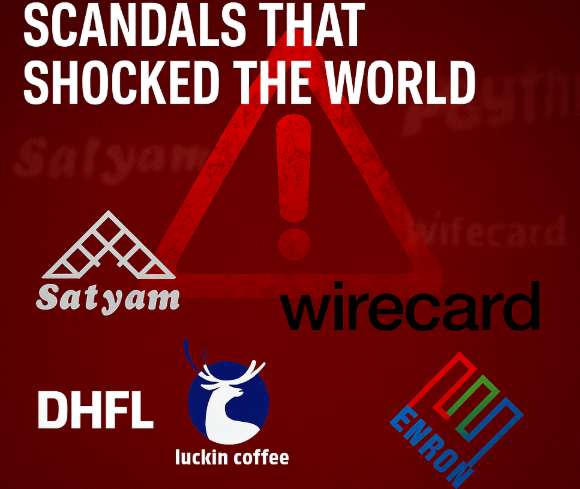
    Around the world, stories like Wirecard, Enron, and IL&FS followed the same pattern — glittering success hiding deep cracks.
    Every fraud left behind the same painful question:

    Were the red flags always there — and did we just fail to see them?

    This blog dives into those warning signs — the subtle yet powerful red flags in financial statements that can reveal when a company’s story doesn’t match its numbers.
    Because in investing, it’s not optimism that saves your money — it’s awareness.


    🧭 10-Point Cash Flow Red-Flag Checklist for Investors

    Red Flags in Financial Statements - Cash Flow Statement

    For investors, cash flow statements are the lifeline that reveal the true health of a business, beyond the glossy headlines. Ignoring subtle red flags can turn seemingly safe investments into painful losses. Here we summarize 10 red flags in cash flow that every investor must know, helping you spot trouble before it’s too late.

    #Check ThisWhy It Matters / Red Flag SignalReal-World Example
    1Is Cash Flow from Operations (CFO) consistently positive?Profitable businesses should generate cash. Multiple years of negative CFO = unsustainable.Kingfisher Airlines – persistent negative CFO led to debt trap.
    2Compare CFO vs Net ProfitCFO should roughly track profit. If profit > CFO for 2–3 years → likely aggressive revenue recognition.Satyam, Enron.
    3Check CFO/Net Profit Ratio (>1 ideally)A healthy company converts most of its earnings into cash. <1 indicates weak cash collection or fake sales.Satyam – ratio <0.5 before scandal.
    4Look at Free Cash Flow (FCF = CFO – Capex)Negative FCF over long periods → dependency on external funding.Kingfisher, Start-ups like WeWork pre-IPO.
    5Watch “Other Current Assets/Liabilities” in CFO adjustmentsLarge swings here can be used to manipulate CFO.Enron used complex structures to inflate CFO.
    6Scrutinize Investing Cash Flows (CFI)Sale of assets or “investments in subsidiaries” might hide poor operations or round-tripping.Wirecard – fake “escrow” accounts & investments.
    7Analyze Financing Cash Flow (CFF)Rising borrowings or frequent equity dilution despite profit = cash crunch.Yes Bank – relied on fresh borrowings.
    8Verify Cash Balances with Debt LevelsHigh cash + high debt = questionable. Why borrow if cash exists?Wirecard claimed high cash but was actually missing €1.9 bn.
    9Look for One-time or Unusual InflowsSudden inflows from asset sales, grants, or subsidiaries may inflate CFO temporarily.Satyam & Enron both showed “one-off” boosts.
    10Read Auditor’s and Notes to Accounts for cash-flow anomaliesAuditors often flag inconsistencies in “bank balances,” “related-party cash flows,” or “non-reconciled statements.”Wirecard, Yes Bank (RBI observations).

    ⚙️ How to Apply This Practically

    1. Pull last 5 years’ cash flow data (from Annual Report or Screener.in).
    2. Create simple ratios:
      • CFO / Net Profit
      • FCF = CFO – Capex
      • Debt / CFO
    3. Watch for trends, not one-year anomalies.
    4. Cross-verify cash with borrowings — if both rise together, investigate.
    5. Always read the Notes section — that’s where hidden details lie.

    Quick Rule of Thumb

    “If profits rise but cash doesn’t, believe the cash.”

    Because cash is reality, profit is opinion.


    🚨 Red Flags in Profit & Loss Statement (with Real-World Examples)

    P&L

    While revenue growth and profits may look impressive on the surface, subtle anomalies—like unusual expense patterns, inconsistent margins, or one-off gains—can signal deeper financial troubles. Early detection of these warning signs helps investors avoid costly mistakes and make informed decisions, ensuring that a promising-looking business doesn’t turn into a hidden risk.


    1️⃣ Rapid Revenue Growth without Cash Support

    Red Flag: Revenue growing fast but not matched by cash inflow or customer receipts.
    Why It’s Risky: Indicates fake/inflated sales, round-tripping, or channel stuffing.
    Case: Satyam Computer (India, 2009)

    • Reported strong double-digit revenue growth every year.
    • But receivables kept rising, and cash didn’t increase proportionately.
    • Later revealed that invoices were fabricated to show fake revenue.
      → Check: Revenue growth vs. CFO growth; Debtors turnover ratio.

    2️⃣ Consistently Rising Profits with Flat or Declining Sales

    Red Flag: Margins rising unnaturally while sales stagnate.
    Why It’s Risky: Artificial margin inflation via reduced depreciation, deferred expenses, or lower provisions.
    Case: Enron (USA, 2001)

    • Reported massive profit growth by using mark-to-market accounting — recognizing future gains as present income.
    • Actual sales and cash lagged behind.
      → Check: Profit growth vs. sales growth; sudden margin expansion.

    Mark-to-market accounting is legal, but it becomes dangerous when abused. Enron, for example, booked projected profits as actual income long before cash arrived, using unrealistic assumptions. For investors, this is a clear red flag—profits on paper don’t always mean real money in the bank.


    3️⃣ High “Other Income” Contribution

    Red Flag: A big chunk of profit coming from “Other Income” rather than core operations.
    Why It’s Risky: Non-operating income (interest, asset sale, forex gain) may be one-time or non-recurring.
    Case: Yes Bank (India, 2017–19)

    • Showed stable profit numbers despite rising NPAs.
    • Part of the earnings came from “bond trading gains” and write-back of provisions.
      → Check: % of Other Income in total profit; sustainability of that income.

    4️⃣ Frequent Changes in Accounting Policies or Estimates

    Red Flag: Change in depreciation method, inventory valuation, or revenue recognition timing.
    Why It’s Risky: Such changes can boost or delay expenses to inflate profit.
    Case: Jet Airways (India)

    • Changed depreciation policy to extend asset life → reduced annual depreciation expense.
    • Helped temporarily improve profits before eventual collapse.
      → Check: Notes to Accounts — “Change in accounting policies.”

    5️⃣ Low or Declining Expense Ratios without Operational Explanation

    Red Flag: Sharp drop in cost of goods sold or operating expenses without clear reason.
    Why It’s Risky: Indicates expense under-reporting, capitalization, or deferred recognition.
    Case: DHFL (India)

    • Expenses understated by showing interest costs as “capitalized” assets, boosting short-term profits.
      → Check: Expense-to-sales ratios; sudden improvement in margins.

    6️⃣ High Reported Profit but Low EPS Growth

    Red Flag: EPS growth lagging behind profit growth.
    Why It’s Risky: Means frequent equity dilution or aggressive accounting adjustments.
    Case: Suzlon Energy (India)

    • Reported profits while issuing more shares and booking notional gains.
    • EPS stagnated despite high reported PAT.
      → Check: Compare PAT growth vs EPS growth; dilution impact.

    7️⃣ Sudden Jump in “Other Expenses” or Unexplained Items

    Red Flag: Vague line items like “miscellaneous expenses,” “exceptional items,” or “adjustments.”
    Why It’s Risky: Hides write-offs, penalties, or related-party payments.
    Case: IL&FS (India, 2018)

    • Large “miscellaneous expenses” masked provisioning for bad loans and project losses.
      → Check: Trend of “Other Expenses” and read notes carefully.

    8️⃣ Low Tax Outgo despite High Reported Profits

    Red Flag: High book profits but very low actual tax payment or deferred tax adjustments.
    Why It’s Risky: Indicates manipulation, deferred taxes, or use of tax shelters.
    Case: Enron again — paid negligible taxes on billions of “profits.”
    → Check: Effective Tax Rate = Tax / PBT → should not be drastically low for long.


    9️⃣ Frequent “Exceptional Gains” Saving Results

    Red Flag: Company shows profit mainly because of “one-time” gains every year.
    Why It’s Risky: Genuine business performance is weak; management masking issues.
    Case: Reliance Capital / ADAG firms (2015–18)

    • Several “exceptional gains” from asset sales and revaluation helped maintain profit.
      → Check: Recurrence of “one-time” gains; remove them for normalized profit.

    🔟 Promoter Compensation Rising Despite Weak Performance

    Red Flag: Salaries, commissions, or bonuses to promoters increasing even when profits or revenues fall.
    Why It’s Risky: Signals governance issues and poor alignment with shareholders.
    Case: Kingfisher Airlines / Vijay Mallya

    • Management took high compensation despite continuous losses.
      → Check: Director remuneration trend vs company performance.

    ⚙️ Quick Investor Ratios to Detect P&L Red Flags

    MetricFormula / CheckHealthy Range
    CFO / Net ProfitCash conversion of profit> 1 preferred
    Operating Margin ConsistencyEBIT / SalesShould be stable; not volatile without reason
    Other Income %Other Income / Total Income< 10–15% ideal
    Effective Tax RateTax / PBTShould be near statutory rate (25–30% in India)
    Debt Service CoverageEBIT / (Interest + Principal)> 1.5 preferred

    📘 Key Lesson

    “When the story in the P&L looks too good to be true — check the cash flow and the notes.”


    🚨 Balance Sheet Red Flags (with Real-World Case Studies)

    Balance Sheet

    The Balance Sheet (BS) reveals the company’s financial strength and reality behind the numbers. Even when P&L and CFO look good, the balance sheet often exposes hidden manipulation.

    1️⃣ Inflated or Fake Assets

    Red Flag: Sudden rise in assets (cash, investments, receivables) without supporting business activity.
    Why It’s Risky: Common trick to show inflated financial strength or hide missing money.
    Case: Wirecard (Germany, 2020)

    • Claimed €1.9 billion in “cash balances” held in escrow accounts that didn’t exist.
    • Auditors (EY) couldn’t verify bank confirmations.
      → Check: Cash balances vs CFO; auditor notes on verification of balances.

    2️⃣ Rising Receivables vs Sales

    Red Flag: Receivables growing faster than revenue.
    Why It’s Risky: Indicates fake sales, delayed collections, or weak customer base.
    Case: Satyam Computer (India, 2009)

    • Trade receivables rose sharply compared to revenue growth.
    • Revealed later that many invoices were fictitious.
      → Check: Debtors Turnover = Sales / Receivables → should remain stable.

    3️⃣ High or Growing Inventory without Sales Growth

    Red Flag: Inventory piling up even as sales stagnate.
    Why It’s Risky: Could indicate overproduction, obsolete stock, or fake capitalization.
    Case: Ricoh India (2016)

    • Reported huge jump in inventory and receivables to inflate revenue.
    • Later disclosed major accounting irregularities.
      → Check: Inventory Turnover; Inventory growth vs Sales growth.

    4️⃣ Capitalizing Operating Expenses

    Red Flag: Unusually high “Capital Work-in-Progress (CWIP)” or “Intangible Assets.”
    Why It’s Risky: Expenses booked as assets → inflates profits and total assets.
    Case: Infrastructure Leasing & Financial Services (IL&FS, India, 2018)

    • Capitalized project costs that should’ve been expensed, masking true losses.
      → Check: CWIP and intangible growth vs actual new projects.

    Red Flag: Loans/advances to subsidiaries, associates, or promoters without clear recovery terms.
    Why It’s Risky: Cash diversion or round-tripping.
    Case: DHFL (India, 2019)

    • Large inter-company loans routed to promoter-linked entities, later found to be siphoning.
      → Check: Related Party Disclosures in Notes; compare loans vs group revenue.

    6️⃣ Sharp Increase in Goodwill or Intangibles

    Red Flag: Rising goodwill from frequent acquisitions.
    Why It’s Risky: Used to mask overpayment or inflate total asset base.
    Case: Jet Airways / Fortis Healthcare

    • Acquisitions led to inflated goodwill, later written off.
      → Check: Goodwill as % of Total Assets; watch for future impairment losses.

    7️⃣ Hidden Debt through Off-Balance-Sheet Liabilities

    Red Flag: Leases, guarantees, or SPVs not reflected as liabilities.
    Why It’s Risky: Hides true leverage and risk.
    Case: Enron (USA, 2001)

    • Used hundreds of off-balance-sheet partnerships (SPEs) to hide debt.
      → Check: Notes on Contingent Liabilities and Commitments.

    8️⃣ Negative Working Capital in Non-FMCG Businesses

    Red Flag: Current liabilities > current assets in industries not typically prepaid by customers.
    Why It’s Risky: Indicates cash flow stress, delayed supplier payments.
    Case: Yes Bank (2018–20)

    • Negative working capital arose as deposits fled and loans turned bad.
      → Check: Current Ratio = Current Assets / Current Liabilities → should be >1.

    9️⃣ Frequent Equity Dilution Despite Profits

    Red Flag: New share issues or warrants even when retained earnings are strong.
    Why It’s Risky: Indicates poor cash generation; promoter enrichment at minority expense.
    Case: Suzlon Energy (India)

    • Repeated equity issuances to fund losses and pay debt.
      → Check: Change in share capital vs retained earnings trend.

    🔟 Auditor or Credit Rating Resignations

    Red Flag: Sudden resignation or qualification in auditor’s report.
    Why It’s Risky: Often happens just before major fraud revelations.
    Case:

    • CG Power (India, 2019) – auditor flagged fund diversion.
    • Manpasand Beverages (India, 2018) – auditor resigned before fraud exposed.
      → Check: Auditor notes, qualifications, emphasis of matter, and resignation reasons.

    📊 Summary Table: Balance Sheet Red Flags

    Red FlagLikely ManipulationExample
    Fake/Inflated CashRound-tripping or missing moneyWirecard
    Receivables > Sales GrowthFake revenueSatyam
    High CWIP/IntangiblesExpense capitalizationIL&FS
    High Related-Party LoansFund diversionDHFL
    Hidden Debt (Off-BS)Leverage concealmentEnron
    Sudden Goodwill JumpOvervaluation of M&AJet Airways
    Negative Working CapitalLiquidity stressYes Bank
    Auditor ChangesFraud cover-upManpasand, CG Power

    🧭 Practical Investor Checks

    1. Compare asset growth vs revenue growth. Assets growing faster = efficiency drop or asset inflation.
    2. Read Notes to Accounts every time. Most manipulations hide in footnotes.
    3. Check debt trends vs CFO. If debt rises but CFO doesn’t, beware.
    4. Track auditor comments & resignations.
    5. Cross-verify cash with interest income. Big cash → should yield interest; if not, fake.

    ESG Red Flags in Financial Statements & Reporting

    From an ESG lens, red flags go beyond just profits—they reveal how responsibly a company operates. Warning signs include:

    • Environmental: Lack of disclosure on carbon emissions, excessive resource consumption, or sudden rise in “green” claims without credible data (greenwashing).
    • Social: Frequent labor disputes, poor worker safety records, or unusually high employee turnover that contradicts “people-first” claims.
    • Governance: Related-party transactions, auditor resignations, opaque ownership structures, or delays in ESG/sustainability reporting.

    Why it matters: Weak ESG practices often correlate with financial manipulation, compliance risks, or reputational damage. Inconsistent or overly polished ESG reports—without independent verification—are major red flags that a company may be using ESG as a PR tool rather than a genuine framework.


    Final Takeaway

    “Balance Sheets tell you what’s real — P&L tells you what they wish were real.”
    Always reconcile P&L + CFO + Balance Sheet together for true financial health.


    ⚠️ Call to Action for Investors: Don’t Just Read Profits — Read Between the Lines

    💡 Most corporate disasters don’t happen overnight — they unfold slowly in the financial statements.
    The signs are always there — in cash flow mismatches, bloated receivables, or auditor notes that nobody bothers to read.

    👉 As an investor, your best protection isn’t luck — it’s literacy.
    Learn to read beyond the headlines and glossy earnings presentations.
    Every rupee you invest is a vote of trust. Don’t give that trust blindly.

    Before you invest, ask yourself:

    1. Do profits convert into real cash?
    2. Are assets genuine, or just accounting entries?
    3. Is debt rising faster than business growth?
    4. Are auditors, credit raters, and management aligned — or exiting quietly?

    🚨 If the numbers don’t tell a consistent story — walk away.
    Greed makes you chase high returns; wisdom makes you protect your capital.


    “Markets reward curiosity, not complacency.”
    Read. Question. Compare. Verify.
    Because the next Satyam, Wirecard, or IL&FS will again look like a success story — until it isn’t.

    Read blogs on corporate governance here.

    Weaver – Critical Red Flags in Financial Statement Reviews
    This resource outlines key indicators such as unusual fluctuations in account balances and inconsistent trends across reporting periods, emphasizing the significance of early identification to mitigate risks. weaver.com

  • Red Flags in Financial Statements-Every Investor Must Know!

    Red Flags in Financial Statements-Every Investor Must Know!


    💣 The Truth Behind the Numbers: Are You Reading the Signs?

    Why the red flags in financial statements get overlooked often?

    It was 2008. The stock market was booming, and Satyam Computer Services was the pride of India’s corporate world.
    The company had just bagged the Golden Peacock Award for Excellence in Corporate Governance — a badge of honor few could dream of.
    Analysts called it a “blue-chip gem,” and investors rushed to buy more shares, confident in its spotless reputation.

    But within months, the mask fell.
    The same company that won awards for transparency was exposed in one of India’s biggest accounting frauds — ₹7,000 crore of fake profits, inflated cash balances, and falsified invoices.

    Around the world, stories like Wirecard, Enron, and IL&FS followed the same pattern — glittering success hiding deep cracks.
    Every fraud left behind the same painful question:

    Were the red flags always there — and did we just fail to see them?

    This blog dives into those warning signs — the subtle yet powerful red flags in financial statements that can reveal when a company’s story doesn’t match its numbers.
    Because in investing, it’s not optimism that saves your money — it’s awareness.


    🧭 10-Point Cash Flow Red-Flag Checklist for Investors

    Red Flags in Financial Statements - Cash Flow Statement

    For investors, cash flow statements are the lifeline that reveal the true health of a business, beyond the glossy headlines. Ignoring subtle red flags can turn seemingly safe investments into painful losses. Here we summarize 10 red flags in cash flow that every investor must know, helping you spot trouble before it’s too late.

    #Check ThisWhy It Matters / Red Flag SignalReal-World Example
    1Is Cash Flow from Operations (CFO) consistently positive?Profitable businesses should generate cash. Multiple years of negative CFO = unsustainable.Kingfisher Airlines – persistent negative CFO led to debt trap.
    2Compare CFO vs Net ProfitCFO should roughly track profit. If profit > CFO for 2–3 years → likely aggressive revenue recognition.Satyam, Enron.
    3Check CFO/Net Profit Ratio (>1 ideally)A healthy company converts most of its earnings into cash. <1 indicates weak cash collection or fake sales.Satyam – ratio <0.5 before scandal.
    4Look at Free Cash Flow (FCF = CFO – Capex)Negative FCF over long periods → dependency on external funding.Kingfisher, Start-ups like WeWork pre-IPO.
    5Watch “Other Current Assets/Liabilities” in CFO adjustmentsLarge swings here can be used to manipulate CFO.Enron used complex structures to inflate CFO.
    6Scrutinize Investing Cash Flows (CFI)Sale of assets or “investments in subsidiaries” might hide poor operations or round-tripping.Wirecard – fake “escrow” accounts & investments.
    7Analyze Financing Cash Flow (CFF)Rising borrowings or frequent equity dilution despite profit = cash crunch.Yes Bank – relied on fresh borrowings.
    8Verify Cash Balances with Debt LevelsHigh cash + high debt = questionable. Why borrow if cash exists?Wirecard claimed high cash but was actually missing €1.9 bn.
    9Look for One-time or Unusual InflowsSudden inflows from asset sales, grants, or subsidiaries may inflate CFO temporarily.Satyam & Enron both showed “one-off” boosts.
    10Read Auditor’s and Notes to Accounts for cash-flow anomaliesAuditors often flag inconsistencies in “bank balances,” “related-party cash flows,” or “non-reconciled statements.”Wirecard, Yes Bank (RBI observations).

    ⚙️ How to Apply This Practically

    1. Pull last 5 years’ cash flow data (from Annual Report or Screener.in).
    2. Create simple ratios:
      • CFO / Net Profit
      • FCF = CFO – Capex
      • Debt / CFO
    3. Watch for trends, not one-year anomalies.
    4. Cross-verify cash with borrowings — if both rise together, investigate.
    5. Always read the Notes section — that’s where hidden details lie.

    Quick Rule of Thumb

    “If profits rise but cash doesn’t, believe the cash.”

    Because cash is reality, profit is opinion.


    🚨 Red Flags in Profit & Loss Statement (with Real-World Examples)

    P&L

    While revenue growth and profits may look impressive on the surface, subtle anomalies—like unusual expense patterns, inconsistent margins, or one-off gains—can signal deeper financial troubles. Early detection of these warning signs helps investors avoid costly mistakes and make informed decisions, ensuring that a promising-looking business doesn’t turn into a hidden risk.


    1️⃣ Rapid Revenue Growth without Cash Support

    Red Flag: Revenue growing fast but not matched by cash inflow or customer receipts.
    Why It’s Risky: Indicates fake/inflated sales, round-tripping, or channel stuffing.
    Case: Satyam Computer (India, 2009)

    • Reported strong double-digit revenue growth every year.
    • But receivables kept rising, and cash didn’t increase proportionately.
    • Later revealed that invoices were fabricated to show fake revenue.
      → Check: Revenue growth vs. CFO growth; Debtors turnover ratio.

    2️⃣ Consistently Rising Profits with Flat or Declining Sales

    Red Flag: Margins rising unnaturally while sales stagnate.
    Why It’s Risky: Artificial margin inflation via reduced depreciation, deferred expenses, or lower provisions.
    Case: Enron (USA, 2001)

    • Reported massive profit growth by using mark-to-market accounting — recognizing future gains as present income.
    • Actual sales and cash lagged behind.
      → Check: Profit growth vs. sales growth; sudden margin expansion.

    Mark-to-market accounting is legal, but it becomes dangerous when abused. Enron, for example, booked projected profits as actual income long before cash arrived, using unrealistic assumptions. For investors, this is a clear red flag—profits on paper don’t always mean real money in the bank.


    3️⃣ High “Other Income” Contribution

    Red Flag: A big chunk of profit coming from “Other Income” rather than core operations.
    Why It’s Risky: Non-operating income (interest, asset sale, forex gain) may be one-time or non-recurring.
    Case: Yes Bank (India, 2017–19)

    • Showed stable profit numbers despite rising NPAs.
    • Part of the earnings came from “bond trading gains” and write-back of provisions.
      → Check: % of Other Income in total profit; sustainability of that income.

    4️⃣ Frequent Changes in Accounting Policies or Estimates

    Red Flag: Change in depreciation method, inventory valuation, or revenue recognition timing.
    Why It’s Risky: Such changes can boost or delay expenses to inflate profit.
    Case: Jet Airways (India)

    • Changed depreciation policy to extend asset life → reduced annual depreciation expense.
    • Helped temporarily improve profits before eventual collapse.
      → Check: Notes to Accounts — “Change in accounting policies.”

    5️⃣ Low or Declining Expense Ratios without Operational Explanation

    Red Flag: Sharp drop in cost of goods sold or operating expenses without clear reason.
    Why It’s Risky: Indicates expense under-reporting, capitalization, or deferred recognition.
    Case: DHFL (India)

    • Expenses understated by showing interest costs as “capitalized” assets, boosting short-term profits.
      → Check: Expense-to-sales ratios; sudden improvement in margins.

    6️⃣ High Reported Profit but Low EPS Growth

    Red Flag: EPS growth lagging behind profit growth.
    Why It’s Risky: Means frequent equity dilution or aggressive accounting adjustments.
    Case: Suzlon Energy (India)

    • Reported profits while issuing more shares and booking notional gains.
    • EPS stagnated despite high reported PAT.
      → Check: Compare PAT growth vs EPS growth; dilution impact.

    7️⃣ Sudden Jump in “Other Expenses” or Unexplained Items

    Red Flag: Vague line items like “miscellaneous expenses,” “exceptional items,” or “adjustments.”
    Why It’s Risky: Hides write-offs, penalties, or related-party payments.
    Case: IL&FS (India, 2018)

    • Large “miscellaneous expenses” masked provisioning for bad loans and project losses.
      → Check: Trend of “Other Expenses” and read notes carefully.

    8️⃣ Low Tax Outgo despite High Reported Profits

    Red Flag: High book profits but very low actual tax payment or deferred tax adjustments.
    Why It’s Risky: Indicates manipulation, deferred taxes, or use of tax shelters.
    Case: Enron again — paid negligible taxes on billions of “profits.”
    → Check: Effective Tax Rate = Tax / PBT → should not be drastically low for long.


    9️⃣ Frequent “Exceptional Gains” Saving Results

    Red Flag: Company shows profit mainly because of “one-time” gains every year.
    Why It’s Risky: Genuine business performance is weak; management masking issues.
    Case: Reliance Capital / ADAG firms (2015–18)

    • Several “exceptional gains” from asset sales and revaluation helped maintain profit.
      → Check: Recurrence of “one-time” gains; remove them for normalized profit.

    🔟 Promoter Compensation Rising Despite Weak Performance

    Red Flag: Salaries, commissions, or bonuses to promoters increasing even when profits or revenues fall.
    Why It’s Risky: Signals governance issues and poor alignment with shareholders.
    Case: Kingfisher Airlines / Vijay Mallya

    • Management took high compensation despite continuous losses.
      → Check: Director remuneration trend vs company performance.

    ⚙️ Quick Investor Ratios to Detect P&L Red Flags

    MetricFormula / CheckHealthy Range
    CFO / Net ProfitCash conversion of profit> 1 preferred
    Operating Margin ConsistencyEBIT / SalesShould be stable; not volatile without reason
    Other Income %Other Income / Total Income< 10–15% ideal
    Effective Tax RateTax / PBTShould be near statutory rate (25–30% in India)
    Debt Service CoverageEBIT / (Interest + Principal)> 1.5 preferred

    📘 Key Lesson

    “When the story in the P&L looks too good to be true — check the cash flow and the notes.”


    🚨 Balance Sheet Red Flags (with Real-World Case Studies)

    Balance Sheet

    The Balance Sheet (BS) reveals the company’s financial strength and reality behind the numbers. Even when P&L and CFO look good, the balance sheet often exposes hidden manipulation.

    1️⃣ Inflated or Fake Assets

    Red Flag: Sudden rise in assets (cash, investments, receivables) without supporting business activity.
    Why It’s Risky: Common trick to show inflated financial strength or hide missing money.
    Case: Wirecard (Germany, 2020)

    • Claimed €1.9 billion in “cash balances” held in escrow accounts that didn’t exist.
    • Auditors (EY) couldn’t verify bank confirmations.
      → Check: Cash balances vs CFO; auditor notes on verification of balances.

    2️⃣ Rising Receivables vs Sales

    Red Flag: Receivables growing faster than revenue.
    Why It’s Risky: Indicates fake sales, delayed collections, or weak customer base.
    Case: Satyam Computer (India, 2009)

    • Trade receivables rose sharply compared to revenue growth.
    • Revealed later that many invoices were fictitious.
      → Check: Debtors Turnover = Sales / Receivables → should remain stable.

    3️⃣ High or Growing Inventory without Sales Growth

    Red Flag: Inventory piling up even as sales stagnate.
    Why It’s Risky: Could indicate overproduction, obsolete stock, or fake capitalization.
    Case: Ricoh India (2016)

    • Reported huge jump in inventory and receivables to inflate revenue.
    • Later disclosed major accounting irregularities.
      → Check: Inventory Turnover; Inventory growth vs Sales growth.

    4️⃣ Capitalizing Operating Expenses

    Red Flag: Unusually high “Capital Work-in-Progress (CWIP)” or “Intangible Assets.”
    Why It’s Risky: Expenses booked as assets → inflates profits and total assets.
    Case: Infrastructure Leasing & Financial Services (IL&FS, India, 2018)

    • Capitalized project costs that should’ve been expensed, masking true losses.
      → Check: CWIP and intangible growth vs actual new projects.

    Red Flag: Loans/advances to subsidiaries, associates, or promoters without clear recovery terms.
    Why It’s Risky: Cash diversion or round-tripping.
    Case: DHFL (India, 2019)

    • Large inter-company loans routed to promoter-linked entities, later found to be siphoning.
      → Check: Related Party Disclosures in Notes; compare loans vs group revenue.

    6️⃣ Sharp Increase in Goodwill or Intangibles

    Red Flag: Rising goodwill from frequent acquisitions.
    Why It’s Risky: Used to mask overpayment or inflate total asset base.
    Case: Jet Airways / Fortis Healthcare

    • Acquisitions led to inflated goodwill, later written off.
      → Check: Goodwill as % of Total Assets; watch for future impairment losses.

    7️⃣ Hidden Debt through Off-Balance-Sheet Liabilities

    Red Flag: Leases, guarantees, or SPVs not reflected as liabilities.
    Why It’s Risky: Hides true leverage and risk.
    Case: Enron (USA, 2001)

    • Used hundreds of off-balance-sheet partnerships (SPEs) to hide debt.
      → Check: Notes on Contingent Liabilities and Commitments.

    8️⃣ Negative Working Capital in Non-FMCG Businesses

    Red Flag: Current liabilities > current assets in industries not typically prepaid by customers.
    Why It’s Risky: Indicates cash flow stress, delayed supplier payments.
    Case: Yes Bank (2018–20)

    • Negative working capital arose as deposits fled and loans turned bad.
      → Check: Current Ratio = Current Assets / Current Liabilities → should be >1.

    9️⃣ Frequent Equity Dilution Despite Profits

    Red Flag: New share issues or warrants even when retained earnings are strong.
    Why It’s Risky: Indicates poor cash generation; promoter enrichment at minority expense.
    Case: Suzlon Energy (India)

    • Repeated equity issuances to fund losses and pay debt.
      → Check: Change in share capital vs retained earnings trend.

    🔟 Auditor or Credit Rating Resignations

    Red Flag: Sudden resignation or qualification in auditor’s report.
    Why It’s Risky: Often happens just before major fraud revelations.
    Case:

    • CG Power (India, 2019) – auditor flagged fund diversion.
    • Manpasand Beverages (India, 2018) – auditor resigned before fraud exposed.
      → Check: Auditor notes, qualifications, emphasis of matter, and resignation reasons.

    📊 Summary Table: Balance Sheet Red Flags

    Red FlagLikely ManipulationExample
    Fake/Inflated CashRound-tripping or missing moneyWirecard
    Receivables > Sales GrowthFake revenueSatyam
    High CWIP/IntangiblesExpense capitalizationIL&FS
    High Related-Party LoansFund diversionDHFL
    Hidden Debt (Off-BS)Leverage concealmentEnron
    Sudden Goodwill JumpOvervaluation of M&AJet Airways
    Negative Working CapitalLiquidity stressYes Bank
    Auditor ChangesFraud cover-upManpasand, CG Power

    🧭 Practical Investor Checks

    1. Compare asset growth vs revenue growth. Assets growing faster = efficiency drop or asset inflation.
    2. Read Notes to Accounts every time. Most manipulations hide in footnotes.
    3. Check debt trends vs CFO. If debt rises but CFO doesn’t, beware.
    4. Track auditor comments & resignations.
    5. Cross-verify cash with interest income. Big cash → should yield interest; if not, fake.

    ESG Red Flags in Financial Statements & Reporting

    From an ESG lens, red flags go beyond just profits—they reveal how responsibly a company operates. Warning signs include:

    • Environmental: Lack of disclosure on carbon emissions, excessive resource consumption, or sudden rise in “green” claims without credible data (greenwashing).
    • Social: Frequent labor disputes, poor worker safety records, or unusually high employee turnover that contradicts “people-first” claims.
    • Governance: Related-party transactions, auditor resignations, opaque ownership structures, or delays in ESG/sustainability reporting.

    Why it matters: Weak ESG practices often correlate with financial manipulation, compliance risks, or reputational damage. Inconsistent or overly polished ESG reports—without independent verification—are major red flags that a company may be using ESG as a PR tool rather than a genuine framework.


    Final Takeaway

    “Balance Sheets tell you what’s real — P&L tells you what they wish were real.”
    Always reconcile P&L + CFO + Balance Sheet together for true financial health.


    ⚠️ Call to Action for Investors: Don’t Just Read Profits — Read Between the Lines

    💡 Most corporate disasters don’t happen overnight — they unfold slowly in the financial statements.
    The signs are always there — in cash flow mismatches, bloated receivables, or auditor notes that nobody bothers to read.

    👉 As an investor, your best protection isn’t luck — it’s literacy.
    Learn to read beyond the headlines and glossy earnings presentations.
    Every rupee you invest is a vote of trust. Don’t give that trust blindly.

    Before you invest, ask yourself:

    1. Do profits convert into real cash?
    2. Are assets genuine, or just accounting entries?
    3. Is debt rising faster than business growth?
    4. Are auditors, credit raters, and management aligned — or exiting quietly?

    🚨 If the numbers don’t tell a consistent story — walk away.
    Greed makes you chase high returns; wisdom makes you protect your capital.


    “Markets reward curiosity, not complacency.”
    Read. Question. Compare. Verify.
    Because the next Satyam, Wirecard, or IL&FS will again look like a success story — until it isn’t.

    Read blogs on corporate governance here.

    Weaver – Critical Red Flags in Financial Statement Reviews
    This resource outlines key indicators such as unusual fluctuations in account balances and inconsistent trends across reporting periods, emphasizing the significance of early identification to mitigate risks. weaver.com

  • Red Flags in Financial Statements-Every Investor Must Know!

    Red Flags in Financial Statements-Every Investor Must Know!


    💣 The Truth Behind the Numbers: Are You Reading the Signs?

    Why the red flags in financial statements get overlooked often?

    It was 2008. The stock market was booming, and Satyam Computer Services was the pride of India’s corporate world.
    The company had just bagged the Golden Peacock Award for Excellence in Corporate Governance — a badge of honor few could dream of.
    Analysts called it a “blue-chip gem,” and investors rushed to buy more shares, confident in its spotless reputation.

    But within months, the mask fell.
    The same company that won awards for transparency was exposed in one of India’s biggest accounting frauds — ₹7,000 crore of fake profits, inflated cash balances, and falsified invoices.

    Around the world, stories like Wirecard, Enron, and IL&FS followed the same pattern — glittering success hiding deep cracks.
    Every fraud left behind the same painful question:

    Were the red flags always there — and did we just fail to see them?

    This blog dives into those warning signs — the subtle yet powerful red flags in financial statements that can reveal when a company’s story doesn’t match its numbers.
    Because in investing, it’s not optimism that saves your money — it’s awareness.


    🧭 10-Point Cash Flow Red-Flag Checklist for Investors

    Red Flags in Financial Statements - Cash Flow Statement

    For investors, cash flow statements are the lifeline that reveal the true health of a business, beyond the glossy headlines. Ignoring subtle red flags can turn seemingly safe investments into painful losses. Here we summarize 10 red flags in cash flow that every investor must know, helping you spot trouble before it’s too late.

    #Check ThisWhy It Matters / Red Flag SignalReal-World Example
    1Is Cash Flow from Operations (CFO) consistently positive?Profitable businesses should generate cash. Multiple years of negative CFO = unsustainable.Kingfisher Airlines – persistent negative CFO led to debt trap.
    2Compare CFO vs Net ProfitCFO should roughly track profit. If profit > CFO for 2–3 years → likely aggressive revenue recognition.Satyam, Enron.
    3Check CFO/Net Profit Ratio (>1 ideally)A healthy company converts most of its earnings into cash. <1 indicates weak cash collection or fake sales.Satyam – ratio <0.5 before scandal.
    4Look at Free Cash Flow (FCF = CFO – Capex)Negative FCF over long periods → dependency on external funding.Kingfisher, Start-ups like WeWork pre-IPO.
    5Watch “Other Current Assets/Liabilities” in CFO adjustmentsLarge swings here can be used to manipulate CFO.Enron used complex structures to inflate CFO.
    6Scrutinize Investing Cash Flows (CFI)Sale of assets or “investments in subsidiaries” might hide poor operations or round-tripping.Wirecard – fake “escrow” accounts & investments.
    7Analyze Financing Cash Flow (CFF)Rising borrowings or frequent equity dilution despite profit = cash crunch.Yes Bank – relied on fresh borrowings.
    8Verify Cash Balances with Debt LevelsHigh cash + high debt = questionable. Why borrow if cash exists?Wirecard claimed high cash but was actually missing €1.9 bn.
    9Look for One-time or Unusual InflowsSudden inflows from asset sales, grants, or subsidiaries may inflate CFO temporarily.Satyam & Enron both showed “one-off” boosts.
    10Read Auditor’s and Notes to Accounts for cash-flow anomaliesAuditors often flag inconsistencies in “bank balances,” “related-party cash flows,” or “non-reconciled statements.”Wirecard, Yes Bank (RBI observations).

    ⚙️ How to Apply This Practically

    1. Pull last 5 years’ cash flow data (from Annual Report or Screener.in).
    2. Create simple ratios:
      • CFO / Net Profit
      • FCF = CFO – Capex
      • Debt / CFO
    3. Watch for trends, not one-year anomalies.
    4. Cross-verify cash with borrowings — if both rise together, investigate.
    5. Always read the Notes section — that’s where hidden details lie.

    Quick Rule of Thumb

    “If profits rise but cash doesn’t, believe the cash.”

    Because cash is reality, profit is opinion.


    🚨 Red Flags in Profit & Loss Statement (with Real-World Examples)

    P&L

    While revenue growth and profits may look impressive on the surface, subtle anomalies—like unusual expense patterns, inconsistent margins, or one-off gains—can signal deeper financial troubles. Early detection of these warning signs helps investors avoid costly mistakes and make informed decisions, ensuring that a promising-looking business doesn’t turn into a hidden risk.


    1️⃣ Rapid Revenue Growth without Cash Support

    Red Flag: Revenue growing fast but not matched by cash inflow or customer receipts.
    Why It’s Risky: Indicates fake/inflated sales, round-tripping, or channel stuffing.
    Case: Satyam Computer (India, 2009)

    • Reported strong double-digit revenue growth every year.
    • But receivables kept rising, and cash didn’t increase proportionately.
    • Later revealed that invoices were fabricated to show fake revenue.
      → Check: Revenue growth vs. CFO growth; Debtors turnover ratio.

    2️⃣ Consistently Rising Profits with Flat or Declining Sales

    Red Flag: Margins rising unnaturally while sales stagnate.
    Why It’s Risky: Artificial margin inflation via reduced depreciation, deferred expenses, or lower provisions.
    Case: Enron (USA, 2001)

    • Reported massive profit growth by using mark-to-market accounting — recognizing future gains as present income.
    • Actual sales and cash lagged behind.
      → Check: Profit growth vs. sales growth; sudden margin expansion.

    Mark-to-market accounting is legal, but it becomes dangerous when abused. Enron, for example, booked projected profits as actual income long before cash arrived, using unrealistic assumptions. For investors, this is a clear red flag—profits on paper don’t always mean real money in the bank.


    3️⃣ High “Other Income” Contribution

    Red Flag: A big chunk of profit coming from “Other Income” rather than core operations.
    Why It’s Risky: Non-operating income (interest, asset sale, forex gain) may be one-time or non-recurring.
    Case: Yes Bank (India, 2017–19)

    • Showed stable profit numbers despite rising NPAs.
    • Part of the earnings came from “bond trading gains” and write-back of provisions.
      → Check: % of Other Income in total profit; sustainability of that income.

    4️⃣ Frequent Changes in Accounting Policies or Estimates

    Red Flag: Change in depreciation method, inventory valuation, or revenue recognition timing.
    Why It’s Risky: Such changes can boost or delay expenses to inflate profit.
    Case: Jet Airways (India)

    • Changed depreciation policy to extend asset life → reduced annual depreciation expense.
    • Helped temporarily improve profits before eventual collapse.
      → Check: Notes to Accounts — “Change in accounting policies.”

    5️⃣ Low or Declining Expense Ratios without Operational Explanation

    Red Flag: Sharp drop in cost of goods sold or operating expenses without clear reason.
    Why It’s Risky: Indicates expense under-reporting, capitalization, or deferred recognition.
    Case: DHFL (India)

    • Expenses understated by showing interest costs as “capitalized” assets, boosting short-term profits.
      → Check: Expense-to-sales ratios; sudden improvement in margins.

    6️⃣ High Reported Profit but Low EPS Growth

    Red Flag: EPS growth lagging behind profit growth.
    Why It’s Risky: Means frequent equity dilution or aggressive accounting adjustments.
    Case: Suzlon Energy (India)

    • Reported profits while issuing more shares and booking notional gains.
    • EPS stagnated despite high reported PAT.
      → Check: Compare PAT growth vs EPS growth; dilution impact.

    7️⃣ Sudden Jump in “Other Expenses” or Unexplained Items

    Red Flag: Vague line items like “miscellaneous expenses,” “exceptional items,” or “adjustments.”
    Why It’s Risky: Hides write-offs, penalties, or related-party payments.
    Case: IL&FS (India, 2018)

    • Large “miscellaneous expenses” masked provisioning for bad loans and project losses.
      → Check: Trend of “Other Expenses” and read notes carefully.

    8️⃣ Low Tax Outgo despite High Reported Profits

    Red Flag: High book profits but very low actual tax payment or deferred tax adjustments.
    Why It’s Risky: Indicates manipulation, deferred taxes, or use of tax shelters.
    Case: Enron again — paid negligible taxes on billions of “profits.”
    → Check: Effective Tax Rate = Tax / PBT → should not be drastically low for long.


    9️⃣ Frequent “Exceptional Gains” Saving Results

    Red Flag: Company shows profit mainly because of “one-time” gains every year.
    Why It’s Risky: Genuine business performance is weak; management masking issues.
    Case: Reliance Capital / ADAG firms (2015–18)

    • Several “exceptional gains” from asset sales and revaluation helped maintain profit.
      → Check: Recurrence of “one-time” gains; remove them for normalized profit.

    🔟 Promoter Compensation Rising Despite Weak Performance

    Red Flag: Salaries, commissions, or bonuses to promoters increasing even when profits or revenues fall.
    Why It’s Risky: Signals governance issues and poor alignment with shareholders.
    Case: Kingfisher Airlines / Vijay Mallya

    • Management took high compensation despite continuous losses.
      → Check: Director remuneration trend vs company performance.

    ⚙️ Quick Investor Ratios to Detect P&L Red Flags

    MetricFormula / CheckHealthy Range
    CFO / Net ProfitCash conversion of profit> 1 preferred
    Operating Margin ConsistencyEBIT / SalesShould be stable; not volatile without reason
    Other Income %Other Income / Total Income< 10–15% ideal
    Effective Tax RateTax / PBTShould be near statutory rate (25–30% in India)
    Debt Service CoverageEBIT / (Interest + Principal)> 1.5 preferred

    📘 Key Lesson

    “When the story in the P&L looks too good to be true — check the cash flow and the notes.”


    🚨 Balance Sheet Red Flags (with Real-World Case Studies)

    Balance Sheet

    The Balance Sheet (BS) reveals the company’s financial strength and reality behind the numbers. Even when P&L and CFO look good, the balance sheet often exposes hidden manipulation.

    1️⃣ Inflated or Fake Assets

    Red Flag: Sudden rise in assets (cash, investments, receivables) without supporting business activity.
    Why It’s Risky: Common trick to show inflated financial strength or hide missing money.
    Case: Wirecard (Germany, 2020)

    • Claimed €1.9 billion in “cash balances” held in escrow accounts that didn’t exist.
    • Auditors (EY) couldn’t verify bank confirmations.
      → Check: Cash balances vs CFO; auditor notes on verification of balances.

    2️⃣ Rising Receivables vs Sales

    Red Flag: Receivables growing faster than revenue.
    Why It’s Risky: Indicates fake sales, delayed collections, or weak customer base.
    Case: Satyam Computer (India, 2009)

    • Trade receivables rose sharply compared to revenue growth.
    • Revealed later that many invoices were fictitious.
      → Check: Debtors Turnover = Sales / Receivables → should remain stable.

    3️⃣ High or Growing Inventory without Sales Growth

    Red Flag: Inventory piling up even as sales stagnate.
    Why It’s Risky: Could indicate overproduction, obsolete stock, or fake capitalization.
    Case: Ricoh India (2016)

    • Reported huge jump in inventory and receivables to inflate revenue.
    • Later disclosed major accounting irregularities.
      → Check: Inventory Turnover; Inventory growth vs Sales growth.

    4️⃣ Capitalizing Operating Expenses

    Red Flag: Unusually high “Capital Work-in-Progress (CWIP)” or “Intangible Assets.”
    Why It’s Risky: Expenses booked as assets → inflates profits and total assets.
    Case: Infrastructure Leasing & Financial Services (IL&FS, India, 2018)

    • Capitalized project costs that should’ve been expensed, masking true losses.
      → Check: CWIP and intangible growth vs actual new projects.

    Red Flag: Loans/advances to subsidiaries, associates, or promoters without clear recovery terms.
    Why It’s Risky: Cash diversion or round-tripping.
    Case: DHFL (India, 2019)

    • Large inter-company loans routed to promoter-linked entities, later found to be siphoning.
      → Check: Related Party Disclosures in Notes; compare loans vs group revenue.

    6️⃣ Sharp Increase in Goodwill or Intangibles

    Red Flag: Rising goodwill from frequent acquisitions.
    Why It’s Risky: Used to mask overpayment or inflate total asset base.
    Case: Jet Airways / Fortis Healthcare

    • Acquisitions led to inflated goodwill, later written off.
      → Check: Goodwill as % of Total Assets; watch for future impairment losses.

    7️⃣ Hidden Debt through Off-Balance-Sheet Liabilities

    Red Flag: Leases, guarantees, or SPVs not reflected as liabilities.
    Why It’s Risky: Hides true leverage and risk.
    Case: Enron (USA, 2001)

    • Used hundreds of off-balance-sheet partnerships (SPEs) to hide debt.
      → Check: Notes on Contingent Liabilities and Commitments.

    8️⃣ Negative Working Capital in Non-FMCG Businesses

    Red Flag: Current liabilities > current assets in industries not typically prepaid by customers.
    Why It’s Risky: Indicates cash flow stress, delayed supplier payments.
    Case: Yes Bank (2018–20)

    • Negative working capital arose as deposits fled and loans turned bad.
      → Check: Current Ratio = Current Assets / Current Liabilities → should be >1.

    9️⃣ Frequent Equity Dilution Despite Profits

    Red Flag: New share issues or warrants even when retained earnings are strong.
    Why It’s Risky: Indicates poor cash generation; promoter enrichment at minority expense.
    Case: Suzlon Energy (India)

    • Repeated equity issuances to fund losses and pay debt.
      → Check: Change in share capital vs retained earnings trend.

    🔟 Auditor or Credit Rating Resignations

    Red Flag: Sudden resignation or qualification in auditor’s report.
    Why It’s Risky: Often happens just before major fraud revelations.
    Case:

    • CG Power (India, 2019) – auditor flagged fund diversion.
    • Manpasand Beverages (India, 2018) – auditor resigned before fraud exposed.
      → Check: Auditor notes, qualifications, emphasis of matter, and resignation reasons.

    📊 Summary Table: Balance Sheet Red Flags

    Red FlagLikely ManipulationExample
    Fake/Inflated CashRound-tripping or missing moneyWirecard
    Receivables > Sales GrowthFake revenueSatyam
    High CWIP/IntangiblesExpense capitalizationIL&FS
    High Related-Party LoansFund diversionDHFL
    Hidden Debt (Off-BS)Leverage concealmentEnron
    Sudden Goodwill JumpOvervaluation of M&AJet Airways
    Negative Working CapitalLiquidity stressYes Bank
    Auditor ChangesFraud cover-upManpasand, CG Power

    🧭 Practical Investor Checks

    1. Compare asset growth vs revenue growth. Assets growing faster = efficiency drop or asset inflation.
    2. Read Notes to Accounts every time. Most manipulations hide in footnotes.
    3. Check debt trends vs CFO. If debt rises but CFO doesn’t, beware.
    4. Track auditor comments & resignations.
    5. Cross-verify cash with interest income. Big cash → should yield interest; if not, fake.

    ESG Red Flags in Financial Statements & Reporting

    From an ESG lens, red flags go beyond just profits—they reveal how responsibly a company operates. Warning signs include:

    • Environmental: Lack of disclosure on carbon emissions, excessive resource consumption, or sudden rise in “green” claims without credible data (greenwashing).
    • Social: Frequent labor disputes, poor worker safety records, or unusually high employee turnover that contradicts “people-first” claims.
    • Governance: Related-party transactions, auditor resignations, opaque ownership structures, or delays in ESG/sustainability reporting.

    Why it matters: Weak ESG practices often correlate with financial manipulation, compliance risks, or reputational damage. Inconsistent or overly polished ESG reports—without independent verification—are major red flags that a company may be using ESG as a PR tool rather than a genuine framework.


    Final Takeaway

    “Balance Sheets tell you what’s real — P&L tells you what they wish were real.”
    Always reconcile P&L + CFO + Balance Sheet together for true financial health.


    ⚠️ Call to Action for Investors: Don’t Just Read Profits — Read Between the Lines

    💡 Most corporate disasters don’t happen overnight — they unfold slowly in the financial statements.
    The signs are always there — in cash flow mismatches, bloated receivables, or auditor notes that nobody bothers to read.

    👉 As an investor, your best protection isn’t luck — it’s literacy.
    Learn to read beyond the headlines and glossy earnings presentations.
    Every rupee you invest is a vote of trust. Don’t give that trust blindly.

    Before you invest, ask yourself:

    1. Do profits convert into real cash?
    2. Are assets genuine, or just accounting entries?
    3. Is debt rising faster than business growth?
    4. Are auditors, credit raters, and management aligned — or exiting quietly?

    🚨 If the numbers don’t tell a consistent story — walk away.
    Greed makes you chase high returns; wisdom makes you protect your capital.


    “Markets reward curiosity, not complacency.”
    Read. Question. Compare. Verify.
    Because the next Satyam, Wirecard, or IL&FS will again look like a success story — until it isn’t.

    Read blogs on corporate governance here.

    Weaver – Critical Red Flags in Financial Statement Reviews
    This resource outlines key indicators such as unusual fluctuations in account balances and inconsistent trends across reporting periods, emphasizing the significance of early identification to mitigate risks. weaver.com

  • Red Flags in Financial Statements-Every Investor Must Know!

    Red Flags in Financial Statements-Every Investor Must Know!


    💣 The Truth Behind the Numbers: Are You Reading the Signs?

    Why the red flags in financial statements get overlooked often?

    It was 2008. The stock market was booming, and Satyam Computer Services was the pride of India’s corporate world.
    The company had just bagged the Golden Peacock Award for Excellence in Corporate Governance — a badge of honor few could dream of.
    Analysts called it a “blue-chip gem,” and investors rushed to buy more shares, confident in its spotless reputation.

    But within months, the mask fell.
    The same company that won awards for transparency was exposed in one of India’s biggest accounting frauds — ₹7,000 crore of fake profits, inflated cash balances, and falsified invoices.

    Around the world, stories like Wirecard, Enron, and IL&FS followed the same pattern — glittering success hiding deep cracks.
    Every fraud left behind the same painful question:

    Were the red flags always there — and did we just fail to see them?

    This blog dives into those warning signs — the subtle yet powerful red flags in financial statements that can reveal when a company’s story doesn’t match its numbers.
    Because in investing, it’s not optimism that saves your money — it’s awareness.


    🧭 10-Point Cash Flow Red-Flag Checklist for Investors

    Red Flags in Financial Statements - Cash Flow Statement

    For investors, cash flow statements are the lifeline that reveal the true health of a business, beyond the glossy headlines. Ignoring subtle red flags can turn seemingly safe investments into painful losses. Here we summarize 10 red flags in cash flow that every investor must know, helping you spot trouble before it’s too late.

    #Check ThisWhy It Matters / Red Flag SignalReal-World Example
    1Is Cash Flow from Operations (CFO) consistently positive?Profitable businesses should generate cash. Multiple years of negative CFO = unsustainable.Kingfisher Airlines – persistent negative CFO led to debt trap.
    2Compare CFO vs Net ProfitCFO should roughly track profit. If profit > CFO for 2–3 years → likely aggressive revenue recognition.Satyam, Enron.
    3Check CFO/Net Profit Ratio (>1 ideally)A healthy company converts most of its earnings into cash. <1 indicates weak cash collection or fake sales.Satyam – ratio <0.5 before scandal.
    4Look at Free Cash Flow (FCF = CFO – Capex)Negative FCF over long periods → dependency on external funding.Kingfisher, Start-ups like WeWork pre-IPO.
    5Watch “Other Current Assets/Liabilities” in CFO adjustmentsLarge swings here can be used to manipulate CFO.Enron used complex structures to inflate CFO.
    6Scrutinize Investing Cash Flows (CFI)Sale of assets or “investments in subsidiaries” might hide poor operations or round-tripping.Wirecard – fake “escrow” accounts & investments.
    7Analyze Financing Cash Flow (CFF)Rising borrowings or frequent equity dilution despite profit = cash crunch.Yes Bank – relied on fresh borrowings.
    8Verify Cash Balances with Debt LevelsHigh cash + high debt = questionable. Why borrow if cash exists?Wirecard claimed high cash but was actually missing €1.9 bn.
    9Look for One-time or Unusual InflowsSudden inflows from asset sales, grants, or subsidiaries may inflate CFO temporarily.Satyam & Enron both showed “one-off” boosts.
    10Read Auditor’s and Notes to Accounts for cash-flow anomaliesAuditors often flag inconsistencies in “bank balances,” “related-party cash flows,” or “non-reconciled statements.”Wirecard, Yes Bank (RBI observations).

    ⚙️ How to Apply This Practically

    1. Pull last 5 years’ cash flow data (from Annual Report or Screener.in).
    2. Create simple ratios:
      • CFO / Net Profit
      • FCF = CFO – Capex
      • Debt / CFO
    3. Watch for trends, not one-year anomalies.
    4. Cross-verify cash with borrowings — if both rise together, investigate.
    5. Always read the Notes section — that’s where hidden details lie.

    Quick Rule of Thumb

    “If profits rise but cash doesn’t, believe the cash.”

    Because cash is reality, profit is opinion.


    🚨 Red Flags in Profit & Loss Statement (with Real-World Examples)

    P&L

    While revenue growth and profits may look impressive on the surface, subtle anomalies—like unusual expense patterns, inconsistent margins, or one-off gains—can signal deeper financial troubles. Early detection of these warning signs helps investors avoid costly mistakes and make informed decisions, ensuring that a promising-looking business doesn’t turn into a hidden risk.


    1️⃣ Rapid Revenue Growth without Cash Support

    Red Flag: Revenue growing fast but not matched by cash inflow or customer receipts.
    Why It’s Risky: Indicates fake/inflated sales, round-tripping, or channel stuffing.
    Case: Satyam Computer (India, 2009)

    • Reported strong double-digit revenue growth every year.
    • But receivables kept rising, and cash didn’t increase proportionately.
    • Later revealed that invoices were fabricated to show fake revenue.
      → Check: Revenue growth vs. CFO growth; Debtors turnover ratio.

    2️⃣ Consistently Rising Profits with Flat or Declining Sales

    Red Flag: Margins rising unnaturally while sales stagnate.
    Why It’s Risky: Artificial margin inflation via reduced depreciation, deferred expenses, or lower provisions.
    Case: Enron (USA, 2001)

    • Reported massive profit growth by using mark-to-market accounting — recognizing future gains as present income.
    • Actual sales and cash lagged behind.
      → Check: Profit growth vs. sales growth; sudden margin expansion.

    Mark-to-market accounting is legal, but it becomes dangerous when abused. Enron, for example, booked projected profits as actual income long before cash arrived, using unrealistic assumptions. For investors, this is a clear red flag—profits on paper don’t always mean real money in the bank.


    3️⃣ High “Other Income” Contribution

    Red Flag: A big chunk of profit coming from “Other Income” rather than core operations.
    Why It’s Risky: Non-operating income (interest, asset sale, forex gain) may be one-time or non-recurring.
    Case: Yes Bank (India, 2017–19)

    • Showed stable profit numbers despite rising NPAs.
    • Part of the earnings came from “bond trading gains” and write-back of provisions.
      → Check: % of Other Income in total profit; sustainability of that income.

    4️⃣ Frequent Changes in Accounting Policies or Estimates

    Red Flag: Change in depreciation method, inventory valuation, or revenue recognition timing.
    Why It’s Risky: Such changes can boost or delay expenses to inflate profit.
    Case: Jet Airways (India)

    • Changed depreciation policy to extend asset life → reduced annual depreciation expense.
    • Helped temporarily improve profits before eventual collapse.
      → Check: Notes to Accounts — “Change in accounting policies.”

    5️⃣ Low or Declining Expense Ratios without Operational Explanation

    Red Flag: Sharp drop in cost of goods sold or operating expenses without clear reason.
    Why It’s Risky: Indicates expense under-reporting, capitalization, or deferred recognition.
    Case: DHFL (India)

    • Expenses understated by showing interest costs as “capitalized” assets, boosting short-term profits.
      → Check: Expense-to-sales ratios; sudden improvement in margins.

    6️⃣ High Reported Profit but Low EPS Growth

    Red Flag: EPS growth lagging behind profit growth.
    Why It’s Risky: Means frequent equity dilution or aggressive accounting adjustments.
    Case: Suzlon Energy (India)

    • Reported profits while issuing more shares and booking notional gains.
    • EPS stagnated despite high reported PAT.
      → Check: Compare PAT growth vs EPS growth; dilution impact.

    7️⃣ Sudden Jump in “Other Expenses” or Unexplained Items

    Red Flag: Vague line items like “miscellaneous expenses,” “exceptional items,” or “adjustments.”
    Why It’s Risky: Hides write-offs, penalties, or related-party payments.
    Case: IL&FS (India, 2018)

    • Large “miscellaneous expenses” masked provisioning for bad loans and project losses.
      → Check: Trend of “Other Expenses” and read notes carefully.

    8️⃣ Low Tax Outgo despite High Reported Profits

    Red Flag: High book profits but very low actual tax payment or deferred tax adjustments.
    Why It’s Risky: Indicates manipulation, deferred taxes, or use of tax shelters.
    Case: Enron again — paid negligible taxes on billions of “profits.”
    → Check: Effective Tax Rate = Tax / PBT → should not be drastically low for long.


    9️⃣ Frequent “Exceptional Gains” Saving Results

    Red Flag: Company shows profit mainly because of “one-time” gains every year.
    Why It’s Risky: Genuine business performance is weak; management masking issues.
    Case: Reliance Capital / ADAG firms (2015–18)

    • Several “exceptional gains” from asset sales and revaluation helped maintain profit.
      → Check: Recurrence of “one-time” gains; remove them for normalized profit.

    🔟 Promoter Compensation Rising Despite Weak Performance

    Red Flag: Salaries, commissions, or bonuses to promoters increasing even when profits or revenues fall.
    Why It’s Risky: Signals governance issues and poor alignment with shareholders.
    Case: Kingfisher Airlines / Vijay Mallya

    • Management took high compensation despite continuous losses.
      → Check: Director remuneration trend vs company performance.

    ⚙️ Quick Investor Ratios to Detect P&L Red Flags

    MetricFormula / CheckHealthy Range
    CFO / Net ProfitCash conversion of profit> 1 preferred
    Operating Margin ConsistencyEBIT / SalesShould be stable; not volatile without reason
    Other Income %Other Income / Total Income< 10–15% ideal
    Effective Tax RateTax / PBTShould be near statutory rate (25–30% in India)
    Debt Service CoverageEBIT / (Interest + Principal)> 1.5 preferred

    📘 Key Lesson

    “When the story in the P&L looks too good to be true — check the cash flow and the notes.”


    🚨 Balance Sheet Red Flags (with Real-World Case Studies)

    Balance Sheet

    The Balance Sheet (BS) reveals the company’s financial strength and reality behind the numbers. Even when P&L and CFO look good, the balance sheet often exposes hidden manipulation.

    1️⃣ Inflated or Fake Assets

    Red Flag: Sudden rise in assets (cash, investments, receivables) without supporting business activity.
    Why It’s Risky: Common trick to show inflated financial strength or hide missing money.
    Case: Wirecard (Germany, 2020)

    • Claimed €1.9 billion in “cash balances” held in escrow accounts that didn’t exist.
    • Auditors (EY) couldn’t verify bank confirmations.
      → Check: Cash balances vs CFO; auditor notes on verification of balances.

    2️⃣ Rising Receivables vs Sales

    Red Flag: Receivables growing faster than revenue.
    Why It’s Risky: Indicates fake sales, delayed collections, or weak customer base.
    Case: Satyam Computer (India, 2009)

    • Trade receivables rose sharply compared to revenue growth.
    • Revealed later that many invoices were fictitious.
      → Check: Debtors Turnover = Sales / Receivables → should remain stable.

    3️⃣ High or Growing Inventory without Sales Growth

    Red Flag: Inventory piling up even as sales stagnate.
    Why It’s Risky: Could indicate overproduction, obsolete stock, or fake capitalization.
    Case: Ricoh India (2016)

    • Reported huge jump in inventory and receivables to inflate revenue.
    • Later disclosed major accounting irregularities.
      → Check: Inventory Turnover; Inventory growth vs Sales growth.

    4️⃣ Capitalizing Operating Expenses

    Red Flag: Unusually high “Capital Work-in-Progress (CWIP)” or “Intangible Assets.”
    Why It’s Risky: Expenses booked as assets → inflates profits and total assets.
    Case: Infrastructure Leasing & Financial Services (IL&FS, India, 2018)

    • Capitalized project costs that should’ve been expensed, masking true losses.
      → Check: CWIP and intangible growth vs actual new projects.

    Red Flag: Loans/advances to subsidiaries, associates, or promoters without clear recovery terms.
    Why It’s Risky: Cash diversion or round-tripping.
    Case: DHFL (India, 2019)

    • Large inter-company loans routed to promoter-linked entities, later found to be siphoning.
      → Check: Related Party Disclosures in Notes; compare loans vs group revenue.

    6️⃣ Sharp Increase in Goodwill or Intangibles

    Red Flag: Rising goodwill from frequent acquisitions.
    Why It’s Risky: Used to mask overpayment or inflate total asset base.
    Case: Jet Airways / Fortis Healthcare

    • Acquisitions led to inflated goodwill, later written off.
      → Check: Goodwill as % of Total Assets; watch for future impairment losses.

    7️⃣ Hidden Debt through Off-Balance-Sheet Liabilities

    Red Flag: Leases, guarantees, or SPVs not reflected as liabilities.
    Why It’s Risky: Hides true leverage and risk.
    Case: Enron (USA, 2001)

    • Used hundreds of off-balance-sheet partnerships (SPEs) to hide debt.
      → Check: Notes on Contingent Liabilities and Commitments.

    8️⃣ Negative Working Capital in Non-FMCG Businesses

    Red Flag: Current liabilities > current assets in industries not typically prepaid by customers.
    Why It’s Risky: Indicates cash flow stress, delayed supplier payments.
    Case: Yes Bank (2018–20)

    • Negative working capital arose as deposits fled and loans turned bad.
      → Check: Current Ratio = Current Assets / Current Liabilities → should be >1.

    9️⃣ Frequent Equity Dilution Despite Profits

    Red Flag: New share issues or warrants even when retained earnings are strong.
    Why It’s Risky: Indicates poor cash generation; promoter enrichment at minority expense.
    Case: Suzlon Energy (India)

    • Repeated equity issuances to fund losses and pay debt.
      → Check: Change in share capital vs retained earnings trend.

    🔟 Auditor or Credit Rating Resignations

    Red Flag: Sudden resignation or qualification in auditor’s report.
    Why It’s Risky: Often happens just before major fraud revelations.
    Case:

    • CG Power (India, 2019) – auditor flagged fund diversion.
    • Manpasand Beverages (India, 2018) – auditor resigned before fraud exposed.
      → Check: Auditor notes, qualifications, emphasis of matter, and resignation reasons.

    📊 Summary Table: Balance Sheet Red Flags

    Red FlagLikely ManipulationExample
    Fake/Inflated CashRound-tripping or missing moneyWirecard
    Receivables > Sales GrowthFake revenueSatyam
    High CWIP/IntangiblesExpense capitalizationIL&FS
    High Related-Party LoansFund diversionDHFL
    Hidden Debt (Off-BS)Leverage concealmentEnron
    Sudden Goodwill JumpOvervaluation of M&AJet Airways
    Negative Working CapitalLiquidity stressYes Bank
    Auditor ChangesFraud cover-upManpasand, CG Power

    🧭 Practical Investor Checks

    1. Compare asset growth vs revenue growth. Assets growing faster = efficiency drop or asset inflation.
    2. Read Notes to Accounts every time. Most manipulations hide in footnotes.
    3. Check debt trends vs CFO. If debt rises but CFO doesn’t, beware.
    4. Track auditor comments & resignations.
    5. Cross-verify cash with interest income. Big cash → should yield interest; if not, fake.

    ESG Red Flags in Financial Statements & Reporting

    From an ESG lens, red flags go beyond just profits—they reveal how responsibly a company operates. Warning signs include:

    • Environmental: Lack of disclosure on carbon emissions, excessive resource consumption, or sudden rise in “green” claims without credible data (greenwashing).
    • Social: Frequent labor disputes, poor worker safety records, or unusually high employee turnover that contradicts “people-first” claims.
    • Governance: Related-party transactions, auditor resignations, opaque ownership structures, or delays in ESG/sustainability reporting.

    Why it matters: Weak ESG practices often correlate with financial manipulation, compliance risks, or reputational damage. Inconsistent or overly polished ESG reports—without independent verification—are major red flags that a company may be using ESG as a PR tool rather than a genuine framework.


    Final Takeaway

    “Balance Sheets tell you what’s real — P&L tells you what they wish were real.”
    Always reconcile P&L + CFO + Balance Sheet together for true financial health.


    ⚠️ Call to Action for Investors: Don’t Just Read Profits — Read Between the Lines

    💡 Most corporate disasters don’t happen overnight — they unfold slowly in the financial statements.
    The signs are always there — in cash flow mismatches, bloated receivables, or auditor notes that nobody bothers to read.

    👉 As an investor, your best protection isn’t luck — it’s literacy.
    Learn to read beyond the headlines and glossy earnings presentations.
    Every rupee you invest is a vote of trust. Don’t give that trust blindly.

    Before you invest, ask yourself:

    1. Do profits convert into real cash?
    2. Are assets genuine, or just accounting entries?
    3. Is debt rising faster than business growth?
    4. Are auditors, credit raters, and management aligned — or exiting quietly?

    🚨 If the numbers don’t tell a consistent story — walk away.
    Greed makes you chase high returns; wisdom makes you protect your capital.


    “Markets reward curiosity, not complacency.”
    Read. Question. Compare. Verify.
    Because the next Satyam, Wirecard, or IL&FS will again look like a success story — until it isn’t.

    Read blogs on corporate governance here.

    Weaver – Critical Red Flags in Financial Statement Reviews
    This resource outlines key indicators such as unusual fluctuations in account balances and inconsistent trends across reporting periods, emphasizing the significance of early identification to mitigate risks. weaver.com

  • Red Flags in Financial Statements-Every Investor Must Know!

    Red Flags in Financial Statements-Every Investor Must Know!


    💣 The Truth Behind the Numbers: Are You Reading the Signs?

    Why the red flags in financial statements get overlooked often?

    It was 2008. The stock market was booming, and Satyam Computer Services was the pride of India’s corporate world.
    The company had just bagged the Golden Peacock Award for Excellence in Corporate Governance — a badge of honor few could dream of.
    Analysts called it a “blue-chip gem,” and investors rushed to buy more shares, confident in its spotless reputation.

    But within months, the mask fell.
    The same company that won awards for transparency was exposed in one of India’s biggest accounting frauds — ₹7,000 crore of fake profits, inflated cash balances, and falsified invoices.

    Around the world, stories like Wirecard, Enron, and IL&FS followed the same pattern — glittering success hiding deep cracks.
    Every fraud left behind the same painful question:

    Were the red flags always there — and did we just fail to see them?

    This blog dives into those warning signs — the subtle yet powerful red flags in financial statements that can reveal when a company’s story doesn’t match its numbers.
    Because in investing, it’s not optimism that saves your money — it’s awareness.


    🧭 10-Point Cash Flow Red-Flag Checklist for Investors

    Red Flags in Financial Statements - Cash Flow Statement

    For investors, cash flow statements are the lifeline that reveal the true health of a business, beyond the glossy headlines. Ignoring subtle red flags can turn seemingly safe investments into painful losses. Here we summarize 10 red flags in cash flow that every investor must know, helping you spot trouble before it’s too late.

    #Check ThisWhy It Matters / Red Flag SignalReal-World Example
    1Is Cash Flow from Operations (CFO) consistently positive?Profitable businesses should generate cash. Multiple years of negative CFO = unsustainable.Kingfisher Airlines – persistent negative CFO led to debt trap.
    2Compare CFO vs Net ProfitCFO should roughly track profit. If profit > CFO for 2–3 years → likely aggressive revenue recognition.Satyam, Enron.
    3Check CFO/Net Profit Ratio (>1 ideally)A healthy company converts most of its earnings into cash. <1 indicates weak cash collection or fake sales.Satyam – ratio <0.5 before scandal.
    4Look at Free Cash Flow (FCF = CFO – Capex)Negative FCF over long periods → dependency on external funding.Kingfisher, Start-ups like WeWork pre-IPO.
    5Watch “Other Current Assets/Liabilities” in CFO adjustmentsLarge swings here can be used to manipulate CFO.Enron used complex structures to inflate CFO.
    6Scrutinize Investing Cash Flows (CFI)Sale of assets or “investments in subsidiaries” might hide poor operations or round-tripping.Wirecard – fake “escrow” accounts & investments.
    7Analyze Financing Cash Flow (CFF)Rising borrowings or frequent equity dilution despite profit = cash crunch.Yes Bank – relied on fresh borrowings.
    8Verify Cash Balances with Debt LevelsHigh cash + high debt = questionable. Why borrow if cash exists?Wirecard claimed high cash but was actually missing €1.9 bn.
    9Look for One-time or Unusual InflowsSudden inflows from asset sales, grants, or subsidiaries may inflate CFO temporarily.Satyam & Enron both showed “one-off” boosts.
    10Read Auditor’s and Notes to Accounts for cash-flow anomaliesAuditors often flag inconsistencies in “bank balances,” “related-party cash flows,” or “non-reconciled statements.”Wirecard, Yes Bank (RBI observations).

    ⚙️ How to Apply This Practically

    1. Pull last 5 years’ cash flow data (from Annual Report or Screener.in).
    2. Create simple ratios:
      • CFO / Net Profit
      • FCF = CFO – Capex
      • Debt / CFO
    3. Watch for trends, not one-year anomalies.
    4. Cross-verify cash with borrowings — if both rise together, investigate.
    5. Always read the Notes section — that’s where hidden details lie.

    Quick Rule of Thumb

    “If profits rise but cash doesn’t, believe the cash.”

    Because cash is reality, profit is opinion.


    🚨 Red Flags in Profit & Loss Statement (with Real-World Examples)

    P&L

    While revenue growth and profits may look impressive on the surface, subtle anomalies—like unusual expense patterns, inconsistent margins, or one-off gains—can signal deeper financial troubles. Early detection of these warning signs helps investors avoid costly mistakes and make informed decisions, ensuring that a promising-looking business doesn’t turn into a hidden risk.


    1️⃣ Rapid Revenue Growth without Cash Support

    Red Flag: Revenue growing fast but not matched by cash inflow or customer receipts.
    Why It’s Risky: Indicates fake/inflated sales, round-tripping, or channel stuffing.
    Case: Satyam Computer (India, 2009)

    • Reported strong double-digit revenue growth every year.
    • But receivables kept rising, and cash didn’t increase proportionately.
    • Later revealed that invoices were fabricated to show fake revenue.
      → Check: Revenue growth vs. CFO growth; Debtors turnover ratio.

    2️⃣ Consistently Rising Profits with Flat or Declining Sales

    Red Flag: Margins rising unnaturally while sales stagnate.
    Why It’s Risky: Artificial margin inflation via reduced depreciation, deferred expenses, or lower provisions.
    Case: Enron (USA, 2001)

    • Reported massive profit growth by using mark-to-market accounting — recognizing future gains as present income.
    • Actual sales and cash lagged behind.
      → Check: Profit growth vs. sales growth; sudden margin expansion.

    Mark-to-market accounting is legal, but it becomes dangerous when abused. Enron, for example, booked projected profits as actual income long before cash arrived, using unrealistic assumptions. For investors, this is a clear red flag—profits on paper don’t always mean real money in the bank.


    3️⃣ High “Other Income” Contribution

    Red Flag: A big chunk of profit coming from “Other Income” rather than core operations.
    Why It’s Risky: Non-operating income (interest, asset sale, forex gain) may be one-time or non-recurring.
    Case: Yes Bank (India, 2017–19)

    • Showed stable profit numbers despite rising NPAs.
    • Part of the earnings came from “bond trading gains” and write-back of provisions.
      → Check: % of Other Income in total profit; sustainability of that income.

    4️⃣ Frequent Changes in Accounting Policies or Estimates

    Red Flag: Change in depreciation method, inventory valuation, or revenue recognition timing.
    Why It’s Risky: Such changes can boost or delay expenses to inflate profit.
    Case: Jet Airways (India)

    • Changed depreciation policy to extend asset life → reduced annual depreciation expense.
    • Helped temporarily improve profits before eventual collapse.
      → Check: Notes to Accounts — “Change in accounting policies.”

    5️⃣ Low or Declining Expense Ratios without Operational Explanation

    Red Flag: Sharp drop in cost of goods sold or operating expenses without clear reason.
    Why It’s Risky: Indicates expense under-reporting, capitalization, or deferred recognition.
    Case: DHFL (India)

    • Expenses understated by showing interest costs as “capitalized” assets, boosting short-term profits.
      → Check: Expense-to-sales ratios; sudden improvement in margins.

    6️⃣ High Reported Profit but Low EPS Growth

    Red Flag: EPS growth lagging behind profit growth.
    Why It’s Risky: Means frequent equity dilution or aggressive accounting adjustments.
    Case: Suzlon Energy (India)

    • Reported profits while issuing more shares and booking notional gains.
    • EPS stagnated despite high reported PAT.
      → Check: Compare PAT growth vs EPS growth; dilution impact.

    7️⃣ Sudden Jump in “Other Expenses” or Unexplained Items

    Red Flag: Vague line items like “miscellaneous expenses,” “exceptional items,” or “adjustments.”
    Why It’s Risky: Hides write-offs, penalties, or related-party payments.
    Case: IL&FS (India, 2018)

    • Large “miscellaneous expenses” masked provisioning for bad loans and project losses.
      → Check: Trend of “Other Expenses” and read notes carefully.

    8️⃣ Low Tax Outgo despite High Reported Profits

    Red Flag: High book profits but very low actual tax payment or deferred tax adjustments.
    Why It’s Risky: Indicates manipulation, deferred taxes, or use of tax shelters.
    Case: Enron again — paid negligible taxes on billions of “profits.”
    → Check: Effective Tax Rate = Tax / PBT → should not be drastically low for long.


    9️⃣ Frequent “Exceptional Gains” Saving Results

    Red Flag: Company shows profit mainly because of “one-time” gains every year.
    Why It’s Risky: Genuine business performance is weak; management masking issues.
    Case: Reliance Capital / ADAG firms (2015–18)

    • Several “exceptional gains” from asset sales and revaluation helped maintain profit.
      → Check: Recurrence of “one-time” gains; remove them for normalized profit.

    🔟 Promoter Compensation Rising Despite Weak Performance

    Red Flag: Salaries, commissions, or bonuses to promoters increasing even when profits or revenues fall.
    Why It’s Risky: Signals governance issues and poor alignment with shareholders.
    Case: Kingfisher Airlines / Vijay Mallya

    • Management took high compensation despite continuous losses.
      → Check: Director remuneration trend vs company performance.

    ⚙️ Quick Investor Ratios to Detect P&L Red Flags

    MetricFormula / CheckHealthy Range
    CFO / Net ProfitCash conversion of profit> 1 preferred
    Operating Margin ConsistencyEBIT / SalesShould be stable; not volatile without reason
    Other Income %Other Income / Total Income< 10–15% ideal
    Effective Tax RateTax / PBTShould be near statutory rate (25–30% in India)
    Debt Service CoverageEBIT / (Interest + Principal)> 1.5 preferred

    📘 Key Lesson

    “When the story in the P&L looks too good to be true — check the cash flow and the notes.”


    🚨 Balance Sheet Red Flags (with Real-World Case Studies)

    Balance Sheet

    The Balance Sheet (BS) reveals the company’s financial strength and reality behind the numbers. Even when P&L and CFO look good, the balance sheet often exposes hidden manipulation.

    1️⃣ Inflated or Fake Assets

    Red Flag: Sudden rise in assets (cash, investments, receivables) without supporting business activity.
    Why It’s Risky: Common trick to show inflated financial strength or hide missing money.
    Case: Wirecard (Germany, 2020)

    • Claimed €1.9 billion in “cash balances” held in escrow accounts that didn’t exist.
    • Auditors (EY) couldn’t verify bank confirmations.
      → Check: Cash balances vs CFO; auditor notes on verification of balances.

    2️⃣ Rising Receivables vs Sales

    Red Flag: Receivables growing faster than revenue.
    Why It’s Risky: Indicates fake sales, delayed collections, or weak customer base.
    Case: Satyam Computer (India, 2009)

    • Trade receivables rose sharply compared to revenue growth.
    • Revealed later that many invoices were fictitious.
      → Check: Debtors Turnover = Sales / Receivables → should remain stable.

    3️⃣ High or Growing Inventory without Sales Growth

    Red Flag: Inventory piling up even as sales stagnate.
    Why It’s Risky: Could indicate overproduction, obsolete stock, or fake capitalization.
    Case: Ricoh India (2016)

    • Reported huge jump in inventory and receivables to inflate revenue.
    • Later disclosed major accounting irregularities.
      → Check: Inventory Turnover; Inventory growth vs Sales growth.

    4️⃣ Capitalizing Operating Expenses

    Red Flag: Unusually high “Capital Work-in-Progress (CWIP)” or “Intangible Assets.”
    Why It’s Risky: Expenses booked as assets → inflates profits and total assets.
    Case: Infrastructure Leasing & Financial Services (IL&FS, India, 2018)

    • Capitalized project costs that should’ve been expensed, masking true losses.
      → Check: CWIP and intangible growth vs actual new projects.

    Red Flag: Loans/advances to subsidiaries, associates, or promoters without clear recovery terms.
    Why It’s Risky: Cash diversion or round-tripping.
    Case: DHFL (India, 2019)

    • Large inter-company loans routed to promoter-linked entities, later found to be siphoning.
      → Check: Related Party Disclosures in Notes; compare loans vs group revenue.

    6️⃣ Sharp Increase in Goodwill or Intangibles

    Red Flag: Rising goodwill from frequent acquisitions.
    Why It’s Risky: Used to mask overpayment or inflate total asset base.
    Case: Jet Airways / Fortis Healthcare

    • Acquisitions led to inflated goodwill, later written off.
      → Check: Goodwill as % of Total Assets; watch for future impairment losses.

    7️⃣ Hidden Debt through Off-Balance-Sheet Liabilities

    Red Flag: Leases, guarantees, or SPVs not reflected as liabilities.
    Why It’s Risky: Hides true leverage and risk.
    Case: Enron (USA, 2001)

    • Used hundreds of off-balance-sheet partnerships (SPEs) to hide debt.
      → Check: Notes on Contingent Liabilities and Commitments.

    8️⃣ Negative Working Capital in Non-FMCG Businesses

    Red Flag: Current liabilities > current assets in industries not typically prepaid by customers.
    Why It’s Risky: Indicates cash flow stress, delayed supplier payments.
    Case: Yes Bank (2018–20)

    • Negative working capital arose as deposits fled and loans turned bad.
      → Check: Current Ratio = Current Assets / Current Liabilities → should be >1.

    9️⃣ Frequent Equity Dilution Despite Profits

    Red Flag: New share issues or warrants even when retained earnings are strong.
    Why It’s Risky: Indicates poor cash generation; promoter enrichment at minority expense.
    Case: Suzlon Energy (India)

    • Repeated equity issuances to fund losses and pay debt.
      → Check: Change in share capital vs retained earnings trend.

    🔟 Auditor or Credit Rating Resignations

    Red Flag: Sudden resignation or qualification in auditor’s report.
    Why It’s Risky: Often happens just before major fraud revelations.
    Case:

    • CG Power (India, 2019) – auditor flagged fund diversion.
    • Manpasand Beverages (India, 2018) – auditor resigned before fraud exposed.
      → Check: Auditor notes, qualifications, emphasis of matter, and resignation reasons.

    📊 Summary Table: Balance Sheet Red Flags

    Red FlagLikely ManipulationExample
    Fake/Inflated CashRound-tripping or missing moneyWirecard
    Receivables > Sales GrowthFake revenueSatyam
    High CWIP/IntangiblesExpense capitalizationIL&FS
    High Related-Party LoansFund diversionDHFL
    Hidden Debt (Off-BS)Leverage concealmentEnron
    Sudden Goodwill JumpOvervaluation of M&AJet Airways
    Negative Working CapitalLiquidity stressYes Bank
    Auditor ChangesFraud cover-upManpasand, CG Power

    🧭 Practical Investor Checks

    1. Compare asset growth vs revenue growth. Assets growing faster = efficiency drop or asset inflation.
    2. Read Notes to Accounts every time. Most manipulations hide in footnotes.
    3. Check debt trends vs CFO. If debt rises but CFO doesn’t, beware.
    4. Track auditor comments & resignations.
    5. Cross-verify cash with interest income. Big cash → should yield interest; if not, fake.

    ESG Red Flags in Financial Statements & Reporting

    From an ESG lens, red flags go beyond just profits—they reveal how responsibly a company operates. Warning signs include:

    • Environmental: Lack of disclosure on carbon emissions, excessive resource consumption, or sudden rise in “green” claims without credible data (greenwashing).
    • Social: Frequent labor disputes, poor worker safety records, or unusually high employee turnover that contradicts “people-first” claims.
    • Governance: Related-party transactions, auditor resignations, opaque ownership structures, or delays in ESG/sustainability reporting.

    Why it matters: Weak ESG practices often correlate with financial manipulation, compliance risks, or reputational damage. Inconsistent or overly polished ESG reports—without independent verification—are major red flags that a company may be using ESG as a PR tool rather than a genuine framework.


    Final Takeaway

    “Balance Sheets tell you what’s real — P&L tells you what they wish were real.”
    Always reconcile P&L + CFO + Balance Sheet together for true financial health.


    ⚠️ Call to Action for Investors: Don’t Just Read Profits — Read Between the Lines

    💡 Most corporate disasters don’t happen overnight — they unfold slowly in the financial statements.
    The signs are always there — in cash flow mismatches, bloated receivables, or auditor notes that nobody bothers to read.

    👉 As an investor, your best protection isn’t luck — it’s literacy.
    Learn to read beyond the headlines and glossy earnings presentations.
    Every rupee you invest is a vote of trust. Don’t give that trust blindly.

    Before you invest, ask yourself:

    1. Do profits convert into real cash?
    2. Are assets genuine, or just accounting entries?
    3. Is debt rising faster than business growth?
    4. Are auditors, credit raters, and management aligned — or exiting quietly?

    🚨 If the numbers don’t tell a consistent story — walk away.
    Greed makes you chase high returns; wisdom makes you protect your capital.


    “Markets reward curiosity, not complacency.”
    Read. Question. Compare. Verify.
    Because the next Satyam, Wirecard, or IL&FS will again look like a success story — until it isn’t.

    Read blogs on corporate governance here.

    Weaver – Critical Red Flags in Financial Statement Reviews
    This resource outlines key indicators such as unusual fluctuations in account balances and inconsistent trends across reporting periods, emphasizing the significance of early identification to mitigate risks. weaver.com

  • Red Flags in Financial Statements-Every Investor Must Know!

    Red Flags in Financial Statements-Every Investor Must Know!


    💣 The Truth Behind the Numbers: Are You Reading the Signs?

    Why the red flags in financial statements get overlooked often?

    It was 2008. The stock market was booming, and Satyam Computer Services was the pride of India’s corporate world.
    The company had just bagged the Golden Peacock Award for Excellence in Corporate Governance — a badge of honor few could dream of.
    Analysts called it a “blue-chip gem,” and investors rushed to buy more shares, confident in its spotless reputation.

    But within months, the mask fell.
    The same company that won awards for transparency was exposed in one of India’s biggest accounting frauds — ₹7,000 crore of fake profits, inflated cash balances, and falsified invoices.

    Around the world, stories like Wirecard, Enron, and IL&FS followed the same pattern — glittering success hiding deep cracks.
    Every fraud left behind the same painful question:

    Were the red flags always there — and did we just fail to see them?

    This blog dives into those warning signs — the subtle yet powerful red flags in financial statements that can reveal when a company’s story doesn’t match its numbers.
    Because in investing, it’s not optimism that saves your money — it’s awareness.


    🧭 10-Point Cash Flow Red-Flag Checklist for Investors

    Red Flags in Financial Statements - Cash Flow Statement

    For investors, cash flow statements are the lifeline that reveal the true health of a business, beyond the glossy headlines. Ignoring subtle red flags can turn seemingly safe investments into painful losses. Here we summarize 10 red flags in cash flow that every investor must know, helping you spot trouble before it’s too late.

    #Check ThisWhy It Matters / Red Flag SignalReal-World Example
    1Is Cash Flow from Operations (CFO) consistently positive?Profitable businesses should generate cash. Multiple years of negative CFO = unsustainable.Kingfisher Airlines – persistent negative CFO led to debt trap.
    2Compare CFO vs Net ProfitCFO should roughly track profit. If profit > CFO for 2–3 years → likely aggressive revenue recognition.Satyam, Enron.
    3Check CFO/Net Profit Ratio (>1 ideally)A healthy company converts most of its earnings into cash. <1 indicates weak cash collection or fake sales.Satyam – ratio <0.5 before scandal.
    4Look at Free Cash Flow (FCF = CFO – Capex)Negative FCF over long periods → dependency on external funding.Kingfisher, Start-ups like WeWork pre-IPO.
    5Watch “Other Current Assets/Liabilities” in CFO adjustmentsLarge swings here can be used to manipulate CFO.Enron used complex structures to inflate CFO.
    6Scrutinize Investing Cash Flows (CFI)Sale of assets or “investments in subsidiaries” might hide poor operations or round-tripping.Wirecard – fake “escrow” accounts & investments.
    7Analyze Financing Cash Flow (CFF)Rising borrowings or frequent equity dilution despite profit = cash crunch.Yes Bank – relied on fresh borrowings.
    8Verify Cash Balances with Debt LevelsHigh cash + high debt = questionable. Why borrow if cash exists?Wirecard claimed high cash but was actually missing €1.9 bn.
    9Look for One-time or Unusual InflowsSudden inflows from asset sales, grants, or subsidiaries may inflate CFO temporarily.Satyam & Enron both showed “one-off” boosts.
    10Read Auditor’s and Notes to Accounts for cash-flow anomaliesAuditors often flag inconsistencies in “bank balances,” “related-party cash flows,” or “non-reconciled statements.”Wirecard, Yes Bank (RBI observations).

    ⚙️ How to Apply This Practically

    1. Pull last 5 years’ cash flow data (from Annual Report or Screener.in).
    2. Create simple ratios:
      • CFO / Net Profit
      • FCF = CFO – Capex
      • Debt / CFO
    3. Watch for trends, not one-year anomalies.
    4. Cross-verify cash with borrowings — if both rise together, investigate.
    5. Always read the Notes section — that’s where hidden details lie.

    Quick Rule of Thumb

    “If profits rise but cash doesn’t, believe the cash.”

    Because cash is reality, profit is opinion.


    🚨 Red Flags in Profit & Loss Statement (with Real-World Examples)

    P&L

    While revenue growth and profits may look impressive on the surface, subtle anomalies—like unusual expense patterns, inconsistent margins, or one-off gains—can signal deeper financial troubles. Early detection of these warning signs helps investors avoid costly mistakes and make informed decisions, ensuring that a promising-looking business doesn’t turn into a hidden risk.


    1️⃣ Rapid Revenue Growth without Cash Support

    Red Flag: Revenue growing fast but not matched by cash inflow or customer receipts.
    Why It’s Risky: Indicates fake/inflated sales, round-tripping, or channel stuffing.
    Case: Satyam Computer (India, 2009)

    • Reported strong double-digit revenue growth every year.
    • But receivables kept rising, and cash didn’t increase proportionately.
    • Later revealed that invoices were fabricated to show fake revenue.
      → Check: Revenue growth vs. CFO growth; Debtors turnover ratio.

    2️⃣ Consistently Rising Profits with Flat or Declining Sales

    Red Flag: Margins rising unnaturally while sales stagnate.
    Why It’s Risky: Artificial margin inflation via reduced depreciation, deferred expenses, or lower provisions.
    Case: Enron (USA, 2001)

    • Reported massive profit growth by using mark-to-market accounting — recognizing future gains as present income.
    • Actual sales and cash lagged behind.
      → Check: Profit growth vs. sales growth; sudden margin expansion.

    Mark-to-market accounting is legal, but it becomes dangerous when abused. Enron, for example, booked projected profits as actual income long before cash arrived, using unrealistic assumptions. For investors, this is a clear red flag—profits on paper don’t always mean real money in the bank.


    3️⃣ High “Other Income” Contribution

    Red Flag: A big chunk of profit coming from “Other Income” rather than core operations.
    Why It’s Risky: Non-operating income (interest, asset sale, forex gain) may be one-time or non-recurring.
    Case: Yes Bank (India, 2017–19)

    • Showed stable profit numbers despite rising NPAs.
    • Part of the earnings came from “bond trading gains” and write-back of provisions.
      → Check: % of Other Income in total profit; sustainability of that income.

    4️⃣ Frequent Changes in Accounting Policies or Estimates

    Red Flag: Change in depreciation method, inventory valuation, or revenue recognition timing.
    Why It’s Risky: Such changes can boost or delay expenses to inflate profit.
    Case: Jet Airways (India)

    • Changed depreciation policy to extend asset life → reduced annual depreciation expense.
    • Helped temporarily improve profits before eventual collapse.
      → Check: Notes to Accounts — “Change in accounting policies.”

    5️⃣ Low or Declining Expense Ratios without Operational Explanation

    Red Flag: Sharp drop in cost of goods sold or operating expenses without clear reason.
    Why It’s Risky: Indicates expense under-reporting, capitalization, or deferred recognition.
    Case: DHFL (India)

    • Expenses understated by showing interest costs as “capitalized” assets, boosting short-term profits.
      → Check: Expense-to-sales ratios; sudden improvement in margins.

    6️⃣ High Reported Profit but Low EPS Growth

    Red Flag: EPS growth lagging behind profit growth.
    Why It’s Risky: Means frequent equity dilution or aggressive accounting adjustments.
    Case: Suzlon Energy (India)

    • Reported profits while issuing more shares and booking notional gains.
    • EPS stagnated despite high reported PAT.
      → Check: Compare PAT growth vs EPS growth; dilution impact.

    7️⃣ Sudden Jump in “Other Expenses” or Unexplained Items

    Red Flag: Vague line items like “miscellaneous expenses,” “exceptional items,” or “adjustments.”
    Why It’s Risky: Hides write-offs, penalties, or related-party payments.
    Case: IL&FS (India, 2018)

    • Large “miscellaneous expenses” masked provisioning for bad loans and project losses.
      → Check: Trend of “Other Expenses” and read notes carefully.

    8️⃣ Low Tax Outgo despite High Reported Profits

    Red Flag: High book profits but very low actual tax payment or deferred tax adjustments.
    Why It’s Risky: Indicates manipulation, deferred taxes, or use of tax shelters.
    Case: Enron again — paid negligible taxes on billions of “profits.”
    → Check: Effective Tax Rate = Tax / PBT → should not be drastically low for long.


    9️⃣ Frequent “Exceptional Gains” Saving Results

    Red Flag: Company shows profit mainly because of “one-time” gains every year.
    Why It’s Risky: Genuine business performance is weak; management masking issues.
    Case: Reliance Capital / ADAG firms (2015–18)

    • Several “exceptional gains” from asset sales and revaluation helped maintain profit.
      → Check: Recurrence of “one-time” gains; remove them for normalized profit.

    🔟 Promoter Compensation Rising Despite Weak Performance

    Red Flag: Salaries, commissions, or bonuses to promoters increasing even when profits or revenues fall.
    Why It’s Risky: Signals governance issues and poor alignment with shareholders.
    Case: Kingfisher Airlines / Vijay Mallya

    • Management took high compensation despite continuous losses.
      → Check: Director remuneration trend vs company performance.

    ⚙️ Quick Investor Ratios to Detect P&L Red Flags

    MetricFormula / CheckHealthy Range
    CFO / Net ProfitCash conversion of profit> 1 preferred
    Operating Margin ConsistencyEBIT / SalesShould be stable; not volatile without reason
    Other Income %Other Income / Total Income< 10–15% ideal
    Effective Tax RateTax / PBTShould be near statutory rate (25–30% in India)
    Debt Service CoverageEBIT / (Interest + Principal)> 1.5 preferred

    📘 Key Lesson

    “When the story in the P&L looks too good to be true — check the cash flow and the notes.”


    🚨 Balance Sheet Red Flags (with Real-World Case Studies)

    Balance Sheet

    The Balance Sheet (BS) reveals the company’s financial strength and reality behind the numbers. Even when P&L and CFO look good, the balance sheet often exposes hidden manipulation.

    1️⃣ Inflated or Fake Assets

    Red Flag: Sudden rise in assets (cash, investments, receivables) without supporting business activity.
    Why It’s Risky: Common trick to show inflated financial strength or hide missing money.
    Case: Wirecard (Germany, 2020)

    • Claimed €1.9 billion in “cash balances” held in escrow accounts that didn’t exist.
    • Auditors (EY) couldn’t verify bank confirmations.
      → Check: Cash balances vs CFO; auditor notes on verification of balances.

    2️⃣ Rising Receivables vs Sales

    Red Flag: Receivables growing faster than revenue.
    Why It’s Risky: Indicates fake sales, delayed collections, or weak customer base.
    Case: Satyam Computer (India, 2009)

    • Trade receivables rose sharply compared to revenue growth.
    • Revealed later that many invoices were fictitious.
      → Check: Debtors Turnover = Sales / Receivables → should remain stable.

    3️⃣ High or Growing Inventory without Sales Growth

    Red Flag: Inventory piling up even as sales stagnate.
    Why It’s Risky: Could indicate overproduction, obsolete stock, or fake capitalization.
    Case: Ricoh India (2016)

    • Reported huge jump in inventory and receivables to inflate revenue.
    • Later disclosed major accounting irregularities.
      → Check: Inventory Turnover; Inventory growth vs Sales growth.

    4️⃣ Capitalizing Operating Expenses

    Red Flag: Unusually high “Capital Work-in-Progress (CWIP)” or “Intangible Assets.”
    Why It’s Risky: Expenses booked as assets → inflates profits and total assets.
    Case: Infrastructure Leasing & Financial Services (IL&FS, India, 2018)

    • Capitalized project costs that should’ve been expensed, masking true losses.
      → Check: CWIP and intangible growth vs actual new projects.

    Red Flag: Loans/advances to subsidiaries, associates, or promoters without clear recovery terms.
    Why It’s Risky: Cash diversion or round-tripping.
    Case: DHFL (India, 2019)

    • Large inter-company loans routed to promoter-linked entities, later found to be siphoning.
      → Check: Related Party Disclosures in Notes; compare loans vs group revenue.

    6️⃣ Sharp Increase in Goodwill or Intangibles

    Red Flag: Rising goodwill from frequent acquisitions.
    Why It’s Risky: Used to mask overpayment or inflate total asset base.
    Case: Jet Airways / Fortis Healthcare

    • Acquisitions led to inflated goodwill, later written off.
      → Check: Goodwill as % of Total Assets; watch for future impairment losses.

    7️⃣ Hidden Debt through Off-Balance-Sheet Liabilities

    Red Flag: Leases, guarantees, or SPVs not reflected as liabilities.
    Why It’s Risky: Hides true leverage and risk.
    Case: Enron (USA, 2001)

    • Used hundreds of off-balance-sheet partnerships (SPEs) to hide debt.
      → Check: Notes on Contingent Liabilities and Commitments.

    8️⃣ Negative Working Capital in Non-FMCG Businesses

    Red Flag: Current liabilities > current assets in industries not typically prepaid by customers.
    Why It’s Risky: Indicates cash flow stress, delayed supplier payments.
    Case: Yes Bank (2018–20)

    • Negative working capital arose as deposits fled and loans turned bad.
      → Check: Current Ratio = Current Assets / Current Liabilities → should be >1.

    9️⃣ Frequent Equity Dilution Despite Profits

    Red Flag: New share issues or warrants even when retained earnings are strong.
    Why It’s Risky: Indicates poor cash generation; promoter enrichment at minority expense.
    Case: Suzlon Energy (India)

    • Repeated equity issuances to fund losses and pay debt.
      → Check: Change in share capital vs retained earnings trend.

    🔟 Auditor or Credit Rating Resignations

    Red Flag: Sudden resignation or qualification in auditor’s report.
    Why It’s Risky: Often happens just before major fraud revelations.
    Case:

    • CG Power (India, 2019) – auditor flagged fund diversion.
    • Manpasand Beverages (India, 2018) – auditor resigned before fraud exposed.
      → Check: Auditor notes, qualifications, emphasis of matter, and resignation reasons.

    📊 Summary Table: Balance Sheet Red Flags

    Red FlagLikely ManipulationExample
    Fake/Inflated CashRound-tripping or missing moneyWirecard
    Receivables > Sales GrowthFake revenueSatyam
    High CWIP/IntangiblesExpense capitalizationIL&FS
    High Related-Party LoansFund diversionDHFL
    Hidden Debt (Off-BS)Leverage concealmentEnron
    Sudden Goodwill JumpOvervaluation of M&AJet Airways
    Negative Working CapitalLiquidity stressYes Bank
    Auditor ChangesFraud cover-upManpasand, CG Power

    🧭 Practical Investor Checks

    1. Compare asset growth vs revenue growth. Assets growing faster = efficiency drop or asset inflation.
    2. Read Notes to Accounts every time. Most manipulations hide in footnotes.
    3. Check debt trends vs CFO. If debt rises but CFO doesn’t, beware.
    4. Track auditor comments & resignations.
    5. Cross-verify cash with interest income. Big cash → should yield interest; if not, fake.

    ESG Red Flags in Financial Statements & Reporting

    From an ESG lens, red flags go beyond just profits—they reveal how responsibly a company operates. Warning signs include:

    • Environmental: Lack of disclosure on carbon emissions, excessive resource consumption, or sudden rise in “green” claims without credible data (greenwashing).
    • Social: Frequent labor disputes, poor worker safety records, or unusually high employee turnover that contradicts “people-first” claims.
    • Governance: Related-party transactions, auditor resignations, opaque ownership structures, or delays in ESG/sustainability reporting.

    Why it matters: Weak ESG practices often correlate with financial manipulation, compliance risks, or reputational damage. Inconsistent or overly polished ESG reports—without independent verification—are major red flags that a company may be using ESG as a PR tool rather than a genuine framework.


    Final Takeaway

    “Balance Sheets tell you what’s real — P&L tells you what they wish were real.”
    Always reconcile P&L + CFO + Balance Sheet together for true financial health.


    ⚠️ Call to Action for Investors: Don’t Just Read Profits — Read Between the Lines

    💡 Most corporate disasters don’t happen overnight — they unfold slowly in the financial statements.
    The signs are always there — in cash flow mismatches, bloated receivables, or auditor notes that nobody bothers to read.

    👉 As an investor, your best protection isn’t luck — it’s literacy.
    Learn to read beyond the headlines and glossy earnings presentations.
    Every rupee you invest is a vote of trust. Don’t give that trust blindly.

    Before you invest, ask yourself:

    1. Do profits convert into real cash?
    2. Are assets genuine, or just accounting entries?
    3. Is debt rising faster than business growth?
    4. Are auditors, credit raters, and management aligned — or exiting quietly?

    🚨 If the numbers don’t tell a consistent story — walk away.
    Greed makes you chase high returns; wisdom makes you protect your capital.


    “Markets reward curiosity, not complacency.”
    Read. Question. Compare. Verify.
    Because the next Satyam, Wirecard, or IL&FS will again look like a success story — until it isn’t.

    Read blogs on corporate governance here.

    Weaver – Critical Red Flags in Financial Statement Reviews
    This resource outlines key indicators such as unusual fluctuations in account balances and inconsistent trends across reporting periods, emphasizing the significance of early identification to mitigate risks. weaver.com

  • Red Flags in Financial Statements-Every Investor Must Know!

    Red Flags in Financial Statements-Every Investor Must Know!


    💣 The Truth Behind the Numbers: Are You Reading the Signs?

    Why the red flags in financial statements get overlooked often?

    It was 2008. The stock market was booming, and Satyam Computer Services was the pride of India’s corporate world.
    The company had just bagged the Golden Peacock Award for Excellence in Corporate Governance — a badge of honor few could dream of.
    Analysts called it a “blue-chip gem,” and investors rushed to buy more shares, confident in its spotless reputation.

    But within months, the mask fell.
    The same company that won awards for transparency was exposed in one of India’s biggest accounting frauds — ₹7,000 crore of fake profits, inflated cash balances, and falsified invoices.

    Around the world, stories like Wirecard, Enron, and IL&FS followed the same pattern — glittering success hiding deep cracks.
    Every fraud left behind the same painful question:

    Were the red flags always there — and did we just fail to see them?

    This blog dives into those warning signs — the subtle yet powerful red flags in financial statements that can reveal when a company’s story doesn’t match its numbers.
    Because in investing, it’s not optimism that saves your money — it’s awareness.


    🧭 10-Point Cash Flow Red-Flag Checklist for Investors

    Red Flags in Financial Statements - Cash Flow Statement

    For investors, cash flow statements are the lifeline that reveal the true health of a business, beyond the glossy headlines. Ignoring subtle red flags can turn seemingly safe investments into painful losses. Here we summarize 10 red flags in cash flow that every investor must know, helping you spot trouble before it’s too late.

    #Check ThisWhy It Matters / Red Flag SignalReal-World Example
    1Is Cash Flow from Operations (CFO) consistently positive?Profitable businesses should generate cash. Multiple years of negative CFO = unsustainable.Kingfisher Airlines – persistent negative CFO led to debt trap.
    2Compare CFO vs Net ProfitCFO should roughly track profit. If profit > CFO for 2–3 years → likely aggressive revenue recognition.Satyam, Enron.
    3Check CFO/Net Profit Ratio (>1 ideally)A healthy company converts most of its earnings into cash. <1 indicates weak cash collection or fake sales.Satyam – ratio <0.5 before scandal.
    4Look at Free Cash Flow (FCF = CFO – Capex)Negative FCF over long periods → dependency on external funding.Kingfisher, Start-ups like WeWork pre-IPO.
    5Watch “Other Current Assets/Liabilities” in CFO adjustmentsLarge swings here can be used to manipulate CFO.Enron used complex structures to inflate CFO.
    6Scrutinize Investing Cash Flows (CFI)Sale of assets or “investments in subsidiaries” might hide poor operations or round-tripping.Wirecard – fake “escrow” accounts & investments.
    7Analyze Financing Cash Flow (CFF)Rising borrowings or frequent equity dilution despite profit = cash crunch.Yes Bank – relied on fresh borrowings.
    8Verify Cash Balances with Debt LevelsHigh cash + high debt = questionable. Why borrow if cash exists?Wirecard claimed high cash but was actually missing €1.9 bn.
    9Look for One-time or Unusual InflowsSudden inflows from asset sales, grants, or subsidiaries may inflate CFO temporarily.Satyam & Enron both showed “one-off” boosts.
    10Read Auditor’s and Notes to Accounts for cash-flow anomaliesAuditors often flag inconsistencies in “bank balances,” “related-party cash flows,” or “non-reconciled statements.”Wirecard, Yes Bank (RBI observations).

    ⚙️ How to Apply This Practically

    1. Pull last 5 years’ cash flow data (from Annual Report or Screener.in).
    2. Create simple ratios:
      • CFO / Net Profit
      • FCF = CFO – Capex
      • Debt / CFO
    3. Watch for trends, not one-year anomalies.
    4. Cross-verify cash with borrowings — if both rise together, investigate.
    5. Always read the Notes section — that’s where hidden details lie.

    Quick Rule of Thumb

    “If profits rise but cash doesn’t, believe the cash.”

    Because cash is reality, profit is opinion.


    🚨 Red Flags in Profit & Loss Statement (with Real-World Examples)

    P&L

    While revenue growth and profits may look impressive on the surface, subtle anomalies—like unusual expense patterns, inconsistent margins, or one-off gains—can signal deeper financial troubles. Early detection of these warning signs helps investors avoid costly mistakes and make informed decisions, ensuring that a promising-looking business doesn’t turn into a hidden risk.


    1️⃣ Rapid Revenue Growth without Cash Support

    Red Flag: Revenue growing fast but not matched by cash inflow or customer receipts.
    Why It’s Risky: Indicates fake/inflated sales, round-tripping, or channel stuffing.
    Case: Satyam Computer (India, 2009)

    • Reported strong double-digit revenue growth every year.
    • But receivables kept rising, and cash didn’t increase proportionately.
    • Later revealed that invoices were fabricated to show fake revenue.
      → Check: Revenue growth vs. CFO growth; Debtors turnover ratio.

    2️⃣ Consistently Rising Profits with Flat or Declining Sales

    Red Flag: Margins rising unnaturally while sales stagnate.
    Why It’s Risky: Artificial margin inflation via reduced depreciation, deferred expenses, or lower provisions.
    Case: Enron (USA, 2001)

    • Reported massive profit growth by using mark-to-market accounting — recognizing future gains as present income.
    • Actual sales and cash lagged behind.
      → Check: Profit growth vs. sales growth; sudden margin expansion.

    Mark-to-market accounting is legal, but it becomes dangerous when abused. Enron, for example, booked projected profits as actual income long before cash arrived, using unrealistic assumptions. For investors, this is a clear red flag—profits on paper don’t always mean real money in the bank.


    3️⃣ High “Other Income” Contribution

    Red Flag: A big chunk of profit coming from “Other Income” rather than core operations.
    Why It’s Risky: Non-operating income (interest, asset sale, forex gain) may be one-time or non-recurring.
    Case: Yes Bank (India, 2017–19)

    • Showed stable profit numbers despite rising NPAs.
    • Part of the earnings came from “bond trading gains” and write-back of provisions.
      → Check: % of Other Income in total profit; sustainability of that income.

    4️⃣ Frequent Changes in Accounting Policies or Estimates

    Red Flag: Change in depreciation method, inventory valuation, or revenue recognition timing.
    Why It’s Risky: Such changes can boost or delay expenses to inflate profit.
    Case: Jet Airways (India)

    • Changed depreciation policy to extend asset life → reduced annual depreciation expense.
    • Helped temporarily improve profits before eventual collapse.
      → Check: Notes to Accounts — “Change in accounting policies.”

    5️⃣ Low or Declining Expense Ratios without Operational Explanation

    Red Flag: Sharp drop in cost of goods sold or operating expenses without clear reason.
    Why It’s Risky: Indicates expense under-reporting, capitalization, or deferred recognition.
    Case: DHFL (India)

    • Expenses understated by showing interest costs as “capitalized” assets, boosting short-term profits.
      → Check: Expense-to-sales ratios; sudden improvement in margins.

    6️⃣ High Reported Profit but Low EPS Growth

    Red Flag: EPS growth lagging behind profit growth.
    Why It’s Risky: Means frequent equity dilution or aggressive accounting adjustments.
    Case: Suzlon Energy (India)

    • Reported profits while issuing more shares and booking notional gains.
    • EPS stagnated despite high reported PAT.
      → Check: Compare PAT growth vs EPS growth; dilution impact.

    7️⃣ Sudden Jump in “Other Expenses” or Unexplained Items

    Red Flag: Vague line items like “miscellaneous expenses,” “exceptional items,” or “adjustments.”
    Why It’s Risky: Hides write-offs, penalties, or related-party payments.
    Case: IL&FS (India, 2018)

    • Large “miscellaneous expenses” masked provisioning for bad loans and project losses.
      → Check: Trend of “Other Expenses” and read notes carefully.

    8️⃣ Low Tax Outgo despite High Reported Profits

    Red Flag: High book profits but very low actual tax payment or deferred tax adjustments.
    Why It’s Risky: Indicates manipulation, deferred taxes, or use of tax shelters.
    Case: Enron again — paid negligible taxes on billions of “profits.”
    → Check: Effective Tax Rate = Tax / PBT → should not be drastically low for long.


    9️⃣ Frequent “Exceptional Gains” Saving Results

    Red Flag: Company shows profit mainly because of “one-time” gains every year.
    Why It’s Risky: Genuine business performance is weak; management masking issues.
    Case: Reliance Capital / ADAG firms (2015–18)

    • Several “exceptional gains” from asset sales and revaluation helped maintain profit.
      → Check: Recurrence of “one-time” gains; remove them for normalized profit.

    🔟 Promoter Compensation Rising Despite Weak Performance

    Red Flag: Salaries, commissions, or bonuses to promoters increasing even when profits or revenues fall.
    Why It’s Risky: Signals governance issues and poor alignment with shareholders.
    Case: Kingfisher Airlines / Vijay Mallya

    • Management took high compensation despite continuous losses.
      → Check: Director remuneration trend vs company performance.

    ⚙️ Quick Investor Ratios to Detect P&L Red Flags

    MetricFormula / CheckHealthy Range
    CFO / Net ProfitCash conversion of profit> 1 preferred
    Operating Margin ConsistencyEBIT / SalesShould be stable; not volatile without reason
    Other Income %Other Income / Total Income< 10–15% ideal
    Effective Tax RateTax / PBTShould be near statutory rate (25–30% in India)
    Debt Service CoverageEBIT / (Interest + Principal)> 1.5 preferred

    📘 Key Lesson

    “When the story in the P&L looks too good to be true — check the cash flow and the notes.”


    🚨 Balance Sheet Red Flags (with Real-World Case Studies)

    Balance Sheet

    The Balance Sheet (BS) reveals the company’s financial strength and reality behind the numbers. Even when P&L and CFO look good, the balance sheet often exposes hidden manipulation.

    1️⃣ Inflated or Fake Assets

    Red Flag: Sudden rise in assets (cash, investments, receivables) without supporting business activity.
    Why It’s Risky: Common trick to show inflated financial strength or hide missing money.
    Case: Wirecard (Germany, 2020)

    • Claimed €1.9 billion in “cash balances” held in escrow accounts that didn’t exist.
    • Auditors (EY) couldn’t verify bank confirmations.
      → Check: Cash balances vs CFO; auditor notes on verification of balances.

    2️⃣ Rising Receivables vs Sales

    Red Flag: Receivables growing faster than revenue.
    Why It’s Risky: Indicates fake sales, delayed collections, or weak customer base.
    Case: Satyam Computer (India, 2009)

    • Trade receivables rose sharply compared to revenue growth.
    • Revealed later that many invoices were fictitious.
      → Check: Debtors Turnover = Sales / Receivables → should remain stable.

    3️⃣ High or Growing Inventory without Sales Growth

    Red Flag: Inventory piling up even as sales stagnate.
    Why It’s Risky: Could indicate overproduction, obsolete stock, or fake capitalization.
    Case: Ricoh India (2016)

    • Reported huge jump in inventory and receivables to inflate revenue.
    • Later disclosed major accounting irregularities.
      → Check: Inventory Turnover; Inventory growth vs Sales growth.

    4️⃣ Capitalizing Operating Expenses

    Red Flag: Unusually high “Capital Work-in-Progress (CWIP)” or “Intangible Assets.”
    Why It’s Risky: Expenses booked as assets → inflates profits and total assets.
    Case: Infrastructure Leasing & Financial Services (IL&FS, India, 2018)

    • Capitalized project costs that should’ve been expensed, masking true losses.
      → Check: CWIP and intangible growth vs actual new projects.

    Red Flag: Loans/advances to subsidiaries, associates, or promoters without clear recovery terms.
    Why It’s Risky: Cash diversion or round-tripping.
    Case: DHFL (India, 2019)

    • Large inter-company loans routed to promoter-linked entities, later found to be siphoning.
      → Check: Related Party Disclosures in Notes; compare loans vs group revenue.

    6️⃣ Sharp Increase in Goodwill or Intangibles

    Red Flag: Rising goodwill from frequent acquisitions.
    Why It’s Risky: Used to mask overpayment or inflate total asset base.
    Case: Jet Airways / Fortis Healthcare

    • Acquisitions led to inflated goodwill, later written off.
      → Check: Goodwill as % of Total Assets; watch for future impairment losses.

    7️⃣ Hidden Debt through Off-Balance-Sheet Liabilities

    Red Flag: Leases, guarantees, or SPVs not reflected as liabilities.
    Why It’s Risky: Hides true leverage and risk.
    Case: Enron (USA, 2001)

    • Used hundreds of off-balance-sheet partnerships (SPEs) to hide debt.
      → Check: Notes on Contingent Liabilities and Commitments.

    8️⃣ Negative Working Capital in Non-FMCG Businesses

    Red Flag: Current liabilities > current assets in industries not typically prepaid by customers.
    Why It’s Risky: Indicates cash flow stress, delayed supplier payments.
    Case: Yes Bank (2018–20)

    • Negative working capital arose as deposits fled and loans turned bad.
      → Check: Current Ratio = Current Assets / Current Liabilities → should be >1.

    9️⃣ Frequent Equity Dilution Despite Profits

    Red Flag: New share issues or warrants even when retained earnings are strong.
    Why It’s Risky: Indicates poor cash generation; promoter enrichment at minority expense.
    Case: Suzlon Energy (India)

    • Repeated equity issuances to fund losses and pay debt.
      → Check: Change in share capital vs retained earnings trend.

    🔟 Auditor or Credit Rating Resignations

    Red Flag: Sudden resignation or qualification in auditor’s report.
    Why It’s Risky: Often happens just before major fraud revelations.
    Case:

    • CG Power (India, 2019) – auditor flagged fund diversion.
    • Manpasand Beverages (India, 2018) – auditor resigned before fraud exposed.
      → Check: Auditor notes, qualifications, emphasis of matter, and resignation reasons.

    📊 Summary Table: Balance Sheet Red Flags

    Red FlagLikely ManipulationExample
    Fake/Inflated CashRound-tripping or missing moneyWirecard
    Receivables > Sales GrowthFake revenueSatyam
    High CWIP/IntangiblesExpense capitalizationIL&FS
    High Related-Party LoansFund diversionDHFL
    Hidden Debt (Off-BS)Leverage concealmentEnron
    Sudden Goodwill JumpOvervaluation of M&AJet Airways
    Negative Working CapitalLiquidity stressYes Bank
    Auditor ChangesFraud cover-upManpasand, CG Power

    🧭 Practical Investor Checks

    1. Compare asset growth vs revenue growth. Assets growing faster = efficiency drop or asset inflation.
    2. Read Notes to Accounts every time. Most manipulations hide in footnotes.
    3. Check debt trends vs CFO. If debt rises but CFO doesn’t, beware.
    4. Track auditor comments & resignations.
    5. Cross-verify cash with interest income. Big cash → should yield interest; if not, fake.

    ESG Red Flags in Financial Statements & Reporting

    From an ESG lens, red flags go beyond just profits—they reveal how responsibly a company operates. Warning signs include:

    • Environmental: Lack of disclosure on carbon emissions, excessive resource consumption, or sudden rise in “green” claims without credible data (greenwashing).
    • Social: Frequent labor disputes, poor worker safety records, or unusually high employee turnover that contradicts “people-first” claims.
    • Governance: Related-party transactions, auditor resignations, opaque ownership structures, or delays in ESG/sustainability reporting.

    Why it matters: Weak ESG practices often correlate with financial manipulation, compliance risks, or reputational damage. Inconsistent or overly polished ESG reports—without independent verification—are major red flags that a company may be using ESG as a PR tool rather than a genuine framework.


    Final Takeaway

    “Balance Sheets tell you what’s real — P&L tells you what they wish were real.”
    Always reconcile P&L + CFO + Balance Sheet together for true financial health.


    ⚠️ Call to Action for Investors: Don’t Just Read Profits — Read Between the Lines

    💡 Most corporate disasters don’t happen overnight — they unfold slowly in the financial statements.
    The signs are always there — in cash flow mismatches, bloated receivables, or auditor notes that nobody bothers to read.

    👉 As an investor, your best protection isn’t luck — it’s literacy.
    Learn to read beyond the headlines and glossy earnings presentations.
    Every rupee you invest is a vote of trust. Don’t give that trust blindly.

    Before you invest, ask yourself:

    1. Do profits convert into real cash?
    2. Are assets genuine, or just accounting entries?
    3. Is debt rising faster than business growth?
    4. Are auditors, credit raters, and management aligned — or exiting quietly?

    🚨 If the numbers don’t tell a consistent story — walk away.
    Greed makes you chase high returns; wisdom makes you protect your capital.


    “Markets reward curiosity, not complacency.”
    Read. Question. Compare. Verify.
    Because the next Satyam, Wirecard, or IL&FS will again look like a success story — until it isn’t.

    Read blogs on corporate governance here.

    Weaver – Critical Red Flags in Financial Statement Reviews
    This resource outlines key indicators such as unusual fluctuations in account balances and inconsistent trends across reporting periods, emphasizing the significance of early identification to mitigate risks. weaver.com

  • Financial Modeling: What It Is, How to Build It, and a Case Study

    Financial Modeling: What It Is, How to Build It, and a Case Study


    What is Financial Modeling?

    Imagine being able to predict the future of your business, make smarter investment decisions, and turn raw numbers into a clear roadmap for growth. That’s exactly what financial modeling does—it transforms complex financial data into actionable insights, helping entrepreneurs, investors, and professionals make decisions with confidence. Whether you’re planning a startup, evaluating a new project, or managing an existing business, mastering financial modeling can be your ultimate game-changer.

    Financial modeling is a critical tool in corporate finance, investment analysis, and strategic decision-making. It allows analysts, investors, and business leaders to forecast a company’s financial performance, evaluate investment opportunities, and make informed decisions.

    Financial modeling is the process of creating a mathematical representation of a company’s financial performance. Typically built in Excel or other spreadsheet tools, a financial model uses historical data and assumptions about the future to predict revenue, expenses, cash flows, and profitability.

    Key purposes of financial modeling include:

    • Valuation: Estimating a company’s worth for M&A, IPOs, or investment decisions.
    • Decision-making: Assessing the impact of strategic initiatives such as new projects or cost-cutting measures.
    • Fundraising & budgeting: Helping companies plan capital requirements and allocations.
    • Scenario analysis: Evaluating “what if” scenarios, like changes in sales growth, interest rates, or market conditions.

    How to Build a Financial Model

    Financial Modeling

    Building a financial model requires both financial knowledge and technical skills in Excel or similar tools. Here’s a step-by-step approach:

    1. Gather Historical Data

    Collect at least 3–5 years of financial statements, including:

    • Income Statement
    • Balance Sheet
    • Cash Flow Statement

    2. Identify Key Drivers

    Determine the main variables that influence the company’s financial performance, such as:

    • Revenue growth rate
    • Gross margin
    • Operating expenses
    • Capital expenditures
    • Debt levels

    3. Build Assumptions

    Assumptions are the foundation of your model. For example:

    • Sales will grow 10% annually
    • Gross margin will remain 45%
    • Debt repayment schedule and interest rates

    4. Forecast Financial Statements

    Using historical data and assumptions, project:

    • Income Statement: Revenues, expenses, EBITDA, net income
    • Balance Sheet: Assets, liabilities, equity
    • Cash Flow Statement: Cash inflows and outflows, free cash flow

    5. Conduct Scenario Analysis

    Evaluate different situations such as:

    • Optimistic case (higher sales, lower costs)
    • Base case (expected performance)
    • Pessimistic case (lower sales, higher costs)

    6. Perform Valuation

    Use methods like:

    • Discounted Cash Flow (DCF) analysis
    • Comparable company analysis
    • Precedent transactions

    7. Make Decisions

    • Evaluates Feasibility – Tests if new projects or expansions (like going online) are financially viable.
    • Forecasts Performance – Projects revenues, costs, and cash flows to anticipate future results.
    • Assesses Value – Helps determine enterprise value (EV) and shareholder returns.
    • Compares Scenarios – Runs “what-if” analyses to see outcomes under different assumptions.
    • Supports Investors & Lenders – Builds confidence by showing structured, data-driven decisions.

    TrendMart’s Journey: How Financial Modeling Guided a Smart Online Expansion

    Financial Modeling

    Meet Rohit, a passionate entrepreneur running TrendMart, a small retail store in his hometown. For years, Rohit had a loyal local customer base, but he wanted to expand online to tap into a larger market. The big question:

    “Is going online financially feasible, or will it drain my resources?”

    To answer this, Rohit turned to financial modeling.


    Step 1: Looking Back – Understanding the Past

    Rohit started by analyzing TrendMart’s historical performance:

    YearRevenue (₹M)Net Profit (₹M)
    2022505
    2023606
    2024707

    Revenue grew steadily, and net profit hovered around 10% of revenue. This gave Rohit a solid base for future projections.


    Step 2: Identifying Key Drivers

    Next, Rohit worked with a financial analyst to identify key drivers for his online expansion:

    • Revenue growth: How quickly online sales could increase
    • Gross margin: Ensuring products remain profitable after platform fees
    • Operating expenses: Marketing, logistics, and technology costs
    • Expansion cost: Initial setup investment for online operations

    How Key Drivers Are Determined

    Drivers are the variables that directly affect financial performance. Analysts identify them by studying the business model, industry, and past data.

    For TrendMart (a retail business going online), the key drivers were:

    • Revenue growth rate
      • Determined from historical trends (2022–2024 revenue grew ~15–20%).
      • Benchmarked against industry growth rates (e.g., online retail sector in India might be growing 15–25% per year).
      • Adjusted for company’s capacity (Rohit can’t grow faster than logistics/marketing allows).
    • Gross margin (profit after direct costs)
      • Historical gross margin (in local retail ~40%).
      • Industry benchmarks for online retail margins.
      • Impact of platform commissions (e.g., Amazon, Flipkart might take 8–15%).
    • Operating expenses (marketing, logistics, salaries, rent, IT)
      • Historical expense ratio ~20% of revenue.
      • Online expansion typically increases marketing costs, so assumption tested at 20–25%.
    • Capital expenditures (CapEx)
      • One-time expansion cost (₹10M) estimated from tech platform setup, warehouse, delivery tie-ups, and digital marketing campaigns.
      • Cross-checked with vendor quotations or benchmarks.
    • Discount rate (12%)
      • Based on cost of capital (Rohit could borrow at ~10–12%, investors would also expect ~12–15%).

    Step 3: Making Realistic Assumptions

    Together, they agreed on the following assumptions:

    • Revenue growth: 15% per year
    • Gross margin: 40%
    • Operating expenses: 20% of revenue
    • One-time online expansion cost: ₹10M in Year 1
    • Discount rate for valuation: 12%

    These assumptions became the backbone of TrendMart’s financial model.

    The strength of a financial model lies in how realistic and justifiable the assumptions are. A smart analyst:

    • Uses data + industry research + judgment
    • Tests multiple scenarios (best, worst, base)
    • Documents the rationale, so investors and managers know why those numbers were used

    Step 4: Forecasting the Future

    Using the model, Rohit projected revenues, profits, and cash flow for the next 3 years.

    YearRevenue (₹M)Gross Profit (₹M)Operating Expenses (₹M)Expansion Cost (₹M)Net Profit (₹M)
    2025803216106
    20269236.818.4018.4
    202710642.421.2021.2

    Step-by-step calculations for 2025:

    • Revenue = 70 × 1.15 = 80.5 ≈ 80
    • Gross Profit = 80 × 0.40 = 32
    • Operating Expenses = 80 × 0.20 = 16
    • Net Profit = 32 − 16 − 10 (expansion cost) = 6

    This forecast gave Rohit a clear picture of profitability under the expansion plan.


    Step 5: Valuation Using Discounted Cash Flow (DCF)

    Rohit wanted to know the value his business could achieve with an online presence. Using a simplified DCF approach:

    Step 5a: Free Cash Flow (FCF)

    YearNet Profit / FCF (₹M)
    20256
    202618.4
    202721.2

    Free Cash Flow is the cash available to investors (debt + equity holders) after the company pays for:

    • Day-to-day operations, and
    • Necessary capital expenditures (CapEx).

    👉 Formula (simplified):

    FCF=EBIT×(1−Tax Rate)+Depreciation−CapEx−ΔWorking Capital

    In practice, analysts often adjust based on data availability. For smaller case studies (like TrendMart), we sometimes approximate FCF ≈ Net Profit if depreciation, taxes, and working capital changes are small or stable.

    In real-world corporate models, FCF requires:

    • Working capital projections (inventory, receivables, payables)
    • Detailed tax calculation (EBIT × (1 – tax rate))
    • Depreciation & amortization adjustments
    • Ongoing CapEx estimates (warehouses, logistics, IT upgrades)

    Step 5b: Present Value of Cash Flows

    PV=FCF​/(1+r)^t

    Where r = 12% discount rate, t = year number

    • 2025: 6 / 1.12 ≈ 5.36
    • 2026: 18.4 / (1.12)^2 ≈ 14.66
    • 2027: 21.2 / (1.12)^3 ≈ 15.1

    Total Present Value (EV) = 5.36 + 14.66 + 15.1 ≈ ₹35.1M

    👉 This is the Enterprise Value of TrendMart based on our simplified 3-year model.

    Note: A full DCF would include a terminal value, but even this simplified model shows the financial upside of going online.


    Step 6: Scenario Analysis – Preparing for Uncertainty

    Rohit tested different growth scenarios:

    • Optimistic: 20% revenue growth → Net Profit Year 2027 ≈ 26.8 → EV higher
    • Pessimistic: 10% growth → Net Profit Year 2027 ≈ 16.1 → EV lower

    This risk assessment helped him plan contingencies, like phasing marketing spend or gradual rollout, if online adoption was slower.


    Step 7: Making the Decision – Go Online or Not?

    The financial model guided Rohit in multiple ways:

    1. Profitability check: Even after the ₹10M expansion cost, profits remain positive.
    2. Cash flow planning: He knew exactly how much funding was needed upfront.
    3. Risk assessment: Scenario analysis prepared him for slow or fast growth.
    4. Valuation insight: The online expansion could significantly increase TrendMart’s worth, attracting potential investors.
    5. Timing strategy: He could plan when to spend on marketing and platform development to optimize returns.

    ✅ With these insights, Rohit made a data-driven decision: he would expand online, confident that TrendMart could grow sustainably and profitably.


    Considering Terminal Value

    Let’s extend the TrendMart case with a Terminal Value (TV) to get a more realistic Enterprise Value (EV).


    Step 1: Recap of Free Cash Flows (FCFs)

    From TrendMart’s online expansion model:

    YearForecast FCF (₹M)
    20256.0
    202618.4
    202721.2

    We will now discount these to present value (PV).

    Discount rate (WACC) = 12%.

    PV=FCF/(1+r)^t

    • 2025 PV = 6 / (1.12)^1 ≈ 5.36M
    • 2026 PV = 18.4 / (1.12)^2 ≈ 14.66M
    • 2027 PV = 21.2 / (1.12)^3 ≈ 15.10M

    👉 Sum of 3-year PVs = 35.12M


    Step 2: Add Terminal Value (TV)

    Since businesses don’t stop after 3 years, we estimate a terminal value from 2027 onward.

    We’ll use the Gordon Growth Method: TV=FCF2027×(1+g)/(r−g)

    Where:

    • FCF2027=21.2M
    • Long-term growth rate (ggg) = 4% (reasonable for retail in India)
    • Discount rate (rrr) = 12%

    TV=21.2×1.04/(0.12−0.04)

    TV=22.048/0.08=275.6


    Step 3: Discount the Terminal Value

    PV(TV)=275.6(1.12)^3

    PV(TV) ≈ 275.6/1.4049 ​≈ 196.2M


    Step 4: Enterprise Value (EV)

    EV=PV(FCFs)+PV(TV)

    EV=35.12M+196.2M=231.3M

    👉 Enterprise Value of TrendMart ≈ ₹231M


    Step 5: Equity Value

    If TrendMart has:

    • Debt = ₹30M
    • Cash = ₹5M

    Then, Equity Value=EV−Debt+Cash

    Equity Value=231.3−30+5=206.3M

    So the shareholders’ value of TrendMart is about ₹206M.


    Why This Matters for Rohit’s Decision

    • Before expansion, TrendMart might have been valued much lower (say ₹80–100M).
    • After adding the online channel, EV rises to ₹231MValue Creation confirmed.
    • Rohit now has proof that going online is not just profitable, but also increases shareholder wealth significantly.

    In short: Adding the terminal value makes the model realistic, showing that TrendMart’s long-term value creation is far greater than the near-term profits.


    Key Takeaways

    • Financial modeling turns uncertainty into clarity.
    • Even small businesses can use it to plan expansions, manage cash flow, and attract investors.
    • Scenario analysis ensures you are prepared for risks, not just optimistic forecasts.
    • A model is not just numbers—it’s a decision-making tool that guides strategy and growth.

    Call to Action

    “Don’t leave your business decisions to guesswork—start building your financial model today and take control of your financial future. Download our free template, explore step-by-step examples, and turn numbers into actionable insights!”

    Read more blogs here.

    Here’s a good reference link for financial modeling (concepts, examples, templates):

    11 Financial Modeling Examples & Templates for 2025

  • Financial Modeling: What It Is, How to Build It, and a Case Study

    Financial Modeling: What It Is, How to Build It, and a Case Study


    What is Financial Modeling?

    Imagine being able to predict the future of your business, make smarter investment decisions, and turn raw numbers into a clear roadmap for growth. That’s exactly what financial modeling does—it transforms complex financial data into actionable insights, helping entrepreneurs, investors, and professionals make decisions with confidence. Whether you’re planning a startup, evaluating a new project, or managing an existing business, mastering financial modeling can be your ultimate game-changer.

    Financial modeling is a critical tool in corporate finance, investment analysis, and strategic decision-making. It allows analysts, investors, and business leaders to forecast a company’s financial performance, evaluate investment opportunities, and make informed decisions.

    Financial modeling is the process of creating a mathematical representation of a company’s financial performance. Typically built in Excel or other spreadsheet tools, a financial model uses historical data and assumptions about the future to predict revenue, expenses, cash flows, and profitability.

    Key purposes of financial modeling include:

    • Valuation: Estimating a company’s worth for M&A, IPOs, or investment decisions.
    • Decision-making: Assessing the impact of strategic initiatives such as new projects or cost-cutting measures.
    • Fundraising & budgeting: Helping companies plan capital requirements and allocations.
    • Scenario analysis: Evaluating “what if” scenarios, like changes in sales growth, interest rates, or market conditions.

    How to Build a Financial Model

    Financial Modeling

    Building a financial model requires both financial knowledge and technical skills in Excel or similar tools. Here’s a step-by-step approach:

    1. Gather Historical Data

    Collect at least 3–5 years of financial statements, including:

    • Income Statement
    • Balance Sheet
    • Cash Flow Statement

    2. Identify Key Drivers

    Determine the main variables that influence the company’s financial performance, such as:

    • Revenue growth rate
    • Gross margin
    • Operating expenses
    • Capital expenditures
    • Debt levels

    3. Build Assumptions

    Assumptions are the foundation of your model. For example:

    • Sales will grow 10% annually
    • Gross margin will remain 45%
    • Debt repayment schedule and interest rates

    4. Forecast Financial Statements

    Using historical data and assumptions, project:

    • Income Statement: Revenues, expenses, EBITDA, net income
    • Balance Sheet: Assets, liabilities, equity
    • Cash Flow Statement: Cash inflows and outflows, free cash flow

    5. Conduct Scenario Analysis

    Evaluate different situations such as:

    • Optimistic case (higher sales, lower costs)
    • Base case (expected performance)
    • Pessimistic case (lower sales, higher costs)

    6. Perform Valuation

    Use methods like:

    • Discounted Cash Flow (DCF) analysis
    • Comparable company analysis
    • Precedent transactions

    7. Make Decisions

    • Evaluates Feasibility – Tests if new projects or expansions (like going online) are financially viable.
    • Forecasts Performance – Projects revenues, costs, and cash flows to anticipate future results.
    • Assesses Value – Helps determine enterprise value (EV) and shareholder returns.
    • Compares Scenarios – Runs “what-if” analyses to see outcomes under different assumptions.
    • Supports Investors & Lenders – Builds confidence by showing structured, data-driven decisions.

    TrendMart’s Journey: How Financial Modeling Guided a Smart Online Expansion

    Financial Modeling

    Meet Rohit, a passionate entrepreneur running TrendMart, a small retail store in his hometown. For years, Rohit had a loyal local customer base, but he wanted to expand online to tap into a larger market. The big question:

    “Is going online financially feasible, or will it drain my resources?”

    To answer this, Rohit turned to financial modeling.


    Step 1: Looking Back – Understanding the Past

    Rohit started by analyzing TrendMart’s historical performance:

    YearRevenue (₹M)Net Profit (₹M)
    2022505
    2023606
    2024707

    Revenue grew steadily, and net profit hovered around 10% of revenue. This gave Rohit a solid base for future projections.


    Step 2: Identifying Key Drivers

    Next, Rohit worked with a financial analyst to identify key drivers for his online expansion:

    • Revenue growth: How quickly online sales could increase
    • Gross margin: Ensuring products remain profitable after platform fees
    • Operating expenses: Marketing, logistics, and technology costs
    • Expansion cost: Initial setup investment for online operations

    How Key Drivers Are Determined

    Drivers are the variables that directly affect financial performance. Analysts identify them by studying the business model, industry, and past data.

    For TrendMart (a retail business going online), the key drivers were:

    • Revenue growth rate
      • Determined from historical trends (2022–2024 revenue grew ~15–20%).
      • Benchmarked against industry growth rates (e.g., online retail sector in India might be growing 15–25% per year).
      • Adjusted for company’s capacity (Rohit can’t grow faster than logistics/marketing allows).
    • Gross margin (profit after direct costs)
      • Historical gross margin (in local retail ~40%).
      • Industry benchmarks for online retail margins.
      • Impact of platform commissions (e.g., Amazon, Flipkart might take 8–15%).
    • Operating expenses (marketing, logistics, salaries, rent, IT)
      • Historical expense ratio ~20% of revenue.
      • Online expansion typically increases marketing costs, so assumption tested at 20–25%.
    • Capital expenditures (CapEx)
      • One-time expansion cost (₹10M) estimated from tech platform setup, warehouse, delivery tie-ups, and digital marketing campaigns.
      • Cross-checked with vendor quotations or benchmarks.
    • Discount rate (12%)
      • Based on cost of capital (Rohit could borrow at ~10–12%, investors would also expect ~12–15%).

    Step 3: Making Realistic Assumptions

    Together, they agreed on the following assumptions:

    • Revenue growth: 15% per year
    • Gross margin: 40%
    • Operating expenses: 20% of revenue
    • One-time online expansion cost: ₹10M in Year 1
    • Discount rate for valuation: 12%

    These assumptions became the backbone of TrendMart’s financial model.

    The strength of a financial model lies in how realistic and justifiable the assumptions are. A smart analyst:

    • Uses data + industry research + judgment
    • Tests multiple scenarios (best, worst, base)
    • Documents the rationale, so investors and managers know why those numbers were used

    Step 4: Forecasting the Future

    Using the model, Rohit projected revenues, profits, and cash flow for the next 3 years.

    YearRevenue (₹M)Gross Profit (₹M)Operating Expenses (₹M)Expansion Cost (₹M)Net Profit (₹M)
    2025803216106
    20269236.818.4018.4
    202710642.421.2021.2

    Step-by-step calculations for 2025:

    • Revenue = 70 × 1.15 = 80.5 ≈ 80
    • Gross Profit = 80 × 0.40 = 32
    • Operating Expenses = 80 × 0.20 = 16
    • Net Profit = 32 − 16 − 10 (expansion cost) = 6

    This forecast gave Rohit a clear picture of profitability under the expansion plan.


    Step 5: Valuation Using Discounted Cash Flow (DCF)

    Rohit wanted to know the value his business could achieve with an online presence. Using a simplified DCF approach:

    Step 5a: Free Cash Flow (FCF)

    YearNet Profit / FCF (₹M)
    20256
    202618.4
    202721.2

    Free Cash Flow is the cash available to investors (debt + equity holders) after the company pays for:

    • Day-to-day operations, and
    • Necessary capital expenditures (CapEx).

    👉 Formula (simplified):

    FCF=EBIT×(1−Tax Rate)+Depreciation−CapEx−ΔWorking Capital

    In practice, analysts often adjust based on data availability. For smaller case studies (like TrendMart), we sometimes approximate FCF ≈ Net Profit if depreciation, taxes, and working capital changes are small or stable.

    In real-world corporate models, FCF requires:

    • Working capital projections (inventory, receivables, payables)
    • Detailed tax calculation (EBIT × (1 – tax rate))
    • Depreciation & amortization adjustments
    • Ongoing CapEx estimates (warehouses, logistics, IT upgrades)

    Step 5b: Present Value of Cash Flows

    PV=FCF​/(1+r)^t

    Where r = 12% discount rate, t = year number

    • 2025: 6 / 1.12 ≈ 5.36
    • 2026: 18.4 / (1.12)^2 ≈ 14.66
    • 2027: 21.2 / (1.12)^3 ≈ 15.1

    Total Present Value (EV) = 5.36 + 14.66 + 15.1 ≈ ₹35.1M

    👉 This is the Enterprise Value of TrendMart based on our simplified 3-year model.

    Note: A full DCF would include a terminal value, but even this simplified model shows the financial upside of going online.


    Step 6: Scenario Analysis – Preparing for Uncertainty

    Rohit tested different growth scenarios:

    • Optimistic: 20% revenue growth → Net Profit Year 2027 ≈ 26.8 → EV higher
    • Pessimistic: 10% growth → Net Profit Year 2027 ≈ 16.1 → EV lower

    This risk assessment helped him plan contingencies, like phasing marketing spend or gradual rollout, if online adoption was slower.


    Step 7: Making the Decision – Go Online or Not?

    The financial model guided Rohit in multiple ways:

    1. Profitability check: Even after the ₹10M expansion cost, profits remain positive.
    2. Cash flow planning: He knew exactly how much funding was needed upfront.
    3. Risk assessment: Scenario analysis prepared him for slow or fast growth.
    4. Valuation insight: The online expansion could significantly increase TrendMart’s worth, attracting potential investors.
    5. Timing strategy: He could plan when to spend on marketing and platform development to optimize returns.

    ✅ With these insights, Rohit made a data-driven decision: he would expand online, confident that TrendMart could grow sustainably and profitably.


    Considering Terminal Value

    Let’s extend the TrendMart case with a Terminal Value (TV) to get a more realistic Enterprise Value (EV).


    Step 1: Recap of Free Cash Flows (FCFs)

    From TrendMart’s online expansion model:

    YearForecast FCF (₹M)
    20256.0
    202618.4
    202721.2

    We will now discount these to present value (PV).

    Discount rate (WACC) = 12%.

    PV=FCF/(1+r)^t

    • 2025 PV = 6 / (1.12)^1 ≈ 5.36M
    • 2026 PV = 18.4 / (1.12)^2 ≈ 14.66M
    • 2027 PV = 21.2 / (1.12)^3 ≈ 15.10M

    👉 Sum of 3-year PVs = 35.12M


    Step 2: Add Terminal Value (TV)

    Since businesses don’t stop after 3 years, we estimate a terminal value from 2027 onward.

    We’ll use the Gordon Growth Method: TV=FCF2027×(1+g)/(r−g)

    Where:

    • FCF2027=21.2M
    • Long-term growth rate (ggg) = 4% (reasonable for retail in India)
    • Discount rate (rrr) = 12%

    TV=21.2×1.04/(0.12−0.04)

    TV=22.048/0.08=275.6


    Step 3: Discount the Terminal Value

    PV(TV)=275.6(1.12)^3

    PV(TV) ≈ 275.6/1.4049 ​≈ 196.2M


    Step 4: Enterprise Value (EV)

    EV=PV(FCFs)+PV(TV)

    EV=35.12M+196.2M=231.3M

    👉 Enterprise Value of TrendMart ≈ ₹231M


    Step 5: Equity Value

    If TrendMart has:

    • Debt = ₹30M
    • Cash = ₹5M

    Then, Equity Value=EV−Debt+Cash

    Equity Value=231.3−30+5=206.3M

    So the shareholders’ value of TrendMart is about ₹206M.


    Why This Matters for Rohit’s Decision

    • Before expansion, TrendMart might have been valued much lower (say ₹80–100M).
    • After adding the online channel, EV rises to ₹231MValue Creation confirmed.
    • Rohit now has proof that going online is not just profitable, but also increases shareholder wealth significantly.

    In short: Adding the terminal value makes the model realistic, showing that TrendMart’s long-term value creation is far greater than the near-term profits.


    Key Takeaways

    • Financial modeling turns uncertainty into clarity.
    • Even small businesses can use it to plan expansions, manage cash flow, and attract investors.
    • Scenario analysis ensures you are prepared for risks, not just optimistic forecasts.
    • A model is not just numbers—it’s a decision-making tool that guides strategy and growth.

    Call to Action

    “Don’t leave your business decisions to guesswork—start building your financial model today and take control of your financial future. Download our free template, explore step-by-step examples, and turn numbers into actionable insights!”

    Read more blogs here.

    Here’s a good reference link for financial modeling (concepts, examples, templates):

    11 Financial Modeling Examples & Templates for 2025