Category: Women Empowerment

Women Empowerment

  • Beyond the Cake: The Real Meaning of International Women’s Day

    Beyond the Cake: The Real Meaning of International Women’s Day

    At 4:30 pm on a Friday, the office conference room slowly fills up.

    Pink balloons hang from the ceiling.
    A cake sits in the center of the table.

    Someone announces, “Happy Women’s Day everyone!”

    The team claps. Photos are taken. The cake is cut. The HR manager gives a short speech about “empowering women in the workplace.”

    Everyone smiles.

    But on Monday morning, the same office quietly returns to normal.

    The same women who cut the cake:

    • are passed over for promotions and kept in lower roles than men
    • are often paid less for the same work, due to pay gap bias and belief men are primary earners
    • see their ideas ignored in meetings, until repeated by a man
    • are called “too emotional” or “difficult” when they question decisions
    • are denied leadership roles due to assumptions about marriage, motherhood, childcare
    • face bias around late-night work, travel, relocation expectations

    Many struggle to grow due to:
    male-dominated leadership networks where promotions circulate among men
    • encounter conscious and unconscious gender bias in hiring and evaluations
    • face male ego barriers when women challenge or lead men
    • are judged by traditional norms expecting men to lead
    double burden of career and family responsibilities while proving commitment

    Women Inequality in Office

    Many quickly learn the unspoken rule of survival:

    The safest way to succeed is to say “yes” to male bosses.

    Independent thinking is often seen as difficult.
    Disagreement is seen as disrespect.
    Leadership is seen as aggression.

    And yet, every year we celebrate International Women’s Day.

    But this day was never meant to be about cakes, flowers, or corporate photo sessions.

    It was born from struggle, courage, and a demand for equality and women are still struggling for equality.


    How Women’s Day Began: A Movement, Not a Celebration

    International Women’s Day traces its origins to the early 1900s, when women workers across Europe and the United States began protesting against poor working conditions, low wages, and lack of political rights.

    In 1917, women in Russia went on strike demanding “Bread and Peace.”
    Their protest became a powerful turning point in history and March 8 later became associated with women’s struggles for justice.

    Decades later, the United Nations officially recognized International Women’s Day in 1977, giving global legitimacy to the movement.

    Since then, March 8 has become a day to recognize women’s achievements while reminding the world that equality is still unfinished business.

    Milestones That Changed Women’s Rights

    Progress for women has come step by step through decades of activism.

    Global milestones

    • 1893 – New Zealand becomes the first country to grant women voting rights
    • 1945 – The UN Charter recognizes equality between men and women
    • 1975 – UN declares International Women’s Year
    • 1977 – UN formally recognizes International Women’s Day
    • 1993 – UN Declaration on Elimination of Violence Against Women

    Milestones in India

    India too has seen powerful progress:

    • 1917 – Indian women demand voting rights during British rule
    • 1950 – The Indian Constitution guarantees equal voting rights
    • 1966 – India elects its first woman Prime Minister
    • 2005 – Domestic Violence Act strengthens legal protection for women
    • Growing participation of women in entrepreneurship, science, governance, and sports

    But progress has been uneven.

    And many challenges remain.


    The Silent Crisis: Domestic Violence

    While corporate discussions focus on leadership and diversity, millions of women are still fighting for something far more basic — safety in their own homes.

    Globally, 1 in 3 women experience physical or sexual violence during their lifetime, most often from an intimate partner.

    Many cases go unreported due to:

    • fear
    • financial dependence
    • social stigma
    • pressure to “protect family honour”

    Domestic violence is not limited to physical abuse.

    It also includes:

    • emotional control
    • financial restriction
    • intimidation and psychological manipulation

    For many women, the most dangerous place is not the street — but their own home.


    The Gender Gap: Where the World Stands

    Despite decades of progress, gender equality remains far from reality.

    According to the Global Gender Gap Report, the world has closed only about 68% of the gender gap.

    Countries leading in gender equality include:

    1. Iceland
    2. Finland
    3. Norway
    4. New Zealand
    5. United Kingdom

    These countries perform well because of:

    • equal pay policies
    • parental leave for both parents
    • higher representation of women in leadership
    • strong laws against discrimination

    Where India Stands

    India ranked 131 out of 148 countries in the Global Gender Gap Report 2025.

    The biggest challenges remain in:

    • economic participation
    • wage equality
    • leadership representation

    Even today, many workplaces still struggle with:

    • fewer women in senior roles
    • gender bias in promotions
    • unequal pay for similar work

    This shows that economic growth alone does not guarantee gender equality.

    Social attitudes must change too.


    From Pain to Power: Indian Women Who Broke Barriers

    Despite challenges, countless women have risen above adversity and rewritten the rules.

    Their stories show what is possible when courage meets opportunity.


    Kalpana Chawla – From a Small Town to Space

    Born in Karnal, Haryana, Kalpana Chawla grew up in a time when aerospace engineering was considered a male domain.

    Yet she pursued her dream relentlessly, eventually becoming an astronaut at NASA.

    In 1997 she became the first woman of Indian origin to travel to space.

    Her life showed millions of girls that dreams are not limited by geography or gender.


    Kiran Mazumdar-Shaw – Building a Global Biotech Company

    When Kiran Mazumdar-Shaw started her career, banks refused to lend to her because she was a young woman entrepreneur.

    Undeterred, she started a small biotechnology company in a garage.

    That company later became Biocon, one of India’s leading biotech firms.

    Her journey transformed her from a struggling entrepreneur to one of the most influential business leaders in India.


    Mary Kom – Fighting Inside and Outside the Ring

    Growing up in rural Manipur, Mary Kom faced poverty, social barriers, and skepticism about women in boxing.

    Yet she persevered.

    She went on to become a six-time world boxing champion and Olympic medalist.

    Her story is proof that strength has nothing to do with gender.


    An Often Ignored Truth: Women Must Support Women

    While many barriers come from society, another challenge sometimes comes from within our own circles.

    Too often, women are pushed into competing for limited opportunities.

    This can create:

    • jealousy
    • unhealthy competition
    • lack of mentorship

    But real progress happens when women move from competition to collaboration.

    When women support each other:

    • workplaces become more inclusive
    • leadership pipelines become stronger
    • younger women gain confidence to rise

    The success of one woman should not be seen as a threat.

    It should be seen as a door opening for many others.


    The Real Call to Action

    International Women’s Day should not end with a cake or a social media post.

    It should inspire real change.

    Governments must

    • strengthen laws against domestic violence
    • ensure equal pay and workplace protections
    • increase women’s political representation

    Organizations must

    • promote women based on merit
    • create inclusive leadership cultures
    • eliminate bias in hiring and promotions

    Men must

    • become allies in equality
    • challenge discrimination
    • support women’s leadership

    And women must

    • support other women instead of competing destructively
    • mentor younger women
    • celebrate each other’s achievements
    • speak up against injustice

    The Question Every Workplace Must Ask

    When the cake is cut and the photos are posted, every organization should pause and ask:

    Are we celebrating women — or truly empowering them?

    Because the true spirit of International Women’s Day lies not in celebration.

    It lies in creating a world where:

    • a woman’s voice is heard
    • her ideas are respected
    • her safety is protected
    • her leadership is welcomed

    And where women stand not against each other — but together.

    🔗 United Nations – International Women’s Day Background

    Read more blogs on Women Empowerment here.

  • Navratri, the Power of 9 Goddesses & the Call for Women Empowerment in India

    Navratri, the Power of 9 Goddesses & the Call for Women Empowerment in India


    Navratri — “nine nights” — is one of India’s most significant festivals, celebrated in diverse ways across the country. At its heart, it is a worship of Shakti (Divine Feminine energy), but cultural expressions vary region to region:

    • In Bengal, Navratri is about artistic devotion and grandeur.
    • In North India, it is about Ramlila and the victory of good.
    • In South India, it is about tradition, learning, and culture.
    • In Gujarat, it is about dance, community, and the joy of Shakti.

    Despite the diversity, one theme is common across India: Navratri is the celebration of feminine energy and the triumph of good over evil.


    🌟 Navratri in Gujarat – The Dance Festival of India

    Gujarat is where Navratri takes its most colorful and energetic form. It is not just a religious festival here — it is a cultural extravaganza.

    Key Highlights:

    1. Garba & Dandiya Raas
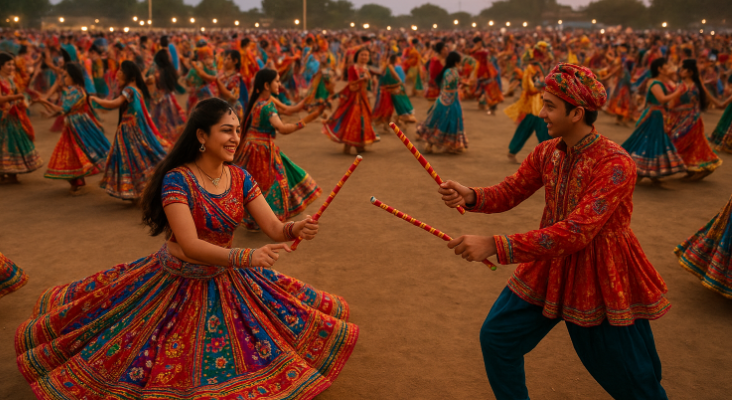
      • Every night, thousands gather in open grounds to perform Garba (circular dance around an earthen lamp symbolizing Goddess Durga) and Dandiya (dance with decorated sticks).
      • Dressed in vibrant chaniya cholis (for women) and kediyu with dhotis (for men), the dance is both devotional and celebratory.
      • The rhythm of dhol, folk songs, and modern fusions keep people dancing late into the night.
    2. Aarti & Devotion
      • Before Garba, people perform Aarti of Goddess Amba (Durga) with devotional songs.
      • Temples like Ambaji, Pavagadh, and Bahucharaji see massive pilgrimages during Navratri.
    3. Community Bonding
      • Navratri in Gujarat is not just for locals — it attracts visitors from all over India and abroad.
      • Cities like Ahmedabad, Vadodara, Surat, and Rajkot host some of the largest Garba events in the world.
    4. Economic & Cultural Impact
      • Local artisans, weavers, musicians, and event organizers thrive during this period.
      • Tourism, hospitality, and retail industries boom as people travel to Gujarat to experience Navratri.

    Navratri – A Powerful Message

    Navratri is more than just a festival of lights, colors, music, and fasting. It is a celebration of the divine feminine energy (Shakti) — the power that creates, nurtures, and transforms the universe. Across nine nights, Hindus worship nine different forms of Goddess Durga, each symbolizing a unique strength and virtue.

    But beyond the rituals and traditions, Navratri carries a powerful message for today’s India: true progress lies in empowering women to lead — in homes, communities, boardrooms, and governance.


    The 9 Goddesses & Their Powers

    Each goddess represents qualities that modern India urgently needs — courage, discipline, justice, creativity, nurturing leadership, fearlessness, and wisdom.

    1. Shailaputri (Strength & Stability) – Symbol of courage and grounding.
    2. Brahmacharini (Devotion & Discipline) – Power of self-control and focus.
    3. Chandraghanta (Bravery & Grace) – Teaching balance of strength with compassion.
    4. Kushmanda (Creativity & Radiance) – Energy to create new beginnings.
    5. Skandamata (Nurturing Leadership) – Embodiment of responsibility and care.
    6. Katyayani (Justice & Determination) – Fierce protector against injustice.
    7. Kaalratri (Fearlessness & Transformation) – Destroyer of ignorance and fear.
    8. Mahagauri (Purity & Resilience) – Grace under adversity.
    9. Siddhidatri (Wisdom & Fulfillment) – Bestower of knowledge and solutions.

    Women as the Living Embodiment of the 9 Goddesses

    Transforming Society & Economics

    India celebrates Navratri by worshipping nine forms of Goddess Durga — each representing a unique power. What we often forget is that these same qualities already exist naturally in women, expressed every day in families, workplaces, and communities. Recognizing and nurturing them can create a massive social and economic transformation.


    1. Shailaputri – Strength & Stability

    • Natural quality in women: Inner resilience to handle crises at home and in society.
    • Impact: Women leaders can bring stability to economies during turbulence, just as they hold families together in difficult times.

    2. Brahmacharini – Devotion & Discipline

    • Natural quality in women: Persistence in education, caregiving, and career growth despite barriers.
    • Impact: A disciplined female workforce improves productivity, governance, and long-term economic growth.

    3. Chandraghanta – Bravery & Grace

    • Natural quality in women: Ability to fight injustice yet maintain compassion.
    • Impact: Women in leadership roles balance assertive decisions with inclusivity, reducing workplace conflicts and creating healthier communities.

    4. Kushmanda – Creativity & Radiance

    • Natural quality in women: Creativity in problem-solving, innovation in business, and cultural contributions.
    • Impact: Women entrepreneurs and professionals drive innovation, contributing to new industries, startups, and economic dynamism.

    5. Skandamata – Nurturing Leadership

    • Natural quality in women: Caring for family, mentoring peers, and community building.
    • Impact: Women leaders focus on education, health, and social welfare — strengthening the human capital that powers long-term growth.

    6. Katyayani – Justice & Determination

    • Natural quality in women: Courage to stand against inequality, harassment, and injustice.
    • Impact: Greater participation of women in law, judiciary, and governance strengthens the justice system and social fairness.

    7. Kaalratri – Fearlessness & Transformation

    • Natural quality in women: Willingness to break stereotypes, challenge taboos, and embrace change.
    • Impact: Women innovators and reformers dismantle regressive norms, driving social reforms that boost equality and economic inclusion.

    8. Mahagauri – Purity & Resilience

    • Natural quality in women: Calm perseverance despite hardships, often without recognition.
    • Impact: In times of crisis (pandemics, climate challenges), women’s resilience ensures continuity in homes, businesses, and essential services.

    9. Siddhidatri – Wisdom & Fulfillment

    • Natural quality in women: Sharing knowledge, guiding children, teams, and communities.
    • Impact: Women educators, leaders, and mentors create empowered future generations, fueling sustainable progress.

    Transforming Society & Economics

    • Socially → Empowered women bring fairness, compassion, and progress into governance, families, and communities.
    • Economically → If India matches men’s workforce participation with women, the economy could grow by $700+ billion by 2025 (McKinsey estimate).

    The Reality: Women in India Today

    • Women constitute 48% of India’s population but are underrepresented in leadership roles.
    • Female labor force participation is just around 25–27% (one of the lowest globally).
    • In politics, only 15% of MPs are women, despite women forming nearly half the electorate.
    • Corporate leadership has seen progress, but women CEOs in India’s top companies remain rare.

    India ranks high on worship of the feminine divine but low on empowerment of women in society — a paradox that Navratri reminds us to confront.


    Why Women Empowerment & Leadership is the Need of the Hour

    1. Economic Growth – Studies show India’s GDP could rise by $770 billion by 2025 if women’s participation in the workforce matched men’s.
    2. Better Governance – Villages with women-led panchayats have shown improvements in education, sanitation, and healthcare.
    3. Corporate Performance – Companies with more women leaders report higher profitability and innovation.
    4. Balanced Society – Empowered women create healthier families, better-educated children, and stronger communities.

    The Reality Today

    Every Navratri, people decorate pandals, light diyas, and bow to nine forms of Goddess Durga. Yet, behind closed doors and office walls, many women continue to face abuse, harassment, and discrimination.

    This is the paradox of our society:

      • People worship women as goddesses during festivals, but many fail to respect women as humans in daily life.
      • At Home: Domestic violence, emotional abuse, financial dependence, and lack of decision-making rights.
      • At Workplace: Harassment, unequal pay, glass ceilings, and lack of safe working environments.
      • In Society: Victim-blaming, restrictive gender roles, and silencing of women’s voices.

      Unless this cycle is broken, celebrating Navratri remains incomplete.


      Navratri is not just about devotion — it is about embodying the goddess qualities in real life. As a society, India must:

      • Educate & Skill Women – Bridge the education-to-employment gap.
      • Ensure Equal Opportunities – In hiring, promotions, and pay.
      • Promote Women in Leadership – From village councils to Parliament, from startups to boardrooms.
      • Shift Mindsets – Celebrate women not just as nurturers, but also as decision-makers and change-makers.

      Conclusion

      As we light lamps and chant prayers this Navratri, let us remember: the power of the nine goddesses is not confined to mythology. It lives in every woman around us.

      India’s rise in the 21st century depends not just on technology, infrastructure, or economic reforms, but on awakening the Shakti within society — empowering women to lead with courage, wisdom, and compassion.

      Women already embody the nine goddess-like qualities. Society only needs to recognize, respect, and enable them. When we do, India’s society becomes more just, and its economy more unstoppable.

      Navratri reminds us: when women rise, the nation rises.

      Read more blogs on women empowerment here.

      Read – 6 Cities where Garba & Dandia is played at peak.

    • Navratri, the Power of 9 Goddesses & the Call for Women Empowerment in India

      Navratri, the Power of 9 Goddesses & the Call for Women Empowerment in India


      Navratri — “nine nights” — is one of India’s most significant festivals, celebrated in diverse ways across the country. At its heart, it is a worship of Shakti (Divine Feminine energy), but cultural expressions vary region to region:

      • In Bengal, Navratri is about artistic devotion and grandeur.
      • In North India, it is about Ramlila and the victory of good.
      • In South India, it is about tradition, learning, and culture.
      • In Gujarat, it is about dance, community, and the joy of Shakti.

      Despite the diversity, one theme is common across India: Navratri is the celebration of feminine energy and the triumph of good over evil.


      🌟 Navratri in Gujarat – The Dance Festival of India

      Gujarat is where Navratri takes its most colorful and energetic form. It is not just a religious festival here — it is a cultural extravaganza.

      Key Highlights:

      1. Garba & Dandiya Raas
        • Every night, thousands gather in open grounds to perform Garba (circular dance around an earthen lamp symbolizing Goddess Durga) and Dandiya (dance with decorated sticks).
        • Dressed in vibrant chaniya cholis (for women) and kediyu with dhotis (for men), the dance is both devotional and celebratory.
        • The rhythm of dhol, folk songs, and modern fusions keep people dancing late into the night.
      2. Aarti & Devotion
        • Before Garba, people perform Aarti of Goddess Amba (Durga) with devotional songs.
        • Temples like Ambaji, Pavagadh, and Bahucharaji see massive pilgrimages during Navratri.
      3. Community Bonding
        • Navratri in Gujarat is not just for locals — it attracts visitors from all over India and abroad.
        • Cities like Ahmedabad, Vadodara, Surat, and Rajkot host some of the largest Garba events in the world.
      4. Economic & Cultural Impact
        • Local artisans, weavers, musicians, and event organizers thrive during this period.
        • Tourism, hospitality, and retail industries boom as people travel to Gujarat to experience Navratri.

      Navratri – A Powerful Message

      Navratri is more than just a festival of lights, colors, music, and fasting. It is a celebration of the divine feminine energy (Shakti) — the power that creates, nurtures, and transforms the universe. Across nine nights, Hindus worship nine different forms of Goddess Durga, each symbolizing a unique strength and virtue.

      But beyond the rituals and traditions, Navratri carries a powerful message for today’s India: true progress lies in empowering women to lead — in homes, communities, boardrooms, and governance.


      The 9 Goddesses & Their Powers

      Each goddess represents qualities that modern India urgently needs — courage, discipline, justice, creativity, nurturing leadership, fearlessness, and wisdom.

      1. Shailaputri (Strength & Stability) – Symbol of courage and grounding.
      2. Brahmacharini (Devotion & Discipline) – Power of self-control and focus.
      3. Chandraghanta (Bravery & Grace) – Teaching balance of strength with compassion.
      4. Kushmanda (Creativity & Radiance) – Energy to create new beginnings.
      5. Skandamata (Nurturing Leadership) – Embodiment of responsibility and care.
      6. Katyayani (Justice & Determination) – Fierce protector against injustice.
      7. Kaalratri (Fearlessness & Transformation) – Destroyer of ignorance and fear.
      8. Mahagauri (Purity & Resilience) – Grace under adversity.
      9. Siddhidatri (Wisdom & Fulfillment) – Bestower of knowledge and solutions.

      Women as the Living Embodiment of the 9 Goddesses

      Transforming Society & Economics

      India celebrates Navratri by worshipping nine forms of Goddess Durga — each representing a unique power. What we often forget is that these same qualities already exist naturally in women, expressed every day in families, workplaces, and communities. Recognizing and nurturing them can create a massive social and economic transformation.


      1. Shailaputri – Strength & Stability

      • Natural quality in women: Inner resilience to handle crises at home and in society.
      • Impact: Women leaders can bring stability to economies during turbulence, just as they hold families together in difficult times.

      2. Brahmacharini – Devotion & Discipline

      • Natural quality in women: Persistence in education, caregiving, and career growth despite barriers.
      • Impact: A disciplined female workforce improves productivity, governance, and long-term economic growth.

      3. Chandraghanta – Bravery & Grace

      • Natural quality in women: Ability to fight injustice yet maintain compassion.
      • Impact: Women in leadership roles balance assertive decisions with inclusivity, reducing workplace conflicts and creating healthier communities.

      4. Kushmanda – Creativity & Radiance

      • Natural quality in women: Creativity in problem-solving, innovation in business, and cultural contributions.
      • Impact: Women entrepreneurs and professionals drive innovation, contributing to new industries, startups, and economic dynamism.

      5. Skandamata – Nurturing Leadership

      • Natural quality in women: Caring for family, mentoring peers, and community building.
      • Impact: Women leaders focus on education, health, and social welfare — strengthening the human capital that powers long-term growth.

      6. Katyayani – Justice & Determination

      • Natural quality in women: Courage to stand against inequality, harassment, and injustice.
      • Impact: Greater participation of women in law, judiciary, and governance strengthens the justice system and social fairness.

      7. Kaalratri – Fearlessness & Transformation

      • Natural quality in women: Willingness to break stereotypes, challenge taboos, and embrace change.
      • Impact: Women innovators and reformers dismantle regressive norms, driving social reforms that boost equality and economic inclusion.

      8. Mahagauri – Purity & Resilience

      • Natural quality in women: Calm perseverance despite hardships, often without recognition.
      • Impact: In times of crisis (pandemics, climate challenges), women’s resilience ensures continuity in homes, businesses, and essential services.

      9. Siddhidatri – Wisdom & Fulfillment

      • Natural quality in women: Sharing knowledge, guiding children, teams, and communities.
      • Impact: Women educators, leaders, and mentors create empowered future generations, fueling sustainable progress.

      Transforming Society & Economics

      • Socially → Empowered women bring fairness, compassion, and progress into governance, families, and communities.
      • Economically → If India matches men’s workforce participation with women, the economy could grow by $700+ billion by 2025 (McKinsey estimate).

      The Reality: Women in India Today

      • Women constitute 48% of India’s population but are underrepresented in leadership roles.
      • Female labor force participation is just around 25–27% (one of the lowest globally).
      • In politics, only 15% of MPs are women, despite women forming nearly half the electorate.
      • Corporate leadership has seen progress, but women CEOs in India’s top companies remain rare.

      India ranks high on worship of the feminine divine but low on empowerment of women in society — a paradox that Navratri reminds us to confront.


      Why Women Empowerment & Leadership is the Need of the Hour

      1. Economic Growth – Studies show India’s GDP could rise by $770 billion by 2025 if women’s participation in the workforce matched men’s.
      2. Better Governance – Villages with women-led panchayats have shown improvements in education, sanitation, and healthcare.
      3. Corporate Performance – Companies with more women leaders report higher profitability and innovation.
      4. Balanced Society – Empowered women create healthier families, better-educated children, and stronger communities.

      The Reality Today

      Every Navratri, people decorate pandals, light diyas, and bow to nine forms of Goddess Durga. Yet, behind closed doors and office walls, many women continue to face abuse, harassment, and discrimination.

      This is the paradox of our society:

        • People worship women as goddesses during festivals, but many fail to respect women as humans in daily life.
        • At Home: Domestic violence, emotional abuse, financial dependence, and lack of decision-making rights.
        • At Workplace: Harassment, unequal pay, glass ceilings, and lack of safe working environments.
        • In Society: Victim-blaming, restrictive gender roles, and silencing of women’s voices.

        Unless this cycle is broken, celebrating Navratri remains incomplete.


        Navratri is not just about devotion — it is about embodying the goddess qualities in real life. As a society, India must:

        • Educate & Skill Women – Bridge the education-to-employment gap.
        • Ensure Equal Opportunities – In hiring, promotions, and pay.
        • Promote Women in Leadership – From village councils to Parliament, from startups to boardrooms.
        • Shift Mindsets – Celebrate women not just as nurturers, but also as decision-makers and change-makers.

        Conclusion

        As we light lamps and chant prayers this Navratri, let us remember: the power of the nine goddesses is not confined to mythology. It lives in every woman around us.

        India’s rise in the 21st century depends not just on technology, infrastructure, or economic reforms, but on awakening the Shakti within society — empowering women to lead with courage, wisdom, and compassion.

        Women already embody the nine goddess-like qualities. Society only needs to recognize, respect, and enable them. When we do, India’s society becomes more just, and its economy more unstoppable.

        Navratri reminds us: when women rise, the nation rises.

        Read more blogs on women empowerment here.

        Read – 6 Cities where Garba & Dandia is played at peak.

      • Navratri, the Power of 9 Goddesses & the Call for Women Empowerment in India

        Navratri, the Power of 9 Goddesses & the Call for Women Empowerment in India


        Navratri — “nine nights” — is one of India’s most significant festivals, celebrated in diverse ways across the country. At its heart, it is a worship of Shakti (Divine Feminine energy), but cultural expressions vary region to region:

        • In Bengal, Navratri is about artistic devotion and grandeur.
        • In North India, it is about Ramlila and the victory of good.
        • In South India, it is about tradition, learning, and culture.
        • In Gujarat, it is about dance, community, and the joy of Shakti.

        Despite the diversity, one theme is common across India: Navratri is the celebration of feminine energy and the triumph of good over evil.


        🌟 Navratri in Gujarat – The Dance Festival of India

        Gujarat is where Navratri takes its most colorful and energetic form. It is not just a religious festival here — it is a cultural extravaganza.

        Key Highlights:

        1. Garba & Dandiya Raas
          • Every night, thousands gather in open grounds to perform Garba (circular dance around an earthen lamp symbolizing Goddess Durga) and Dandiya (dance with decorated sticks).
          • Dressed in vibrant chaniya cholis (for women) and kediyu with dhotis (for men), the dance is both devotional and celebratory.
          • The rhythm of dhol, folk songs, and modern fusions keep people dancing late into the night.
        2. Aarti & Devotion
          • Before Garba, people perform Aarti of Goddess Amba (Durga) with devotional songs.
          • Temples like Ambaji, Pavagadh, and Bahucharaji see massive pilgrimages during Navratri.
        3. Community Bonding
          • Navratri in Gujarat is not just for locals — it attracts visitors from all over India and abroad.
          • Cities like Ahmedabad, Vadodara, Surat, and Rajkot host some of the largest Garba events in the world.
        4. Economic & Cultural Impact
          • Local artisans, weavers, musicians, and event organizers thrive during this period.
          • Tourism, hospitality, and retail industries boom as people travel to Gujarat to experience Navratri.

        Navratri – A Powerful Message

        Navratri is more than just a festival of lights, colors, music, and fasting. It is a celebration of the divine feminine energy (Shakti) — the power that creates, nurtures, and transforms the universe. Across nine nights, Hindus worship nine different forms of Goddess Durga, each symbolizing a unique strength and virtue.

        But beyond the rituals and traditions, Navratri carries a powerful message for today’s India: true progress lies in empowering women to lead — in homes, communities, boardrooms, and governance.


        The 9 Goddesses & Their Powers

        Each goddess represents qualities that modern India urgently needs — courage, discipline, justice, creativity, nurturing leadership, fearlessness, and wisdom.

        1. Shailaputri (Strength & Stability) – Symbol of courage and grounding.
        2. Brahmacharini (Devotion & Discipline) – Power of self-control and focus.
        3. Chandraghanta (Bravery & Grace) – Teaching balance of strength with compassion.
        4. Kushmanda (Creativity & Radiance) – Energy to create new beginnings.
        5. Skandamata (Nurturing Leadership) – Embodiment of responsibility and care.
        6. Katyayani (Justice & Determination) – Fierce protector against injustice.
        7. Kaalratri (Fearlessness & Transformation) – Destroyer of ignorance and fear.
        8. Mahagauri (Purity & Resilience) – Grace under adversity.
        9. Siddhidatri (Wisdom & Fulfillment) – Bestower of knowledge and solutions.

        Women as the Living Embodiment of the 9 Goddesses

        Transforming Society & Economics

        India celebrates Navratri by worshipping nine forms of Goddess Durga — each representing a unique power. What we often forget is that these same qualities already exist naturally in women, expressed every day in families, workplaces, and communities. Recognizing and nurturing them can create a massive social and economic transformation.


        1. Shailaputri – Strength & Stability

        • Natural quality in women: Inner resilience to handle crises at home and in society.
        • Impact: Women leaders can bring stability to economies during turbulence, just as they hold families together in difficult times.

        2. Brahmacharini – Devotion & Discipline

        • Natural quality in women: Persistence in education, caregiving, and career growth despite barriers.
        • Impact: A disciplined female workforce improves productivity, governance, and long-term economic growth.

        3. Chandraghanta – Bravery & Grace

        • Natural quality in women: Ability to fight injustice yet maintain compassion.
        • Impact: Women in leadership roles balance assertive decisions with inclusivity, reducing workplace conflicts and creating healthier communities.

        4. Kushmanda – Creativity & Radiance

        • Natural quality in women: Creativity in problem-solving, innovation in business, and cultural contributions.
        • Impact: Women entrepreneurs and professionals drive innovation, contributing to new industries, startups, and economic dynamism.

        5. Skandamata – Nurturing Leadership

        • Natural quality in women: Caring for family, mentoring peers, and community building.
        • Impact: Women leaders focus on education, health, and social welfare — strengthening the human capital that powers long-term growth.

        6. Katyayani – Justice & Determination

        • Natural quality in women: Courage to stand against inequality, harassment, and injustice.
        • Impact: Greater participation of women in law, judiciary, and governance strengthens the justice system and social fairness.

        7. Kaalratri – Fearlessness & Transformation

        • Natural quality in women: Willingness to break stereotypes, challenge taboos, and embrace change.
        • Impact: Women innovators and reformers dismantle regressive norms, driving social reforms that boost equality and economic inclusion.

        8. Mahagauri – Purity & Resilience

        • Natural quality in women: Calm perseverance despite hardships, often without recognition.
        • Impact: In times of crisis (pandemics, climate challenges), women’s resilience ensures continuity in homes, businesses, and essential services.

        9. Siddhidatri – Wisdom & Fulfillment

        • Natural quality in women: Sharing knowledge, guiding children, teams, and communities.
        • Impact: Women educators, leaders, and mentors create empowered future generations, fueling sustainable progress.

        Transforming Society & Economics

        • Socially → Empowered women bring fairness, compassion, and progress into governance, families, and communities.
        • Economically → If India matches men’s workforce participation with women, the economy could grow by $700+ billion by 2025 (McKinsey estimate).

        The Reality: Women in India Today

        • Women constitute 48% of India’s population but are underrepresented in leadership roles.
        • Female labor force participation is just around 25–27% (one of the lowest globally).
        • In politics, only 15% of MPs are women, despite women forming nearly half the electorate.
        • Corporate leadership has seen progress, but women CEOs in India’s top companies remain rare.

        India ranks high on worship of the feminine divine but low on empowerment of women in society — a paradox that Navratri reminds us to confront.


        Why Women Empowerment & Leadership is the Need of the Hour

        1. Economic Growth – Studies show India’s GDP could rise by $770 billion by 2025 if women’s participation in the workforce matched men’s.
        2. Better Governance – Villages with women-led panchayats have shown improvements in education, sanitation, and healthcare.
        3. Corporate Performance – Companies with more women leaders report higher profitability and innovation.
        4. Balanced Society – Empowered women create healthier families, better-educated children, and stronger communities.

        The Reality Today

        Every Navratri, people decorate pandals, light diyas, and bow to nine forms of Goddess Durga. Yet, behind closed doors and office walls, many women continue to face abuse, harassment, and discrimination.

        This is the paradox of our society:

          • People worship women as goddesses during festivals, but many fail to respect women as humans in daily life.
          • At Home: Domestic violence, emotional abuse, financial dependence, and lack of decision-making rights.
          • At Workplace: Harassment, unequal pay, glass ceilings, and lack of safe working environments.
          • In Society: Victim-blaming, restrictive gender roles, and silencing of women’s voices.

          Unless this cycle is broken, celebrating Navratri remains incomplete.


          Navratri is not just about devotion — it is about embodying the goddess qualities in real life. As a society, India must:

          • Educate & Skill Women – Bridge the education-to-employment gap.
          • Ensure Equal Opportunities – In hiring, promotions, and pay.
          • Promote Women in Leadership – From village councils to Parliament, from startups to boardrooms.
          • Shift Mindsets – Celebrate women not just as nurturers, but also as decision-makers and change-makers.

          Conclusion

          As we light lamps and chant prayers this Navratri, let us remember: the power of the nine goddesses is not confined to mythology. It lives in every woman around us.

          India’s rise in the 21st century depends not just on technology, infrastructure, or economic reforms, but on awakening the Shakti within society — empowering women to lead with courage, wisdom, and compassion.

          Women already embody the nine goddess-like qualities. Society only needs to recognize, respect, and enable them. When we do, India’s society becomes more just, and its economy more unstoppable.

          Navratri reminds us: when women rise, the nation rises.

          Read more blogs on women empowerment here.

          Read – 6 Cities where Garba & Dandia is played at peak.

        • Navratri, the Power of 9 Goddesses & the Call for Women Empowerment in India

          Navratri, the Power of 9 Goddesses & the Call for Women Empowerment in India


          Navratri — “nine nights” — is one of India’s most significant festivals, celebrated in diverse ways across the country. At its heart, it is a worship of Shakti (Divine Feminine energy), but cultural expressions vary region to region:

          • In Bengal, Navratri is about artistic devotion and grandeur.
          • In North India, it is about Ramlila and the victory of good.
          • In South India, it is about tradition, learning, and culture.
          • In Gujarat, it is about dance, community, and the joy of Shakti.

          Despite the diversity, one theme is common across India: Navratri is the celebration of feminine energy and the triumph of good over evil.


          🌟 Navratri in Gujarat – The Dance Festival of India

          Gujarat is where Navratri takes its most colorful and energetic form. It is not just a religious festival here — it is a cultural extravaganza.

          Key Highlights:

          1. Garba & Dandiya Raas
            • Every night, thousands gather in open grounds to perform Garba (circular dance around an earthen lamp symbolizing Goddess Durga) and Dandiya (dance with decorated sticks).
            • Dressed in vibrant chaniya cholis (for women) and kediyu with dhotis (for men), the dance is both devotional and celebratory.
            • The rhythm of dhol, folk songs, and modern fusions keep people dancing late into the night.
          2. Aarti & Devotion
            • Before Garba, people perform Aarti of Goddess Amba (Durga) with devotional songs.
            • Temples like Ambaji, Pavagadh, and Bahucharaji see massive pilgrimages during Navratri.
          3. Community Bonding
            • Navratri in Gujarat is not just for locals — it attracts visitors from all over India and abroad.
            • Cities like Ahmedabad, Vadodara, Surat, and Rajkot host some of the largest Garba events in the world.
          4. Economic & Cultural Impact
            • Local artisans, weavers, musicians, and event organizers thrive during this period.
            • Tourism, hospitality, and retail industries boom as people travel to Gujarat to experience Navratri.

          Navratri – A Powerful Message

          Navratri is more than just a festival of lights, colors, music, and fasting. It is a celebration of the divine feminine energy (Shakti) — the power that creates, nurtures, and transforms the universe. Across nine nights, Hindus worship nine different forms of Goddess Durga, each symbolizing a unique strength and virtue.

          But beyond the rituals and traditions, Navratri carries a powerful message for today’s India: true progress lies in empowering women to lead — in homes, communities, boardrooms, and governance.


          The 9 Goddesses & Their Powers

          Each goddess represents qualities that modern India urgently needs — courage, discipline, justice, creativity, nurturing leadership, fearlessness, and wisdom.

          1. Shailaputri (Strength & Stability) – Symbol of courage and grounding.
          2. Brahmacharini (Devotion & Discipline) – Power of self-control and focus.
          3. Chandraghanta (Bravery & Grace) – Teaching balance of strength with compassion.
          4. Kushmanda (Creativity & Radiance) – Energy to create new beginnings.
          5. Skandamata (Nurturing Leadership) – Embodiment of responsibility and care.
          6. Katyayani (Justice & Determination) – Fierce protector against injustice.
          7. Kaalratri (Fearlessness & Transformation) – Destroyer of ignorance and fear.
          8. Mahagauri (Purity & Resilience) – Grace under adversity.
          9. Siddhidatri (Wisdom & Fulfillment) – Bestower of knowledge and solutions.

          Women as the Living Embodiment of the 9 Goddesses

          Transforming Society & Economics

          India celebrates Navratri by worshipping nine forms of Goddess Durga — each representing a unique power. What we often forget is that these same qualities already exist naturally in women, expressed every day in families, workplaces, and communities. Recognizing and nurturing them can create a massive social and economic transformation.


          1. Shailaputri – Strength & Stability

          • Natural quality in women: Inner resilience to handle crises at home and in society.
          • Impact: Women leaders can bring stability to economies during turbulence, just as they hold families together in difficult times.

          2. Brahmacharini – Devotion & Discipline

          • Natural quality in women: Persistence in education, caregiving, and career growth despite barriers.
          • Impact: A disciplined female workforce improves productivity, governance, and long-term economic growth.

          3. Chandraghanta – Bravery & Grace

          • Natural quality in women: Ability to fight injustice yet maintain compassion.
          • Impact: Women in leadership roles balance assertive decisions with inclusivity, reducing workplace conflicts and creating healthier communities.

          4. Kushmanda – Creativity & Radiance

          • Natural quality in women: Creativity in problem-solving, innovation in business, and cultural contributions.
          • Impact: Women entrepreneurs and professionals drive innovation, contributing to new industries, startups, and economic dynamism.

          5. Skandamata – Nurturing Leadership

          • Natural quality in women: Caring for family, mentoring peers, and community building.
          • Impact: Women leaders focus on education, health, and social welfare — strengthening the human capital that powers long-term growth.

          6. Katyayani – Justice & Determination

          • Natural quality in women: Courage to stand against inequality, harassment, and injustice.
          • Impact: Greater participation of women in law, judiciary, and governance strengthens the justice system and social fairness.

          7. Kaalratri – Fearlessness & Transformation

          • Natural quality in women: Willingness to break stereotypes, challenge taboos, and embrace change.
          • Impact: Women innovators and reformers dismantle regressive norms, driving social reforms that boost equality and economic inclusion.

          8. Mahagauri – Purity & Resilience

          • Natural quality in women: Calm perseverance despite hardships, often without recognition.
          • Impact: In times of crisis (pandemics, climate challenges), women’s resilience ensures continuity in homes, businesses, and essential services.

          9. Siddhidatri – Wisdom & Fulfillment

          • Natural quality in women: Sharing knowledge, guiding children, teams, and communities.
          • Impact: Women educators, leaders, and mentors create empowered future generations, fueling sustainable progress.

          Transforming Society & Economics

          • Socially → Empowered women bring fairness, compassion, and progress into governance, families, and communities.
          • Economically → If India matches men’s workforce participation with women, the economy could grow by $700+ billion by 2025 (McKinsey estimate).

          The Reality: Women in India Today

          • Women constitute 48% of India’s population but are underrepresented in leadership roles.
          • Female labor force participation is just around 25–27% (one of the lowest globally).
          • In politics, only 15% of MPs are women, despite women forming nearly half the electorate.
          • Corporate leadership has seen progress, but women CEOs in India’s top companies remain rare.

          India ranks high on worship of the feminine divine but low on empowerment of women in society — a paradox that Navratri reminds us to confront.


          Why Women Empowerment & Leadership is the Need of the Hour

          1. Economic Growth – Studies show India’s GDP could rise by $770 billion by 2025 if women’s participation in the workforce matched men’s.
          2. Better Governance – Villages with women-led panchayats have shown improvements in education, sanitation, and healthcare.
          3. Corporate Performance – Companies with more women leaders report higher profitability and innovation.
          4. Balanced Society – Empowered women create healthier families, better-educated children, and stronger communities.

          The Reality Today

          Every Navratri, people decorate pandals, light diyas, and bow to nine forms of Goddess Durga. Yet, behind closed doors and office walls, many women continue to face abuse, harassment, and discrimination.

          This is the paradox of our society:

            • People worship women as goddesses during festivals, but many fail to respect women as humans in daily life.
            • At Home: Domestic violence, emotional abuse, financial dependence, and lack of decision-making rights.
            • At Workplace: Harassment, unequal pay, glass ceilings, and lack of safe working environments.
            • In Society: Victim-blaming, restrictive gender roles, and silencing of women’s voices.

            Unless this cycle is broken, celebrating Navratri remains incomplete.


            Navratri is not just about devotion — it is about embodying the goddess qualities in real life. As a society, India must:

            • Educate & Skill Women – Bridge the education-to-employment gap.
            • Ensure Equal Opportunities – In hiring, promotions, and pay.
            • Promote Women in Leadership – From village councils to Parliament, from startups to boardrooms.
            • Shift Mindsets – Celebrate women not just as nurturers, but also as decision-makers and change-makers.

            Conclusion

            As we light lamps and chant prayers this Navratri, let us remember: the power of the nine goddesses is not confined to mythology. It lives in every woman around us.

            India’s rise in the 21st century depends not just on technology, infrastructure, or economic reforms, but on awakening the Shakti within society — empowering women to lead with courage, wisdom, and compassion.

            Women already embody the nine goddess-like qualities. Society only needs to recognize, respect, and enable them. When we do, India’s society becomes more just, and its economy more unstoppable.

            Navratri reminds us: when women rise, the nation rises.

            Read more blogs on women empowerment here.

            Read – 6 Cities where Garba & Dandia is played at peak.

          • Rakhi 2025: A Sister’s Eternal Love, A Mother’s Bold Stand for Daughters Dreams & a Plea for Safer Roads

            Rakhi 2025: A Sister’s Eternal Love, A Mother’s Bold Stand for Daughters Dreams & a Plea for Safer Roads

            One rakhi left untied, a love that still ties us together.


            Rakhi 2025 – A Sister’s Love, A Bond Beyond Time

            Rakhi 2025 is more than just a thread tied around a wrist — it’s a timeless symbol of the unbreakable bond between a brother and sister. This sacred festival celebrates love, protection, and the promise to stand by each other through life’s joys and challenges. Each Rakhi carries emotions woven with memories, making it a tradition that transcends generations.

            For Vimal Meghrajani, also called Vimmy, or Cheeni, Rakhi was always a day of joy and togetherness. Every year, she and her elder sister Radhika lovingly tied rakhis to their brothers, sharing laughter, sweets, and stories of childhood. It was a ritual that not only celebrated sibling love but also strengthened their family bonds — a tradition she cherished deeply, never missing a single Rakhi… until fate intervened just days before Rakhi 2025.


            A Sister Called Cheeni

            Vimal Meghrajani was fondly called Cheeni for her sweet-as-sugar nature — had a smile that could light up a room and a heart that embraced everyone she met. She connected effortlessly with people of all ages — elders found comfort in her presence, children adored her, and friends treasured her as a lifelong companion.

            Cheeni had a magical way of making every guest feel at home — greeting them with a warm embrace, her radiant smile, and plates full of delicious, lovingly prepared food. From fragrant curries to her signature sweets, every dish carried the taste of her affection, leaving hearts as full as the stomachs she fed.There was magic in Cheeni’s hands — every recipe she touched turned into a masterpiece of flavour. Her kitchen was a place where aromas danced, spices sang, and every bite told a story of love, care, and tradition.

            She was the kind of person whose presence felt like a comforting embrace — always ready with emotional support, a listening ear, and words that could soothe even the deepest wounds. Her jovial spirit and ever-present smile lit up every room she entered. She loved to sing, often filling the air with melodies that carried away the heaviness of life. No matter what sorrows she faced, she had an extraordinary gift of moving forward with grace, never letting pain dim her cheerfulness. In her gentle way, she not only healed her own heart but became a source of healing and hope for everyone around her.


            Roots in Vidarbha, Dreams in Nagpur

            Born in the Nagpur city, major commercial and political centre of the Vidarbha region of Maharashtra, Vimal was a gentle, graceful young woman with apple-pink cheeks and a smile so radiant it could light up any room. She got married to a hardworking clothes merchant from the small town of Lakhani, Life in a small town had its charms, but Vimal’s dreams for her children were bigger.

            Her two daughters, Neha and Juhi, were the pride of her life. The small town could not offer them the quality of higher education she envisioned, so with courage and determination, Vimal made a bold move — shifting to Nagpur with her girls while her husband stayed back in Lakhani to continue his business and care for his aging mother.

            Vimal quietly became a pillar of women’s empowerment in her small town of Lakhani. She encouraged families to send their daughters for higher education and become independent, often guiding parents to see the value in a girl’s dreams. Whether it was helping with college admissions, sharing resources, or simply giving words of courage, she lit a path for many young women to study beyond school and stand on their own feet. Her belief was simple yet powerful — “Educate a daughter, and you empower an entire family.” She loved her daughters and fulfilled their dreams same way as she would have done if she had a son.


            A Mother, Masi, Bua — Friend of All

            Cheeni, wasn’t just a mother. She was a masi, a bua, a friend, and a confidante to many. She supported her daughters’ professional education and careers every step of the way. Juhi went on to become an engineer, then earned her MBA from IMT Nagpur, and rose to Deputy General Manager at Airtel. She supported Neha in building her career as interior designer. Neha & Juhi got inspiration from her mother’s strength.

            Cheeni was the emotional anchor for everyone in the family — as a loving bua, a caring masi, a dependable sister, a warm chachi, and a supportive bhabhi & wife. She had a unique way of making each relationship feel special, listening without judgment, offering wise yet gentle advice, and wrapping every heartache in her comforting embrace. For every relative, she was not just family, but a safe haven of love, laughter, and understanding.

            With her infectious smile and lighthearted spirit, Cheeni had a way of dissolving sorrows and turning even the heaviest moments into smiles, bringing warmth and joy into everyone’s life.


            Rakhi 2025 – One Rakhi Untied

            It was Monday, 4th August 2025 — just five days before Raksha Bandhan. Vimal (Cheeni) had already begun preparations, planning to buy sweets, rakhis, coconuts, and an aarti thali, ready to tie the sacred thread of love to her brothers. But fate struck cruelly.

            While returning home on a two-wheeler with her husband, a truck — rashly overtaking another in violation of traffic rules — crashed into the 2 wheeler from the side. The impact caused a fatal brain injury, ending her life in an instant. Her husband lay unconscious, while the driver sped away without even stopping to help.

            This was not just an accident — it was a heinous act of negligence that turned a festive countdown into an unbearable loss on Nagpur’s deadly Ring Road.

            Reference – Times of India, Precautionary: viral-accident video.

            Rakhi 2025 - 1 Rakhi Untied - Ring Road Accident

            Ring Road – A Rising Danger Zone

            Nagpur’s Ring Road, meant to ease traffic, has instead become notorious for fatal accidents — especially near Jeripatka, Kalamna, Mankapur, and Gorewada.
            The facts tell a grim story:

            • Hundreds of crashes every year, many involving heavy trucks.
            • Overspeeding and dangerous overtaking are leading causes.
            • Poor lighting, lack of pedestrian safety measures, and weak enforcement worsen the danger.

            💡 Suggested Improvements

            Here are some practical suggestions to improve safety on Ring Road Nagpur, especially in terms of heavy vehicle vs. smaller vehicle mix:

            1. Dedicated Heavy Vehicle Lanes
              • On stretches of Ring Road with high heavy vehicle traffic, build or mark dedicated lanes for trucks and buses, separated from lighter traffic.
            2. Strengthen Enforcement of Timing Bans
              • Use cameras, checkpoints, and penalties to ensure that heavy vehicles adhere to time restrictions.
              • Increase monitoring, especially during times heavy vehicles are prohibited.
            3. Complete Road Width Consistency
              • Fix bottlenecks like the Mankapur narrowing. Ensure the full stretch maintains uniform lane width and safety dividers.
            4. Pedestrian & Cyclist Infrastructure
              • Build continuous sidewalks/footpaths along Ring Road.
              • Provide safe crossings, pedestrian bridges, or underpasses where needed.
              • Install cycling lanes where cyclists are known to use the road.
            5. Improve Lighting, Signage & Black Spot Treatment
              • Better street lighting especially at night to reduce surprise obstacles.
              • Clear signboards for speed limits, heavy vehicle lanes, and warning markers.
              • Identify black spots (locations with repeated accidents) and rectify them (e.g., rumblers, speed breakers, reflective signage).
            6. Traffic Calming Measures
              • Use speed enforcement, rumble strips, narrow entry zones, etc., especially near residential/urban stretches.
            7. Public Awareness Campaigns
              • Educate drivers (both heavy and small vehicle) about safety, blind spots, correct overtaking, etc.
            8. Better Road Surface Maintenance
              • Fix potholes, broken dividers, bad patches quickly, especially after monsoon. Damaged surfaces are more dangerous when mixed with heavy vehicle traffic.
            9. Emergency Response & Camera Surveillance
              • Deploy quick emergency response teams for accidents.
              • Use CCTV and speed cameras to monitor violations and accidents.
            10. Policy & Planning Transparency
              • Publish up-to-date statistics for Ring Road accidents so citizens can see the scale.
              • Involve community in planning road safety for Ring Road (residents, frequent users).

            Turning Loss into Change

            Vimal’s story should not be another forgotten statistic. Her life and love must inspire safer roads for everyone.

            We call for:

            1. Strict action against such drivers overtaking, rash driving.
            2. Strict speed monitoring with working CCTV and speed cameras.
            3. Driver rest enforcement for heavy vehicles to reduce fatigue-related crashes.
            4. Better road lighting & pedestrian crossings on accident-prone stretches.
            5. Swift prosecution of rash and negligent drivers.
            6. Awareness campaigns to change reckless driving culture.

            Call to Action – Making Roads Safer Before Another Rakhi Turns into Mourning

            Despite the tragedy, the truck driver responsible for the accident is still not arrested. This raises painful questions—Why is there a delay in action? Is a sister’s life so easily forgotten once the headlines fade?

            We call upon the authorities to act swiftly:

            • Arrest the accused driver without delay
            • Ensure transparent investigation and speedy trial
            • Send a strong message that reckless driving will not go unpunished

            Justice delayed is justice denied—and for families like Vimal’s, every day without accountability deepens the wound.

            According to reports from The Times of India, the Ring Road stretch in Nagpur—where Vimal Meghrajani lost her life—has witnessed several fatal accidents in recent years. The loss of a beloved sister just days before Rakhi 2025 is a grim reminder that road safety cannot remain a low priority.

            We urge:

            • Government Authorities – Install better lighting, functional speed cameras, and dedicated pedestrian crossings on accident-prone stretches like Ring Road.
            • Traffic Police – Intensify patrolling, conduct surprise checks for rash driving, and ensure immediate prosecution of offenders.
            • Local Administration – Create public awareness drives in nearby villages and city areas to educate about road discipline.

            🌍 What’s Needed in India

            • Dedicated Freight Corridors: The govt is building some for trains, but not enough for trucks.
            • Strict Lane Enforcement: Cameras + higher penalties for trucks not following rules.
            • Separate Lanes in Cities: Bus-only or truck-only lanes in metros can reduce accidents.
            • Better Driver Training: Many truck drivers are poorly trained, fatigued, and underpaid — increasing risk.

            Every life lost is not just a statistic—it’s a family torn apart. Let Vimal’s story be the turning point that brings quick, decisive action.


            What You Can Do

            • Share Vimal’s story to amplify the call for road safety.
            • Raise the issue in local ward meetings and civic forums.
            • Drive responsibly — someone’s sister, mother, or daughter is waiting for them.
            • Personal Safety Practices: Always wear helmets/seatbelts, avoid night driving on highways, stay alert near heavy vehicles.
            • Family Awareness: Make safety a strict family value — no speeding, no mobile while driving.
            • Advocacy: Join or support local road safety groups that push for better enforcement and infrastructure.

            Until infrastructure improves, defensive driving is our only shield:

            • Always give trucks/buses extra space.
            • Never ride/drive in their blind spots (sides, right in front, or behind).
            • Avoid overtaking from the left.
            • Prefer safer timings (avoid highways at night when trucks dominate).

            In Memory of Cheeni

            The rakhi may have been left untied, but the love it symbolises will never fade. Let Vimal’s courage as a mother and warmth as a sister inspire a movement — for safer roads, stronger communities, and a future where no bond of love is cut short.

            In loving memory of Cheeni, whose gentle heart, radiant smile, and boundless warmth touched every soul she met. Though she is no longer with us, her love, laughter, and the beautiful memories she created will continue to live on in the hearts of all who knew her, forever inspiring kindness and joy❤.

            RIP – Rest in Peace.🙏

            Read more blogs on women empowerment here.

          • Rakhi 2025: A Sister’s Eternal Love, A Mother’s Bold Stand for Daughters Dreams & a Plea for Safer Roads

            Rakhi 2025: A Sister’s Eternal Love, A Mother’s Bold Stand for Daughters Dreams & a Plea for Safer Roads

            One rakhi left untied, a love that still ties us together.


            Rakhi 2025 – A Sister’s Love, A Bond Beyond Time

            Rakhi 2025 is more than just a thread tied around a wrist — it’s a timeless symbol of the unbreakable bond between a brother and sister. This sacred festival celebrates love, protection, and the promise to stand by each other through life’s joys and challenges. Each Rakhi carries emotions woven with memories, making it a tradition that transcends generations.

            For Vimal Meghrajani, also called Vimmy, or Cheeni, Rakhi was always a day of joy and togetherness. Every year, she and her elder sister Radhika lovingly tied rakhis to their brothers, sharing laughter, sweets, and stories of childhood. It was a ritual that not only celebrated sibling love but also strengthened their family bonds — a tradition she cherished deeply, never missing a single Rakhi… until fate intervened just days before Rakhi 2025.


            A Sister Called Cheeni

            Vimal Meghrajani was fondly called Cheeni for her sweet-as-sugar nature — had a smile that could light up a room and a heart that embraced everyone she met. She connected effortlessly with people of all ages — elders found comfort in her presence, children adored her, and friends treasured her as a lifelong companion.

            Cheeni had a magical way of making every guest feel at home — greeting them with a warm embrace, her radiant smile, and plates full of delicious, lovingly prepared food. From fragrant curries to her signature sweets, every dish carried the taste of her affection, leaving hearts as full as the stomachs she fed.There was magic in Cheeni’s hands — every recipe she touched turned into a masterpiece of flavour. Her kitchen was a place where aromas danced, spices sang, and every bite told a story of love, care, and tradition.

            She was the kind of person whose presence felt like a comforting embrace — always ready with emotional support, a listening ear, and words that could soothe even the deepest wounds. Her jovial spirit and ever-present smile lit up every room she entered. She loved to sing, often filling the air with melodies that carried away the heaviness of life. No matter what sorrows she faced, she had an extraordinary gift of moving forward with grace, never letting pain dim her cheerfulness. In her gentle way, she not only healed her own heart but became a source of healing and hope for everyone around her.


            Roots in Vidarbha, Dreams in Nagpur

            Born in the Nagpur city, major commercial and political centre of the Vidarbha region of Maharashtra, Vimal was a gentle, graceful young woman with apple-pink cheeks and a smile so radiant it could light up any room. She got married to a hardworking clothes merchant from the small town of Lakhani, Life in a small town had its charms, but Vimal’s dreams for her children were bigger.

            Her two daughters, Neha and Juhi, were the pride of her life. The small town could not offer them the quality of higher education she envisioned, so with courage and determination, Vimal made a bold move — shifting to Nagpur with her girls while her husband stayed back in Lakhani to continue his business and care for his aging mother.

            Vimal quietly became a pillar of women’s empowerment in her small town of Lakhani. She encouraged families to send their daughters for higher education and become independent, often guiding parents to see the value in a girl’s dreams. Whether it was helping with college admissions, sharing resources, or simply giving words of courage, she lit a path for many young women to study beyond school and stand on their own feet. Her belief was simple yet powerful — “Educate a daughter, and you empower an entire family.” She loved her daughters and fulfilled their dreams same way as she would have done if she had a son.


            A Mother, Masi, Bua — Friend of All

            Cheeni, wasn’t just a mother. She was a masi, a bua, a friend, and a confidante to many. She supported her daughters’ professional education and careers every step of the way. Juhi went on to become an engineer, then earned her MBA from IMT Nagpur, and rose to Deputy General Manager at Airtel. She supported Neha in building her career as interior designer. Neha & Juhi got inspiration from her mother’s strength.

            Cheeni was the emotional anchor for everyone in the family — as a loving bua, a caring masi, a dependable sister, a warm chachi, and a supportive bhabhi & wife. She had a unique way of making each relationship feel special, listening without judgment, offering wise yet gentle advice, and wrapping every heartache in her comforting embrace. For every relative, she was not just family, but a safe haven of love, laughter, and understanding.

            With her infectious smile and lighthearted spirit, Cheeni had a way of dissolving sorrows and turning even the heaviest moments into smiles, bringing warmth and joy into everyone’s life.


            Rakhi 2025 – One Rakhi Untied

            It was Monday, 4th August 2025 — just five days before Raksha Bandhan. Vimal (Cheeni) had already begun preparations, planning to buy sweets, rakhis, coconuts, and an aarti thali, ready to tie the sacred thread of love to her brothers. But fate struck cruelly.

            While returning home on a two-wheeler with her husband, a truck — rashly overtaking another in violation of traffic rules — crashed into the 2 wheeler from the side. The impact caused a fatal brain injury, ending her life in an instant. Her husband lay unconscious, while the driver sped away without even stopping to help.

            This was not just an accident — it was a heinous act of negligence that turned a festive countdown into an unbearable loss on Nagpur’s deadly Ring Road.

            Reference – Times of India, Precautionary: viral-accident video.

            Rakhi 2025 - 1 Rakhi Untied - Ring Road Accident

            Ring Road – A Rising Danger Zone

            Nagpur’s Ring Road, meant to ease traffic, has instead become notorious for fatal accidents — especially near Jeripatka, Kalamna, Mankapur, and Gorewada.
            The facts tell a grim story:

            • Hundreds of crashes every year, many involving heavy trucks.
            • Overspeeding and dangerous overtaking are leading causes.
            • Poor lighting, lack of pedestrian safety measures, and weak enforcement worsen the danger.

            💡 Suggested Improvements

            Here are some practical suggestions to improve safety on Ring Road Nagpur, especially in terms of heavy vehicle vs. smaller vehicle mix:

            1. Dedicated Heavy Vehicle Lanes
              • On stretches of Ring Road with high heavy vehicle traffic, build or mark dedicated lanes for trucks and buses, separated from lighter traffic.
            2. Strengthen Enforcement of Timing Bans
              • Use cameras, checkpoints, and penalties to ensure that heavy vehicles adhere to time restrictions.
              • Increase monitoring, especially during times heavy vehicles are prohibited.
            3. Complete Road Width Consistency
              • Fix bottlenecks like the Mankapur narrowing. Ensure the full stretch maintains uniform lane width and safety dividers.
            4. Pedestrian & Cyclist Infrastructure
              • Build continuous sidewalks/footpaths along Ring Road.
              • Provide safe crossings, pedestrian bridges, or underpasses where needed.
              • Install cycling lanes where cyclists are known to use the road.
            5. Improve Lighting, Signage & Black Spot Treatment
              • Better street lighting especially at night to reduce surprise obstacles.
              • Clear signboards for speed limits, heavy vehicle lanes, and warning markers.
              • Identify black spots (locations with repeated accidents) and rectify them (e.g., rumblers, speed breakers, reflective signage).
            6. Traffic Calming Measures
              • Use speed enforcement, rumble strips, narrow entry zones, etc., especially near residential/urban stretches.
            7. Public Awareness Campaigns
              • Educate drivers (both heavy and small vehicle) about safety, blind spots, correct overtaking, etc.
            8. Better Road Surface Maintenance
              • Fix potholes, broken dividers, bad patches quickly, especially after monsoon. Damaged surfaces are more dangerous when mixed with heavy vehicle traffic.
            9. Emergency Response & Camera Surveillance
              • Deploy quick emergency response teams for accidents.
              • Use CCTV and speed cameras to monitor violations and accidents.
            10. Policy & Planning Transparency
              • Publish up-to-date statistics for Ring Road accidents so citizens can see the scale.
              • Involve community in planning road safety for Ring Road (residents, frequent users).

            Turning Loss into Change

            Vimal’s story should not be another forgotten statistic. Her life and love must inspire safer roads for everyone.

            We call for:

            1. Strict action against such drivers overtaking, rash driving.
            2. Strict speed monitoring with working CCTV and speed cameras.
            3. Driver rest enforcement for heavy vehicles to reduce fatigue-related crashes.
            4. Better road lighting & pedestrian crossings on accident-prone stretches.
            5. Swift prosecution of rash and negligent drivers.
            6. Awareness campaigns to change reckless driving culture.

            Call to Action – Making Roads Safer Before Another Rakhi Turns into Mourning

            Despite the tragedy, the truck driver responsible for the accident is still not arrested. This raises painful questions—Why is there a delay in action? Is a sister’s life so easily forgotten once the headlines fade?

            We call upon the authorities to act swiftly:

            • Arrest the accused driver without delay
            • Ensure transparent investigation and speedy trial
            • Send a strong message that reckless driving will not go unpunished

            Justice delayed is justice denied—and for families like Vimal’s, every day without accountability deepens the wound.

            According to reports from The Times of India, the Ring Road stretch in Nagpur—where Vimal Meghrajani lost her life—has witnessed several fatal accidents in recent years. The loss of a beloved sister just days before Rakhi 2025 is a grim reminder that road safety cannot remain a low priority.

            We urge:

            • Government Authorities – Install better lighting, functional speed cameras, and dedicated pedestrian crossings on accident-prone stretches like Ring Road.
            • Traffic Police – Intensify patrolling, conduct surprise checks for rash driving, and ensure immediate prosecution of offenders.
            • Local Administration – Create public awareness drives in nearby villages and city areas to educate about road discipline.

            🌍 What’s Needed in India

            • Dedicated Freight Corridors: The govt is building some for trains, but not enough for trucks.
            • Strict Lane Enforcement: Cameras + higher penalties for trucks not following rules.
            • Separate Lanes in Cities: Bus-only or truck-only lanes in metros can reduce accidents.
            • Better Driver Training: Many truck drivers are poorly trained, fatigued, and underpaid — increasing risk.

            Every life lost is not just a statistic—it’s a family torn apart. Let Vimal’s story be the turning point that brings quick, decisive action.


            What You Can Do

            • Share Vimal’s story to amplify the call for road safety.
            • Raise the issue in local ward meetings and civic forums.
            • Drive responsibly — someone’s sister, mother, or daughter is waiting for them.
            • Personal Safety Practices: Always wear helmets/seatbelts, avoid night driving on highways, stay alert near heavy vehicles.
            • Family Awareness: Make safety a strict family value — no speeding, no mobile while driving.
            • Advocacy: Join or support local road safety groups that push for better enforcement and infrastructure.

            Until infrastructure improves, defensive driving is our only shield:

            • Always give trucks/buses extra space.
            • Never ride/drive in their blind spots (sides, right in front, or behind).
            • Avoid overtaking from the left.
            • Prefer safer timings (avoid highways at night when trucks dominate).

            In Memory of Cheeni

            The rakhi may have been left untied, but the love it symbolises will never fade. Let Vimal’s courage as a mother and warmth as a sister inspire a movement — for safer roads, stronger communities, and a future where no bond of love is cut short.

            In loving memory of Cheeni, whose gentle heart, radiant smile, and boundless warmth touched every soul she met. Though she is no longer with us, her love, laughter, and the beautiful memories she created will continue to live on in the hearts of all who knew her, forever inspiring kindness and joy❤.

            RIP – Rest in Peace.🙏

            Read more blogs on women empowerment here.

          • Rakhi 2025: A Sister’s Eternal Love, A Mother’s Bold Stand for Daughters Dreams & a Plea for Safer Roads

            Rakhi 2025: A Sister’s Eternal Love, A Mother’s Bold Stand for Daughters Dreams & a Plea for Safer Roads

            One rakhi left untied, a love that still ties us together.


            Rakhi 2025 – A Sister’s Love, A Bond Beyond Time

            Rakhi 2025 is more than just a thread tied around a wrist — it’s a timeless symbol of the unbreakable bond between a brother and sister. This sacred festival celebrates love, protection, and the promise to stand by each other through life’s joys and challenges. Each Rakhi carries emotions woven with memories, making it a tradition that transcends generations.

            For Vimal Meghrajani, also called Vimmy, or Cheeni, Rakhi was always a day of joy and togetherness. Every year, she and her elder sister Radhika lovingly tied rakhis to their brothers, sharing laughter, sweets, and stories of childhood. It was a ritual that not only celebrated sibling love but also strengthened their family bonds — a tradition she cherished deeply, never missing a single Rakhi… until fate intervened just days before Rakhi 2025.


            A Sister Called Cheeni

            Vimal Meghrajani was fondly called Cheeni for her sweet-as-sugar nature — had a smile that could light up a room and a heart that embraced everyone she met. She connected effortlessly with people of all ages — elders found comfort in her presence, children adored her, and friends treasured her as a lifelong companion.

            Cheeni had a magical way of making every guest feel at home — greeting them with a warm embrace, her radiant smile, and plates full of delicious, lovingly prepared food. From fragrant curries to her signature sweets, every dish carried the taste of her affection, leaving hearts as full as the stomachs she fed.There was magic in Cheeni’s hands — every recipe she touched turned into a masterpiece of flavour. Her kitchen was a place where aromas danced, spices sang, and every bite told a story of love, care, and tradition.

            She was the kind of person whose presence felt like a comforting embrace — always ready with emotional support, a listening ear, and words that could soothe even the deepest wounds. Her jovial spirit and ever-present smile lit up every room she entered. She loved to sing, often filling the air with melodies that carried away the heaviness of life. No matter what sorrows she faced, she had an extraordinary gift of moving forward with grace, never letting pain dim her cheerfulness. In her gentle way, she not only healed her own heart but became a source of healing and hope for everyone around her.


            Roots in Vidarbha, Dreams in Nagpur

            Born in the Nagpur city, major commercial and political centre of the Vidarbha region of Maharashtra, Vimal was a gentle, graceful young woman with apple-pink cheeks and a smile so radiant it could light up any room. She got married to a hardworking clothes merchant from the small town of Lakhani, Life in a small town had its charms, but Vimal’s dreams for her children were bigger.

            Her two daughters, Neha and Juhi, were the pride of her life. The small town could not offer them the quality of higher education she envisioned, so with courage and determination, Vimal made a bold move — shifting to Nagpur with her girls while her husband stayed back in Lakhani to continue his business and care for his aging mother.

            Vimal quietly became a pillar of women’s empowerment in her small town of Lakhani. She encouraged families to send their daughters for higher education and become independent, often guiding parents to see the value in a girl’s dreams. Whether it was helping with college admissions, sharing resources, or simply giving words of courage, she lit a path for many young women to study beyond school and stand on their own feet. Her belief was simple yet powerful — “Educate a daughter, and you empower an entire family.” She loved her daughters and fulfilled their dreams same way as she would have done if she had a son.


            A Mother, Masi, Bua — Friend of All

            Cheeni, wasn’t just a mother. She was a masi, a bua, a friend, and a confidante to many. She supported her daughters’ professional education and careers every step of the way. Juhi went on to become an engineer, then earned her MBA from IMT Nagpur, and rose to Deputy General Manager at Airtel. She supported Neha in building her career as interior designer. Neha & Juhi got inspiration from her mother’s strength.

            Cheeni was the emotional anchor for everyone in the family — as a loving bua, a caring masi, a dependable sister, a warm chachi, and a supportive bhabhi & wife. She had a unique way of making each relationship feel special, listening without judgment, offering wise yet gentle advice, and wrapping every heartache in her comforting embrace. For every relative, she was not just family, but a safe haven of love, laughter, and understanding.

            With her infectious smile and lighthearted spirit, Cheeni had a way of dissolving sorrows and turning even the heaviest moments into smiles, bringing warmth and joy into everyone’s life.


            Rakhi 2025 – One Rakhi Untied

            It was Monday, 4th August 2025 — just five days before Raksha Bandhan. Vimal (Cheeni) had already begun preparations, planning to buy sweets, rakhis, coconuts, and an aarti thali, ready to tie the sacred thread of love to her brothers. But fate struck cruelly.

            While returning home on a two-wheeler with her husband, a truck — rashly overtaking another in violation of traffic rules — crashed into the 2 wheeler from the side. The impact caused a fatal brain injury, ending her life in an instant. Her husband lay unconscious, while the driver sped away without even stopping to help.

            This was not just an accident — it was a heinous act of negligence that turned a festive countdown into an unbearable loss on Nagpur’s deadly Ring Road.

            Reference – Times of India, Precautionary: viral-accident video.

            Rakhi 2025 - 1 Rakhi Untied - Ring Road Accident

            Ring Road – A Rising Danger Zone

            Nagpur’s Ring Road, meant to ease traffic, has instead become notorious for fatal accidents — especially near Jeripatka, Kalamna, Mankapur, and Gorewada.
            The facts tell a grim story:

            • Hundreds of crashes every year, many involving heavy trucks.
            • Overspeeding and dangerous overtaking are leading causes.
            • Poor lighting, lack of pedestrian safety measures, and weak enforcement worsen the danger.

            💡 Suggested Improvements

            Here are some practical suggestions to improve safety on Ring Road Nagpur, especially in terms of heavy vehicle vs. smaller vehicle mix:

            1. Dedicated Heavy Vehicle Lanes
              • On stretches of Ring Road with high heavy vehicle traffic, build or mark dedicated lanes for trucks and buses, separated from lighter traffic.
            2. Strengthen Enforcement of Timing Bans
              • Use cameras, checkpoints, and penalties to ensure that heavy vehicles adhere to time restrictions.
              • Increase monitoring, especially during times heavy vehicles are prohibited.
            3. Complete Road Width Consistency
              • Fix bottlenecks like the Mankapur narrowing. Ensure the full stretch maintains uniform lane width and safety dividers.
            4. Pedestrian & Cyclist Infrastructure
              • Build continuous sidewalks/footpaths along Ring Road.
              • Provide safe crossings, pedestrian bridges, or underpasses where needed.
              • Install cycling lanes where cyclists are known to use the road.
            5. Improve Lighting, Signage & Black Spot Treatment
              • Better street lighting especially at night to reduce surprise obstacles.
              • Clear signboards for speed limits, heavy vehicle lanes, and warning markers.
              • Identify black spots (locations with repeated accidents) and rectify them (e.g., rumblers, speed breakers, reflective signage).
            6. Traffic Calming Measures
              • Use speed enforcement, rumble strips, narrow entry zones, etc., especially near residential/urban stretches.
            7. Public Awareness Campaigns
              • Educate drivers (both heavy and small vehicle) about safety, blind spots, correct overtaking, etc.
            8. Better Road Surface Maintenance
              • Fix potholes, broken dividers, bad patches quickly, especially after monsoon. Damaged surfaces are more dangerous when mixed with heavy vehicle traffic.
            9. Emergency Response & Camera Surveillance
              • Deploy quick emergency response teams for accidents.
              • Use CCTV and speed cameras to monitor violations and accidents.
            10. Policy & Planning Transparency
              • Publish up-to-date statistics for Ring Road accidents so citizens can see the scale.
              • Involve community in planning road safety for Ring Road (residents, frequent users).

            Turning Loss into Change

            Vimal’s story should not be another forgotten statistic. Her life and love must inspire safer roads for everyone.

            We call for:

            1. Strict action against such drivers overtaking, rash driving.
            2. Strict speed monitoring with working CCTV and speed cameras.
            3. Driver rest enforcement for heavy vehicles to reduce fatigue-related crashes.
            4. Better road lighting & pedestrian crossings on accident-prone stretches.
            5. Swift prosecution of rash and negligent drivers.
            6. Awareness campaigns to change reckless driving culture.

            Call to Action – Making Roads Safer Before Another Rakhi Turns into Mourning

            Despite the tragedy, the truck driver responsible for the accident is still not arrested. This raises painful questions—Why is there a delay in action? Is a sister’s life so easily forgotten once the headlines fade?

            We call upon the authorities to act swiftly:

            • Arrest the accused driver without delay
            • Ensure transparent investigation and speedy trial
            • Send a strong message that reckless driving will not go unpunished

            Justice delayed is justice denied—and for families like Vimal’s, every day without accountability deepens the wound.

            According to reports from The Times of India, the Ring Road stretch in Nagpur—where Vimal Meghrajani lost her life—has witnessed several fatal accidents in recent years. The loss of a beloved sister just days before Rakhi 2025 is a grim reminder that road safety cannot remain a low priority.

            We urge:

            • Government Authorities – Install better lighting, functional speed cameras, and dedicated pedestrian crossings on accident-prone stretches like Ring Road.
            • Traffic Police – Intensify patrolling, conduct surprise checks for rash driving, and ensure immediate prosecution of offenders.
            • Local Administration – Create public awareness drives in nearby villages and city areas to educate about road discipline.

            🌍 What’s Needed in India

            • Dedicated Freight Corridors: The govt is building some for trains, but not enough for trucks.
            • Strict Lane Enforcement: Cameras + higher penalties for trucks not following rules.
            • Separate Lanes in Cities: Bus-only or truck-only lanes in metros can reduce accidents.
            • Better Driver Training: Many truck drivers are poorly trained, fatigued, and underpaid — increasing risk.

            Every life lost is not just a statistic—it’s a family torn apart. Let Vimal’s story be the turning point that brings quick, decisive action.


            What You Can Do

            • Share Vimal’s story to amplify the call for road safety.
            • Raise the issue in local ward meetings and civic forums.
            • Drive responsibly — someone’s sister, mother, or daughter is waiting for them.
            • Personal Safety Practices: Always wear helmets/seatbelts, avoid night driving on highways, stay alert near heavy vehicles.
            • Family Awareness: Make safety a strict family value — no speeding, no mobile while driving.
            • Advocacy: Join or support local road safety groups that push for better enforcement and infrastructure.

            Until infrastructure improves, defensive driving is our only shield:

            • Always give trucks/buses extra space.
            • Never ride/drive in their blind spots (sides, right in front, or behind).
            • Avoid overtaking from the left.
            • Prefer safer timings (avoid highways at night when trucks dominate).

            In Memory of Cheeni

            The rakhi may have been left untied, but the love it symbolises will never fade. Let Vimal’s courage as a mother and warmth as a sister inspire a movement — for safer roads, stronger communities, and a future where no bond of love is cut short.

            In loving memory of Cheeni, whose gentle heart, radiant smile, and boundless warmth touched every soul she met. Though she is no longer with us, her love, laughter, and the beautiful memories she created will continue to live on in the hearts of all who knew her, forever inspiring kindness and joy❤.

            RIP – Rest in Peace.🙏

            Read more blogs on women empowerment here.

          • 7 Mighty Mountains, 1 Iron-Willed Woman: Arunima Sinha’s Unstoppable Climb to Glory

            7 Mighty Mountains, 1 Iron-Willed Woman: Arunima Sinha’s Unstoppable Climb to Glory

            There are stories that speak to the mind—and then there are stories like Arunima Sinha’s, that speak to the soul.

            In a country where countless women fight silent battles every day, Arunima’s journey doesn’t just inspire—it ignites. It reminds us that no wound is deep enough to bury a dream, and no fall is final unless we choose not to rise.

            Table of Contents


            The Fall That Changed Everything

            Arunima Sinha thrown out of train

            In 2011, Arunima Sinha, a national-level volleyball player, boarded a train bound for Delhi, never knowing that within minutes, her life would hang between life and death. She was pushed out by thieves for resisting a robbery attempt. The train crushed her leg. She lay bleeding on the tracks all night, helpless, broken—but not defeated.

            That night, under the stars and surrounded by silence and pain, Arunima made a decision that changed her life—and countless others’. She would climb Mount Everest.

            Think about that for a moment.

            A woman, just 24, with one leg amputated, still bandaged and reeling from trauma, declared her dream to scale the world’s highest peak. Many called her mad. But what they didn’t realize was that madness is often just unshakable belief in a world too scared to try.

            Arunima Sinha in hospital

            🏔️ Mountains Climbed by Arunima Sinha

            Mount Everest

            Arunima Sinha’s mountaineering journey is one of unmatched courage, endurance, and grit. After losing her left leg in a brutal train accident, instead of falling into despair, she set an extraordinary goal — to climb Mount Everest and inspire others with disabilities to dream big. She not only achieved that but went on to conquer six more of the highest peaks in the world, becoming a global symbol of perseverance.


            Seven Summits Completed by Arunima Sinha

            Arunima Sinha not just climbed Mount Everest, but successfully climbed mountains on all seven continents — completing the prestigious “Seven Summits Challenge”.

            The Seven Summits refer to the highest mountain on each of the seven continents, and conquering all of them is considered one of the most elite achievements in mountaineering.

            Arunima Sinha

            1. Mount Everest (Asia) – 8,848 m

            Date: 21 May 2013

            • She became the first female amputee in the world to climb Mount Everest.
            • Completed after 52 days of expedition through treacherous icefalls, blizzards, and oxygen-starved altitudes.
            • Trained under Bachendri Pal, India’s first woman Everest summiteer.

            2. Mount Kilimanjaro (Africa) – 5,895 m

            Date: May 2014

            • Located in Tanzania, Africa’s tallest mountain.
            • Climbing it with a prosthetic leg required tremendous balance and stamina on rocky terrain.

            3. Mount Elbrus (Europe) – 5,642 m

            Date: July 2014

            • The highest peak in Europe, located in Russia.
            • Known for its harsh winds and subzero temperatures.

            4. Mount Kosciuszko (Australia) – 2,228 m

            Date: April 2015

            • Though smaller in height, the challenge was navigating terrain with a prosthetic on unfamiliar trails.

            5. Mount Aconcagua (South America) – 6,961 m

            Date: December 2015

            • Argentina’s highest peak and the highest outside of Asia.
            • Extremely difficult due to high altitudes and rough winds.

            6. Mount Carstensz Pyramid (Oceania) – 4,884 m

            Date: 2016

            • Located in Papua province of Indonesia, it involves vertical rock climbing and heavy rainfall.

            7. Mount Vinson (Antarctica) – 4,892 m

            Date: 2019

            • The final summit of her “Seven Summits Challenge”.
            • Harshest weather conditions — icy winds, -30°C temperatures, and complete isolation.

            Significance:

            • She is among the very few amputees in the world to complete the Seven Summits.
            • First female amputee globally to achieve this feat.
            • Represents India in the rare league of mountaineers to conquer all seven.

            🌟 How Challenging It Was – And Why She Never Gave Up

            🩺 Physical Struggles

            • Arunima had a steel rod inserted in her right leg and a prosthetic left leg.
            • Extreme cold made the prosthetic painful; it would bruise and cut her skin, sometimes causing bleeding.
            • Carrying a 20+ kg backpack, oxygen cylinders, ropes, and gear over glaciers and rocky ridges added pressure on her single natural leg.

            🧠 Mental & Emotional Battles

            • Facing mockery, disbelief, and discouragement from people who thought she was chasing the impossible.
            • Battling post-traumatic stress from the train accident, and the emotional pain of societal rejection.
            • At many points, especially during Everest, she considered turning back — but reminded herself of the millions of disabled people watching her as a beacon of hope.

            💬 Her Words That Inspire

            “I wasn’t climbing a mountain. I was climbing every moment that told me I couldn’t.”

            “I wanted to prove that being physically challenged does not mean being mentally weak.”


            🔥 The Inner Fire That Drove Her

            • A promise to herself that she would not let her life end in pity or silence.
            • Her vision to inspire and uplift every person with disability, trauma, or loss.
            • She saw the mountain not as a summit to win, but a stage to prove that pain can be transformed into power.
            Arunima Sinha

            Climbing More Than Mountains

            In May 2013, Arunima Sinha became the first female amputee to scale Mount Everest. But the summit wasn’t just a personal victory. It was a message. A roar from the rooftop of the world:
            “I may have lost a leg, but I have found my voice.”

            And with that voice, she began empowering others—especially women.

            Arunima Sinha

            She wasn’t interested in just becoming a symbol. She wanted to build something that lasts. And so, she founded the Arunima Foundation and later, the Shaheed Chandra Shekhar Azad Divyang Khel Academy, where underprivileged and differently-abled youth—are trained in sports, given prosthetics, education, and something much more precious: self-belief.

            Where others saw pity, Arunima saw potential.


            From Survivor to Sisterhood

            In dusty villages and narrow alleyways, where girls are told to shrink, behave, and blend in, Arunima walks in with crutches and medals, with a story stitched in steel. She tells them:

            “You are not weak. The world just hasn’t seen your strength yet.”

            To girls who’ve been told their bodies are broken, she teaches movement.
            To women who’ve been silenced, she gives the microphone.
            To daughters who were told they’re a burden, she says: You are the fire.

            Her journey isn’t just her own anymore—it belongs to every woman who dares to rise.


            An Everest in Every Woman

            Arunima doesn’t measure achievement in applause or awards. For her, success is the girl in a wheelchair who smiles for the first time. The teenage amputee who now dreams of playing for India. The mother who walks into the foundation’s gates ashamed and walks out with her head held high.

            She empowers through empathy.
            She uplifts through action.
            She leads by simply living her truth—loud, proud, and unafraid.


            Arunima Sinha’s Personal Life and Family Support

            Arunima Sinha was born on 20 July 1989 in Ambedkar Nagar, Uttar Pradesh, into a modest middle-class family. Her father was an engineer in the Indian Army, and her mother, Gyan Bala, a health supervisor. Arunima lost her father at the age of three, and her mother single-handedly raised her and her siblings with strength and values.

            During her darkest hour of train accident, her family stood like a rock beside her—especially her mother, who played a pivotal role in emotionally supporting her during her long recovery and rehabilitation.

            Arunima is not married and does not have children. She has chosen to dedicate her life to social work, motivational speaking, and training women and differently-abled people. Her journey is an embodiment of inner strength, self-reliance, and determination.

            Key Support Systems:

            • Mother Gyan Bala: Her constant support and motivation.
            • Brother Omprakash: Helped her during treatment and travels post-accident.
            • Family support: Played a key role in her mental recovery.
            • Mentorship by Bachendri Pal: India’s first woman to scale Mount Everest, who inspired and guided Arunima through mountaineering training.

            Today, Arunima runs the “Arunima Foundation”, works toward uplifting the differently-abled, and is an inspiration to millions for rising stronger after unimaginable trauma.


            Arunima Sinha’s Social Work & Arunima Foundation: A Legacy of Empowerment

            After becoming the world’s first female amputee to scale Mount Everest in 2013, Arunima Sinha didn’t stop at personal victory—she turned her pain into purpose. Deeply moved by the suffering of others like her, she resolved to uplift and empower differently-abled individuals, underprivileged children, and women who are battling societal and physical limitations.


            🌟 Arunima Foundation: Vision & Mission

            Founded in 2015, the Arunima Foundation (also referred to as Dr. Arunima Sinha Foundation) is a registered charitable trust with the core belief that disability is not inability, and everyone deserves dignity, opportunity, and hope.

            🧭 Mission:

            “To transform lives by providing physical, emotional, educational, and vocational support to the disabled, underprivileged, and disaster-affected, especially women and children.”

            🎯 Vision:

            To create a society where the disabled are self-reliant, skilled, respected, and included in mainstream development.


            💠 Key Initiatives & Impact Areas

            Arunima Foundation

            1. 🧍‍♀️ Empowering the Differently-Abled

            • The foundation trains physically challenged individuals in sports, self-defense, yoga, and survival skills.
            • Provides prosthetics, mobility aids, and emotional support for accident survivors, particularly amputees.
            • Regular counseling sessions for trauma victims—especially those with suicidal thoughts post-accident.

            2. 🎓 Education & Skilling for Underprivileged

            • Arunima’s foundation provides free education, books, uniforms, and digital literacy to children from poor backgrounds, especially in rural and tribal areas.
            • Vocational training for disabled youth and women in tailoring, computer skills, and crafts to enable financial independence.

            3. 🛠️ Skill Centres & Residential Training Programs

            • Plans to build a residential sports academy for the disabled, with facilities for mountaineering, athletics, and adventure sports.
            • Offers life-skills training and confidence-building modules for acid attack survivors, rape victims, and widows.

            4. 🌱 Women Empowerment

            • Special focus on training widows and domestic violence survivors in self-defense and entrepreneurship.
            • Women are mentored in public speaking, leadership, and motivation, using Arunima’s story as a model.

            5. 🚑 Disaster Relief & Community Aid

            • During natural disasters and the COVID-19 pandemic, the foundation organized food drives, medical kits, and support for frontline workers.
            • Also distributes wheelchairs, hearing aids, artificial limbs, and other assistive devices in collaboration with hospitals and NGOs.

            🤝 Collaborations & Support

            • Collaborates with Bachendri Pal’s Tata Adventure Foundation, sports councils, and disability rights organizations.
            • Supported by corporates, public donors, and social workers, the foundation continues to grow through goodwill and Arunima’s unbreakable reputation.

            🧗‍♀️ Beyond Philanthropy – Inspiration in Action

            • Arunima often visits schools, jails, cancer wards, and rehab centers to give motivational talks.
            • She believes “you don’t need two legs to stand tall, just courage.”
            • Her speeches are now part of empowerment seminars, TEDx, UN events, and school syllabi.

            📌 Current Goals of the Foundation:

            • Build a fully equipped residential facility and sports training center for the disabled.
            • Expand rural outreach to help one lakh+ physically challenged individuals in the next 5 years.
            • Develop an online portal for career counseling and free tele-counseling for trauma victims.

            🏅 Major Awards & Honors of Arunima Sinha

            Arunima Sinha Awards

            🇮🇳 1. Padma Shri (2015)

            • India’s fourth-highest civilian award.
            • Conferred by the Government of India for her extraordinary achievement in sports and her contribution to inspiring persons with disabilities.
            • Given by then President Pranab Mukherjee at the Rashtrapati Bhavan.

            🗻 2. Tenzing Norgay National Adventure Award (2015)

            • India’s highest recognition in the field of adventure sports.
            • Given by the Ministry of Youth Affairs and Sports for her feat of scaling Mount Everest as an amputee.
            • Acknowledged her endurance, courage, and mountaineering skill.

            💬 3. Honorary Doctorate by University of Strathclyde, Glasgow (2018)

            • Conferred with an Honorary Doctor of Laws (LL.D.).
            • For her pioneering achievements and role in inspiring millions worldwide.

            🌍 4. Listed Among ‘100 Most Inspirational Women’ by BBC (2014)

            • Selected in BBC’s 100 Women List, honoring women making significant impact globally.
            • Celebrated for breaking stereotypes and leading social change after disability.

            🕊️ 5. UN Women Empowerment Icon (Recognized at International Platforms)

            • Invited by United Nations, and various international forums.
            • Recognized for her advocacy on women’s empowerment, disability rights, and mental strength.

            🏅 6. Arjuna Award – Nomination & Recommendation

            • While not confirmed as a recipient, her name was officially recommended for the Arjuna Award for her contribution to Indian sports as a differently-abled athlete.

            📚 Other Honours and Recognitions

            • National Role Model Award (2016) – By the Ministry of Social Justice and Empowerment.
            • CNN-IBN Indian of the Year Special Achievement Award (2013).
            • Rotary International Vocational Excellence Award – For social service and leadership.
            • Women of Substance Award – Honoring her story of resilience and transformation.
            • Limca Book of Records – For being the first female amputee in the world to scale Mount Everest.
            • Youth Icon Awards – By several universities and youth groups across India.
            • Recognized by PM Narendra Modi – Featured in his “Mann Ki Baat” as a symbol of women’s strength.

            🧗‍♀️ A Living Legend

            Arunima’s achievements are now part of school textbooks in some Indian states. She’s invited to universities, TEDx talks, Army academies, and rehabilitation centers as a speaker who changes lives with her story.


            🌟 Legacy of Arunima Sinha

            Arunima Sinha’s legacy goes far beyond climbing mountains — she elevated the spirit of millions. From a national athlete to a train accident survivor, and then becoming the first female amputee to scale Mount Everest, she redefined what it means to be unstoppable. Her courage lit a path for disabled individuals, women, and trauma survivors to reclaim their strength. Through her foundation, she continues to empower the marginalised, proving that a setback is a setup for a greater comeback.

            She leaves behind not just footprints on snowy peaks, but a trail of hope, healing, and heroism.


            Call to Action

            🔹 Support Arunima Foundation – Donate, volunteer, or partner to help empower the disabled and underprivileged.
            🔹 Share Her Story – Spread awareness and inspire others by sharing her journey on social media or blogs.
            🔹 Invite Her to Speak – Host Arunima for motivational talks in schools, corporates, and institutions.
            🔹 Be Inspired – Take that first step toward your own summit. Let Arunima’s legacy ignite your purpose.

            💬 “If Arunima can conquer Everest with one leg, what’s stopping you from climbing your own?”

            Watch the video on Arunima Sinha’s story in Hindi here. Read more brave stories on women empowerment here.

          • 7 Mighty Mountains, 1 Iron-Willed Woman: Arunima Sinha’s Unstoppable Climb to Glory

            7 Mighty Mountains, 1 Iron-Willed Woman: Arunima Sinha’s Unstoppable Climb to Glory

            There are stories that speak to the mind—and then there are stories like Arunima Sinha’s, that speak to the soul.

            In a country where countless women fight silent battles every day, Arunima’s journey doesn’t just inspire—it ignites. It reminds us that no wound is deep enough to bury a dream, and no fall is final unless we choose not to rise.

            Table of Contents


            The Fall That Changed Everything

            Arunima Sinha thrown out of train

            In 2011, Arunima Sinha, a national-level volleyball player, boarded a train bound for Delhi, never knowing that within minutes, her life would hang between life and death. She was pushed out by thieves for resisting a robbery attempt. The train crushed her leg. She lay bleeding on the tracks all night, helpless, broken—but not defeated.

            That night, under the stars and surrounded by silence and pain, Arunima made a decision that changed her life—and countless others’. She would climb Mount Everest.

            Think about that for a moment.

            A woman, just 24, with one leg amputated, still bandaged and reeling from trauma, declared her dream to scale the world’s highest peak. Many called her mad. But what they didn’t realize was that madness is often just unshakable belief in a world too scared to try.

            Arunima Sinha in hospital

            🏔️ Mountains Climbed by Arunima Sinha

            Mount Everest

            Arunima Sinha’s mountaineering journey is one of unmatched courage, endurance, and grit. After losing her left leg in a brutal train accident, instead of falling into despair, she set an extraordinary goal — to climb Mount Everest and inspire others with disabilities to dream big. She not only achieved that but went on to conquer six more of the highest peaks in the world, becoming a global symbol of perseverance.


            Seven Summits Completed by Arunima Sinha

            Arunima Sinha not just climbed Mount Everest, but successfully climbed mountains on all seven continents — completing the prestigious “Seven Summits Challenge”.

            The Seven Summits refer to the highest mountain on each of the seven continents, and conquering all of them is considered one of the most elite achievements in mountaineering.

            Arunima Sinha

            1. Mount Everest (Asia) – 8,848 m

            Date: 21 May 2013

            • She became the first female amputee in the world to climb Mount Everest.
            • Completed after 52 days of expedition through treacherous icefalls, blizzards, and oxygen-starved altitudes.
            • Trained under Bachendri Pal, India’s first woman Everest summiteer.

            2. Mount Kilimanjaro (Africa) – 5,895 m

            Date: May 2014

            • Located in Tanzania, Africa’s tallest mountain.
            • Climbing it with a prosthetic leg required tremendous balance and stamina on rocky terrain.

            3. Mount Elbrus (Europe) – 5,642 m

            Date: July 2014

            • The highest peak in Europe, located in Russia.
            • Known for its harsh winds and subzero temperatures.

            4. Mount Kosciuszko (Australia) – 2,228 m

            Date: April 2015

            • Though smaller in height, the challenge was navigating terrain with a prosthetic on unfamiliar trails.

            5. Mount Aconcagua (South America) – 6,961 m

            Date: December 2015

            • Argentina’s highest peak and the highest outside of Asia.
            • Extremely difficult due to high altitudes and rough winds.

            6. Mount Carstensz Pyramid (Oceania) – 4,884 m

            Date: 2016

            • Located in Papua province of Indonesia, it involves vertical rock climbing and heavy rainfall.

            7. Mount Vinson (Antarctica) – 4,892 m

            Date: 2019

            • The final summit of her “Seven Summits Challenge”.
            • Harshest weather conditions — icy winds, -30°C temperatures, and complete isolation.

            Significance:

            • She is among the very few amputees in the world to complete the Seven Summits.
            • First female amputee globally to achieve this feat.
            • Represents India in the rare league of mountaineers to conquer all seven.

            🌟 How Challenging It Was – And Why She Never Gave Up

            🩺 Physical Struggles

            • Arunima had a steel rod inserted in her right leg and a prosthetic left leg.
            • Extreme cold made the prosthetic painful; it would bruise and cut her skin, sometimes causing bleeding.
            • Carrying a 20+ kg backpack, oxygen cylinders, ropes, and gear over glaciers and rocky ridges added pressure on her single natural leg.

            🧠 Mental & Emotional Battles

            • Facing mockery, disbelief, and discouragement from people who thought she was chasing the impossible.
            • Battling post-traumatic stress from the train accident, and the emotional pain of societal rejection.
            • At many points, especially during Everest, she considered turning back — but reminded herself of the millions of disabled people watching her as a beacon of hope.

            💬 Her Words That Inspire

            “I wasn’t climbing a mountain. I was climbing every moment that told me I couldn’t.”

            “I wanted to prove that being physically challenged does not mean being mentally weak.”


            🔥 The Inner Fire That Drove Her

            • A promise to herself that she would not let her life end in pity or silence.
            • Her vision to inspire and uplift every person with disability, trauma, or loss.
            • She saw the mountain not as a summit to win, but a stage to prove that pain can be transformed into power.
            Arunima Sinha

            Climbing More Than Mountains

            In May 2013, Arunima Sinha became the first female amputee to scale Mount Everest. But the summit wasn’t just a personal victory. It was a message. A roar from the rooftop of the world:
            “I may have lost a leg, but I have found my voice.”

            And with that voice, she began empowering others—especially women.

            Arunima Sinha

            She wasn’t interested in just becoming a symbol. She wanted to build something that lasts. And so, she founded the Arunima Foundation and later, the Shaheed Chandra Shekhar Azad Divyang Khel Academy, where underprivileged and differently-abled youth—are trained in sports, given prosthetics, education, and something much more precious: self-belief.

            Where others saw pity, Arunima saw potential.


            From Survivor to Sisterhood

            In dusty villages and narrow alleyways, where girls are told to shrink, behave, and blend in, Arunima walks in with crutches and medals, with a story stitched in steel. She tells them:

            “You are not weak. The world just hasn’t seen your strength yet.”

            To girls who’ve been told their bodies are broken, she teaches movement.
            To women who’ve been silenced, she gives the microphone.
            To daughters who were told they’re a burden, she says: You are the fire.

            Her journey isn’t just her own anymore—it belongs to every woman who dares to rise.


            An Everest in Every Woman

            Arunima doesn’t measure achievement in applause or awards. For her, success is the girl in a wheelchair who smiles for the first time. The teenage amputee who now dreams of playing for India. The mother who walks into the foundation’s gates ashamed and walks out with her head held high.

            She empowers through empathy.
            She uplifts through action.
            She leads by simply living her truth—loud, proud, and unafraid.


            Arunima Sinha’s Personal Life and Family Support

            Arunima Sinha was born on 20 July 1989 in Ambedkar Nagar, Uttar Pradesh, into a modest middle-class family. Her father was an engineer in the Indian Army, and her mother, Gyan Bala, a health supervisor. Arunima lost her father at the age of three, and her mother single-handedly raised her and her siblings with strength and values.

            During her darkest hour of train accident, her family stood like a rock beside her—especially her mother, who played a pivotal role in emotionally supporting her during her long recovery and rehabilitation.

            Arunima is not married and does not have children. She has chosen to dedicate her life to social work, motivational speaking, and training women and differently-abled people. Her journey is an embodiment of inner strength, self-reliance, and determination.

            Key Support Systems:

            • Mother Gyan Bala: Her constant support and motivation.
            • Brother Omprakash: Helped her during treatment and travels post-accident.
            • Family support: Played a key role in her mental recovery.
            • Mentorship by Bachendri Pal: India’s first woman to scale Mount Everest, who inspired and guided Arunima through mountaineering training.

            Today, Arunima runs the “Arunima Foundation”, works toward uplifting the differently-abled, and is an inspiration to millions for rising stronger after unimaginable trauma.


            Arunima Sinha’s Social Work & Arunima Foundation: A Legacy of Empowerment

            After becoming the world’s first female amputee to scale Mount Everest in 2013, Arunima Sinha didn’t stop at personal victory—she turned her pain into purpose. Deeply moved by the suffering of others like her, she resolved to uplift and empower differently-abled individuals, underprivileged children, and women who are battling societal and physical limitations.


            🌟 Arunima Foundation: Vision & Mission

            Founded in 2015, the Arunima Foundation (also referred to as Dr. Arunima Sinha Foundation) is a registered charitable trust with the core belief that disability is not inability, and everyone deserves dignity, opportunity, and hope.

            🧭 Mission:

            “To transform lives by providing physical, emotional, educational, and vocational support to the disabled, underprivileged, and disaster-affected, especially women and children.”

            🎯 Vision:

            To create a society where the disabled are self-reliant, skilled, respected, and included in mainstream development.


            💠 Key Initiatives & Impact Areas

            Arunima Foundation

            1. 🧍‍♀️ Empowering the Differently-Abled

            • The foundation trains physically challenged individuals in sports, self-defense, yoga, and survival skills.
            • Provides prosthetics, mobility aids, and emotional support for accident survivors, particularly amputees.
            • Regular counseling sessions for trauma victims—especially those with suicidal thoughts post-accident.

            2. 🎓 Education & Skilling for Underprivileged

            • Arunima’s foundation provides free education, books, uniforms, and digital literacy to children from poor backgrounds, especially in rural and tribal areas.
            • Vocational training for disabled youth and women in tailoring, computer skills, and crafts to enable financial independence.

            3. 🛠️ Skill Centres & Residential Training Programs

            • Plans to build a residential sports academy for the disabled, with facilities for mountaineering, athletics, and adventure sports.
            • Offers life-skills training and confidence-building modules for acid attack survivors, rape victims, and widows.

            4. 🌱 Women Empowerment

            • Special focus on training widows and domestic violence survivors in self-defense and entrepreneurship.
            • Women are mentored in public speaking, leadership, and motivation, using Arunima’s story as a model.

            5. 🚑 Disaster Relief & Community Aid

            • During natural disasters and the COVID-19 pandemic, the foundation organized food drives, medical kits, and support for frontline workers.
            • Also distributes wheelchairs, hearing aids, artificial limbs, and other assistive devices in collaboration with hospitals and NGOs.

            🤝 Collaborations & Support

            • Collaborates with Bachendri Pal’s Tata Adventure Foundation, sports councils, and disability rights organizations.
            • Supported by corporates, public donors, and social workers, the foundation continues to grow through goodwill and Arunima’s unbreakable reputation.

            🧗‍♀️ Beyond Philanthropy – Inspiration in Action

            • Arunima often visits schools, jails, cancer wards, and rehab centers to give motivational talks.
            • She believes “you don’t need two legs to stand tall, just courage.”
            • Her speeches are now part of empowerment seminars, TEDx, UN events, and school syllabi.

            📌 Current Goals of the Foundation:

            • Build a fully equipped residential facility and sports training center for the disabled.
            • Expand rural outreach to help one lakh+ physically challenged individuals in the next 5 years.
            • Develop an online portal for career counseling and free tele-counseling for trauma victims.

            🏅 Major Awards & Honors of Arunima Sinha

            Arunima Sinha Awards

            🇮🇳 1. Padma Shri (2015)

            • India’s fourth-highest civilian award.
            • Conferred by the Government of India for her extraordinary achievement in sports and her contribution to inspiring persons with disabilities.
            • Given by then President Pranab Mukherjee at the Rashtrapati Bhavan.

            🗻 2. Tenzing Norgay National Adventure Award (2015)

            • India’s highest recognition in the field of adventure sports.
            • Given by the Ministry of Youth Affairs and Sports for her feat of scaling Mount Everest as an amputee.
            • Acknowledged her endurance, courage, and mountaineering skill.

            💬 3. Honorary Doctorate by University of Strathclyde, Glasgow (2018)

            • Conferred with an Honorary Doctor of Laws (LL.D.).
            • For her pioneering achievements and role in inspiring millions worldwide.

            🌍 4. Listed Among ‘100 Most Inspirational Women’ by BBC (2014)

            • Selected in BBC’s 100 Women List, honoring women making significant impact globally.
            • Celebrated for breaking stereotypes and leading social change after disability.

            🕊️ 5. UN Women Empowerment Icon (Recognized at International Platforms)

            • Invited by United Nations, and various international forums.
            • Recognized for her advocacy on women’s empowerment, disability rights, and mental strength.

            🏅 6. Arjuna Award – Nomination & Recommendation

            • While not confirmed as a recipient, her name was officially recommended for the Arjuna Award for her contribution to Indian sports as a differently-abled athlete.

            📚 Other Honours and Recognitions

            • National Role Model Award (2016) – By the Ministry of Social Justice and Empowerment.
            • CNN-IBN Indian of the Year Special Achievement Award (2013).
            • Rotary International Vocational Excellence Award – For social service and leadership.
            • Women of Substance Award – Honoring her story of resilience and transformation.
            • Limca Book of Records – For being the first female amputee in the world to scale Mount Everest.
            • Youth Icon Awards – By several universities and youth groups across India.
            • Recognized by PM Narendra Modi – Featured in his “Mann Ki Baat” as a symbol of women’s strength.

            🧗‍♀️ A Living Legend

            Arunima’s achievements are now part of school textbooks in some Indian states. She’s invited to universities, TEDx talks, Army academies, and rehabilitation centers as a speaker who changes lives with her story.


            🌟 Legacy of Arunima Sinha

            Arunima Sinha’s legacy goes far beyond climbing mountains — she elevated the spirit of millions. From a national athlete to a train accident survivor, and then becoming the first female amputee to scale Mount Everest, she redefined what it means to be unstoppable. Her courage lit a path for disabled individuals, women, and trauma survivors to reclaim their strength. Through her foundation, she continues to empower the marginalised, proving that a setback is a setup for a greater comeback.

            She leaves behind not just footprints on snowy peaks, but a trail of hope, healing, and heroism.


            Call to Action

            🔹 Support Arunima Foundation – Donate, volunteer, or partner to help empower the disabled and underprivileged.
            🔹 Share Her Story – Spread awareness and inspire others by sharing her journey on social media or blogs.
            🔹 Invite Her to Speak – Host Arunima for motivational talks in schools, corporates, and institutions.
            🔹 Be Inspired – Take that first step toward your own summit. Let Arunima’s legacy ignite your purpose.

            💬 “If Arunima can conquer Everest with one leg, what’s stopping you from climbing your own?”

            Watch the video on Arunima Sinha’s story in Hindi here. Read more brave stories on women empowerment here.